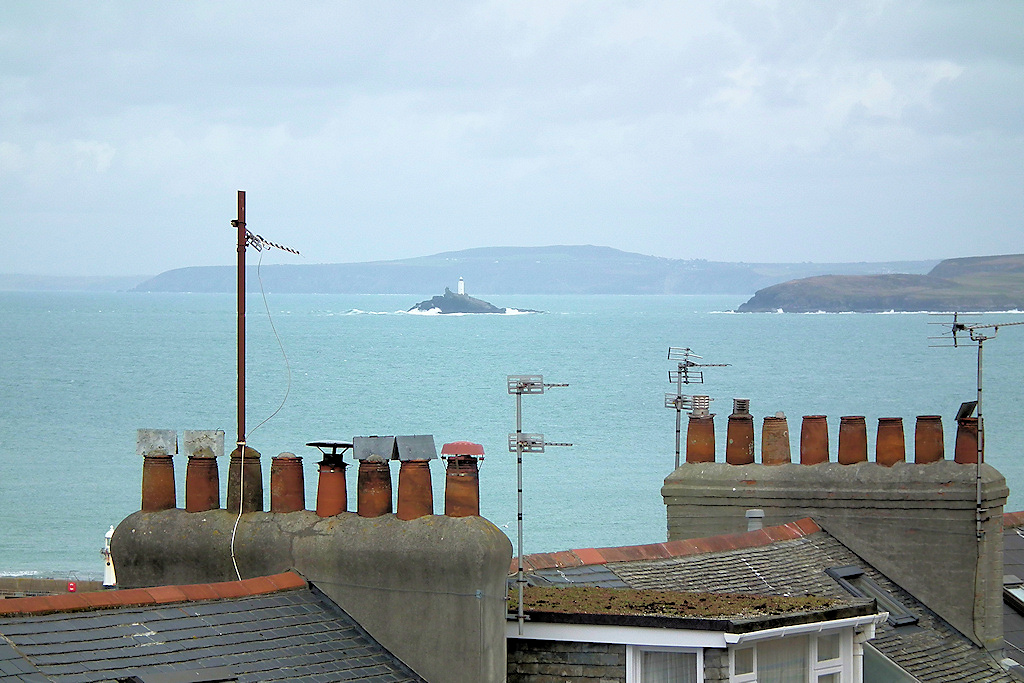
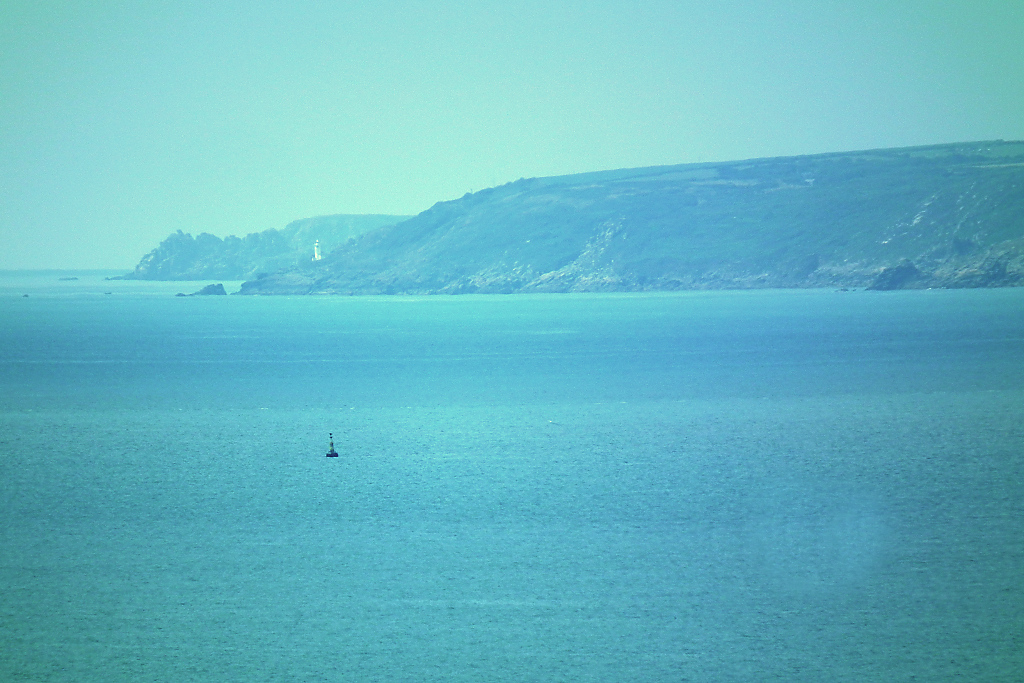
Godrevy Head and Lighthouse from St Ives, Cornwall, with St Agnes Beacon behind
Here’s one of my podtalks, recorded in early August, Lughnasa, at the Oak Dragon Camp in Somerset.
It’s all about our prehistory in Britain, and how and why people built ancient sites, and their advanced shamanic-magical culture, and sympathetic, sustainable societies, and the creation of gods and religion, and a few other wee matters such as these.
A sweep over the megalithic periods of the Neolithic and Bronze ages. 90 mins.
If you’re resident in Cornwall or a Cornwall fan, or you’re likely to visit here this year, and if you’re into visiting ancient sites, these maps are useful.
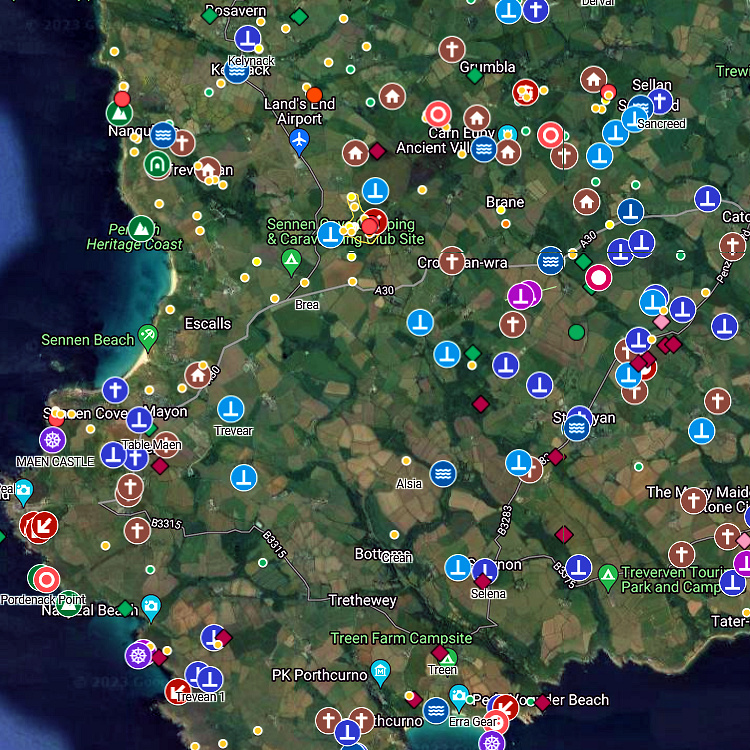
The last five days, since it has been rainy a lot and quite often really white-out foggy, I’ve been doing my six-monthly updates of the ancient maps of Cornish and Scillonian ancient sites that I’ve been working on since 2015.
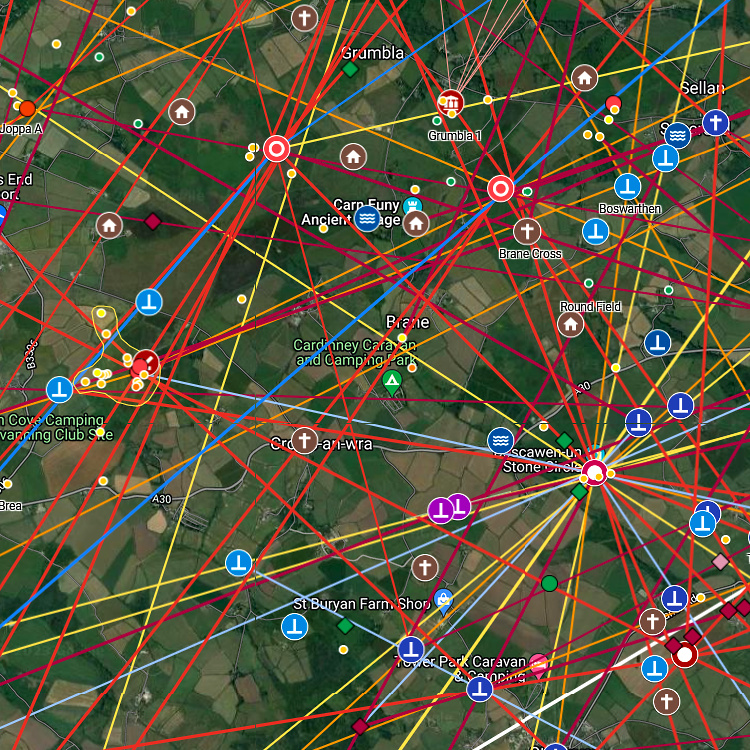
There are two main maps: 1. ancient sites 2. ancient site alignments
These are not just maps but also rather encyclopaedic databases. That is, if you click on an ancient site symbol, a popup give you information and links to other sites where there’s more info about that site.
The location of ancient sites is very accurate and these maps can be used in the field, so that you can find sites when tramping around.
However, before entering ancient sites, please switch your phone off completely, so that you don’t pollute the site and you feel and experience the site more clearly.
If you live in Cornwall or are visiting this summer, or if you’re a fan of Cornwall, these maps are very useful!
One of the big themes of my life has been time – dealing with the present, understanding the past and envisioning the future.
The future has preoccupied me since I was a late teenager – sitting around with friends, discussing things, trying to see which way the world will go. That’s still an open and evolving question, though for me the issues are clearer now [see:The World in 2050] and my perceptions of fifty years ago, honed by experience and the passing of time, in essence remain quite consistent.
Looking at the future led me to the past. As a student at the London School of Economics during the ‘troubles’ of 1969-71, I’d experienced what it’s like being in a revolution that is suppressed and fails – a devastating transition from inspired ferment to cruel disillusionment. Many are the peoples round the world who have experienced similar since then.
Trying to deal with my ‘political pain’, I studied the movements of change of the past, seeking clues. Then I was given a gift.
Ragged and burned out, one summer’s day I hitched out of London, landing up two days later in the Orkney islands. I found the Ring of Brogar, a big stone circle, and innocently I decided to sleep in the middle of it. I wasn’t expecting a major soul-intervention that night. But it came.
I had a profound lucid dream in which hundreds of people danced around the circle. Chanting and stamping rhythmically as they moved round it, they made the earth resound like a deeply donging bell, generating a charged magical atmosphere.
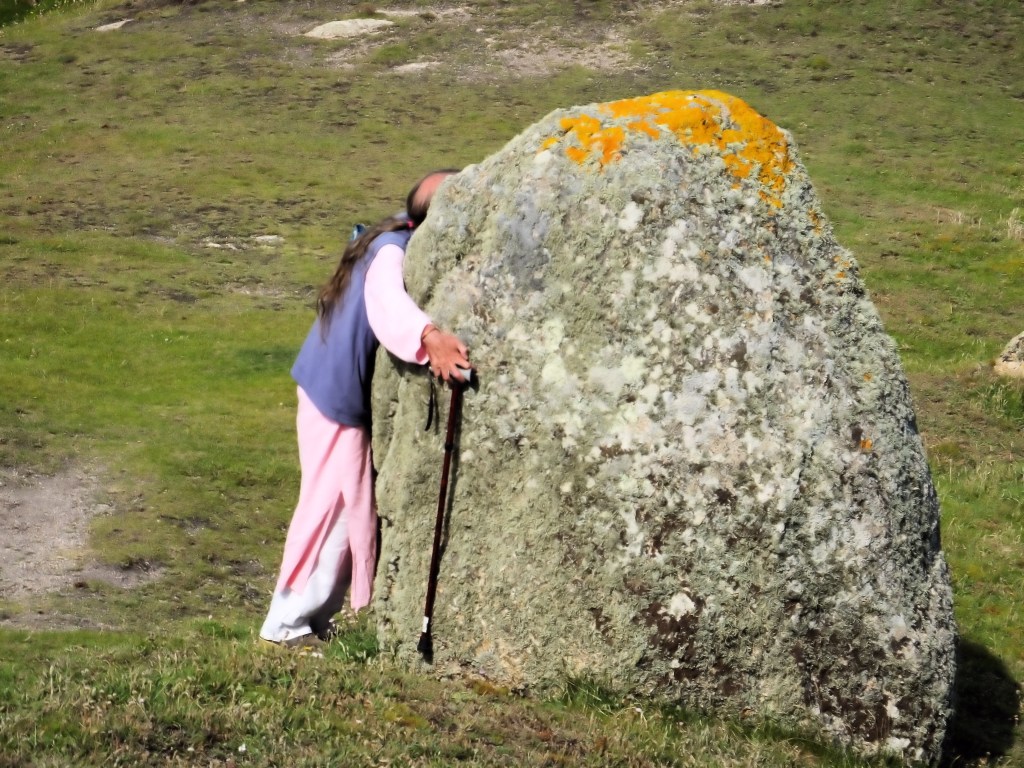
Loving my favourite stone at Carn Lês Boel
One of them came, reached down and said, “Come and join us“. Which I duly did. From then on I was a smitten megalithomaniac. A deep memory of ancient times was reawakened. Back then too I was involved with time, responsible for organising longterm observances and rites to work with Metonic, Jupiter, Saturn and other longer cycles of time.
Guess what, in this life, by the mid-1980s I was initiating consciousness-raising camps, doing a modern version of the same thing. And they were astrologically timed. After one of the camps I had a moving inner experience where the modern I and the ancient me were dialoguing, sharing our perspectives from our contrasting points in time.
So, I’ve been an astrologer, historian, antiquarian and futurologist. I didn’t particularly plan this but that’s the way it unfolded, in paragraphs and chapters through life. While studying astrology in the 1970s it felt more like remembering than learning afresh. By 1990 I had compiled The Historical Ephemeris of historical cycles with a timeline of events, showing how major-scale changes in human ideas and activities can be identified by observing such cycles. A labour of love, much ignored by historians, it needed doing and I did it.
For the last decade I’ve been studying and mapping West Penwith’s prehistoric sites. We have lots of them. One day I realised why the ancient Penwithians had gone to all the trouble of building these things. Experiences gathered in world healing [see:The Flying Squad] over the previous 35ish years led to a lightbulb moment that came up at Bosiliack Barrow, where I go whenever I seek insights. It’s funny how a revelation often simply uncovers something obvious and already there, though until then it is unseen.
I’m not particularly into earth healing, lightworking or healing and prayer circles, though it’s important that people do these. I’m more into working surgically with specific issues that obstruct progress, in an inner journeying and energy-working sense. It involves addressing fundamental social and cultural patternings, tendencies and institutions that become spotlighted by current events, digging down to get closer to the heart of things, unconcealing and helping to heal the layered pain and damage that humanity has brought upon itself over time. In our own time, these issues are getting in the way of necessary change.
CASPN members, after doing maintenance work at Boscawen-ûn
Consciousness work is upstepped immensely when groups of people work together. Over time, in activities with others that I’ve been involved with, remarkable outcomes have occasionally arisen from it. The Council of Nine (I wrote a book for them in the early 1990s) had emphasised this too: “If there are thirty-six with one mind, focused together, then the entire world, even the universe, may be changed“.
However, an undistracted, unwavering, one-minded focus is needed for that, and it’s not easy. If a group or network knits itself together over time, melding as a group, it can build up a momentum and focus that can take us at least part way along that track.
Sometimes it even happens unintentionally in the public sphere – moving moments experienced at a captivating music concert, a funeral, an uprising or even in a football crowd. Notable in particular are those moments that shake the awareness and feelings of mainstream people in their millions – poignant events, situations and crises that can sometimes evoke a one-mindedness in millions of people at the same time.
When the numbers rise, the intention and energy-holding are good, and there is real feeling behind it, the work people do in this field does have a positive effect, incrementally raising the world’s vibrational level. I encourage you to include this kind of work as a slice of attention in your life, in whatever way is best for you.
Brane chambered cairn, near Carn Euny
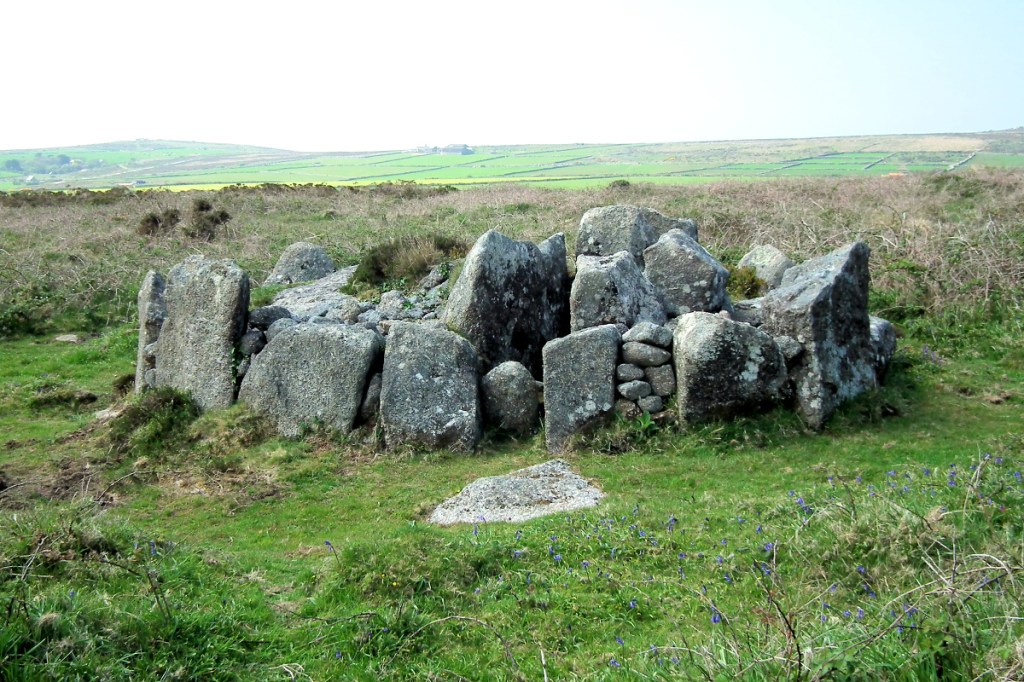
Back to ancient sites. The key sites are those that enclose space – stone circles, enclosures, chambered cairns, caves, wells and dolmens. Here intense vibrational fields can be built up within that space. That’s what the people in my dream fifty years ago were doing.
In many ancient sites we can still feel vestiges of those energy-fields, built up over the centuries during the megalithic era. A presence is in residence. At Boscawen-ûn stone circle, a couple of miles from me, it’s quite common that, when you arrive, someone else is leaving, and when you leave, someone else arrives. There’s something bigger going on here.
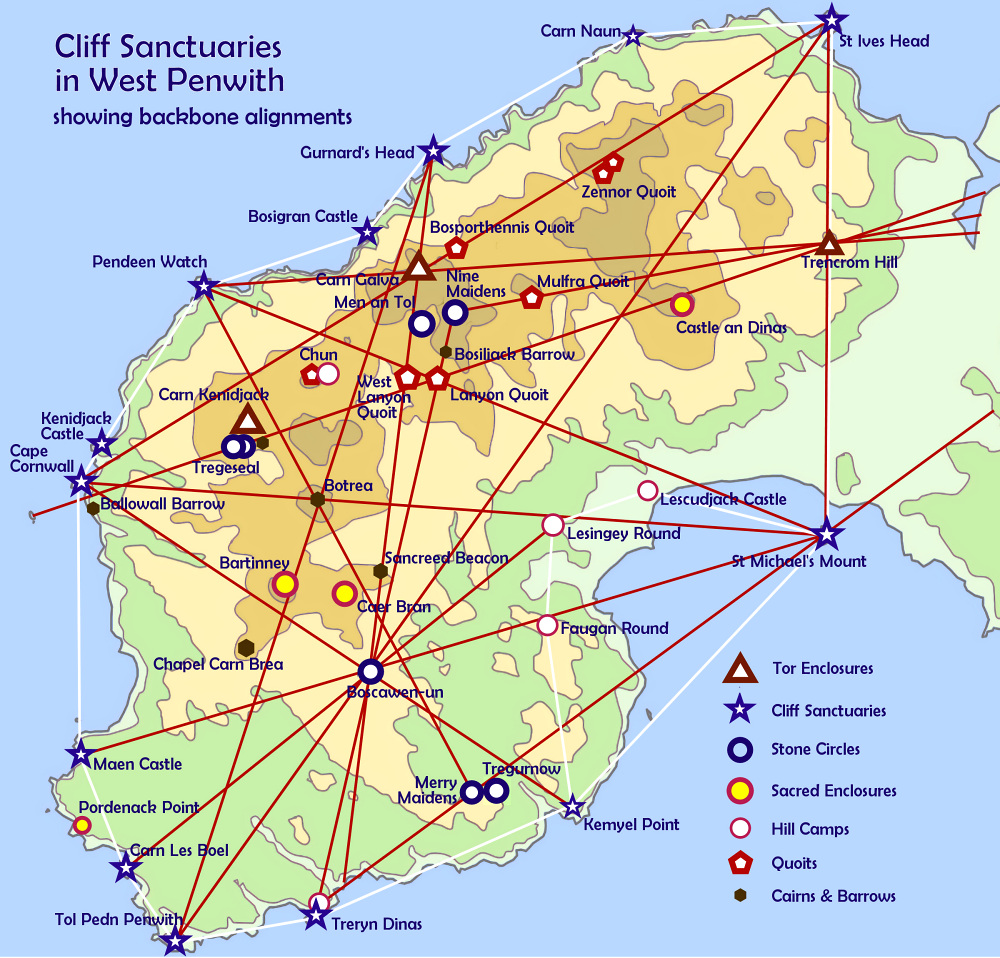
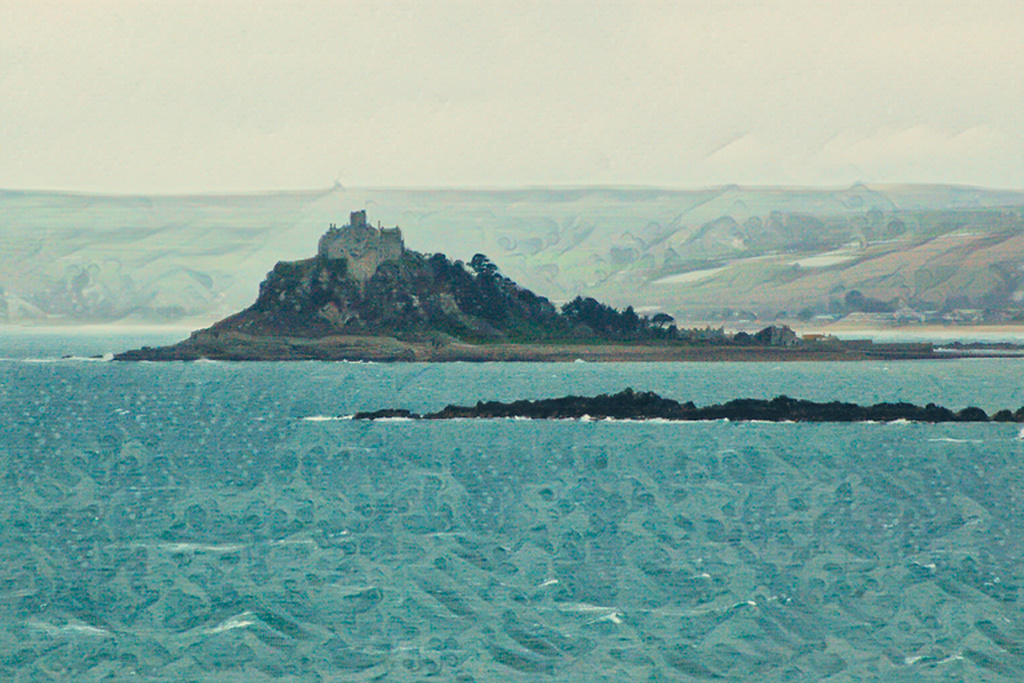
Being a peninsula at the end of a bigger peninsula (Cornwall and Devon), West Penwith has definite edges, bounded by the sea. Even the landward side in the east is guarded by three hills in a dead straight line (St Michael’s Mount, Trencrom Hill and St Ives’ Head), creating a threshold and energy-shield. (Interestingly, the G7 conference held in Cornwall in 2021 was located exactly on this line.)
Bosiliack Barrow
As I did my research, it came clear that this was not just a fascinating collection of ancient sites – they constituted one big, integrated system, roughly 10×15 miles in size, and purposefully built. It was rooted in the landscape, anchored to key hills (neolithic tor enclosures) and promontories (cliff sanctuaries). The location of major sites such as stone circles is largely determined by these.
These sites are also variously plugged into underground water-energy systems beneath them. Stone circles and dolmens are sited on top of ‘blind springs’, energy-springs emerging as a vortex on the surface, which the ancients then entrained and focused by building an ancient site on top.
They’re also plugged into the wider cosmos by alignments to the rising and setting points of the sun and moon at key times of year, as well as, in some cases, certain key stars – marked out by alignments to menhirs, cairns or natural features. The designs, geometry and mathematics of many sites also embodied principles such as the Metonic cycle, a 19-year cycle of relationship between the solar and lunar calendars, both of which were used at the time.
Tregeseal
Stone circles and other sites are placed in remarkable locations, with a visible relationship with the lay of the land. Tregeseal stone circle, near me, lies in the apex of a U-shaped bowl of hills which meld together to highlight a gap in the west, toward the sea and the distant Isles of Scilly, which float on the ocean like a mystic realm on the edge of the world.
Stone circles, enclosures and certain hills and features were amped up by cairns, menhirs and other markers that were aligned to them, acting as feeders, relays and batteries. These integrated the system as a whole into a network. In some cairns, bodies were buried not for the memorialisation purposes we now practice with our dead, but to bless and light up the land and the network by burying the relics of revered people at carefully-chosen places – rather like the medieval reverence for saints’ relics.
It was all for the engineering of conditions in which advanced consciousness levels could be achieved – though there were other purposes too. Enclosed energy-spaces such as stone circles and chambers are insulated, charged-up spaces. In Penwith, background radiation in a stone circle is much lower inside than outside it, and this applies also to background psychic noise. A protected, charged space like this allows clearer and stronger psychic, shamanic and healing work – and many of you will have experienced this yourselves.
At the Hundredth Monkey camps of the mid-1990s we built up an energy-field in the circle that resembled those that they built up at ancient sites. An energy-field morphs into a reality-field, where the framework of reality changes gear and things become possible that are not available under normal circumstances.
This was noticeable at the end of a camp when we closed the circle – the mood would subside like a slow puncture, ‘normality’ would restore its grip and the background noise and clamour of the busy world around began intruding again. We had been in a magic space with very different character, norms and rules.
Treen chambered cairn
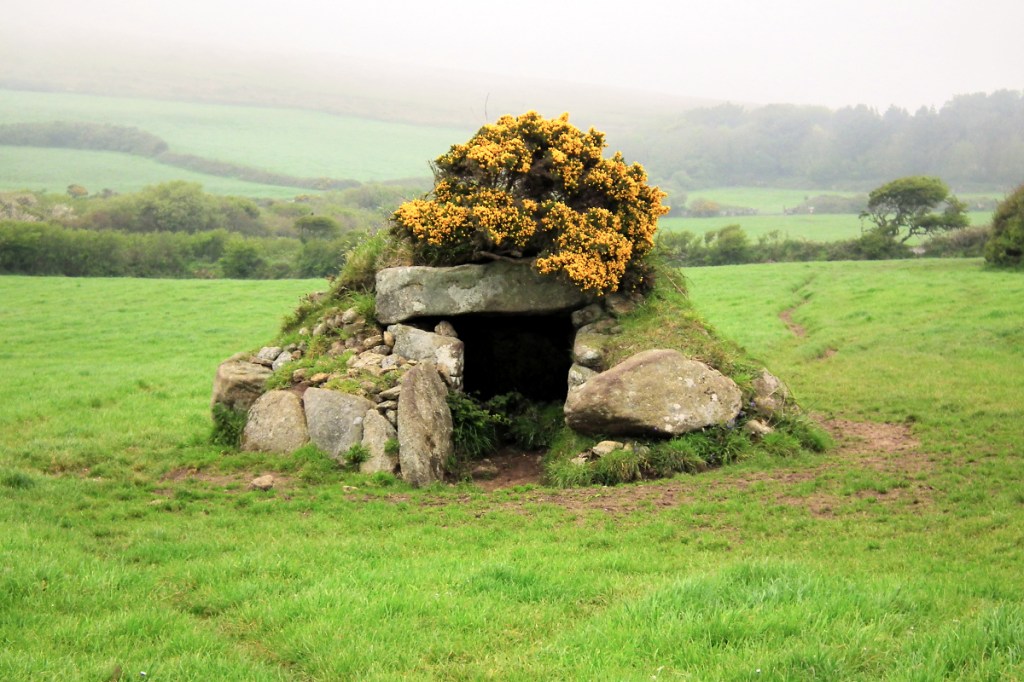
Inside chambered cairns there’s a profound quietness providing ideal conditions for solitary meditation, vision-questing, innerwork and conscious dying, and also for the treatment of seeds, tools, elixirs and magical objects. Insulated from outside by stone and earth, such cairns sit on energy-vortices generated by the intersection of two or more underground water streams underneath. This makes the chamber into an energy-bath or orgone accumulator, valuable for entering into altered states.
Apart from ‘getting high’, why did they bother with all this? It had a direct bearing on the fortunes of people and tribes, as an investment that paid good dividends. Although their civilisation was materially simple, it was culturally and spiritually sophisticated. They had an advanced technology that worked esoterically with the essence of life, the core dynamics within all things, with which they could carry out forms of genetic modification, long-distance communication, medical procedures, ecological and climatic regulation and societal problem-solving.
They weren’t manipulating genetics the way we do today: instead they created energised conditions within which organisms could modify and enhance themselves, and this has been demonstrated to be possible in modern-time experiments too. They needed no telegraph wires or radio waves for communication: trained psychics, often some of society’s neurodiverse people, trained up, would enter a state in which time and distance ceased being an issue.
As for weather-modification, by siting menhirs, mounds and stones on top of energy-conductive water and metal veins and magnetic anomalies, they could neutralise the excesses of bioelectric charge between land and sky, reducing climatic extremes and damaging weather events. Conducting sometimes long and complex rites they focused on keeping Gaia and the spirits of land, sea and sky happy.
Caer Brân
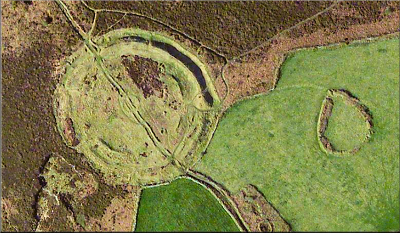
Different kinds of sites evoke different responses – this concerns consciousness-engineering. Just over the valley from me is Caer Brân, a circular hillbrow enclosure surrounded by earth banks, which could hold a gathering of at least 300 people – I believe it was the parliament site for Penwith in the bronze and iron ages. Parliament-moots were probably held annually at a fullmoon around summer solstice, exploiting the virtues of the time and the site, which is exactly aligned with two other circular enclosures (Castle an Dinas and Pordenack Point), with a summer solstice orientation. Though it has a remarkable panorama encompassing Mount’s Bay and the Isles of Scilly, you can’t really see the view from inside because the surrounding banks obscure it. This entrains consciousness upwards and inwards.
Chapel Carn Brea from Boscawen-ûn
Meanwhile, on a neolithic tor hill or a hill camp, awareness opens out over a wide vista, invoking an upward-and-outward feeling. Or at some sites our attention might be entrained in certain directions – at Boscawen-ûn we are drawn toward Chapel Carn Brea, the very last hill in Britain, a beacon hill topped with a neolithic longbarrow and bronze age cairns. In contrast, in a chamber or holy well a deep interiority arises. Ancient sites had added properties engineered into them.
People did ongoing magical work over many generations, well-trained, focused and serious in intent. To crank it up further, they chose power points in time – an eclipse, solstice or planetary configuration – amplifying and pushing their energy-work over a critical potency hump.
There are things to learn from all this. I’m not suggesting building new stone circles everywhichwhere, but there are ways we can amp up world healing work by learning from the shamanic methodology and philosophy that megalithic peoples used. One key element is groupwork and another is the focus such a group can build up. In some respects this was easier for the ancients since they were mostly related, well accustomed to it and also much less psychologically scatterbrained than we. But we moderns have our virtues, such as psychospiritual diversity, a lot of creativity and a good measure of despair regarding the state of the world.
My feeling is that, in the coming decades, events on planet Earth will reach moments of intensity where everyone worldwide gets a deep and clear sense of the full extent of what’s at stake. Events have a way of manifesting scenarios before us that stir us up, press our collective buttons and present sharp dilemmas – whether they’re big events such as the recent earthquakes in Türkiye and Syria, or small, highly poignant events such as a refugee baby washed up dead on Greek shores. These experiences focus minds and hearts, invoking archetypal imagery, stirring sentiments and moral choices. This global process will intensify in coming times and there’s an inevitable crunchpoint approaching, or a few of them, where we’re faced with events of a ‘this really is it‘ kind.
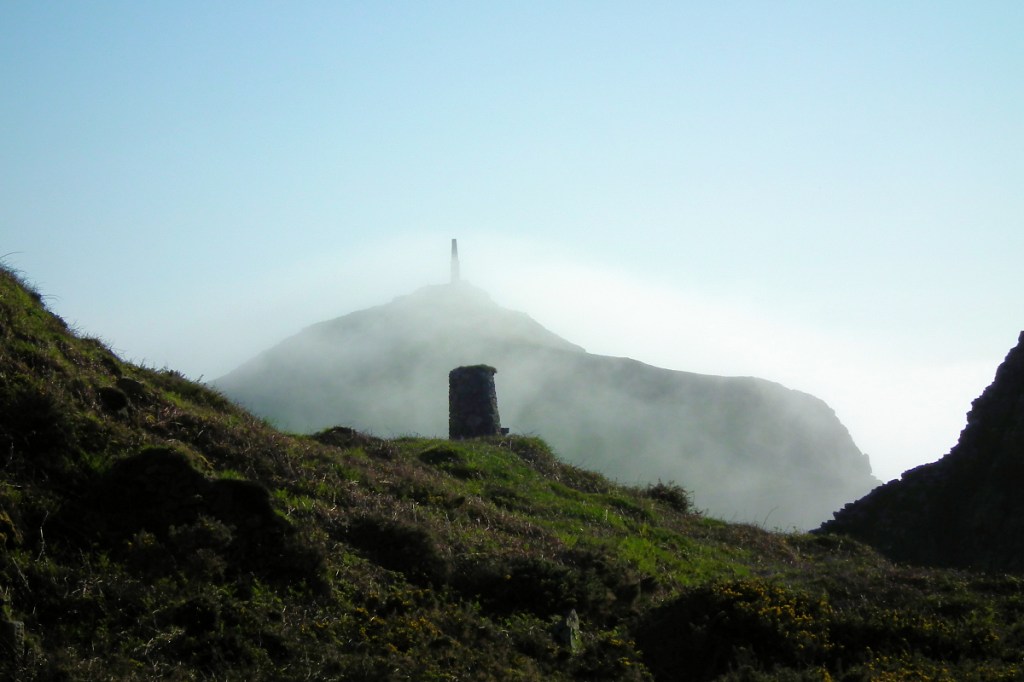
Chapel Carn Brea
It all hangs around whether we pull together globally or atomise into a tangled mess of narrow interests. It’s not just a matter of practical cooperation, effort and peacemaking, but also one of one-minded and one-hearted inner consensus. We’re faced with a mountain of global issues that require a miracle, or a stream of them, and normal means of fixing our problem are too slow and clunky. Only a quantum shift of approach and priorities is likely to prevent disastrous levels of hardship and disruption in coming decades.
A miracle requires the focusing and intensification of an energy field to the extent that our former understanding of reality flips. Nothing much might immediately change, but everything looks and feels very different. A new reality-field supersedes the previous one. The rules change and remarkable things happen. This depends greatly on how, collectively, we see and judge things – a disaster can be made good if if leads to fundamental changes.
This involves going to the heart of things, dealing with them in a psychospiritual way. Not to the exclusion of practical solutions, but complementing them. Making a big step in the collective heart of humanity. Creating a resonance that overrides the psychic disarray and disturbance of today – a central cause of today’s global problems.
‘Disaster’ means out of tune with or loss of the stars. Out of sync with nature, human nature and the cosmos. Out of sync with the guiding light within. The ancients did their shamanic energy-work to keep things resonating well, knowing that everything is interconnected and interdependent. Fixing the world today involves a big cooperation in every possible sense, between humans and with nature and the cosmos.
We have this in our collective memory – it’s a taproot memory in humanity’s collective soul. If we read the underlying meaning of current events to be a manifestation of all that we semi-consciously fear, dread, need and hope for, it is possible to see how events are leading us toward a crunch point, a truth point. A point of focus where everyone’s awareness potentially comes together to think a new and deep thought.
Mên Scryfa and Carn Galva
So something in our deep memory from former millennia holds a key here. And it concerns the future.
Time is a strange thing, and dimensional. When I went down with cancer, my life expectancy was shortened yet strangely I was given a gift of expanded time. In a time-poor world I became time-rich. Not long ago I asked myself whether I’d like my old life back, and I realised I didn’t really. Though life is more difficult now, and serving time as a cancer patient, 70% dead and hovering there, mostly alone, has tested me to the limit, time has morphed toward a more timeless zone where other things start happening. Loss of physical capability has led to something of a gain in inner ability. Life on Earth always has its compensations!
Perhaps that’s where the world is heading. Global loss of traction caused by increasing crises and disruptions could well lead to a similar compensating factor, experienced by growing numbers of people. I’ve discovered this in the crisis zones I’ve been in – such intensity can pull out the true human in us. When your life is at risk you play for high stakes, and there’s no alternative. You’re drawn into the immediacy of now, and time changes in power and potency. That’s where root-questions are met. From a world healing viewpoint, that’s where the crunchpoint lies, and from it will be born the next world, whatever shape that takes.
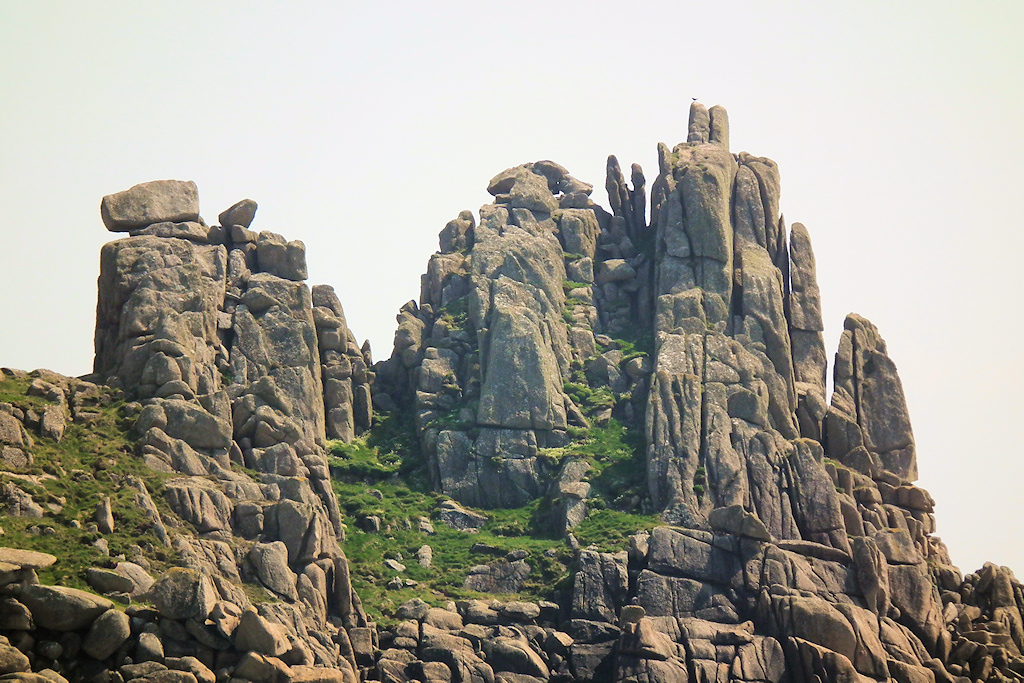
Logan Rock or Castel Tredhyn, castle of Tredyn (SW 3972 2198)
With a daunting magic and brooding mystery hovering around it, Treryn Dinas is a fascinating place, though it’s also a place not to be messed with. Enter with respect or the Cosmic Trickster might knobble you with a dash of unsolicited reality.
You get the feeling odd things might have happened here. It’s a place of mystery, power, sorcery and truth. Not exactly tranquil, it is nonetheless impressive in its strong underlying feeling of power. In folklore it was the home of giants.
On the actual dinas there aren’t easy assembly places or comfortable places to hang out – precarious scrambling is involved – so at any time people will have been in small numbers only on the dinas. Something about this and its obstacular nature gives the dinas its character. It’s strong in feeling, and worth visiting to feel the brooding, enigmatic character of the place.
The headland has two parts, the rocky headland itself and a large encampment to its landward side called Treen Circle, built in the Iron Age, according to archaeological orthodoxy – and the banks on its landward side probably were Iron Age.
However, its first use would have been in the Neolithic 3000s BCE, if not earlier, even if little or nothing was built there then. Neolithic artefacts and relics have been found on the dinas – items and offerings hidden in the rocks.
How otherwise can we say it’s Neolithic? First, the dinas is so prominent and rich in character that it must have been important.
Second, Treen Circle lies exactly on a backbone alignment (108) through the Merry Maidens, St Michael’s Mount and Carn Brea – an alignment of three natural features (two Neolithic tor enclosures and one cliff sanctuary) with a Bronze Age stone circle dropped onto it. Treen Circle is where people would hang out and camp when visiting the dinas. Antiquarians once thought there was a stone circle in Treen Circle, but this is improbable.
It was the most inhabited of the cliff sanctuaries of Penwith except perhaps for St Michael’s Mount. Treen Circle encampment was large – it could have hosted some pretty big gatherings and, in the Iron Age, quite a few people in roundhouses. This would have been a summer residence – in winter it is exposed.
It was strategically placed, not far from Porthcurno, one of Penwith’s prime landing beaches. But still, it’s a bit far away for defence of the beach, if such were necessary, so a defensive purpose to the dinas is questionable, even though Treen Circle is separated from the surrounding landscape by a significant Iron Age rampart and ditch.
Just outside it, a strongly aligned menhir has recently been rediscovered and re-erected.
Unlike many cliff sanctuaries, Treryn Dinas had practical value, with good farmland and fishing grounds nearby, situated in a commanding position that is a twenty minute trot from Porthcurno.
One wonders whether rocking the logan rock at Treryn Dinas was done to make sound and rhythm for geomantic reasons, to pulse the earth, or even as an ancient kind of foghorn, sounding out a slow drumbeat to warn boats when sea mists were down.
The rather unique upstanding stone at its summit gives Treryn Dinas a special character – it might have been placed there.
Another backbone alignment runs from Treryn Dinas to Boscawen-ûn stone circle, Lanyon Quoit, Bosiliack Barrow (a rather special chambered cairn) and a menhir just yards from the Nine Maidens. So, three of Penwith’s stone circles are linked with Treryn Dinas – that’s significant. Even so, no alignment has been found with Tregeseal, the fourth stone circle of Penwith.
I’m doing a series about cliff sanctuaries in West Penwith, Cornwall, where I live. I forgot to post the first one here when I did it, so you’re getting a bonus blog this time, about two cliff sanctuaries. The first is about Cape Cornwall and the second about Bosigran Castle. Also, at the bottom is mention of my forthcoming visit to Glastonbury at Easter – if you happen to live in or around it.
Cape Cornwall as seen from Nancherrow valley
Cape Cornwall
Down’ere in West Penwith, Cornwall (right at the end) we have an important coastal feature called cliff castles – though I call them cliff sanctuaries, a far better descriptor. Archaeologically they are customarily dated back to the iron age (from 500 BCE on), though actually they go back to the neolithic 3000s BCE.
Cape Cornwall and the Brisons rocks from near Cape Kenidjack
That is, when this area was mostly forested, the main places you could get out of it, ‘get some space’, were on the neolithic tors and hills and the cliff sanctuaries. So these formed the first major ancient sites in the area.
This is one cliff sanctuary, Kilgooth Ust (pr: ‘east’), the Gooseback of St Just, or Cape Cornwall, and it’s near St Just. It was severely affected by the tin trade 150ish years ago – hence the remnant chimney and the houses. But it is a classic, and it’s one of the major alignment centres of Penwith. Originally it had four barrows on its neck. Here’s an alignments map: https://www.google.co.uk/maps/d/viewer…
Cape Cornwall as seen from Carn Gloose
Around Cape Cornwall were some of the richest deposits of metals in ancient times, with arsenic-rich tin, gold and other rare metals used in metal smelting to create different qualities and finishes, from around 1800 BCE. On either side of Kilgooth Ust was a landing bay where metal ingots were exported.
The rocks offshore are called The Brisons. It’s the left-hand, southern one that is the energy-centre there. In neolithic and bronze age times they were probably not islands.
Cape Cornwall as seen from Sennen
I’ll post a few more cliff sanctuaries as time goes on. See the map to see the other cliff sanctuaries in the area, forming a necklace around Penwith, the ancient Belerion, or ‘radiant land’. These were sanctified spaces, and you can feel it.
Until someone did a proper theodolite job in late Victorian times, this was regarded as the Land’s End. But actually, what’s now called Land’s End is a matter of yards further west. But this, in a way, is the energetic Land’s End.
Bosigran Castle
Bos chy carn, ‘home house [under the] crag’, often translated as ‘Ygraine’s home’ (Map ref: SW 4169 3688)
This is one of my favourite cliff sanctuaries, mainly because of its friendly atmosphere. There’s a story that it was the home of a queen – Ygraine, after King Arthur’s mythic mother, but it has other possible meanings too. It has a hospitable, sociable feeling. So, this queen, whoever she was, might well have been a great lady, leaving a strong imprint.
Today, it attracts lots of rock climbers – avid Bristolians in VW vans. You can be sitting there listening to the waves, looking wistfully over the sea toward Ireland, when a clinking starts up and, sooner or later, a helmeted climber appears over the parapet, trailing ropes and looking pleased. On one occasion a school of minke whales cruised past and the climbers were spellbound, frozen to the spot, hanging in weird positions on their ropes. I was moved too, preoccupied as I had been with my prehistoric ponderings and customary flask of anthropocene tea.
The top of Bosigran Castle is rocky and divided into a number of different natural spaces. Carn Galva is behind
Bosigran has a pleasantly healing and relieving feeling. Good for spending time when the weather is pleasant, it’s a great place for picnics, in both Neolithic and modern times. It could easily accommodate around 200 people for a summer weekend shindig, though there is no evidence and little likelihood of permanent occupation (too exposed in winter). Summer nights spent around a campfire would have been wonderful. It lies below Carn Galva, the magic mountain of Penwith, and perhaps the tribe that had Bosigran Castle lived around Carn Galva, coming down to the cliff sanctuary for special occasions. Summer sunsets there can be special.
The ‘throne’
A rocky Iron Age rampart sections it off from the surrounding land, though defence is only one possible reason it is there. More likely it was simply an energy-threshold, since when you cross it you get the feeling you’re entering special space. There are several distinct areas on top of Bosigran, each with rock platforms that could serve as outdoor ‘rooms’ – so it’s a place where a number of things could happen at the same time. At one of these areas is a throne-like rock where one can imagine a chief, wise-woman or druid sitting, with their flock arrayed around them.
The logan rock
The top of Bosigran is littered with earthfast rocks and, apart from the boundary rampart, there are few signs of rock-moving or the placing of stone, except in two instances. There is a logan or rocking stone on the top, near the ‘throne’. These are flattish granite boulders balanced in such a way that they could be rocked. It’s possible they were natural, or placed there or adjusted slightly to make them rock. What the purpose of logan stones was, we do not know, but the ancients clearly thought them special. These were the bass drums of the Neolithic era. Perhaps people drummed along to the deep rocking sound, building up a stirring, thumping beat.
The ‘council circle’
Further along the left side of the headland and down a bit, there is a sunken, west-facing area with an array of rocks which suggest a ‘council circle’, as if it were a place for undisturbed discussions.
Nearby is a line of three rocks with their lined-up edges aligned toward Pendeen Watch, a neighbouring cliff sanctuary. These are (I think) deliberately oriented stones intended to highlight the relationship between the two cliff sanctuaries.
The zawn (inlet)
Bosigran is a good example of a cliff sanctuary potentially serving as a coastal beacon site – the prehistoric equivalent of a lighthouse. A few of the cliff sanctuaries will have been connected with trade, but this is unlikely at Bosigran. This was a place for gatherings and events. It’s a pleasant half-mile walk down from the road, and it’s worth going down into the zawn (inlet) on the western side too, to watch the seabirds, waves and climbers. There are some interesting tin-mining remains in the valley, with signs of tin-streaming methods having been used in centuries past.
I shall be in Glastonbury over Easter and doing two gigs while there.
One is at the Legend Conference in the Assembly Rooms on Sunday 9th April at 10am on Sunday morning, and here’s the blurb…
———–
Consciousness work and the way it can affect our reality
My talk will be focusing on consciousness work and the way it can affect our reality. I’ll be going back to our roots, in the neolithic and beyond, to the early inner imaginal work that gave root to the core stuff of our culture, to our beliefs and ways of perceiving things. Using my home area, West Penwith in Cornwall, as an example, I’ll show how ancient sites were built for consciousness work in order to penetrate and engineer the heart of reality – amongst other things affecting the climate, the ecosystem and human society. Which happen to be issues that are a wee bit important today.
Forty years ago, the Assembly Rooms hosted some very early experiments in ‘working the circle’ – something that is now accepted and common – and Glastonbury is a place with deep historic and esoteric roots too. So the heart of my talk is about consciousness work in the imaginal sphere, how this might be used in jogging the prevailing reality-field of our world, and how it all started several millennia ago.
I shall also be doing ‘An Evening with Palden Jenkins’ on Friday evening, 7th April, hosted by the Inner Light Community, and that will be announced on their site and on my Facebook page soon.
On Saturday I’ll be around if anyone wishes to meet up. However, I’ll need you not to wear me out, and to have your phone switched off! I’m a bit of an old crock and I’m electrosensitive (my cancer is caused by EM radiation). Still here though!
I’ve just done another upload to my audio archive of talks from former decades. It’s taking shape, gradually – my wintertime project.
This one is about ancient British time systems and the way they are built into ancient remains from the neolithic and bronze ages. It discusses key issues such as solstices, equinoxes, eclipses, lunar maxima and minima, the rising and setting of stars, zodiacs and subjective inner time.
I’ve just listened to a rather inspired one, which I did in Byron Bay, Australia, in 1992, shortly after writing the book ‘The Only Planet of Choice’. If you’re a TOPOC freak, you might be interested in this one. It’s called ‘An ET View of Terrestrials and What’s Happening on Planet Earth‘. Trivial, mad, timewasting stuff, of course…
I’m learning a lot from these talks – it’s funny, that. But when you’re in life’s last chapter, it’s really fascinating trawling through old stuff, just to get a balanced view of things you’ve been involved with through life. It’s a bit like putting yourself on the scales to see how it all balances up. You gotta look at the plusses and the minuses.
When I was 24 I had a near-death experience that changed my brains and removed a lot of my memory and capacity to remember the events of my life. This is why, if I haven’t seen you for over a decade, I might look vaguely at you while a memory is slowly emerging (sorry about that).
So it can be quite a surprise, actually, to hear myself rabbiting on from around thirtyish years ago – and I’ve come across some gems – but the thing is, was it the same life?
And that’s just some of them
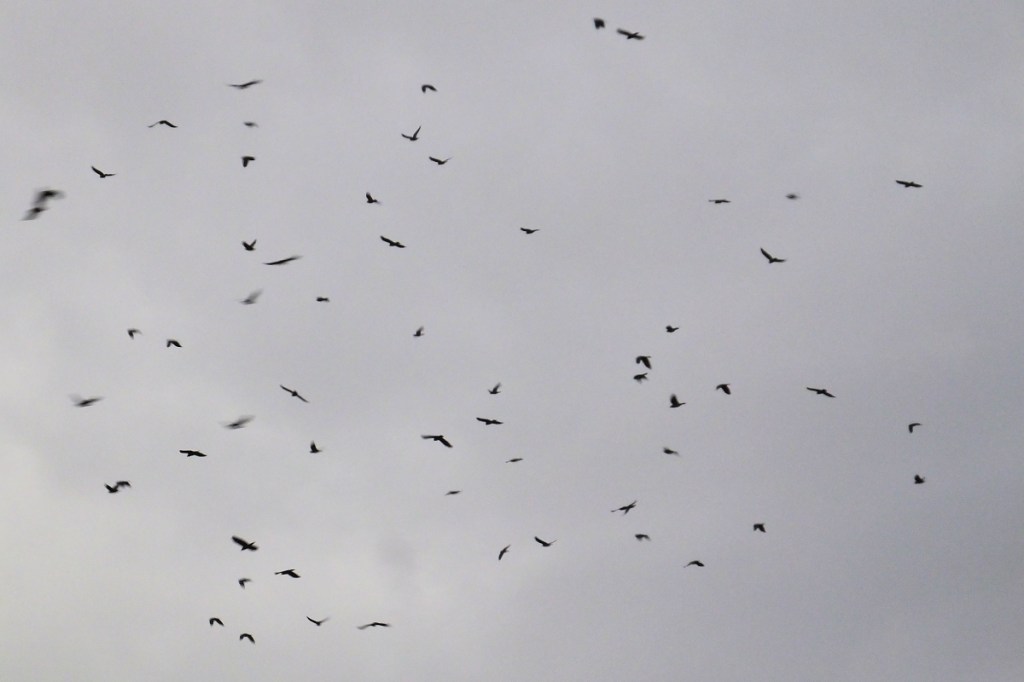
We have hundreds of crows living down in the woods below our farm. They assemble after autumn equinox and spend the winter together, dispersing around Penwith around spring equinox. In the evenings they get worked up, crarking a lot until, around dusk, they go into swoopy formations and an impressive tribal synergy process.
It’s like the corvid tribe has an identity and mind of its own, which the individual crows plug into as they do these dusk rituals, before they all settle in the trees to spend the night together, as one tribe – all of them probably related.
This is one of the blessings of my life at present. Another is the little birds, robin and tits that feed at the feeder hanging in the dogrose bush outside my door.
I’m on an astrological transit called Neptune opposition Saturn, and one symptom of this is aloneness. This is a life-pattern of mine, both a blessing and a bane. Much of my greatest work, in terms of studies and writing, has emerged during times of isolation and adversity – as if I’ve been given a perverse gift of extended time in which the only thing I can do is the work.
Kinda serving time – but there’s a double-entendre to that term. I’m a saturnine type, and that’s what it’s about – fulfilling the agreement, the covenant, as best I can. And Saturn says to each and every one of us, each in our own way: you can do it now and there will be consequences, or you can do it later with other consequences, but you will do it – and the easier path is to take what appears to be the harder path (though it isn’t harder in the end).
Writing a book, building a website or doing research… most other options become mysteriously unavailable when it’s time to do one of these. But not forever, and the window shuts if I don’t seize the time, even when I just have potatoes to eat.
But then, that’s one of my best contributions and people benefit from it, and if I sat around chatting, socialising or treading the money-mill I wouldn’t be doing it and it wouldn’t happen. Cos it takes hours, days, months and years, and a life’s work takes a life to do (sometimes longer).
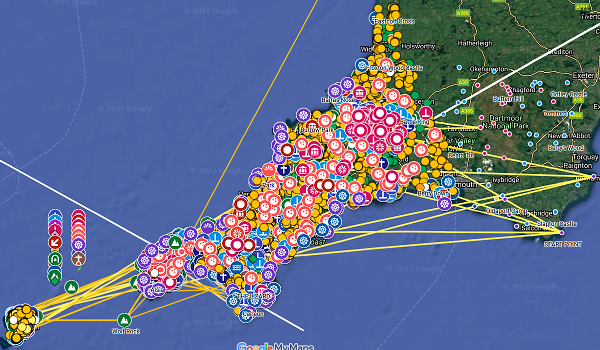
So the current fiddly operation I’m on right now is tweaks to the ancient sites maps of Cornwall that I’ve been doing for the last six years. This time I’m looking at ancient site alignments coming from Dartmoor and Exmoor in Devon into Cornwall. Bodmin Moor acts as a kind of hub for incoming alignments, though some pass through it. It’s amazing, the accuracy with which these alignments cross quite long distances of up to 100km, hitting ancient sites within just a few metres.
One remarkable thing is this. I was reluctant to get involved with Devon (too much work), but I chose a few sites, such as Berry Head and Start Point, and found some amazing alignments. More recently I decided (after procrastinating) to add key sites in Dartmoor to the map (takes about 5-10 minutes per site) – and fascinatingly, some of those sites appeared exactly on the alignments I had already found. Amazing. How they did this without satellites, I do not know (though I have a few theories).
That’s Bartinney, as seen from the 2,000 year old iron age courtyard house up on Botrea Hill
It’s in gradual progress – but (if you wish) check out those alignments from Berry Head, Torbay, and Start Point – one goes all the way to Bartinney Castle, just on the other side of the valley and visible when I look up from my desk. As I write in my forthcoming book, if you wanted to land a mothership in West Penwith, that’d be the place.
I have to do the uploads from a non-public ‘sandbox’ map of Cornwall to the public maps late at night, since many people will (hopefully) be in bed, and their visits to the maps won’t get disrupted as the maps blink on and off, one layer at a time as each layer is replaced, tweaked and twooked. Well, that’s how it gets late at night… it takes about three hours.
The latest upload happened last night. I was buzzing on Dexamethasone at the time – a legal and free cancer drug, just like meditation, but fundamentally different and prescribed by different sources). But Dex helps me get a few things done, in the two days I’m taking it.
So you’ll find the current stage of this research here:
There’s one more thing… no one can take away your life’s work from you. If you feel they are doing that, then you have a short-term, not a longterm problem and the value of the experience is to confirm that it’s right to get on with it somehow, and to oblige you to get right behind it.
Whatever is going on in your life, your life’s work goes with you on a somewhat separate track, fed by and feeding through to things that happen to you, or books you read, or people who deliver prompts and clues. Withholding and hanging back on our life’s work is one of the great causes of the global problems we have today. It’s also a cause of future illness.
I’m not a great withholder, but cancer put the cards on the table and told me: there’s more, and it’s time. Part of me doesn’t care so much about how my ideas and initiatives are received any more – though of course I do care a lot, but not for the same reasons as before. So I’m getting down many of the threads I’ve pursued in life, for the record, because I’ve been privileged to live through a pretty exciting and edgy time, and I’ve shared this with so many good people. It’s worth leaving tracks, whether or not future generations know or care whose shoulders they’re standing on. Because human history and the passing of the generations simply eats us for breakfast and dissolves us into nothingness.
Even those of whom history thinks well are often remembered for weird and often incorrect reasons. Once upon a time, on Iona, I had an inner dialogue with the soul of St Columba, a founder of monasteries and evangelist for the faith, looked on as a shining light of former times. Not so – he was a murderer and completely screwed up in Ulster, got out, saw the light, and did all that from guilt and a sense of penance. He disliked the way he is remembered.
Similarly with Salah-ad-Din, regarded as a great and just Kurdish ruler of Syria and Egypt. He had offered a power-sharing arrangement in Palestine that would have changed future history, and the Crusaders (Richard the Lionheart) didn’t take it. (It wasn’t helped by the fact that his son and a rich European lady, who would be required to marry to guarantee the treaty, didn’t want to.) He didn’t like that. He got the Crusaders out of Jerusalem and penned them up in Acre, but then, tired of campaigning against assholes and wanting to complete the job, he made a fatal error, causing many deaths. He died, heartbroken, not long after. What he remembers of that life is not the same as what many remember today.
St Michael’s Mount – 5,500 years ago a Neolithic Tor Enclosure. Picture from my book.
The deed is done. I finished writing my book Shining Land. Been writing it since December. So now it will go out to a few readers for checking – I present quite a few radical ideas, and I want to make sure they make sense. It’s all about the ancient sites of West Penwith and ‘megalithic geoengineering’. Phew, so that’s done. Now I can pay more attention to family, friends and people.
After my cancer treatment in November to March I landed up with a lot of fatigue and brain-fog, so in the last six months I haven’t been very functional. I’ve been alive and active for only 6-8 hours each day, with a need to do my daily tasks, cook food and run my house as well as write the book and live a life. All in a slow and doddery way.
I’ve had a lot of trouble with making decisions, complexity and problem-solving, and yet, when I’ve been clear enough to write, my brains have done well. Obviously it concerns different parts of the brain. But one advantage of the fatigue has been that, when I go to bed in the afternoon, lying there in a strange heavy stupour with my leaden body totally flumped, my psyche floats around the subtle worlds in a hypnopompic, dreamlike state, and in that time I’ve mulled sluggishly over things and given each proposition and paragraph far more thought than I’ve done in the ten previous books I’ve written.
It’s strange, writing books. You can’t show anyone until long after it’s finished. It’s hidden away in a computer file, and I can’t hold it, prod it or wave it around. As far as you lot are concerned, I’ve been quiet, seemingly doing nothing. But I’ve been doing lots. It’s now ready – apart from a final review after a few readers have vetted it.
Lockdown hasn’t been a problem. Every time I write a book I go into lockdown, so I’m well practiced. When I did The Only Planet of Choice in 1992 I was locked down for 18 months. The main difference has been that, usually, people think I’m being antisocial. But during Covid I’ve suddenly not been antisocial. Nothing changed for me – it was others’ attitudes that changed! But if ‘normality’ returns, I’ll be antisocial again, haha.
Meanwhile, healthwise I have been improving 5-10% each month. As Victoria, a nurse heroine, warned me back in March, I won’t return to the same place where I was before I was diagnosed with bone marrow cancer. Back at winter solstice I felt like a 95 year old. Now I feel like an 80 year old – getting younger! But I don’t think I’ll get a lot younger. My body is getting older – I’ve just reached what my old friend Sig Lonegren, the dowser, called the Big-Seven-Oh. He reached it ten years before me.
You ought to see all the supplements and remedies I’m taking. Most of them are capsuled in those funny plasticky capsules, and I don’t want to swallow 15 of those every day. So religiously I break open these dratted things, mix them together, add a dash of top-grade local runny honey, let it soak in, and then I take this superpowered spludge on a teaspoon. I’m no longer on pharmaceuticals, thanks be.
One of the weird things has been that, during my treatment since November, only one doctor has actually touched me – that was a poor registrar who had to stick his finger up my bum to see whether I had prostate cancer (I don’t). It has been ‘bloods’, x-rays, PET scans, CT scans and MRI scans and, sure, they’re amazing. But not a soul has actually listened to my heart, looked at my tongue or touched me. This is modern medicine.
So when I went to John Tillyard, a brilliant chiropractor in Hayle, he actually touched me, and it was amazing! His hands were so firm, and he was so good at what he was doing – he hit me on the spot first time and every time. Three treatments and I was standing and moving so much better. Bless you, John – you’re a good man. Soul-sister Miriam has been giving me remote healings on Zoom too – I am much blessed.
My back will never return to its former strength and straightness – I’ll probably be using sticks for the rest of my life. It’s useful having four legs though. I can stagger around the house without sticks for up to three minutes, and that’s it. Three vertebrae in my lower back collapsed a year ago – that was the first sign of the cancer. My bones have lost substance: I click my back in at least five places when I lie down. You can hear it – it’s quite shocking first time. Bone marrow cancer erodes your bones, and though this has been stopped by the chemo treatment, my bones aren’t what they were.
For astrologers out there, guess what, I’m on a Neptune opposition Saturn right now, and it’s all about bones. Bones that have lost their firmness. I’ve had teeth falling out too. But I’m still here and, despite this, when my energy is up I can walk a mile or two – slowly and dodderily – especially in inspiring places, of which there is no shortage around here.
Thanks be to three amazing ladies. First is Lynne, who cares for my heart, spirits and soul, second is Penny, a fine soul who cleans my house and does tasks, and third is Karen, a Brummie angel who does my shopping each Thursday. I am held in the hands of the Goddess. Also Helen, my homoeopath, who gave me a radioactive lanthanide Curium 1M remedy recently, and that really pulled me together. Oops, was it legal to say that?
The doctors are happy with my cancer – the readings are good – but they think I might have lung cancer. I don’t. When I said this to the specialist I could see her thinking, “Uh-oh, he’s one of those”. She politely called my response ‘conservative’. Then, just this morning, a lung cancer nurse rang me, following a recent CT scan – a really nice chap – to tell me that the suspected lung cancer has not got worse and might even have got a bit better. They’ll test me again in a year. I told him that, all my life, I’ve been something of a healer, especially in my humanitarian work, and this is a case of Healer, heal thyself. “Interesting attitude”, he said. “You might be right”.
I’ve been rather shocked though at the extent to which the NHS hasn’t been caring much for me – and I’m glad I have holistic treatments and practitioners to resort to. But there’s a problem with both doctors and holistic practitioners: they are all specialists, all stuck in silos. It’s a completely non-integrated system, both in the NHS and the holistic sector. No one except Lynne is watching my overall condition. I’ve even had difficulty getting advice and appointments from my GP. When I ring them they take copious notes and… nothing happens.
That’s weird. I understand their situation with Covid, but I’m feeling ignored. But then, that simply means it’s for me to self-manage and do whatever I feel best, and that suits me fine. Kind of. I’d appreciate more knowledge and advice, especially (here comes a pipedream) from someone who understands both pharma and holistic medicine.
So now I’m a seventysomething. I never thought I’d get this far. In my life I’ve had at least ten opportunities to die, and I’m still here! Hello world. I’ll live until my angels decide it’s no longer worth keeping me here, and I get the feeling they have a few more tasks lined up. The book I’ve just written was the first. Since having cancer I’ve moved into a new archetype within – which many might see, for better or worse, as a ‘wise old man’ archetype. I’m becoming a voice calling from the far beyond (well, down’ere near Land’s End, it does feel like that). That’s what ‘Penwith’ means – the end of the beyond.
The ancient name for this Land’s End area is Belerion – the shining land. And it does.
Some time ago, when fire-walking was all the rage, people nagged me to join in and I just wasn’t taken with it. Perhaps they thought I was weak-willed – me, with Mars in Scorpio? No, if you want a test of the will, try cancer. It’ll get you where expensive new age trainings just don’t reach. It’ll confront you with all your fears. It’ll give you the biggest choice you ever made. It’s gloriously unromantic. It’ll truly test your will to live. It will hone your spirit – if, that is, you choose that route. It’ll prepare you for joining the Ancestors. It’s a bizarre kind of Gift of God. I don’t recommend it, but if it comes to you, do your best with it.
I’ve done acid, been with Tibetan Lamas, swamis, shamans, sheikhs and so many wondrous people, I’ve communed with ETs and transdimensional beings, hobnobbed with magnates, hippies, monarchs and Gazans, and cancer is another stage on that enlightenment path. Before any of us came here, we were, after all, warned that it was not going to be easy on Earth. We thought, “That’s okay, I’ll manage it, and besides, I want the chocolate”. And here we are, on this Earth – and you ought to find out about the crimes, injustices and near-slavery that are involved in providing you with that chocolate too.
This is the time and the future is here, now. This is it. Forget returning to normality: too much in this world needs to change and we can’t afford normality – it’s a killer. Normality is eating out the heart of the Mother.
Now that I’ve finished the book, I might muster up some further utterances on the state of the world, as I see it. Might even do some podcasts from stone circles and clifftops, far beyond, with not a surveillance camera in sight. We shall see. One day at a time.
And bless you all for being you. Thanks for reading this.

















You must be logged in to post a comment.