Two limited-edition evening talks with Palden Jenkins
at The Hive in Penzance, Cornwall, TR18 4TP. Fridays 25th Sept and 30th Oct, 7.00pm.
We stand on a threshold, peering over the edge.
These two talks are about our personal lives, our circles and communities and our national and global futures. Limited-edition because these might be the last public talks I give – I’m on my way out, standing on my own edge and peering over it.
The funny thing is that, soon after deciding to do these talks and announcing them, I plummeted into a deep and rather nightmarish illness. Already a cancer patient living on extra time, I wondered whether I’d make it through. It looks like I did. So I come to you having recently wobbled on that edge.
Back in 2020 I described the late 2020s as an ‘avalanche of events’. Well, here we are. Personally and globally we are being squeezed, stretched, shaken and squirted into a new, change-rich, insecure reality in which it’s difficult to see what is to come next. But it’s coming anyway and it’s getting bigger and deeper.
Here’s the nub of it: this grinding, fear-inducing process is the very mechanism by which the changes that are needed will come. In our own lives, we’re challenged to step into our true selves, and so it is with Planet Earth. Earth seeks to realign with her purpose, her soul, and we, as itchy nits on her skin, are a part of that process.
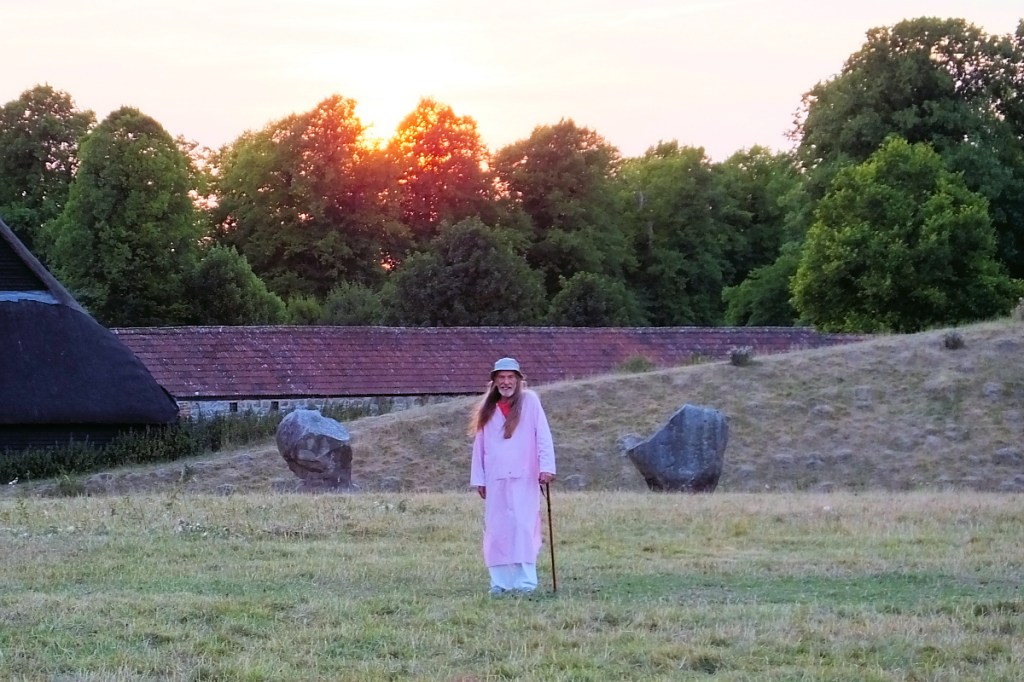
Avebury. Photo by Rebecca Brain.
In a sense, we humans are losing control. But don’t fall for the fearsome idea that we’re doomed, that World War Three is coming – that’s a trap of the mind and heart. It’s time to choose.
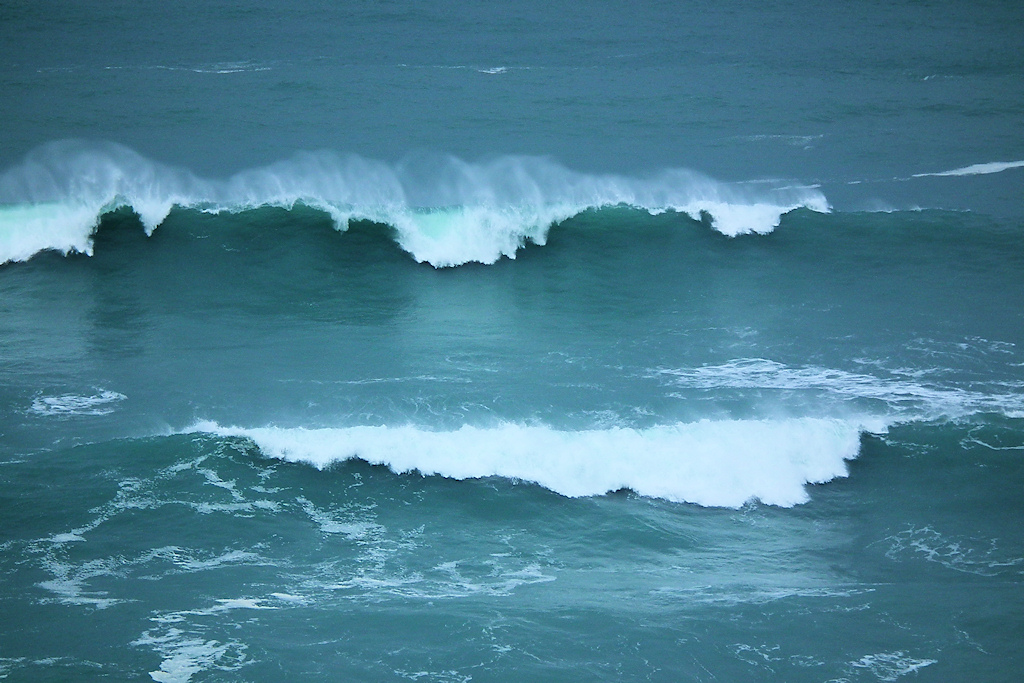
Losing control, there’s another level of balance and magic that comes up underneath. It’s all about riding that wave. Overcoming fear.
Seven years ago my life changed thanks to cancer. I was given a year or two to live and I’ve been hovering on the edge ever since. It yields insights. One insight is this: the more we work with change within ourselves, habituating ourselves to shedding skins and starting over, the more adept we become for the time when the big change really comes.
It might not look like it, but another world is birthing itself and it’s already in labour. The big squeeze is happening and, by being alive today, you’ve chosen to be part of it.
Everything that begins comes to an end. Yet we don’t die: we’re reborn into another world. This is what I’m facing at the end of my life, and eventually it comes to each and every one of us.
I’m a former astrologer, geomancer, original thinker, consciousness-worker, project-founder and humanitarian, a veteran of the 1960s and the late 20th Century alternative society. I have a few perspectives to share, and that’s what these two evenings are about.
I was listening to a feature on the BBC World Service about the Afghan women’s football team, who have recently been reunited in New Zealand. My eyes flooded with tears. Now, I have no particular reason to feel this way about refugee Afghan sportswomen, but the tears came up anyway, from somewhere deep down. Not for the first time: this is happening quite often, prompted by the smallest of triggers.
Yesterday it was a little bat: it comes out at dusk, swooping around in our farmyard, catching insects attracted by the lights in my cabin. Up came the tears, set off by an upwelling feeling for the lonely struggle of the bat to find food, thanks to a serious decline in insect populations in Britain. Yes, that bat and its fellows could be doomed by the unthought-through ecological malpractices of the British people, blithely getting on with our lives, worrying about the prices of school uniforms, avocados and tankfuls of petrol.
Another was a story about computer programmers in Gaza, trying to find work internationally, on laptops retrieved and refurbished from the rubble – they just want to feed their families. Another was a story about seamen stuck on boats in the Persian Gulf – they just want to go home. Their kids haven’t seen them for ages. They’re victims of a geriatrically whimsical president in a faraway country who labours under the belief that his priorities are bigger and more important than everyone else’s.
These aren’t just narrowband tears restricted to feelings of pain and sadness. Sometimes I emerge from these soggy interludes with a smile and a feeling of relief – not because relief is imminent for these poor souls, but because of the tender humanity and emotional solidarity that lies within these feelings. This human vulnerability, so easy to bomb, mow down and bulldoze, is where the future of humanity lies.
Our desensitised world is so caught up in its dramas that we forget what we’re here for. Though we have a wide spectrum of feelings about the state of the world, collectively we have lost our emotional anchorage, our moral compass. We’re burdened with enough of our own problems, and distant people are another matter. It’s a sad dilemma, this.
Occasionally bursts of empathy come along when we see lines of refugees in a futile trek over the mountains, heading for refugee camps far from home, or a baby lying dead on a beach on the edge of the rich world. That child had lost its chance for a better life – a life of cars, refrigerators and the juggling of timetables and monthly bills.
But mostly, while we get empathic twinges as the media trot out yet another disaster in someone else’s backyard, we don’t have time. We have to get on with stuff. This is the way in which, on this planetary world, we’re unwittingly destroying ourselves, as well as all the other critters and species who nowadays find themselves dependent on our decisions and behaviour. I’d love things to be otherwise but, well, sorry, I’m too busy right now.
Nevertheless, we are all empaths underneath, true humans at heart, and herein lies a big solution. Not in arguments about net zero or GDP, but in a feeling of human togetherness and shared vulnerability. We’re all in this together, sharing as we do a rather small world. Yes, even billionaires are lonely and afraid.
Our current global trajectory pushes us in a direction where, to our horror and surprise, we might rediscover a big truth – that it is in our own best interests to prioritise everyone’s interest. To make sacrifices in our own lives, just as the world’s victims and underdogs today are doing for us.
It’s in our best interest to let those tears come up. To feel the pain of the world. And its tender joy, sprouting like springtime flowers in the nightmarish wastelands of today. To forgive ourselves for screwing up. To see things with another optic. To set the past behind us, entering the future facing forwards.
Whatever unfolds in the coming decades, our descendants shall one day live in a new world, whatever form that takes – we are creating it now. We’re getting closer to a showdown, a catharsis of global choice, and we’re all here for that. If you wish to escape it, that’s fine, but you’ll be missing something – missing the redemption of a planetary world. It’s the biggest game in town. And it’s happening in our own hearts.
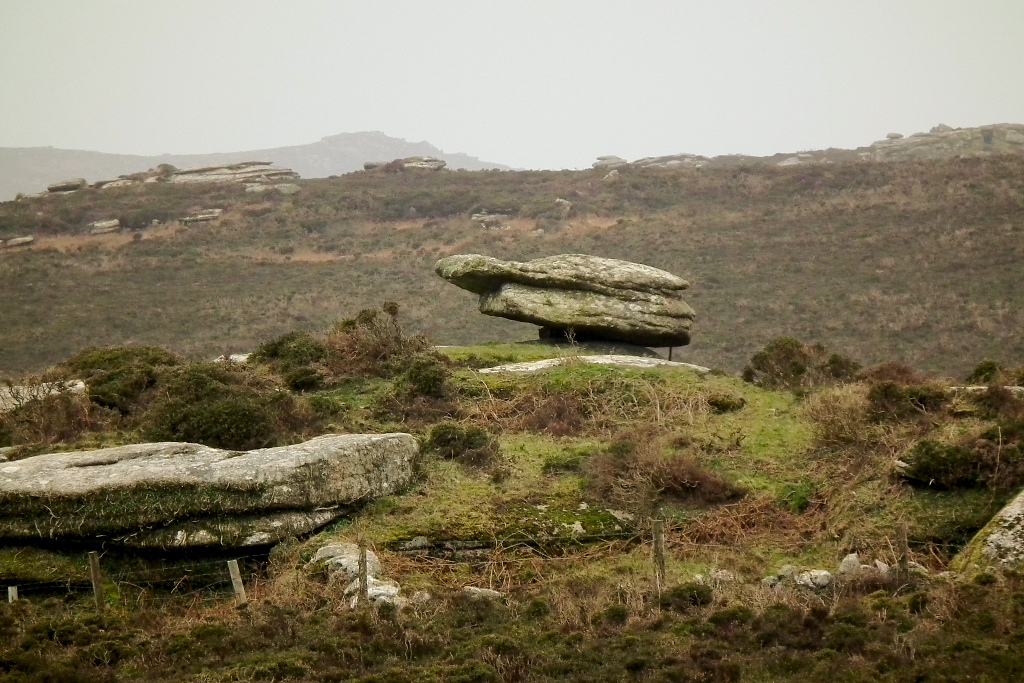
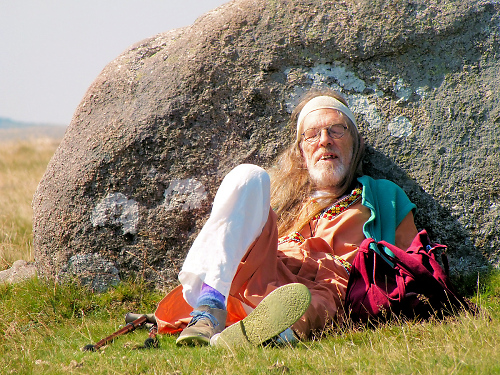
A natural or a placed rock? This one is probably natural. Zennor Hill, West Penwith.
I’m only as good as I am in my worst moments. This is what I have learned, or perhaps re-learned, recently. I’ve been going through a lot of physical pain, and pain has a way of reducing and diminishing me, bringing me down into a state of unclarity bordering on despair, so that my best efforts at staying conscious get to be a struggle.
This is affecting my writing. Already, peripheral neuropathy in my fingers has made typing difficult, and my fingers miss the buttons, and there is so much correction and re-editing to do that I lose track of what I’m trying to write.
Unfortunately, using speech-recognition software isn’t as simple as many people believe when they recommend it, and it doesn’t work well with me. That said, about one third of this blog was first-drafted this way, then re-edited.
It’s the pain that is really doing it. Pain demands complete attention – it is merciless, scooping up consciousness and attention and blurring my inner focus. It’s my left foot only, but the pain level is so high that it can keep me awake all night or, in the day, at times bring up tears of helplessness. I’ve also been weakened by tiredness – finding myself wondering whether it is day or night, what time it is, and what’s happening.
So I will not be writing as much as I have done in the past. Which I regret, because writing has been a major part of my life – I’ve spent mega-thousands of hours doing it. But that’s the way things are now and I must accept it. The pain I am currently dealing with soaks up so much of my attention and energy, and that’s that.
This brings up something of a fear. It is the fear that, if I say nothing and go quiet, I’ll be forgotten. It’s probably an early-life psychological issue or a past-life memory, or both. I can be forgotten for perfectly good reasons – people are busy, and so many things shout for our attention, and people assume that, if I’m quiet, I must be okay, or that perhaps they should not disturb me. Or relationships become digitalised and weakened, with a constant stream of how-are-yous with little or no face-to-face contact. But I do have people close to me who keep their eyes on me and I much appreciate their involvement in my life.
This is about neurological pain. It’s to do with the interaction of our neurological system (the information system), which is plugged into our body, and our conscious mind, which isn’t directly so. It has a lot to do with what we give attention to. However, it is easy to say this, but when in deep pain it’s difficult to summon enough focused attention to change the pain from the inside.
Pain has a way of forcing us to pay attention to it whether or not we wish to. It sucks up all clarity, positivity and perspective. It’s important not to panic and to avoid getting too caught up in it, though this in itself can be difficult when the pain gets mixed up with nightmares and dream-stuff in the quiet loneliness of the deep night.
Holding my focus has become more of an issue. I wrote a blog last week and ground to a halt with it. This is what I wrote…
Weird pillow granite on Carn Galva
I don’t know whether Agonos is a proper Greek word but, in the middle of the night a few nights ago, it gyrated around in my mind, aptly describing the state I was in. Things have been tough, and daily life is hard work. I’m doing quite well regarding the blood cancer, Multiple Myeloma, that I’ve had for seven years now – it is held at bay with cancer drugs. It’s the side-issues that cause the agony – especially peripheral neuropathy – and I have also acquired a secondary skin cancer, a carcinoma. Doctors’ visits, tests, pills and interventions are increasing.
I feel like I’m in my Nineties, shuffling around like an old crock. Things have been changing in recent months, and life and my medical condition have been getting more complex, as have relationships with the various different doctors I’m under. It’s a long uphill grind. The pain in my feet dredges and wrings me out. I have some fundamental life-questions to sort out too, the main one being this: is all this toil and trouble actually worth it?
Peripheral neuropathy is a side-effect of cancer drugs I’ve taken since 2019, which have killed off the nerve endings in my feet and fingertips. Initially it leads to an ungrounded loss of feeling – I learned to live with that though, since the cancer drugs have kept me alive and I’m glad about that. But recently it has developed into two kinds of acute pain: one is a feeling of burning in the feet and the other is a bony pain, like the excruciating pain you get when you stub your toe. Except it doesn’t go away.
These happen when I am sleeping, relaxing and not moving. With a vengeance. When I move around the pain usually subsides. But I cannot move around at all times of the day and night – I need to rest and sleep too! The sensors and signals in my neurological system have gone haywire, sending the wrong signals to the brain, which registers pain and exaggerates it, sending the wrong signals back. This is rather ironic, for one who has spent so long on computers! It becomes a psychological loop that is difficult to break out of, even with painkillers.
I was given a drug (Amitriptylene) to deal with the peripheral neuropathy, and it helped partially, but it had a big psychological effect. It drained my willpower, making small tasks seem big, and making me ask depressive questions like ‘What’s the point?’ and give up. In the blurb for the drug they do say ‘risk of sui*cidal thoughts’. I’m not desperate, lost or unstable enough to be thinking of that, but I can see how such thoughts can develop with that drug. So I’ve been switched to another drug (Nortriptylene) and I cannot yet tell whether it is helping or when it will start working (it takes 4-6 weeks, apparently). The question drags on.
I’m unhappy about the number of drugs I’m prescribed and the number of doctors who are tinkering with me – none of them know me and they tend to look at the computer more than at me. Tests and scans are amazing, but sometimes a look in my eyes or a feel of my feet would do better – cheaper and faster too. The doctors and nurses are all good people, doing their best, but they work in a medical system that is not really designed for humans – for the whole human.
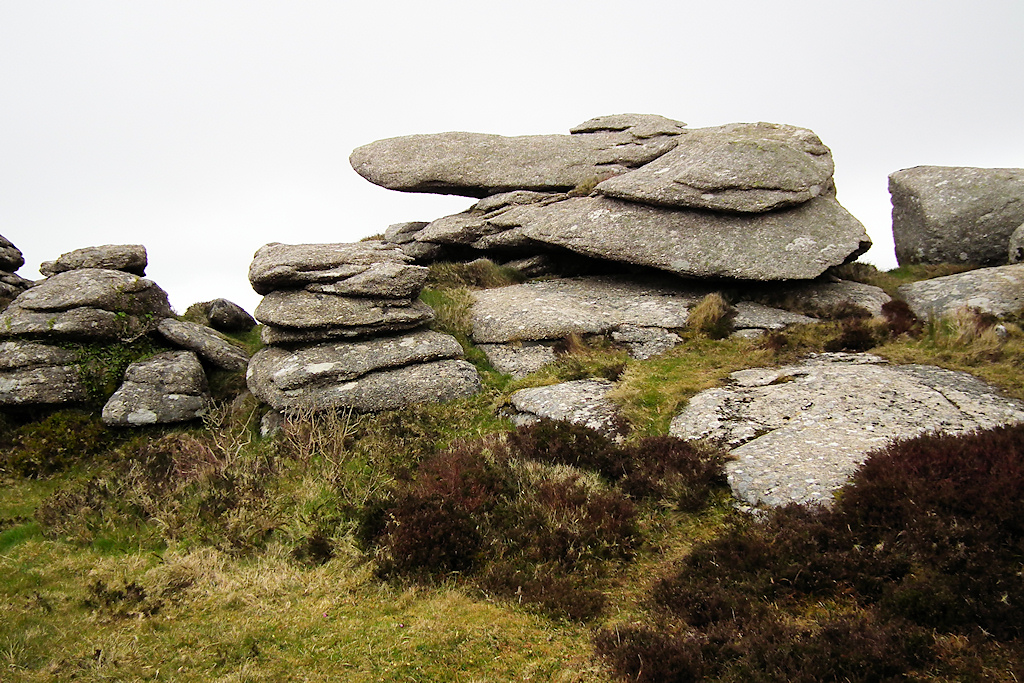
There’s a good chance this is a human-placed or adjusted rock. Simply to enhance nature.
So that was what I wrote and didn’t finish. It’s the same with this one, where I need to report to friends and relations what is happening, so that you know, and I’m not sure how to finish it.
I’m making some sort of progress though, giving the pain less attention, taking more of an uncomplaining and accepting attitude – when I can – and receiving some insights into my father, mother and ancestors, and into the way of things.
My left foot hurts a lot right now. I wish this would end. I guess there must be a good reason why it doesn’t. I haven’t found it though.
Eitherwhichway, I wanted to give you a read-out on where things stand for me. I’ll probably be saying less and recycling more in the way of old material from now on (but it’s good stuff). But I have a new digital helper here in Cornwall, Lucy, who, all things being well, will handle my online affairs when I lose the ability to do so – we’re running in and working through details and questions, as time goes on.
Thanks to all of you who have been following my blogs, pods and other outpourings. After getting cancer it gave my life new meaning, and the creativity of it has itself had deep healing effects. Were that not so, I think I might well have died in winter 2022. I am so glad that good souls out there like you have been enjoying and benefiting from them, and so grateful to have touched the lives of so many people – as you have touched mine.
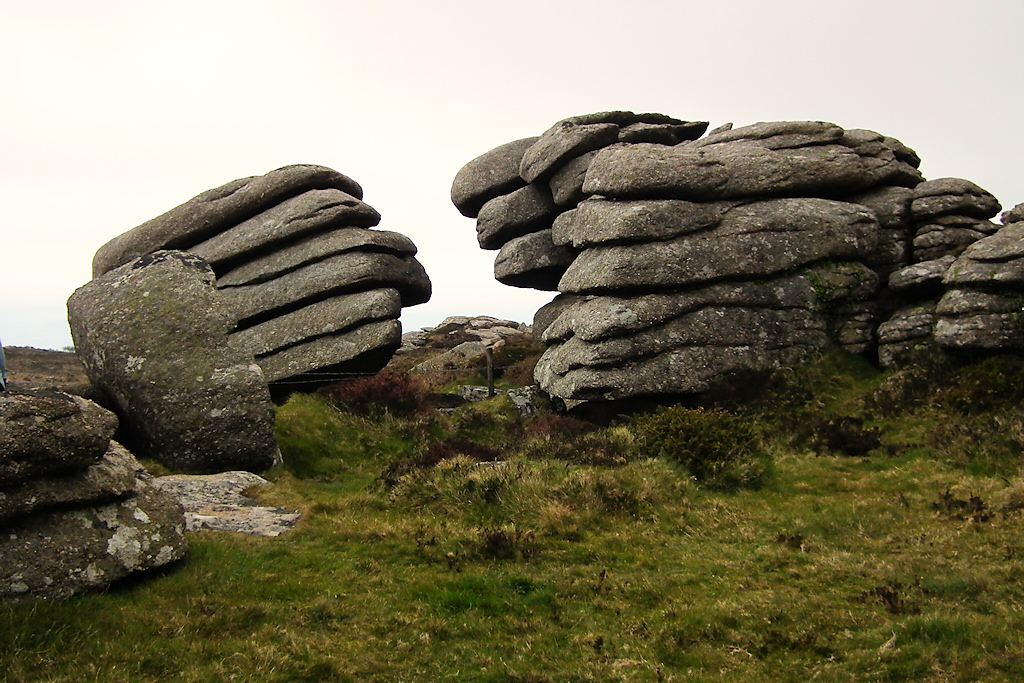
These are at Sperris Quoit, forming part of a kind of rock temple close to the quoit. I think these are placed rocks.
In life’s final chapter, as daily life gets more difficult, the multi-level, even multidimensional costs and benefits of staying alive can shift, and the costs can get to outweigh the benefits. Just getting up out of a chair or clipping toenails can be quite an operation! Sometimes cooking food wears me out so much that I can’t eat it (but often I cook for 2-3 days each time, so it’s not disastrous).
I’m active and functional for about six hours each day, usually doing catch-up things – phone calls, messaging, clearing up and self-care – and then I wear myself out even more! “Palden, why won’t you reply to me? Have I done something wrong?”. No. I can’t keep up, that’s all, and I lose track, and I can’t spend all day at my computer.
That’s the way things are. I’ve written here about problems and hard stuff, yet I’m still grateful for the experience. That might sound a bit schizoid but, for better or worse, throughout my life I’ve always tried to make the best out of apparently bad situations, and it doesn’t stop now – and they aren’t necessarily bad either, if handled well and turned around. I’m minded to dredge up a quote I quoted several times a few years ago in my blogs:
It’s okay in the end. If it’s not okay, it’s not the end.
I was given that jewel of wisdom by a Berliner, while standing amidst the geological drama of the Sinai Desert in Egypt in 2012. We were like ships passing in the night, briefly meeting as soul-friends in the middle of the void. I wish I could remember his name.
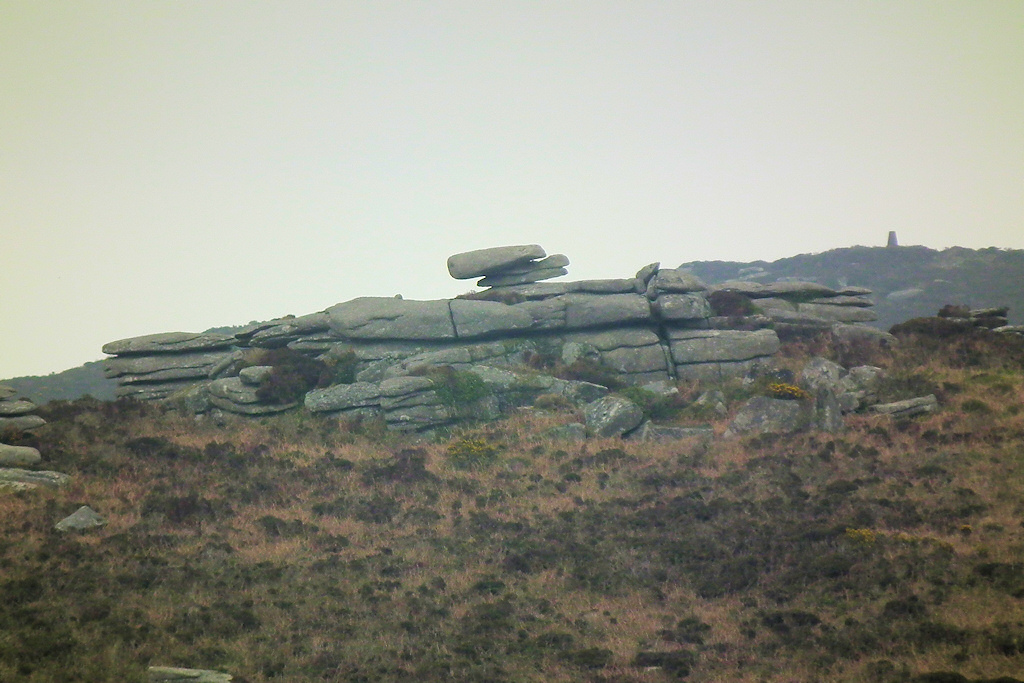
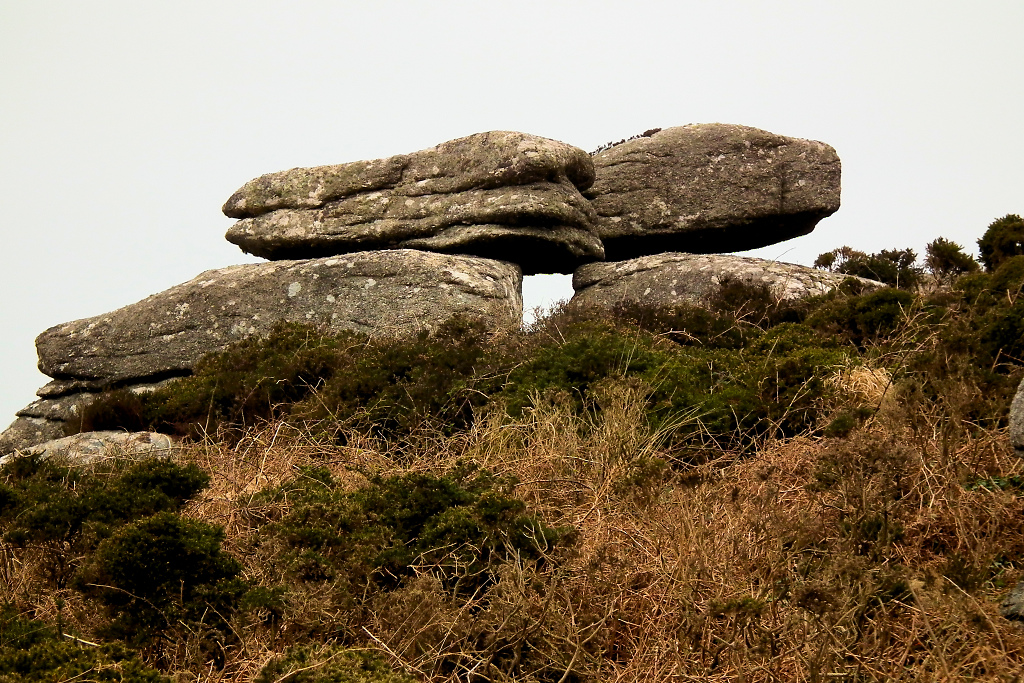
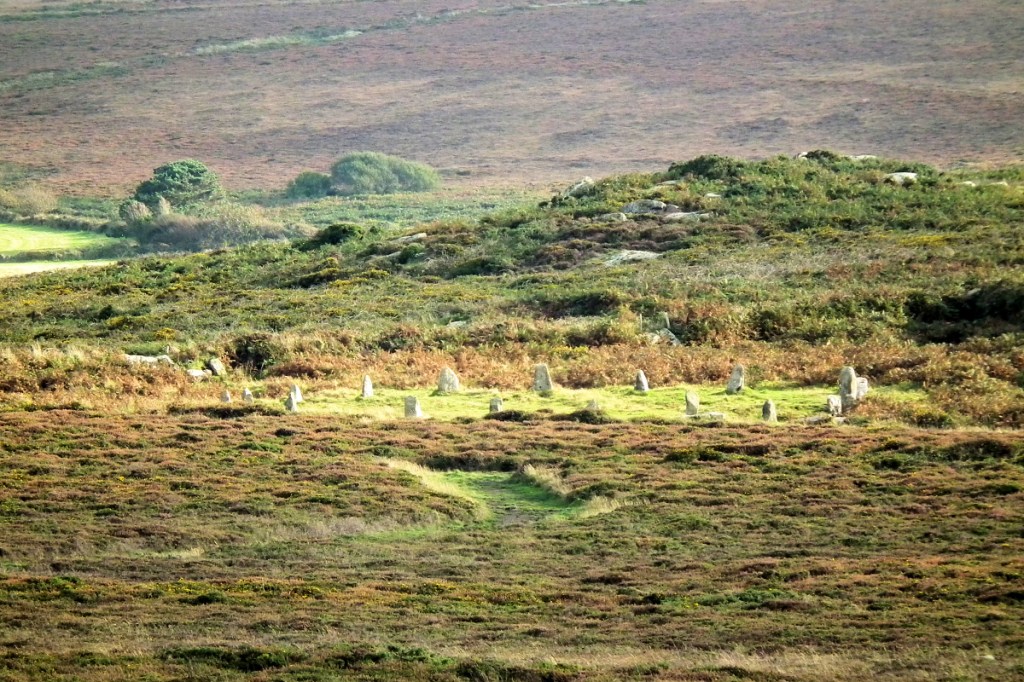
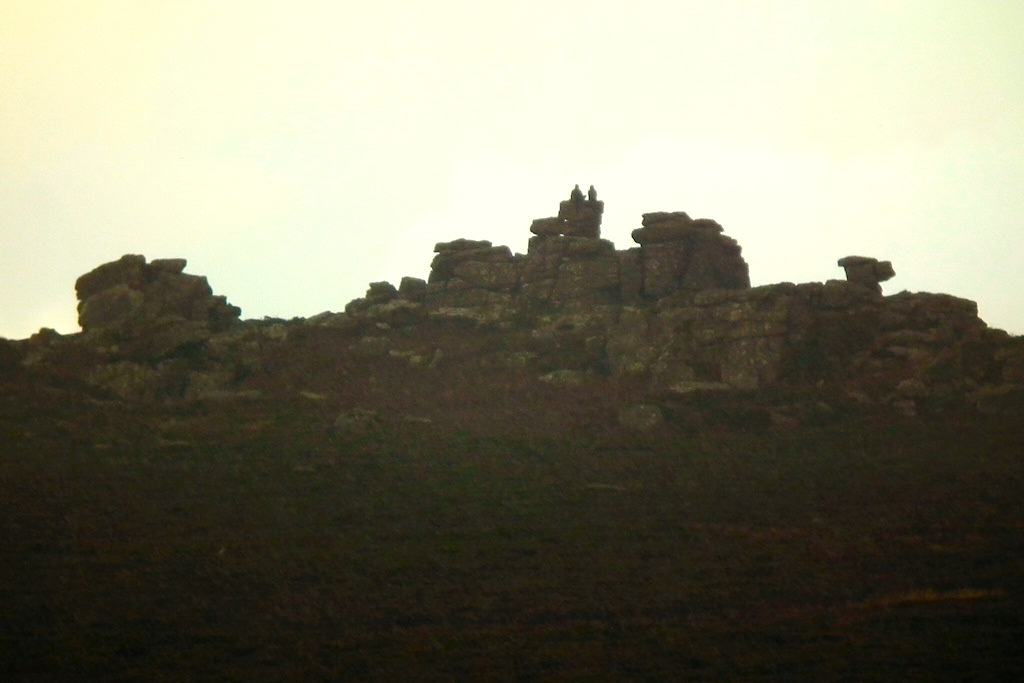
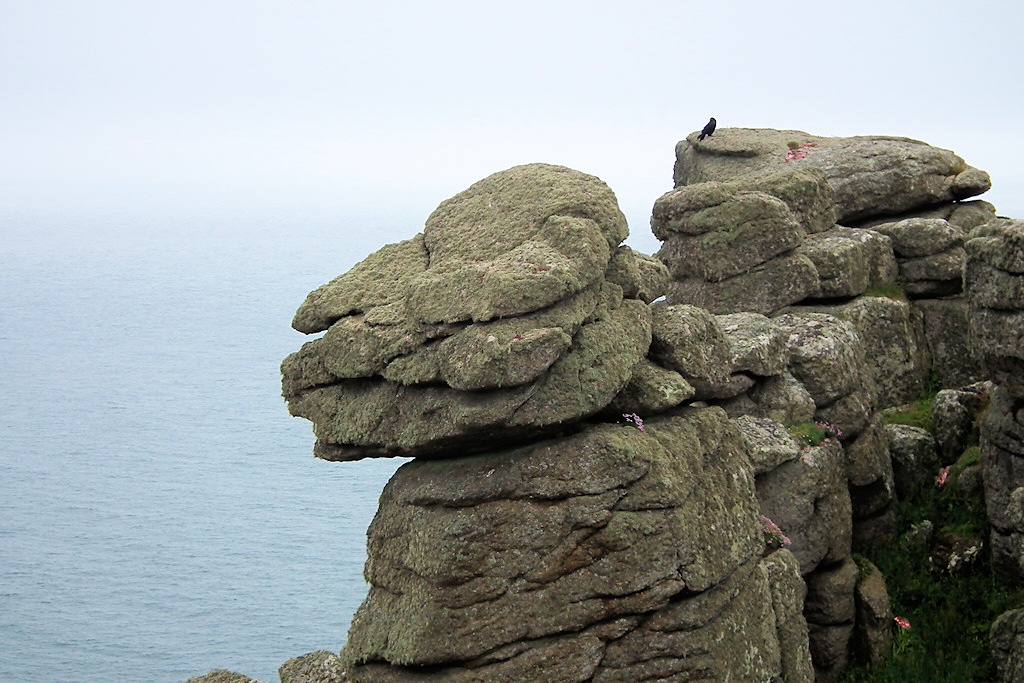
The pics are from Zennor Hill and Sperris Croft in West Penwith, Cornwall. Some of these rocks are natural (it’s weird granitic geology round there) and some are placed or moved – back in the Neolithic, around 5,700 years ago. The question is, which are which? With some it is clear and with others it is a matter of debate.
Most people think this is natural, but I think there’s a good chance this was placed, or adjusted.
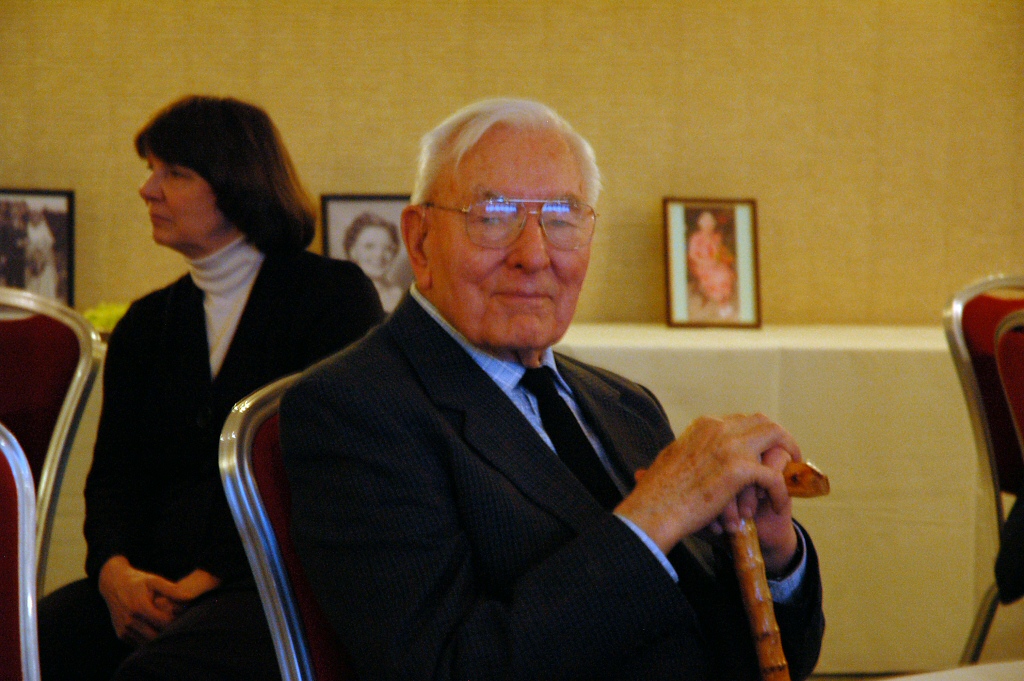
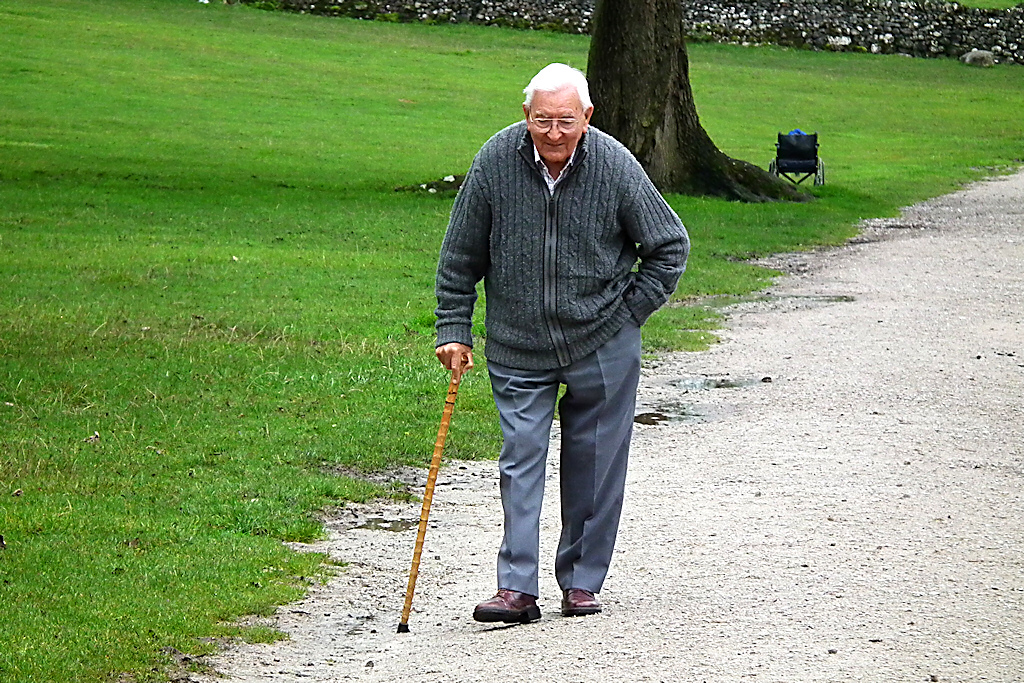
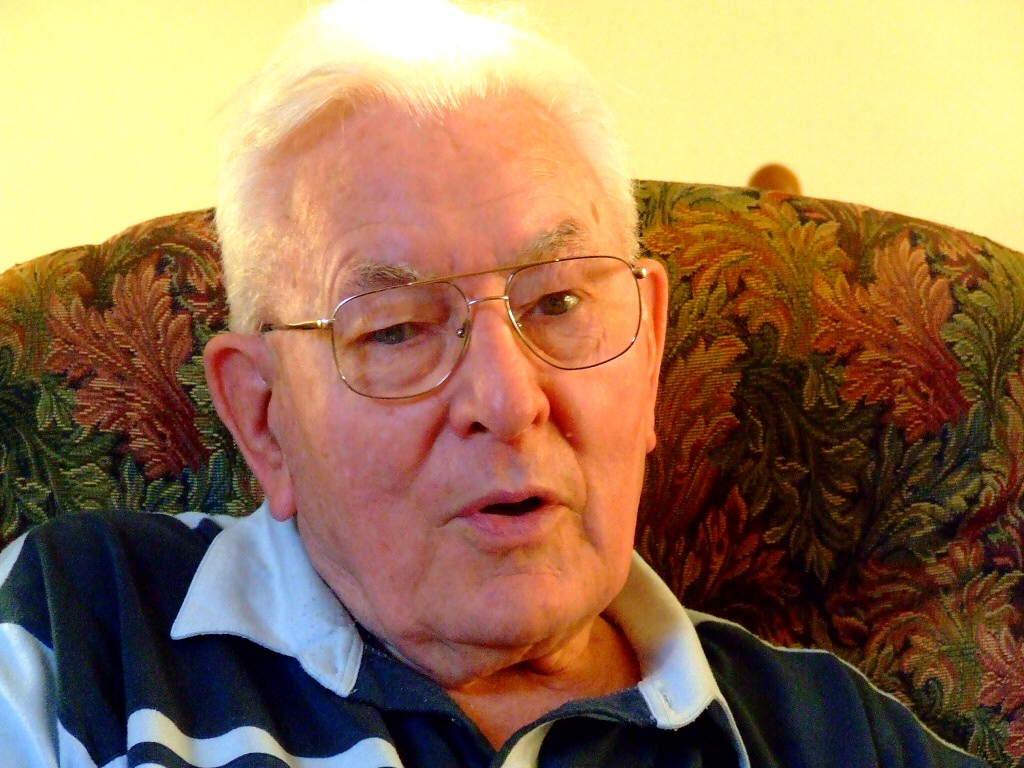
Pics in this blog are of my father, Julian Jenkins – no longer on this Earth. Here he is, noble at his wife’s, my mother Ruth’s, funeral
I’m getting a feeling that, unless something changes or I’m getting things wrong, it might not be too long before I join the ancestors. That’s not a heavy feeling – there’s a dawning sense of relief to it. Of course, you never get to know when and how death will come, until it actually happens. So I’m faced with rather a strange choice: is it best to talk about this while I can, in case I keel over quite soon, or am I overdramatising something that is not actually imminent?
There is indeed a feeling of migration going on, a gradual shifting from here to there which, at some point, will mean that my heart stops pumping. The time will have come to go over to the otherworld – whatever that lands up truly meaning.
But the otherworld doesn’t start there. I want to return to a thought I shared a couple of years ago, about dying. Dying is a gradual psycho-spiritual process, and every one of us is dead to some extent, at this very moment. You might be only 10% dead, but part of you is over there. I’d estimate myself to be 80ish percent dead at present, up from the 70ish percent of a few months ago – though it’s a non-measurable perception.
Whether or not you’re aware of it, your psyche is much more bendy, pulsating, edgeless, multilevel, imaginal, transdimensional and empathic than you think. We’re addicted to the idea and the feeling of individuality, as if there is a clear boundary between what is me and what is not me, when actually there isn’t.
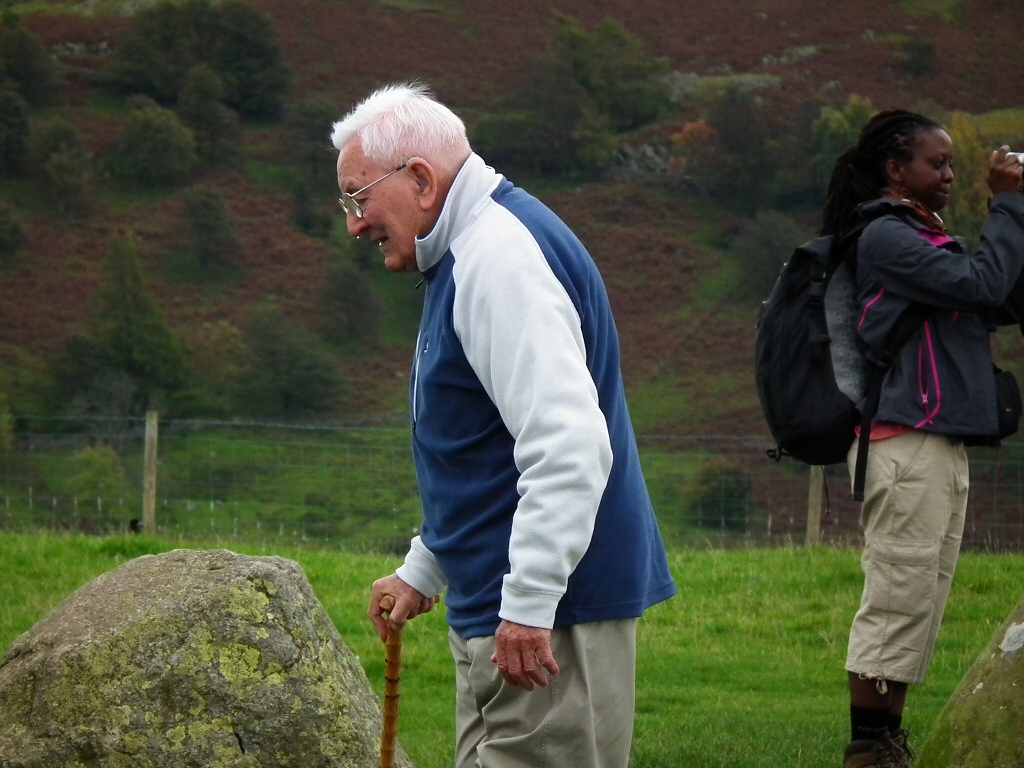
Julian at Castle Rigg stone circle, Cumbria, in his final years
Part of our deeper psyche oozes over to the other side, and on a more regular basis than we might think. This happens especially when a loved one, or a person who is important to us, dies. Part of us goes over with them, and it’s important to give time and space to experience that. It’s a blessed, spacious feeling, and a great gift. That feeling of inner connection with a deceased soul can be quite strong in the first few weeks. Over the course of a year, that emigrant soul will come back clearly at times. You get a flash of them – if only a glimpse – and you feel them and their vibe quite distinctly. So listen and talk back – this is important.
That’s how it works with ancestors. Early in human history, when we lived in genetically-defined tribes, souls would tend to recycle within the tribe’s psycho-spiritual field. We modern people have now burst out of our tribes, seeking experiential variety and following a multiplicity of possibilities. Both genetically and as souls we have become remarkably mixed and mongrelised. We’ve been at it for millennia.
But there are also specific threads that pertain to our own personal life-stories and interpersonal histories. People in our past have acted as beacons of light, rescuers, enemies, teachers, harmers, questioners and friends to us, and they live within us now, and it’s a personal thing. Or it might be a tribal or group-soul thing – a concatenation of souls with a shared identity and purpose.
Ancestors continue to live through us. They watch and witness from another place, sometimes lending a hand or dropping thoughts into our heads, or acting as an element of memory, as a model of how to do things, or how not to do things, that helps us shape the lives we live now.
One of my key guiding ancestors was a man who was alive in the mid-19th Century in South Wales, where he was well-known as a healer of last resort. Doctors would refer patients to him if they felt they could do no more. Apparently he was a curmudgeonly, difficult old git, with a big, white, Karl Marx beard, though he had a glint in his eye too. At times he would disappear up into the mountains on his horse, leaving the world behind, to collect herbs and spend time on his own. Yet he was gifted with a wondrous ability. He would reappear, back from the mountains, and people would come to him.
I first met him, inside myself, when I was young, during an inner journey on my third acid trip, in 1967. Over time he has returned, as if watching me, especially at critical points in life. It took some years of questioning relatives to find out who he was. He had been an embarrassment to the family, so he was not well remembered. But he was well-known and he did apparently save a lot of lives. He still turns up on the movie-screen of my psyche every now and then, and he’s both a genetic and a spirit-ancestor to me. And I am a bit like him too.
In this life I’ve been involved with large numbers of people, organising events, running groups, standing on stages, muttering down microphones, writing books and building websites, connecting deeply with many amazing souls. I’m aware that, having played a catalytic, key-turning role in many people’s lives, that makes me a kind of spirit-ancestor to at least some of them – once I’ve popped my clogs, that is.
So, after I’ve gone from this life, please do remember to check me out every now and then. Or if you find me checking you out, please do say hello. See whether there’s a message in it for you. I’ll pop up in your thoughts for a micro-second, and you’ll get a distinct feeling of me that comes with it.
Adventuring
But it’s not just that. This is a two-way thing. Being up in ‘heaven’, lacking an earthly body, it means that, if we ancestors want to get stuff done on Earth, we need to get people to do it on our behalf. This gets tricky. Modern humans suffer doubt, thinking that such thoughts are ‘just imagination’, and setting them aside. This can be frustrating for a soul on the other side: try talking to someone on Earth and they just ignore you and walk away! However, we can meet you in your dreams, and sometimes such interactions percolate through into waking-life – into what we call consciousness.
One of the things I am glad about is that, throughout life, I have often followed these promptings. I wake up with a feeling, an inspiration or a compulsion to do something, big or small (this blog about ancestors being one example), and I feel driven to do it. There’s a certain magic that comes with such downloads, a feeling that the prompting points towards something that is genuinely supposed to be. The outcomes from prompts like this can be much bigger than anticipated too.
Acting as an ancestor is rather a choice and a commitment. It’s a resolution to be available and of service to souls who remain in the land of the living, and service to the universe’s wider agendas. You don’t automatically become an ancestor just by dying: it’s a choice to be present, accessible and involved.
It also depends on how others see you, as a sort of role model or example. On some level, and whether or not people are conscious of it, you become a star in their inner firmament. You become a watcher. You cannot interfere, though you can lay seeds of possibility and simply be there for people.
Here’s the main reason I’m dwelling on this. From an earthly viewpoint, my health and condition have been deteriorating in recent months. I find I’m becoming less focused on, and interested in, the world around me. More often, I find myself floating off and disengaging, interiorised and seeing the world more like an outsider, once-removed.
I remember this when my Sagittarian father was in his nineties. I’d take him on adventures – he liked that. He would fall asleep during the journey but, when the engine stopped and he awoke, there before us would be a panorama over the mountains or the sea. We’d sit there sharing a flask of tea, sometimes going for a slow walk. Or I would go for a walk and he’d fall asleep. I was giving him a last look at the world, and we’d visit some of his favourite places. He died over a decade ago, but we still nod and wink to each other across the dimensions. Those were valuable moments.
We certainly are multidimensional intelligences, and this becomes more and more apparent as we approach death. Except, as intelligences, we don’t always use our full intelligence. Jean Piaget, a sociologist, once said, ‘Intelligence is not about what you know, it’s about what you do when you don’t know’.
Indeed. This is the story of life on Earth. It’s a life filled with paradox and improvisation, and we each have a different instruction manual and a unique experiential path to follow, just to complicate things.
I’ve just begun revising my cancer book, Blessings that Bones Bring – it needs to be shortened and sharpened. The book is a distillation of relevant material from my cancer-and-life blog, Notes from the Far Beyond. It’s in both digital and audiobook formats.
Next there is a question of how to end the book, since a cancer story, in my case at least, ends when I die. However, I’m not dead yet and, after death, I won’t be able to write the final chapter. That’s one of those paradoxes. I haven’t figured out what to do about ending the book, but something will work out.
So that’s my project for the next few weeks – apart from getting through each day. At this late-life stage, it’s a matter of completing what I can of the flapping threads of my life, while I still can, even though existence is twice as difficult as it used to be before cancer along.
I hope this rather rambling blog makes some sense. Perhaps I’ll return to this ancestor theme another time. I might be losing the plot, going off at tangents, but something else is dawning inside. In the land of the living it looks as if things are going wrong and I am deteriorating, but in the land of the soul something new is starting up. Or perhaps I’m getting a re-training in how to function in the rather rarefied consciousness-realm where ancestors spend much of their timeless time. I wonder if they serve good tea there?
This doesn’t really feel like a journey into the Great Unknown: instead, it feels like going home. It was this life that was all about the Great Unknown – a life in a world where we drive bulldozers through the laws of the universe. We flail around in the choppy seas of earthly experience, bumping up against things and people, struggling to make sense of a pervasive fiction that we call ‘reality’. However, at the end of it we are permitted to go home, and our bruises and wounds are attended to – if, that is, we allow it. If we don’t allow it, we start our next life carrying the baggage, hurt and aberrations of the life or the lives we had before.
Meanwhile, if you’re in the mood for some seriously moving rock’n’roll, here’s a remarkable musical rendering of the dying process, in a Christian cultural context: Gabriel Fauré’s Requiem: https://www.youtube.com/watch?v=aPI3E0Sxs0E
I’m moving towards the end of six decades of public speaking and teaching. I feel it in my aching bones and sluggish brains – what’s left of them. My synapses have run almost enough marathons for this lifetime. But I think I’ll last until the end of this year, inshallah. So I’m going to do a few talks and classes during the rest of 2026. That is, if people invite me, and if it’s doable.
I was thinking recently about my capacity earlier in life to hold and convey vastnesses of information and big, wide perspectives. In my audio archive there are talks from thirtyish years ago, and some of that stuff surprises me now. Gosh, was that me? Was it in this life or another? The audio archive is here: https://www.palden.co.uk/audio-archive.html
I’ve always been rather a polymath, covering a range of subjects. A typical hyper-focused Aspergers type, I became a veritable expert in each subject I took on, and subject to occasional bursts of genius. But that’s what I did in mid-life, and now I’m rather a worn out, ponderous old hippy veteran who’s seeing things in more of a reflective way. More transdimensional. But I still have a few more things to share.
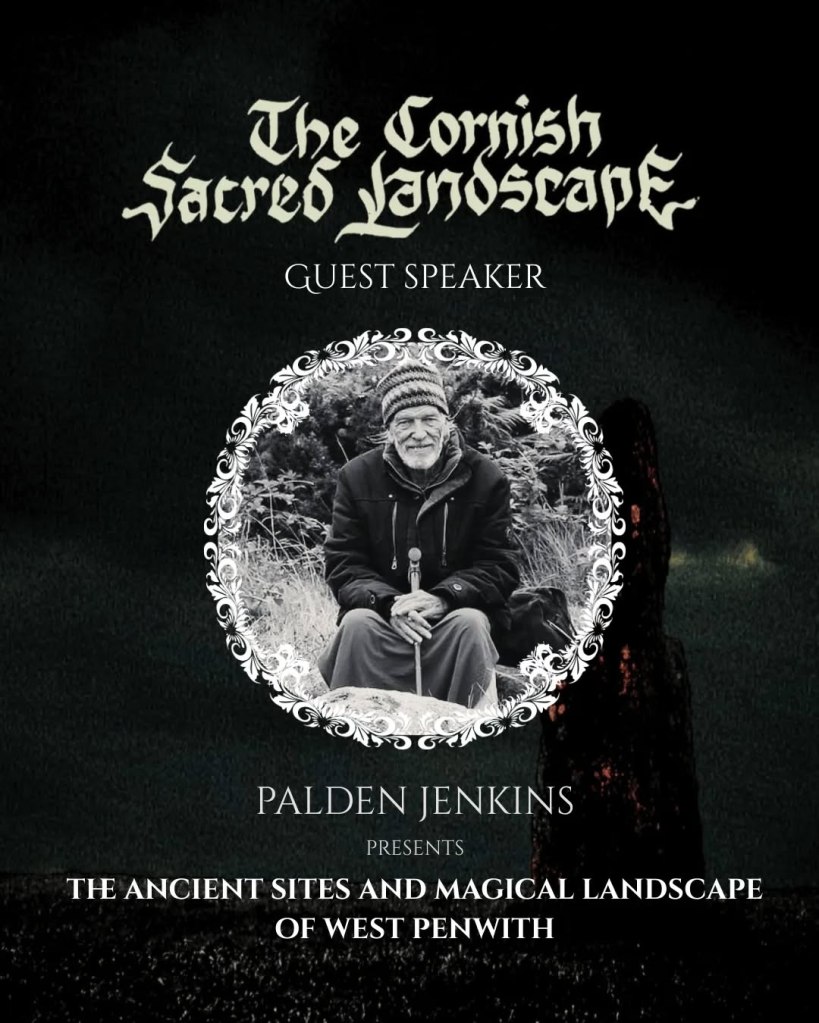
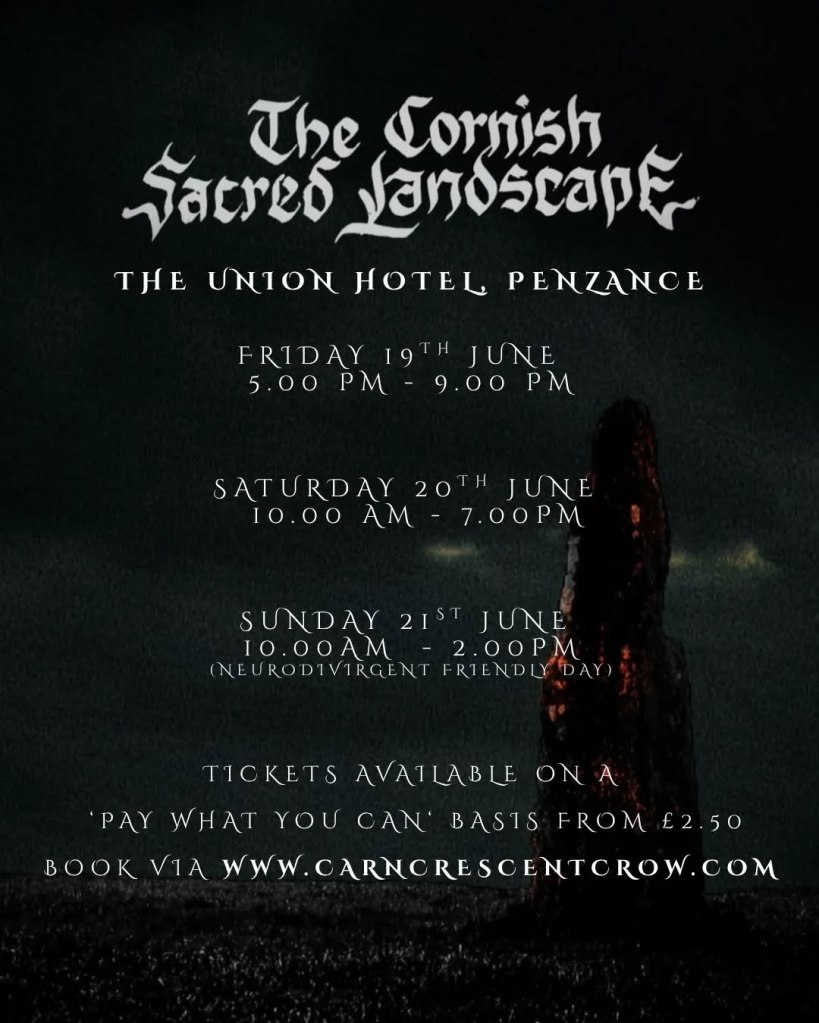
I’m doing a talk in Penzance as part of the Golowan Festival around summer solstice, courtesy of an old friend and neighbour, Na Nook. (Info: The Cornish Sacred Landscape.) I’ll be holding forth on the prehistoric society of West Penwith in the Neolithic and Bronze Ages.
This is about the ancients’ worldview, their optic, their magic and their society, as demonstrated in the ancient sites they left behind. That’s fascinating, though what’s most important is that we need to learn from the ancients – it’s growing in relevance today. I’m really happy with the discoveries I’ve made about Penwith’s ancient sites in the last fifteen years. This is a kind of final statement of where I’ve come to on that matter.
As usual for me, it’ll take 20-30 years for people to really get what I’m talking about – being ahead of the times has been both a blessing and a bane in life. Hence, I’m leaving an extensive online archive which, I hope, will stay intact and available for at least thirty years! Perhaps its time will come. In the archive there’s some interesting stuff from the 1990s – some of you might enjoy Paldywan Kenobi’s Millennial Master Class from 1995.
At the JustLiveCamp at Morvah, in Penwith, Cornwall, 23–29 May, a community camp in sacred Cornwall, I’ll be giving a talk about quoits, stone circles and cliff sanctuaries. Chun Quoit is just up the hill from the camp, and I’ll happily transport those who are present on a journey into the Neolithic, 5,000 years ago, to connect with those times – the much-forested times when Chun Quoit and Chun Castle were first built.
If I can, I hope to make a trip around parts of Britain during this year, to see old friends and haunts. As you might gather, my health and mental acuity are approaching a stage where making coherent talks is becoming less possible, but if there are invitations to speak, and if it’s doable (I have to be brought by a driver-minder) then I’ll do my best!
I hope to be able to keep on with podcasts – they’re still doable. Blogs are more difficult because my fingers no longer work well. A lot of people think voice recognition programmes are a solution but, no, they take so much re-editing and correction work that I find they don’t necessarily help. Besides, written English is a little different from spoken English.
Perhaps I need a digital assistant – someone living nearby with networking and literacy skills who would like to manage my online process as I pass away. To the right person this could be really interesting, since I have a large archive of material which can easily be recycled. We shall see. Magic happens – and sometimes it doesn’t, and something else happens instead!
Anyway, here’s a new podcast about ancient sites. I pose the simple question, why do people like visiting ancient sites? We need to look at this question. We need to be honest about a few things. I believe we need to get a bit more serious about ancient sites and what they mean for us now. It’s here:
All things being well, my penultimate book, Shining Land – the ancient sites of West Penwith and what they say about megalithic civilisation, might come out in printed form before long. It already exists in digital and audiobook format, and it’s here: https://www.palden.co.uk/shiningland/
My final book, Blessings that Bones Bring, is going through a review and hopefully will emerge as a second edition by the end of the year. Or sometime – in Cornwall we say ‘dreckly‘. Clare, one of my helper-angels, is assisting with that. It’s made up of re-edited cancer-related extracts from my cancer blog.
It gives the inside story about being a spiritually-oriented cancer patient, and about cancer as a spiritual path and process – a path of awakening, acceptance and completion. As I say somewhere in the book, doctors saved my life and healers gave me a new life – and this is how it has been.
Everything that begins and is born eventually comes to an end. This is the nature of life. This is our learning. We come here to master this. It’s all in the grand scheme of things and, guess what, it’s a training for a greater life. Yes, folks, there’s further to go.
Just remember: you are on a journey, and this life in a physical body, on a dense, spinning and rather troubled planet, is but a stage along that path.
Oh, and while we’re here, I invite you to join me and a widely-spread group of shining souls in the Sunday Meditation, any and every Sunday. Come and waste half an hour with us, for a homoeopathic dose of infinity.
Whether or not you do so, please put in a prayer for all those people round the world whose lives are being devastated by the military actions of fucking assholes who believe they can bend people to their will and their geopolitical delusions by bombing hell out of them. Both the bombers and the bombed are to be pitied, each for their own reasons, and may the 21st Century be the final century in which this kind of insanity is permitted to happen.
Yes, permitted. You can go on as much as you like about Illuminati, Reptilians, Bilderbergers, Oligarchs or any Them you can name, but, in the end, it is we, humanity, who permit all this madness to happen. It is in our hands. We can do it. It has to be done.
With love, Palden
BTW: I was given the nickname Paldywan Kenobi in 1986 by a boy, then aged about eight, in a rather deep, hot and heavy talking-stick sharing circle at the time of Chernobyl, and the name kinda stuck. He stood there with the stick before him like knight holding a medieval standard, uttering words of power that I can’t remember but I’ll never forget. He’s William Cartwright, nowadays a rock musician in Glastonbury. This is where children become our teachers. And our parents.
If you ever get a serious late life illness such as cancer (and there’s a good chance you will, even if you’ve looked after yourself, as I had), or simply if you’re growing older and more decrepit, you come to a stage where you need help. You just can’t do all the things you used to be able to do.
When I was younger I could open every jar, reach things down from high places, safely drive everyone home after a party when they were tired and stoned, and overcome many challenges that now are well beyond my scope. Nowadays I don’t have the strength to open stuck jars, some logs I can’t chop, and if I took the lead of my neighbour’s sweet dog it would pull me over. Sometimes I’m really useless. I can’t drive any more either – what, me, a traveller-soul with Gemini Moon and Sagittarius rising?
Yesterday was like that. I’m on a new drug which is supposed to help with peripheral neuropathy – it’s called Amitriptyline and I’m not getting on well with it. It’s draining my energy, my head is befogged, I’m losing my balance and I’m just sitting here in an armchair like a sackful of manglewurzels.
On days like that I really appreciate some help, often just with small things – things to make life a bit easier because, in my situation, life is twice as difficult as it once was, and more painful too. Just standing upright is strenuous, and going for a walk for half a mile takes a lot of focus and willpower.
People often ask, “Anything I can get you?” This doesn’t work – my brain blanks out. Writing a shopping list isn’t easy: that’s left-brained stuff that I’m no longer good at. So, often, I’ll say No, when actually I should say Yes, but I can’t in that moment think of anything I need. Five minutes later, my intuitive right-brain will start working, and I’ll remember. But it’s already too late. That’s tricky.
Managing this process can at first be quite confronting, because it requires opening up to the generosity of others. You can’t complain if they get the wrong thing or turn up late when you’re stuck in a rainstorm – after all, they’re doing this out of the goodness of their hearts. The secret is to hold your silence and appreciate the gifts you’ve been given, even if it’s raining – then you mention it diplomatically at a later moment. Don’t complain.
There are different kinds of help, and it’s necessary to clarify this. Some people try too hard to help and fuss too much, or they might not have the right skills, or they might not be emotionally sensitive, or they might be a dodgy driver – so it’s important to find the right kinds of people, and sometimes one must be frank with people about this.
You get quite close to your helpers. I have a new helper who has been with me for a few weeks, and it’s working well, but it is still taking her time to figure out where everything is in my little house, and how I like things to be. She’s attentive to that, and that’s good, and we have interesting discussions too, because part of the benefit she brings me is some company (since I spend most of my time alone).
But it’s not just that. I have a wider group of friends, FoP – Friends of Palden. They help me in all sorts of big and little ways. But most of them don’t see me very often. So the first thing they do, and sincerely, is to ask me “How are you?”. That’s not the right thing to do. I need you to look at me, watch and witness me and tell me what you observe. If you ask me “How are you?” at different times of day, I will give quite different answers too.
Besides, it’s not easy being asked how I am five or six times a day. I have to assess myself and give some sort of answer, and there are times when that works fine and other times when it’s actually rather difficult. Instead, you could tell me how you are. So, sometimes, when someone asks me “How are you?”, I just say, “I’m like this!”, opening out my arms. I invite you to make your own assessment, because your observations of me are more useful than my own observations of me.
Special qualities… well, one key quality is reliability. You see, if someone rings me up just before they’re due to come, saying “Oh, sorry, I’m too busy, can we make it next Tuesday instead?”, that can be tricky too. Well, yes, we can, and that’s kinda okay, but actually it makes quite a big difference, even if I can’t at this very moment say why, or give a list of things that needed doing. So it is good to have people coming along reasonably regularly. Not least because the number of e-mails and messages that can otherwise be generated can be staggering, when things lapse into ball-juggling flexi-territory.
Also, there’s the matter of the computer and phone. If I don’t respond, what does this mean? Am I in bed, gone out, sitting on the toilet or dead? Should someone check me out? Or perhaps they decide not to bother me. A helper who knows me well, with a little intuition on top, can usually figure this out. But if I am dead, then it helps to discover this before I start smelling too much.
Regularity also helps because of memory issues. It can be quite challenging and complicated managing a group of four, five or six people who are all in changeable states. So recently I’ve managed to sort things out rather differently. I’ve now got two ‘reliable regulars’ and then a number of occasionals and reservists, and that works well.
The two regulars cover me three days a week – they come for an hour or two on Tuesdays, Thursdays and Saturdays – and then the occasionals come when they can, or drive me to Treliske hospital (thirtyish miles), or take me out somewhere… or things like that, on a more flexible basis.
The funny thing is that one of my reliable regulars is called Claire, and the other is called Clare – just to confuse things! Perhaps my Anima is telling me something, though I’m not sure what.
But actually, for it to really work, it’s necessary for a person to get to know me more closely than they normally would. This includes seeing me in my weak states, at times when I’m quite helpless, and I might need tenderness of a kind that wouldn’t usually happen with friends who come to socialise. Other times, I’m quite bright, cheerful and able, and there isn’t much for my helper to do, so we sit, drink tea and chat, and that’s really good too.
There’s something nice about this because I’m no longer seeking one-to-one relationship (been there, done that), which in this era of toxic maleness, makes me a reasonably safe bet. I’m not going to try it on. There’s also a difference between depending on help and emotional dependency – something that can get confused and tangly in close relationships.
Claire, who has worked with me for eighteen months now, has really got me sussed. When we go shopping she knows what I’m looking for, so she wanders off, comes back and puts things in the basket, with a knowing smile, and that’s really useful. She points things out to me and helps with the most difficult part at the end when we’re checking out.
She packs the bags and keeps the cashier entertained while I fumble around with cards, lists and last-minute memory-eruptions. I find that last bit really exhausting. Then she drives me home, puts stuff in the fridge, unpacks the bags, makes some tea and leaves me to rest and defragment. I’m happy with that. But that arises from the fact that she’s got to know me. She can read me off.
This matters a lot because my brains have been affected by chemotherapy – they call it chemo-brain. My executive functions – the left-brain stuff – are a lot weaker now. So although I’m quite brainy, I have difficulty figuring out certain things. It helps to have someone around who’s like a second brain, who will remind me to take my pills, or to be ready to go, or to remember to take something with me, or perhaps to tell me that my complexion is not very good today, or making useful observations and suggestions.
So if you’re in a situation rather like mine, as a net recipient of help, it’s worth giving some thought to the different kinds of help you might need, and the different kinds of people who will be good at giving it – and enjoying doing so. One male friend of mine, Kai, loves going shopping for me and he’s really good at it, and I can say to him, “Oh, just use your commonsense…” when he asks whether I’d prefer this or that, because I know he’ll get the right thing and, if he doesn’t, that’ll be interesting and useful too. On the other hand, he’s not so good at making tea, so I don’t expect it of him – I enjoy making tea for him instead. After all, this is about energy-exchange. I only get to see him occasionally (he’s a Gemini, travelling a lot), but this works well because both of us have identified how we slot into each other, given the circumstances we each have.
There’s a big sociological problem going on here. It’s this. Everyone is busy rushing around, racing timetables and to-do lists. They are time-poor. It’s a deep cultural and psychological thing in our society. This time-poverty sometimes makes things difficult. Occasionally I need a person to slow down to my speed, and at times it’s really good for them to do that, and they are grateful for it – it’s something I can give.
But people who are just fitting me into their busy timetable… well, that can be difficult. I remember, I did this once to a soul-sister with breast cancer – I’m sorry, Lily, but I was up to my neck in stuff and felt unable to stretch into your space. I realised this only when I got cancer and experienced others doing it to me. Us men, it can take us a while to realise these things, but we do get there in the end. Well, a lot of us do: toxic males make a lot of noise, but new men are more numerous than we appear to be.
This is to do with the way our society is today. We have become alienated and atomised as a society, and many of our family and community energy-saving mechanisms have deteriorated or disappeared. My own family is a case in point. I have four grown up children and seven grandchildren, and they’re all lovely people, and they do care, and they’ve got busy lives to pursue, and we live quite a long distance from each other and in two different countries. In truth, that’s mainly my fault, not theirs, since it was I who chose to live at the far end of Cornwall, a long way from everyone else!
Living and working in Palestine taught me a lot. I’d been brought up in a NW European Protestant environment, where you’re supposed to pay for all that you receive and deserve all that you get. If you go to any Muslim country (including Iran), you quickly find out that it is offensive to try to pay for other people’s generosity or to return the favour. You are depriving them of the right to give. To them, everything comes from God and returns to God, so they’re just channelling the infinite beneficence of Allah. Hindus do this too. So you have to develop other ways of circulating the energy, and this has nothing to do with returning the favour or paying your way.
These are guilt-driven, obsolete Christian beliefs – all about indebtedness and original sin. The result is that we live in a mean-hearted, capitalist society made up of a few winners and lots of losers, which doesn’t really care for the weak and needy, because everyone is busy pursuing our own paths through life and, in the end, we don’t have enough time for each other!
Arabs taught me how to receive. This opens up channels of sharing and mutuality. It creates an inherently supportive society, a generosity economy where there is little need for professional carers or babysitters because the extended family or the community can handle it. I learned something about the Christian virtue of giving without counting the cost – a practice that works well in a society where everyone does it. But it’s more difficult in a society where only some do.
I might need help, but even in my needy condition, it’s also a matter of what I can offer. Support is a two-way thing. I can’t do a lot now, but the funny thing is that some of my helpers simply enjoy coming to sit in my nice, warm, radiation-free cabin, drinking tea, chatting and doing nothing much at all. They can slow down for a while before they have to return to the madding crowd or to shepherd their elusive teenagers around.
On a good day they might also have a lightbulb moment, arising from a conversation that we have over tea and biscuits. Yes, one thing that useless old codgers like me can still deliver is the occasional gem of insight and perspective, helping people remember that this is not the end of the world and that everything turns full circle in the course of time. It’s all alright, really, even when you don’t quite know why or how.
There’s some sort of energy-circulation going on with FoP and with friends and acquaintances further afield. I have soul-sister, Jo, in Oz, and we haven’t seen each other for thirty years, yet we’re still close. In some respects I feel a bit like a cosmic-energy server, operating in a psychic network of souls near and far that functions of its own accord, on a mysterious level where we get only faint intimations of what’s really going on between us.
Perhaps that’s why I spend a lot of time alone nowadays, to give space to tune in to all those people, dead or alive, who resonate on a similar soul-network to the one I’m on. Twenty years ago I lived at the bottom of Glastonbury Tor – a distinctly noisier kind of energy-place in comparison with West Penwith, where I live now, sitting on a granitic pile of crystals in the wild Atlantic.
I’ve said enough. I might return to this theme another time. There’s more to say, but I can’t think what it might be. Except for this…
At age fifty I realised that I had no capital or savings. So I chose to trust in building up my social and spiritual capital, and to work at it. I decided to make it as easy, pleasant and rewarding as I could for people to help me, when the time came that I would need help, and to stay useful right to the very end. Us Virgos, we need to feel useful. I’ve screwed up a good few times with this but, since cancer came to me in 2019, I’ve been much blessed with fine helpers and minders, and I’m really grateful for that. Including Lynne. I mean, really, really grateful, and thank you all for that. And the funny thing is that it all ends with a funeral!
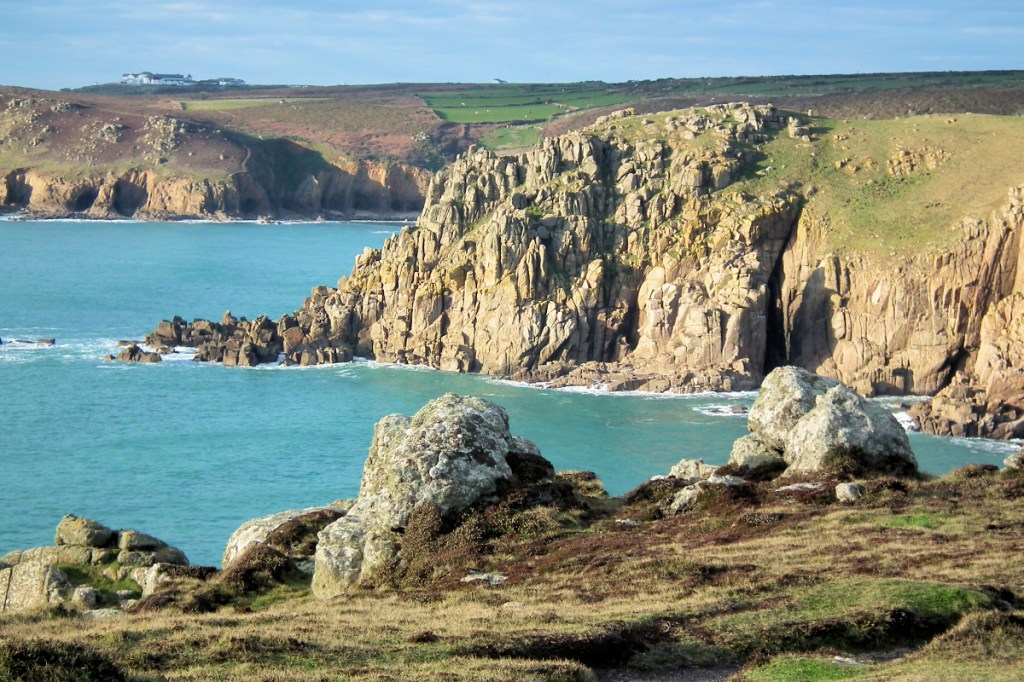
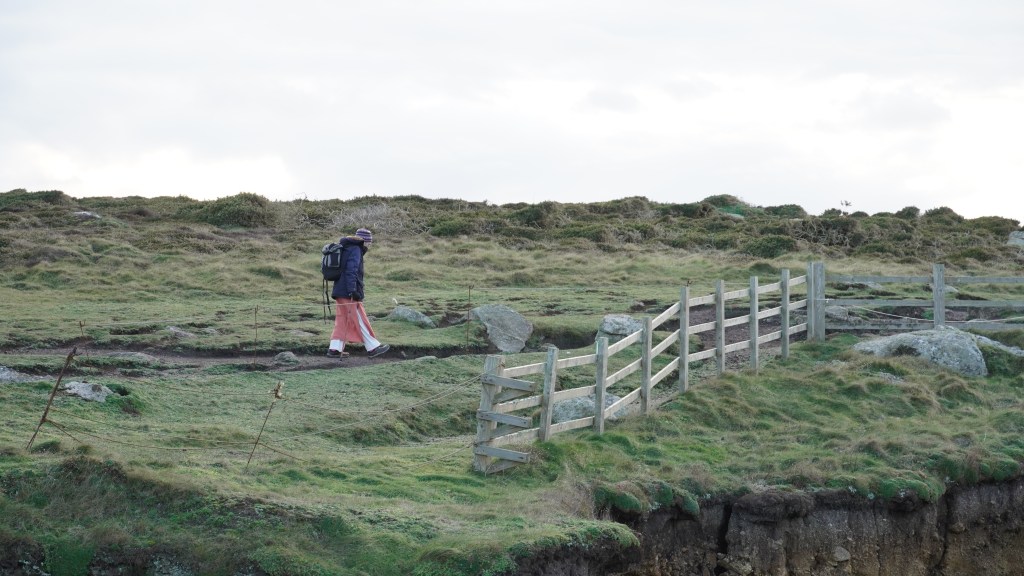
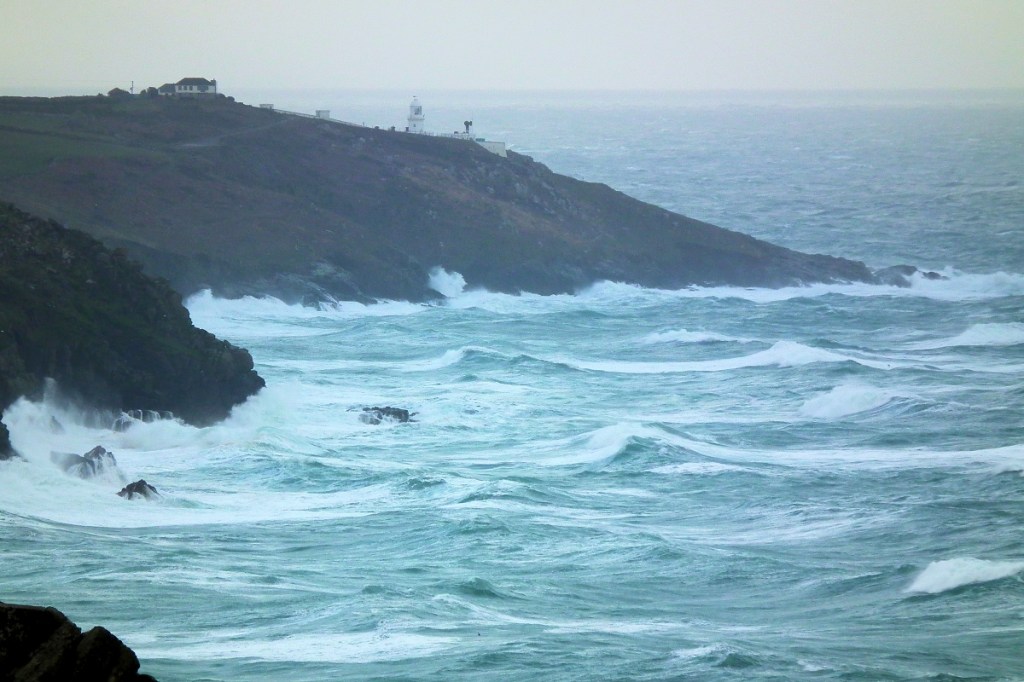
I can’t remember who gave me this pic, but thanks anyway! It is taken on the coast path from Land’s End to Pordenack Point – one of my favourite haunts.
Recently I’ve been feeling rather uninspired. Saturn and Neptune are in opposition to my natal Mercury, and I’m feeling it. Mercury is a key planet in my chart and, since the age of fourteen, for better and for worse, I’ve been a big communicator, and the struggle to clarify my ideas and make myself understood has been a key part of my growth. When I was a boy I was quiet and shy – would you believe? – and it took until my teenage years to find my voice and until age 36 to become good enough as a writer.
It’s kind of like drying up, this uninspiration. It’s a feeling that I’ve said all that I can say – and I’m not one for repeating myself. I’ve also been wondering how much people are interested – though this is often solved by spending time with someone to find out what’s going on for them.
And so I took another tack – after all I’m rather a workaholic, continually looking for new things to do to keep myself occupied. Nowadays, although I’m reasonably noisy online, I spend most of my life alone and quiet. In another world.
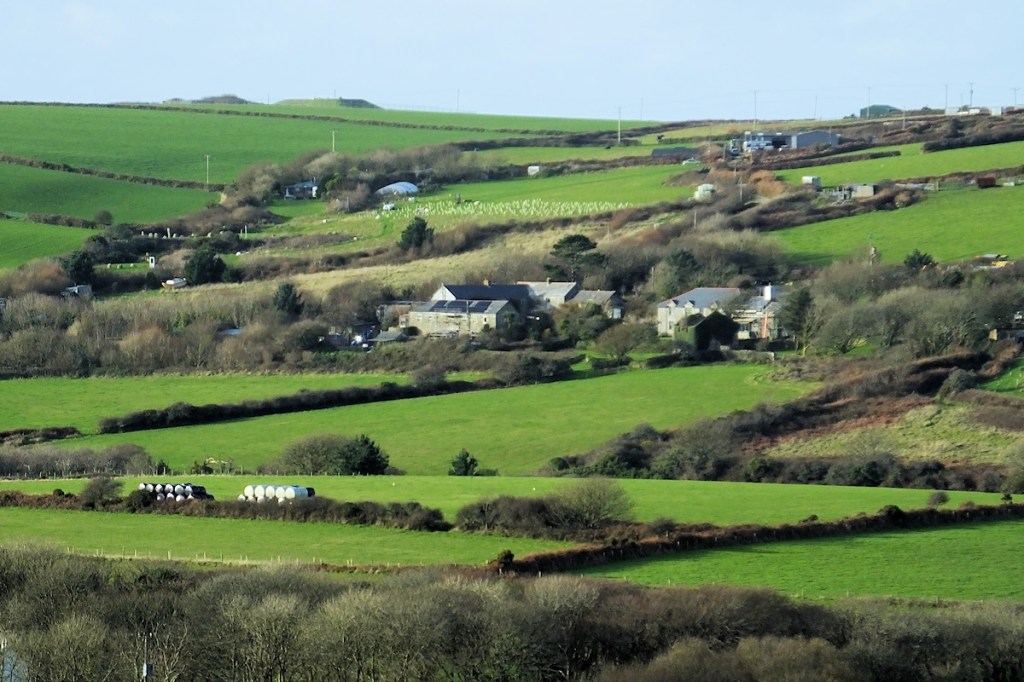
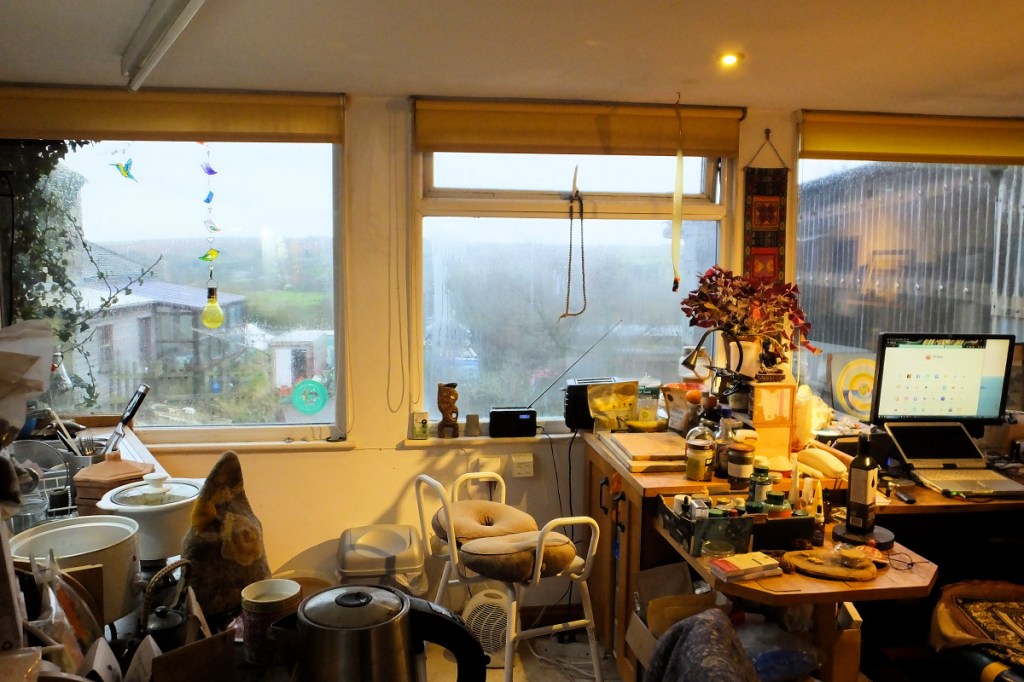
This is the farm where I live, in the far west of Cornwall
Over the last few years I’ve been turning my website into an archive. After all, it’s thirty years old now (started in 1994), and I’ve been adding bits to it every few years which, with a bit of tweaking has been gradually turned into an archive over the last two years. I don’t have money or property to leave to my descendants but, for what it’s worth, they are getting a digital estate, and I’ve often had the feeling that a few of my seven grandchildren might find some treasure there.
A while ago, I was tooling through some old radio programmes which I made twenty years ago, when I lived in Glastonbury, and they were surprisingly good. Especially since, in comparison to many of the talking-heads podcasts which are pouring out now online, the content was really rich, good, original and quite unique. This is partially because Glastonbury is a place which is a source of new ideas and initiatives, and some of the people living there are true originators in their fields.
It was not difficult to bring in old friends to provide interesting material for this programme. I called it This is the Light Programme. That’s a bit of an older generation joke: it refers to a time before about 1970 when BBC Radio had just three channels – the Home Service, the World Service and the Light Programme.
So I have been reviving many of the interviews in those programmes and creating a new section of my archive called Recycling Light – this was the Light Programme. The first few programmes will be coming out soon on the new moon, and I shall continue reworking more of them, making them ready to add to the list of Recycled Light programmes.
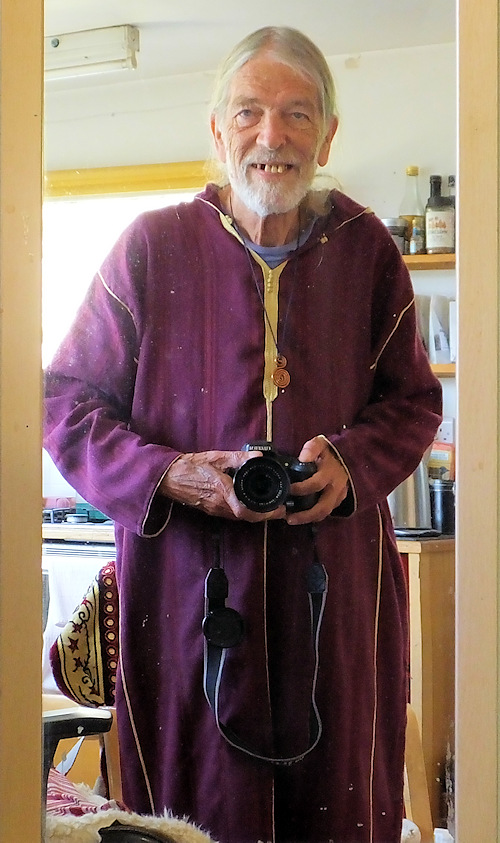
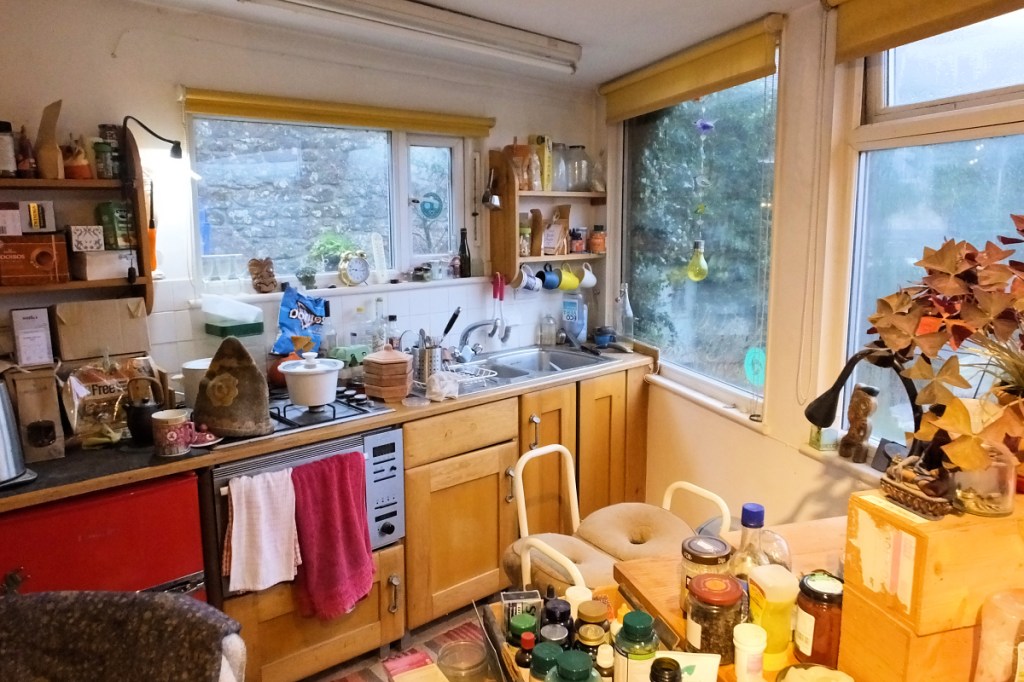
This is my kitchen
And yes, on the whole, when I post a blog or a podcast, I do it at astrologically auspicious moments – this matter of timing is more important than most people think. So this blog was uploaded with Jupiter rising, Mercury on the Midheaven and lots of planets in the tenth house. That’ll do.
I’m recycling these programmes because of the quality of the ideas coming through them. The first is the story of two Glastonbury characters who had been involved in the Middle East – one, Colette Barnard, was in Tehran at the time of the ayatollahs’ revolution in the late 1970s, and the other, Tom Clark, has been involved with funding and supporting progressive projects in the Middle East, particularly women’s and backchannel diplomacy projects. So the first programme is a really interesting interview with these two characters.
The second programme is an interview with Peter Taylor, a critical scientist, ecologist and shaman. He and I have been dialoguing for decades, cousins of the soul, sharing a political-spiritual activist approach to our respective areas of work. He used to be a scientific adviser to Greenpeace in the 1980s and also to government and United Nations bodies on ecological matters, and he is a detractor in the climate question and also one of the inventors and early advocates of the concept of rewilding, a concept which is now accepted but, thirty years ago, it was an entirely new idea and quite radical. What? Wolves? Beavers? Weeds and scrub? Well, yes.
The third programme involves two old friends who, like me, have been involved in researching alternative archaeology and prehistory. One, Sig Lonegren, is a dowser, who can find information about ancient sites which the majority of us have no access to at all. Now in his eighties, he has been a major contributor to the field of earth mysteries. The second, Bruce Garrard, has been doing a lot of thinking about the early origins of human society – particularly of the question of gender and the historic formation of gender roles. So they have interesting things to say.
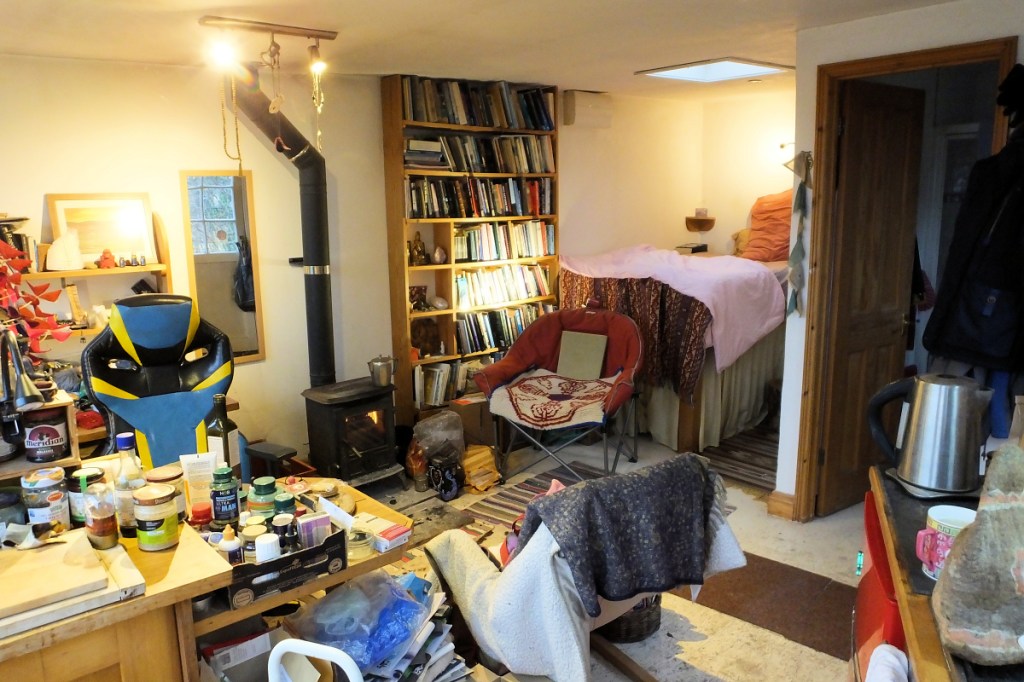
That’s where I rest and sleep. When resting I can watch the swallows, buzzards and jackdaws outside.
It was a great privilege to make that programme. It was weekly, and we did it for a year. Each programme was three hours long. Unfortunately I have had to take the music out, for rights reasons, and to rework it into a new format, but it turned out that this was a good thing to do. My son Tulki, who was then eleven years old, was the studio manager – he used to run the controls. He and I work well together. Now he’s turning thirty. Time moves on.
So in a few days time, I’m coming out with something new on my website. It’s become a really big site over the years, as I have added bits and chunks to it every couple of years. Partially it’s a manifestation of the story of my life, of being one who has advocated ideas which, in general, are right for the world, but which the world is not ready for or interested in accepting.
This has been the story of my life and that of many other people of my generation – particularly the drop-outs. We’ve had to live and work as ‘alternative types’, playing our part in society from the periphery, not from the centre.
When I was lying in a hospital bed with cancer six years ago, being eyeballed by Death and reviewing my life, I realised that I needed to leave as much as I could online, just in case it becomes relevant and useful in the future. Because the need can arise to refer back to the original people who first thought up the ideas which have become commonplace as time has gone on.
Many of the things that I’ve believed in and advocated have been roughly twenty to thirty years ahead of their mainstream adoption – or at least the beginning of it. So I’m leaving this archive in the hope that it becomes useful to someone in the future.
So when the new moon comes along I’ll be launching this new segment of my website called Recycling Light, and I hope you find it useful and interesting.
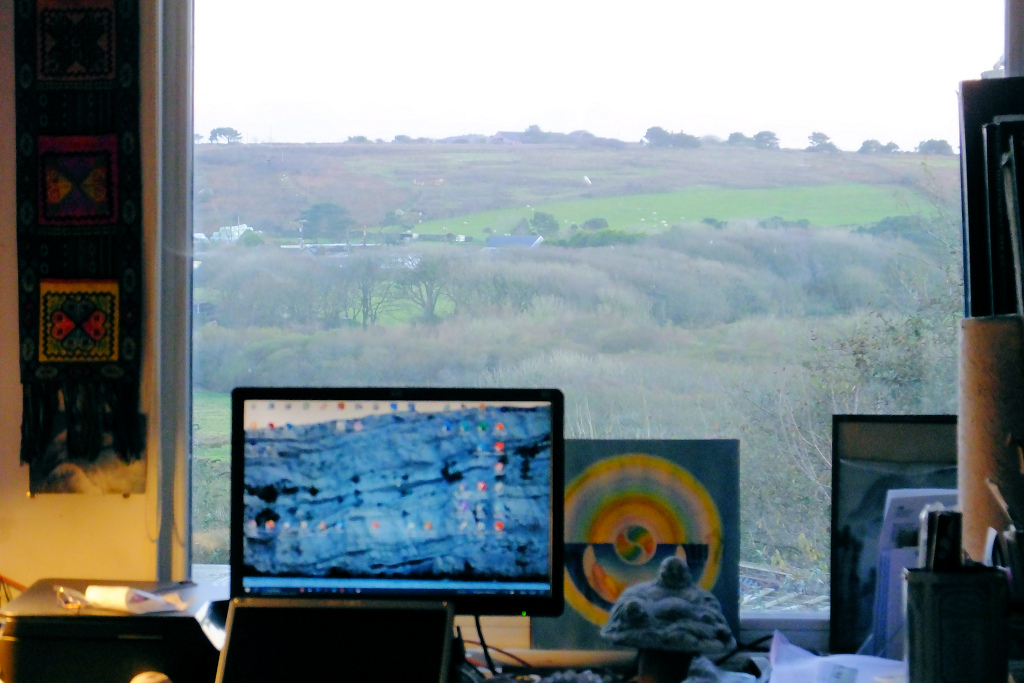
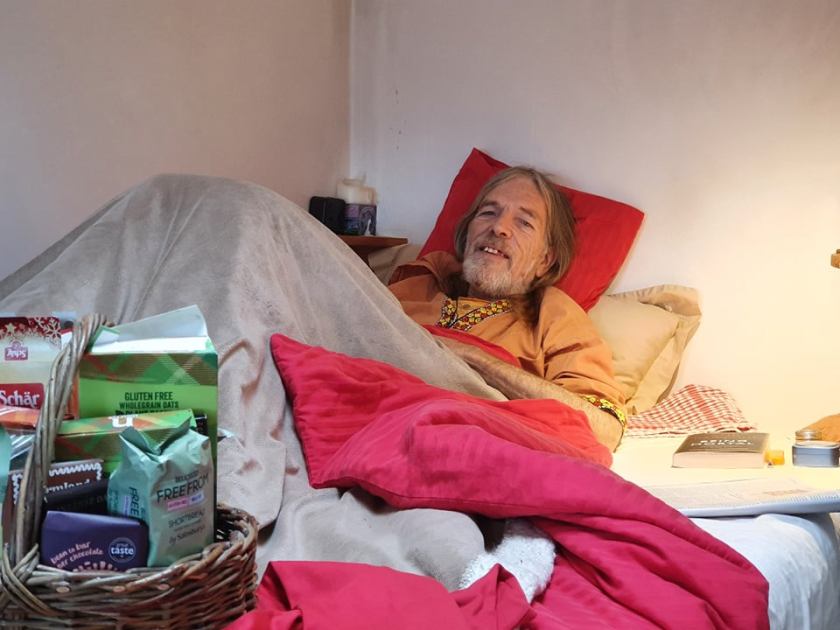
That’s the view from my bed. On that hill is an ancient site called Caer Bran – around 3,500 years ago it was the parliament site for the clans of Belerion, or West Penwith.
Now it’s time to have breakfast – before it’s lunchtime. And I have to work out what pills to take this morning. As a cancer patient I am given lots of pills, but if you adopt a holistic approach to cancer treatment, then it’s double trouble because there are loads of supplements and other therapies to take pills for too! Groan.
(Though if you follow this route, I recommend keeping the pharma drugs and the holistics separate – taking them at different times of day, with food between them – since they operate according to different principles and in some cases can conflict.)
There’s a gift in everything. A state of uninspiration has led to a state of audio-recycling.
Once I encountered a paper bag, and on the side was printed, ‘Recycled materials – do come again’. Yes indeed, if that is your path. There’s also the option of going beyond.
But that depends a lot on what we do with the life we have, and the way we played our hand of cards.
This is one of the best blogs I’ve written and it’s time to give it another spin. It’s all about dying, and prepping for it while we’re alive.
Ancient guardian at Pordenack Point, Cornwall. Busy watching.
Quite a few people have followed my outpourings because I’m a cancer patient with some deep and wide perspectives on it. I’m one of those who was told I had perhaps a year to live (and it felt like it), and here I still am, six years later.
I haven’t said much about cancer recently. Partially because I’ve said a lot already and tend not to repeat myself. However, there are recent friends and followers out there who haven’t had the full story.
I’m mulling it all over… and that’s part of the reason for relative silence on it. My cancer book ‘Blessings that Bones Bring’, available on my site, is undergoing a revision, and a new version will come out sometime – here in Cornwall we say ‘dreckly’. It needs to be shorter and more focused on what matters most to cancer patients and their helpers. Some new reflections are brewing, but my psyche moves slowly nowadays…
If you need something now, then go to my podcast page and look for the ‘Cancer and Dying’ section. To get a sense of the progression from earlier to later days, start from the bottom and work upwards. It’s here:
I have an incurable blood cancer called Multiple Myeloma – it can only be managed and held at bay, medically. It affects the bones: the first sign, in my case, was that the four bottom vertebrae in my back collapsed and, from that day on, my life changed. Rather painfully at first.
I became a partially-disabled old crock. It was a soul-shift. I’m not sure whether I went down with cancer or went up with it. But it confirmed and tested a life-lesson I had already learned, that everything in life is a gift.
Repeat: everything in life is a gift. Especially at those times when it doesn’t feel like it.
Time spent in Palestine taught me that, though cancer took it to a new level. As a peacemaker, I distinctly disbelieve in the notion of ‘fighting cancer’ – and as it happens, I’m still alive, so there might be something in it.
Cancer is not a failure or an aberration – it is a gift. It is an awakener. It presents hard facts and profound choices. This is about free will at its deepest level. Surrender. Acceptance like you’ve never accepted before.
Living with cancer is very difficult, and that’s the point. It confronts us on why we’re here and what it’s all about.
I’m in a different life now, drawing on the mixed outcomes of the life I’ve had, but it feels like a different life. Funny, that.
Anyway, I woke up with this morning with the thought to reconnect with fellow cancer-experiencers, and something is brewing, and I just wanted to say that.
If you’re struggling through the darkness, just keep going. On a soul level, during times like that we make a lot of progress.
They came. And they went. They went scorching along the south coast of Britain toward the Netherlands. The storm gods, that is. It was a right old holy hoolie, a demonstration of the Power and the Glory for everyone in Cornwall to hide away from. And we did.
It’s one of those situations where you just have to huddle down, say your prayers and wait. One of those situations where even proudly hubristic secular rationalists start saying a prayer, just in case. You have to wait until it’s over, because it’s no longer in your power to do anything much else.
The winds were resolute, firm and consistent, not blustery or tricksy – they were forceful, merciless and thoroughly unrestrained. This was what in capitalism they call a hostile take-over. No consultation, no regard for human rights, no compassion: just the energy and might of a full-on Atlantic storm, a gift of the gods to remind us how small we are and how easy it is to wipe us out and dispose of us, if Nature so chooses.
Too often, we arrogant, self-centred, comfort-addicted humans forget this. It’s not that difficult for Nature to blink or cough, sending us beetling off to Heaven in our thousands, for the angels to sort out. Well, I’m heading that way anyway, sometime soon, and if the weather gods wish to take me today, getting in there first before the cancer gods get me, then what a way to go. I won’t complain. You have to get to Heaven somehow, after all, and in this there is no choice except for timing and method.
But it was okay. The lights went off and I sat in bed, reading in candlelight a novel about the Dreyfus Affair of 1890s France – as it happens, topically, a prime example of institutional anti-Semitism if ever there was one. Then I dropped off to sleep, with 100mph winds screeching over my little cabin, The Lookout.
They were coming from the northwest, and a hill stands there behind the farm, sheltering us from the Atlantic vastness, 3,000 miles of it, and it was okay. Had the winds been coming from the south, as in some of the storms of 2014, there would have been trouble on the farm. We were okay, but across Cornwall a lot of people were not, and many trees lost their lives. I found myself wondering what small birds do in super-storms like this, like the tits, dunnets and the robin who patronise the feeder outside my door.
Anyhow, I’m a survivor, and programmed up for it. Well, much of the time. The main dangers I have faced in my life have been from humans – control-freaky Israeli soldiers, nervy Palestinian freedom fighters, gritty ISIS terrorists and crack-addled Nigerian criminals – and the force of Nature has a more comforting side to it.
It is mighty, threatening and decisive, administering justice in a remarkably even-handed way and singling out all those things you’d failed to notice or do anything about during calmer times, making them fly. But it speaks the words of The Ultimate, and no one can argue with that – even The Donald, living as he does in a hurricane corridor called Florida, the land of the flowers, who badly needs to realise that he is not God and never will be.
But human dangers are another matter, and with them you’re dealing with a different, more capricious and regrettable kind of randomness.
When I woke up there was no power or water. Jon, the farmer, was clearing up the mess in the farmyard – the roof of his woodshed had radically repositioned itself. There was no phone signal, so a neighbour had driven to where there was a signal, finding out that we might, with luck, expect power back Friday afternoon. It took until Saturday afternoon.
Well and good. Except there’s one problem. Why is it that the power always returns just at that moment when you’re beginning to enjoy the calm and the candlelight?
But I do have a woodstove, and it soon was alight. There was the light of a lovely golden dawn over the valley, exhibiting another kind of Power and Glory from that of the night before. The birds were very quiet, probably a bit groggy after a long, trying midwinter night. There was no sign of the flight of geese who pass over the farm in the morning, hooting and croaking to the Void as if sadly lamenting the insecurity and non-attachment that migrating animals have to accept. They’d probably come from Greenland, Iceland or Norway, now wondering whether they might have been better to stay there.
So I pottered around. The worst that can happen is that the food in my freezer defrosts. No bombs are falling, and no earthquake-aftershocks are to be expected. Before long a saucepan was on the woodstove, warming up for the first pot of tea. I stumbled down into the farmyard and along the track to check a neighbour – yes, she was okay and huddling in bed with her dog. I came back, making my walking-stick work hard, poured the tea and read more of my book. Then I rooted around in the cupboards and found a Tilda pack of lemon and herb rice – and that went on the stove too, with some grapes thrown in.
One of the best meals I’ve ever had was during an Israeli lockdown on the West Bank. People in the rich world, all neurotic about our loss of freedoms, complained loudly during the Covid lockdowns, but with an Israeli lockdown, well, if you go out, you risk getting shot – it’s quite simple. Israeli troops are trained to shoot first and think later. In circumstances such as this, a kind of culinary gallows humour takes over and, using what you have in the cupboards, some amazing feasts can be had.
This is partially a perceptual issue. At a Palestinian refugee quarter outside Damascus, since I was a European with some diplomatic skills, I went out to see if I could find some food for the family I was staying with. We outsiders sometimes could get to places and negotiate things that others could not – though it would depend, of course, on the mood and values of any gun-toting man you met along the way, and whether they spoke English, German, Swedish or French. My ageing, sixty-something brains were having difficulty absorbing Arabic.
I usually managed to convince them I was a decent chap. Arabs are good at reading your body-language. Anyway, it was my lucky day and I came back with a shoulder-bag of bread – including, strangely, a plastic-wrapped pack of German pumpernickel. We had a true feast – of bread, with a few old, chewy olives thrown in. And, believe me, it was a wondrous and happy feast. Palestinians are well used to this kind of thing, though they have one weak point: they go through big coffee-withdrawal problems during lockdowns and hard times.
People often ask me what I used to do in Palestine and Syria. Well, I’ve done three books and an audiobook on the matter (links below), but the short answer is, things like this. Such as finding bread for a family to eat because, in the circumstances, I had the capacity to do so. It’s a small matter, finding food, but a meal can have a big effect on people’s mood and welfare. And you get to eat something too.
So a Cornish winter hoolie, well, it takes me back to that alert, resigned, improvisational, ready-to-run state that you get into when stuck in an emergency. You’re out of control of your fate, yet strangely in control too – though it’s necessary to leave the fear until later. In a funny sort of way it brings out the best in me. Comfortably normal regularity is not my forte, as my former partners can easily testify.
My computer battery is running out and I’ve said enough. I’ve been churning out verbiage for a whole lifetime, so no more is necessary. And, as usual, I’ve forgotten my tea and it has gone cold. So I’ll put my mug on the woodstove and, lo behold, in a few minutes it’ll be warm again. What simple delight can be found in small mercies.
And, as Arabs often say, Allahu Akbar, God is Great. Life is a wondrous thing. It’s a gift that’s worth cherishing while we have it. As something of an expert in other worlds and their characteristics, I can safely inform you that the tea on Earth is the best in the whole Universe. If you don’t believe me, your turn will come to find out.
However, compensations are available in Heaven. It’s a cool place to be, so don’t worry about the tea or other such things. Other things matter there. But just make sure that, when your own time comes, you’ve had enough of the experiences of this world to have, in another sense, truly had enough of them.




You must be logged in to post a comment.