I’ve been working with a village of Tuareg for ten years, in a small people-sized support operation. They live in the Sahara desert, a day away from the historic city of Timbuktu in Mali.
We restocked their goats and camels after a terrible drought, helped them dig a new well and build a small village school.
But now I need to pull out – I can’t continue with things I used to be able to do. But I don’t want to abandon them.
So this pod tells the story, and about the dilemma of a humanitarian with a need to pass this on.
With love, Palden
Thanks to Constanze Küppers in Germany for prompting me to make this pod
I find that, as I’m growing down, I’m going into transitional phases where things change and I have to review and revise what I can do and can’t do, and all sorts of other things in between. This get tricky when the abilities I’m losing are a deep part of my identity.
So, as a writer and communicator I’ve spent bazillions of hours, days and weeks banging away on typewriter and computer keyboards. But my fingers are losing their accuracy, and I can’t do it like I used to be able to.
It’s called peripheral neuropathy in medical speak – loss of feeling and coordination in the fingers and feet. It’s a funny sensation of non-feeling where feeling ought to be, a bit like music that’s turned down too low.
I’m getting an impression my blogs are too long for some readers – they’re a 15-minute read – and they tend to stretch synapses quite a bit.
So I think I’m going to do more podcasts. Or, in some cases, both.
Here’s my last blog, about pain, as a podcast, and you can find it on Spotify, Google and Apple Podcasts, such as here:
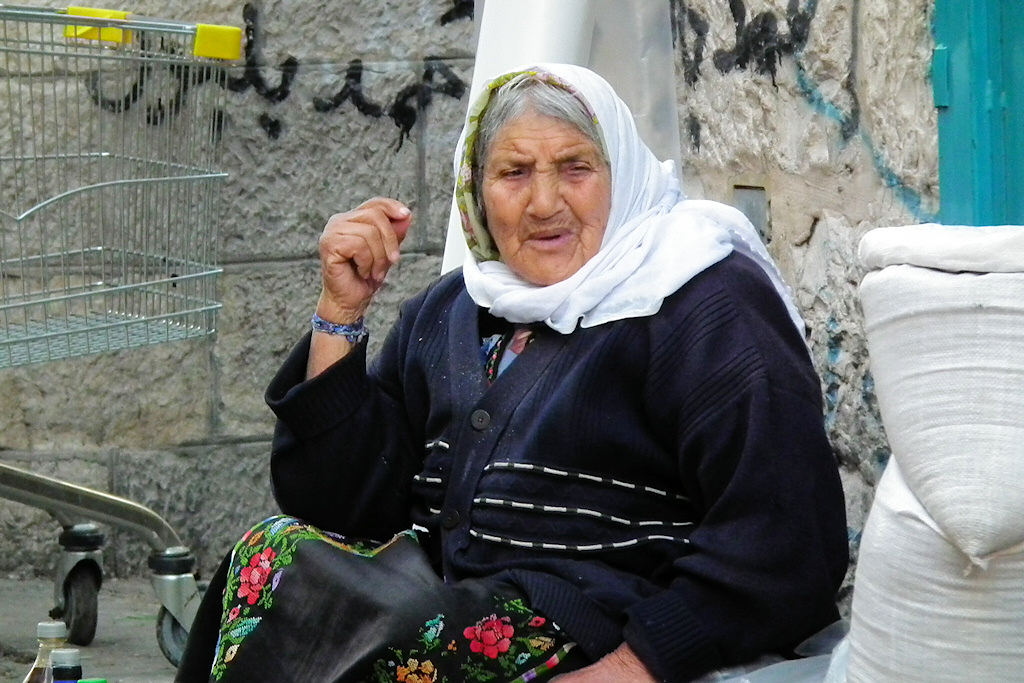
This and the pics below were taken in Bethlehem, Palestine, in Dec 2012
I was talking to a friend about our different illnesses and she said, “You must be suffering more than I”. This made me think, because suffering cannot be quantified and I can’t really say ‘I am suffering more than you’. Or at least, if I do, I’m making judgements about that person and about me that don’t really hold up. With pain, it’s really difficult being objective – it all hangs around our capacity to accept, tolerate and handle it.
Pain is partially to do with what is happening and partially to do with how we’re perceiving and experiencing it. I knew this before cancer came my way, but I’ve found since then that it is more true than I thought. I don’t instantly reach for the painkillers – avoidance of pain charges its price too. I use them only when I’m worn down, needing a break, to stop myself going into a self-fulfilling pain loop.
It’s not easy. But we do make things more difficult than they need to be. We create more friction inside ourselves than we need to have. We take difficulty and pain as negative experiences, something bad, something wrong – often according to beliefs and predispositions that aren’t very good for us.
Yet pain isn’t wrong – there’s something strangely right about it, if we can but change our perspective and suspend judgement enough to see how this might be so. Too often we compare our pain with how we feel things ought to be, how they used to be or how they could be, and this has a way of increasing the pain. Because it turns us away from facing it.
It comes down to attitude. Attitude might or might not change our circumstances or their causes, but certainly it can change how we experience and handle it all.
I’ve learned a lot from people in conflict zones, especially Palestinians, who have developed such attitude over the generations, in both the personal and the social spheres. They’ve got tragically used to dealing with hardship and they’ve developed ways and means of surviving in situations where levels of hardship and suffering are high – such as sharing what they have and looking after each other. They aren’t angels and they make mistakes, but they’re better than we at protecting and helping each other, and making the best out of a bad set of circumstances.
Many people in the comfortable countries can get really upset over issues that are relatively small, such as a power blackout, a shortage, a traffic jam, or someone not doing what they said they would do. Tolerance levels are low, tight and sharp-edged. We have an unhelpful sense of entitlement to a problem-free life. So when the shit hits the fan we catastrophise it, mishandling it and often creating more problems than were needed.
In all of life’s situations there is a degree of choice, either to make a big deal over something or to square with it, accept it and do the best we can. The choice lies around the friction we put up. It’s an honesty process, and with pain we’re forced to face stuff we don’t like facing.
Spiritually, a key issue is this: we come to Earth to learn, get experience, go through it, learn from it and hone the soul. Because at the end of life, all you take with you is what you have become as a result of having lived a life. Pain is an intense kind of experience that has a way of grinding at us, drilling holes in us, attempting a takeover of our psyche and giving us a truth-and-reality experience.
It’s the price we pay for the pleasure of being in a body and the experiential access that it gives us to the wonders of the world. Without a body we cannot stuff chocolate, have orgasms, go on holiday or bliss out in a field of bluebells. Pleasure and pain, whether emotional or physical, are two ends of the same experiential spectrum, and you don’t get one without the other.
I had a remarkable experience six years ago when first stricken with cancer – a blood cancer called Multiple Myeloma, which erodes the bones and creates all sorts of trouble and pain. Since then I’ve had treatment, though there is no remission from Myeloma, and am now on a maintenance regime of medication, supplements and working on myself. I’m surprised to be alive, actually, though clearly there are reasons to be here.
The cancer came on quickly over a few months and I deteriorated rapidly. At times I was in extreme, 150% pain, immobilised, helpless, rendered into a wreck of a man, at death’s door. One day the pain was so intense that I couldn’t even raise my head from the pillow to drink – moving a millimetre made my bones grind and grate. But I had to drink anyway and tried moving.
The pain was so overwhelming that something in me popped out of my body and I saw myself from above – as a soul having an experience on Earth, lying there, all crippled and useless. There was something strangely comical about this. Something in me could see the poignant humour in it – here I was, suffering, more than I had ever experienced, and it was bizarre. I started chuckling. It really hurt to laugh. My then partner, looking on, thought I was losing my marbles.
The funny thing was that my experience of pain suddenly changed. It seemed to become more distant. I became more at peace with it. I was able to face it and accept it, from more of a distance – it was simply a fact, a situation. Something profound had shifted in the space of several minutes.
Over the next few weeks it decreased further and within a couple of months my pain levels were around 30%. Also, my boundaries had shifted. Previously, I could handle 20% pain without it getting to me too much, but afterwards I could handle 40-50% – my pain threshold had moved and it has stayed there since.
Over the last six years I’ve hovered around 10%, with a permanent, steady and stiff ache. I hardly notice it, having become used to it. Most of the time I accept it – except perhaps in the late afternoon when Sir Isaac Newton seems to switch up the Law of Gravity. But there are times when I do notice the pain and it gets to me, deep down – especially in winter. Usually these are times when my spirits are low and I’m feeling worn out with life.
So there’s something here about being spirit-propped. The pain, disability and precarity of a cancer patient have somehow thinned the membrane between me and spirit – a membrane that I used to try so hard to cross, while now it comes more naturally. There’s something to this about the perspective of experiencing life as a soul in a body, visiting Earth.
Pain hits us all, in all sorts of ways and degrees, and at various times. It can go deep, and we each have our crosses to bear.
For example, throughout my adult life I’ve experienced ‘political pain’ – the pain of being misunderstood and misjudged in public, and paying a high price for it (as a dissident and an Aspie-Autistic). It has impacted me immensely. It’s the pain of being wronged in the social and political sphere – sometimes by evolving facts and sometimes by the wrongdoings and micro-harms of others, or by the madnesses of crowds. Even so, this pain forced me to come to terms with the reality of it, to understand what was going on underneath and to forgive the people involved, and to understand and forgive myself too – and in late life, forgiveness has been a gift to the soul and a lightening of a burden.
The world’s pain levels are escalating in the 2020s, partially because so many souls are alive today having a human experience, and partially because life is getting tougher for everyone, everywhere. Outrageously tough situations such as we have seen recently in Gaza are just the tip of a very big iceberg.
And here’s the rub: no one is exempt. Hence, a generous and charitable attitude toward others in need is wise since the tables can turn. We might one day be glad to receive others’ help.
It’s our choice as to whether or not the future is going to bring hard times. We can make a big deal about things ‘going wrong’, or we can accept things and get on with it. In the end, many problems are not as big as we think they are. What might to one person be a disastrous crisis, to another person is just another boring night of bombing.
We create sufferings simply by complaining, being angry, feeling hurt, self-victimisation, or by doing things which are not the wisest. So the level of actual hardship and difficulty we face is a different matter to the way we handle it, and in the latter lies our choice.
Even so, for some on our planet, life is really hard and, in the short term, they don’t have many options – if, that is, they survive. This is not ‘their karma’: this is the world’s collective karma spilling over onto them.
One of the things I’ve noticed in my peacemaking work is that many of the peoples most beset by longterm war – Bosnia, Ireland, Afghanistan, Vietnam, Lebanon, Sudan, Palestine – can be the nicest people around, and it does not seem fair that such ‘karma’ should fall on them. The people most affected by climate change are mostly not the ones who created it, and the world’s poor are losers in a system steered by others. But even they are faced with occasions when choice becomes available.
If we follow a deeper path through life, over time it changes our emotional responses, perspective and priorities. We don’t need to consume as much, we don’t need to ricochet through life, we don’t need to deny ourselves tender moments with loved ones, and we don’t need to create as much waste and damage as we do.
Because something changes inside. It’s a slowly-distilling sense of basic trust, a simple knowing that, somehow, things are going to work out. Especially if we allow it. The issue isn’t about being perfect – it’s about learning from life’s lessons and making good outcomes out of difficult situations.
So this matter of hardship and suffering depends so much on where we’re looking from. While I have a blood cancer, I’m partially disabled and life is difficult, it doesn’t mean I’m sitting here suffering all the time. Though I must admit there are times when I do.
Sometimes, in down times my spirits seem lost in a fog of fatigue, but even then it’s a matter of being patient and letting it be. I can struggle against it, feeling as if I ought to be doing this or I wish I could do that, when in fact it’s okay to take it as it comes, to flop down in a dull state and let it be. I tend then to revive more easily next day. It’s just that I’ve have been given yet another cameo experience of being on planet Earth.
Since it’s crap weather (here in Cornwall, at least), and winter seems to be coming on early (here in Cornwall, at least), you might like some vitamins for the ears (wherever you are, and however things are).
I’ve assembled my four audiobooks in one place, here…
Good for when you’re stuck in a traffic jam, stuck in bed, stuck in the kitchen or stuck on a train, or if you’re fed up with the radio, or simply if you’d like something interesting to listen to!
One reason I’m not writing as much nowadays about the Sunday meditation, or doing written blogs, is that my physical capacity to write is slowly diminishing. It’s all about fingers on the keyboard, and brains. This is the way of things. Yet there is cause for gratitude.
A few days ago it was six years since my life suddenly changed, one afternoon in 2019 while doing gardening. Four of the bottom vertebrae of my back collapsed and, since then, I’ve been partially disabled and also much aged. At first it seemed I had a bad back problem – the pain was total – but after three months I was diagnosed with a blood cancer, Multiple Myeloma, and it looked and felt as if I had a year or two to live.
I’m still here.
“Mr Jenkins, I don’t know what you’re doing but, whatever you’re doing, do carry on.” So said the haematologist in charge of my case, not long ago. The pharmaceuticals and the holistics I’ve been on since then have definitely saved me, but there are two extra things that I believe have made the crucial difference, beyond the medications, supplements and therapies.
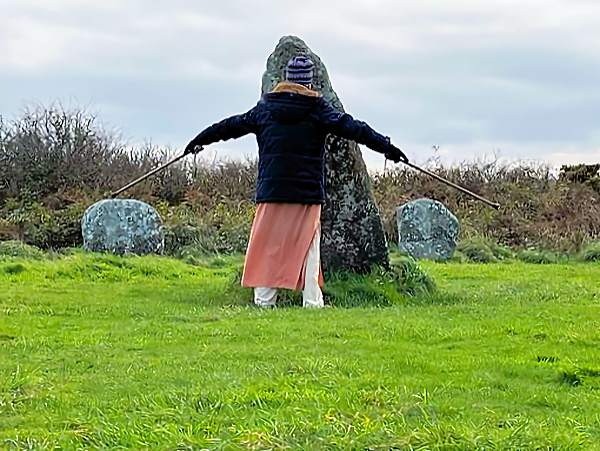
Hella Point, Tol Pedn Penwith
The key one concerns being ‘spirit-propped‘ – that’s what it feels like. Being held up by spirit. And doing things to make it so, to prioritise spirit. Of which the Sunday meditation is one. There are times when my spirits flag, I droop terribly, and my body is half-dead, but I bounce back after surrendering, handing myself over to soul and spirit. In a recent podcast I told about the ‘inner doctors‘ I work with – they have helped tremendously. And spirit and attitude keep me going, even through the worst times.
But there’s another one too, which is related: having a mission. I’m a relentlessly mission-driven person and, once I had adjusted to living with cancer, the prospect of having a short life ahead activated something in me: a deep wish to bring my life’s work to some sort of conclusion and to hand it on for others to do something with. After all, all of a sudden I had a lot of available time, and I’ve been on my own a lot too. I was given the space to do it.
So I’ve been doing some remote humanitarian work, and writing and podcasting, and completing my geomancy research, and building an archive of former work on my website. Currently I’m working on an audiobook version of Shining Land, about earth-energy, geomancy and the ancient sites of West Penwith, where I live. That’ll be ready soon.
I have no idea what happens after that, and my strength and abilities are declining, and winter is coming on. Spirit has clearly told me to do only things I am asked to do, and not to push myself. Okay, yes.
But there’s one thing I’ll continue to the very end, which has helped greatly thus far – the Sunday meditation. I hope it has been good for those of you who have joined in over time. I know that my friends upstairs – the Nine – are happy with people they’ve met, and in some cases re-met, in the meditation. And if anyone chooses to continue with it after I’ve gone, the channel will still be open, and there will be times when you’ll sense me there with you.
Because it helps. It helps raise our planet, inch by inch. It helps with the resolution and healing of many things – even during times when it feels like everything in the world is going backwards. Your thoughts and prayers help the oppressed, and they help transform and turn around the great destruction and the great delusion.
If you’re wondering what this Sunday meditation is, check out this page and, if you’d like to join in, you’re welcome:
It’s dead simple. Just sit with us for half an hour, wherever and whoever you are. There’s no prescribed method or mantra, no sign-up and you don’t need to be online: just do meditation in your own way, however you do it, being in the zone with us. The times are below, for different countries. Come with us to the wordless world, the world beyond and within all things. It drips with sparkly diamonds of light.
Current meditation times, on Sundays: UK, Ireland & Portugal 8-8.30pm West Europe 9-9.30pm East Europe, Turkiye and the Levant 10-10.30pm Brazil-Argentina 4-4.30pm CST, Mexico, Jamaica, Colombia 2-2.30pm EST, Cuba 3-3.30pm PST North America 12noon-12.30pm
Life has been quite a grind and a test recently. Living as a partially disabled cancer patient makes wading through life twice as difficult, and sometimes I get deeply weary with it. That’s been happening recently.
But there’s a weird psychological program in me that has meant that some of the best work I’ve ever done has been done during such periods, when my Saturnine tough-it-out programming gets activated by life and its grinding difficulties. I tend to tough it out by engaging myself in doing something. A project.
It’s an Aspie hyperfocus thing: if you can’t change your circumstances, change your mood by doing something creative and ultimately useful – even if it yields no immediate benefits. That’s how the program goes – for me, at least. Except there is one big benefit: it changes my mood. And, bit by bit, that can change everything.
That’s how, somehow, over the last forty years, I’ve managed to write fifteen or so books on quite a variety of subjects. Many were written amidst difficult circumstances, or arising out of them. The gratifying thing is that I still agree with pretty much everything I’ve written – or spoken about, broadcast or taught. I have few regrets about it. Which is quite remarkable, really.
Just recently I’ve been at it again. I had a crisis a month ago where I felt uninspired, feeling that I’d said everything I needed to say, and were people interested anyway? Well, as such crises do, it represented a deeper fermentation process going on in the nether recesses of my psyche, and an inner repositioning was going on, unbeknownst to me. I started looking at ‘outstanding issues’ and ‘unfinished bits’ in what I have done. After all, as a disabled oldie who spends more time alone than I would prefer, I do have lots of time.
Just yesterday, my friend Brian Charlton was here. He’s another Glastonbury defector now living in West Penwith – there’s a little secret cabal of us, actually. He lives the other side of St Just, our local village, and he is part a local support group, the ‘Friends of Palden’, that is a blessing in my life. He was on his weekly visit, and benignly badgering me about these unfinished bits. Very perceptive. I realised he was right. I needed to beaver away at clarifying and finalising the signals I’ve been putting out, and there are unfinished bits, and bits yet to evolve further, if life allows.
But there was more: I realised was already instinctively doing it, though I hadn’t realised it until then. It had started with two podcasts, both of which came up spontaneously, about Inner Doctors and Intuition. That got me flowing again, unblocking the logjam that had scrangled up my psyche. That’s one secret that many creators need to understand: if you get blocked up, do something, anything, to get yourself unblocked. And it’s best to forget what you think you ought to be doing, and to be spontaneous and creative instead – because that’s where the taproot of creativity lies.
Then suddenly I found myself starting doing a revision of one of my books, Shining Land, about the ancient sites of West Penwith. Well, there were some typos, readability issues and tweaks to attend to. So I thought. But as things progressed, I realised that new work I have done in the last few years, since I wrote the book, needed adding. I’d gained some new perspectives too, blessed as I am with lots of thinking time.
Most of the book has just needed tweaks and small improvements, but the chapter on Hill Camps has had a rewrite, adding my thoughts on Bronze Age circular enclosures such as Caer Brân, built around the 1800s BCE for tribal gatherings, and their significance. Also, I’ve added new material to the final part of the book, about Megalithic Geoengineering, breaking the last chapter into two and adding new work to both, about landscape temples, wildwood cover in the Bronze Age and ancient trackways in Penwith. And there are some new maps and pictures. I’ve worked on the indexing too (it’s rather tedious).
But here’s the rub. I can’t write books any more. My brains can’t do it. I can do blogs, podcasts and small projects, because they are done and dusted in a day or two. But books? No, they’re big projects. Even so, I can revise books I’ve written before, and the great virtue of revising a book is that the big thinking has already been done. So I can focus on style, details, text-flow, images, maps and new ideas. I can make it a better read.
I discovered this ten years ago when revising an astrology book first published in 1987, Living in Time. It was a good book but it had dated, with out-of-date examples in it from the 1960s to the 1980s. It also needed another spin, since times had changed and many more people were aware of what the book writes about. This is how Google’s AI assesses it:
“Power Points in Time is the title of a book by Palden Jenkins that explores the concept of time and its influence on various aspects of life, drawing on astrology and other cyclical patterns. It examines how understanding these patterns can provide insights into events, decisions, and even the meaning of life. The book uses examples like lunar phases, planetary alignments, and ancient festivals to illustrate how time can be understood as more than just a linear progression.“
Actually, that’s a pretty good summary. That’s the first time I’ve used AI in any of my writings, and it’s likely to be one of the last, since I am decidedly AI-free and Patreon-free in my outpourings. And, for better or worse, I prioritise eyeballs and ideas over monetisation too.
Gurnard’s Head
So I revised Living in Time and it came out in 2015 as Power Points in Time. I really enjoyed doing that revision, precisely because the big thinking had been done, so I could focus on other things. But there was another matter too: in 1987 I had pitched the book to people interested in astrology, though later I found that it was most popular with people interested in ancient sites – a different circle of readers. Meanwhile, over the quarter century that followed, I had developed a clearer idea of the combined importance of power points in space (ancient sites) and power points in time (peak periods). So I re-pitched the book toward this ‘power points’ idea.
Then a few years passed, and a big change came to my life – getting cancer and becoming disabled – and, reviewing my life, I realised I hadn’t written a book about ancient sites, even though, on and off, I had studied the matter for fifty years and had done a lot of research in Cornwall for ten years. So along came Shining Land – the ancient sites of West Penwith and what they say about megalithic civilisation. My core proposition was that ancient sites were built for conducting shamanic consciousness work, and that the 600ish ancient sites of West Penwith actually constituted one big, integrated ancient site.
By making a ‘landscape temple’ out of the whole cliff-bound Penwith peninsula, it was possible to raise this consciousness work to a higher level, to benefit not only the local area and its people but the whole planet. The planet is one being, that we have come to know as Gaia, and if the ancients got themselves into enough of an elevated state to do so, they could commune with Gaia, adding a human touch to her work as a planet-being.
They were practicing what I’ve come to call Megalithic Geoengineering. Big stuff. Planetary stuff. And, of course, there’s something to learn from this today.
Lesingey Round
So, you see, in health and life circumstances I have been labouring somewhat, though in other respects I’ve been quietly chiselling away at generating uplift and raising my spirits by doing those things that I can do, and being creative with it. It fires up my circuitry. Meanwhile I’m de-focusing on those things I can’t do and can’t have – things that weigh me down. As a result, a new, 2025 version of Shining Land will come out shortly as an online book. So there are results to this. Results germinated out of a time of hardship.
Two things happened to help turn things around. One was the spontaneous eruption of the ‘Inner Doctors’ podcast, which revived my creative spirits, and the other was a session with a homoeopath, my neighbour Anna Jenkins (no relation – we Jenkinses are a big Welsh clan). I think the remedies she prescribed have dislodged some fixities and rigidities within me. Well, to be honest, I cannot tell yet, because the last week has been low, lonely and dark and I cannot tell whether my cancer and demise are getting worse or whether this is what homoeopaths call a ‘healing crisis’. But I think I’ll opt for the latter.
It has more hope in it. And hope and belief are motivators. Not as an imposition on evolving reality, but as a way of intersecting fruitfully with it. Hopefully.
Changing the way we see things: inside every problem lies a solution, as long as we allow ourselves to see it.
Sometimes I struggle with that. So, in case you thought you were the only one in this vast universe who struggles with it, think again, for you are not alone.
When cancer came into my life nearly six years ago, I found myself adapting some inner visualisation techniques I had learned earlier in life to my new situation. It was a spontaneous thing and a way of dealing with my situation.
I met a group of ‘inner doctors’, engaging in dialogue with them and allowing them to examine me and work on me. The amazing thing is that, in my experience, it has really worked.
So this podcast is about the inner doctors. It’s for people with life-changing or terminal ailments or disabilities, or their helpers, friends or families. But it could be useful to anyone, if only for future reference – after all, especially as you grow older, all sorts of things can happen. They did to me.
I’ve been greatly helped by the inner doctors. They even seem to have helped my outer doctors in hospital, as they treat me. So this might interest you and prove useful.
Though you do need to believe.
Note: in the podcast, at times I did not distinguish sufficiently between inner and outer doctors! Sorry for the confusion.
So here am I, a lifelong author and communicator, and I’ve been sitting here in recent weeks with nothing much to say. That’s unusual. It isn’t ‘writer’s block’: it’s a funny feeling of little to say. In my birth chart, Neptune and Saturn are opposing Mercury right now, so I guess this blog is expressing the essence of what that double transit is bringing.
I’m one of those authors who, if I have little that is meaningful to say, I don’t just rattle off material just to fill space, stay regular, fulfil expectations or contractual requirements. I go quiet instead. The best of my writing has always come when there’s a need. I wake up with it, and out it comes.
In life this has given rather uncanny gift which has been both a blessing and a bane: a strange capacity to articulate ideas and perspectives that other people were about to get, but they hadn’t got there yet. As if speaking to people from the future, pointing to how it’s going to be. Or might be. Or could be.
I haven’t always got this right, though there have been times I’ve got things very right. Sometimes I’ve perceived a possible reality that just didn’t happen that way, or I underestimated the influence of obstructors, or got my facts wrong, or suffered wishful thinking or over-optimism, or simply mis-estimated things.
Yet at times I’ve hit the nail right on the head, and it has sparked outcomes or affected people and situations far more than anticipated – sometimes going into the magical-miracle zone. Cosmic catalysis.
It’s a question of whether the benefits from things I got right have outweighed the misfires and problematicals. It feels as if this question is on the weighing scales at present. And, perhaps to prove the point, recently I’ve had little to say. It’s a pause for rumination. Or perhaps a reality-flip is going on. Or a reassessment.
A winding lane in Grumbla, Cornwall
My ongoing cancer saga continues. A new symptom has appeared in recent months: I’m losing the use of my legs. That’s what it feels like, though diagnosis is yet to come, following an imminent MRI scan of my pelvis and a diagnosis in the coming week. My legs are exhausted after a hundred yards, as if I’d just hiked forty miles. Even when just standing still, they turn to rubber, as if they’re about to give way.
It varies on whether it’s an Up day or a Down day. Down days have increased, when I have little energy, drive or inspiration. So something is going on.
It reminds me of six years ago when no distinct symptoms of cancer had yet appeared, but something wasn’t right. It wasn’t possible to put a finger on anything until my back suddenly gave way in August 2019. This was the first concrete symptom of a rapidly developing blood cancer, Multiple Myeloma. It’s ‘multiple’ because it has a range of disparate effects that vary greatly from person to person. This makes it difficult to diagnose.
So it took twelve long weeks to progress from a back-breakage to a cancer diagnosis, though this process was helped by a series of three inspired acts of intuition by, in succession, a cranial osteopath, a GP and a hospital specialist. Bless them all.
I can’t put my finger on what’s happening now, but something is happening. Astrologically, it concerns Mercury, and I’m a Mercurial person (a Virgo with a Gemini Moon). This feels neurological. There’s that ‘nothing to say’ syndrome too. And there’s more.
Rock art, Morvah, Penwith
It concerns ‘growing down’ – losing our powers. This demands a lot of acceptance – getting used to the fact that something is ending. Really ending. In the past I’ve been a cross-country runner and mountaineer, and I find loss of leg-power to be confronting.
Also, as an author, many people are retreating from their phones and social media habits and, thus, many of my readers are simply disappearing. The default answer is to spread into new online media and engage in networking and marketisation strategies. I’m getting loads of e-mails from online promoters who want to marketise my podcasts.
I’d love to reach more of the kinds of people who might benefit from my blogs and podcasts, but I’m not interested in all that promo stuff. My abilities are waning and I can’t manage the work that’s involved. I’m not seeking to set up a business or build my career. This lifelong content creator is sharing his end-of-life process, that’s all.
By nature I am, or was, an integrity-marketer, studiously avoiding falsities, glamours, competitiveness and deceptions in my approach. I used to be a whizzo at this, but not now – my time was 20-40 years ago. Nowadays, online media are changing so much – I can’t keep up, and get my head around all the details. Meanwhile, digital costs and charges are rising, and this obliges monetisation. I can’t do this any more, I don’t have what it takes to crank up a business and I don’t want to leave too many complexities for my son to sort out when I pop my clogs.
So where this goes is anyone’s guess. Anything that increases my workload or demands feats of memory and micro-management will simply not work. Anything I do needs to serve my health and wellbeing without weighing me down, and I’m already going at the maximum pace I can handle. So there’s a dilemma here.
Fresh sets of eyes peer out on the great wide world. In a few weeks they will fly thousands of miles.
Anyway, there’s something to learn from all this. It’s a matter of looking at what’s underneath. It’s about acceptance of What Is. It’s a reduction of options. This happens to those of us who experience a gradual, stepwise end-of-life decline instead of a sudden, drastic one – things narrow and shut down, bit by bit. It’s simply a matter of doing our best with what is, and what we’re capable of doing – there’s little or no option. It can be difficult and rather final, though there’s a joy and fulfilment in it too, if we choose to see the gift in it.
Earlier in my cancer saga I used to measure my condition in terms of perceived age. My physical age is currently 74, and normally I hover around 80-85 in perceived age, but in the last few days I’ve felt like 95 – energyless, wan, off-balance, needing someone to hold my hand, and wondering whether the latest rewrite of my will makes sense.
Yet I’m also transported into the eternal present, propped up in bed, hearing the singing of birds in a crisp, microsecond, sonorous, meaning-rich way, as if they’re teaching me something. Which they are.
They’re teaching me a very special something. A something that words cannot truly encompass because words reduce it. It’s a silence between each frame of life’s movie. A moment of seeing, a shifting of optic, a moment of existential tranquillity. It’s very quiet. It’s momentary yet vast. A glimpse of the Void. A taste of the Silence. A Neptunian slippage of consciousness into a temporary eternity.
So perhaps having little to say has its virtues. After all, I’ve managed to say something about it, so something must be happening right! It just goes to show, there is indeed a gift in everything.
This is mainly for my generational peers – if you’re in your 70s, 80s or 90s, your bones are getting creaky and your mind is getting sluggish.
In the life-cycle we’re given, we grow up and later we grow down. In steps.
It’s also about karma-clearance. Sorting out our stuff at the end of life, so that we don’t carry all of it with us when we go over to the other side – to the realm of the Ancestors.
I’ve been involved in humanitarian work, and recently I’ve needed to work on my patterns around givingness and compassion fatigue. Commitment. Success and failure in helping people. Deep heart stuff.
And it’s about acceptance. That’s one of the biggest learning experiences life ever gives us.
47 mins long. Introduced and outroduced by the birds of Grumbla in the Far Beyond, down’ere in Cornwall.
It’s the Sunday meditation again, and I have revived sufficiently from an illness that floored me last week to be able to elbow you about it! That is, you’re welcome to join us in the zone – times for different countries are below. It’s an open meditation space lasting half an hour. To quote Van Morrison: no guru, no teacher, no method – just you and me in the garden… Follow your own path, together with us following ours. We shall be blessed.
The illness was a fluey thing. My energy was low, and I’d been pushing hard and under pressure in my remote humanitarian work. So when I got cold and wet during a trip to Falmouth, my soul pulled the plug and I went down through it. Next day I was semi-conscious, stiff and hurting, with sluggish brains, wobbly balance, burning feet (peripheral neuropathy) and I was right out of it, gone, hardly here.
A pertinent sign at Gurnard’s Head, in West Penwith
My predominant emotion was grief, over things that have happened, and particularly over moral dilemmas and painful moments in my humanitarian work over the years. I’ve seen people face hardship, suffer and die who, in my estimation, should not have died, and at times I’ve been unable to help – often quite simply I did not have the funds needed for medical treatment for an amputation or to save a life.
This is a deep dilemma being faced by many humanitarians now, as governments blithely withdraw funding and the public shrugs its shoulders. For me, in late life, it has left traces of regret, even though I know that the net value of my work was positive overall, and there’s a lot I’m glad about.
But the illness enabled me to go deep, deep down to a place where the hidden roots of life’s experiences and events ferment and bubble. This is one of the big virtues of illness that many people try their best to avoid – the consciousness changes it can bring about. Sometimes our soul needs to cut us down and render us helpless, to help us work through something – burn through something. Whether or not we actually do this is a life-choice and an exercise of profound free will.
Seals asleep at Godrevy
It is an act of free will to choose to go through a turning in the deepest seat of consciousness. You have to go over the edge and take the plunge. Getting into the habit of doing this throughout our lives sets us up for one of life’s greatest and most moving of experiences – dying.
As you approach death, life tends to take you down in stages – a series of crunch moments or crises where your worldly powers and agency are reduced, your world shrinks, and you bodily functions deteriorate. This incremental withdrawal yields the possibility of a new seeing, a new understanding, if we so choose it. Though it involves perceiving truths that can at first be uncomfortable. Yet facing and accepting these revealings becomes a relief too, an understanding, a forgiveness. For this life had simply been a short visit on an ongoing pathway. It begins and it ends.
Sir George, looking straight at you
Back in the 1990s I was privileged to help and spend quality time with Sir George Trevelyan, who was in effect the grandfather of the New Age movement in Britain. Very much a man of the Twentieth Century, born in 1906 and dying in 1996, he was an aristocratic philanthropist, thinker and educator, planting the seeds of the new age and the green movement in the 1940s-70s. He was a four-planet Scorpio. At the very end, he died by decision, announcing that he should not be disturbed or given any food or drinks. He was gone in 4-5 days.
Here’s a video of him talking in 1988, in his eighties. Thank you, Sir George, for being you, for what you did with and for so many people, and for pointing the way in my life too.
Meanwhile, if you care to join today’s meditation… see you there!
Love, Palden
Current meditation times, on Sundays: UK, Ireland & Portugal 8-8.30pm GMT W Europe 9-9.30pm E Europe, Turkiye and the Levant 10-10.30pm Brazil-Argentina 4-4.30pm CST, Mexico, Jamaica, Colombia 2-2.30pm EST, Cuba 3-3.30pm PST North America 12-12.30am
You must be logged in to post a comment.