Recently I’ve been struggling to complete my customary long-form blogs. My brainz have been rather battered by cancer and the pharma-drugs I’ve been taking to deal with it. But they have kept me alive for seven years now (to my surprise). Typing on a keyboard is getting difficult too.
The consequence is that I’ve been losing track of my message after two-three paragraphs. This vexed me and I ground my stuff over it for a while. Then I remembered…
To quote I Ching: The Creative works through the easy and The Receptive works through the simple.
So, from now on, it looks like I’m going to be doing shorts. I think my soul-brother Alan will like that – he’s been elbowing me about writing shorter blogs for a good while now!
Love, Palden
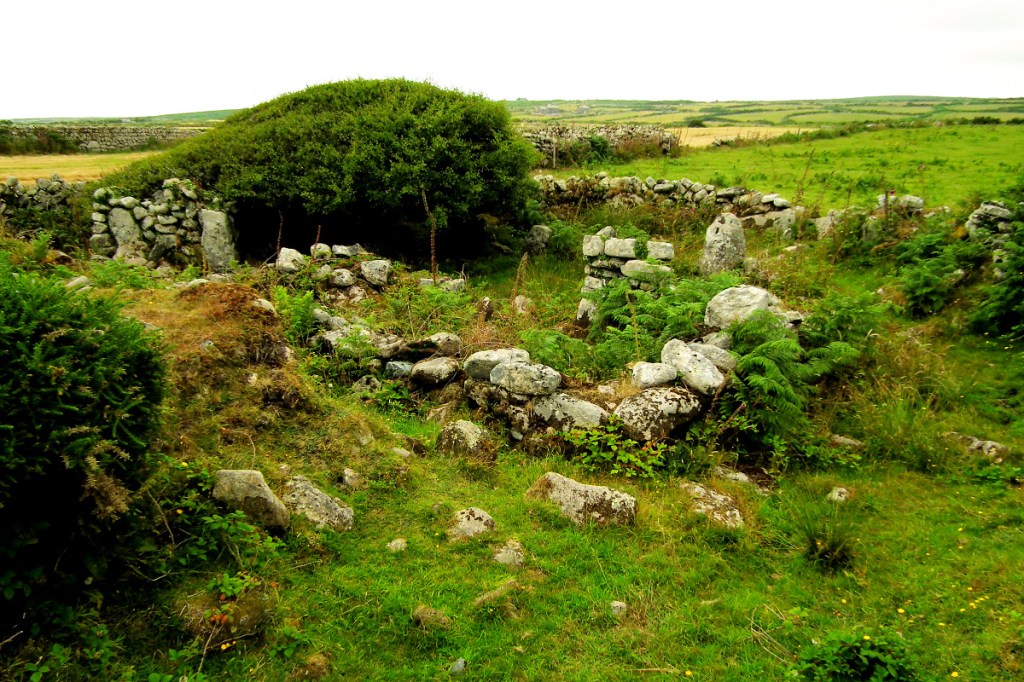
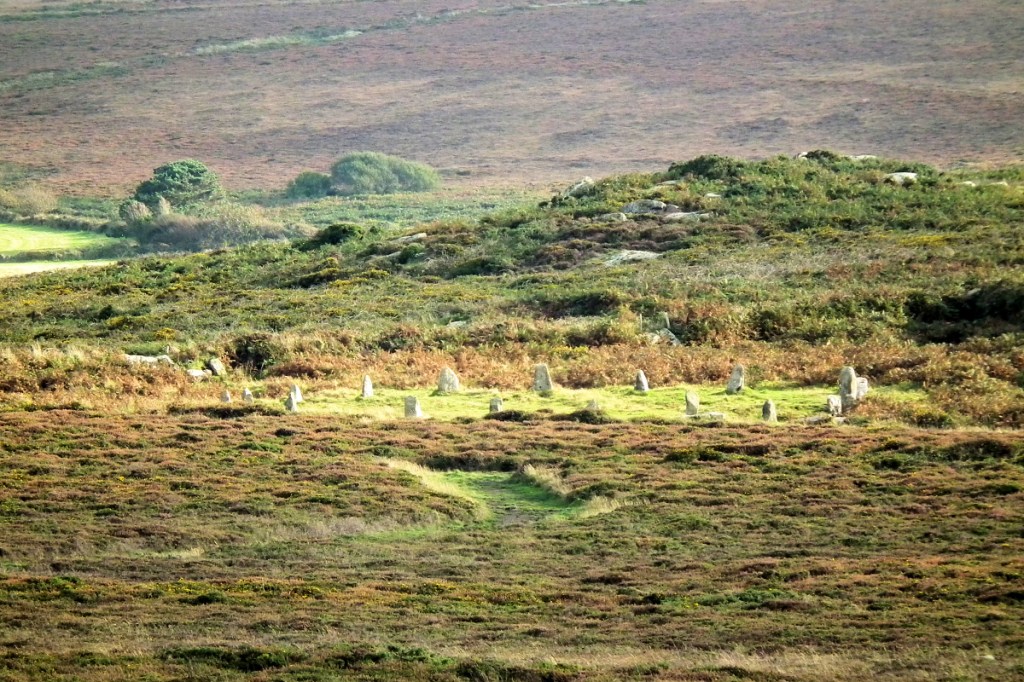
Two thousand years ago, this was someone’s home. This is at Bosporthennis, Penwith, Cornwall.
Back in 2012 I was doing a tour of duty in Palestine. I didn’t know it at the time, but it was to be my last. After that I was visiting Palestinian refugees in Syria, who were in an awkward situation regarding the Assad family’s ultimately self-destructive habit of shooting at their own people.
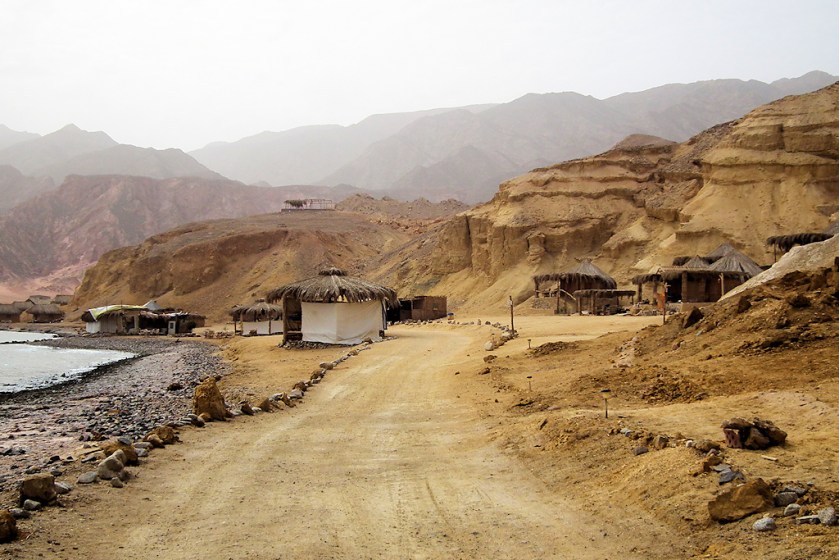
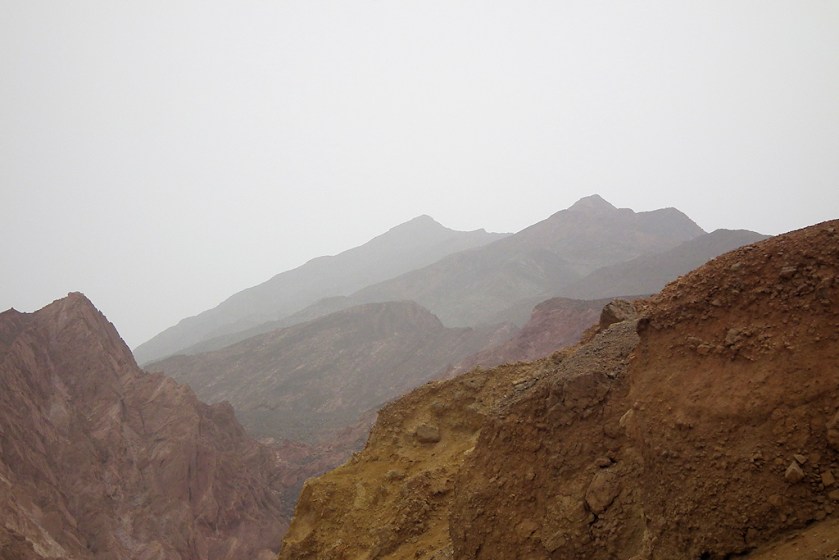
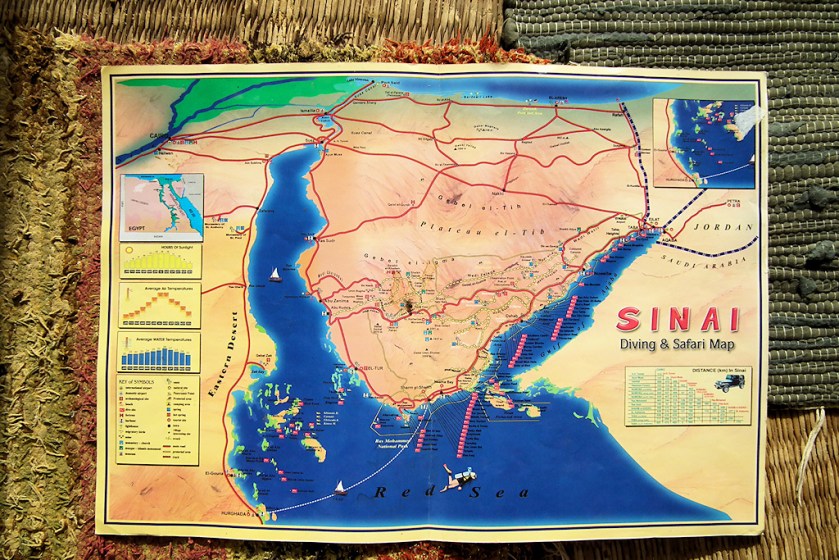
Rock Sea Camp, near Nuweiba, Egypt
The Assads had been good to the Palestinians, but the Palestinians could not accept what the Syrian regime was doing. That put them in a politically awkward situation. So, at the request of some Palestinians in Bethlehem, who could not visit their relatives in Syria, I went from Amman in Jordan to Yarmouk refugee camp near Damascus to help with some awkward issues they were facing.
This was early on in the Syrian civil war in 2013-4, when there were about 5-6 parties slugging it out. You couldn’t tell who was shooting, or who the next checkpoint belonged to – it was a nightmare. It was a matter of staying calm, being friendly and hoping for the best – it worked. I’m good at that and, as proof, I’m still alive.
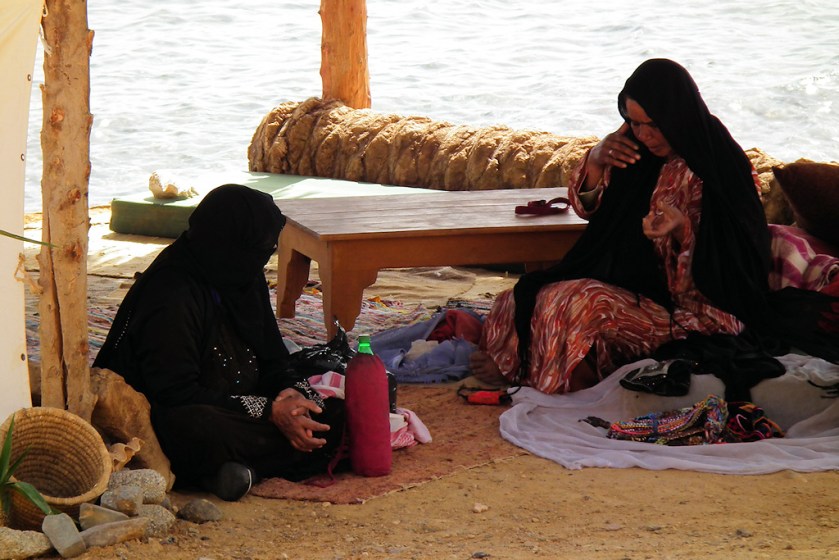
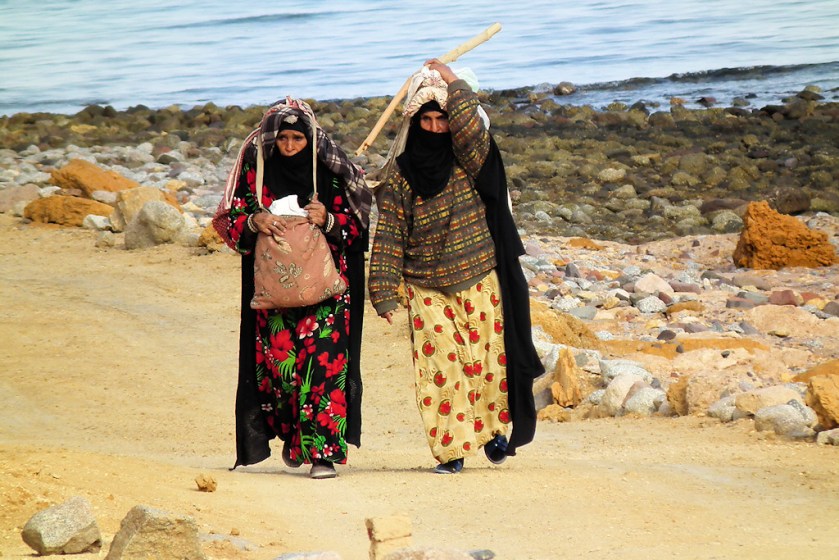
Anyway, while in Palestine I had to leave after three months because I had only a three month tourist visa. I had to leave and then re-enter – a rather dodgy business. So I caught a bus to Eilat in the far south of Israel, over the prickly border into Egypt (the Israelis give you a harder time when you’re leaving than when you’re entering), and then I hitched a ride in a Bedouin taxi down to the Rock Sea Camp.
While there, I wrote this blog entry, called ‘Lost in Arabiyya’:
Rock Sea was a camp by the side of Red Sea, not far from Nuweiba, filled mostly with Europeans. https://www.rocksea.net They mostly flew in from Europe via Sharm el Sheikh – Egypt’s big tourist resort on the Sinai peninsula.
I went there to decompress, to think things over, and then to return to Bethlehem for another two months in the rather hot frying pan that is Palestine.
I needed this thinking time because I had been involved in some rather hair-raising events in Bethlehem, and there was a chance that certain people might have been watching me. Not very nice people. The story (as much as I can safely tell it) is here, as an audiobook called Blogging in Bethlehem:
So this is the short story of what went on for me at Rock Sea, extracted from my third Palestine book, called O Little Town of Bethlehem – Christmas in God’s Holy Land, available online here, for free: https://www.palden.co.uk/pop/order.html
Love, Abu Balden
Arabs can’t say ‘p’ – instead they say ‘b’. Hence that, there, I’m called Balden. ‘Abu’ is an honorific meaning ‘father figure’.
I’m moving towards the end of six decades of public speaking and teaching. I feel it in my aching bones and sluggish brains – what’s left of them. My synapses have run almost enough marathons for this lifetime. But I think I’ll last until the end of this year, inshallah. So I’m going to do a few talks and classes during the rest of 2026. That is, if people invite me, and if it’s doable.
I was thinking recently about my capacity earlier in life to hold and convey vastnesses of information and big, wide perspectives. In my audio archive there are talks from thirtyish years ago, and some of that stuff surprises me now. Gosh, was that me? Was it in this life or another? The audio archive is here: https://www.palden.co.uk/audio-archive.html
I’ve always been rather a polymath, covering a range of subjects. A typical hyper-focused Aspergers type, I became a veritable expert in each subject I took on, and subject to occasional bursts of genius. But that’s what I did in mid-life, and now I’m rather a worn out, ponderous old hippy veteran who’s seeing things in more of a reflective way. More transdimensional. But I still have a few more things to share.
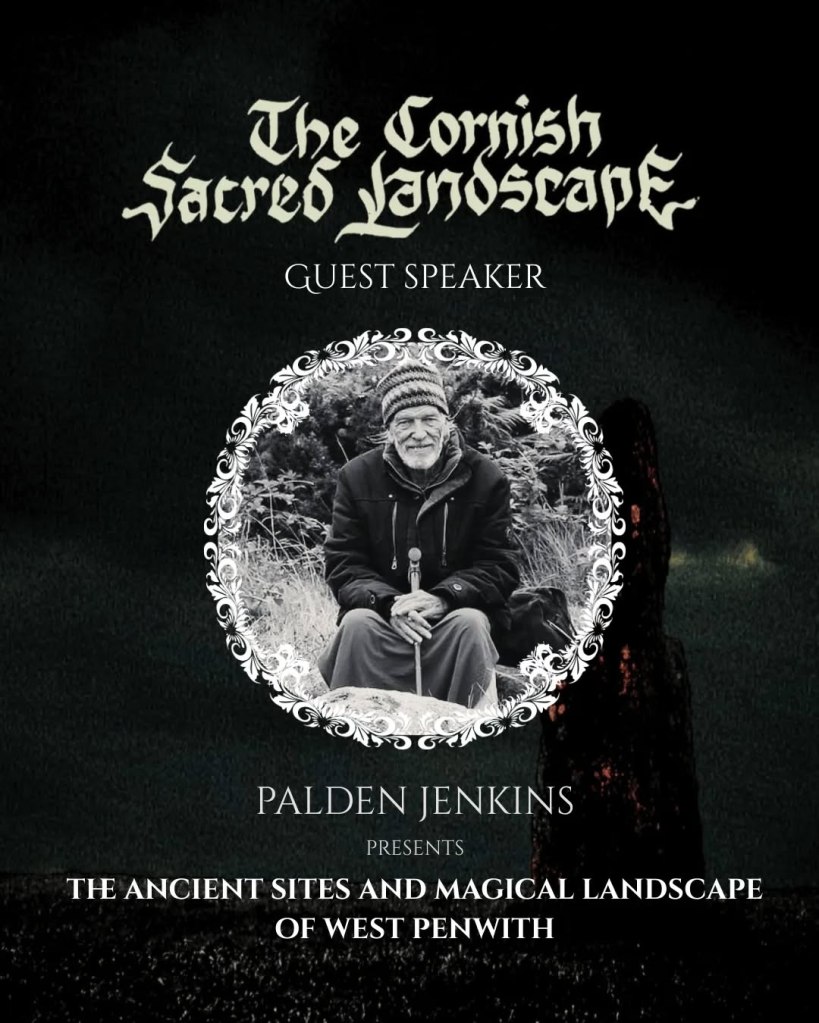
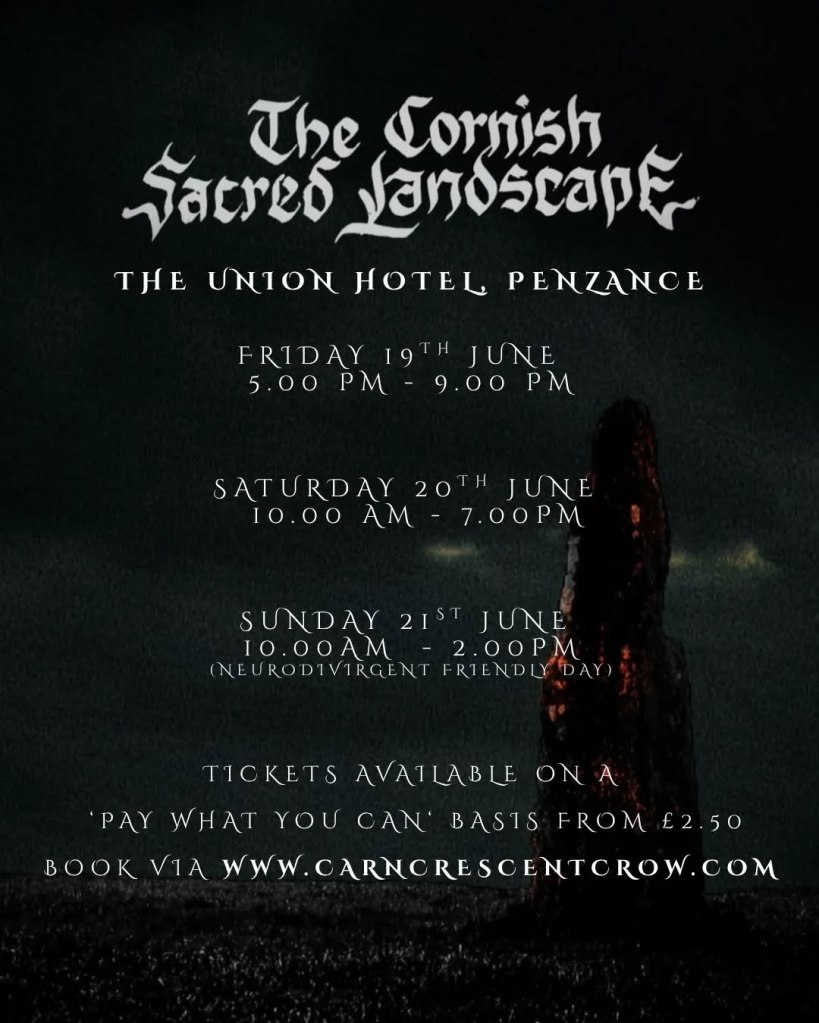
I’m doing a talk in Penzance as part of the Golowan Festival around summer solstice, courtesy of an old friend and neighbour, Na Nook. (Info: The Cornish Sacred Landscape.) I’ll be holding forth on the prehistoric society of West Penwith in the Neolithic and Bronze Ages.
This is about the ancients’ worldview, their optic, their magic and their society, as demonstrated in the ancient sites they left behind. That’s fascinating, though what’s most important is that we need to learn from the ancients – it’s growing in relevance today. I’m really happy with the discoveries I’ve made about Penwith’s ancient sites in the last fifteen years. This is a kind of final statement of where I’ve come to on that matter.
As usual for me, it’ll take 20-30 years for people to really get what I’m talking about – being ahead of the times has been both a blessing and a bane in life. Hence, I’m leaving an extensive online archive which, I hope, will stay intact and available for at least thirty years! Perhaps its time will come. In the archive there’s some interesting stuff from the 1990s – some of you might enjoy Paldywan Kenobi’s Millennial Master Class from 1995.
At the JustLiveCamp at Morvah, in Penwith, Cornwall, 23–29 May, a community camp in sacred Cornwall, I’ll be giving a talk about quoits, stone circles and cliff sanctuaries. Chun Quoit is just up the hill from the camp, and I’ll happily transport those who are present on a journey into the Neolithic, 5,000 years ago, to connect with those times – the much-forested times when Chun Quoit and Chun Castle were first built.
If I can, I hope to make a trip around parts of Britain during this year, to see old friends and haunts. As you might gather, my health and mental acuity are approaching a stage where making coherent talks is becoming less possible, but if there are invitations to speak, and if it’s doable (I have to be brought by a driver-minder) then I’ll do my best!
I hope to be able to keep on with podcasts – they’re still doable. Blogs are more difficult because my fingers no longer work well. A lot of people think voice recognition programmes are a solution but, no, they take so much re-editing and correction work that I find they don’t necessarily help. Besides, written English is a little different from spoken English.
Perhaps I need a digital assistant – someone living nearby with networking and literacy skills who would like to manage my online process as I pass away. To the right person this could be really interesting, since I have a large archive of material which can easily be recycled. We shall see. Magic happens – and sometimes it doesn’t, and something else happens instead!
Anyway, here’s a new podcast about ancient sites. I pose the simple question, why do people like visiting ancient sites? We need to look at this question. We need to be honest about a few things. I believe we need to get a bit more serious about ancient sites and what they mean for us now. It’s here:
All things being well, my penultimate book, Shining Land – the ancient sites of West Penwith and what they say about megalithic civilisation, might come out in printed form before long. It already exists in digital and audiobook format, and it’s here: https://www.palden.co.uk/shiningland/
My final book, Blessings that Bones Bring, is going through a review and hopefully will emerge as a second edition by the end of the year. Or sometime – in Cornwall we say ‘dreckly‘. Clare, one of my helper-angels, is assisting with that. It’s made up of re-edited cancer-related extracts from my cancer blog.
It gives the inside story about being a spiritually-oriented cancer patient, and about cancer as a spiritual path and process – a path of awakening, acceptance and completion. As I say somewhere in the book, doctors saved my life and healers gave me a new life – and this is how it has been.
Everything that begins and is born eventually comes to an end. This is the nature of life. This is our learning. We come here to master this. It’s all in the grand scheme of things and, guess what, it’s a training for a greater life. Yes, folks, there’s further to go.
Just remember: you are on a journey, and this life in a physical body, on a dense, spinning and rather troubled planet, is but a stage along that path.
Oh, and while we’re here, I invite you to join me and a widely-spread group of shining souls in the Sunday Meditation, any and every Sunday. Come and waste half an hour with us, for a homoeopathic dose of infinity.
Whether or not you do so, please put in a prayer for all those people round the world whose lives are being devastated by the military actions of fucking assholes who believe they can bend people to their will and their geopolitical delusions by bombing hell out of them. Both the bombers and the bombed are to be pitied, each for their own reasons, and may the 21st Century be the final century in which this kind of insanity is permitted to happen.
Yes, permitted. You can go on as much as you like about Illuminati, Reptilians, Bilderbergers, Oligarchs or any Them you can name, but, in the end, it is we, humanity, who permit all this madness to happen. It is in our hands. We can do it. It has to be done.
With love, Palden
BTW: I was given the nickname Paldywan Kenobi in 1986 by a boy, then aged about eight, in a rather deep, hot and heavy talking-stick sharing circle at the time of Chernobyl, and the name kinda stuck. He stood there with the stick before him like knight holding a medieval standard, uttering words of power that I can’t remember but I’ll never forget. He’s William Cartwright, nowadays a rock musician in Glastonbury. This is where children become our teachers. And our parents.
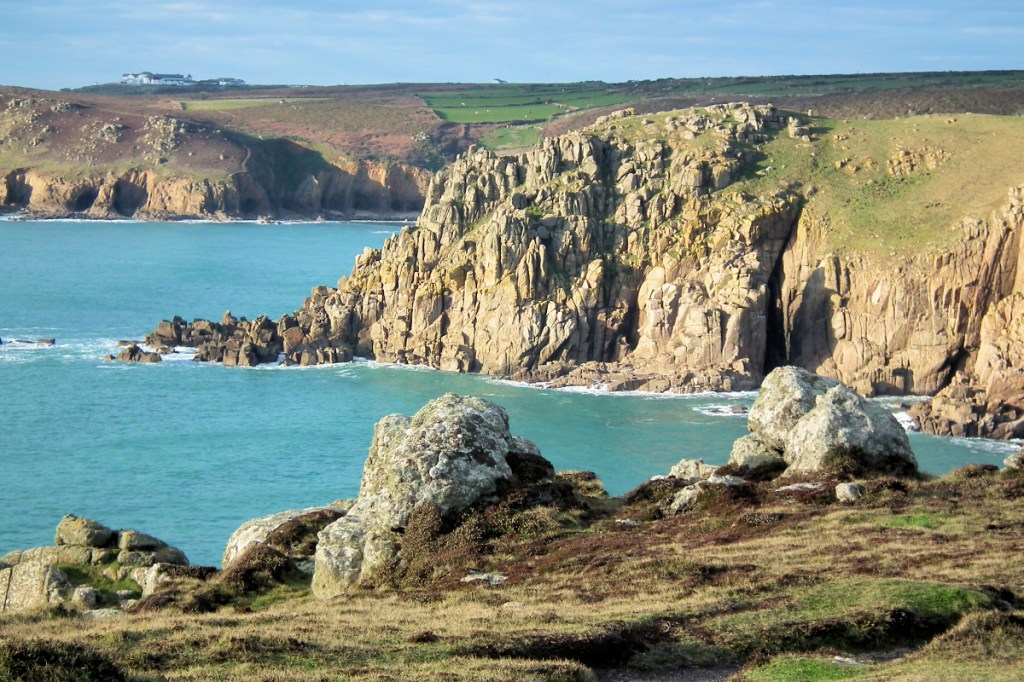
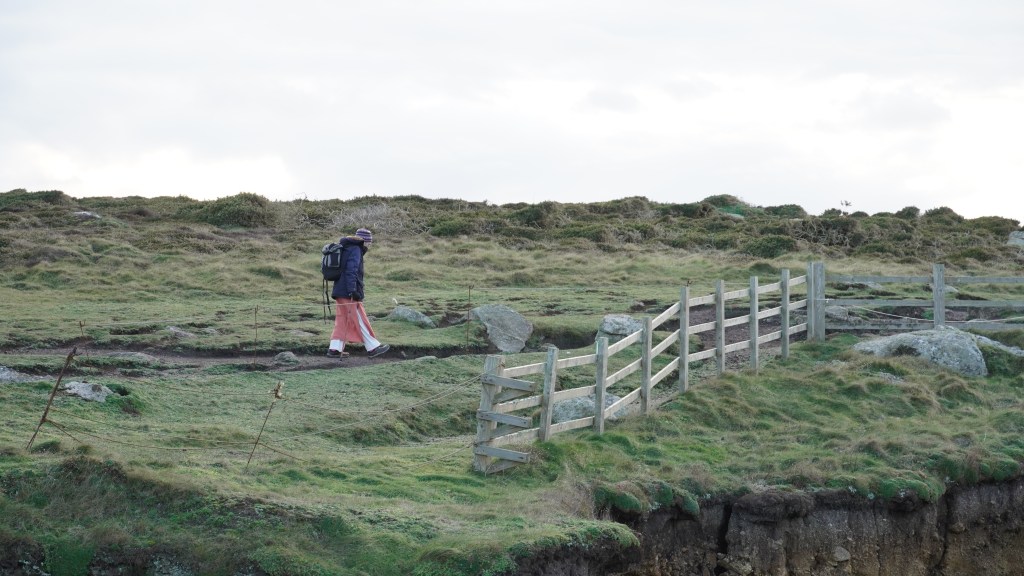
I can’t remember who gave me this pic, but thanks anyway! It is taken on the coast path from Land’s End to Pordenack Point – one of my favourite haunts.
Recently I’ve been feeling rather uninspired. Saturn and Neptune are in opposition to my natal Mercury, and I’m feeling it. Mercury is a key planet in my chart and, since the age of fourteen, for better and for worse, I’ve been a big communicator, and the struggle to clarify my ideas and make myself understood has been a key part of my growth. When I was a boy I was quiet and shy – would you believe? – and it took until my teenage years to find my voice and until age 36 to become good enough as a writer.
It’s kind of like drying up, this uninspiration. It’s a feeling that I’ve said all that I can say – and I’m not one for repeating myself. I’ve also been wondering how much people are interested – though this is often solved by spending time with someone to find out what’s going on for them.
And so I took another tack – after all I’m rather a workaholic, continually looking for new things to do to keep myself occupied. Nowadays, although I’m reasonably noisy online, I spend most of my life alone and quiet. In another world.
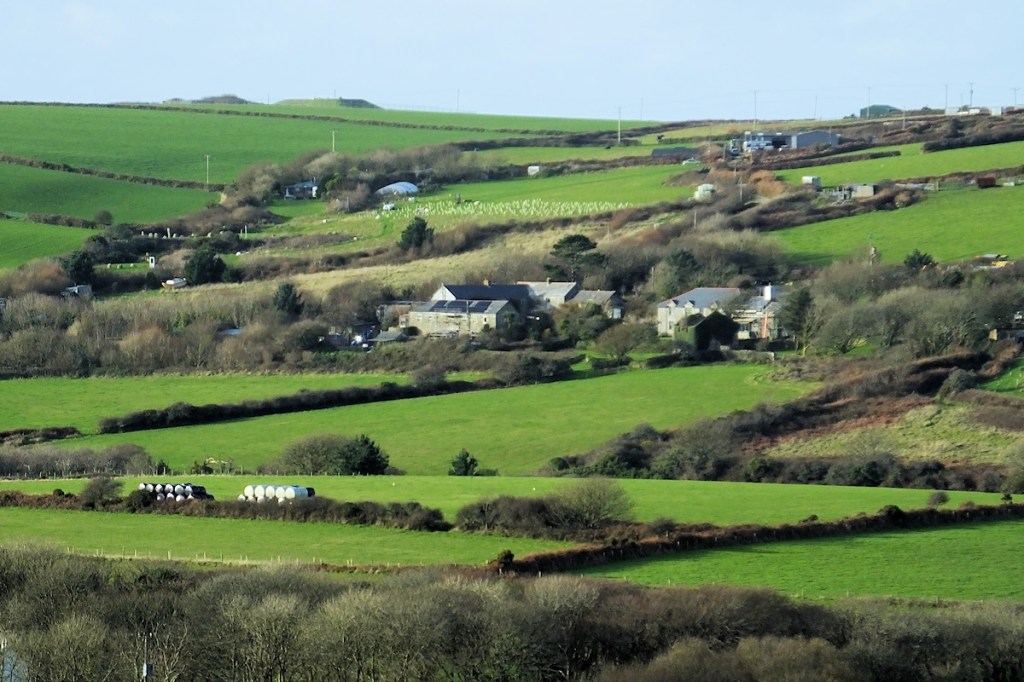
This is the farm where I live, in the far west of Cornwall
Over the last few years I’ve been turning my website into an archive. After all, it’s thirty years old now (started in 1994), and I’ve been adding bits to it every few years which, with a bit of tweaking has been gradually turned into an archive over the last two years. I don’t have money or property to leave to my descendants but, for what it’s worth, they are getting a digital estate, and I’ve often had the feeling that a few of my seven grandchildren might find some treasure there.
A while ago, I was tooling through some old radio programmes which I made twenty years ago, when I lived in Glastonbury, and they were surprisingly good. Especially since, in comparison to many of the talking-heads podcasts which are pouring out now online, the content was really rich, good, original and quite unique. This is partially because Glastonbury is a place which is a source of new ideas and initiatives, and some of the people living there are true originators in their fields.
It was not difficult to bring in old friends to provide interesting material for this programme. I called it This is the Light Programme. That’s a bit of an older generation joke: it refers to a time before about 1970 when BBC Radio had just three channels – the Home Service, the World Service and the Light Programme.
So I have been reviving many of the interviews in those programmes and creating a new section of my archive called Recycling Light – this was the Light Programme. The first few programmes will be coming out soon on the new moon, and I shall continue reworking more of them, making them ready to add to the list of Recycled Light programmes.
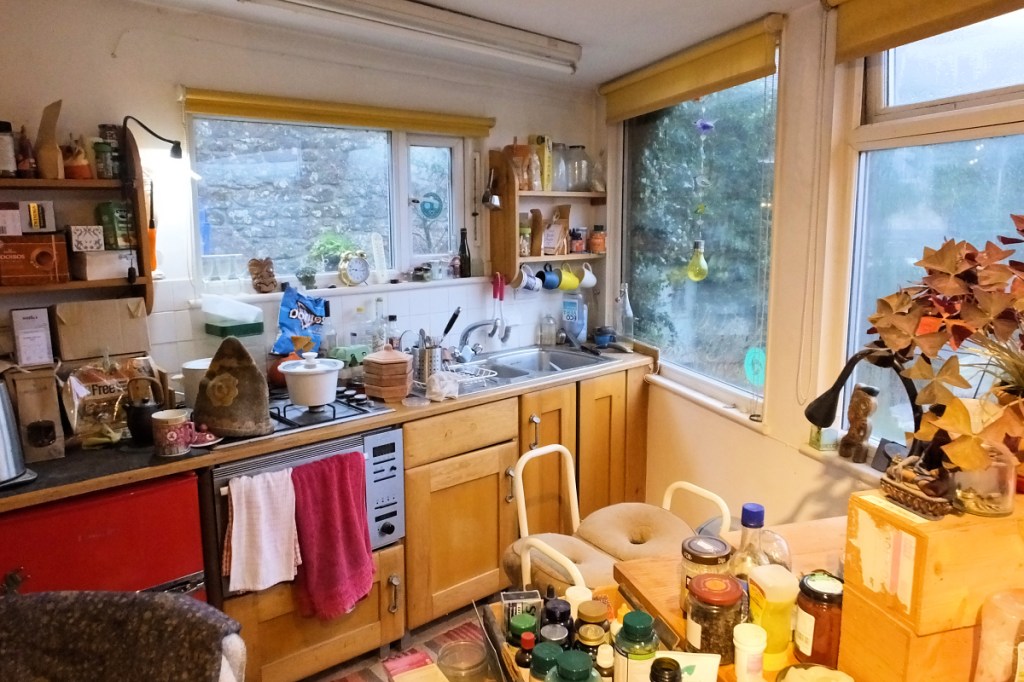
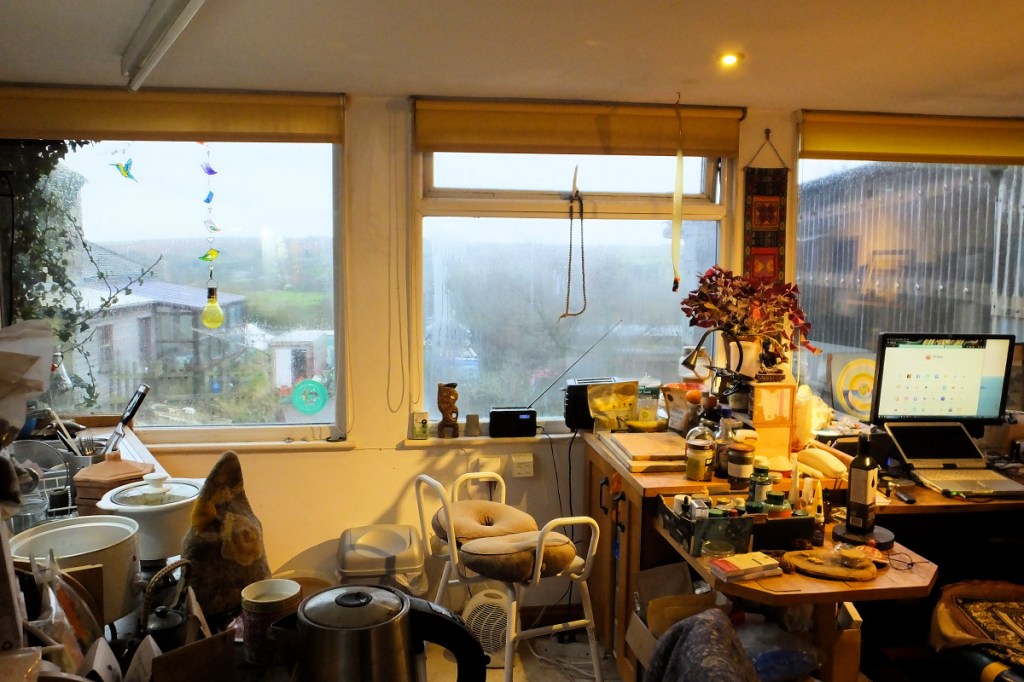
This is my kitchen
And yes, on the whole, when I post a blog or a podcast, I do it at astrologically auspicious moments – this matter of timing is more important than most people think. So this blog was uploaded with Jupiter rising, Mercury on the Midheaven and lots of planets in the tenth house. That’ll do.
I’m recycling these programmes because of the quality of the ideas coming through them. The first is the story of two Glastonbury characters who had been involved in the Middle East – one, Colette Barnard, was in Tehran at the time of the ayatollahs’ revolution in the late 1970s, and the other, Tom Clark, has been involved with funding and supporting progressive projects in the Middle East, particularly women’s and backchannel diplomacy projects. So the first programme is a really interesting interview with these two characters.
The second programme is an interview with Peter Taylor, a critical scientist, ecologist and shaman. He and I have been dialoguing for decades, cousins of the soul, sharing a political-spiritual activist approach to our respective areas of work. He used to be a scientific adviser to Greenpeace in the 1980s and also to government and United Nations bodies on ecological matters, and he is a detractor in the climate question and also one of the inventors and early advocates of the concept of rewilding, a concept which is now accepted but, thirty years ago, it was an entirely new idea and quite radical. What? Wolves? Beavers? Weeds and scrub? Well, yes.
The third programme involves two old friends who, like me, have been involved in researching alternative archaeology and prehistory. One, Sig Lonegren, is a dowser, who can find information about ancient sites which the majority of us have no access to at all. Now in his eighties, he has been a major contributor to the field of earth mysteries. The second, Bruce Garrard, has been doing a lot of thinking about the early origins of human society – particularly of the question of gender and the historic formation of gender roles. So they have interesting things to say.
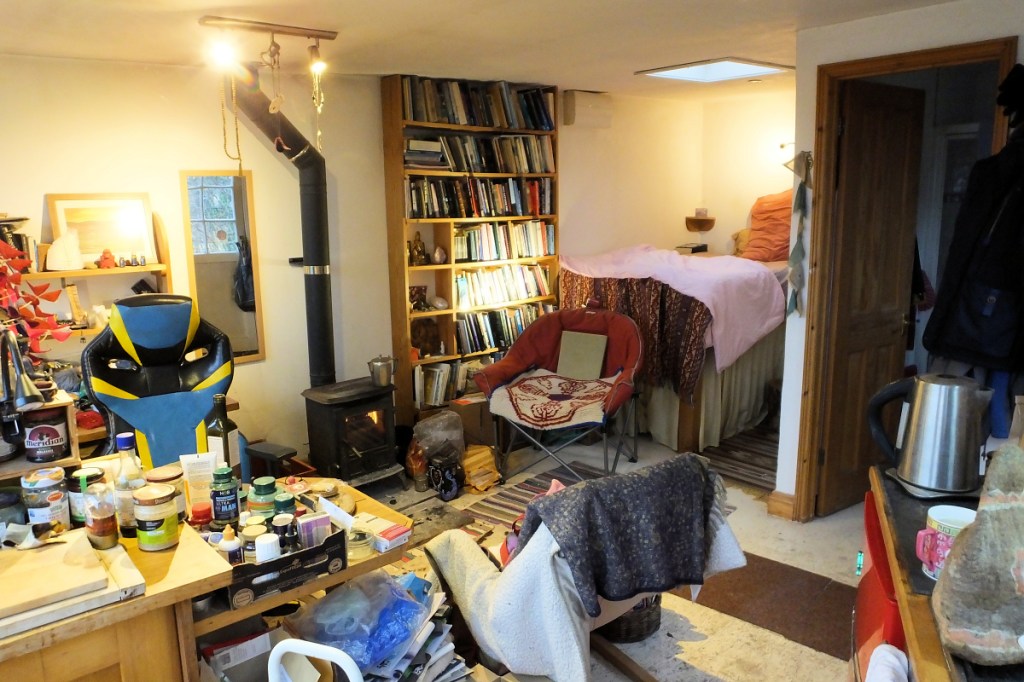
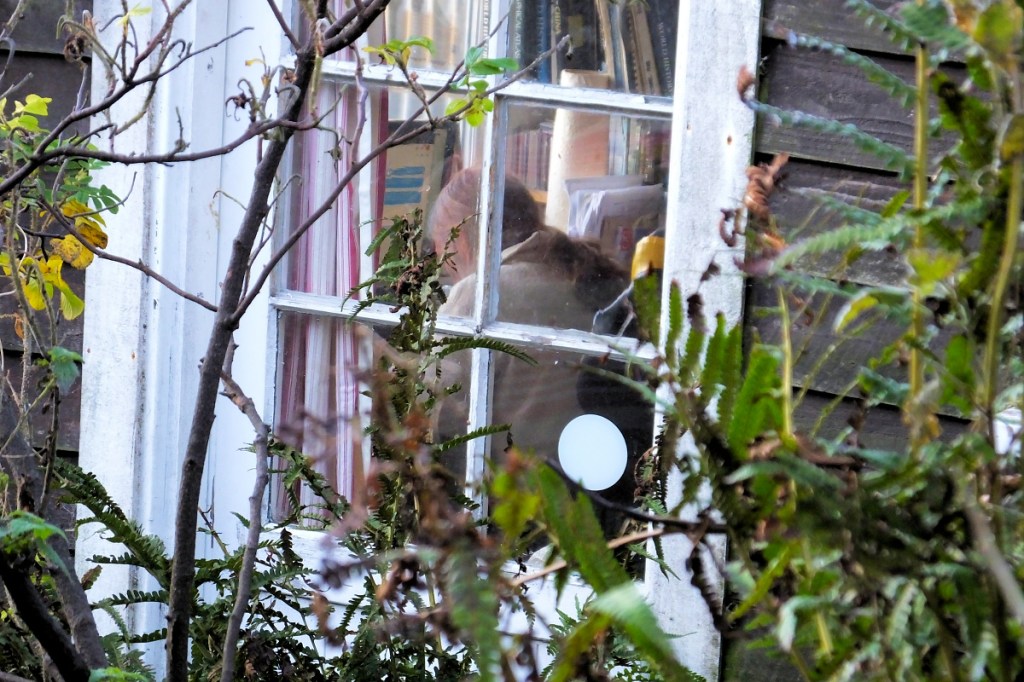
That’s where I rest and sleep. When resting I can watch the swallows, buzzards and jackdaws outside.
It was a great privilege to make that programme. It was weekly, and we did it for a year. Each programme was three hours long. Unfortunately I have had to take the music out, for rights reasons, and to rework it into a new format, but it turned out that this was a good thing to do. My son Tulki, who was then eleven years old, was the studio manager – he used to run the controls. He and I work well together. Now he’s turning thirty. Time moves on.
So in a few days time, I’m coming out with something new on my website. It’s become a really big site over the years, as I have added bits and chunks to it every couple of years. Partially it’s a manifestation of the story of my life, of being one who has advocated ideas which, in general, are right for the world, but which the world is not ready for or interested in accepting.
This has been the story of my life and that of many other people of my generation – particularly the drop-outs. We’ve had to live and work as ‘alternative types’, playing our part in society from the periphery, not from the centre.
When I was lying in a hospital bed with cancer six years ago, being eyeballed by Death and reviewing my life, I realised that I needed to leave as much as I could online, just in case it becomes relevant and useful in the future. Because the need can arise to refer back to the original people who first thought up the ideas which have become commonplace as time has gone on.
Many of the things that I’ve believed in and advocated have been roughly twenty to thirty years ahead of their mainstream adoption – or at least the beginning of it. So I’m leaving this archive in the hope that it becomes useful to someone in the future.
So when the new moon comes along I’ll be launching this new segment of my website called Recycling Light, and I hope you find it useful and interesting.
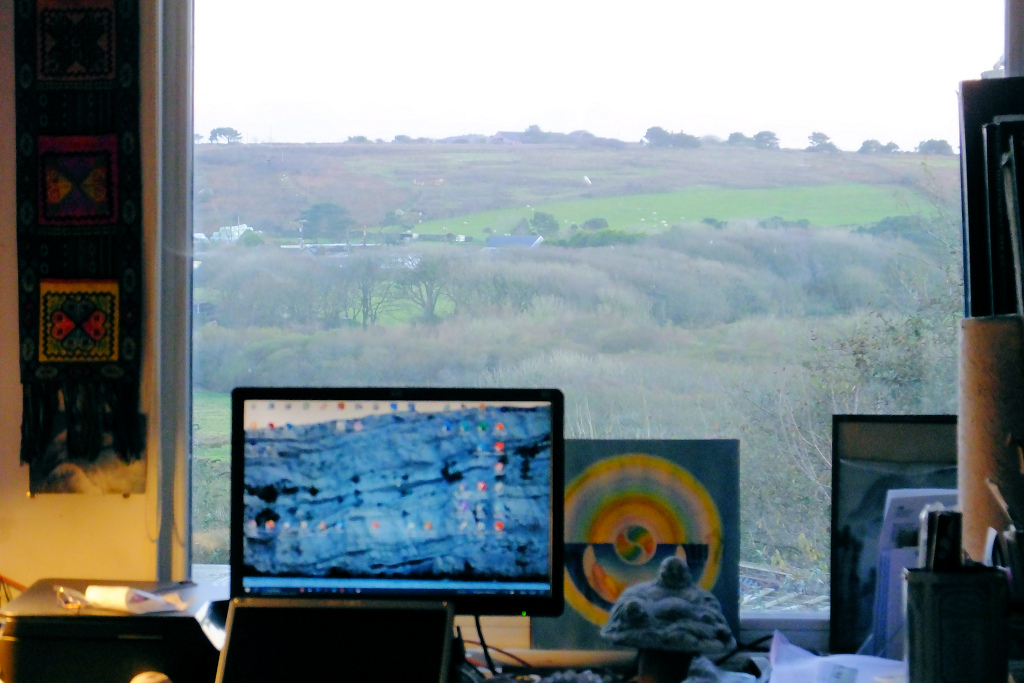
That’s the view from my bed. On that hill is an ancient site called Caer Bran – around 3,500 years ago it was the parliament site for the clans of Belerion, or West Penwith.
Now it’s time to have breakfast – before it’s lunchtime. And I have to work out what pills to take this morning. As a cancer patient I am given lots of pills, but if you adopt a holistic approach to cancer treatment, then it’s double trouble because there are loads of supplements and other therapies to take pills for too! Groan.
(Though if you follow this route, I recommend keeping the pharma drugs and the holistics separate – taking them at different times of day, with food between them – since they operate according to different principles and in some cases can conflict.)
There’s a gift in everything. A state of uninspiration has led to a state of audio-recycling.
Life has been quite a grind and a test recently. Living as a partially disabled cancer patient makes wading through life twice as difficult, and sometimes I get deeply weary with it. That’s been happening recently.
But there’s a weird psychological program in me that has meant that some of the best work I’ve ever done has been done during such periods, when my Saturnine tough-it-out programming gets activated by life and its grinding difficulties. I tend to tough it out by engaging myself in doing something. A project.
It’s an Aspie hyperfocus thing: if you can’t change your circumstances, change your mood by doing something creative and ultimately useful – even if it yields no immediate benefits. That’s how the program goes – for me, at least. Except there is one big benefit: it changes my mood. And, bit by bit, that can change everything.
That’s how, somehow, over the last forty years, I’ve managed to write fifteen or so books on quite a variety of subjects. Many were written amidst difficult circumstances, or arising out of them. The gratifying thing is that I still agree with pretty much everything I’ve written – or spoken about, broadcast or taught. I have few regrets about it. Which is quite remarkable, really.
Just recently I’ve been at it again. I had a crisis a month ago where I felt uninspired, feeling that I’d said everything I needed to say, and were people interested anyway? Well, as such crises do, it represented a deeper fermentation process going on in the nether recesses of my psyche, and an inner repositioning was going on, unbeknownst to me. I started looking at ‘outstanding issues’ and ‘unfinished bits’ in what I have done. After all, as a disabled oldie who spends more time alone than I would prefer, I do have lots of time.
Just yesterday, my friend Brian Charlton was here. He’s another Glastonbury defector now living in West Penwith – there’s a little secret cabal of us, actually. He lives the other side of St Just, our local village, and he is part a local support group, the ‘Friends of Palden’, that is a blessing in my life. He was on his weekly visit, and benignly badgering me about these unfinished bits. Very perceptive. I realised he was right. I needed to beaver away at clarifying and finalising the signals I’ve been putting out, and there are unfinished bits, and bits yet to evolve further, if life allows.
But there was more: I realised was already instinctively doing it, though I hadn’t realised it until then. It had started with two podcasts, both of which came up spontaneously, about Inner Doctors and Intuition. That got me flowing again, unblocking the logjam that had scrangled up my psyche. That’s one secret that many creators need to understand: if you get blocked up, do something, anything, to get yourself unblocked. And it’s best to forget what you think you ought to be doing, and to be spontaneous and creative instead – because that’s where the taproot of creativity lies.
Then suddenly I found myself starting doing a revision of one of my books, Shining Land, about the ancient sites of West Penwith. Well, there were some typos, readability issues and tweaks to attend to. So I thought. But as things progressed, I realised that new work I have done in the last few years, since I wrote the book, needed adding. I’d gained some new perspectives too, blessed as I am with lots of thinking time.
Most of the book has just needed tweaks and small improvements, but the chapter on Hill Camps has had a rewrite, adding my thoughts on Bronze Age circular enclosures such as Caer Brân, built around the 1800s BCE for tribal gatherings, and their significance. Also, I’ve added new material to the final part of the book, about Megalithic Geoengineering, breaking the last chapter into two and adding new work to both, about landscape temples, wildwood cover in the Bronze Age and ancient trackways in Penwith. And there are some new maps and pictures. I’ve worked on the indexing too (it’s rather tedious).
But here’s the rub. I can’t write books any more. My brains can’t do it. I can do blogs, podcasts and small projects, because they are done and dusted in a day or two. But books? No, they’re big projects. Even so, I can revise books I’ve written before, and the great virtue of revising a book is that the big thinking has already been done. So I can focus on style, details, text-flow, images, maps and new ideas. I can make it a better read.
I discovered this ten years ago when revising an astrology book first published in 1987, Living in Time. It was a good book but it had dated, with out-of-date examples in it from the 1960s to the 1980s. It also needed another spin, since times had changed and many more people were aware of what the book writes about. This is how Google’s AI assesses it:
“Power Points in Time is the title of a book by Palden Jenkins that explores the concept of time and its influence on various aspects of life, drawing on astrology and other cyclical patterns. It examines how understanding these patterns can provide insights into events, decisions, and even the meaning of life. The book uses examples like lunar phases, planetary alignments, and ancient festivals to illustrate how time can be understood as more than just a linear progression.“
Actually, that’s a pretty good summary. That’s the first time I’ve used AI in any of my writings, and it’s likely to be one of the last, since I am decidedly AI-free and Patreon-free in my outpourings. And, for better or worse, I prioritise eyeballs and ideas over monetisation too.
Gurnard’s Head
So I revised Living in Time and it came out in 2015 as Power Points in Time. I really enjoyed doing that revision, precisely because the big thinking had been done, so I could focus on other things. But there was another matter too: in 1987 I had pitched the book to people interested in astrology, though later I found that it was most popular with people interested in ancient sites – a different circle of readers. Meanwhile, over the quarter century that followed, I had developed a clearer idea of the combined importance of power points in space (ancient sites) and power points in time (peak periods). So I re-pitched the book toward this ‘power points’ idea.
Then a few years passed, and a big change came to my life – getting cancer and becoming disabled – and, reviewing my life, I realised I hadn’t written a book about ancient sites, even though, on and off, I had studied the matter for fifty years and had done a lot of research in Cornwall for ten years. So along came Shining Land – the ancient sites of West Penwith and what they say about megalithic civilisation. My core proposition was that ancient sites were built for conducting shamanic consciousness work, and that the 600ish ancient sites of West Penwith actually constituted one big, integrated ancient site.
By making a ‘landscape temple’ out of the whole cliff-bound Penwith peninsula, it was possible to raise this consciousness work to a higher level, to benefit not only the local area and its people but the whole planet. The planet is one being, that we have come to know as Gaia, and if the ancients got themselves into enough of an elevated state to do so, they could commune with Gaia, adding a human touch to her work as a planet-being.
They were practicing what I’ve come to call Megalithic Geoengineering. Big stuff. Planetary stuff. And, of course, there’s something to learn from this today.
Lesingey Round
So, you see, in health and life circumstances I have been labouring somewhat, though in other respects I’ve been quietly chiselling away at generating uplift and raising my spirits by doing those things that I can do, and being creative with it. It fires up my circuitry. Meanwhile I’m de-focusing on those things I can’t do and can’t have – things that weigh me down. As a result, a new, 2025 version of Shining Land will come out shortly as an online book. So there are results to this. Results germinated out of a time of hardship.
Two things happened to help turn things around. One was the spontaneous eruption of the ‘Inner Doctors’ podcast, which revived my creative spirits, and the other was a session with a homoeopath, my neighbour Anna Jenkins (no relation – we Jenkinses are a big Welsh clan). I think the remedies she prescribed have dislodged some fixities and rigidities within me. Well, to be honest, I cannot tell yet, because the last week has been low, lonely and dark and I cannot tell whether my cancer and demise are getting worse or whether this is what homoeopaths call a ‘healing crisis’. But I think I’ll opt for the latter.
It has more hope in it. And hope and belief are motivators. Not as an imposition on evolving reality, but as a way of intersecting fruitfully with it. Hopefully.
Changing the way we see things: inside every problem lies a solution, as long as we allow ourselves to see it.
Sometimes I struggle with that. So, in case you thought you were the only one in this vast universe who struggles with it, think again, for you are not alone.
It’s raining. Unwittingly, we were teleported into October. Well, that’s the case down’ere in Cornwall. I’ve even lit up my woodstove to cheer things up.
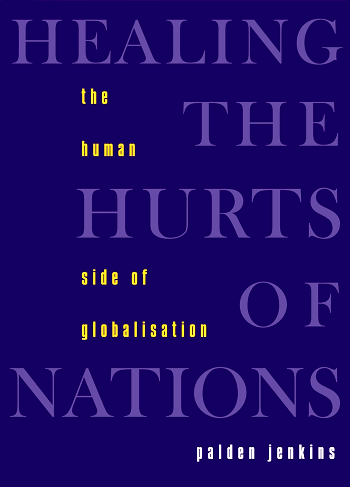
Then I started working on a half-finished website – a shortened version of my 2003 book ‘Healing the Hurts of Nations’. I wrote that in Glastonbury as the Iraq War was building up. It’ll be ready dreckly – a Cornish word meaning ‘whenever’.
One of the funny things that has happened in my life has been that I’ve given focus to quite a wide variety of different subjects and areas of activity. I give each of them total attention, lots of time and energy, sometimes to the annoyance of people close to me.
Something comes out of it that lands up as a book or a project of some sort. And then, once it’s complete and wrapped up, I have a tendency to move on to something different. Sag rising and Gemini Moon. Four planets in the Ninth. Or manic Aspie obsession, perhaps.
Which means that, over my lifetime, I’ve accumulated a range of bits of work. This one here, ‘Silk Roads’, represents the para-political and geopolitical side of me, fed by the historian and feeding the stuff I’ve done in humanitarian activities and world healing.
The other side of this is that I’ve made contributions to many fields – astrology, geomancy and cereology are other ones – though I haven’t stuck around long enough to really milk any of them fully. Other people got better known than I. By the time the ideas I’ve put forward start gaining traction, I’m off somewhere else.
This traction process seems to take around 30 years – a Saturn cycle. It’s frustratingly slow when you’re younger, but it starts making more sense when your bones start creaking. It’s necessary to let go of the urge for fame and success, let others get the accolades and royalties, and instead enjoy feeding the collective psyche with ideas and impulses that take on a life of their own. After all, ideas don’t come from us – they come through us. It’s all to do with feeding future history with ideational fertiliser. Planting seeds.
At the end of life, that process seems to be turning around, for me. I’m leaving an online archive of much of my stuff on my now rather labyrinthine 600-page website, and it’s all there for anyone who wishes to trawl through it. Or for anyone who find the parts that are waiting for them. It has become a kind of wholeness – at least to me. But for most of you, bits of it will be valuable.
Cape Kenidjack, a cliff sanctuary
I’m now approaching what might be a crisis. I’m running out of stuff that needs revising and entering into the archive, and also my capacity to cook up new stuff is diminishing. Blogs and podcastswork quite well, because I can get them done in a matter of hours, but books, no, I can’t do books any more.
I can do single intense workshops like the Magic Circles I did last year, but these are in-the-moment one-offs, never to be repeated. I can’t do longer courses or series any more. For both better and for worse, chemo-brain and ageing have put me more into my right, intuitive-imaginal brain. It kinda trundles along like an old steam engine, but the livery is a tad smart.
I’m able to do a few more five-hour Magic Circles, if you’re an organiser who’d like to host one. I can’t organise them myself, but on the night you’ll get something really memorable, special for that moment and for the needs of those present. I’m contemplating doing some online… er… I’m looking for a term like ‘master class’ but better… one a month for 4-5 months. But really, I prefer now to work amongst people, not online. People power me up.
In my last life-chapter, I find myself looking for something new – there’s something that needs to come right. I need to find a situation where, as a partially-disabled but rather interesting old crock with cancer, I can play my part and make the contribution that I can make, and not be difficult to have around – and have someone cover my back or even consider hosting a good decline and death.
Investigating an iron age settlement in Penwith
I want to fix this sometime before long, in the coming year. Before it’s too late for me to make a change. I’m not sure whether it involves moving – I do love it where I live, but I’m too alone here now. It’s circumstances rather than location that matter most. Perhaps my world is gradually shrinking.
Anyway, here’s a re-posting of an interesting chunk from Healing the Hurts of Nations, in case your eyeballs needed something to get down on, to feed your synapses with some interesting stuff. It’s all about humanity’s largely unconscious attempts at becoming a planetary race.
That’s rather important, a key ingredient in the next stage of human evolution. All of the issues before us, including local and personal ones, are now planetary in context and thoroughly affected by global-scale influences. Like it or not, we’re becoming one humanity. It’s an at times painful process, and at times it’s amazing.
It’s a kind of destiny. It was not foreordained how we would get here, and the process has been in many ways cruel, but it’s what humanity is heading toward. It’s a bit like an acorn that is programmed to become a mighty oak – it’ll get there somehow.
The uniting of humanity is necessary because we can then join the wider, greater universal order, but only as a unified race of beings. At present we can’t handle that idea, but it’s coming. Also, the only way we can fix our own problems on Earth is by becoming a unified race of beings. It all boils down to simple questions: who decides and who gains? Well, now, by necessity, we’re a team, currently with 8 billion players.
We’re in the critical part of that process now. I’d suggest the process properly started in the 1960s and will, at least in principle, be worked out by the 2060s-70s. That is, by then, I think we will know the state of play on Earth, what we have to work with, and we will have started doing it. Whatever that entails at the time. (For more on this, click ‘The 2020s’ above.)
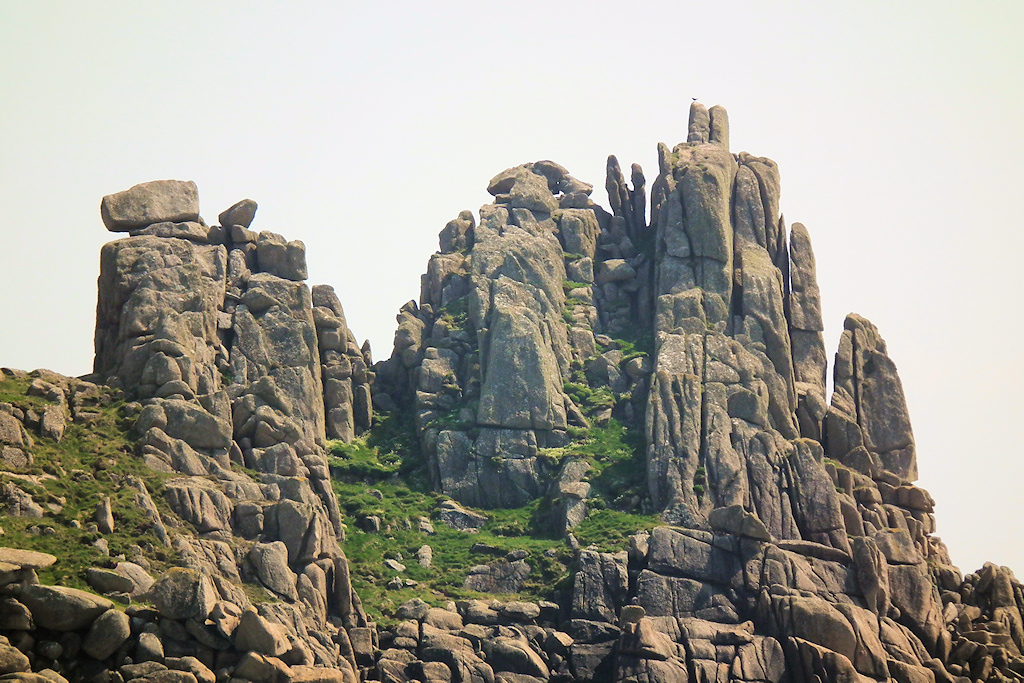
Logan Rock or Castel Tredhyn, castle of Tredyn (SW 3972 2198)
With a daunting magic and brooding mystery hovering around it, Treryn Dinas is a fascinating place, though it’s also a place not to be messed with. Enter with respect or the Cosmic Trickster might knobble you with a dash of unsolicited reality.
You get the feeling odd things might have happened here. It’s a place of mystery, power, sorcery and truth. Not exactly tranquil, it is nonetheless impressive in its strong underlying feeling of power. In folklore it was the home of giants.
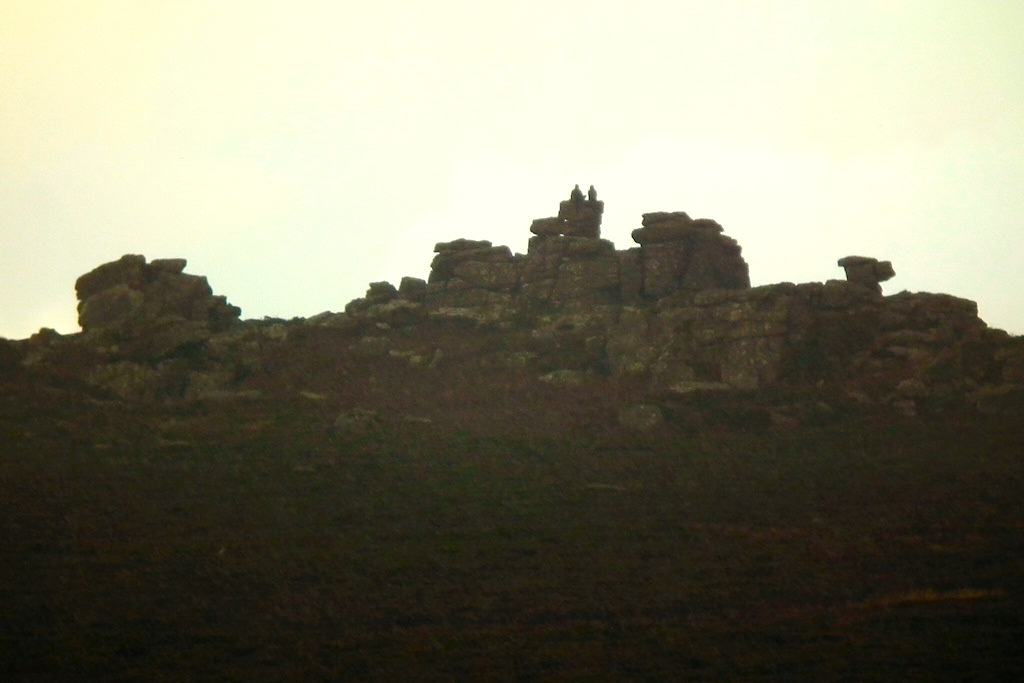
On the actual dinas there aren’t easy assembly places or comfortable places to hang out – precarious scrambling is involved – so at any time people will have been in small numbers only on the dinas. Something about this and its obstacular nature gives the dinas its character. It’s strong in feeling, and worth visiting to feel the brooding, enigmatic character of the place.
The headland has two parts, the rocky headland itself and a large encampment to its landward side called Treen Circle, built in the Iron Age, according to archaeological orthodoxy – and the banks on its landward side probably were Iron Age.
However, its first use would have been in the Neolithic 3000s BCE, if not earlier, even if little or nothing was built there then. Neolithic artefacts and relics have been found on the dinas – items and offerings hidden in the rocks.
How otherwise can we say it’s Neolithic? First, the dinas is so prominent and rich in character that it must have been important.
Second, Treen Circle lies exactly on a backbone alignment (108) through the Merry Maidens, St Michael’s Mount and Carn Brea – an alignment of three natural features (two Neolithic tor enclosures and one cliff sanctuary) with a Bronze Age stone circle dropped onto it. Treen Circle is where people would hang out and camp when visiting the dinas. Antiquarians once thought there was a stone circle in Treen Circle, but this is improbable.
It was the most inhabited of the cliff sanctuaries of Penwith except perhaps for St Michael’s Mount. Treen Circle encampment was large – it could have hosted some pretty big gatherings and, in the Iron Age, quite a few people in roundhouses. This would have been a summer residence – in winter it is exposed.
It was strategically placed, not far from Porthcurno, one of Penwith’s prime landing beaches. But still, it’s a bit far away for defence of the beach, if such were necessary, so a defensive purpose to the dinas is questionable, even though Treen Circle is separated from the surrounding landscape by a significant Iron Age rampart and ditch.
Just outside it, a strongly aligned menhir has recently been rediscovered and re-erected.
Unlike many cliff sanctuaries, Treryn Dinas had practical value, with good farmland and fishing grounds nearby, situated in a commanding position that is a twenty minute trot from Porthcurno.
One wonders whether rocking the logan rock at Treryn Dinas was done to make sound and rhythm for geomantic reasons, to pulse the earth, or even as an ancient kind of foghorn, sounding out a slow drumbeat to warn boats when sea mists were down.
The rather unique upstanding stone at its summit gives Treryn Dinas a special character – it might have been placed there.
Another backbone alignment runs from Treryn Dinas to Boscawen-ûn stone circle, Lanyon Quoit, Bosiliack Barrow (a rather special chambered cairn) and a menhir just yards from the Nine Maidens. So, three of Penwith’s stone circles are linked with Treryn Dinas – that’s significant. Even so, no alignment has been found with Tregeseal, the fourth stone circle of Penwith.








You must be logged in to post a comment.