It’s the Sunday meditation again, and I have revived sufficiently from an illness that floored me last week to be able to elbow you about it! That is, you’re welcome to join us in the zone – times for different countries are below. It’s an open meditation space lasting half an hour. To quote Van Morrison: no guru, no teacher, no method – just you and me in the garden… Follow your own path, together with us following ours. We shall be blessed.
The illness was a fluey thing. My energy was low, and I’d been pushing hard and under pressure in my remote humanitarian work. So when I got cold and wet during a trip to Falmouth, my soul pulled the plug and I went down through it. Next day I was semi-conscious, stiff and hurting, with sluggish brains, wobbly balance, burning feet (peripheral neuropathy) and I was right out of it, gone, hardly here.
A pertinent sign at Gurnard’s Head, in West Penwith
My predominant emotion was grief, over things that have happened, and particularly over moral dilemmas and painful moments in my humanitarian work over the years. I’ve seen people face hardship, suffer and die who, in my estimation, should not have died, and at times I’ve been unable to help – often quite simply I did not have the funds needed for medical treatment for an amputation or to save a life.
This is a deep dilemma being faced by many humanitarians now, as governments blithely withdraw funding and the public shrugs its shoulders. For me, in late life, it has left traces of regret, even though I know that the net value of my work was positive overall, and there’s a lot I’m glad about.
But the illness enabled me to go deep, deep down to a place where the hidden roots of life’s experiences and events ferment and bubble. This is one of the big virtues of illness that many people try their best to avoid – the consciousness changes it can bring about. Sometimes our soul needs to cut us down and render us helpless, to help us work through something – burn through something. Whether or not we actually do this is a life-choice and an exercise of profound free will.
Seals asleep at Godrevy
It is an act of free will to choose to go through a turning in the deepest seat of consciousness. You have to go over the edge and take the plunge. Getting into the habit of doing this throughout our lives sets us up for one of life’s greatest and most moving of experiences – dying.
As you approach death, life tends to take you down in stages – a series of crunch moments or crises where your worldly powers and agency are reduced, your world shrinks, and you bodily functions deteriorate. This incremental withdrawal yields the possibility of a new seeing, a new understanding, if we so choose it. Though it involves perceiving truths that can at first be uncomfortable. Yet facing and accepting these revealings becomes a relief too, an understanding, a forgiveness. For this life had simply been a short visit on an ongoing pathway. It begins and it ends.
Sir George, looking straight at you
Back in the 1990s I was privileged to help and spend quality time with Sir George Trevelyan, who was in effect the grandfather of the New Age movement in Britain. Very much a man of the Twentieth Century, born in 1906 and dying in 1996, he was an aristocratic philanthropist, thinker and educator, planting the seeds of the new age and the green movement in the 1940s-70s. He was a four-planet Scorpio. At the very end, he died by decision, announcing that he should not be disturbed or given any food or drinks. He was gone in 4-5 days.
Here’s a video of him talking in 1988, in his eighties. Thank you, Sir George, for being you, for what you did with and for so many people, and for pointing the way in my life too.
Meanwhile, if you care to join today’s meditation… see you there!
Love, Palden
Current meditation times, on Sundays: UK, Ireland & Portugal 8-8.30pm GMT W Europe 9-9.30pm E Europe, Turkiye and the Levant 10-10.30pm Brazil-Argentina 4-4.30pm CST, Mexico, Jamaica, Colombia 2-2.30pm EST, Cuba 3-3.30pm PST North America 12-12.30am
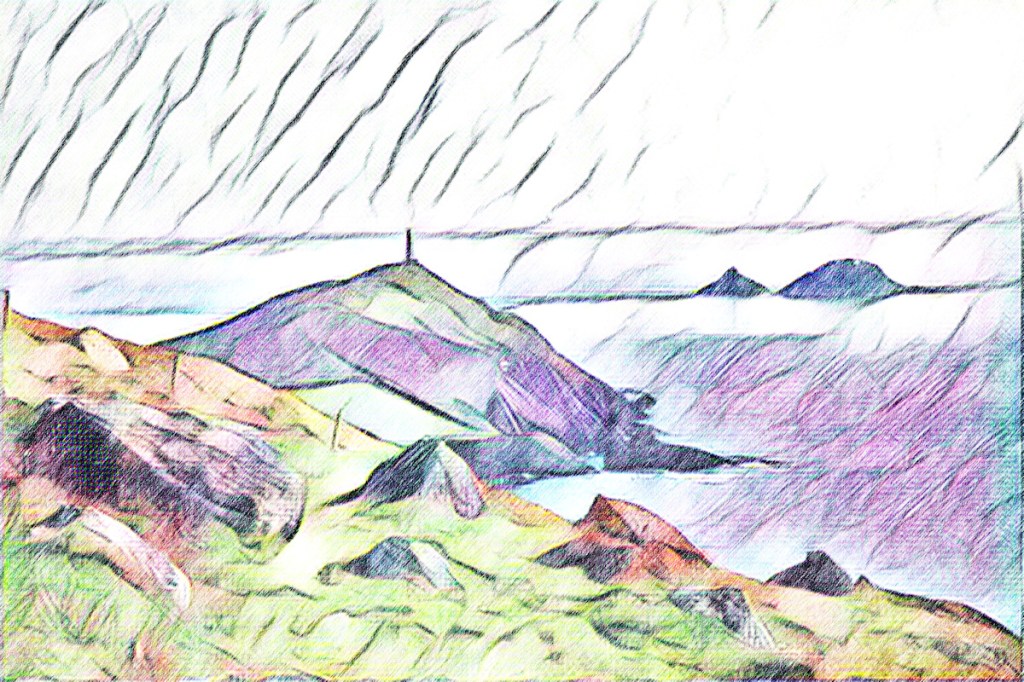
Kilgooth Ust or Cape Cornwall, with The Brisons behind
First things first…The Sunday Meditation continues, whether or not I announce it. Sometimes I can’t, and there’s no one to cover for me. Yet I’m always there meditating at the appointed time, and so are quite a few other people.
You’re welcome to join us. It’s a recipe-free open meditation, especially for independent souls who follow their own path or live relatively isolated from others. All you need is half an hour, a cushion and your inner presence. Join us in the zone. No need to be online.
I might not be able to do regular meditation calls from now on. A lot of things are happening and I’m rather overwhelmed! Much of it is good stuff, and some is difficult – mainly my humanitarian work.
I three-quarters wrote a blog about this, about compassion fatigue, but I’m not fully clear how to write about a few delicate issues, so that’s gone into in the ‘later or never’ pile. For me, as a lifelong author and editor, getting stuck on some writing is unusual and strangely frustrating!
Even so, things are happening.
– I’m doing a talk on Tuesday 15th April, 7.30 at Gwithti an Pystri, the Museum of Folklore and Magic in Falmouth (book ahead);
– then there’s a visit to Gloucester to see my old friend Ibrahim Issa from Hope Flowers School in Bethlehem, Palestine, on 2-4 May (I’m still looking for a driver-minder for that, or a workable way to get there and back);
– and a talk at the Pathways to the Past conference in St Just, Cornwall, on Saturday 24th May (I’m really happy about that);
– and another at the Just Live Camp near Morvah in Penwith a day or two after, on 25th or 26th May.
Then there’s the Belerion Project, about which I’m really happy too. It’s a research project into the subtle energy and psychoactive effects of the system of ancient sites in Penwith. We did our first field trip to Portheras Common Barrow recently and, despite weather challenges, it went really well. Thanks to everyone who came. The next is on Wednesday 7th May.
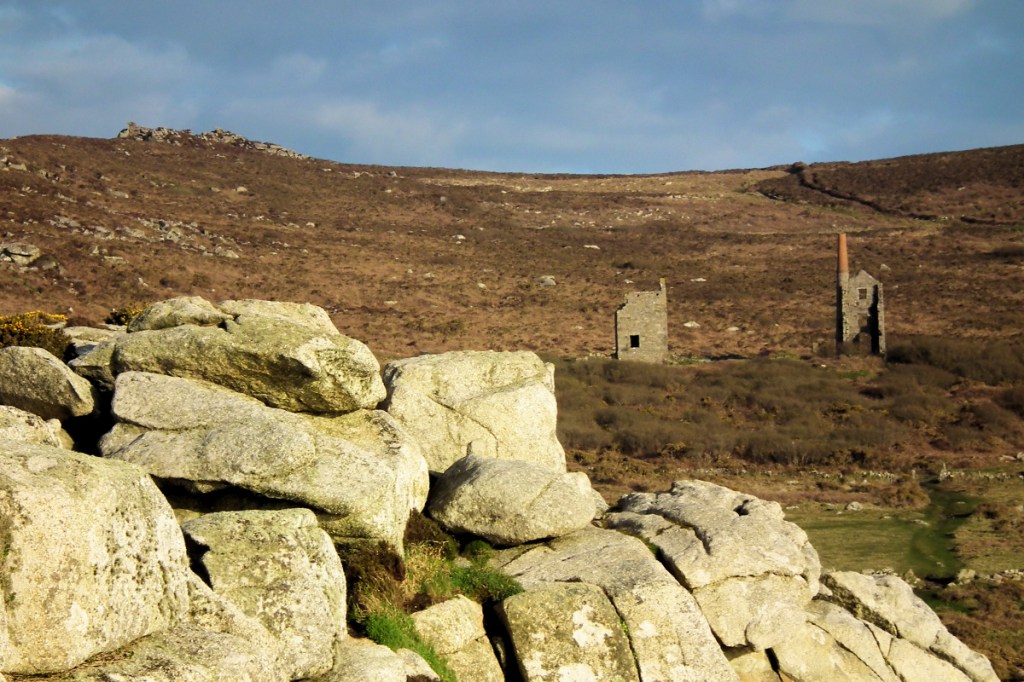
Carn Les Boel and Carn Barra
I’ve always been rather workaholicky but, age 75 and doing a cancer trip, recently I’ve been running at capacity. Just getting ready to go out can wear me out, requiring a rest, and everything requires twice the effort it took in pre-cancer days. My brains aren’t handling all the messages, chats and enquiries involved – apologies to people I fail to answer.
I’m a hyperfocused Aspie, you see – good at concentrating for hours in a right-brained way but bad at hopping from thing to thing in a left-brained way. Aged brains do get creaky and slow! This is a mixed gift that has come with cancer: I’ve done some of the best creativity of my life, though I have a decreased capacity for admin, lists, names, timetables and even time itself. Or remembering to have dinner.
That’s the way it goes. Ideally I need an assistant (who lives close by and knows me well – not online). But I cannot pay such a person. That’s been one of the issues of my life that I was trying to write about in the latest, as yet unpublished blog: I’ve never had an expense account to finance projects and missions. It’s mostly come out of my own pocket.
A plus with this is that I’ve pulled off some mighty stunts on a slim budget, and I’ve been a free agent, but it is wearing too, and many good things could have happened if I’d had better funding.
For those who suggest I should ‘just’ do some crowd-sourcing (takes ten minutes, it’s easy and the money floods in, haha), I ask, do you require soldiers to fund their service at the frontline? Soldiers are paid salaries and pensions while peacemakers are told it’s our choice, our risk and why don’t we get a proper job?
You might hear a thread of resentment there. That’s why I didn’t complete the blog. I’ve got stuff around it. It’s still happening now: I and others I’m working with in Ghana, Mali and Palestine are all being seriously obstructed by, would you believe, the actions, errors, denials and avoidances of two banks, one in USA and one in Australia.
It’s not simple, this game. Paldywan Kenobi stares down the banksters! Who’d have thought I’d get sucked into teaching banks how to be human, at my age? Oh, and dealing with a few crime gangs, Wagners and drug-addled murderers along the way, remotely from my eyrie here in Cornwall. Well, I’m quite good at it, actually, and many people give up on such things when things get big or dangerous. I tend to hang in there.
When you step into what used to be called The Great Work, the rules of normal life seem to levitate out of the window and disappear. Retirement is something other people do.
For astrologers, I’ve just gone through Saturn opposing my natal Saturn (and square Moon and Ascendant). So I’m doing Saturn, yet again. When I started my cancer trip five years ago, I thought I had 1-3 years left, so I put my rather mission-driven, saturnine sense of life-purpose to the side. But it has started up again!
Well, my dear old late Mum used to say, “There’s no rest for the wicked!”. Well, yes, perhaps so, or perhaps not. She was a do-gooder too, handing me down that pattern, bless her. In our self-centred times, it’s not a sensible strategy, doing good, but some of us choose it or get sucked into it anyway.
Compassion fatigue, versus ‘To give and not to count the cost’. Non-attachment to the fruits of our labours, versus ‘Give me the compensation you owe for your frigging corporate errors’. Yes, these things have been rattling around in my heart during those Saturn transits. Well, life is for the learning.
I’ve been reminding myself of something a young Berliner taught me while standing (as you do) in the Sinai Desert. I repeat this here, particularly for people infected with the Trump virus:
It’s okay in the end. If it’s not okay, it’s not the end.
Love from me – as you might sense, in a rather saturnine mood on this fullmoon!
Bosigran Castle, a cliff sanctuary in West Penwith
I wasn’t expecting to be alive now. Just over five years ago, it genuinely felt as if it was ‘game over’. But after a year or two I was still here and marginally improving – as it goes with the blood cancer I have, Multiple Myeloma. I’d become partially disabled, ageing ten or more years (it felt different on different days), and squeezed through a big change with no going back. Many elements of my old life were now outside my range of physical and mental possibilities – though, to compensate, my spirits went through a big boost.
This boost was partially a ‘gift of God’ and partially I chose to take it that way. Though perhaps there was only one option. It was a choiceless choice, really. Gifts of God can be like that.
Even so, after two years, early in 2022 I sank into a deep, dark, muddy, wintertime crisis. Hm, this gift was grinding me down, squeezing and pushing me to see how far I could go. Astrologically, Neptune was opposing my Saturn – a revelation of uncomfortable truths, old shadows, limitations, inhibitions and self-sabotaging patterns. Again, I got used to the idea that I might be approaching ‘game over’. There I was, deteriorating, 90% dead and hovering. Part of me was withdrawing from life, giving up, feeling worn out. My hope account was overdrawn.
Then something started happening which, again, wasn’t on my roadmap. By springtime 2022 I started emerging from the shadowlands and reviving. Not back to where I’d been before, but to a new place. I wasn’t ‘better’, yet something in me was lighting up. Something was slotting into place.
Looking back from here, I was going through an archetypal, deep-self change. It necessitated a systems-reboot – a slough of despond trip. Archetype-change is a deep thing, hardly conscious, though clues come through at odd moments. I had no sense of the archetypal identity I was receiving or adopting, yet I could feel the change. There was a feeling of lostness, a lack of anchorage, together with an as yet shapeless feeling of new-foundness. I was switching tracks.
At different phases of our lives, deep down, we live out a succession of selfhoods and archetypes. An archetype is universal, but archetypes of a more personal kind mould themselves around us, our characters and our trans-life storylines. Through these selfhoods we plug into more universal archetypes, acting them out in the context of our lives and our available life-possibilities. These change and develop over time. That is, we learn – sometimes whether we like it or not!
In my experience, one selfhood can be dominant for a period of life while others operate as sub-threads or sub-personalities. Then, at critical points, major life-changes come and a rearrangement can occur. This, for me, is connected with other lives I’ve had, or am yet to have.
In Jungian psychology they talk of twelve classic archetypes: everyman, the innocent, the hero, outlaw, explorer, creator, ruler, magician, lover, caregiver, jester and sage. Well, that’s not a bad attempt, though such classifications of higher-dimensional forms can be rather limiting.
What was slotting into place was perhaps a variant of the sage, spiced with a dash of the creator and the ruler. Deep down, I’ve always been rather old in character, an inbuilt patriarch and natural leader, but something didn’t quite fit when I was younger. I didn’t handle it well and, though a lot was achieved, I came in for painful criticism. As an older soul in a younger body and personality, there was a disjunction. There was guilt hiding in there too, with impostor syndrome and a feeling I wasn’t good enough.
I managed to step out of that around age 42 – helped, no less, by a bunch of ETs. When I asked them whether I was the right person to work with them, they simply said I was the first person they’d encountered for a long time who needed no preparation. Boom – that rather changed things. I’d been kinda talent-spotted by them.
But there’s an advantage to self-doubt, as long as you don’t loiter too long in its shadows: it makes you work hard at life and become good at whatever you’re attempting to do. During my forties I was getting things more right.
Later in life, this ‘old soul’ thing suddenly began making more sense. Cancer came along, inducing a rapid ageing, physically and psychologically. I was in my early seventies and cancer pushed me into my eighties. Suddenly, ‘old soul’ started to fit.
I was starting on a new path. Which was strange, because I had thought I’d reached the end! People were beginning to call me an elder, though I had reservations – especially when standing alongside my friend Ba Miller, who is a sprightly 92. Certainly I was a veteran, having been through stuff that ‘sensible’ people wouldn’t touch. But in true Aspie fashion, I tend not to do fashionable things, and elderhood was becoming fashionable and I didn’t want to sit in that box.
However, in 2022, when I had to work hard at staggering five metres from my bed to the kitchen, I realised something about elderhood. If you’re wizened with experience and advancing in age, and getting to a disabled stage where you just can’t do things and participate in things as you once did, you start moving from veteran to elder. But if you’re still involved in all sorts of concerns and rushing around fixing the world, you might be a veteran but something hasn’t happened yet.
It has to do with dependency and helplessness. Worldly reality and our involvement with it change bigtime. There’s a lot you can no longer do, and death’s hollow eyes are eyeballing you. On the approach to death you acquire a growing incapacity to control things. Ultimately, death is pretty much the most out-of-control thing we ever encounter in life – though birth, sex and life’s rollercoaster do at times come close.
This helplessness forces levels of acceptance that are deeply transformative. Acceptance leads to revelations about the true nature of things. At death, the money you earned and spent is of little relevance – and if it is, perhaps you have a problem. What’s important is what you’ve reallydone – and what you’ve not done and might have done. It’s about the balance of goodness and harm you’ve brought, the lessons you’ve learned and taught, and the net effect and the underlying meaning of it all – and how it all ended up.
I had an earlier archetypal change at age fifty on the year of the Millennium – astrologically, on a Pluto square Sun and Chiron Return. It was a dark-night-of-the-soul year when I was obliged to question everything I’d done thus far, after thirty years ‘on the campaign trail’. Had I got it all wrong? Was the world going down the tube?
Two deep messages came through: head for the heart of darkness, and do only those things that people ask you to do. Not long after, Palestinians asked me, and I found myself getting involved more and more with them. It was a risky decision but it had an overwhelming feeling of rightness and inevitability to it – it was a classic choiceless choice.[1]
Archetypally, this represented a transition from the imprint of a medieval Muslim holy warrior during my life in the 1980s-90s, to that of an early 20th Century Austrian aristocratic philanthropist in the early 2000s. With the first, I was running camps, editing books and playing a prominent role in Glastonbury, working in the ‘new age’ sphere, and with the second I was involved in humanitarian and geopolitical issues, particularly with Palestine and Syria.
As for the aristocrat, our dynasty, the Habsburgs, had fallen when I was twentyish and I’d spent my twenties and thirties in that life campaigning with other Habsburgs for the uniting of Europe. In WW2 I was a diplomat, involved in discreet manoeuvrings and string-pulling.
And guess what? In this life, when I was sixteen in 1966, I won a schools’ public speaking championship giving a notes-free talk on, of all things… why we should join theEuropean Community (as it was called then). That’s an example of the way that stuff leaks over from other lives into our current life – whether or not we’re aware of it.
In that early 20th Century life, it all ended suddenly at age 46 in a bombing or fire, at the end of WW2. I died with a painful feeling that demanded deep self-forgiveness: despite my efforts as a philanthropist and diplomat, people’s needs in WW2 were so great that I and others like me just couldn’t do enough to help. I felt that responsibility heavily. For every person I could save, ten or a hundred would die. It was an enormous, tragic challenge riddled with oversized moral dilemmas.
Many things suddenly ended in this life too when, in 2019, I keeled over with cancer. Except the chop didn’t come down fully. Instead I was shoved through the mill and squeezed into a different shape – literally. One day, as I was emerging from the 2022 crisis, a rather loud voice within said, in no uncertain terms: “Ah, before you go, there’s something more we’d like you to do”. Part of me groaned and part of me lit up – that’s my pattern.
So now I’m sitting in a new archetypal selfhood. I’ve got the gist of it and am sitting in it, and it’s playing itself out as life goes on each day. In character it’s aged, wizened, megalithic British, fragile and yet strangely strong and lively in spirit.
The Oracle’s Chair
I did a regression with my friend Jen.[2] When she counted me down I was immediately there, in that version of me, in that time – perhaps the early Bronze Age around 2200 BCE. I was at Bosigran Castle, here in Penwith, at a summertime gathering of our people – a few hundred of them. I was sitting in what I call the ‘druid’s chair’ – people who know Bosigran will easily guess the place. As Jen was counting me down I sank into the granite, melding with it. Despite its solidity, something in me was expanding and extending toward infinity. I realised this wasn’t the ‘druid’s chair’, it was the ‘oracle’s chair’. I wasn’t the oracle, though I was permitted to sit in the chair.
There was an emotional twist to this. As a Bronze Age druid I was peripatetic – I had renounced my home as part of my druidic vows. Here at Bosigran I felt as if I was amongst ‘my people’, except they weren’t my people, though they were welcoming and I stayed with them when I could. I was in charge of the longterm festivals in the isles of Britain – the ones that happened once every twelve or sixty or 500 years. I was at home here in Penwith, but I had to move on – the next stop was in the Glastonbury direction. That’s my story: I’ve always been part of many tribes, always having to move on.
Archetypal shifts come to us all at certain times, though it depends greatly on how much we tune into them and act them out, in the context of our lives and possibilities. Or do we conceal ourselves, playing safe and hanging back from the callings of our souls? This is where free-will comes into play, though ultimately there is only one answer and we know what it is.
Spirit has a plan. When I was younger, I feared disability more than death. The idea of landing up in a wheelchair put the shits up me. Well, the soul delivers specially customised lessons. Eventually I was indeed given disability, though it came later in life so that I could do other things first. It was tailor-made for me – a partial disability, carefully designed to confront me on issues that were specifically mine and even give me a few benefits. The disability was enough to change my life but not too much to completely incapacitate me. It has opened up a new, strangely different chapter of life, with some lenience and mercy to it. Brilliant. Just enough, and not too much.
Seeing things this way has been really useful. What I like about working with past-life regression is this: it isn’t just a matter of gaining information about other lives. That’s useful, but it’s not the whole deal. For me, regression connects me up with those lives more consciously and kinetically – an energy-exchange is set up. The interactive circuitry between me and my other lives has been more fully activated, and they’re cooperating far more.
Inputs from other lives into this life can happen unconsciously, or they can be permitted more consciously – that’s our choice. Bringing them to greater consciousness tends to make them less problematic and more of an asset. Besides, they are there anyway, operating as aspects or sub-personalities of ourselves that sometimes jostle to express themselves.
In a few of my lives I’ve been a public figure – known by large numbers of people, for all sorts of reasons – and, in this life it has helped greatly to understand things in these terms. That’s quite complex. Old lieutenants, friends, wives, foes, fathers, rivals and followers have reappeared and, while this is the stuff of life, it’s also an enactment of bigger narratives on a deeper level. Some of these narratives we can tap into, and others remain a mystery – something that we will perhaps only see and understand in the fullness of time.
Photo by Selina al-Mukhtar. (The rest are by me.)
For this is not really about time, about the linear passage of the future through the present to the past. We are all extensions of the soul, and each of our lives is a bit like an arm of an octopus. Soul exists in a ‘quantum’ realm where time and space do not exist. It extends and inserts itself into time and space through the different lives we live. These are lived in differing situations and historical periods, each acting out amazing variations of a basic, core story that threads through all of our lives.
But, from the viewpoint of soul, all of these lives are being lived and experienced simultaneously. Not exactly at the same time, because there is no time when you’re outside time. But the same soul experiences and computes the whole lot. It doesn’t get involved in the day-to-day details, but it does attend to the overall story.
In these day-to-day, year-to-year details we have a lot of free-will, if we exercise it. This involves aligning a multiplicity of day-to-day details with the wider, deeper story – at least to the extent that we can do it in each life. But equally we can choose to resist, divert or screw up the narrative – and the consequences go into a pile of learnings and corrections we sooner or later will need to go through.
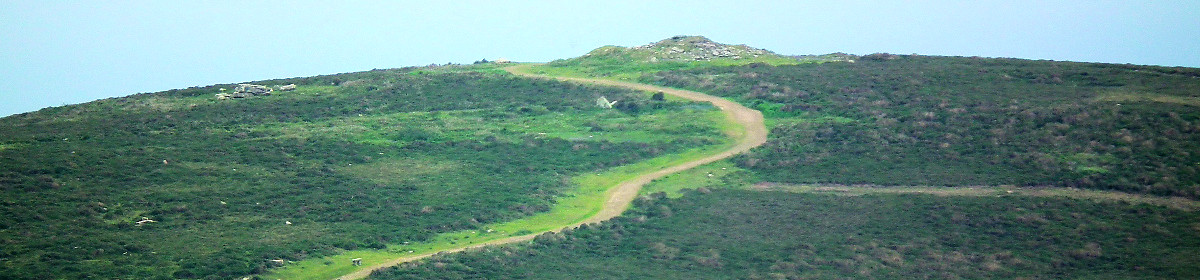
Looking uphill from Bosigran. Carn Galva, a Neolithic Tor, is on the left
Going back to the starting theme of this blog… I still have no idea how long I’m supposed to be here. Many people blithely instruct me to think positively and have a determinedly long life, as if to protect them from facing the facts of death. But then, once in a while, I’ll have a choking fit or a sudden dangerous wobble to remind me that my account could be terminated at any moment. Sorry, but we don’t choose in advance the moment and manner of our passing. It’s possible to feel it coming, but the time and circumstance are unknowns.
This is the case for everybody, but it’s rather different when cancer or another terminal illness comes along. It becomes an acute question that can’t be set aside. Before cancer came, I assumed life would go on and I didn’t have to think about it. But cancer placed a yawning gap in front of me, demanding a fundamental change in attitude. Life became a very temporary thing.
This unpredictability seems to have been a necessary precondition for the emergence of the new archetype that has been surfacing over the last three years. I seem to be on a new mission, though the duration and extent of it remains a mystery. It’s all a matter of making provisional plans based on contingencies and possible realities.
I mean, what on Earth am I doing starting (with others) a new project, when my life’s going down the drain? But there’s something about the approaches to death that accentuates remaining, outstanding issues – things that need to come to some sort of completion before we go.
At present I’m involved with starting the Belerion Project, researching the ancient sites of West Penwith.[3] I cannot be its leader because the clock is ticking on me, so I need to render myself expendable from the beginning. That’s a happy challenge and a refreshing change, for a rather reluctant and jaded leader-type like me.
This project means a lot to me on a deep level – something to do with connecting with the deep memory of an ancient British selfhood. A selfhood who sat in the Oracle Chair at Bosigran, shrinking into the quartz to probe the depths. A man of knowledge who had realised that – as my Tibetan teacher Gyalwa Karmapa once put it – it’s all just like a fart in the Void.
The whole lot… a pile of crap. Life is a surprisingly rapid foray into a very strange world. And here we all are, doing a funny dance on Planet Earth. But remember, the idea behind educational courses is to graduate and then move on, readied for service.
Some days I have days where inspiration-levels droop, so I rattle off a podcast or a blog, if I can muster up a gem to start with – a starting thought. It’s a way of getting inspiration-channels moving, and sometimes something good comes out. Not always – I have quite a few rejects.
A few days ago I was feeling a bit like that – the cancer drugs were affecting me, I’d been on my own too much, it was raining and foggy, and I was casting around for a spark to give me some ignition. Oldies sometimes need a bit of that – ignition. And going to rest in bed isn’t that inspiring once you’ve done it for some years. Yes, even with the amazing view I have out of the window from my bed.
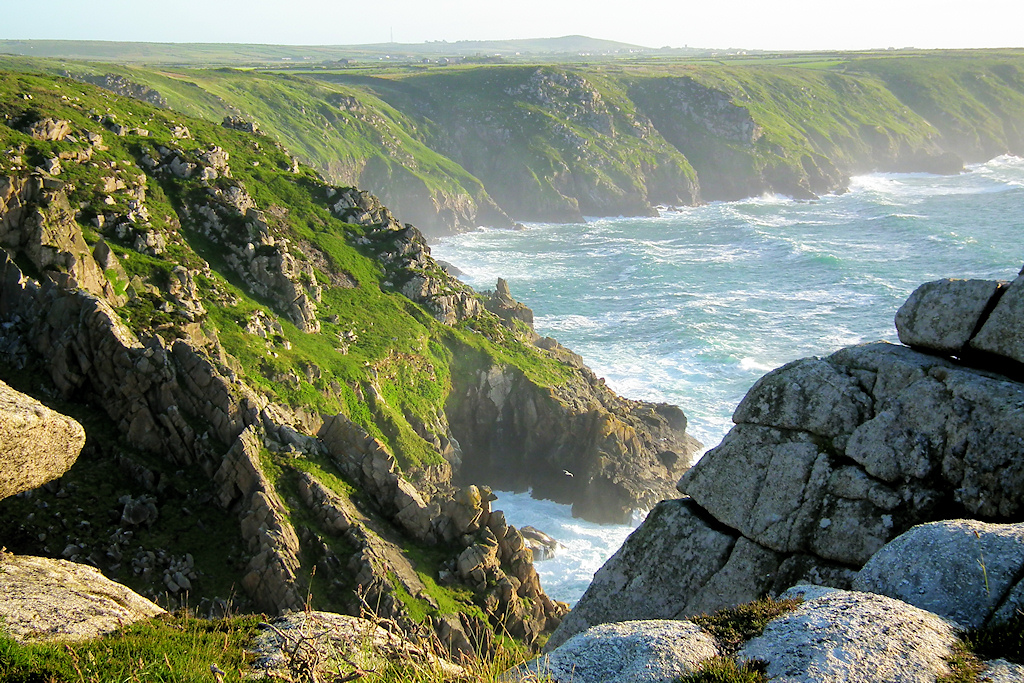
Bosigran Castle, a cliff sanctuary, West Penwith, Cornwall
It has been one of my pathologies in life – a wee ability to ignite people and things, providing a spark that sets things in motion. This is part of the role of an astrologer, but I’m one of those who has got his fingers in various pies over the decades, for all sorts of reasons. Some of these spark-moments I hear about or see the results of, often years later, and some I hope have happened anyway, somewhere, sometime, whether or not Schroeder’s Cat was watching, and unbeknownst to me. I’m happy about that. It has been a privilege to participate in people’s lives in that way.
I’m still at it – helping our proud nation raise, widen and deepen its true productivity levels, the true GDP of our people, through helping people fix their souls, and periodically managing to pass them occasional keys that open doors. Except nowadays I’m doddering around like an old fogey on sticks, wondering when the next seat is likely to appear. I go at about one-third of the pace of most people. I’ve passed my best-before date, so at times I have to work at finding a spark to ignite the old creativity-plugs.
I made a deep, bone-level decision during this winter. I’d been building up for it ever since getting stricken with cancer in late 2019. Perhaps it wasn’t a decision, more a confirmation or full acceptance of something I knew was the case but perhaps didn’t have the confidence to really go the whole way. It was like a conversion.
I decided that I shall not die for medical reasons.
Before you start overthinking and wondering what I mean, I mean this… I’ll die because it’s time and I’ve had enough, I’ve done what I came to do and to be (well, more or less), and because the angels no longer need to prop me up, and because I’m ready and cooked. Whenever that happens, I imagine I’ll go out quite quickly – y’know, an armchair job, or in my sleep, or a quick illness.
We shall see. Or perhaps tha angels might pull another trick and give me another lesson to learn. Sorry, mate, you don’t always get what you want! And what do you mean by ‘a good death’ anyway? Are you kidding?
Anyway, there’s not far to go – it’s months or a few years, as far as I can tell. But this isn’t to do with time. It’s to do with the fulfilment of all that needs fulfilling. Or a decent enough amount of it to lay it all to rest and hand in my cards.
There’s another thing too: dying is a part of life, not different from it, or a disjunction. It’s not ‘things going wrong’. It’s a continuity, a transition into another state, and the bits need to be in place for that, ideally. But once the bits are in place, you need to do it, to give permission for the tide to lift you up and take you away.
However, as you might already have found, our ideals often lead us along trackways that lead us all over the place – life on Earth is really complex and easy to get lost in. The path is rarely as straight and simple as it looked on the map. Or perhaps ideals trick us into doing things we’d run away from otherwise.
Who knows when I’ll drop off my perch? Do you know when or how you’ll drop, yourself? Probably not. I’ve been an astrologer for fifty years and I can’t answer that one. I don’t even try.
We don’t exist as individual selves as much as we would like to believe. We Westerners value ourselves very highly – y’know, it’s 400 Palestinians exchanged for six Israelis. And we make a big deal when people pop their clogs and remind us of our own impermanence, frailty and helplessness. We make stone memorials to them, as if to keep them pinned down in our world. We think of dying as a loss, as things going wrong, as loved ones leaving us.
In life we’re supposed to be on top of things – clearing that list, keeping to the timetable, doing what’s required, being responsible. But in the other world, well, that’s irrelevant. It’s necessary to allow ourselves to immerse and drown in the void and float through the vortex, to that far-off place where you no longer need to pay bills or fill in forms.
Ah, correction… unless you create that reality for yourself up there too! This can arise out of the illusion that, as long as we’re doing something, we must be alive. So we keep trying to do things, even when death is busy netting us.
But the big secret is, when you get there, to that expanded moment when your heart stops, there is nothing more you can do about all that, about that life you had. It’s over. Kaputt. Gesloten. Finito. Gone.
Then you’re in another world.
Palden at Bosigran, recently. Photo by Selina al-Mukhtar.
The fascinating thing is that we have karmic threads that permeate our lives and crop up in all sorts of ways in those lives. Since the soul does not exist within the experiential and sequential narratives of time, it lives all of its lives, from its viewpoint, at the same time. No time. Therefore, there is interchange and multilogue going on between our different lives, both on Earth and off it, and continually.
Think about it for a while… that’s rather a big thought.
For me, one of those karmic threads over several lives has been about calling together groups, clans, armies and throngs. This is a bit weird, because I’m quite a hermit too, or I prefer beavering away in the background. I’m not always doing that pulling-people-together trip, but in certain lives I’ve had that (shall we call it) calling or duty. In the life I’m now speaking from, it was called ‘The Camps’, and a number of readers will have been at them in former decades. And they still progress whether I’m there or not. Loads of other gatherings, groups, circles and networks too, and not only in this lifetime.
Some good people were key souls in making the camps happen – sister and brother souls who formed a constellation of energy and logistics to pull off a miracle. I dropped in the seed-idea, which was quietly formulated with a small number of people in our kitchen at the time, bless their souls, who ended up ‘holding the energy’ at the camps. A few are dead now, and others ageing. I get the feeling we’ll find ourselves meeting up again upstairs though.
In unconscious anticipation of this, the name of the cafe at the very first three seasons of camps around Glastonbury in the mid-eighties was called ‘Pie in the Sky’. Precisely. You’re welcome to come along, when you get to heaven.
Bosigran Castle as seen from Pendeen Watch direction
Anyway, when I started writing this it was intended to be a few paragraphs. As you see, it turned into more than that. But then, with loads of planets in Pisces right now, whaddya expect except slippery, bouncy dollops of the Great Unknown? So you got this diatribe. Apologies – I’ll go away in a moment. Nevertheless, it’s AI-free and much better than just re-posting neat memes with someone else’s pictures in the background. I hope.
The idea was to tell you about a new podcast. Recently I’ve been going on a bit about other worlds, other millennia, flying souls and random outbursts of imagineering and, this time, I thought I’d say a few things about life on Earth. If you’ve been there, or if you find yourself there now, it might give you a few interesting perspectives, while you’re busy doing the ironing or trying to figure out how to fix your car.
Or not, as the case may be. Who knows? Eitherwhichway, the pod is what came out of my brainbox and voicebox one rainy day when no one was looking. Except for the robin who sits outside eyeballing me expectantly and wondering what I’m doing.
Oh, and by the way, remember the Sunday meditations. They happen every Sunday on a cushion near you. Follow the link below if you need details. Keep it simple. Just do it.
Love from me. Paldywan.
The found sounds at the beginning and end are from recent early mornings on the farm in West Penwith, Cornwall.
This is particularly for people affected by cancer or any other serious or terminal illness.
I’ve been a member of the Honourable Company of Cancer Patients for over five years now and, amazingly, I’m still alive, and against the odds. I have a blood cancer, Multiple Myeloma, and I didn’t expect to live this long.
I waded through the tough grind of chemotherapy and dealing with physical disablement. I went down, nearly fell through the cracks, and found myself emerging from a dark tunnel around three years ago.
I found myself starting a new life – well, kind of. I have no idea how long I am to live – it could be next month or five years. But I found a reason to be alive.
This podcast is not about the medical stuff: it’s about the experience of cancer and what it can do to us. Deep in our soul.
This is my fiftieth podcast from the far beyond. The birds in the intro and outro were recorded here on the farm early in the morning on 19th February 2025. To me, they’re medicine birds – especially the geese, who overwinter here.
Yes, you’ve probably done it before -getting dead, that is. While this involves falling into the Great Unknown, swimming in the Vastness, it’s in your personal bundle of knowhow, somewhere deep down.
This February 2025 Aha Class was about the process of dying and what happens afterwards. The talk comes in two parts. They’re here:
I’m drawing on personal experience. This is what it’s like from the inside – at least, as I have experienced it, and the way I see it.
The range of possible dying experiences is vast, actually, and tailor-made for every soul according to our karmic dispositions and where we have got to in the lifetime we’ve just had.
The audio recordings of this two-part talk are ready and out now. Save them for a good moment – this is a special one.
Next month’s Aha Class is about geopolitical healing – working inwardly with wars, disasters and the deeper levels of the issues at stake on our planet at present.
The next Aha Class on Weds 12th Feb 2025 at The Hive, Penzance, Cornwall.
Receiving cancer into my life five years ago, I’ve looked in the face of death several times, and quite experientially. In fact, at present I’m surprised, even rather disoriented, to be alive. But it didn’t start there – this has been an evolving theme of my life. So in this Aha Class I’ll be sharing some insights and perceptions I’ve picked up along the way.
I had a life-changing near-death experience at age 24 – accidental food poisoning (hemlock, actually). I was unconscious for nine days, awakening with much of my memory wiped clean. Not long afterwards I met up with Tibetan Lamas, who taught their perceptions of life and death, about the bardos, the differing realms of existence, of which life is but one. Frankly, their blessings and kindness kept me on the rails during a very difficult time.
Then I became involved with campaigning for home-birth, following the births of two of my daughters. To me, a good natural birth made inherent sense with no need for rational explanation. Later in life I was even able to communicate with a soul before his birth, and he talked to me about what it was like being in his (to us) little world.
Later, from the 1990s onwards, I found myself working psychically with dying people, helping them over to the other side. Some were people I knew, and others were in conflict zones experiencing tricky deaths. Having been to the edge of death myself, I was able to help them transition – holding their hand and going over with them. It was remarkable how variable their experiences were. I was also part of a group (the Flying Squad) in which amongst other things we did psychic soul-rescue work in earthquake and disaster zones.
Since getting cancer five years ago, I’ve been hovering close to the threshold myself a few times. This has been a true education. Hovering on the boundaries really made me aware of the contrasting issues in both worlds. I feel reasonably comfortable about dying: in my way of seeing things, I’ll be going home. Well, at least for a while. I’m a bit beat-up and in need of deep healing.
I see things from the viewpoint of reincarnation. Looking at things this way, getting born, being alive and getting dead take on a new light. There’s something of us that continues through all of this. A newborn baby is not a blank slate devoid of character, and a person who dies doesn’t just stop existing – it’s a journey of the soul. Not only this but, as many of you might have found, being a witness to a birth or a death can be a wondrous and spirit-showered experience in its own right.
Dying is like an assessment of where we’ve actually got to after living a life. In the end it’s our own assessment, though it might take the shape of St Peter, or a wrathful deity, or a wise old angel. It comes from a place of truth, perspective and far-seeing that dawns in us during the dying process. This dawning can happen before, during or after clinical death, depending on where we are at – in terms of what we have truly become. This sounds serious, though it can also be joyful and a relief. It all depends on what we have done with our lives and where we have come to with it all.
This isn’t about judgements like ‘right’ and ‘wrong’. It’s about seeing the true and full range of causes and consequences arising from all that we have been part of – what we have done and not done during those defining moments, those periods of time and those dramas we were in. There’s an understanding, a forgiveness, a grace and mercy to it. We come to understand why things went that way.
Dying before we die: this can make the dying transition easier, decongesting the process. Getting stuff sorted before we go – and not just writing our will, but clarifying things in our heart and soul, in truth and ‘before God’. We all need to do a reckoning, a forgiveness, a resolution and a releasing, with ourselves, people and the world.
It was as it was. What have I learned from it and what have I become? I’ve made mistakes and done things I’m not happy about, and it’s a process of owning up and squaring with it. In some cases I’ve done things to rebalance or rectify things, and in others I have not. Even with unresolved issues, it’s necessary to accept their unresolution.
There’s also a balancing factor – the things we’ve done that we can be happy with, that brought forwardness to others and the world, some of which we did precisely to redeem our own shadows, to pass through a karmic gateway. Part of this reckoning involves acknowledging our strong points and things we are glad about.
So this talk is for anyone facing death, or witnessing it in a person close to them, or feeling bereaved, or working with dying people, or preoccupied with the deep-seated questions that life and death raise. Actually, if truth be known, that’s everyone, but we have room for thirty-fiveish people at the Aha Class! It will be recorded and posted online afterwards.
I take a rather left-field and spiritualistic approach to all this. Whether or not you agree, I hope this talk might help get you into the zone, elasticise some ideas and set some things in motion. In our modern Western culture we have a big taboo around questions of birth and death, and this is very strange and not to our advantage. Even so, every one of us got born (well done) and every one of us is heading for the exit (good luck). So perhaps it’s worth giving this matter a little attention.
Do come if you can. If you can’t, the audio recording is posted online about a week afterwards.
Yes, that’s the drug I’m on today, together with Lenidalomide, Dexamethasone, Apixaban and Aciclovir – it’s enough to make pharma-paranoiacs run a mile. Many have been the messages I’ve had which recommend all sorts of alternative means of staying alive. No doubt well intentioned, I nevertheless find myself writing back to ask whether they have actual experience of what they recommend – which has mostly not been the case. Most seem to think I have a ‘normal’ cancer, without actually knowing I have Multiple Myeloma, an incurable blood cancer and definitely not normal.
I’ve listed all the holistic supplements, remedies and methods that I use in my cancer treatment in my book and audiobook ‘Blessings that Bones Bring‘. With a philosophy of counting my blessings, I’m doing both pharma and holistics, and it works, and the ideological contradiction between them that many people set up for themselves is something I gladly omit to subscribe to.
Just as well really – I’m alive against the odds. But the biggest medicine of all is this. If you are practicing your life-purpose, the reason why you came here to Earth, as a priority, then you’re likely to stay alive until it’s reasonably complete – whatever that means. However, here’s the rub: for some people, dying and the manner of their death can also be part of that life-purpose. Princess Di was an example.
It’s an initiation. You might be a smart-arse with a masters or a doctorate, but they will not qualify you for this. What’s needed is every single cubic inch of humanity you have in you. It comes at you, takes away your control and takes you off, out of your body to another place.
Or perhaps you believe it all goes dark and the you that is you somehow suddenly stops being you – you’ve become a useless pile of dust returning to the dust. Well, good luck with that, though you might be heading for a few surprises. In my experience, the journey doesn’t stop there. Just as well really.
I do have a strange tendency to believe that there’s more to existence than that. The last five years, since cancer gave itself to me, have reinforced that belief. If indeed it is a belief. After all, do I believe in breakfast? Do I believe in trees, rain and sunshine? I’ve been really close to dying, several times. Actually, I shouldn’t be alive – and that’s not a medical opinion but my own observation. I’ve made it through thanks to a series of miracles, a few acts of faith and a strange capacity to rebirth myself. Plus the prayers and goodwill of friends, the blessings of guardian angels, and… work. Yes, work. Working at the reason why I came, and whether I’ve done enough of it to feel satsified with a job well enough done.
Much to my surprise. I wasn’t expecting to be alive after five years, and it leaves me in rather an open space. I thought that at most I had three years, and now I’m on extra time. It’s a matter of figuring out how to make plans while knowing that I’m vulnerable enough, and my grip on life is tenuous enough, to pop my clogs tomorrow or the next day.
For me, it’s a matter of taking charge of my death. It’s my decision – not anyone else’s. Except perhaps for those angels. A year ago, my haematological specialist at the Royal Cornwall hospital said to me, “Well, Mr Jenkins, I don’t know what you do, and I don’t want to know but, whatever you’re doing, keep on doing it“. Indeed, I did, and I’m still here. I’m an easy customer for her – I get few complications, I’m uncomplaining though I’m also calm and clear about certain issues, and she leaves me to my own devices. No, not toxic digital devices, but devices such as intuition… and inner doctors.
Yes, I’ve got some inner doctors. I called them in at an early stage. My angels shunted a few in, too. Once a week, I have a session with them (and at no charge). I go into myself, breathing myself down into a deep state, and I open myself up to them, and there they are. They examine and scan me – using psychospiritual technologies that make Startrek look primitive. I feel them umming and aaahing over things, and consulting, and sometimes I’m flooded with light, or they insert a light-tube into me, or they focus on an organ, and often I’m not at all sure what they’re doing but I can feel them doing it.
At times they raise me up to their level and it feels so friendly, inclusive and welcoming there. I kinda hover there, on my back, held in the middle of their energy-field and jiggled, poked, massaged and blessed by invisible forces. After a while they drop me back down again.
It’s funny how it works. The doctors at Treliske have been worrying about the fact that I’ve been a lifelong smoker – it helps my brains and, as a psychic, also helps me stay on Earth – since I am not a foodie, which is the other way many psychics stay on Earth. So I was to go in for a lung scan. But during my last session with the inner doctors, I did two things. One was to ask for their help in cleaning out my lungs and removing anything that’s unhelpful, and the second was to offer myself up and release all hopes, fears and expectations, to get to a state of full acceptance that, whatever is to happen will happen, and it will be good.
So they flooded my lungs with light and I felt them doing something there. I continued with this in the days that followed but, the day before the scan, the thought came, “Hmmm, this needs more time…“. Claire, a trusty helper from over the hill, took me for the scan. I walked into chaos – the power had gone off – but eventually, on the second interview, the nurse said, “Ah, Mr Jenkins, I’m sorry to say that we can’t scan you because you had a PET scan last August and we cannot scan you more than once a year“. I quietly chuckled. Yes indeed, this needs more time, and I’d just been given it. The nurse didn’t notice me looking upwards and smiling. This is how it sometimes works.
I thanked her for her consideration, saying I am electrosensitive and it matters to me. “Ah, that’s interesting“, said she, proceeding to ask questions as if she knew about it. This was refreshing: in the last five years only one doctor has indicated interest. He showed me a paper in The Lancet which correlated incidences of Multiple Myeloma with proximity to nuke stations. Since then I’ve met other Myeloma patients who have worked operating radar systems, driving nuclear-waste trains from Sellafield, working as high-tension power cable or mobile phone engineers, or as programmers who’ve used a lot of wi-fi…
Once information about EM-radiation is finally made public, everyone will no doubt bleat, “But why weren’t we told?”. To which the answer is: “Why didn’t you feel it and use your commonsense? Did you think it would be alright to irradiate yourself all day and every day without consequence?”.
Well, we humans… we find quite intricate ways of limiting our possibilities and making life difficult. The same applies to me. However, while I have my own self-immolating patterns, I’ve also looked after myself and now find myself still alive as a result – if proof be needed. I’m definitely glad that, at an early age (21) I went vegetarian and changed my life – it has paid off. Yes, I got cancer, but my capacity to deal with it is far greater than most people’s, because on the whole I’ve had a good diet and lifestyle, having built up a good reserve stock of resilience.
But here’s what in the end is the key bit: I’ve been following a growth path, with fewer diversions and denials than most ‘average’ people. If you live on purpose and in purpose, it gives you distinct reasons for staying alive.
But even then, the stories of our lives are multiplex and not limited to being alive in a body. Many of us aren’t even fully installed in our bodies, even when emotionally attached and afraid of losing them. The Council of Nine put it quite well…
“Your Planet Earth is the most beautiful that exists in the universe. It has a physical variety that no other planet has. It has a varied climate that no other planet has. In all the universe there is no planet in existence that has the physical characteristics of Planet Earth. It is the rarest of beauties, and it does attract souls which, once they have come, would like to come back again. This has created a bottleneck of souls recycling on Earth.
“It is of a different nature from any other planet. It has aspects of all planets: it is like a composite of the Universe, with all the positive and all the negative aspects, and all in between, and this is what attracts souls.
“It has with it a gravitational pull that is different from other planets, and because of this a soul begins to feel a physicalness. Souls become adapted to their physical bodies, and they forget the freedom and pleasures they have without it.
“The Earth was created to be a paradise. When souls achieve harmony it will become a paradise again. Planet Earth is the only one of its kind, the only planet of free [individualised] choice in the entire universe, the planet created for the balancing of the spiritual with the physical – in other words, the creating of paradise.“
To some extent this ‘paradise’ business is an attitude of mind. In a funny sort of way, since getting cancer and becoming partially disabled I’ve been happier than before. It’s all to do with how we deal with the life we’ve been given. Nowadays, a lot of people do a lot of complaining about life, as if it’s all someone or something else’s fault. But my best recommendation is, just go to Gaza, Yemen, Sudan, Belarus, Syria, Ukraine, Xinjiang or Myanmar – there are plenty of options – and do a full-spectrum re-assessment. You might find that you come to feel differently about things. That’s what happened to me.
Yeah, life’s a bitch, then you die. However, here’s another gem from the Nine: no one is here by accident.
So, you see, even on pharmaceutical cancer drugs, you can do something with it to make it good. That’s where that free, individualised choice truly lies. It’s on us, not anyone or anything else.
I didn’t expect to be alive today. Yet here I am and here we are, and this is it. We’re a quarter of the way through the 21st Century.
Born mid-century in 1950, it’s rather an age-marker for me. In my twenties in the 1970s, I didn’t really expect that the world would still exist in 2025 – it seemed an age away, and back then the world’s prospects seemed very much at risk. They still are.
It feels as if I’ve lived several lives since then. A new one started in 2019. As a cancer patient since then, I haven’t expected to be alive now either. Five years ago it felt like I’d reached the end, with just one year left. My body was on its last legs, wrung out with pain, I felt like a ninety-something and it seemed as if my angels were close, eyeing me and laying the tracks to receive me.
Or perhaps they were hovering there discussing what to do with me next. Two years later, reviving from a crisis, I woke up one morning with a voice in my head, saying, “Ah, there’s something more that we’d like you to do…”.
Here I am, wondering what’s next. Life is still very provisional. I have a form of blood cancer that can’t be holistically melted away, medically cut out or irradiated. It has permanently changed my body, giving me partial disablement and about 7-8 different side-issues. It’s called Multiple Myeloma because it shows itself in many diverse forms in different people, though it particularly affects the bones – it’s also called Bone Marrow Cancer.
Things indeed are provisional: recently I took on a booking to speak at a conference in May and I wondered what state I’d be in then. However, I’m accustomed to performing in whatever state I find myself in, and if I’m wobbly and unwell I’ve found that, onstage, I can nevertheless be right on form, with my thinking, planning mind already nudged to the side. So unless I’m actually dead, the conference talk should be alright.
But I still get anticipations and, over Christmas, I worked through a good few of them – one being a fear that my cancer might be spreading and becoming something else, something more. I’m having tests later in January.
To be honest, the fear comes from a creeping feeling that whatever happens next might be too big for me, that I can’t handle it. It’s precipice-fear, ‘little me’ stuff, and the kind of fear a little boy gets when looking up at the big, wide world, feeling overwhelmed by the prospect of getting to grips with it all. I spent a few days grinding through this stuff. Then I started emerging from the other side as the newmoon came.
In life, having been through quite a lot of grinding and scraping, I seem to have made it through. So there’s a good chance I’ll make it through the next lot, somehow. They call that resilience. Though, for me, it’s as if that resilience is rooted in a strange mixture of wobbly vulnerability and an accumulated knowing that I’ve done it before and I can do it again.
If I work through my fear in advance, I tend to unmanifest whatever I fear because I’ve already faced it – or at least I start facing it and showing willing. Or it becomes changed, turning out differently and easier than it looked. Or it becomes advantageous to feel the fear and do it anyway, since it then becomes a nexus of breakthrough. I learned this in conflict zones: I’d shit bricks before I went and often I’d be dead calm and on form when I was in the middle of crunchy situations. There were only some cases of bullets flying (I was quite good at not being in places where trouble happened), but there’s a lot of chaos, tension, mess, pathos, pain and complication in conflict situations, and the psycho-emotional aspect of war was very much there.
Right now, I’m not as close to dying as I have been at various times in the last five years. Cancer came during 2019 with no detectable warning, so I didn’t have to go through anticipatory tremors about cancer beforehand, like some people have to when they’re given a diagnosis. I hadn’t felt good in the preceding six months, though it had seemed like a classic down-time that I would hopefully pull out of. But then one day my back cracked while I was gardening. The four lowest back-vertebrae had softened, and in that moment they collapsed. From that moment my life was irreversibly changed. Even after that, for two months it seemed like I had a very bad back problem, though eventually a brilliant specialist in hospital identified Myeloma. Already half-dead, the news hit me really hard – also hitting my then-partner and son, who were involved too.
But when disasters strike, I tend to be quickish to adjust, crashing through the gears of my psyche and getting really real – I don’t waste time fighting it once I realise it’s a full-on crisis. There I was, in total pain, hardly able to move, feeling wretched, and the doctors were saying I had perhaps a year or, if I was lucky, I might survive – they couldn’t tell. I wasn’t expecting this.
There’s something rather special about coming close to death. Everything simplifies dramatically, and many of life’s normal details and concerns evaporate. You’re faced with the simple, straight question of surviving or dying – and the meaning of life. Is this it? Is this the end?
This simplification is a necessary part of the dying process. Many of life’s details that we believe to be important are not actually so. On the other hand, certain experiences and life-issues come to the fore – things we’re glad about, things we regret, things we missed, things we sidelined, things we got right and things we screwed up.
Many of the things that people and society judged to be wrong, bad or inadequate… well, these are the judgements, narrownesses and prejudices of the time and the social environment we’ve lived in. Things that conventional society considers good – money, success, status, property, fame – become diminished, or they flip, turning inside out so that the price we paid for them reveals itself. We might have had a million, but were we wealthy in spirit? We might have a doctorate, but did we really understand? We might have taught a thousand people, but where have they gone?
It depends on how we respond to the arrival of death, and a key part of this is forgiveness of others and of the world, for what they did and didn’t do. There’s also self-forgiveness for all, or at least most, of the ways we have let ourselves down, got our hands dirty or avoided the main issues and the bottom-line truths. Forgiveness lets new, non-judgemental perspectives come through – seeing how things actually were, from all sides, as seen in front of the backdrop of posterity. This deep simplification and clarification is a necessary part of the dying process, and the more we can accept it and make it our own, the better things tend to go.
The more we have faced the music during our lives and amidst our life-crises, the easier this gets at death. Dying is a gradual, cumulative process for many of us, unless we pass away suddenly – it’s not just about our last breath. There’s the matter of dying before we die – going through at least some of those squeezy, grindy processes that we’ll meet at death while we’re still alive. It shortens the queue of issues that can come up around the moment of death.
When I was younger I thought that my growth would slow down in old age – this is not so. It’s going like the clappers. My capacity to process emotions and profound issues has slowed, though it has also deepened to compensate. Nowadays, when faced with a crunchy issue, I need more time to process it through. But there’s a cathartic element to it that makes it easier – a bit like writing a resignation letter and having done with the whole thing. So the big let-go and the forgiveness process seem to accelerate inner growth in the final chapter of life.
Strangely, in late life, recent memory fades relatively and longterm memory comes forward. The recent and the more distant past rearrange themselves, taking on a different perspective. I’ve found myself working through issues deriving from decades ago, together with lifelong patterns that are exposed by things happening now, and sometimes by feelings or memories that blurt up from the hidden recesses of my psyche. In late life we’re strongly encased in our patterns, laid down, routinised and reinforced over the decades, like clothing we can’t quite peel off.
After all, if you are, say, 72 years old, you’ve eaten over 26,000 breakfasts. There’s not a lot we can change because it’s already done. The consequences are with us and there’s no Undo button. But that stuckness in our karmic patterns can be repaired too, if we let it.
We can change our feelings, our standpoint, by learning from the lessons that life has thrust at us – the deeper, more abiding, more all-round lessons. In the end, there is no right or wrong to what has happened in life, though there certainly are consequences – and that’s where our choice and options lay. But it was done, time has moved on and the page has turned.
It was as it was, and now there’s the future, and whether we actually change our behaviours, beliefs and befallings. We need to sort it out with ourselves and with others, if that’s necessary and possible, or accept it, or change the way we feel about it, or own it, or drop it – or do whatever brings some sort of forwardness. That’s a key aspect of life on Earth: living in a perpetually-changing dimension of time and creating forwardness out of the situations we encounter along the way.
If only it were that simple. It’s so easy to forget and lose our way. We get brought back to it when we get to the end of our lives. What was all that for – that life? Am I happy with what happened? Have I become something more than what I was when I started? Did I do what I came here to do?
I’ve been a good boy and a bad boy. I’ve done things I feel happy about and things I regret. I’ve helped a lot of people and hurt a good few. Some things I got right and some things I misjudged. My feelings around all sorts of things have changed as life has progressed. Mercifully, it seems to get lighter as I sift through the piles of detritus left over from a life that has been lived, committing it to posterity one spoon-load at a time.
Though I’ve had a few close runs with dying since getting cancer, a funny thing has happened. I’ve gone through an unexpected inner rebirth – not ‘getting better’ but, as Evangelicals would put it, being born again. The consequence is that, as my spirit-propped condition has improved, life has become more complicated. Part of me seeks that, because I’m not one who can easily sit around weighing down seats, acting like a passive old crock with his head plugged into a TV. Being a passive care-recipient doesn’t turn me on at all.
Partially the complexity comes at me from the world around, even though it’s me unconsciously manifesting it – recently I’ve been getting five friend requests a day on Facebook, presumably because an algorithm decided I’m a somebody. Oh, thanks. I do like friends, but keeping track of it all is beyond me now. To me, a friend is someone who mutually brightens up my life like I might theirs. (Please ‘follow’ me instead!).
I’ve even been setting a few things in motion. Whether they will work is another matter, since I cannot organise them myself as I used to. The three main ones concern the Tuareg, the Sunday Meditation and the ancient sites of West Penwith.[1] My likely short shelf-life, being unpredictable, and the dysfunctions of my brains, make me thoroughly unreliable in organising things.
Also, there’s not a lot of point starting something if it subsides when I pop my clogs. So I’m scattering some seeds of possibility for other people to take care of, if they will, to see whether or not they take root. Which they might, or they might not, and that’s okay. As a reserve option I’m leaving a biggish archive of work online in case someone picks it up, sometime in the vastness of the future. There’s a remarkable loss of control that accompanies dying, and this is one aspect of it.
So dealing with complexities has been quite a big one. I’m asked “How are you?” seven times a day. The answer is, “Well, I’m like THIS, really!” Do you yourself do a systems-check seven times a day to monitor your condition, and can you articulate it in words each time? Even so, I appreciate your concern and good wishes, and I write these periodic blogs to let you know how I am. When they stop, you’ll know I’ve gone, or I’m on my way.
I’ve written before about dying being a gradual process, and I’d call myself seventy-ish percent dead at present, and stable (as it goes) – I go up and down each day. Today (Wednesday 1st January) I’m working myself up for a hospital visit tomorrow for a three-monthly check-up, and a generally friendly but virologically-dangerous period of waiting for it in waiting rooms. Meanwhile, my stalwart friend Claire will sit outside in her car, reading books and twiddling thumbs in a shopping-mall car park – very exciting. I have to work myself up for events like this, and the day after I’m often rather wiped out.
It’s worth thinking about this continuum. Yes, part of you is already dead. That is, part of you is in the otherworld, where your soul, in the timeless zone, is closer to eternity than you currently feel yourself to be. This is of course an illusion – it’s more a matter of where we place our awareness and what we give attention to while we’re alive. That’s one reason I do the Sunday Meditations: to give busy people a manageable, uncomplicated, regular time-slot in which to give the soul a little attention. Do it for a year and you’ll have done it fifty times. It’s like a weekly shot of cozmickle multivitamins. Good for helping face life and its rigours.
Oh, and by the way… lots of people use funny ways of talking about dying, as if not wanting to mention or face it. Like, ‘passing’. Be honest: it’s called ‘dying’. It happens to all of us, inescapably, and you’ve done it before. Even Elon Musk won’t be able to buy himself out of it, on Earth or on Mars. It’s an integral part of our life-cycle, just like getting born. In the Tibetan way of seeing things, the whole of our waking lives are equal in experiential magnitude to the apparently much shorter processes of getting born or getting dead. It’s all about experiential intensity.
During life, moments of crisis that come up can be rather like dying. They’re moments when time stretches in duration while compressing in intensity, when everything comes to a head, crunching together – and these climactic experiences are our training for the expanded moment of death, when we transit, float or squeeze ourselves into another world, whether in peace or struggling with it. How we deal with our crises in life has a big effect on how we deal with our dying. We can make it easier or we can make it harder. The funny thing is that, though dying involves a complete loss of control, it involves possibly the biggest choice and free-will opportunity of our lives since we got born.
My Mum did that. At the end of her life, at age 92, she just could not handle more hospital stays, medications, discomforts and indignities. She made a big decision to stop taking her medication, and she was gone in a few days. Good on you, Mum: you made that choice. It was a big choice, and you did it. Believe me, my Mum wasn’t into meditation and cosmic stuff at all but, in the end, she exercised her choice, a soul-choice. I have a feeling she has flowered in the otherworld.
If you have cancer or any longterm, life-changing ‘condition’, this might interest you. Or if you’re a friend, family member or helper. It’s an audiobook about my cancer process and what I’ve experienced and learned through it. There’s also a text version if you prefer reading.
I have a blood cancer called Multiple Myeloma – typically for me, it’s not one of the common cancers. It has particularly affected my bones, leading to a clutch of other issues too, partially disabling me. Hence ‘multiple’.
This book is for you who might seek a different, deeper, wider approach toward cancer, not so much medically as attitudinally. Here I simply share my experiences, which have worked for me, and it might well give you a few lightbulb moments.
Medically, I have done both chemotherapy and holistic remedies and helpers – a middle path – and my results are good thus far. But the main focus of this account is psycho-spiritual. Yet very real too.
It starts in September 2019, before diagnosis, shortly after my back cracked and my life changed. It covers four years. I guess the story ends whenever I leave my body and life behind. If I am able, I’ll keep writing until I no longer can, and a later edition might take the story to its end. We shall see.
Distilled from a blog, this book more or less retains its blog format, with adaptations and improvements. In a blog of this kind you write whatever comes up on the day, and it doesn’t have to follow from what you wrote before or lead on to what you write next. So that’s how this book unfolds – a bit diary-like, with thoughts and observations that came up as life went on.
As an avid, lifelong communicator, I have always sought to stimulate people’s own thinking, not simply to persuade them to adopt what I say or write. Some readers might find some of the ideas expressed here difficult to accept. If that is so, I hope these writings help you clarify your own way of seeing things. These are my perceptions and experiences, submitted to you for your consideration.
In a way I went down with cancer. In another way I went up with it. It is very much a matter of how we see things. This profound issue affects our experience of being alive with cancer or any other serious terminal illness. It affects the way we create our future, even if we’re seriously ill. Yes, you and I might be dying, but there still is a future, and not just in this body. At least, that’s what I’ve found.
So this is the story of my cancer journey. It’s free, with an option to donate. Gratitude to all of you who have been part of it and helped it along.





















You must be logged in to post a comment.