My website has just gone through its Saturn Return – 28 years old. Erk.
Born in the antediluvian days of the ‘information superhighway’, when John Major was prime minister…
Every coupla years I’ve added an extra bit to it, and it’s like a new age minefield now. Tread carefully.
Unless I suddenly earn a million between now and the time I pop my clogs (with Jupiter in Pisces, such things can sometimes happen, as a kinda cosmic joke!), this is the legacy I’m leaving.
Wurdz. Bl**dy loadsa them.
Perhaps you might now understand why, in late life, I’ve developed a slight allergy to sitting at my computer to chat with people… (‘cos computer keyboard=work, for me).
It started with pink and green punchcards on tea trolleys in 1971. I was on the world’s fourth largest computer at the time (London Univ), and it had a memory of 56k – hot shit! We had the latest tech too – dot-matrix printers! But no keyboards or screens – they came later.
It was my dear old friend Sig Lonegren who nudged me to get on internet in 1994. Initially I had reservations. Perhaps part of me knew this would be a life-changer. I’d been in printing and publishing for some time, but this… well, I had to get ready for it.
Actually, I was on my Saturn opposition, at age 44. This was a step-change. And then… whoosh… egged on my whizz Avalonian programmer friend Barry Hoon, before long, with him, I was creating www.isleofavalon.co.uk which, by 2002, was getting a million visitors per year. (Apart from the content, people liked it because it had zero advertising – no estate agents or shop adverts in sight, and it worked, for the town as a whole.)
One thing I’m looking forward to when I die is the possibility of returning to direct mind-to-mind and heart-to-heart communication. Paper, print, messages and web-pages, well, they have their virtues, but when we’re talking about ‘sharing’, internet just doesn’t measure up.
As an early adopter of internet, one thing that disappoints me about the way things have gone is that too many people, imho, quote and re-post other people’s stuff and media stuff, and too few actually speak for themselves and create from themselves.
I get five-ish friend requests every day, and I look at everyone’s FB page. If you speak for yourself, you interest me more, and you’re more likely to become my friend. People who hide behind re-posted material or blankish pages… well, please come out and give us a sign of who you actually are!
I do have a way of making uncomfortable statements (a bit like Martin Amis, wordsmith, my age, who’s just died)…
One of them is that withholding is a crime against humanity.
I submit this for your consideration.
Having lived through a remarkable slice of time (1950 to now), I’ve been privileged to be surrounded by and adding to a pool of emergent knowledge that lays foundations for the future. My website’s Saturn Return is significant (at least to me) because it marks a transition from a website to an archive.
An archive of an old codger who saw some stuff and did some things to add to what’s changing in this world. This, on the offchance that, like William Blake, my stuff might be valued more after my passing than during my life!
But then, a Saturnine soul like me has to accept that time makes its own decisions, and his Jupiter in Pisces speaks from the Void, and it can take time for time to catch up with Voidness.
If you wish, join me and us in meditation this evening (Sunday) at 8-8.30pm UK time (7-7.30pm GMT). Let’s give this world a push to get through the rather dangerous Mars-Jupiter-Pluto triangle that’s been firing off for the last few days. Angry stuff – facing the music – grasping the nettle – time to be brave.
Second in a series of thoughts and observations about world healing. For people interested in helping the world evolve and break through, by using meditation and innerwork.
When I was organising gatherings and camps in the 1980s, some quite remarkable things took place that demonstrated the capacity of innerwork to change things. Here’s a quote, about something that happened in 1983:
“The high point of the weekend came when we spent twenty minutes sending meditative support to forty or so Glastonbury women who, that weekend, were at Greenham Common USAF base near Newbury on a major protest action against cruise missiles. The meditation seemed profound – we all were quite stirred by it. Later that day, Lydia, one of the women at Greenham, returned to report that the Glastonbury women had instigated a tearing down of the perimeter fence of the base. “We did it!”, she exclaimed. It turned out they had started doing this spontaneously at the very same time that we had sent our meditative support, earlier in the day.“
I’ll always remember that look on Lydia Lyte‘s face….
In the early 1990s I was asked to write a book on behalf of the Council of Nine, some cosmic beings, not of this Earth, who had a lot to say about world healing, and this set me off on a path.
This later developed into two innerwork projects – the Hundredth Monkey Project and the Flying Squad. In these we developed a bundle of techniques and a body of experience, building up a momentum over a twenty year period and working with all sorts of issues during that time.
Now, in late life, and while I can, I’m bringing together my thoughts on world healing in writing and podcasts, to leave to posterity. This is part two (there might be five-ish).
32 minutes long, with bumbly evensong from our farm, and music by my friend Galen in Oregon.
And here’s a thought. I’m not certain about this, but it’s worth contemplating. In the world’s collective psyche, there’s a certain amount of infection with the psychological thought-virus of war. On the whole, it cannot spread and grow any more than the host body, humanity, will allow – the extent to which it is susceptible. But this thought-virus does not decrease unless humanity as a whole shifts its values to build increased immunity to it.
I’m not talking about conscious thoughts or thought-through policies or actions. It’s on an unconscious level. But I’ve sometimes noticed how, when a conflict subsides in one area, another conflict will come up elsewhere, as if the virus hops from an arena where people have developed immunity (often exhaustion and a desire for normality), to an area where the population is susceptible. It will be vulnerable because of divisive politics, ethnic tensions, oligarchic manipulation, outside intervention and proxy-warring, and sometimes outright madness.
I first noticed this in 1990, when the long Lebanese civil war ended and the multiple wars that broke out as the former Yugoslavia disintegrated.
This dynamic happens in other ways too, and we’ve recently had an example. It’s as if the outbreak of war in Sudan has vacuumed up some of the available violence energy, draining some of it away from Ukraine, where a much talked-about escalation of conflict isn’t really happening – some of its motivating energy has been siphoned off by Sudan.
Sometimes the grief that is experienced in conflicts can be overridden by other forms of grief. This we see in eastern Congo at pesent, where recent flooding has sucked much of the energy out of the complex conflict there. it has shifted the emotional focus.
The recent earthquake in Syria came at a time when the Syrian civil war was subsiding, converting the sump of conflict-grief in Syria into another kind of tragedy. On the other hand, in 1999, earthquakes in both Turkiye and Greece brought a simmering longterm conflict between them to an end.
So if we look at humanity’s collective psyche as an enormous, seething ball of blobs, representing mindsets, and interweaving threads, representing themes and issues, all in perpetual motion, then on the whole there will be a fluctuating balance over time between different forces at work.
This includes positive and multifaceted beliefs too – at times there can be outbursts of negativity or positivity which, over time, balance out. Though despite this, there will also be a slow net shift of values happening underneath. In the last century or so, deaths and injuries from conflict, seen in proportion to the size of population, have actually been decreasing significantly.
It’s useful looking at things this way. This isn’t about Russians and Ukrainians, Democrats or Republicans or the people and the regime: it’s about conflict and polarisation, whoever the current puppets and victims are, and whatever they’re in conflict over – which, to confuse things, might not even be the same issue for each side. It affects all of us variously.
So when we look at current events, it’s important to step back, looking behind and underneath those reported events at the underlying dynamics prompting them. One interesting polarity which I have been personally experiencing is this: strangely, as world population has risen (and dramatically so in recent decades) so too has social isolation and loneliness. That is, with much of the world feeling crowded out with other people, a compensating grouping of isolated people has been growing too.
Even so, those with busy lives and lots of people to relate to will often have a shallowness of relationship leading to an underlying loneliness, even if well-distracted, while those with lots of time tend to be factually isolated, left behind in distant villages or shut in unknown rooms, and they feel it in a different way.
We live also in a world where there are hunger and obesity, and extremes of wealth and poverty, advantage and disadvantage. The issue here is that these polarities have become more extreme, and the natural relationship between them has dwindled – and they live in different worlds.
Same planet, different worlds. Yet even though New York City and the Tian Shan mountains are like different worlds, and though our current obsession with identity obscures our common ground, we are all unwitting participants in one planetary group psyche.
All the world’s a stage, and all the men and women merely players; they have their exits and their entrances, and one man in his time plays many parts, his acts being seven ages.
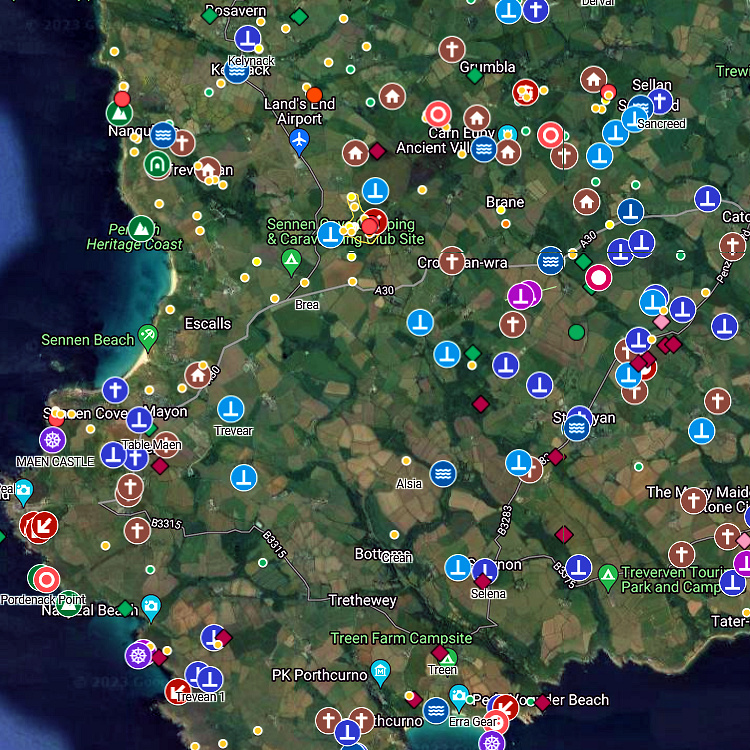
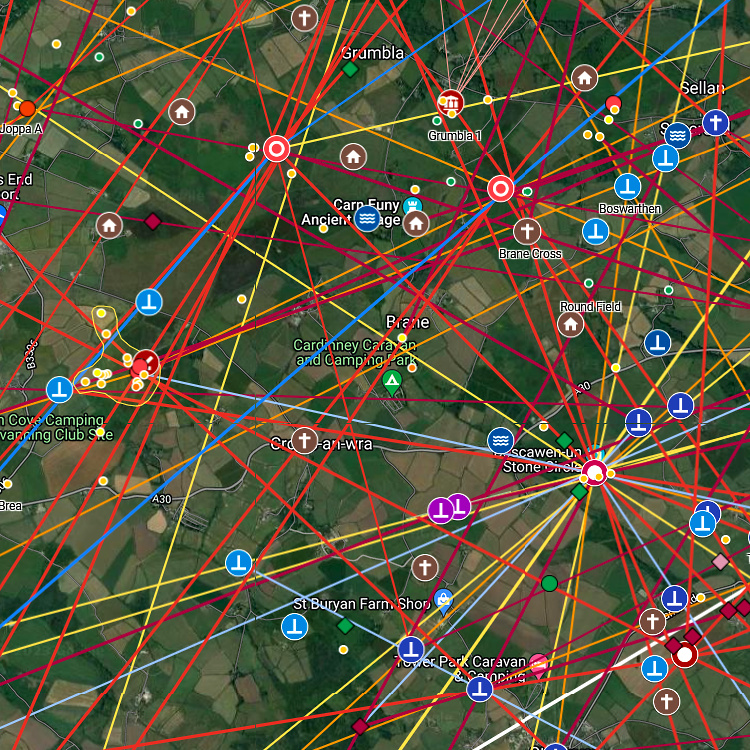
If you’re resident in Cornwall or a Cornwall fan, or you’re likely to visit here this year, and if you’re into visiting ancient sites, these maps are useful.
The last five days, since it has been rainy a lot and quite often really white-out foggy, I’ve been doing my six-monthly updates of the ancient maps of Cornish and Scillonian ancient sites that I’ve been working on since 2015.
There are two main maps: 1. ancient sites 2. ancient site alignments
These are not just maps but also rather encyclopaedic databases. That is, if you click on an ancient site symbol, a popup give you information and links to other sites where there’s more info about that site.
The location of ancient sites is very accurate and these maps can be used in the field, so that you can find sites when tramping around.
However, before entering ancient sites, please switch your phone off completely, so that you don’t pollute the site and you feel and experience the site more clearly.
If you live in Cornwall or are visiting this summer, or if you’re a fan of Cornwall, these maps are very useful!
One of the big themes of my life has been time – dealing with the present, understanding the past and envisioning the future.
The future has preoccupied me since I was a late teenager – sitting around with friends, discussing things, trying to see which way the world will go. That’s still an open and evolving question, though for me the issues are clearer now [see:The World in 2050] and my perceptions of fifty years ago, honed by experience and the passing of time, in essence remain quite consistent.
Looking at the future led me to the past. As a student at the London School of Economics during the ‘troubles’ of 1969-71, I’d experienced what it’s like being in a revolution that is suppressed and fails – a devastating transition from inspired ferment to cruel disillusionment. Many are the peoples round the world who have experienced similar since then.
Trying to deal with my ‘political pain’, I studied the movements of change of the past, seeking clues. Then I was given a gift.
Ragged and burned out, one summer’s day I hitched out of London, landing up two days later in the Orkney islands. I found the Ring of Brogar, a big stone circle, and innocently I decided to sleep in the middle of it. I wasn’t expecting a major soul-intervention that night. But it came.
I had a profound lucid dream in which hundreds of people danced around the circle. Chanting and stamping rhythmically as they moved round it, they made the earth resound like a deeply donging bell, generating a charged magical atmosphere.
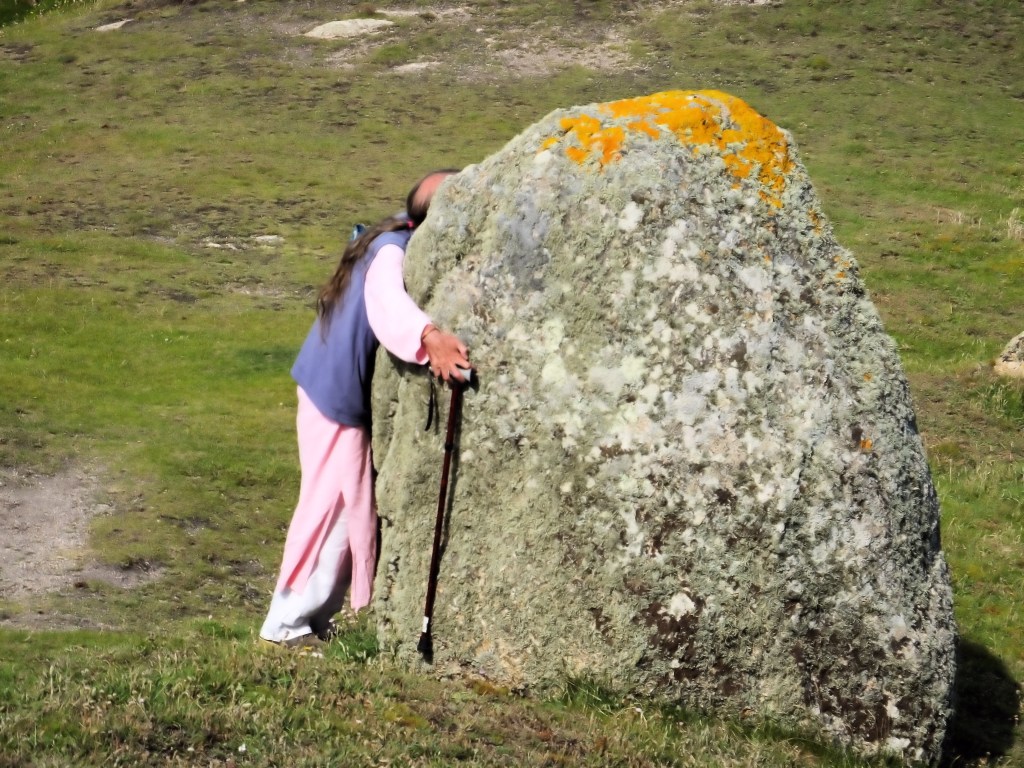
Loving my favourite stone at Carn Lês Boel
One of them came, reached down and said, “Come and join us“. Which I duly did. From then on I was a smitten megalithomaniac. A deep memory of ancient times was reawakened. Back then too I was involved with time, responsible for organising longterm observances and rites to work with Metonic, Jupiter, Saturn and other longer cycles of time.
Guess what, in this life, by the mid-1980s I was initiating consciousness-raising camps, doing a modern version of the same thing. And they were astrologically timed. After one of the camps I had a moving inner experience where the modern I and the ancient me were dialoguing, sharing our perspectives from our contrasting points in time.
So, I’ve been an astrologer, historian, antiquarian and futurologist. I didn’t particularly plan this but that’s the way it unfolded, in paragraphs and chapters through life. While studying astrology in the 1970s it felt more like remembering than learning afresh. By 1990 I had compiled The Historical Ephemeris of historical cycles with a timeline of events, showing how major-scale changes in human ideas and activities can be identified by observing such cycles. A labour of love, much ignored by historians, it needed doing and I did it.
For the last decade I’ve been studying and mapping West Penwith’s prehistoric sites. We have lots of them. One day I realised why the ancient Penwithians had gone to all the trouble of building these things. Experiences gathered in world healing [see:The Flying Squad] over the previous 35ish years led to a lightbulb moment that came up at Bosiliack Barrow, where I go whenever I seek insights. It’s funny how a revelation often simply uncovers something obvious and already there, though until then it is unseen.
I’m not particularly into earth healing, lightworking or healing and prayer circles, though it’s important that people do these. I’m more into working surgically with specific issues that obstruct progress, in an inner journeying and energy-working sense. It involves addressing fundamental social and cultural patternings, tendencies and institutions that become spotlighted by current events, digging down to get closer to the heart of things, unconcealing and helping to heal the layered pain and damage that humanity has brought upon itself over time. In our own time, these issues are getting in the way of necessary change.
CASPN members, after doing maintenance work at Boscawen-ûn
Consciousness work is upstepped immensely when groups of people work together. Over time, in activities with others that I’ve been involved with, remarkable outcomes have occasionally arisen from it. The Council of Nine (I wrote a book for them in the early 1990s) had emphasised this too: “If there are thirty-six with one mind, focused together, then the entire world, even the universe, may be changed“.
However, an undistracted, unwavering, one-minded focus is needed for that, and it’s not easy. If a group or network knits itself together over time, melding as a group, it can build up a momentum and focus that can take us at least part way along that track.
Sometimes it even happens unintentionally in the public sphere – moving moments experienced at a captivating music concert, a funeral, an uprising or even in a football crowd. Notable in particular are those moments that shake the awareness and feelings of mainstream people in their millions – poignant events, situations and crises that can sometimes evoke a one-mindedness in millions of people at the same time.
When the numbers rise, the intention and energy-holding are good, and there is real feeling behind it, the work people do in this field does have a positive effect, incrementally raising the world’s vibrational level. I encourage you to include this kind of work as a slice of attention in your life, in whatever way is best for you.
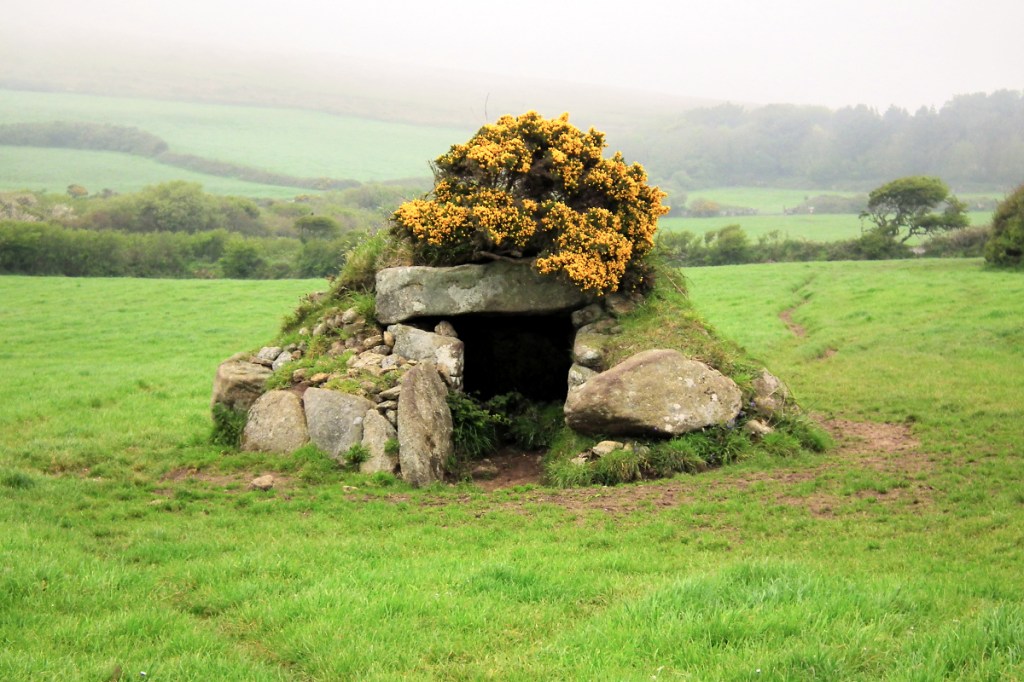
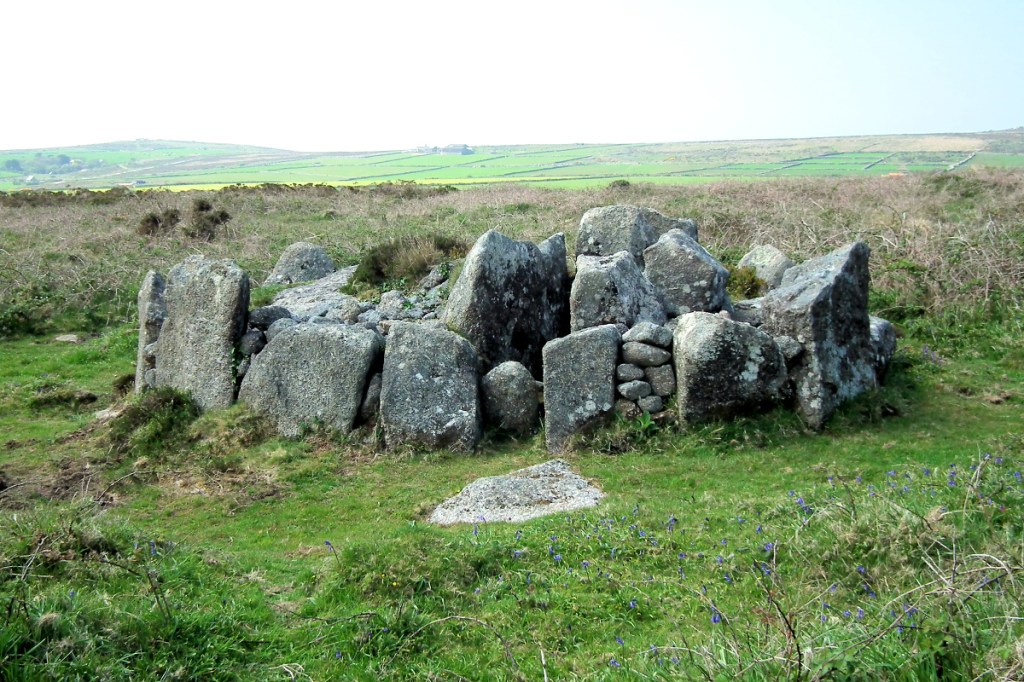
Brane chambered cairn, near Carn Euny
Back to ancient sites. The key sites are those that enclose space – stone circles, enclosures, chambered cairns, caves, wells and dolmens. Here intense vibrational fields can be built up within that space. That’s what the people in my dream fifty years ago were doing.
In many ancient sites we can still feel vestiges of those energy-fields, built up over the centuries during the megalithic era. A presence is in residence. At Boscawen-ûn stone circle, a couple of miles from me, it’s quite common that, when you arrive, someone else is leaving, and when you leave, someone else arrives. There’s something bigger going on here.
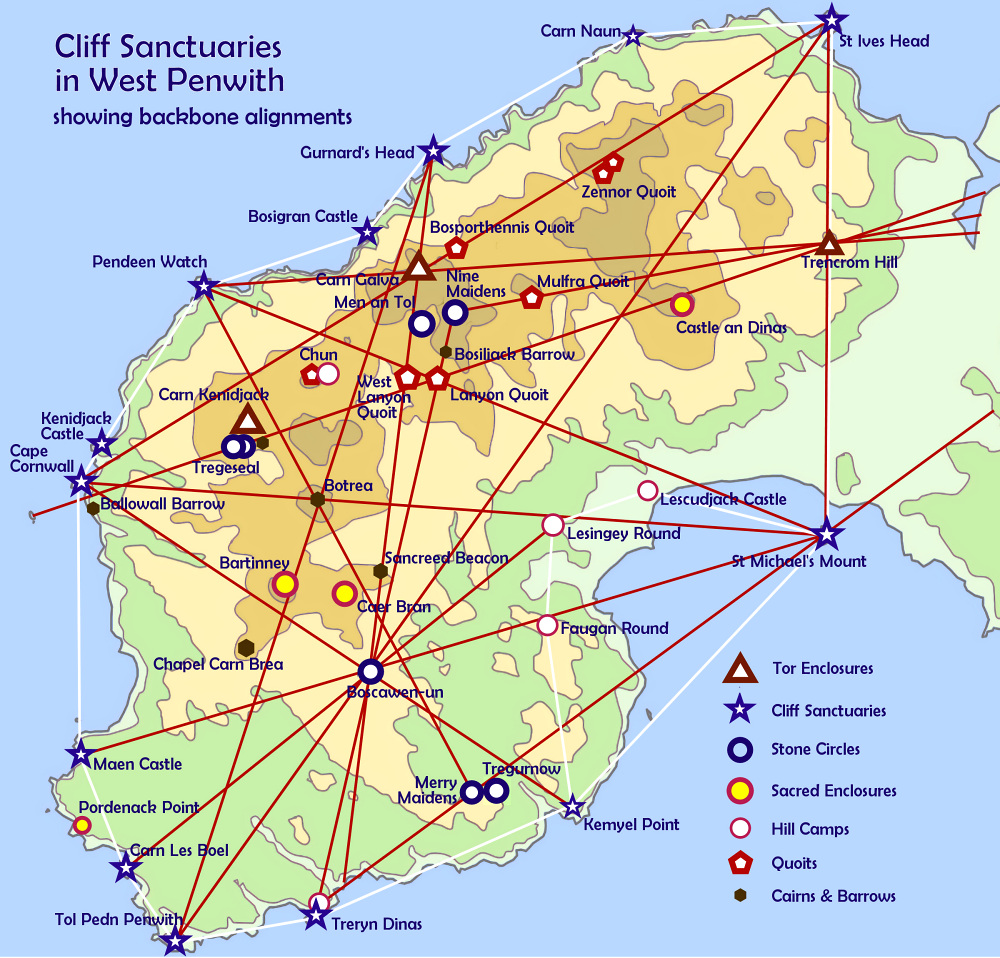
Being a peninsula at the end of a bigger peninsula (Cornwall and Devon), West Penwith has definite edges, bounded by the sea. Even the landward side in the east is guarded by three hills in a dead straight line (St Michael’s Mount, Trencrom Hill and St Ives’ Head), creating a threshold and energy-shield. (Interestingly, the G7 conference held in Cornwall in 2021 was located exactly on this line.)
Bosiliack Barrow
As I did my research, it came clear that this was not just a fascinating collection of ancient sites – they constituted one big, integrated system, roughly 10×15 miles in size, and purposefully built. It was rooted in the landscape, anchored to key hills (neolithic tor enclosures) and promontories (cliff sanctuaries). The location of major sites such as stone circles is largely determined by these.
These sites are also variously plugged into underground water-energy systems beneath them. Stone circles and dolmens are sited on top of ‘blind springs’, energy-springs emerging as a vortex on the surface, which the ancients then entrained and focused by building an ancient site on top.
They’re also plugged into the wider cosmos by alignments to the rising and setting points of the sun and moon at key times of year, as well as, in some cases, certain key stars – marked out by alignments to menhirs, cairns or natural features. The designs, geometry and mathematics of many sites also embodied principles such as the Metonic cycle, a 19-year cycle of relationship between the solar and lunar calendars, both of which were used at the time.
Tregeseal
Stone circles and other sites are placed in remarkable locations, with a visible relationship with the lay of the land. Tregeseal stone circle, near me, lies in the apex of a U-shaped bowl of hills which meld together to highlight a gap in the west, toward the sea and the distant Isles of Scilly, which float on the ocean like a mystic realm on the edge of the world.
Stone circles, enclosures and certain hills and features were amped up by cairns, menhirs and other markers that were aligned to them, acting as feeders, relays and batteries. These integrated the system as a whole into a network. In some cairns, bodies were buried not for the memorialisation purposes we now practice with our dead, but to bless and light up the land and the network by burying the relics of revered people at carefully-chosen places – rather like the medieval reverence for saints’ relics.
It was all for the engineering of conditions in which advanced consciousness levels could be achieved – though there were other purposes too. Enclosed energy-spaces such as stone circles and chambers are insulated, charged-up spaces. In Penwith, background radiation in a stone circle is much lower inside than outside it, and this applies also to background psychic noise. A protected, charged space like this allows clearer and stronger psychic, shamanic and healing work – and many of you will have experienced this yourselves.
At the Hundredth Monkey camps of the mid-1990s we built up an energy-field in the circle that resembled those that they built up at ancient sites. An energy-field morphs into a reality-field, where the framework of reality changes gear and things become possible that are not available under normal circumstances.
This was noticeable at the end of a camp when we closed the circle – the mood would subside like a slow puncture, ‘normality’ would restore its grip and the background noise and clamour of the busy world around began intruding again. We had been in a magic space with very different character, norms and rules.
Treen chambered cairn
Inside chambered cairns there’s a profound quietness providing ideal conditions for solitary meditation, vision-questing, innerwork and conscious dying, and also for the treatment of seeds, tools, elixirs and magical objects. Insulated from outside by stone and earth, such cairns sit on energy-vortices generated by the intersection of two or more underground water streams underneath. This makes the chamber into an energy-bath or orgone accumulator, valuable for entering into altered states.
Apart from ‘getting high’, why did they bother with all this? It had a direct bearing on the fortunes of people and tribes, as an investment that paid good dividends. Although their civilisation was materially simple, it was culturally and spiritually sophisticated. They had an advanced technology that worked esoterically with the essence of life, the core dynamics within all things, with which they could carry out forms of genetic modification, long-distance communication, medical procedures, ecological and climatic regulation and societal problem-solving.
They weren’t manipulating genetics the way we do today: instead they created energised conditions within which organisms could modify and enhance themselves, and this has been demonstrated to be possible in modern-time experiments too. They needed no telegraph wires or radio waves for communication: trained psychics, often some of society’s neurodiverse people, trained up, would enter a state in which time and distance ceased being an issue.
As for weather-modification, by siting menhirs, mounds and stones on top of energy-conductive water and metal veins and magnetic anomalies, they could neutralise the excesses of bioelectric charge between land and sky, reducing climatic extremes and damaging weather events. Conducting sometimes long and complex rites they focused on keeping Gaia and the spirits of land, sea and sky happy.
Caer Brân
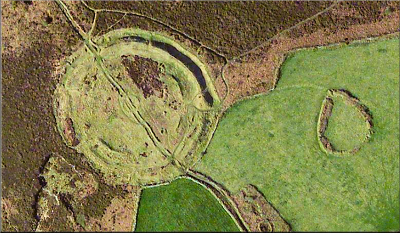
Different kinds of sites evoke different responses – this concerns consciousness-engineering. Just over the valley from me is Caer Brân, a circular hillbrow enclosure surrounded by earth banks, which could hold a gathering of at least 300 people – I believe it was the parliament site for Penwith in the bronze and iron ages. Parliament-moots were probably held annually at a fullmoon around summer solstice, exploiting the virtues of the time and the site, which is exactly aligned with two other circular enclosures (Castle an Dinas and Pordenack Point), with a summer solstice orientation. Though it has a remarkable panorama encompassing Mount’s Bay and the Isles of Scilly, you can’t really see the view from inside because the surrounding banks obscure it. This entrains consciousness upwards and inwards.
Chapel Carn Brea from Boscawen-ûn
Meanwhile, on a neolithic tor hill or a hill camp, awareness opens out over a wide vista, invoking an upward-and-outward feeling. Or at some sites our attention might be entrained in certain directions – at Boscawen-ûn we are drawn toward Chapel Carn Brea, the very last hill in Britain, a beacon hill topped with a neolithic longbarrow and bronze age cairns. In contrast, in a chamber or holy well a deep interiority arises. Ancient sites had added properties engineered into them.
People did ongoing magical work over many generations, well-trained, focused and serious in intent. To crank it up further, they chose power points in time – an eclipse, solstice or planetary configuration – amplifying and pushing their energy-work over a critical potency hump.
There are things to learn from all this. I’m not suggesting building new stone circles everywhichwhere, but there are ways we can amp up world healing work by learning from the shamanic methodology and philosophy that megalithic peoples used. One key element is groupwork and another is the focus such a group can build up. In some respects this was easier for the ancients since they were mostly related, well accustomed to it and also much less psychologically scatterbrained than we. But we moderns have our virtues, such as psychospiritual diversity, a lot of creativity and a good measure of despair regarding the state of the world.
My feeling is that, in the coming decades, events on planet Earth will reach moments of intensity where everyone worldwide gets a deep and clear sense of the full extent of what’s at stake. Events have a way of manifesting scenarios before us that stir us up, press our collective buttons and present sharp dilemmas – whether they’re big events such as the recent earthquakes in Türkiye and Syria, or small, highly poignant events such as a refugee baby washed up dead on Greek shores. These experiences focus minds and hearts, invoking archetypal imagery, stirring sentiments and moral choices. This global process will intensify in coming times and there’s an inevitable crunchpoint approaching, or a few of them, where we’re faced with events of a ‘this really is it‘ kind.
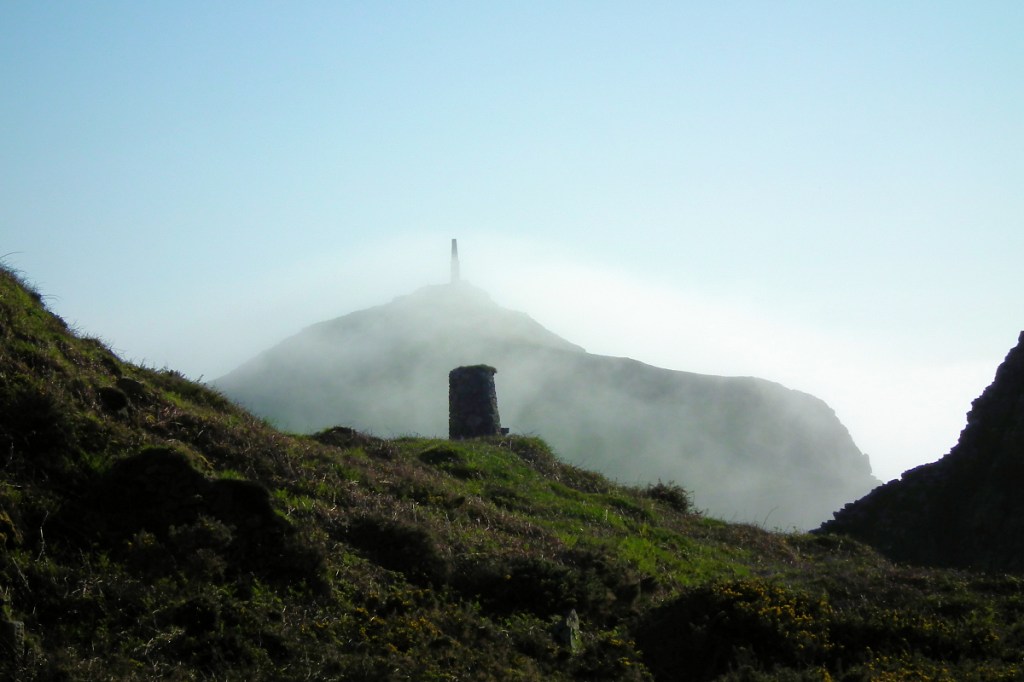
Chapel Carn Brea
It all hangs around whether we pull together globally or atomise into a tangled mess of narrow interests. It’s not just a matter of practical cooperation, effort and peacemaking, but also one of one-minded and one-hearted inner consensus. We’re faced with a mountain of global issues that require a miracle, or a stream of them, and normal means of fixing our problem are too slow and clunky. Only a quantum shift of approach and priorities is likely to prevent disastrous levels of hardship and disruption in coming decades.
A miracle requires the focusing and intensification of an energy field to the extent that our former understanding of reality flips. Nothing much might immediately change, but everything looks and feels very different. A new reality-field supersedes the previous one. The rules change and remarkable things happen. This depends greatly on how, collectively, we see and judge things – a disaster can be made good if if leads to fundamental changes.
This involves going to the heart of things, dealing with them in a psychospiritual way. Not to the exclusion of practical solutions, but complementing them. Making a big step in the collective heart of humanity. Creating a resonance that overrides the psychic disarray and disturbance of today – a central cause of today’s global problems.
‘Disaster’ means out of tune with or loss of the stars. Out of sync with nature, human nature and the cosmos. Out of sync with the guiding light within. The ancients did their shamanic energy-work to keep things resonating well, knowing that everything is interconnected and interdependent. Fixing the world today involves a big cooperation in every possible sense, between humans and with nature and the cosmos.
We have this in our collective memory – it’s a taproot memory in humanity’s collective soul. If we read the underlying meaning of current events to be a manifestation of all that we semi-consciously fear, dread, need and hope for, it is possible to see how events are leading us toward a crunch point, a truth point. A point of focus where everyone’s awareness potentially comes together to think a new and deep thought.
Mên Scryfa and Carn Galva
So something in our deep memory from former millennia holds a key here. And it concerns the future.
Time is a strange thing, and dimensional. When I went down with cancer, my life expectancy was shortened yet strangely I was given a gift of expanded time. In a time-poor world I became time-rich. Not long ago I asked myself whether I’d like my old life back, and I realised I didn’t really. Though life is more difficult now, and serving time as a cancer patient, 70% dead and hovering there, mostly alone, has tested me to the limit, time has morphed toward a more timeless zone where other things start happening. Loss of physical capability has led to something of a gain in inner ability. Life on Earth always has its compensations!
Perhaps that’s where the world is heading. Global loss of traction caused by increasing crises and disruptions could well lead to a similar compensating factor, experienced by growing numbers of people. I’ve discovered this in the crisis zones I’ve been in – such intensity can pull out the true human in us. When your life is at risk you play for high stakes, and there’s no alternative. You’re drawn into the immediacy of now, and time changes in power and potency. That’s where root-questions are met. From a world healing viewpoint, that’s where the crunchpoint lies, and from it will be born the next world, whatever shape that takes.
This is me reading from a chapter from the original manuscript of the book The Only Planet of Choice – essential briefings from deep space, which I compiled and wrote in 1991-92. It contained material from the Council of Nine, a group of high-level cosmic beings who are part of the management structure of the universe, channelled by Phyllis Schlemmer during the 1970s-90s.
In this podcast, Tom, the spokesperson of the Nine, gives some interesting answers to the question “What can I do to contribute to changing the world for the better?”.
The question of fixing the planet Earth problem is taken several levels deeper, to a soul level, and several levels wider, with some mind-stretching notions that, whether or not you agree with them, certainly shed new light on our own understandings of things.
Bosiliack Barrow, West Penwith, Cornwall
It’s a series of interviews with Tom by an interesting group of people who worked with the Nine, including scientist Andrija Puharich and former racing driver Sir John Whitmore, together with others. Interspersed by commentaries written by me. This is the unexpurgated pre-publication version, containing information and some of my commentaries that were removed from the book before publication.
It was a great honour to write this book for the Nine, and hard work too. It came out in 1993. I wrote it in Glastonbury, and most people thought I had left town or gone away somewhere – no, there was a force-field around my house, and the doorbell and phone didn’t ring until the very day I handed in the manuscript.
The podcast is introduced and outroduced by the early morning birds at our farm in West Penwith, Cornwall, with a special appearance of a flight of hoarsely honking geese.
It’s 54 minute long, and you might find it gives you a good number of lightbulb moments.
I’ve been visiting Glastonbury for Easter weekend, and I’ve done two speaking gigs, one podcast interview and a lot of hobnobbing. And cake.
and other tales…
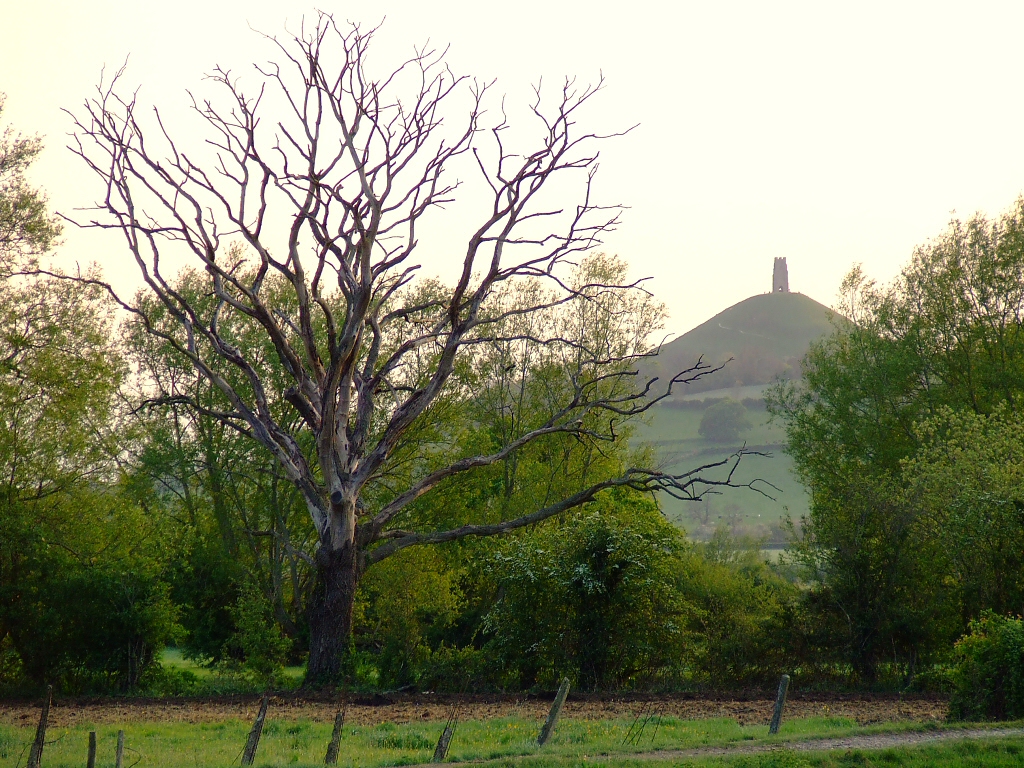
Glastonbury Tor, as seen from Pilton
Tuesday morning, 11th April, Butleigh, near Glastonbury… Today my friend Claudia from Cornwall is taking me home, bless her – she’s driven up here to pick me up. Typically for one with a Moon in Gemini, I’m looking forward to going home and also I am not. I’m looking forward to it because, as a partially-disabled cancer patient, my lovely little home is, well, my refuge. Also I can detox from the generously donated phone radiation I’ve taken in over the last few days – almost everyone I pass or sit near to has a toxic radiation generator on them, and it gets sprayed all over me. It’s weird.
I’m not really looking forward to going home because, in the last year or two, since losing my partner and my capacity to drive, I’ve been isolated in a way I’ve never experienced before. This winter I crossed that strange boundary between aloneness and loneliness, and while I manage quite well with loneliness, compared to many, I don’t like it – it’s an inward-turning vortex, and it’s easy to get sidelined and forgotten by other people, busy as they are with other things.
This said, being alone has its value, and many of us don’t get enough of it. But over winter I’ve been drying up inside and talking to myself too much. If my health condition deteriorates, there is no one to watch over me. It says something about our society when, as was recently mentioned in the UK news, a person’s death is discovered because of the smell. If that’s the case with me, then so be it – after all, my creaky body will already have been abandoned and I’ll be somewhere else. Our society has big issues around death.
Glastonbury Abbey
But then, I’m a strange mixture of a hermit and public figure – it’s the bit in between, personal relationships, where in the end I don’t do so well. That’s classic for an Aspie: I don’t sit easily in the expectation-fields many people quite reasonably have, as a friend, neighbour, partner or parent, and I’ve never sat easily in the boxes society seems to need each of us to sit inside.
This said, as soon as I was diagnosed with cancer in 2019 I found myself sitting inside a neat, simple ‘cancer’ box, unexpectedly eligible for levels of social, financial and medical support that previously were outside my reach – and without that support I would now be dead. It’s a bit strange, being valued by officialdom and mainstream society, at a time of life when my productive value has declined dramatically. I’m now costing society around £200,000 per year. Just my cancer medication costs £4,000 per month. In contrast, twenty years ago I was Glastonbury’s online PR man (running www.isleofavalon.co.uk) and Somerset County Council reckoned I’d raised the town’s local GDP by at least 5-7%, but I still made nothing from it – so this late-life support is rather bizarre, even though welcome.
Yet, when I was lying there in December 2019, newly diagnosed with cancer, hovering just outside death’s door and gulping down large dollops of acceptance together with large numbers of pills and infusions, I decided to make the best of my new situation, come what may, and certainly it is true that I’ve started a new chapter of life. A while ago I revisited an experience I had around age six, in which I feared growing up and going through the full human life-process. I wanted somehow to skip straight from childhood to old age. Now, prematurely aged and reduced by cancer, being an old crock does strangely suit me, and I’ve found a new expression and creativity in this situation, blogging, podcasting and now writing a second post-cancer book (the first was about ancient sites and the second is about world healing).
In the early months of dealing with cancer, I started assessing my condition on a basis of perceived age. After a life in which I had only rarely had illnesses, suddenly I was flattened and floored by cancer. I shot twenty years forward into my nineties, in terms of physical ability and inner perspective, doddering around like the Ancient of Days. As time went on and I started reviving, I grew a bit younger and settled around my mid-eighties. Nowadays I’d put myself around age 80, varying between better and worse days, though physically I’m 72. So I’ve been fast-tracked into a new phase. Yet my spirit has brightened, as if to compensate for a loss of physical strength, ability and vitality – spirit kinda holds me up, now that life is twice as weighty.
Glastonbury High Street
My cancer story started very suddenly one day in late August 2019 in my former partner’s back garden (she was out somewhere): life fundamentally changed that day. I was pulling on a tussock, clearing space for a log-pile, and my back suddenly cracked, very loudly. It was both an external and an internal sound. I was stunned, standing stock still, swaying giddily, and the pain gradually came on over a few minutes until I could do nothing except stagger inside and slowly sit down, seriously excruciated with searing pain.
Four of the bottom vertebrae of my back had collapsed and I was in agony for months. It took ten weeks to find out that I didn’t have just a back problem – I had cancer, and it had me. In the NHS they often ask you to rate your pain on a scale of one to ten, and it was seven on a good day and nine on a bad day – though nowadays I just get one to three, more of a perpetual stiffened inertia and achiness.
With Myeloma or bone-marrow cancer, permanent changes to the blood cause bone-formation to stop, leading to a softening and hollowing out of the bones. It’s a toxicity-related cancer caused in most cases by electromagnetic and nuclear radiation or by certain specific neurotoxic chemicals – in my case it’s quite safely the radiation, looking back on my past history. I’ve known myself to be electrosensitive since the mid-1970s, when I was 25, though it only became a problem around the Millennium when mobile phones and wi-fi started coming into common use.
Chalice Well
But there’s a deeper dimension to this. It’s a disease of sensitivity in an insensitive world, and there’s something good and right about that. I’m more concerned about people who don’t or can’t feel radiation than about those who do. Myeloma concerns blood – life-force and will-to-live – and bones – the structure that holds us up, enabling us to experience living inside a physically constrained body. These are quite fundamental planetary issues, and I’ve dug around in myself to understand how my own planetary-incarnational challenges have served as a basis for cancer.
In a strange way it has been a gift, giving a new perspective and something to work with – every day is an uphill climb, forcing me to focus my wits on doing life as well as I can, making the best of what I have, and accepting what I don’t and can’t have and do – the sex, thrills and rock’n’roll parts of life (though I’m doing alright with drugs, both prescribed and alternative). Having had a rather full life, cancer has added a new dimension that, strangely, fits my story. It’s the current stage on my path. The whole look-and-feel of life has changed.
I’ve been visiting Glastonbury for Easter weekend (it was my home from 1980 to 2008), and I’ve done two speaking gigs, one podcast interview and a lot of hobnobbing. And cake. It has been wonderful, medicinal to the spirit, and I really appreciate the welcome I’ve been given and the interesting conversations we’ve had. It lights me up.
Chalice Well
It has been a radiation nightmare too. At times my nervous system has been juddering, the amygdala in the back of my head has been screaming a high-pitched whine, and after two days I was bordering into the next stages, flu symptoms and heart palpitations – though I’m learning how to hold them off sufficiently while under fire. As I get more irradiated, symptoms gradually escalate: despite all the miracle cures, crystals and gizmos people advocate and offer to counteract radiation, the only option is to get out, find a low-radiation refuge and spend 48 hours detoxing. So if I walk out on you, please don’t take offence – I just need to get out, and it’s that simple.
It’s a strange, new cause of loneliness – I cannot hobnob easily with people since they literally shoot me (and each other) with a rain of EM jangle and noise. Worse, people are, or seem, mostly unaware of it, even if they’re Greens or members of Extinction Rebellion. Hardly anyone thinks of the disastrous effect mobile phones have on plants, animals, the ecosystem and the world’s climate.
Anyway, that is as it is, and I can do little except partially tolerate it and partially keep my distance. It means I can’t hang out with friends unless I’m okay about being poisoned that day, and unless I have two clear days afterwards to recombobulate my energy-bodies before anything else can happen.
Chalice Hill
Many old friends came to the ‘Evening with Palden’ on Friday, and it was so good to see them and share some insights I’ve been coming up with. This is where being alone has its virtues, since it enables me to step outside current social groupthink, to see things from a more reflective viewpoint, less affected by others’ perceptions and the current preoccupations, social judgements and projections of the time. As a writer and podcaster it has allowed me time and space to invest in conceiving, writing and recording material. I’m really happy that it seems to be saying something to readers and listeners. It gives new meaning to a rather time-wealthy life like mine, and a way of contributing something to time-poor people’s lives like many of yours.
I’m not one who is happy sitting round entertaining myself as pensioners are supposed to, or sitting there like a block of wood. I see no point hanging around on Earth without having a meaningful life and making a contribution. A long life is not the main point. I’ve had a whole lot of life and feel quite happy with what I’ve been given. Well, sort of. Of course things could have been better, but it’s life’s imperfections that are a key element in the Planet Earth experience. In the end, that’s what we’re here for.
Frankly, I’ll be relieved when the time comes to go. Life has been one long saga of feeling as if I’m on the wrong planet. I’ll be happy to go home and be myself again. Well, for a recharge, at least. But before I go, there’s more to do and be. I’ve been much blessed, living in a time when so many ideas have been conceived, and the seeds and roots of a new civilisation have been laid. So I’m leaving traces of what life has given me, in print, sound and online, for folks younger than me to imbibe, if it’s useful to them.
The Tor from Maesbury Castle in the Mendips
When I give talks, I’m usually quite unaware of what I have said. I just hope for the best and try to avoid making big bloopers – us Aspies, sometimes we make what we believe to be a bland statement of fact, when for others it can be thoroughly upsetting, confronting and offensive. But I seem to get through each talk without major mishap. It comes to an end, and everyone seems to be happy and glowing, though I come out of it feeling as if I’ve missed something, slightly bereft, but relieved that people are smiling. I’m used to it now. I made some notes of talking points before leaving for Glastonbury but, typically, by the time I got there, I couldn’t find them. Lo behold, they turned up again after I got home. Magic.
At the Legends Conference on Sunday I delivered an entirely new talk. After what seemed like fifteen minutes, Tor came along to say my hour was nearly up, and I was really surprised. I think I managed to make my main point, squeezed in at the end, but I could have made it better. The talk started with an overview of the geomancy of ancient sites, using my home area of West Penwith in Cornwall as a working example, moving on to climate and environmental control and geopolitical healing through consciousness work. This is the gist of my new book, ‘Shining Land’, about the megalithic engineering of consciousness. I’m having difficulty getting it published, but it’ll come out sometime.
Thank you to Lillah Lotus and Rose Temple Morris for putting me up, and to Samia and Dave, Tor and Matthew Fellows for staging things. And to people I met, for being present in this world and sharing a wee slice of their lives. And to Briony, who comes from a similar world to my own, and who had me sussed in minutes. Also to Cho Hopking for teleporting me to Glastonbury, and Claudia Caolin for returning me to Cornwall.
During 2023 I have two objectives, over and above enjoying life: first, to develop more ways of spending time upcountry, with one or two bolt-holes where I can stay – the trick is to find somewhere I fit easily and am no hassle to have around, as a person with special needs; and, second, to see whether the world healing project I am proposing is actually likely to fly – that’s interesting because, with only a few years to live, I cannot lead it. So that’s my agenda for this year, and enough to be getting on with.
Today, Saturday, is spring-like and, having done my clothes-washing duties, I’m summoning my energies to get up the hill behind the farm, to the bronze age platform barrows up on top, 4,000 years old and still doing their geomantic thing. The badgers have dug a new sett on one of the barrows – I’m sure the archaeologists will love that! You can see for fifty miles up there, with a 360° panorama, eastwards to Carn Brea, Mount’s Bay and St Michael’s Mount, and westwards to the Isles of Scilly. I’ll mosey past the main badger sett (apparently it has been there for centuries) and the iron age courtyard house (a mere 2,000 years old). That’s my adventure for today. Well, apart from the blueberry muesli I had for breakfast.
Thanks and well done for reading this! And, guess what, this blog was written using full-on, genuine, certified Human Intelligence. For better or worse.
Love from Pennwydh, the Far Beyond, Paldywan
All of the photos of Glastonbury I took around 2004-7
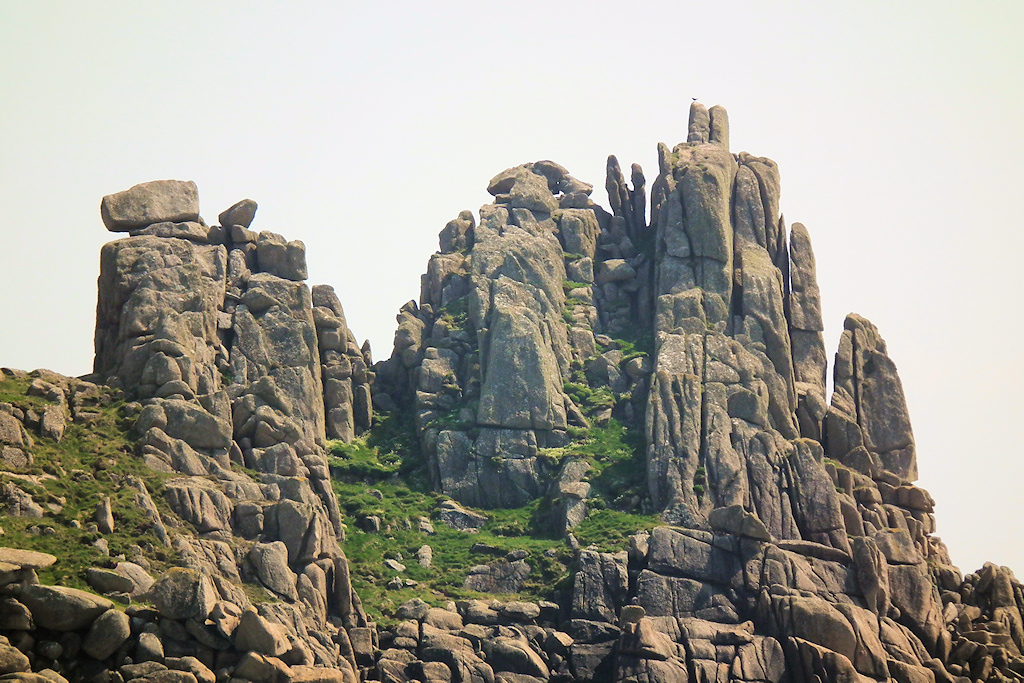
Logan Rock or Castel Tredhyn, castle of Tredyn (SW 3972 2198)
With a daunting magic and brooding mystery hovering around it, Treryn Dinas is a fascinating place, though it’s also a place not to be messed with. Enter with respect or the Cosmic Trickster might knobble you with a dash of unsolicited reality.
You get the feeling odd things might have happened here. It’s a place of mystery, power, sorcery and truth. Not exactly tranquil, it is nonetheless impressive in its strong underlying feeling of power. In folklore it was the home of giants.
On the actual dinas there aren’t easy assembly places or comfortable places to hang out – precarious scrambling is involved – so at any time people will have been in small numbers only on the dinas. Something about this and its obstacular nature gives the dinas its character. It’s strong in feeling, and worth visiting to feel the brooding, enigmatic character of the place.
The headland has two parts, the rocky headland itself and a large encampment to its landward side called Treen Circle, built in the Iron Age, according to archaeological orthodoxy – and the banks on its landward side probably were Iron Age.
However, its first use would have been in the Neolithic 3000s BCE, if not earlier, even if little or nothing was built there then. Neolithic artefacts and relics have been found on the dinas – items and offerings hidden in the rocks.
How otherwise can we say it’s Neolithic? First, the dinas is so prominent and rich in character that it must have been important.
Second, Treen Circle lies exactly on a backbone alignment (108) through the Merry Maidens, St Michael’s Mount and Carn Brea – an alignment of three natural features (two Neolithic tor enclosures and one cliff sanctuary) with a Bronze Age stone circle dropped onto it. Treen Circle is where people would hang out and camp when visiting the dinas. Antiquarians once thought there was a stone circle in Treen Circle, but this is improbable.
It was the most inhabited of the cliff sanctuaries of Penwith except perhaps for St Michael’s Mount. Treen Circle encampment was large – it could have hosted some pretty big gatherings and, in the Iron Age, quite a few people in roundhouses. This would have been a summer residence – in winter it is exposed.
It was strategically placed, not far from Porthcurno, one of Penwith’s prime landing beaches. But still, it’s a bit far away for defence of the beach, if such were necessary, so a defensive purpose to the dinas is questionable, even though Treen Circle is separated from the surrounding landscape by a significant Iron Age rampart and ditch.
Just outside it, a strongly aligned menhir has recently been rediscovered and re-erected.
Unlike many cliff sanctuaries, Treryn Dinas had practical value, with good farmland and fishing grounds nearby, situated in a commanding position that is a twenty minute trot from Porthcurno.
One wonders whether rocking the logan rock at Treryn Dinas was done to make sound and rhythm for geomantic reasons, to pulse the earth, or even as an ancient kind of foghorn, sounding out a slow drumbeat to warn boats when sea mists were down.
The rather unique upstanding stone at its summit gives Treryn Dinas a special character – it might have been placed there.
Another backbone alignment runs from Treryn Dinas to Boscawen-ûn stone circle, Lanyon Quoit, Bosiliack Barrow (a rather special chambered cairn) and a menhir just yards from the Nine Maidens. So, three of Penwith’s stone circles are linked with Treryn Dinas – that’s significant. Even so, no alignment has been found with Tregeseal, the fourth stone circle of Penwith.
I’m doing a series about cliff sanctuaries in West Penwith, Cornwall, where I live. I forgot to post the first one here when I did it, so you’re getting a bonus blog this time, about two cliff sanctuaries. The first is about Cape Cornwall and the second about Bosigran Castle. Also, at the bottom is mention of my forthcoming visit to Glastonbury at Easter – if you happen to live in or around it.
Cape Cornwall as seen from Nancherrow valley
Cape Cornwall
Down’ere in West Penwith, Cornwall (right at the end) we have an important coastal feature called cliff castles – though I call them cliff sanctuaries, a far better descriptor. Archaeologically they are customarily dated back to the iron age (from 500 BCE on), though actually they go back to the neolithic 3000s BCE.
Cape Cornwall and the Brisons rocks from near Cape Kenidjack
That is, when this area was mostly forested, the main places you could get out of it, ‘get some space’, were on the neolithic tors and hills and the cliff sanctuaries. So these formed the first major ancient sites in the area.
This is one cliff sanctuary, Kilgooth Ust (pr: ‘east’), the Gooseback of St Just, or Cape Cornwall, and it’s near St Just. It was severely affected by the tin trade 150ish years ago – hence the remnant chimney and the houses. But it is a classic, and it’s one of the major alignment centres of Penwith. Originally it had four barrows on its neck. Here’s an alignments map: https://www.google.co.uk/maps/d/viewer…
Cape Cornwall as seen from Carn Gloose
Around Cape Cornwall were some of the richest deposits of metals in ancient times, with arsenic-rich tin, gold and other rare metals used in metal smelting to create different qualities and finishes, from around 1800 BCE. On either side of Kilgooth Ust was a landing bay where metal ingots were exported.
The rocks offshore are called The Brisons. It’s the left-hand, southern one that is the energy-centre there. In neolithic and bronze age times they were probably not islands.
Cape Cornwall as seen from Sennen
I’ll post a few more cliff sanctuaries as time goes on. See the map to see the other cliff sanctuaries in the area, forming a necklace around Penwith, the ancient Belerion, or ‘radiant land’. These were sanctified spaces, and you can feel it.
Until someone did a proper theodolite job in late Victorian times, this was regarded as the Land’s End. But actually, what’s now called Land’s End is a matter of yards further west. But this, in a way, is the energetic Land’s End.
Bosigran Castle
Bos chy carn, ‘home house [under the] crag’, often translated as ‘Ygraine’s home’ (Map ref: SW 4169 3688)
This is one of my favourite cliff sanctuaries, mainly because of its friendly atmosphere. There’s a story that it was the home of a queen – Ygraine, after King Arthur’s mythic mother, but it has other possible meanings too. It has a hospitable, sociable feeling. So, this queen, whoever she was, might well have been a great lady, leaving a strong imprint.
Today, it attracts lots of rock climbers – avid Bristolians in VW vans. You can be sitting there listening to the waves, looking wistfully over the sea toward Ireland, when a clinking starts up and, sooner or later, a helmeted climber appears over the parapet, trailing ropes and looking pleased. On one occasion a school of minke whales cruised past and the climbers were spellbound, frozen to the spot, hanging in weird positions on their ropes. I was moved too, preoccupied as I had been with my prehistoric ponderings and customary flask of anthropocene tea.
The top of Bosigran Castle is rocky and divided into a number of different natural spaces. Carn Galva is behind
Bosigran has a pleasantly healing and relieving feeling. Good for spending time when the weather is pleasant, it’s a great place for picnics, in both Neolithic and modern times. It could easily accommodate around 200 people for a summer weekend shindig, though there is no evidence and little likelihood of permanent occupation (too exposed in winter). Summer nights spent around a campfire would have been wonderful. It lies below Carn Galva, the magic mountain of Penwith, and perhaps the tribe that had Bosigran Castle lived around Carn Galva, coming down to the cliff sanctuary for special occasions. Summer sunsets there can be special.
The ‘throne’
A rocky Iron Age rampart sections it off from the surrounding land, though defence is only one possible reason it is there. More likely it was simply an energy-threshold, since when you cross it you get the feeling you’re entering special space. There are several distinct areas on top of Bosigran, each with rock platforms that could serve as outdoor ‘rooms’ – so it’s a place where a number of things could happen at the same time. At one of these areas is a throne-like rock where one can imagine a chief, wise-woman or druid sitting, with their flock arrayed around them.
The logan rock
The top of Bosigran is littered with earthfast rocks and, apart from the boundary rampart, there are few signs of rock-moving or the placing of stone, except in two instances. There is a logan or rocking stone on the top, near the ‘throne’. These are flattish granite boulders balanced in such a way that they could be rocked. It’s possible they were natural, or placed there or adjusted slightly to make them rock. What the purpose of logan stones was, we do not know, but the ancients clearly thought them special. These were the bass drums of the Neolithic era. Perhaps people drummed along to the deep rocking sound, building up a stirring, thumping beat.
The ‘council circle’
Further along the left side of the headland and down a bit, there is a sunken, west-facing area with an array of rocks which suggest a ‘council circle’, as if it were a place for undisturbed discussions.
Nearby is a line of three rocks with their lined-up edges aligned toward Pendeen Watch, a neighbouring cliff sanctuary. These are (I think) deliberately oriented stones intended to highlight the relationship between the two cliff sanctuaries.
The zawn (inlet)
Bosigran is a good example of a cliff sanctuary potentially serving as a coastal beacon site – the prehistoric equivalent of a lighthouse. A few of the cliff sanctuaries will have been connected with trade, but this is unlikely at Bosigran. This was a place for gatherings and events. It’s a pleasant half-mile walk down from the road, and it’s worth going down into the zawn (inlet) on the western side too, to watch the seabirds, waves and climbers. There are some interesting tin-mining remains in the valley, with signs of tin-streaming methods having been used in centuries past.
I shall be in Glastonbury over Easter and doing two gigs while there.
One is at the Legend Conference in the Assembly Rooms on Sunday 9th April at 10am on Sunday morning, and here’s the blurb…
———–
Consciousness work and the way it can affect our reality
My talk will be focusing on consciousness work and the way it can affect our reality. I’ll be going back to our roots, in the neolithic and beyond, to the early inner imaginal work that gave root to the core stuff of our culture, to our beliefs and ways of perceiving things. Using my home area, West Penwith in Cornwall, as an example, I’ll show how ancient sites were built for consciousness work in order to penetrate and engineer the heart of reality – amongst other things affecting the climate, the ecosystem and human society. Which happen to be issues that are a wee bit important today.
Forty years ago, the Assembly Rooms hosted some very early experiments in ‘working the circle’ – something that is now accepted and common – and Glastonbury is a place with deep historic and esoteric roots too. So the heart of my talk is about consciousness work in the imaginal sphere, how this might be used in jogging the prevailing reality-field of our world, and how it all started several millennia ago.
I shall also be doing ‘An Evening with Palden Jenkins’ on Friday evening, 7th April, hosted by the Inner Light Community, and that will be announced on their site and on my Facebook page soon.
On Saturday I’ll be around if anyone wishes to meet up. However, I’ll need you not to wear me out, and to have your phone switched off! I’m a bit of an old crock and I’m electrosensitive (my cancer is caused by EM radiation). Still here though!

















 Notes from the Far Beyond
You must be logged in to post a comment.