Since it’s solstice, here’s an extract from a book of mine, Power Points in Time, about the cycle of the solar year, for your interest. More about the book below.
We tend to take the cycle of the year for granted, viewing it in a rather reductionist, calendrical and mechanical manner. This is partially because the Western calendar has no natural basis, so we tend to think of a calendar as a matter of dating with no further significance. For a solar-based calendar it would make better sense to anchor it in the solstices and equinoxes, allowing us to move more in harmony with the seasonal undertow of life and nature and with overall energy-conditions.
The seasons are brought about by Earth’s orbital relationship with the Sun, in which she exposes each of her poles to the Sun for half of the year as she orbits around it. Each pole is maximally exposed to the Sun around the time of summer solstice, experiencing the midnight sun, while the other pole is in perpetual darkness during its winter solstice.
Outwardly, the Sun gives Earth light and heat, and inwardly there is a deeper energy-weather cycle activating and modulating life-force on Earth, connected with the solstices. Life-force courses through the subtle meridians of the Earth and the energy-systems and patternings of all living things. In terms of our daily lives, a year takes a while, but for the Earth it is just a short inbreath and outbreath in the long course of geological time.
The ancients took it upon themselves to invoke favourable seasonal change, in the knowledge that change is the essence of earthly life and rhythm is the breathing of life-force. They knew also that subtle energy patternings are the energy-framework upon which physically manifest things are draped.
Psycho-spiritually, the Sun within us resides at the centre of our being, around which all of the constituent parts of our psyche orbit. The Sun represents our fundamental raison d’etre, our will-to-live and our source of aliveness. It gets us up in the morning to meet a new day. You could say it channels the soul through into our personalities and earthly natures. It’s a vibrant, shining place within us which seeks to make something good out of life and to evolve through life’s experiences.
Through the Sun in our birth charts, we seek to become something more than we now are, to evolve and serve our purpose, to be part of the life-process and to contribute to it.
This inner Sun goes through its own cycle of the year. We each relate differently to it, depending on the position of the Sun in our birth charts, but we have a common cycle too – the Earth’s cycle. It’s about the fluxings of energy in life and nature and the thrumming of the resonant sphere of the Earth – we’re bathed in it, even when we live in big cities, even on the 25th floor. The Sun moves around the zodiac in the course of a year, exposing us to different shades and tonalities of life-experience as it moves through the signs. An Aquarian day can feel quite different from a similar Piscean day, and what we make of each is up to us.
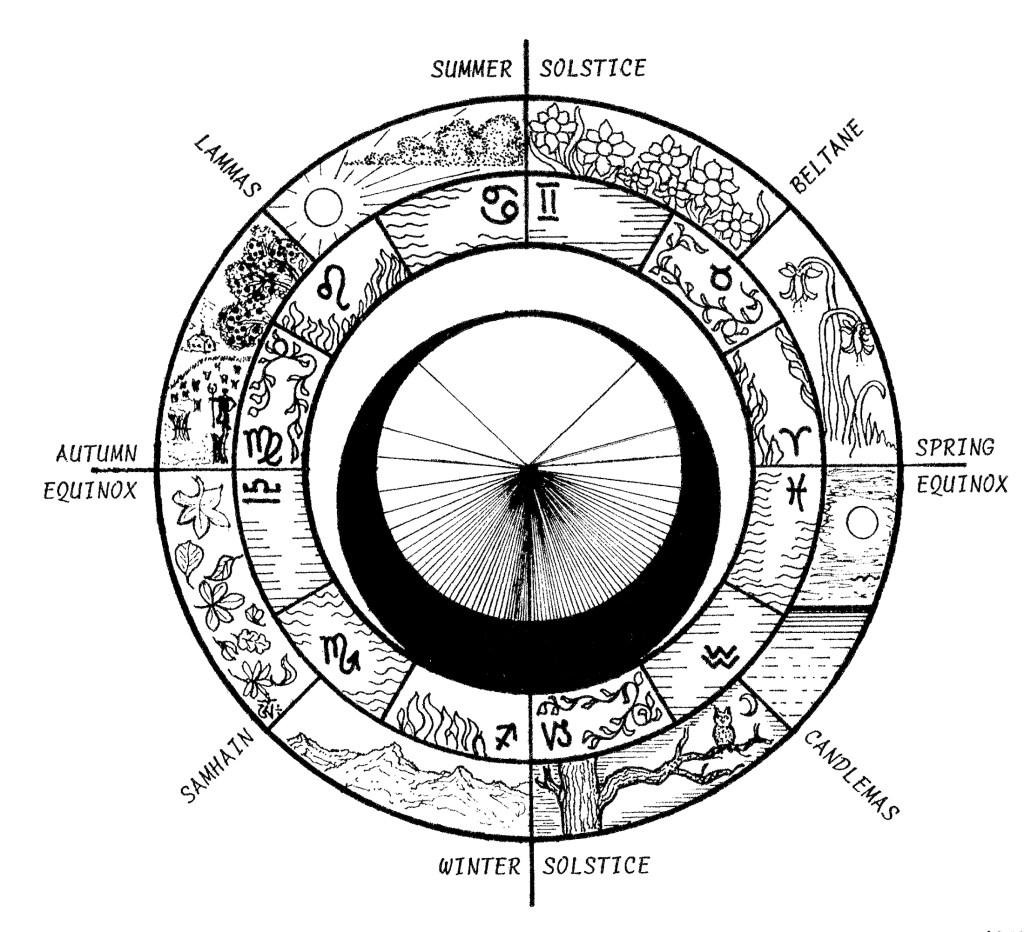
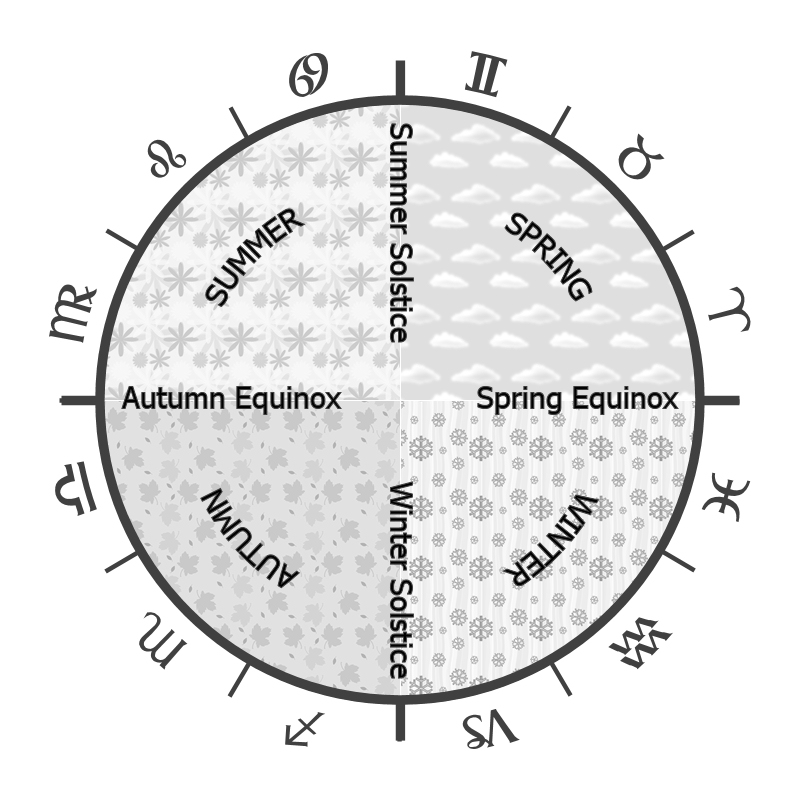
There are twelve signs of the zodiac, and the zodiac is anchored in the four quarter-points of the year – the two solstices and two equinoxes. The solstices represent turning points and the equinoxes represent tipping points in the four seasons.
There’s a three-sign sequence in each season. The zodiac has little to do with the stars and everything to do with the solstices, equinoxes and seasonal alternation, outlining the qualitative and archetypal undertow of the four seasons.
An archetype is an image or root-model of fundamental patterning behind and within all happenings and situations. If I say ‘oak tree’ then you will immediately form an image of an idealised oak tree, even though oak trees vary in shape, size and detail. So an archetype represents a basic patterning or template by which living beings and things shape themselves, even though the precise manner of their shaping varies enormously in real life. And yes, trees have thoughts and feelings.
There’s something interesting here. In Britain, NW Europe and other temperate climes (between about 40° and 60° from the Earth’s equator), nature manifests its actual physical changes in an eightfold, not really a twelvefold pattern. This eightfold pattern is marked out by the four quarter points and also by the mid-points (or cross-quarters) between these. These are important in temperate higher latitudes because the alternation of light and dark, day-length and temperature are more emphasised there. This also happens on a subtle-energy level, and it is these changes which pull us around and squeeze us through certain kinds of experiences at certain times of year.
In latitudes closer to the equator, other factors are emphasised by local circumstances or traditions, such as prevailing winds, rainy seasons, river floods, the rising points of stars such as Sirius or the orbital cycles of Venus. Localised cultures saw things in the light of what was visibly important in their own localities. In Europe, the great ocean is westwards, yet in China it is eastwards, and in Brazil the rainy season determined the way indigenous peoples structured their beliefs, while in Europe or Canada spring and autumn do so.
An eightfold calendar is more natural in NW Europe than a twelvefold one, which originated in Mesopotamia – though they interlock. The Sami (Lappish) people of far-northern Europe have an eightfold year, five seasons being different kinds of what most of us would call winter. The ancient megalith builders of Atlantic Europe 4-5,000 years ago, stretched between Portugal and the Baltic, embodied eightfold mathematics into the alignments and placing of the standing stones and stone circles they built. But both eightfold and twelvefold calendars are anchored similarly in the solstices and equinoxes. So they are related.
The energy principles behind each year are represented by the twelve zodiac signs, and manifest seasonal changes are represented by an eightfold subdivision of the year. This interlocking of principles and practicalities has meaning to it. Here we’ll look at the eight annual subdivisions, and in the next chapter we’ll examine the twelve, the zodiac. The eight, the quarters and cross-quarters, were marked in ancient times by festivals when fires, beacons and lights were lit, representing and re-invoking the life-force.
Power Points in Time. This isn’t a normal astrology book – it has little to do with birth charts or specific events. It’s all about cycles of time – cycles big and small, as astrologers see them. But when the original version of this book, Living in Time, came out in 1987, we found that it wasn’t so much astrologers who got excited about it, but it was pagans, druids and lovers of nature, ancient sites and shamanic practices. So, 28 years later, I updated and reworked the book, which came out in 2015.
It’s still available in print, published by Penwith Press and, while it’s a bit late for Christmas, here’s a thought…
If you are a seeker on a quest to understand a bit more about what lies behind and underneath the events of your life, it pays to have a modicum of understanding of astrology as part of your general knowledge – really, the basics should be taught in schools to teenagers.
It takes a while to get your head and heart around the details, but it pays off, since it’s really interesting, and your understanding of it and of life will evolve over time, as the years progress – whether or not you become an actual astrologer. And wintertime is a great time to get focused on it.
If you’re into ancient sites and working with the inner magic of nature and of time, then here’s a secret. The ancients built their sacred sites at power points in the landscape, but they carried out their ceremonies, rites, healings and workings at power points in time. I wrote this book to help my friends identify and understand power points in time.
Time is what stops everything happening all at once.
Here’s my latest podcast. It’s all about why the ancients built their sacred sites. Well, my perception of it.
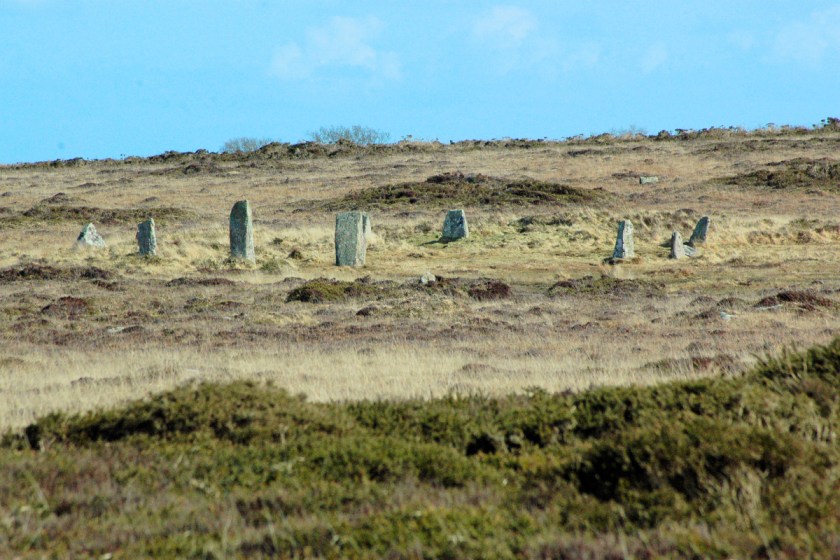
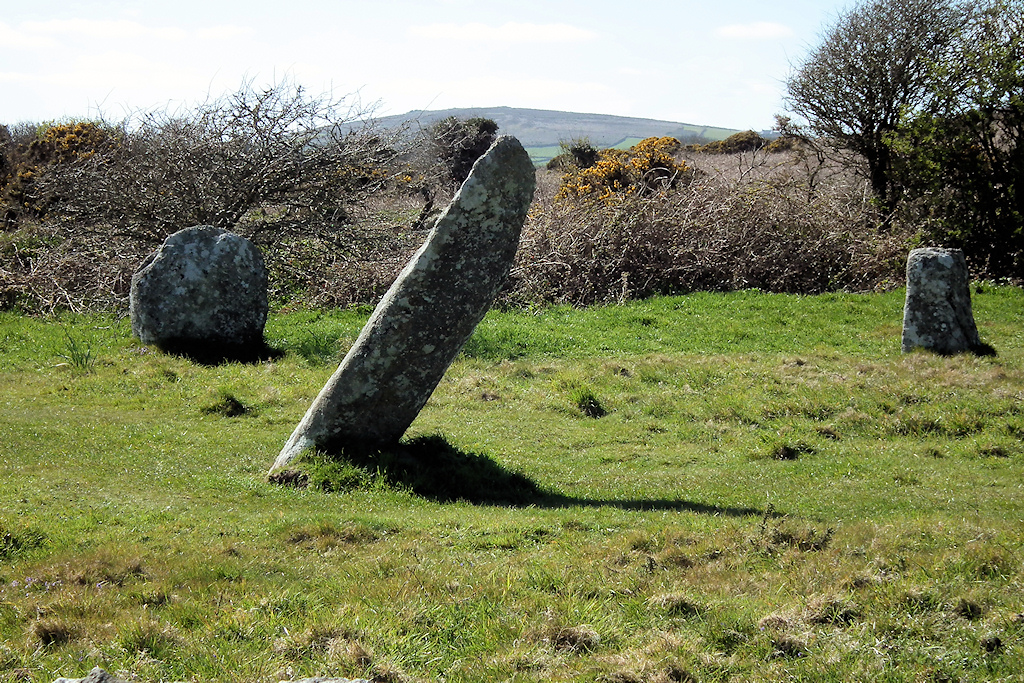
The Nine Maidens, West Penwith, Cornwall
There are thousands of megalithic sites around Britain and in other lands. The ancients didn’t build them for frivolous reasons – it had to bring them definite benefit to make it worth it, however they saw that. It was a big investment with longterm payoffs, going on for many centuries.
It’s all to do with cranked-up consciousness fields and the possibilities that become available when we do focused consciousness work inside them – at power points in space and during power points in time.
Reality’s rules can change and remarkable things can be achieved, even with practical, real-life outcomes. That’s what this podcast is all about. It’s about the way reality can be changed through inner work – or inner work combined with outer work.
Also, we become changed by doing so – this helps solve problems in remarkable ways, also reducing impediments we ourselves create.
The ancient sites of West Penwith and what they say about megalithic civilisation.
Audiobook version
I’m happy to say that the audiobook version of Shining Land is now done and ready. I’ve been working on it for the last month.
I tried to finish it before my birthday (on Friday 5th) but, well, life always has something to teach. I had one episode (of eleven) yet to record, but for two days there was a lot of noise from the rain, and from things going on around the farm, and I couldn’t do it! C’est la vie. I got it done eventually.
So now there is an audiobook version of Shining Land. Although it’s about the ancient sites in this area, West Penwith, at the far end of Cornwall, UK, I’ve adapted the audiobook to make it interesting to listeners far and wide who might never have been here.
The nub of this book and audiobook is megalithic civilisation. It was deeper and far more advanced than we are taught. Their high-tech achievements involved consciousness and energy, working on the nature of matter and the issues that life presents from the inside. It was a sustainable civilisation – in Britain, the megalithic periods of the Neolithic and Bronze Age lasted 500 and 1,200 years respectively.
And there’s a wee chance this might interest you! Audiobooks are great for listening to during long journeys, or while doing other things, or if you’re stuck in bed, or if you need a rest from radio stations.
Both the online book and the audiobook are available free, and voluntary donations are welcome.
It’s funny how sometimes we fall into things unwittingly, then to find that they take up years of our lives. This is what happened with my research into the ancient sites of the area where I live, in West Penwith, Cornwall. It all started one day when I was sitting chatting with Cheryl Straffon, an archaeologist and goddess-oriented pagan who for decades has been a key person here, bringing together a full spectrum of prehistorians, from archaeologists to pagans, and editing Meyn Mamvro, a magazine about Cornish archaeology and earth mysteries.
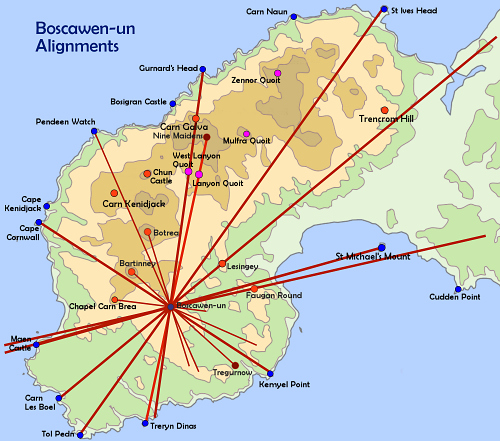
We were talking about John Michell who, in the 1960s-70s, brought the idea of leylines, sacred landscapes and earth mysteries to wider attention in a seminal 1969 book The View over Atlantis. John came to Penwith, doing fieldwork here to demonstrate his point, producing a catalogue of ninetyish ancient site alignments in Penwith, about which he wrote in his 1974 book The Old Stones of Land’s End.
I asked Cheryl whether anyone had made a map of the alignments John had found. No, she said. Hmmm. In former times, I had made a map of the alignments around Glastonbury… “Would it help if I made an alignments map of Penwith?“. “Oooh, yes, it would.“
I thought at first that it might be easier than it turned out to be. It landed up being seven years of work, starting in 2014, and it still gets tweaks and updates now. I’d had one of those falling-into-things moments, just then.
Carn Galva, a classic Neolithic Tor and the axis mundi or world centre of Neolithic Penwith – as seen from Caer Brân
Things had changed since I did the Glastonbury map, hand-drawn in 1982 and revised around 2003. Aerial satellite mapping had arrived on internet. For alignment-oriented geomancers like me this greatly changed the equation, opening up many new possibilities and making alignments maps easily accessible online to the public.
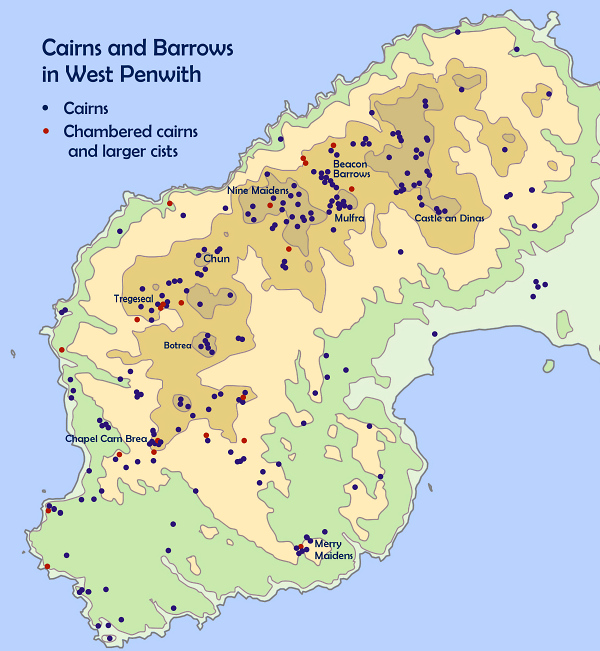
At the beginning it came clear that a genuinely useful map would need to show all of the known ancient sites in Penwith. But there are more than 800 of them, big and small, surviving or destroyed, so this was no small job. They were listed in a variety of online databases which, to complicate things, sometimes gave differing or inaccurate information, so every single site had to be examined closely.[1] I spent months trawling through these sources and building up a base map on which later to mark alignments. Later on I continued the mapwork to cover Scilly and the whole of Cornwall.
Some sites were difficult to confirm, being disappeared, disputed or subject to discussion. Some were visible in the field and others, now destroyed, were beyond trace, though many are mentioned in antiquarians’ records from former times – especially those of one called Dr William Borlase, who tramped around Penwith in the mid-1700s.[2]
Eventually I completed a map of Penwith’s sites. Then it was a matter of working through John Michell’s list of ninetyish alignments, plus others found since his time and listed in Meyn Mamvro.
One can argue till the end of time about the validity of megalithic alignments and sceptics love to do so, claiming an assumed authority of scientific rationality when, to me, all that these complaints demonstrate is that sceptics have not properly researched the matter. There is a simple, evidential, inescapable fact: ancient sites are commonly located in exact alignment with each other. This can be seen and checked by anyone on maps and in the field.
That’s the evidence, whether or not we have an explanation. It happens too much, too exactly and with too many supporting details to be a case of chance or randomness. There are discernable patterns to the specific nature of differing alignments – some are made up solely of cairns or menhirs (standing stones), or they link sites of similar antiquity, or they make some sort of sense in a wide variety of ways. Some alignments are even parallel.
If you look at the online map of Penwith’s alignments [3] it looks like a meaningless jumble with only a modicum of order to it. There’s a ridiculously large number of alignments and it’s difficult figuring out how and why the megalith builders went to the trouble of setting things up like this.
But when you look closer at individual alignments and the sites they connect, they begin making more sense. It’s worth remembering that the ancients walked everywhere, so a lot more happened for them in the space of a mile than it does for us, speeding along in our cars and looking at overview maps.
What is most interesting is that alignments stretch not just between man-made sites, but they also involve natural sites such as hilltops, carns (outcrops) and cliff promontories. The whole system is based on these prominent points – I call them ‘base sites’. The pattern of ancient sites is draped over the three-dimensional canvas of the Penwith landscape and arranged around it. There are also astronomically-oriented alignments and other factors such as energy-vortices, underground and overground energy lines, site intervisibility and even geometry that are involved in the positioning of ancient sites. [For more on this, here’s a talk by me.]
Entering Michell’s ninety alignments on the map, I found that only two were inaccurate and implausible, and I removed them. He had done good, accurate work. While making the map and checking the alignments, I started finding new ones and, before long, the list of alignments grew bigger. Some were found logically, by examining a chosen site to check for alignments, and some were found intuitively, happening on them ‘by chance’. After visiting sites around the fields and moors of Penwith, I would come home to examine their location and possible alignments, sometimes adding a few that way.
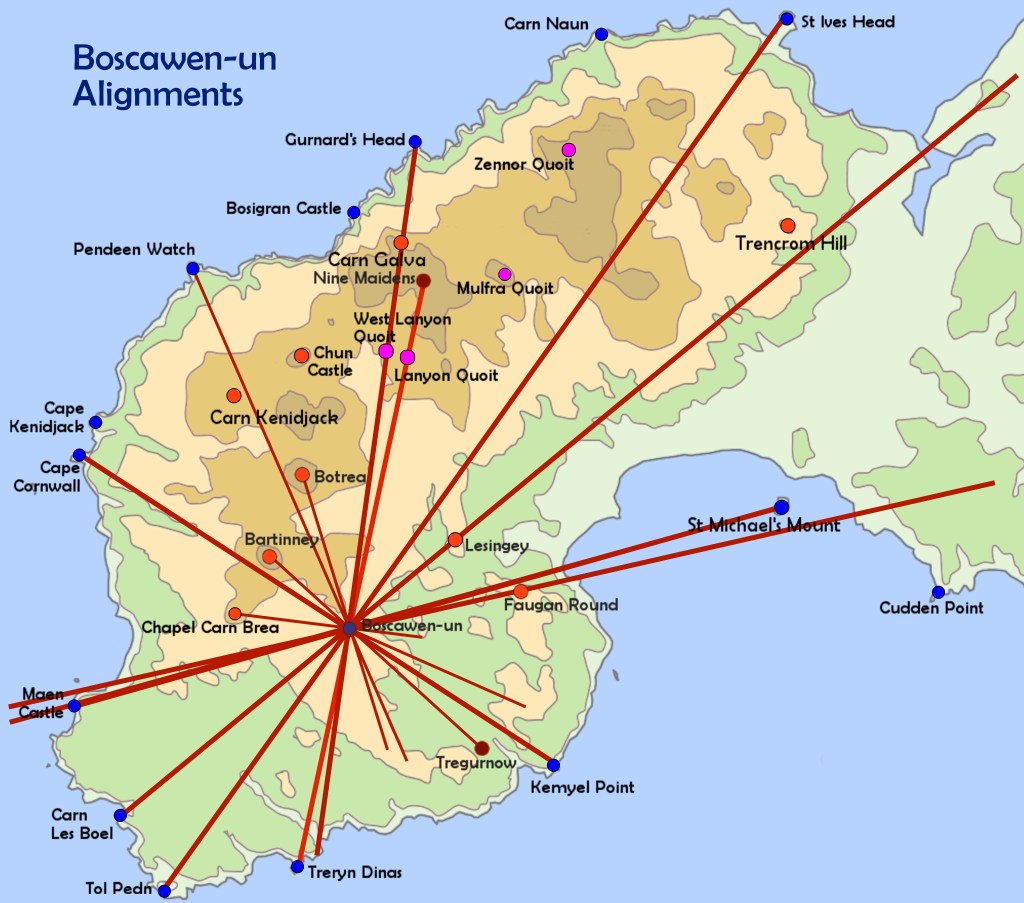
Late one evening I had a Eureka moment. I was thinking about Cape Cornwall, a conical-shaped headland in a marine context, and St Michael’s Mount, a conical-shaped island in a marine context (though originally it stuck out of the forest on dry land). They are rather similar. I wondered whether there was a connection. I looked on the map and, lo behold, a line between them intersected a collection of four Bronze Age barrows on top of the hill on the farm where I live!
Gosh. I had sat many times on those barrows.[4] They are not well-known because, being on what’s now a boggy heather-moorland hill, they look unimpressive, but their 360-degree panoramic location is spectacular. In the Bronze Age they would have been far more attractive, situated on sweet hilltop meadows – the climate was more agreeable 4,000 years ago than it is now.
Then I started looking for further alignments emanating from St Michael’s Mount and Cape Cornwall. Within an hour I had found quite a few. This doesn’t happen very often – I’ve never had such a big discovery of new alignments before or since. These proved to be a new kind of alignment that John Michell and others had not seen.
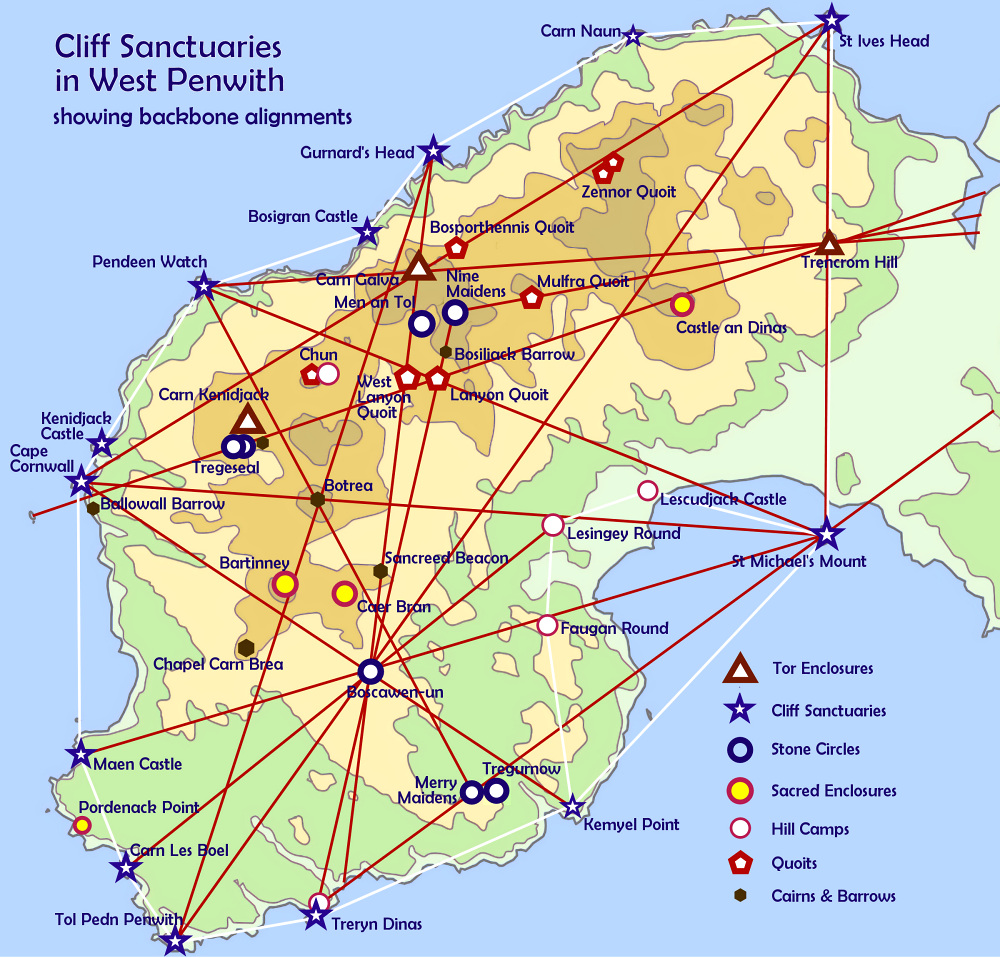
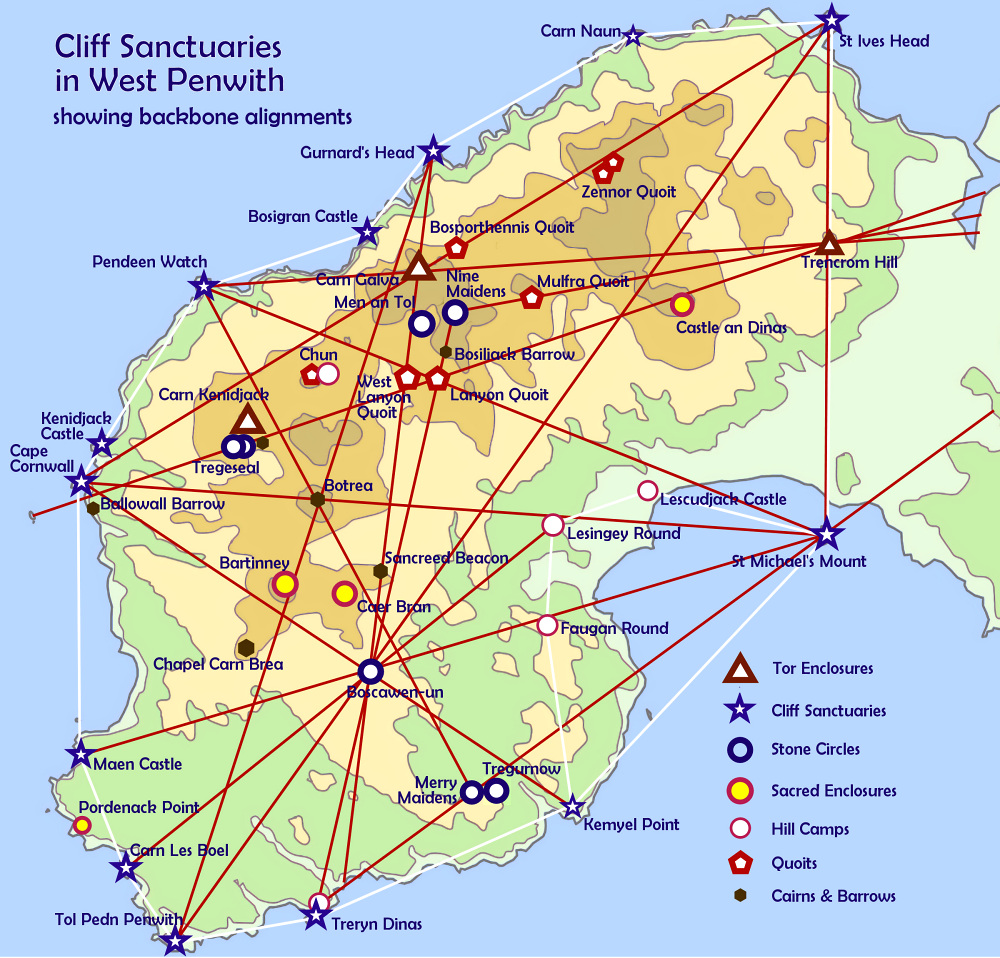
John was looking at constructed Bronze Age sites such as stone circles, menhirs, cairns and barrows, which were built from around 2400 BCE onwards. The new alignments I had found involved Neolithic sites from a millennium earlier, and natural sites such as granite tors and cliff headlands. These alignments acted differently to Michell’s Bronze Age ones, covering longer distances and with fewer points on them. I called them ‘backbone alignments’ – alluding to the main system of fibre-optic cables that connects the internet globally. Connecting Neolithic and natural sites, these alignments were clearly far older than John’s Bronze Age ones.
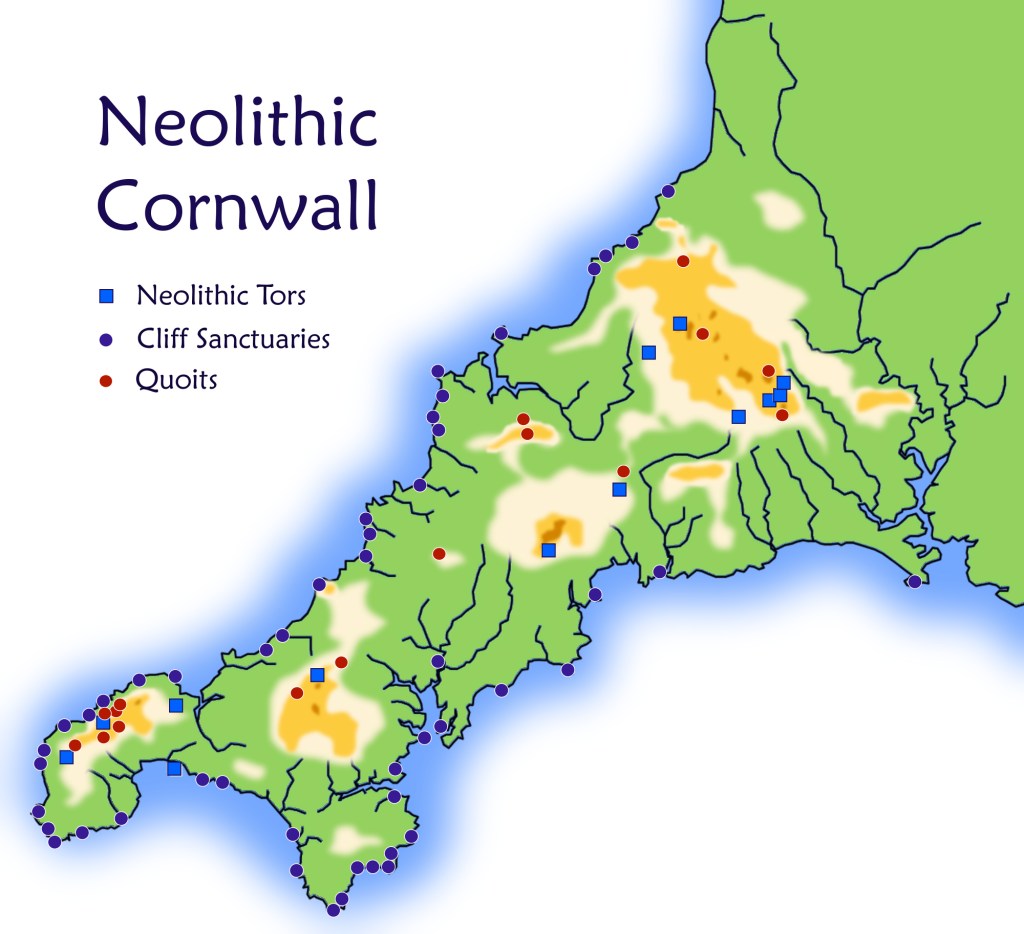
The very first constructed sites in Penwith, Neolithic tor enclosures, were built around 3700 BCE – over a millennium before the stone circles. There were four – Carn Galva, Carn Kenidjack, Trencrom Hill and St Michael’s Mount – and one outside Penwith that features in its landscape, Carn Brea near Redruth.
Many of the newly-discovered backbone alignments also stretched to what I call cliff sanctuaries. Archaeologists call them cliff castles – a term that persuades many people to believe they were used for defensive purposes, which I would argue they were not. They are customarily dated to the Iron Age around 300 BCE, long after the megalithic period, because Iron Age remains are found on them. But the new alignments, associating them with Neolithic sites, suggest they were much older in the first use. Neolithic artifacts have been found at some cliff sanctuaries, but these have not caused them to be properly re-dated to this early time.
Then came the clincher. I found that Lanyon Quoit, one of the key Neolithic sites of Penwith, built around 3600 BCE, was located exactly at the intersection of three of these alignments. In other words, Lanyon Quoit could not have been placed where it is without these three alignments being known at the time – it was positioned to align with two cliff sanctuaries and three Neolithic tors. This definitely re-dates the cliff sanctuaries to the Neolithic, also making them far more important than they previously were understood to be.
Penwith’s four surviving stone circles are all located on backbone alignments. The Merry Maidens, for example, are located exactly on an alignment stretching between Carn Brea and St Michael’s Mount, both Neolithic tors, and Treryn Dinas, a cliff sanctuary. These three natural sites happen, strangely, to be aligned with each other (there are a number of such cases in Penwith). So the stone circle was located there to reinforce the alignment and to draw on the antiquity and earlier primacy of the three Neolithic sites, which came from what in the Bronze Age was a distant former time, some 1,500ish years before.
Eventually, the alignments map of Penwith became really busy with alignments – around 250 of them. They were all genuine alignments, accurate to within 10ft or 3 metres, checked and verified by three people – so this was not a product of sloppy mapping, wishful thinking or ley-hunting zeal.
Alignments are not energy-lines of the kind that is picked up by earth energy dowsers. They are different, even though overground energy lines, like alignments, are also straight. Some overgrounds coincide with alignments, but we yet need to find out the extent to which this is the case.
Trencrom Hill (foreground) and Carn Brea (background) – two Neolithic tors
I’m of the opinion that alignments are not actually lines that are detectable in the landscape. Some dowsers might disagree, but I think they might be picking up on overground energy-lines, or perhaps the thought that links the two sites involved. Instead, it seems that, when a new site was being built, it was simply aligned with other sites in order, presumably, to associate it with them. If you line up five or six objects on a table with gaps between them, aligning them nevertheless gives their distribution some order and coherence. Rendering order out of seeming chaos was important to the ancients. But aligned sites don’t seem to have a connecting current like overground energy-lines do.
It seems to me that aligned sites are instead programmed with the same algorithm, so that they pulsate and resonate with each other, as if tuned to each other. But there isn’t a ‘wire’ connecting them – it’s an internal, implicit connection. It works a bit like what physicists call ‘quantum entanglement’, and as an informational rather than an energetic relationship. An energetic relationship is created by energy-lines that dowsers identify, but alignments don’t do this. So we’re talking here about two different circuitries that each focused on the same ancient sites. And it’s the sites, not the lines, that matter most.
Many ancient sites are thus placed exactly where they are to align them with other sites, though there is no ‘pipe’ connection between them. Instead, they seem to be remotely associated, programmed with the same intent, frequency or behavioural patterns, so that they do similar things at similar times and in similar ways. But they aren’t necessarily directly connected, unless there is also an energy-line between them.
Thus, the Boscregan West cairn, a prominent clifftop cairn on Penwith’s west coast, is aligned with the Neolithic longbarrow on Chapel Carn Brea, and with the now-destroyed Tregurnow stone circle, which was part of the Merry Maidens complex. So these three sites, associated with each other, somehow co-resonated. Or, put another way, two Bronze Age sites, Boscregan cairn and Tregurnow stone circle, were plugged into a Neolithic site on Chapel Carn Brea.
The cliff sanctuaries, embracing the Radiant Land
Interesting, huh? The megalith-builders had quite sophisticated ideas. They weren’t building ancient sites just to decorate the landscape or because it was a nice thing to do. It was a lot of work. They can only have done it because they perceived a definite benefit.
Here’s a much bigger idea. The density of sites and alignments in Penwith, and the way they seem to be integrated into complex relationships with each other, suggest that they operate as one big system. The fundamental substructure is marked out by backbone alignments (yellow on the map), and while the profusion of local alignments (red on the map) seems chaotic to our eyes, it has a certain order of its own. They all seem to make up one big system.
This leads us to the idea that Penwith is an integrated and perhaps super-charged landscape with hundreds of constituent components to it, big and little. That’s the way we should think about it, and not as a disparate scatter of separate sites. After all, Penwith’s ancient name is Belerion – the radiant land – and a place doesn’t pick up a name like that without good reason.
While Penwith’s stone circles and other sites are each modest in size when compared with Stonehenge, Avebury or Callanish, together they make up an enormous system contained by a necklace of cliff sanctuaries and studded with many subsystems. They constitute what can be regarded as a single, big ancient site that is draped over the peninsula’s natural topography and energy-centres.
Each stone circle has a complex or constellation of lesser sites around it – mainly menhirs and barrows. These supporting sites and the surrounding landscape vista exist as an integral part of the stone circle to amplify its purpose – a stone circle doesn’t exist in isolation. In the case of Boscawen-ûn and the Merry Maidens the surrounding agricultural landscape of hedges and fields obscures their wider complexes, but at Tregeseal and the Nine Maidens, located in wilder landscapes, they are more visible.
Tregeseal, for example, sits in a perceptual bowl of hills with a westward vista featuring the Isles of Scilly – almost as if the sweep of hills collects energy from the cosmos to funnel it toward the Scillies. Each stone circle is associated with a hill or tor that is visible from it and a key part of its landscape setting. These complexes are whole systems. In turn, they are aligned with other sites further away, knitting the whole of Penwith into a wholeness.
The stone circles are located on backbone alignments plugged into Neolithic sites – tors and cliff sanctuaries which, in the heavy-forested Neolithic, were the only places where people could get out of the wildwoods. This changed in the Bronze Age, with far more cleared land, which enabled the building of stone circles, menhirs and cairns, but the stone circles, as the ‘cathedrals’ of the system, drew their primacy, authority or blessing from earlier Neolithic sites.
They are key nodes planted in a landscape energy-system with a natural, topographic, geological and subtle-energy foundation. The system fashioned itself around the lay of the land. Here we come to the idea of landscape temples, or whole landscapes that have been developed and consecrated by amping up the natural energies inherent in the land. This was done not only through ‘megalithic geoengineering’ at sacred sites but also through repeated, longterm consciousness-work by successive generations of people. This was an advanced deep-shamanic culture. They imprinted their sacred sites and landscape with repeated and reinforced psychic traces of the shamanic and spiritual practices they conducted over many centuries. They loved the land that gave them a life to live.
An approximate timeline for megalithic Penwith
There is a key aspect of ancient sites that archaeologists miss, and without it ancient sites cannot truly be understood: it concerns earth energy and its psychoactive effects, especially when they are focused and enhanced at man-made ancient sites. These effects cannot easily be detected scientifically, but any person with a modicum of awareness can feel them when visiting sites. We become changed in mood and spirit, sometimes feeling inspired, healed or as if our problems have evaporated. Some people are changed for life – for me, five decades of preoccupation with ancient sites began in 1970 in the Ring of Brogar, a stone circle in the Orkney Isles off Scotland.
These psychoactive effects are a key factor that should be considered ‘legitimate evidence’, regardless of whether or not it can be measured or slotted into existing scientific frameworks. You do not need a doctorate to feel these effects: simply note your feelings and state of being before you enter and after you leave a stone circle. There will be a real change of feeling. Fascinatingly, it can also be quite different in quality and effect each time you visit.
This, I suggest, is a key reason why the ancients went to so much trouble heaving stones around, digging and piling up earth, and doing regular, intentional, collective consciousness work at ancient sites. They spent centuries building up a sophisticated landscape-wide energy-system, and they must have perceived this massive infrastructure investment to be beneficial and worth the effort.
If they had been deluding themselves, it is unlikely that the Bronze Age megalithic period would have lasted 1,200 years. Delusions don’t tend to last that long. There was something very sensible and realistic about the megalithic geoengineering they developed. With our planetary problems of today, we might do well to learn more about what they were up to.
Here’s a final thought. Since right now the world is rather obsessed with warfare, we might also ask ourselves how and why West Penwith is one of the few parts of Britain that has never been invaded – not by Romans, Saxons, Vikings or Normans. In later times Penwith was quietly regarded as lying ‘beyond the reach of the king’s men’. We’ve had some medieval Corsair raids and in the last century or so a seasonal tourist invasion, but Penwith has never actually been invaded. But that, of course, is pure luck and chance, isn’t it?
NOTES:
The main sources were: Heritage Gateway, Historic England, Cornwall Council, Megalithic Portal, Modern Antiquarian, Meyn Mamvro, The Holy Wells of Cornwall map, The Atlas of Hillforts and snippets from other books and sources.
This is for people living in or near Cornwall. Audio recordings of the talk, with accompanying material, will appear online a week or so after the talk, for those who cannot attend.
In my talk in June about the ancient sites of West Penwith (worth a listen) I proposed that the whole of Penwith is one big ancient site – an enormous cliff sanctuary. It’s not just a scattering of stone circles, quoits, carns, menhirs and cairns. Why did ancient Penwithians bother to build so much of this ‘holy machinery’? What was their thinking and what did they seek to achieve?
I’ve been studying ancient sites since around 1970 in Britain, Scandinavia, Greece and Palestine. Since moving to Penwith in 2009, I’ve been working on mapping Penwith’s sites, researching their (John Michell-style) alignments, and divining some valuable psychic-intuitive clues concerning their possible meaning and function. These observations are outlined on the Ancient Penwith website and in my book Shining Land.
In the first half of this evening’s talk, I go further into the sacred energy-technology of Neolithic and Bronze Age Penwithians, and the patterns that suggest that they function as one big megalithic system. We’ll look into how it all took shape from the beginning, the functions of different kinds of ancient sites, and how it all fits together into one big geomantic system.
In the second half I propose what I feel needs to happen next, in terms of researching and working with Penwith’s ancient sites. We need to find out more about how they actually work, geomantically and energetically, and what we can do now to enhance and re-enliven their energy-fields and world-healing qualities – not just an hour-long ceremony now and then, but sustained energy-work, learning more about the specifics of how to do it.
Penwith is an ideal area for this kind of work because it is concise and contained, with plenty of ancient sites and people interested in them. Also, this is Cornwall, not England, and Oxbridge-style archaeological thinking is not the only way to understand megalithic civilisation – here in Penwith, out of sight and out of mind, we have an opportunity to frame things in a rather different way.
There is the possibility of starting a research project involving 10-20 people, in which (say) about forty local sites are surveyed, mapped and chronicled by dowsers and sensitives over (say) a three year period, for their subtle energy characteristics and place-memory. (See below for a shortlist of sites.)
Steadily and systematically, we can visit the sites and truly listen to what they want to say – not imposing our own ideas and predilections but letting the sites and the landscape speak, using methods such as pendulums, meditation, inner journeying and talking stick as research methodologies. Then a report (or a series of them) or a website can report on the findings uncovered by the project.
So I’m wondering out loud whether we need now to take things further, stepping beyond a ‘Wow’ stage to try realistically to penetrate the minds of the Neolithic and Bronze Age megalith builders, to uncover more about ancient sites’ energy-mechanics, their intention and usage, and what we can do about them now. That’s what this evening is all about and, if you can, you’re welcome to come and join in.
This is the audio recording of a wide-ranging talk by me in Glastonbury in early September 2024, with the Inner Light Community.
It’s all about consciousness and levels of reality. I speak about ancient sites, the awareness power of groups of people, close encounters, altered states, consciousness engineering, crop formations, otherworld beings, cancer, dying… and a few anecdotes from my life.
A thoughtful journey through the alternative realms of reality.
This is a recording of a talk I gave on Wednesday 19th in Penzance, here in Cornwall. It would interest anyone who knows and loves West Penwith, and also folks interested in geomancy and alternative prehistory.
It’s about energy-fields, ancient site alignments and the geomancy of ancient sites. I make a radical proposition that the hundreds of sites in Penwith all constituted components of one enormous ancient site covering the whole peninsula.
A collection of interesting maps is provided with the recording of the talk, which is 1hr 48mins long.
To follow in autumn in Penzance, there will be four monthly AHA classes, covering activism (changing the world), prehistory (more about Magic Penwith), power points in time (astrology and the way the tides of time move) and extraterrestrials (about life off and on Earth).
I’m speaking at the Glastonbury Symposium on Sunday July 28th, and I return to Glastonbury on my birthday on 5th September. The subject is ‘Sludging through the Void with Muddy Boots – and why ETs have spindly legs‘.
If you want a really special experience, you might consider coming to the Oak Dragon Camp, Friday 26th July to Sunday 4th August in Somerset. I’ll be there. www.oakdragon.org
Geomantic secrets. This is a telephoto shot of Carn Kenidjack, a Neolithic tor, seen from atop a barrow five miles away at Carn Les Boel, a cliff sanctuary. Here’s the rub: step off that barrow and you can no longer see Carn Kenidjack. That sightline is important.
Over the last month I’ve been doing a complete revision and rewrite of the Ancient Penwith website and, with relief, this morning, on the Piscean new moon, I uploaded it all.
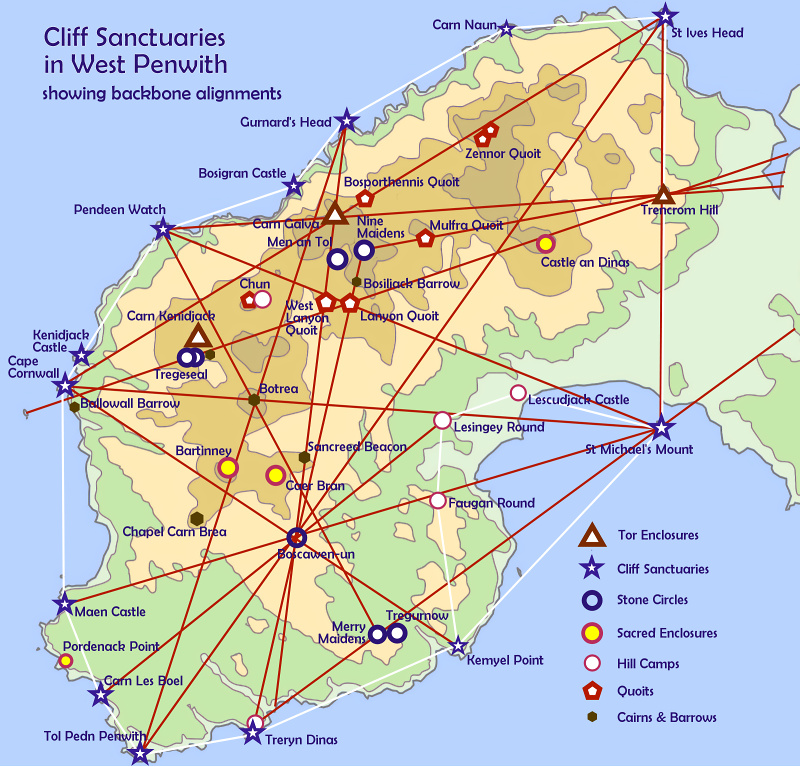
This is the key map that illustrates my main point in this work: that Penwith was an integrated ancient site and cliff sanctuary covering the whole landscape. That integrated system was pegged out between the cliff sanctuaries and Neolithic tors of the peninsula.
I built the site in 2015-19 in connection with my researches into Penwith’s ancient sites and geomancy, leading out of the ancient sites and alignments maps I was also making at the time. Initially the maps covered West Penwith though, by 2019, I had extended it across the whole of Cornwall. The maps, together with fieldwork, were the basis of the research.
It’s a resource site focused on the alternative archaeology and geomancy of West Penwith, as I understand it. In a way it’s a bit like the course on that subject that I never taught. It’s now around 100 pages in size and quite comprehensive.
There will be tweaks and amendments in coming weeks. If you find glitches, errors or dead links, please tell me their page and location! Thanks.
I’m not sure how much longer I have to live (being a cancer patient) and God usually doesn’t tell you when your bucket-kicking initiation will come – so this rendering of the site might be a parting shot. Whatever is the case, do enjoy trawling through it. It’s for you.
Whether or not you agree with this kind of stuff, there are gems there for the finding, and archaeologists will definitely miss something if they omit to give it a trawl and a good think – and a feel too. It’s all a matter of what we consider to be viable and useful evidence, and what conclusions we draw from it.
Near-parallel alignments across West Cornwall
This work is probably incorrect in some details, but the overall points made suggest that this peninsular landscape was built over many centuries into a single large, integrated ancient site and cliff sanctuary. One symptomatic outcome of this is that it has never been forcibly invaded. Well, except perhaps by tourists during summertime.
Have fun! With love, Palden
Archaeoastronomy. The summer solstice sun setting between Trink Hill, left, and Rosewall Hill, right, as seen from the top of Trencrom Hill, a Neolithic tor. This isn’t man-made – this is natural. Think about it…
One of the big themes of my life has been time – dealing with the present, understanding the past and envisioning the future.
The future has preoccupied me since I was a late teenager – sitting around with friends, discussing things, trying to see which way the world will go. That’s still an open and evolving question, though for me the issues are clearer now [see:The World in 2050] and my perceptions of fifty years ago, honed by experience and the passing of time, in essence remain quite consistent.
Looking at the future led me to the past. As a student at the London School of Economics during the ‘troubles’ of 1969-71, I’d experienced what it’s like being in a revolution that is suppressed and fails – a devastating transition from inspired ferment to cruel disillusionment. Many are the peoples round the world who have experienced similar since then.
Trying to deal with my ‘political pain’, I studied the movements of change of the past, seeking clues. Then I was given a gift.
Ragged and burned out, one summer’s day I hitched out of London, landing up two days later in the Orkney islands. I found the Ring of Brogar, a big stone circle, and innocently I decided to sleep in the middle of it. I wasn’t expecting a major soul-intervention that night. But it came.
I had a profound lucid dream in which hundreds of people danced around the circle. Chanting and stamping rhythmically as they moved round it, they made the earth resound like a deeply donging bell, generating a charged magical atmosphere.
Loving my favourite stone at Carn Lês Boel
One of them came, reached down and said, “Come and join us“. Which I duly did. From then on I was a smitten megalithomaniac. A deep memory of ancient times was reawakened. Back then too I was involved with time, responsible for organising longterm observances and rites to work with Metonic, Jupiter, Saturn and other longer cycles of time.
Guess what, in this life, by the mid-1980s I was initiating consciousness-raising camps, doing a modern version of the same thing. And they were astrologically timed. After one of the camps I had a moving inner experience where the modern I and the ancient me were dialoguing, sharing our perspectives from our contrasting points in time.
So, I’ve been an astrologer, historian, antiquarian and futurologist. I didn’t particularly plan this but that’s the way it unfolded, in paragraphs and chapters through life. While studying astrology in the 1970s it felt more like remembering than learning afresh. By 1990 I had compiled The Historical Ephemeris of historical cycles with a timeline of events, showing how major-scale changes in human ideas and activities can be identified by observing such cycles. A labour of love, much ignored by historians, it needed doing and I did it.
For the last decade I’ve been studying and mapping West Penwith’s prehistoric sites. We have lots of them. One day I realised why the ancient Penwithians had gone to all the trouble of building these things. Experiences gathered in world healing [see:The Flying Squad] over the previous 35ish years led to a lightbulb moment that came up at Bosiliack Barrow, where I go whenever I seek insights. It’s funny how a revelation often simply uncovers something obvious and already there, though until then it is unseen.
I’m not particularly into earth healing, lightworking or healing and prayer circles, though it’s important that people do these. I’m more into working surgically with specific issues that obstruct progress, in an inner journeying and energy-working sense. It involves addressing fundamental social and cultural patternings, tendencies and institutions that become spotlighted by current events, digging down to get closer to the heart of things, unconcealing and helping to heal the layered pain and damage that humanity has brought upon itself over time. In our own time, these issues are getting in the way of necessary change.
CASPN members, after doing maintenance work at Boscawen-ûn
Consciousness work is upstepped immensely when groups of people work together. Over time, in activities with others that I’ve been involved with, remarkable outcomes have occasionally arisen from it. The Council of Nine (I wrote a book for them in the early 1990s) had emphasised this too: “If there are thirty-six with one mind, focused together, then the entire world, even the universe, may be changed“.
However, an undistracted, unwavering, one-minded focus is needed for that, and it’s not easy. If a group or network knits itself together over time, melding as a group, it can build up a momentum and focus that can take us at least part way along that track.
Sometimes it even happens unintentionally in the public sphere – moving moments experienced at a captivating music concert, a funeral, an uprising or even in a football crowd. Notable in particular are those moments that shake the awareness and feelings of mainstream people in their millions – poignant events, situations and crises that can sometimes evoke a one-mindedness in millions of people at the same time.
When the numbers rise, the intention and energy-holding are good, and there is real feeling behind it, the work people do in this field does have a positive effect, incrementally raising the world’s vibrational level. I encourage you to include this kind of work as a slice of attention in your life, in whatever way is best for you.
Brane chambered cairn, near Carn Euny
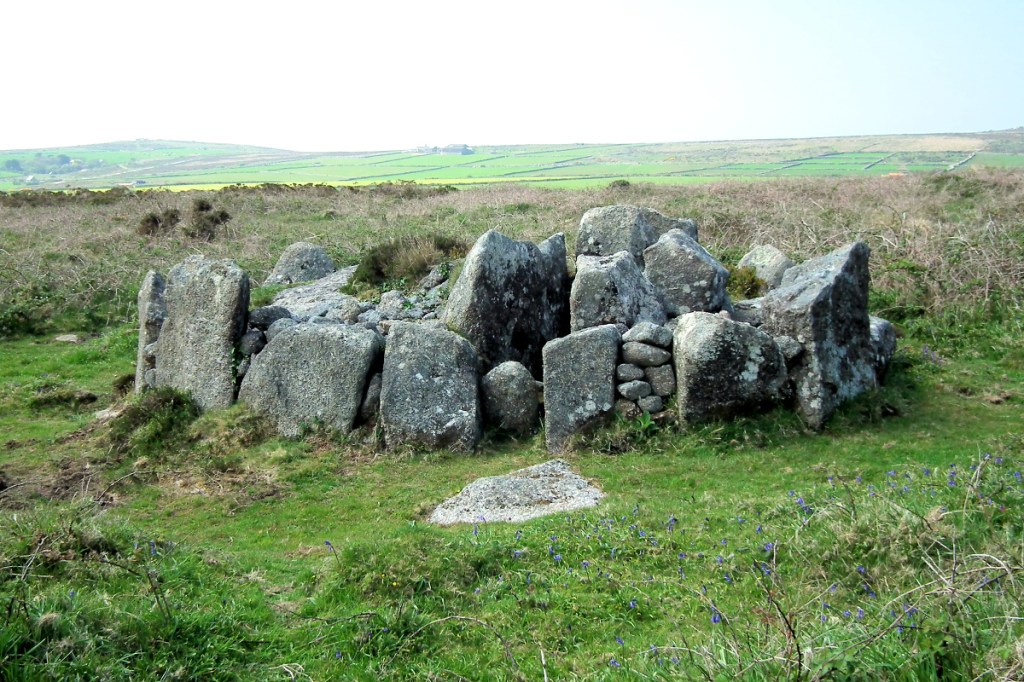
Back to ancient sites. The key sites are those that enclose space – stone circles, enclosures, chambered cairns, caves, wells and dolmens. Here intense vibrational fields can be built up within that space. That’s what the people in my dream fifty years ago were doing.
In many ancient sites we can still feel vestiges of those energy-fields, built up over the centuries during the megalithic era. A presence is in residence. At Boscawen-ûn stone circle, a couple of miles from me, it’s quite common that, when you arrive, someone else is leaving, and when you leave, someone else arrives. There’s something bigger going on here.
Being a peninsula at the end of a bigger peninsula (Cornwall and Devon), West Penwith has definite edges, bounded by the sea. Even the landward side in the east is guarded by three hills in a dead straight line (St Michael’s Mount, Trencrom Hill and St Ives’ Head), creating a threshold and energy-shield. (Interestingly, the G7 conference held in Cornwall in 2021 was located exactly on this line.)
Bosiliack Barrow
As I did my research, it came clear that this was not just a fascinating collection of ancient sites – they constituted one big, integrated system, roughly 10×15 miles in size, and purposefully built. It was rooted in the landscape, anchored to key hills (neolithic tor enclosures) and promontories (cliff sanctuaries). The location of major sites such as stone circles is largely determined by these.
These sites are also variously plugged into underground water-energy systems beneath them. Stone circles and dolmens are sited on top of ‘blind springs’, energy-springs emerging as a vortex on the surface, which the ancients then entrained and focused by building an ancient site on top.
They’re also plugged into the wider cosmos by alignments to the rising and setting points of the sun and moon at key times of year, as well as, in some cases, certain key stars – marked out by alignments to menhirs, cairns or natural features. The designs, geometry and mathematics of many sites also embodied principles such as the Metonic cycle, a 19-year cycle of relationship between the solar and lunar calendars, both of which were used at the time.
Tregeseal
Stone circles and other sites are placed in remarkable locations, with a visible relationship with the lay of the land. Tregeseal stone circle, near me, lies in the apex of a U-shaped bowl of hills which meld together to highlight a gap in the west, toward the sea and the distant Isles of Scilly, which float on the ocean like a mystic realm on the edge of the world.
Stone circles, enclosures and certain hills and features were amped up by cairns, menhirs and other markers that were aligned to them, acting as feeders, relays and batteries. These integrated the system as a whole into a network. In some cairns, bodies were buried not for the memorialisation purposes we now practice with our dead, but to bless and light up the land and the network by burying the relics of revered people at carefully-chosen places – rather like the medieval reverence for saints’ relics.
It was all for the engineering of conditions in which advanced consciousness levels could be achieved – though there were other purposes too. Enclosed energy-spaces such as stone circles and chambers are insulated, charged-up spaces. In Penwith, background radiation in a stone circle is much lower inside than outside it, and this applies also to background psychic noise. A protected, charged space like this allows clearer and stronger psychic, shamanic and healing work – and many of you will have experienced this yourselves.
At the Hundredth Monkey camps of the mid-1990s we built up an energy-field in the circle that resembled those that they built up at ancient sites. An energy-field morphs into a reality-field, where the framework of reality changes gear and things become possible that are not available under normal circumstances.
This was noticeable at the end of a camp when we closed the circle – the mood would subside like a slow puncture, ‘normality’ would restore its grip and the background noise and clamour of the busy world around began intruding again. We had been in a magic space with very different character, norms and rules.
Treen chambered cairn
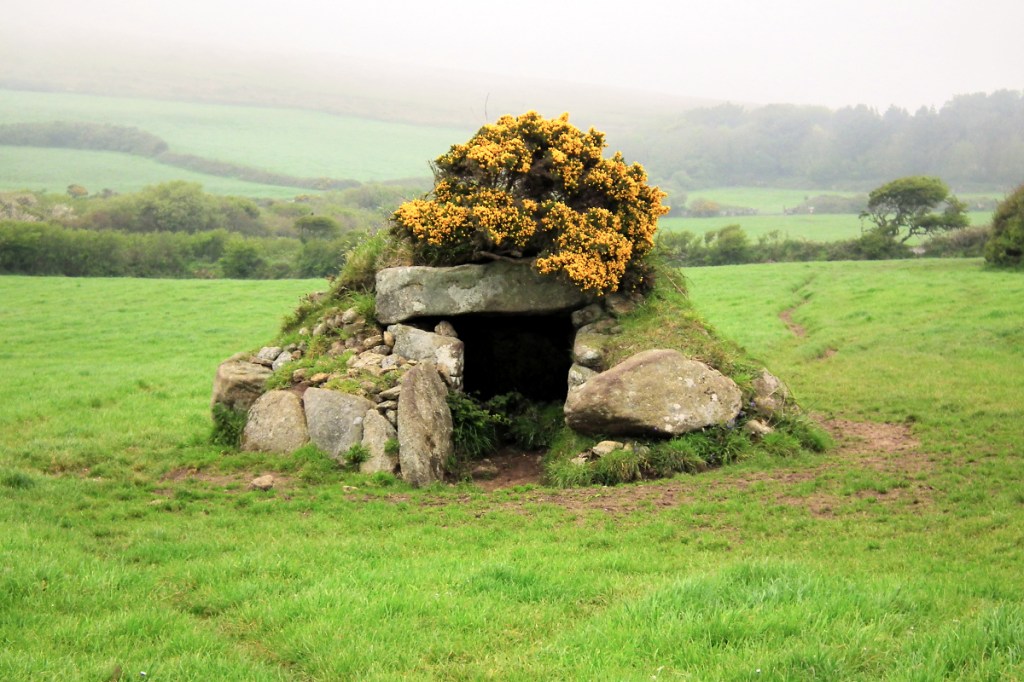
Inside chambered cairns there’s a profound quietness providing ideal conditions for solitary meditation, vision-questing, innerwork and conscious dying, and also for the treatment of seeds, tools, elixirs and magical objects. Insulated from outside by stone and earth, such cairns sit on energy-vortices generated by the intersection of two or more underground water streams underneath. This makes the chamber into an energy-bath or orgone accumulator, valuable for entering into altered states.
Apart from ‘getting high’, why did they bother with all this? It had a direct bearing on the fortunes of people and tribes, as an investment that paid good dividends. Although their civilisation was materially simple, it was culturally and spiritually sophisticated. They had an advanced technology that worked esoterically with the essence of life, the core dynamics within all things, with which they could carry out forms of genetic modification, long-distance communication, medical procedures, ecological and climatic regulation and societal problem-solving.
They weren’t manipulating genetics the way we do today: instead they created energised conditions within which organisms could modify and enhance themselves, and this has been demonstrated to be possible in modern-time experiments too. They needed no telegraph wires or radio waves for communication: trained psychics, often some of society’s neurodiverse people, trained up, would enter a state in which time and distance ceased being an issue.
As for weather-modification, by siting menhirs, mounds and stones on top of energy-conductive water and metal veins and magnetic anomalies, they could neutralise the excesses of bioelectric charge between land and sky, reducing climatic extremes and damaging weather events. Conducting sometimes long and complex rites they focused on keeping Gaia and the spirits of land, sea and sky happy.
Caer Brân
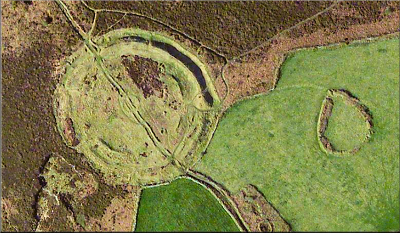
Different kinds of sites evoke different responses – this concerns consciousness-engineering. Just over the valley from me is Caer Brân, a circular hillbrow enclosure surrounded by earth banks, which could hold a gathering of at least 300 people – I believe it was the parliament site for Penwith in the bronze and iron ages. Parliament-moots were probably held annually at a fullmoon around summer solstice, exploiting the virtues of the time and the site, which is exactly aligned with two other circular enclosures (Castle an Dinas and Pordenack Point), with a summer solstice orientation. Though it has a remarkable panorama encompassing Mount’s Bay and the Isles of Scilly, you can’t really see the view from inside because the surrounding banks obscure it. This entrains consciousness upwards and inwards.
Chapel Carn Brea from Boscawen-ûn
Meanwhile, on a neolithic tor hill or a hill camp, awareness opens out over a wide vista, invoking an upward-and-outward feeling. Or at some sites our attention might be entrained in certain directions – at Boscawen-ûn we are drawn toward Chapel Carn Brea, the very last hill in Britain, a beacon hill topped with a neolithic longbarrow and bronze age cairns. In contrast, in a chamber or holy well a deep interiority arises. Ancient sites had added properties engineered into them.
People did ongoing magical work over many generations, well-trained, focused and serious in intent. To crank it up further, they chose power points in time – an eclipse, solstice or planetary configuration – amplifying and pushing their energy-work over a critical potency hump.
There are things to learn from all this. I’m not suggesting building new stone circles everywhichwhere, but there are ways we can amp up world healing work by learning from the shamanic methodology and philosophy that megalithic peoples used. One key element is groupwork and another is the focus such a group can build up. In some respects this was easier for the ancients since they were mostly related, well accustomed to it and also much less psychologically scatterbrained than we. But we moderns have our virtues, such as psychospiritual diversity, a lot of creativity and a good measure of despair regarding the state of the world.
My feeling is that, in the coming decades, events on planet Earth will reach moments of intensity where everyone worldwide gets a deep and clear sense of the full extent of what’s at stake. Events have a way of manifesting scenarios before us that stir us up, press our collective buttons and present sharp dilemmas – whether they’re big events such as the recent earthquakes in Türkiye and Syria, or small, highly poignant events such as a refugee baby washed up dead on Greek shores. These experiences focus minds and hearts, invoking archetypal imagery, stirring sentiments and moral choices. This global process will intensify in coming times and there’s an inevitable crunchpoint approaching, or a few of them, where we’re faced with events of a ‘this really is it‘ kind.
Chapel Carn Brea
It all hangs around whether we pull together globally or atomise into a tangled mess of narrow interests. It’s not just a matter of practical cooperation, effort and peacemaking, but also one of one-minded and one-hearted inner consensus. We’re faced with a mountain of global issues that require a miracle, or a stream of them, and normal means of fixing our problem are too slow and clunky. Only a quantum shift of approach and priorities is likely to prevent disastrous levels of hardship and disruption in coming decades.
A miracle requires the focusing and intensification of an energy field to the extent that our former understanding of reality flips. Nothing much might immediately change, but everything looks and feels very different. A new reality-field supersedes the previous one. The rules change and remarkable things happen. This depends greatly on how, collectively, we see and judge things – a disaster can be made good if if leads to fundamental changes.
This involves going to the heart of things, dealing with them in a psychospiritual way. Not to the exclusion of practical solutions, but complementing them. Making a big step in the collective heart of humanity. Creating a resonance that overrides the psychic disarray and disturbance of today – a central cause of today’s global problems.
‘Disaster’ means out of tune with or loss of the stars. Out of sync with nature, human nature and the cosmos. Out of sync with the guiding light within. The ancients did their shamanic energy-work to keep things resonating well, knowing that everything is interconnected and interdependent. Fixing the world today involves a big cooperation in every possible sense, between humans and with nature and the cosmos.
We have this in our collective memory – it’s a taproot memory in humanity’s collective soul. If we read the underlying meaning of current events to be a manifestation of all that we semi-consciously fear, dread, need and hope for, it is possible to see how events are leading us toward a crunch point, a truth point. A point of focus where everyone’s awareness potentially comes together to think a new and deep thought.
Mên Scryfa and Carn Galva
So something in our deep memory from former millennia holds a key here. And it concerns the future.
Time is a strange thing, and dimensional. When I went down with cancer, my life expectancy was shortened yet strangely I was given a gift of expanded time. In a time-poor world I became time-rich. Not long ago I asked myself whether I’d like my old life back, and I realised I didn’t really. Though life is more difficult now, and serving time as a cancer patient, 70% dead and hovering there, mostly alone, has tested me to the limit, time has morphed toward a more timeless zone where other things start happening. Loss of physical capability has led to something of a gain in inner ability. Life on Earth always has its compensations!
Perhaps that’s where the world is heading. Global loss of traction caused by increasing crises and disruptions could well lead to a similar compensating factor, experienced by growing numbers of people. I’ve discovered this in the crisis zones I’ve been in – such intensity can pull out the true human in us. When your life is at risk you play for high stakes, and there’s no alternative. You’re drawn into the immediacy of now, and time changes in power and potency. That’s where root-questions are met. From a world healing viewpoint, that’s where the crunchpoint lies, and from it will be born the next world, whatever shape that takes.
Jupiter and Saturn have been sailing majestic and low in the sky around midnight. Jupiter is the really bright one – at its brightest right now at the time of the sun’s annual opposition to it – and Saturn is the less bright one about ten moon-widths to the left. During the Jupiter-Pluto-Sun-Saturn period of conjunctions back around January, the whole Covid thing started lifting off, and now we are at a junction point where things could get better or worse, or different for different countries and people. Plus the wider reverberations that arise from all this which, in a way, are more important than Covid itself – there are social quakes coming, as we grasp the full emergent implications of all this.
Later, at winter solstice 2020, we’ll have a conjunction of Jupiter and Saturn. That’s to say, the process we’re in is going to continue and normality won’t return. Longer term, in a 5-10 year perspective, things are hotting up for major shifts and changes, and we’ve already, since January, seen the starting symptoms of an escalating lanslide of issues that will unfold in the coming decade as things accelerate. This is not just about Covid – which historically is but a catalyst – but it’s about the wider and deeper social-economic-ecological changes afoot.
The issue that drives this, really, is ecological, and the way it is now reaching into human society. Covid is caused by human incursion on nature, and nature is coming back at us. Other things are going on too – just yesterday Lynne and I were down in the field below the farm, and the quietness, the lack of insects on a balmy, warm summer’s day, was noticeable. This is big. And that’s just one thing.
But this ecological starting point then reverberates through the social and economic realms, this time through the agency of Covid, but in future it will be other catalysts. They will be unpredictable even though foreseen – anything from megastorms and droughts to invasive species, extinct species, toxic events, social or political madnesses, or anything. I’ve covered the full range of foreseeable issues in my Possibilities 2050 report. These will impact on us in multifarious and intricate ways, just as Covid has done.
Here I’ve been, locked down in the far beyond, watching. ‘Far beyond’ is the literal meaning of the name ‘Penwith’, where I live. But in another sense I watch from the far beyond, listening closely to things more than people. I watch and listen for the underlying threads, and in my long hours wooning in bed in my fatigued post-chemo stupours, it moves around in my psyche, turning over and, occasionally, out comes a big ‘Aha’. If I had time I would write it down or record it, but my plate is full already, and I’m active and serviceable only 6-8 hours each day.
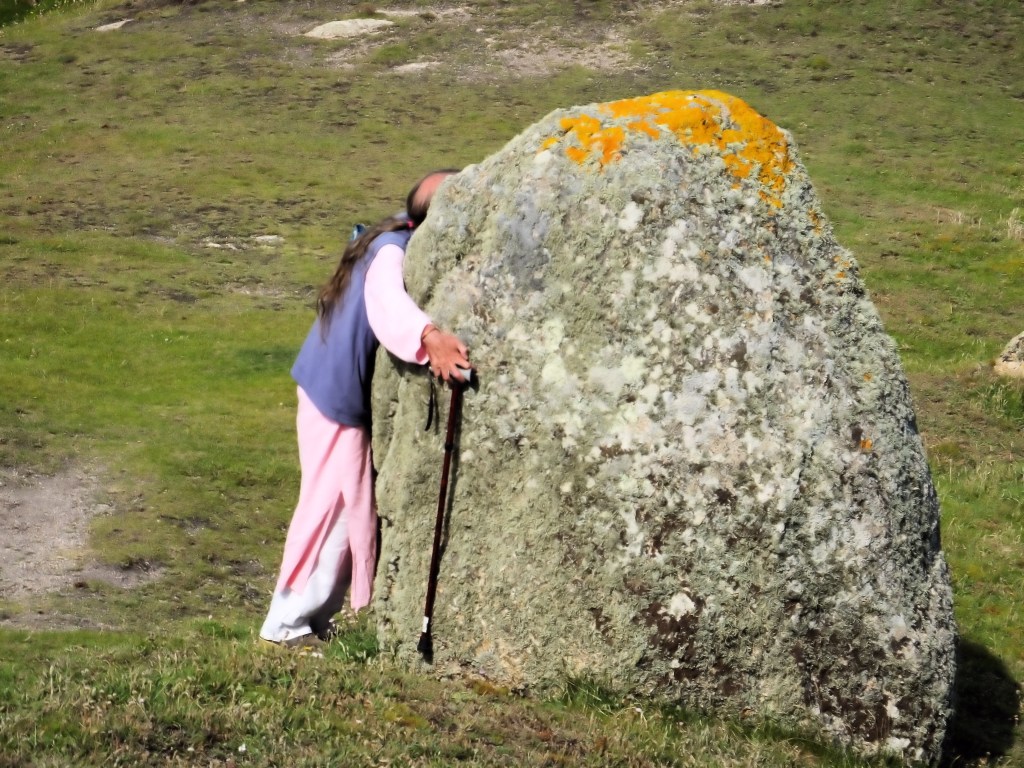
This is how you make love with a bronze age menhir
Besides, most of my focus is on finishing the book I’m writing. Home stretch now. I’m being careful with it, trying to make sure everything I write holds up, because I’m saying a lot and it will rattle a few cages. Most of my books are about three books in terms of density of ideas. This book, Shining Land, is both about the ancient sites of West Penwith (which has more per square mile than anywhere in Britain) and it’s also about ‘megalithic geoengineering’ and its relationship with consciousness. I reckon the people of the neolithic and bronze ages knew how to engineer consciousness, how to build it into the mechanisms of their civilisation and how to work with the inner component of nature in ways that we, in coming decades, need to learn more about.
So, I’m making good use of the situation I’m now in – leaving behind some ideas while I’m still here to leave them. Which goes to show, there can be virtues in having cancer – or in anything we customarily regard as adverse. It has been hard over the last month or so: things have been changing but I am not, overall, getting better. I seem to have cracked the myeloma itself, at least for now, but my back and bones are not good, and I have achey, naggy arthritis. At least, I was told it was arthritis, but I am not sure, and no one is giving it attention.
What’s most troubling is that I do not have overall guidance and supervision from any doctor or practitioner who is knowledgeable in both conventional and complementary medicine. Someone to help me understand and assess the whole picture. I have loads of disparate specialists, doctors and practitioners, bless them, each saying their own bit and recommending their own strategies, and some of the things they get excited about are not my most pressing concerns. So I have to think and feel my way through all this very carefully, and I get an interesting conflict sometimes between what I am told and what intuitively I actually feel. Hardly anyone actually touches me, looks in my eyes or listens to my heart – it’s all remote. It’s MRIs, CTs, PETs, or I even have a radionics genius in Canada or another on an E-Lybra machine in Devon.
The paradox is that, throughout life, I’ve had good health, so few doctors and practitioners actually know me. This is tricky because I’m a one-off odd-bod, and I don’t seem to conform to the normal rules of health and medicine. So doctors and healers take a while to figure out how this guy works. I’ve had several instances in recent months where I have healed or responded far faster and easier than was expected. I do seem to have good medicine-buddhas. But I have also paid a high price in after-effects from some of the drugs I’ve imbibed in the last six months. And I’m the sort of person who can’t easily be shoved through the system in the allotted forty minutes.
Tomorrow I’m going to a chiropractor. He knows me from the time before I was diagnosed with cancer, and that’s a great advantage. He’s also very experienced. I’m in such a state skeletally that I’m not sure how much even he can help, but I need to have a new template for my twisted bodily frame to align to. I’m working on my posture and movements but I feel so out of sync that I need re-setting, to have a design or standard to work to. My bones click on an hourly basis, and when I lie down on my back at night (it’s painful at first), I can click myself in four or five places. It’s a relief to do so, but it’s troubling to be so flexible and frail.
So the doctors think my biggest risk is lung cancer, while I think that, if I’m going to kick the bucket anytime soon, it will more likely be from complications arising from broken bones. My bones have been eaten away by the cancer, a blood and bone marrow condition, so I am susceptible to impacts, and I am yet to find out how many such instances I can take before it’s better to check out.
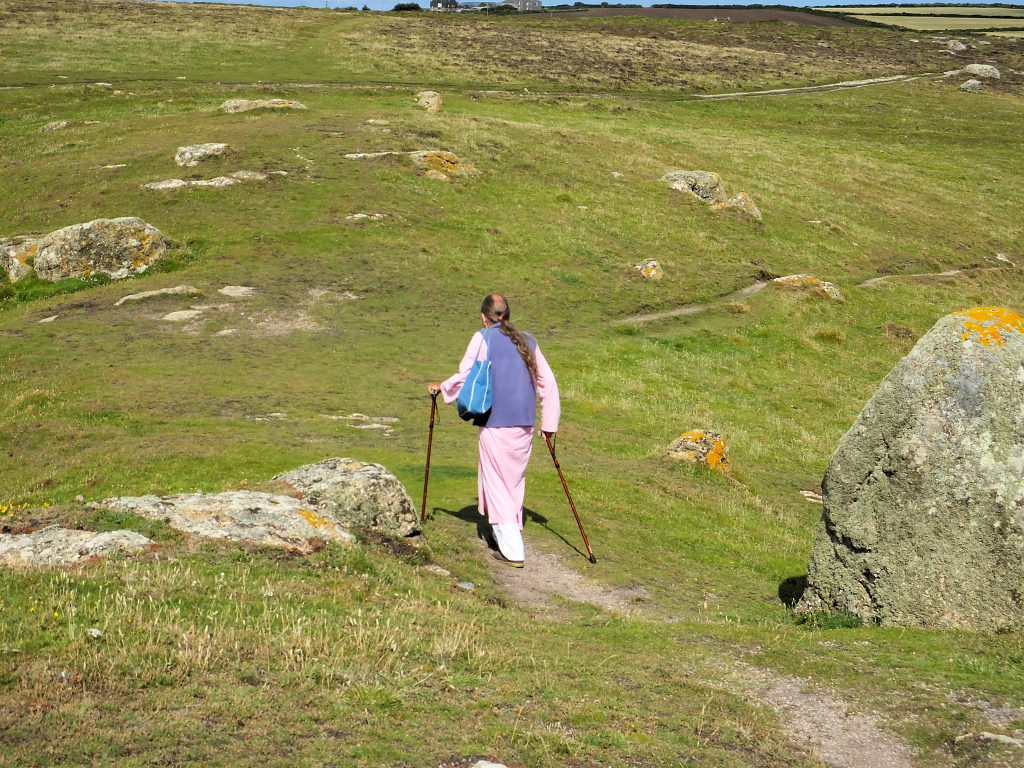
So things are progressing, and also they aren’t progressing, and it’s a labyrinth to stagger though – walking sticks flying as I totter my way through life. Yesterday we made pilgrimage to my favourite place, Carn Les Boel. It was a mile each way and we took it slowly. Pity the poor person who walks with me, but Lynne said yesterday that she’s observing small things in nature that she didn’t give attention to before, because we walk so slowly. This is one of the gifts of doddery old age – you see and bear witness to things others don’t!
I’m not that old – hitting 70 in September – but my body is around 85 and my psyche has had to change to get used to that, to become somewhat like the psyche of a distinctly old man. It’s easy to get annoyed or upset over things I can no longer do, but what’s the point? It just makes life more difficult, for me and for those helping me. The gift here is that being threatened with death makes me very grateful for each day, no matter how low things go. And no one is bombing my house, and a hurricane isn’t on its way: some people have to face stuff like this even when they have cancer, and in this I am lucky. People ask me how I am, and mostly I say, and really mean, “I’m still alive“! Problem is, apart from this, my answer can change hourly, depending on what’s happening right then. Sometimes I’m glowing and sometimes I’m like a lead weight.
Yesterday, at Carn Les Boel, I was glowing. I love looking out over the ocean, and the spirit-beings on the carn are ancient and benign, like old friends, holding me in their upstretched hands. My soul grows and I get stronger in spirit, and this lies at the core of this process. I asked for healing and wholing and offered up my life, to be where I’m most needed and to do what best I can do. I listened to the linguistics of the waves, visited infinity and felt my way round the world, blessing people I know and people I don’t. It was a holy day, and certainly a good change from the rather quiet, shut-in life I’ve been living recently. And God bless Lynne for making this pilgrimage with me – and it’s her pilgrimage too.
Planet Earth is a strange yet beautiful place, and humanity is in such a mess yet so full of promise. I feel so engaged in my heart yet so distant from people and places. I wish I could return to Palestine, to be with old friends there – they are really going through it, both with Covid and with current politics (Palestine’s annexation by Israel and indifferent sabotage by so many countries, including Britain), and their economy is stumbling more than it usually stumbles, and they really don’t deserve this.
I’d love to go to Mali to visit Tinzibitane, the Tuareg village I’ve worked with since 2014. Talking of which, I’m going to try to organise a whip-round to support them soon, so please consider scraping together what you can. In general, the village has been doing well, but Covid has drained their finances. They want to do more to sell their crafts abroad, since tourism in Mali has collapsed. They’re perhaps 70% self-sufficient but when they interact with the wider world they need money. They now have no capital to invest in materials, so I want to try to help them get capitalised so that they can start work on this. More about this soon.
Even here on the farm, far from the madding crowd, there’s a sense of things hotting up around us. The prop planes that take off for the Scilly Isles have been flying in and out. Go out on the roads and the big, black, shiny cars of the English are here. There’s more of a buzzing in the air. But it’s motors, not insects – and one consequence will be fewer birds, like the swallows and bats that swoop around outside my window, who feed on flies.
Bless you all. All will be well. But so much of the secret lies in the way we see things. Life is a problem or life is a gift, and the choice we make about the way we see things is where our free will truly lies – whatever our situation.


















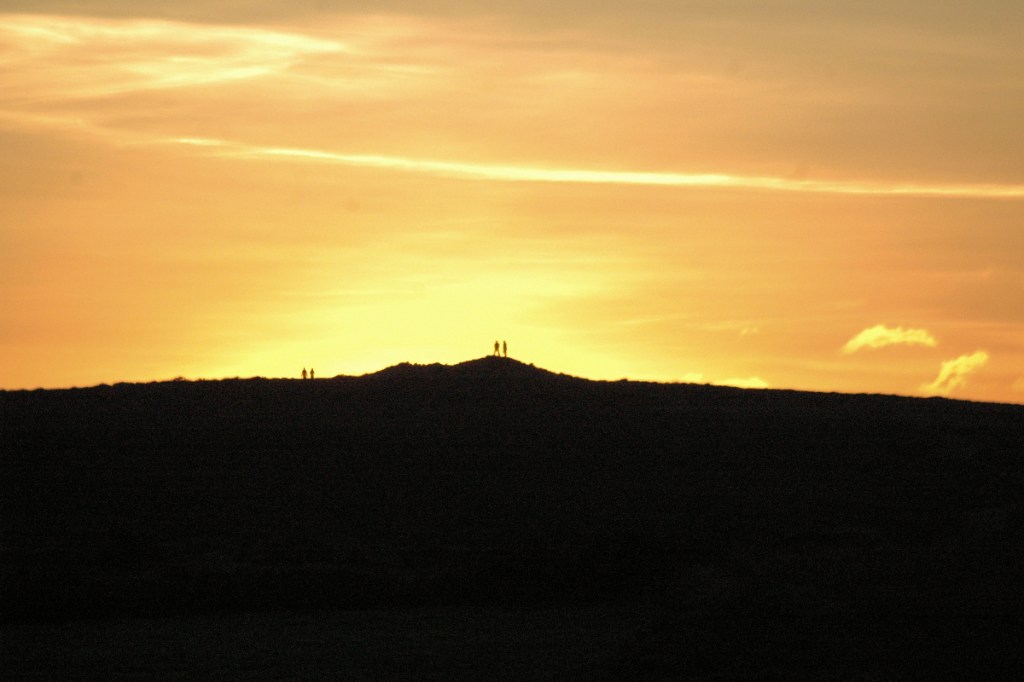
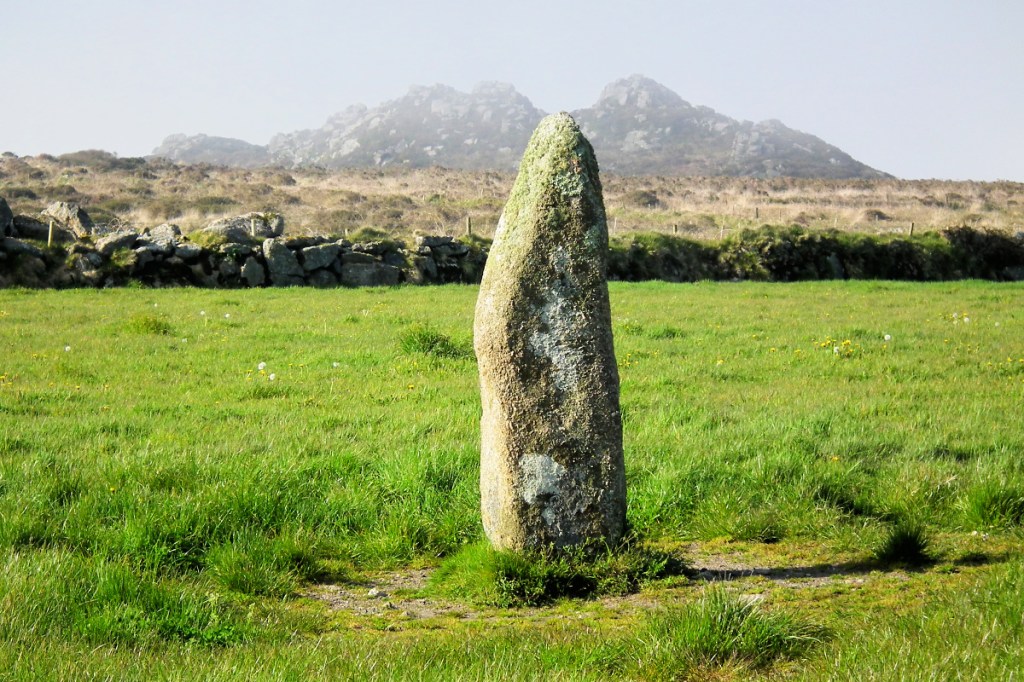
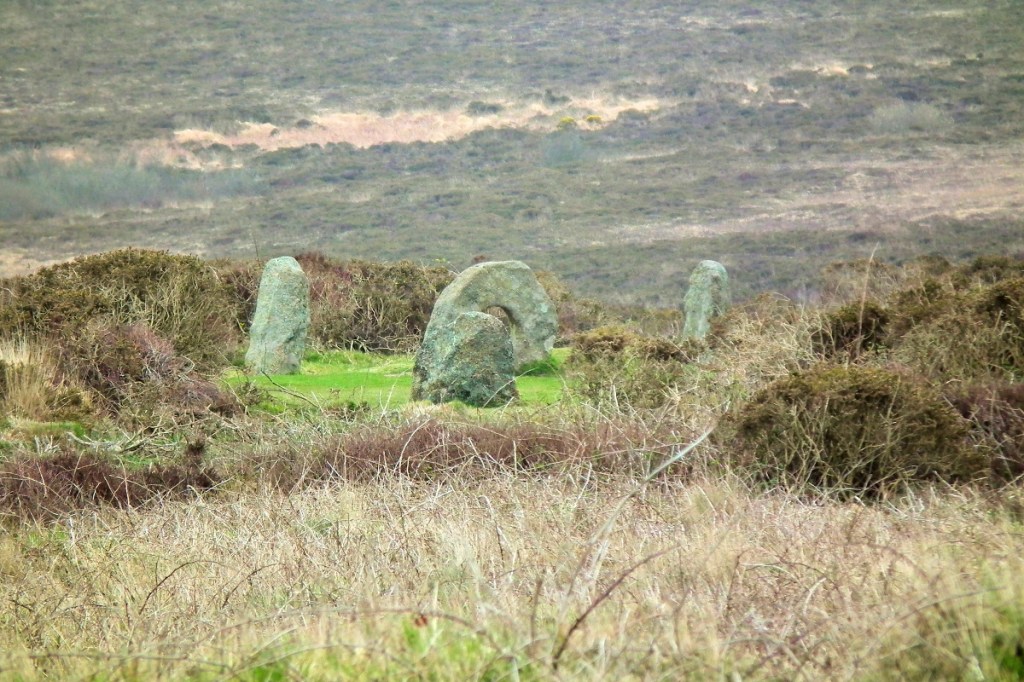
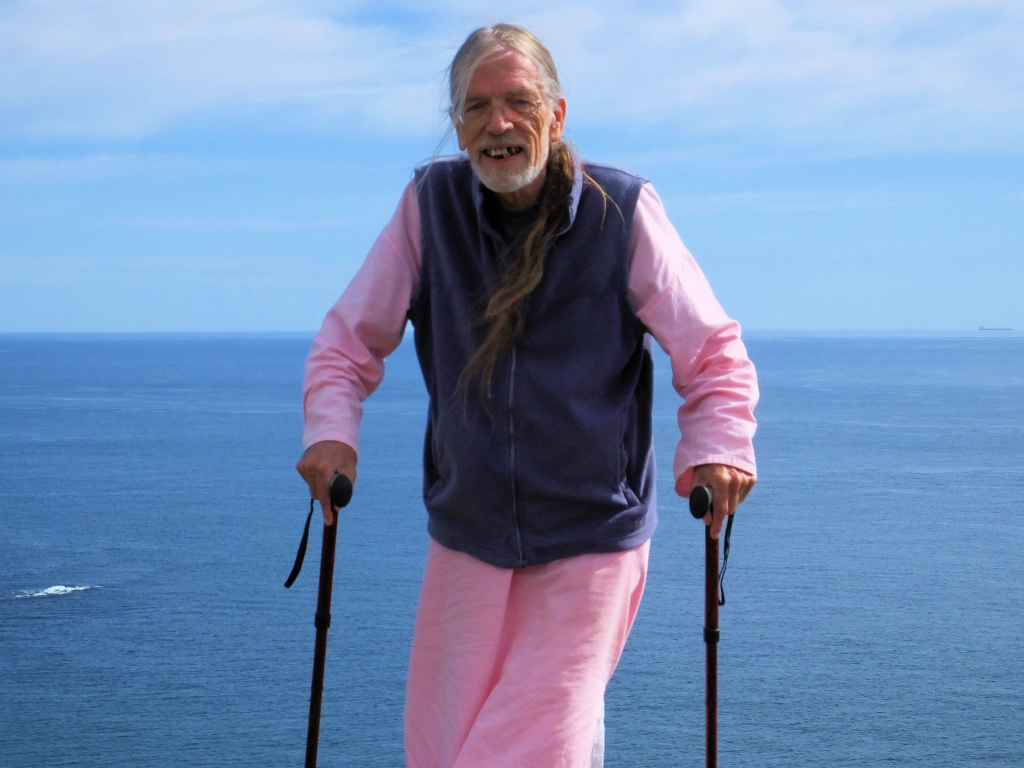
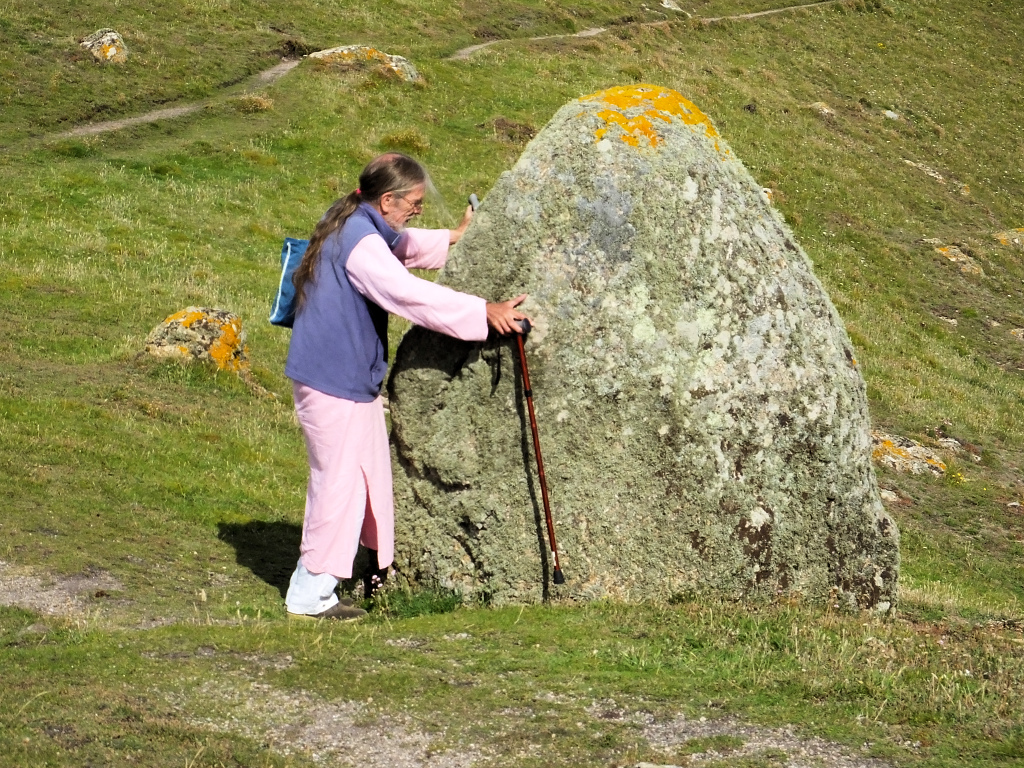
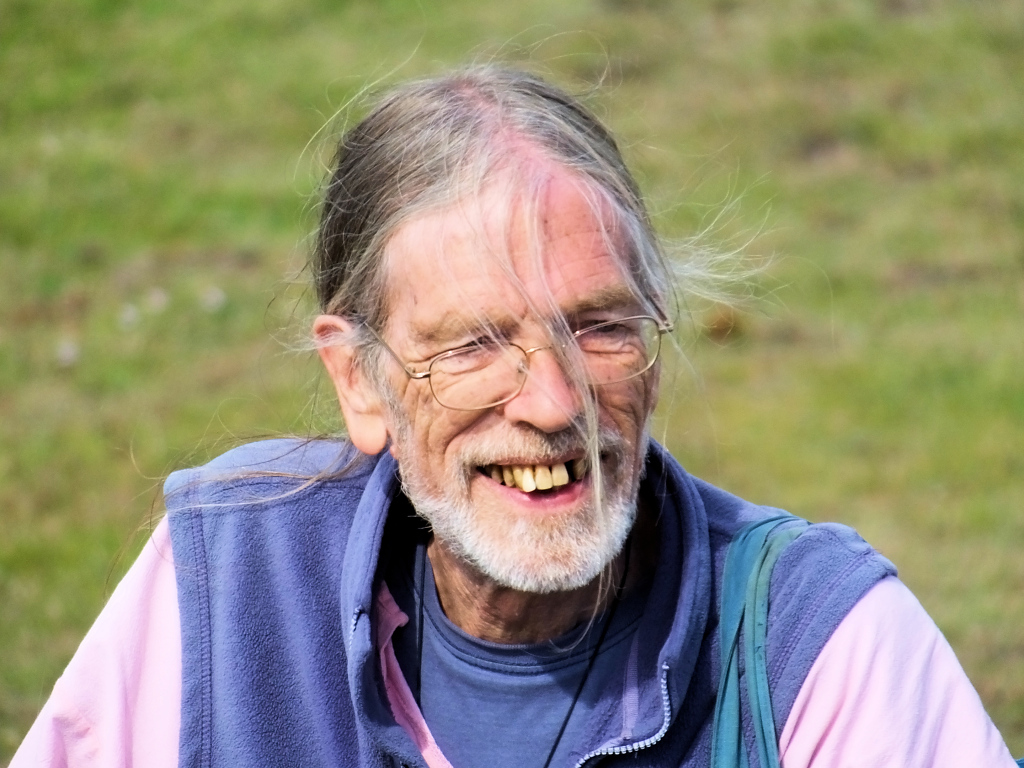 Yesterday, at Carn Les Boel, I was glowing. I love looking out over the ocean, and the spirit-beings on the carn are ancient and benign, like old friends, holding me in their upstretched hands. My soul grows and I get stronger in spirit, and this lies at the core of this process. I asked for healing and wholing and offered up my life, to be where I’m most needed and to do what best I can do. I listened to the linguistics of the waves, visited infinity and felt my way round the world, blessing people I know and people I don’t. It was a holy day, and certainly a good change from the rather quiet, shut-in life I’ve been living recently. And God bless Lynne for making this pilgrimage with me – and it’s her pilgrimage too.
 I’d love to go to Mali to visit Tinzibitane, the Tuareg village I’ve worked with since 2014. Talking of which, I’m going to try to organise a whip-round to support them soon, so please consider scraping together what you can. In general, the village has been doing well, but Covid has drained their finances. They want to do more to sell their crafts abroad, since tourism in Mali has collapsed. They’re perhaps 70% self-sufficient but when they interact with the wider world they need money. They now have no capital to invest in materials, so I want to try to help them get capitalised so that they can start work on this. More about this soon.
 Notes from the Far Beyond
You must be logged in to post a comment.