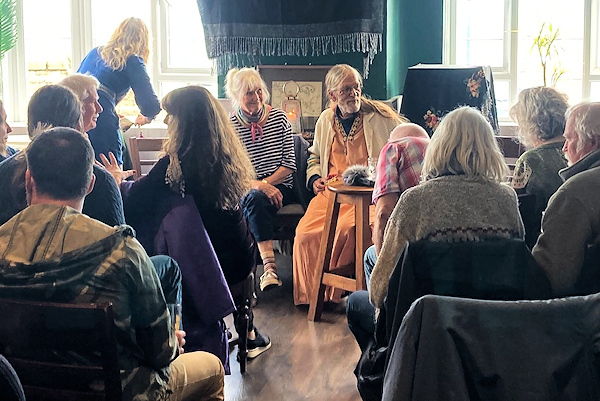
On Sunday, Ba Miller and I shared the floor in Penzance, speaking to a lovely crowd, on the occasion of the late Hamish Miller’s 97th birthday.
Ba herself is 91 – though, with me at 73, a mere stripling, we’re both beat-up and still going strong!
Ba told some anecdotes of what happened when they were following the Apollo and Athena lines from Ireland to Israel, and some really valuable dowsing tips (since it was also World Dowsing Day).
I talked about the energy-landscape of West Penwith, about building megalithic structures for consciousness-engineering and how Penwith is one big ancient site with hundreds of components.
A big thank you to Rachel, Lucy and Lyndz for initiating and organising it, and for their rousing spirit.
To hear our talk (1h 15m), go to my Audio Archive and look for ‘2024 PodTalks’:
Also: my latest book, Blessings that Bones Bring – a spirited Myeloma patient tells his cancer story, is coming out soon in digital PDF format, and before long as an audio book. Whether it gets published in print remains to be seen.I’ll let you know when it’s available.
This 30 minute podcast is recorded while sitting in the remains of an Iron Age Courtyard House, up the hill on the farm where I live.
It doesn’t look very exciting nowadays, though it’s a nice place – but then, if you were 2,000 years old, you might be a bit worse for wear too!
This podcast is all about what life was like in the Iron Age in Cornwall, two millennia ago, and the way people saw things then.
Looking into the yard of the courtyard house. Behind are Sancreed Beacon (left) and Caer Brân (centre right), and far behind them is the hill on which the Merry Maidens stone circle sits.
This was the Celtic period – though the Celts shared a culture, and they were not one people. In West Cornwall many were descendants of the indigenals of the Bronze Age.
It’s about life and reality systems in our time, and in the Iron Age, and also in the Bronze Age and the Neolithic – how people saw life and the world in each of these periods, and how their technologies reflected that.
With some insights into what we can learn from them now. This is important. As elder dowser Sig Lonegren often used to say, quoting his Seneca teacher Twylah Nitsch, ‘We seek not to emulate the ancient ones – we seek what they sought‘.
This is about pitying the winners, social healing and walking our talk.
The core issue is this: ascension and the birth of a new world will take place only when we are truly ready for it.
We wish for peace, ecological restoration, socio-economic justice and change in every sector of life that we can think of.
But the big question is whether and how much we’re ready and willing to do what’s necessary to allow such things to happen.
Until we become ready and willing, we’re holding back progress on planet Earth. As philosopher Edmund Burke put it: ‘For the triumph of evil it is necessary only that good people do nothing‘.
37 mins. Recorded while sitting in the ruins of a 2,000 year old Iron Age courtyard house, down’ere on the farm.
We live in a strange world where its inhabitants, called humans, have a weird tendency to believe that other humans are fundamentally different to them and opposed to them. Don’t go to Planet Earth – the inhabitants there are dangerous, mainly to themselves. This is a bizarre aspect of this particular world.
That’s a paragraph from my book Blogging in Bethlehem. I woke up this morning with the idea to serialise it as an audio book.
But then I wondered whether enough people would be interested to justify the effort. It’s not a very long book (unusually for me). At a guess it would land up as three hours of listening, sectioned into 30ish minute segments.
So I’m wondering about that. Any views?
I can’t start today anyway, because the wind is rattling around too much for sound recording! But I have my cancer treatment tomorrow/Weds – a nurse comes round and it takes just 45 mins. I might well be buzzing on that sufficiently in the following two days to start recording – you never know. Depends on the winds.
My life goes in four-week cycles and treatment affects my psyche, stomach and daily life for around a week. That’s weird for an astrologer who has lived life attuned to natural cycles of a more elastic kind, rather than to a calendrically-regularised grinding cog of time, with a periodicity determined by medication.
Down’ere at the end of Cornwall, stuck out in the Atlantic, we’re getting a lot of high wind and storming. It’s a bit reminiscent of the stormy winter of 2014. The birds are lying low.
Dolphins playing the waves at Nanjizal Bay, Cornwall
And talking of calendars – specifically Gregorian ones – may the rest of your year remain happy. In the end, happiness is a decision of the heart, not an ideal set of circumstances that only occasionally crop up – then they go again. Happy times.
Rather like Greenwich Mean Time, the Gregorian calendar is a vestige of European imperialism. Nowadays it’s neatly called the ‘Common Era’, as if to conceal its origins, and GMT is re-named UT, or ‘universal time’ – except the universe doesn’t follow it.
It might be one of those post-colonial vestiges that stick around for some time. Perhaps the only situation to change this will come when we finally adjust our lives on Earth to the wider universe.
Watching intently. Portheras Cove, West Penwith, Cornwall
Until such a time, since we’re dangerous, we’re under a form of quarantine. Dangerous to the universe and dangerous to ourselves. Most strange.
It sounds simple, but the solution is happiness (as a decision of the heart). The way things are now, though, it looks really complex. Especially with vexatious warring and all manner of dissonances going on.
It needs modelling and shoving through supercomputers because we believe we can sort things out mentally, if only we have enough data. But mentality simply sorts data, even if intelligently. Decisions are made in the heart, the womb and the gut – the parts that AI can only imitate, though it cannot reach.
At this juncture of history, we have a lot of rather big decisions to make. We humans need to get more happy and become less dangerous. Less dissonance, more resonance.
It will affect climate change in a big way, with instantaneous results.
Think about it. But not too much. And I won’t either.
I’m at it again. Here’s my latest podcast, of interest to anyone thinking a bit further than their nose about the current conflicts in the world.
Wars happen because of failed relationships between nations and peoples (and oligarchs). This concerns parapolitics – the politics of planetary evolution.
It’s taken from my 2003 book Healing the Hurts of Nations, written on the buildup to the Iraq war. All about the psyche of the world, the collective unconscious and the psyches of nations – and their unconsciousness as well.
That’s what causes big problems – projection onto others to escape taking responsibility for what we ourselves are doing or have done, or secretly intend to do.
Nations fail to see ourselves as others see us, and to own up to our own shadowy, smelly, dishonest side in our relationships with other nations.
This material is 20 years old and recycled, yet it doesn’t need re-working for 2023-24 – it’s all thoroughly relevant now in our current situation.
Without solving the problem of war and international cooperation, we won’t get through the major crises ahead of us – climate, population, ecology, resources… This podcast suggests how the world can move forward – by a shift of attitude and approach.
This is about time. Time is what stops everything happening all at once.
It stretches us out across a kaleidoscopic storyboard of life-experiences. But in the end, the seemingly lengthy sequence of days and daily life experiences melts into relative insignificance.
It’s what we have become by going through life that matters most. It’s the burnishing and polishing effect of pleasure and pain. Our inner evolution is not something that is hooked directly into time: the progress we make depends more on willingness and openness than on time.
If we devote much of our energy avoiding experiential intensity in our lives, we evolve more slowly. Our experience and usage of the time we have is very much a matter of deep choice. Living life to the full. Not just the comfortable, pleasant stuff but the grindstone, the fire and the soulquake too.
It’s 37 minutes long. This time the recording studio is a field on our farm, with an appearance from the migrating geese of Grumbla.
I’m up on Botrea Barrows in West Penwith, Cornwall, recounting why they’re there, and what life was like 5,500-3,500 years ago in the megalithic era, in the neolithic and bronze ages, when they were built.
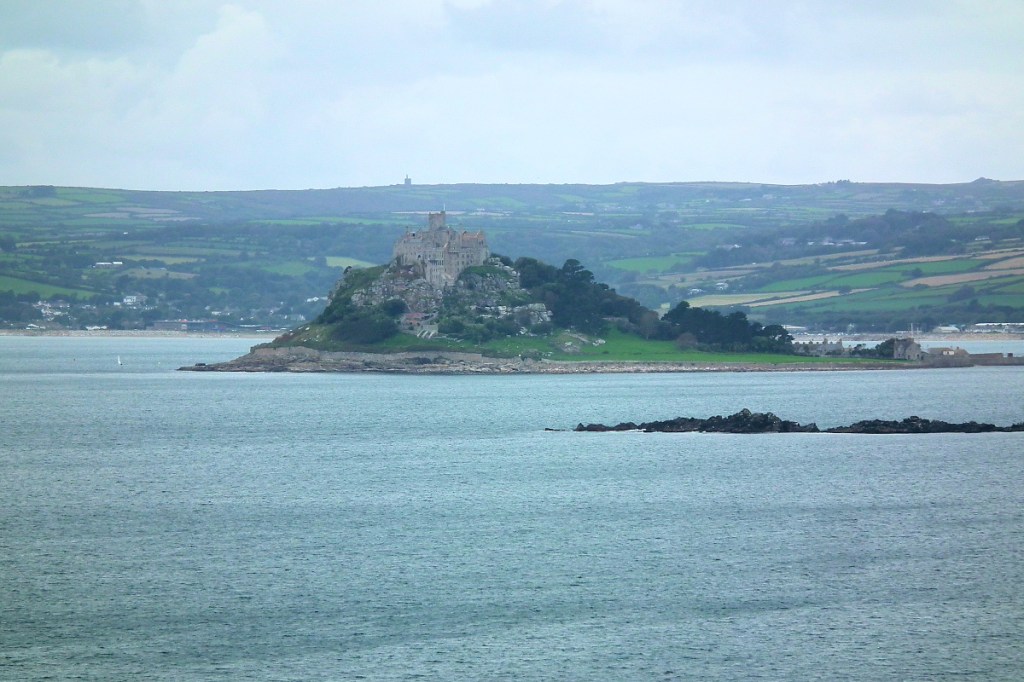
St Michael’s Mount
It’s also about the reasons why the ancient people of Britain went to so much trouble to build sites like this.
They weren’t fools, and they did it to create practical benefits, and they were onto something that is relevant to our day.
It has something to do with building a sustainable civilisation – one that works more or less in harmony with nature. Although it did come to an end, megalithic bronze age civilisation lasted around 1,200 years – pretty good.
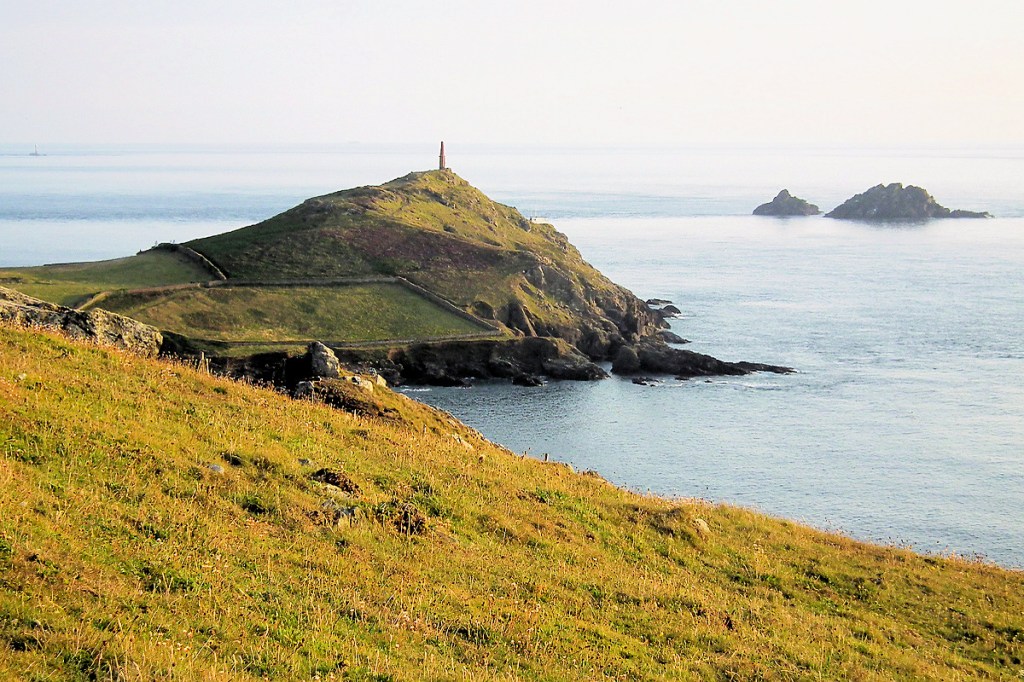
Cape Cornwall
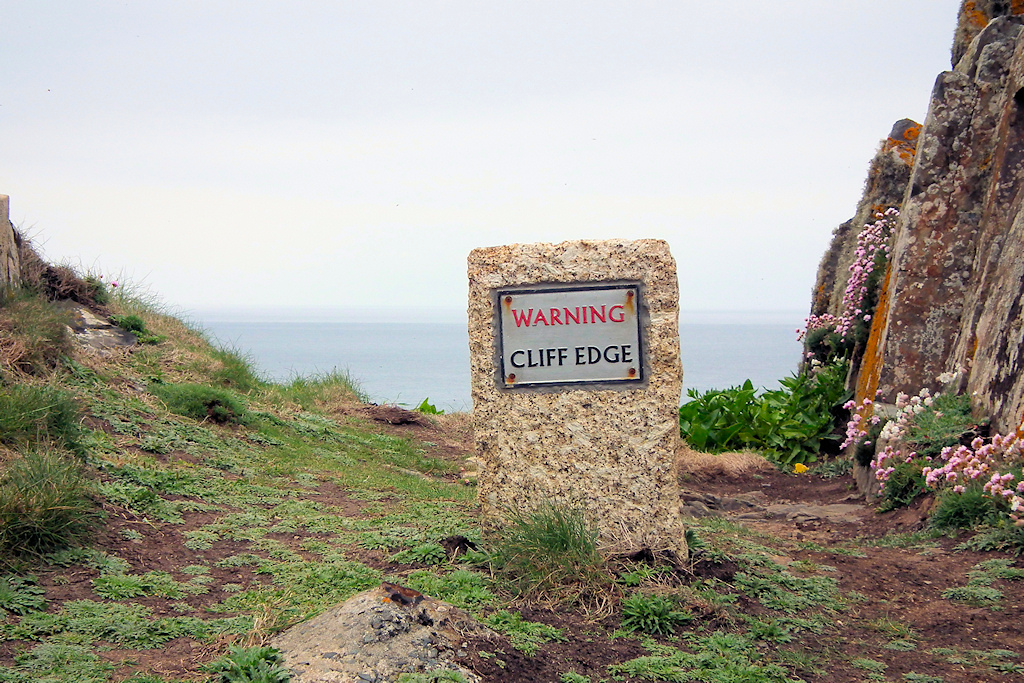
Introduced by a Cornish chough and outroduced by oystercatchers and a raven, and the Atlantic waves at Carn Les Boel, a cliff sanctuary just south of Land’s End, at the furthest end of Cornwall.
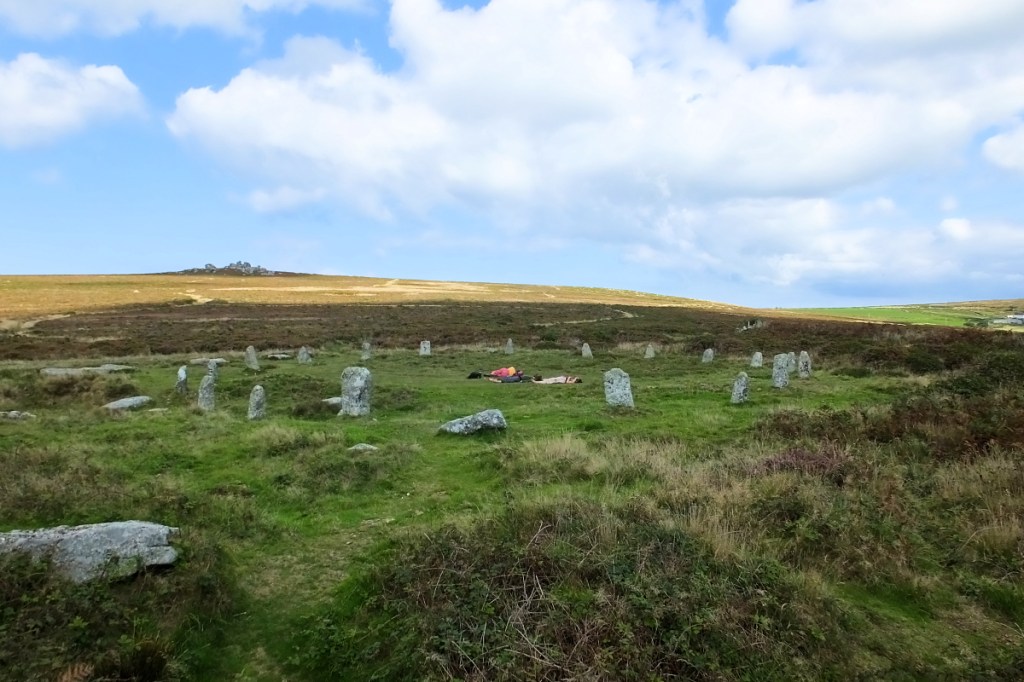
Tregeseal stone circle here in Cornwall sometimes has a knockout effect!
It’s meditation time again on Sunday evening at 8-8.30pm UK time. Do it wherever you are, using methods you’re used to. No sign-up, no strings – it’s a sharing of inner space, with a view to raising the energy of the world. For full details, including the meditation times in different timezones, go here:
On a slightly different matter, I am creating an archive of my work and last week sorted out an astrologically-based talk I did in 1990, shortly after the fall of the Berlin Wall, and Tienanmen Square and a massive shift in all and everything worldwide. This was a time when many new ideas born in the 1960s – environmental, gender, racial, human rights – came into mainstream awareness.
Neolithic longbarrow on Chapel Carn Brea, Cornwall – the last hill in Britain
Interestingly, I predicted several things at the time – that Gorbachev would not last long, that trouble would ensue from Western encroachment on Russia and that online networking would become a big thing. But there was one thing I got wrong: I reckoned the world would make the big and necessary decisions very soon, during the 1990s, and it took another 30 years and we’re only now entering a time, the late 2020s, when such decisions are really likely to be made. Well, better late than never.
This PodTalk is not required listening but some of you might find it interesting. It outlines the astrology and the underlying meaning of of those times, a major junction point of modern history that was only really equalled by the banking crisis of 2008 (when Western world hegemony lapsed) and the Covid crisis (the seeding and beginning of a major social change that is likely to unfold further during the coming 15ish years as Pluto chugs through Aquarius.
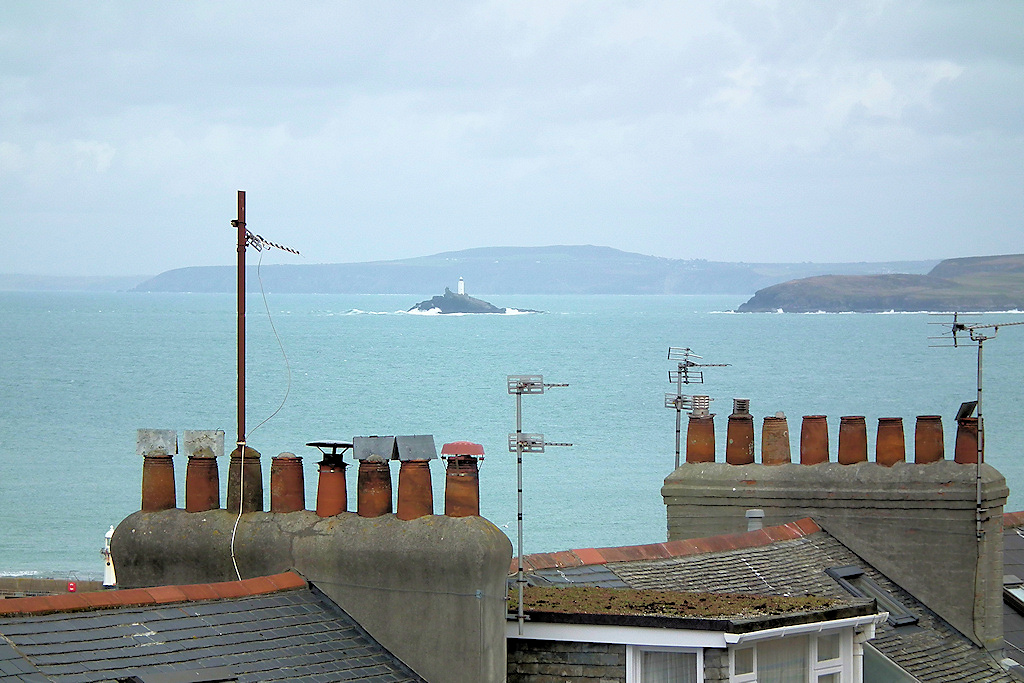
Godrevy Head and Lighthouse from St Ives, Cornwall, with St Agnes Beacon behind
Here’s one of my podtalks, recorded in early August, Lughnasa, at the Oak Dragon Camp in Somerset.
It’s all about our prehistory in Britain, and how and why people built ancient sites, and their advanced shamanic-magical culture, and sympathetic, sustainable societies, and the creation of gods and religion, and a few other wee matters such as these.
A sweep over the megalithic periods of the Neolithic and Bronze ages. 90 mins.
Well, this episode could lose me a few friends… though in the interests of free thinking, the contents of this podcast might deserve a listen.
Either that, or perhaps you’re feeling a bit confused by all this conspiracy malarky, and this podcast might help put things in a little perspective.
We need to get this matter of conspiracy into proportion. It’s a polarised, zero-sum issue for most people – we believe in conspiracy theories or we don’t, black or white, but we need to look at the space in between, the shades of grey.
The answers aren’t straight and simple. There’s truth and falsehood in the conspiracy game, and it’s important not to gobble up ideas because they sound plausible, they fit your picture or they look like a conspiracy.
But don’t reject it all either, just because it’s smoke and mirrors, it makes you feel uncomfortable, others disapprove or authoritative voices pass it all off.
Here, I give my own considered assessment, in thirty minutes.
Intro and outro with the springtime birds of Botrea, offstage noises from Betsy the farm dog, and music by Galen Hefferman in Oregon. 34 mins.











You must be logged in to post a comment.