This is a recording of a talk I gave on Wednesday 19th in Penzance, here in Cornwall. It would interest anyone who knows and loves West Penwith, and also folks interested in geomancy and alternative prehistory.
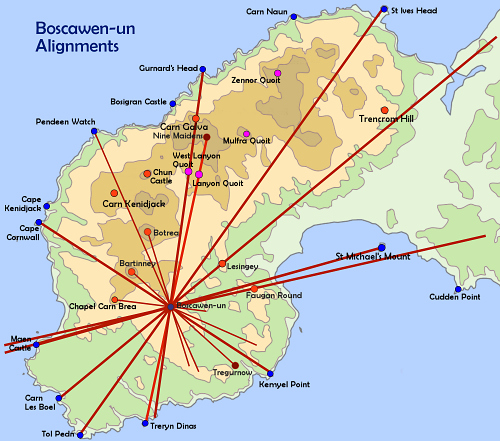
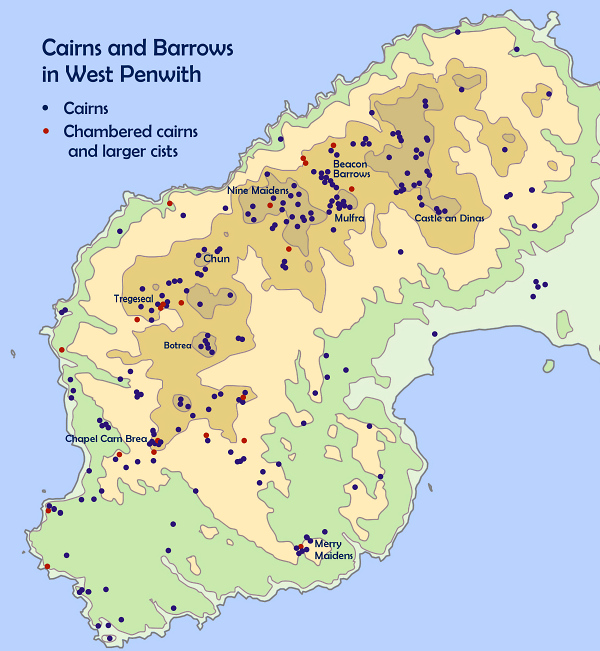
It’s about energy-fields, ancient site alignments and the geomancy of ancient sites. I make a radical proposition that the hundreds of sites in Penwith all constituted components of one enormous ancient site covering the whole peninsula.
A collection of interesting maps is provided with the recording of the talk, which is 1hr 48mins long.
To follow in autumn in Penzance, there will be four monthly AHA classes, covering activism (changing the world), prehistory (more about Magic Penwith), power points in time (astrology and the way the tides of time move) and extraterrestrials (about life off and on Earth).
I’m speaking at the Glastonbury Symposium on Sunday July 28th, and I return to Glastonbury on my birthday on 5th September. The subject is ‘Sludging through the Void with Muddy Boots – and why ETs have spindly legs‘.
If you want a really special experience, you might consider coming to the Oak Dragon Camp, Friday 26th July to Sunday 4th August in Somerset. I’ll be there. www.oakdragon.org
I’ve been a bit quiet on my blog recently. Lots going on, and I’ve been working on a new audiobook too, Blessings that Bones Bring – it’s my cancer story. However, here’s a new podcast, and a follow-up comes along soon.
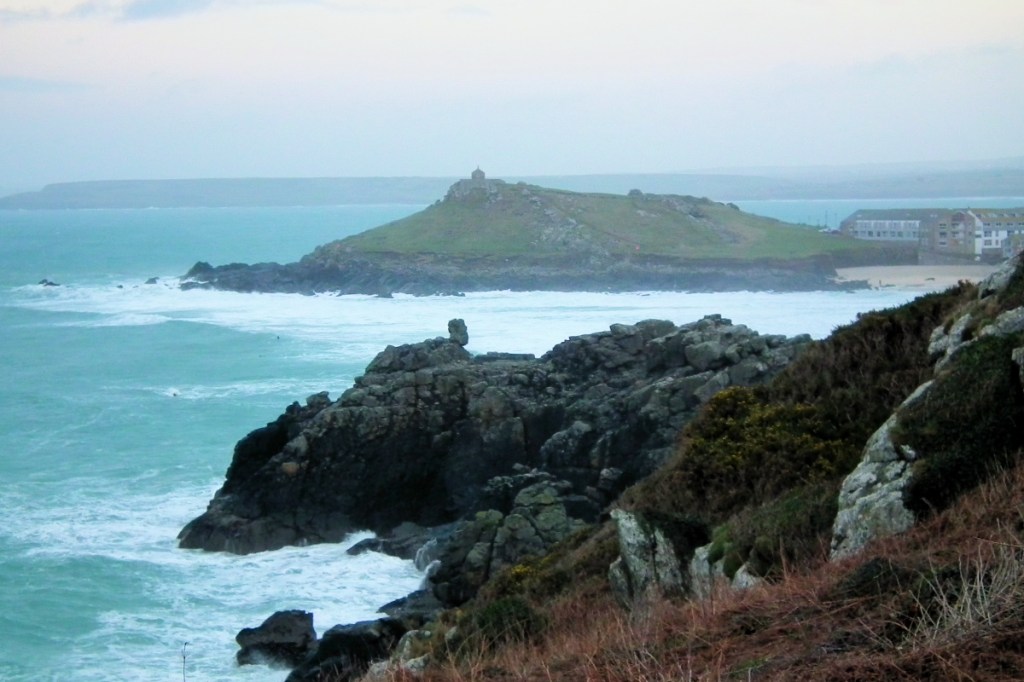
Pordenack Point (it comes up in the podcast)
The Vine of Death – latest podcast
Well, it’s not that bad, but there’s meaning in the name. I’ve just been to an Ayahuasca ceremony, to seek some truth and resolution, and the Grandmother came to me, or I went to her, and I surfed a rather big, surging wave.
Ayahuasca, an Amazonian tree-vine, is called the Vine of Death because, while you don’t actually die, what happens resembles the experience of dying and it’s good practice for it. This, of course, is rather useful to me because, as a cancer patient, that journey is not far away. I got some practice.
The Grandmother is the spirit or goddess of ayahuasca, to whom we are challenged to yield, to receive her teaching and blessing. I met her – we all did – and she treated me gently, then to give me a shake-up.
The journey was very much about resolving and re-weaving some key threads in my life, shedding some baggage and opening to the future. Yes, a person at the end of their life does have a future – in a way, quite a big one.
Four men from four countries, plus a magic cat, travelled a light-year or two in the otherworld and returned, and this is the story as seen through my eyes.
It’s in two parts, covering the first and second days of the ceremony. This is a very personal story, with some tears and chuckles thrown in.
Those of you who know me or have been following me, or who have been listening to or reading my cancer story, Blessings that Bones Bring, might find this interesting. If you’re new to my blogs and podcasts, I really have no idea what you’ll think of this one, though I hope you enjoy the ride!
This is part one, and part two follows within days. 33 minutes.
Planet Earth – quite worth a visit (this is down in our woods).
Down here in Penwith we get a lot of wind – we’re stuck out in the ocean and it loves blowing us away with its power and glory. So it’s a breezy start and finish to this podcast.
It’s one of those things that happen in parts of Planet Earth. And that’s what this podcast is about. Conditions on Earth as seen from the outside.
In coming months I’ll tell you more about things I learned from the Council of Nine – this is the first of a few. What they taught was so multidimensional that it’s difficult to cover it all briefly. In this podcast I present one aspect of it, for your consideration.
It’s all about how our planet was set up and the larger picture on our current global situation. It is the consequence of the application throughout history of human free will. People might legitimately ask, ‘How can the Universe be benign, and how can God be Love when we see things like the disaster in Gaza happening?’, but there is a simple answer.
It is a product of human free will. And collectively as a planetary race we need to apply our free will to deconstruct such tragedies and make them obsolete.
Recorded in May 2024, down in the bluebell woods below our farm. The wind sounds like a powerful gale, but actually it was simply a brisk Cornish ocean breeze rattling in the leaves of the trees. 37 mins long.
This is about pitying the winners, social healing and walking our talk.
The core issue is this: ascension and the birth of a new world will take place only when we are truly ready for it.
We wish for peace, ecological restoration, socio-economic justice and change in every sector of life that we can think of.
But the big question is whether and how much we’re ready and willing to do what’s necessary to allow such things to happen.
Until we become ready and willing, we’re holding back progress on planet Earth. As philosopher Edmund Burke put it: ‘For the triumph of evil it is necessary only that good people do nothing‘.
37 mins. Recorded while sitting in the ruins of a 2,000 year old Iron Age courtyard house, down’ere on the farm.
Wind-strafed heather on Bartinney Castle, West Penwith, Cornwall
I’ve just had my three-monthly phone conversation with the haematologist – she’s at the Royal Cornwall Hospital in Truro. One good thing about my particular cancer, Myeloma, is that it is easily tested and monitored with a blood sample (I had it two weeks ago). So we can do it over the phone. She’s always rather brisk – the poor woman probably gets fed up of the list of calls to make through the day, and with us cancer patients and our anxieties.
Anyway, I had been anticipating bad news. Well, not exactly bad, but not good either. I was hovering between optimism and pessimism.
This winter I’ve begun experiencing a kind of stress – partially due to circumstances but also because part of me feels vulnerable and undefended. No one has my back. It takes me back to experiences I had around the age of six-seven-eight. I remember the feeling of it. I was turning short-sighted, and as an unrecognised Aspie I felt like a stranger in a strange land and a fish out of water. My poor old Mum was always busy with other things, without paying much attention, and the world seemed so big and incomprehensible, and somehow I was expected to manage with all this.
Nowadays they might call that ‘learning difficulties’ but it isn’t really. It’s not a lack of intelligence but a bit too much of it. It’s a complex Aspie perception of the world that takes longer to compute – for me, it took until around age fourteen, when suddenly the other boys started calling me ‘Professor’ instead of ‘Speccy-Foureyes’.
Part of me feels like a seven year old – feeling a need to have someone holding my hand and shielding me from that big world out there. This is quite a change from earlier times in life when I had more confidence and a relative invincibility that was calm under duress and pretty competent – I’m a Virgo, after all, and us Virgos tend to be quite calm and serene, or we tend to be neurotic. Or perhaps both at different times.
So I was somewhere between nervous and calm over this phone call. It could decide many things. One thing in particular is that the next line of treatment – I’ve exhausted two out of five now – is Thalidomide. It’s a good cancer drug, the doctors say, but what makes me nervous is this: my mother took Thalidomide for morning sickness while pregnant with me, and I was very lucky to emerge into life with all my limbs and body-parts intact. Apparently, deformed bodies arise only if the drug is taken during a certain early week of pregnancy, and it wasn’t that week for me. However…
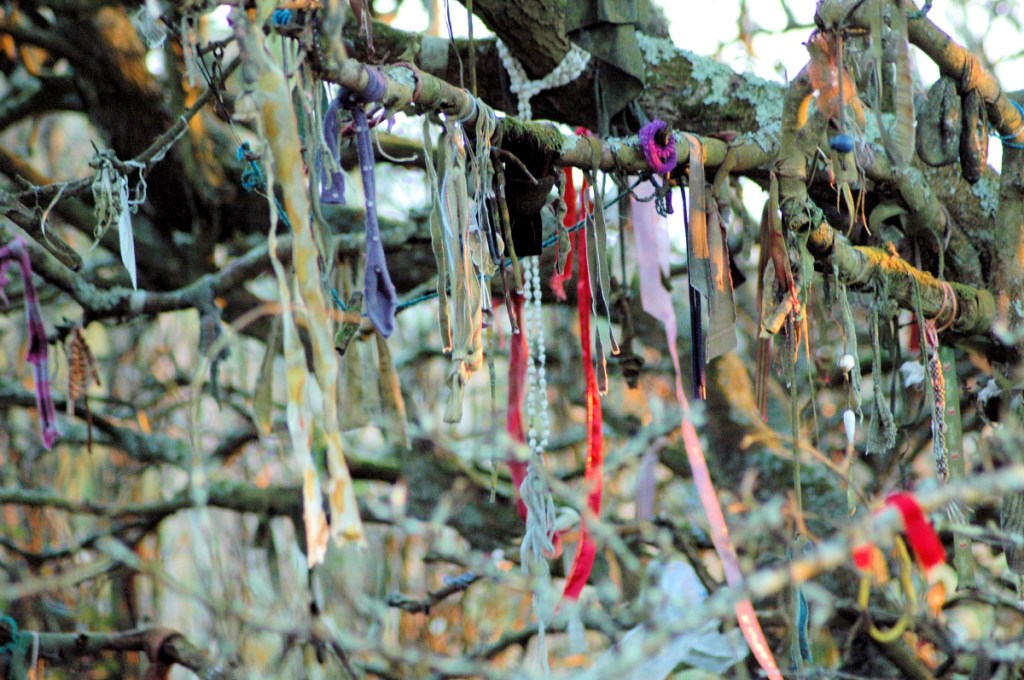
Prayer clooties at St Euny’s Well, near Carn Euny. But if you ever wish to tie a cloutie at a well, make sure it is natural and biodegradable, since the problems you weave into it will disappear as the cloutie rots away. And it doesn’t throttle the tree.
I have Asperger’s Syndrome, and I have wondered whether it’s related to the Thalidomide I took, second-hand, during gestation. The chemotherapy I had four years ago made me wonder about this – particularly the steroid Dexamethasone. The drugs seemed to amplify my Aspie symptoms. The behavioural transition prompted by these drugs helped lose me a partner and some friends. It has become more difficult to manage some of life’s tricky social situations, or deal with bureaucracy, or insensitive people, or hackers, or modern-times complexities.
But, on the plus side, this Aspie-amplification has led to a wave of creativity, perspective and original thinking. As you might perhaps have noticed, I’ve been churning out loads of stuff – mainly in the form of blogs, podcasts and books. That’s the other side of Aspergers – the Aspie genius, with an ability to excel in certain specific interests and gifts (though not necessarily in the full range of abilities that modern humans are supposed to cover). Also, there’s a certain blindness to human guile and manipulation, making us emotionally rather susceptible to getting caught in other people’s webs without realising it.
Many ‘neurotypicals’ judge Aspies to be emotionally neutral or feelingless. Truth is, we get so flooded and drowned in feelingful impressions that we short-circuit or melt down, showing little or no responsive expression except perhaps the look of a rabbit frozen in the headlights. Or a bit like Commander Data. The picture comes clear within hours, days or longer, but by then people have formed their conclusions and stomped off, often making big, inappropriate decisions on our behalf.
Over two years after we separated, I have only recently lightbulbed a bundle of key insights into my relationship with my former partner that I had just not seen before. I had sensed it unconsciously but I still didn’t see it. While talking to a friend I suddenly saw it – the whole pattern and network of connections, events, clues, mistakes and junction-points. It’s funny when that happens – everything suddenly becomes very different. Nothing changes, but everything changes, and a healing can occur.
Yet the paradox is that empathically I understand the workings of the human psyche and human emotions more clearly than many people, though not necessarily in my own personal sphere of life. Many would interpret this as a growth blockage, a refusal to open up to my emotions, but that’s not the case. It’s just that I operate with a different operating system that computes things in a different way, and neurotypicals have some advantages and Aspies have others.
The main problem is that neurotypicals are in the majority and neurotypical culture is dominant, even though today we’re presented with a rather chaotic and multidimensional spectrum of psychodiversity. NTs tend to define the rules and, being more rule-bound than Aspies, they tend to insist that everyone should behave like them, according to their criteria.
Victorian architecture, at Porthmoina Cove, Penwith
Anyway, the haematologist quite likes me – I’m an easy customer. She was pleased (yet again) with my results. I’ve had no cancer medication now for four months and, lo behold, there is no significant change in my readings.
So suddenly I’m feeling relieved. My wobbles were just that – wobbles. It means I won’t have to go on Thalidomide for the next few months at least – and I won’t have to do the rather long journey to the hospital either, once a month.
That’s good, because it comes back to that vulnerable, undefended feeling. My fear is that my Aspie tendencies will get switched up by Thalidomide. The bit that concerns me most is that I have no one to speak for me or cover my back. There are times when I blank out and (this might surprise you) have nothing to say, at precisely the moment when I need to fend for myself. Or I simply forget about something important, remembering it afterwards, and too late. Again, it’s that eight-year old feeling where there are quite a few things you can handle, but some things are too much. You need Mummy or Daddy, or someone, to come to the rescue.
But there’s a lesson here too, in trust. Things always work out alright. My anticipations were based upon the fear that my readings would deteriorate and they’d put me on the new drugs quite quickly. I have a few public speaking engagements coming up, and some anticipation about how well I’ll do on stage if I’m on new drugs. Or whether Thalidomide would lead to regrettable behavioural changes, just as the steroid Dex did. But there was no need to worry, and everything is alright. My readings are fine.
So is Paldywan the oratorical bard. Lacking anyone to talk to, a few days ago I went up the hill to the 2,000 year old ruin of a courtyard house and recorded two podcasts on the trot. And one of them, Ascension, comes out with this blog.
There’s a funny twist I discovered recently. In 2021 I contracted Osteonecrosis of the Jaw (ONJ), as a side-effect of some pharma drugs I had been on earlier. It caused pus to drip from my chin – urgh, yuk! It made me feel horrible and disgusting and, naturally, no one wanted to come near me. I asked myself about the inner meaning of this, digging up an image or a memory of having had leprosy sometime back in history, and being rejected by society. Rejection and exile are two karmic patterns of mine. When I twigged this, it made some sort of sense – deep memory was involved in the ONJ.
As time went on the ONJ subsided, becoming manageable. Then, a few days ago I was looking up the various uses of Thalidomide and the two specific ailments mentioned were leprosy and multiple myeloma (my kind of cancer). Ah, there’s a connection. I’ve been given a clue. Clues like this can act as keys to healing. It’s fascinating how intuition can know things long before the brains catch up.
I’ve started on some new holistic remedies – the main one is Resveratrol, a specific treatment for Myeloma. I’m back on Shitake Mushrooms as well. I have started some new supplements and remedies too, including one by Detox Trading in Devon called Happy Mix – it really does lift the spirits and, with the late spring we’re having, it has helped me emerge from wintertime blues and cabin-fever.
The Watcher. A simulacrum at Porthmoina Cove
I didn’t need to be worried about the haematologist’s verdict. Perhaps I am a neurotic Virgo after all. Though there’s something else here too… cancer has stripped away many of my defences, sensitising me to vibes, energies, situations and scrangles. There’s more emotional lava erupting as well. This makes me both more open and more vulnerable. Small things demand more processing than before, yet I’m less dulled by the very defences, built with the cement of trauma, that are designed to protect us from a rather tough and violating world. Life has become more colourful, textured and meaningful.
So a key cancer benefit – or a possibility, at least – is that cancer is a big jolt to become more human, to live more fully – even if physically constrained like me. In some respects it might be worth looking on cancer as an upgrade – and other terminal, serious and painful ailments too. From a soul viewpoint, at least.
It’s not a matter of primary importance how long we live – dying ‘before one’s time’ isn’t necessarily a failure or a shame. What matters is how we filled the time and space we were given, how we chose to experience the life we had and what contribution we made. In terms of soul evolution, three years with cancer can sometimes be equivalent to fifty years of normality.
But then, you don’t have to contract cancer for that to happen. It’s the way cancer hits you that matters, and what doors it opens – and whether we choose to go through them. This is regardless of how well or badly the cancer goes from a medical viewpoint. It’s the psycho-spiritual impact and the jolt that matters. It induces a cards-on-the-table focus of energy and of will-to-live.
It obliges us to face our shit, stuff, fears, failings and foibles. And regrets. On a deep level, that’s one reason why cancer is increasing in incidence: it’s one way in which the soul of humanity is serving us notice that we need to wake up. Or, at least, wake up more. Or you die. It’s a simple formula. It’s a bit like being in a war or crisis zone – the situation is terrible, but a crazy enspiritedness can take over, making you put your life on the line and getting you through to where you truly need to go.
My cousin Faith calls it a state of super-concentrated uncertainty. Or I’m reminded of the title of Alan Watts’ book of fiftyish years ago, called ‘The Wisdom of Insecurity‘.
Even so, I’m rather relieved to know that I’m cruising along on a cancer plateau and my results are okay. I felt it was so, but the confirmation is much appreciated. After all, it does help to know at least a little about what’s going to happen next. Should I buy a new computer or put some money down for my funeral? Um, I don’t know, but it might be the computer. Sometimes you just have to choose. And that’s what life on Earth is about.
With love, Palden.
[Written using human intelligence. Such as it is.]
PS: my cancer book is progressing, and recently I decided to release it as an audiobook too – better for people with fatigue and chemo-brain. I still haven’t found a really good title for it though. That’s most strange. I guess it’ll come in its own time.
CONSCIENCE AND WORLD CHANGE – a podtalk from 2007. It came out then on Glastonbury Radio.
Many people have been vexed over Gaza, Ukraine, Sudan and the parlous state of the world. It can give a really discouraging, hand-tied feeling of not being able to do anything about it.
This podtalk addresses the matters of conscience and moral sensitivity – personal and also across society and the world. It was broadcast during the Iraq war, when similar feelings were afoot for many people. It’s taken from a book of mine, Healing the Hurts of Nations.
It might hold some answers and put things in perspective, concerning these rather vexatious issues.
Originally it was a radio programme with a really good choice of music woven into it, but for copyright reasons I can’t publish the full version – and that was a two-hour listen, while the talk alone is one hour long.
Leave it for a time when you have some space for something thought-provoking. Because it is. It has some real gems in it.
When an eclipse happens, it’s as if time and normality stop for a while. Our choice is to respond consciously and awarely, or to act out the energies unconsciously – sometimes leading to trouble.
If you aren’t acting consciously and with intent, then there can be confusion or disquiet in your psyche. It’s because the barriers or veils between the levels of awareness and reality are opening up, for a time-stretched short moment. If we are unwilling or unprepared to go deep, then psychological avoidance strategies can kick in, and all sorts of discombobulations can set in with them – things go off at a tangent and can get difficult.
That’s why Emergency Departments in hospitals are usually busy just after eclipses. People get the consequences of unconsciousness.
Things happen to change the agenda. This is an amplified newmoon and the beginning and end of many threads, narratives and trains of events. So it’s rather portentous.
It’s a moment of pattern-setting. That is, we’re given opportunities for re-setting patterns, possibilities and probabilities, just for a short time. Miss it, and it’s gone. It’s a special space of calm intensity. The thoughts-feelings that come up during that time are oracular. They say far more than is being said.
Think positive. What you choose to think and believe can get set at this point. If you’re just running on routine, for better or worse, routine is what you will get, and cringeingly so. If you’re open to possibilities, openings and even miracles, they become more possible.
A miracle is something everyone agreed was impossible until it happens.
It’s a time for forgiveness and releasing. The past is over, and that was that. If it clouds the present and future, you’ll just get repetitions of the past, until it is too late and force majeure takes over.
It’s a time of exaggerated, deep, eerie stillness. In that stillness, be still. Visualise positive, fruitful, helpful outcomes – not necessarily what you want but what is in alignment between you and what the universe seeks.
There’s an element of fate and destiny to this – things that the rational mind does not like to accept. Patterns get set. Whatever comes up in your awareness at the time of an eclipse is relevant and oracular. Your unconscious, your conscious and your superconscious are in temporary, fortuitous alignment – now’s your chance.
Nature goes silent. Birds and animals lie low. Energy-fields collapse and are rebooted. The psyche either goes quiet or it gets jittery, panicky or disquieted.
Modernists like to think the ancients had superstitious beliefs and were scared of eclipses. Not so. This is an ideological and rather arrogant judgement, using imprssions drawn from superstitious times in the Middle Ages, when the Church taught that the Devil was on the rise – which everyone naturally feared.
But the lesson here is that the light doesn’t go out. It’s just a matter of time. It returns, only temporarily obscured by the mechanics of time and planetary orbits. The light never dies, and darkness brings with it a deep and profound revelation of meaning.
An eclipse is an extended short moment of insight and revelation, a superconjunction of the Moon and Sun. So, instead of standing there with expectations of what you think might or should happen, open up and receive what is actually given. Remember, be here now.
In a way, it’s better to feel and eclipse than to see it – this can be something of a distaction, though also it can be deeply stirring to behold.
If doing ceremony, be mindful to avoid confusion and disarray amongst the people present. Don’t wait for the technical time of the eclipse – it is a buildup and aftermath process lasting at least two days on either side of it. Give it time, and settle down – quit chattering, whether to yourself or others. Be there fully.
One of the themes of my life has been social healing – stimulating social and community psycho-spiritual growth. This took shape through the camps of the 1980s and 1990s, community events and early online social networking in Glastonbury and working at the Hope Flowers School in Bethlehem – it was, and still is, focused on trauma recovery and social reconstruction in the militarily occupied West Bank of Palestine.
Modernity has brought individualism with it – the development of an urban-industrial society required the breakdown of community bonds and social sharing. Nowadays so individuated, each responsible for our own lives whether or not we like it, we tend to over-personalise our hurts, complexes and issues. Some of us take more personal responsibility than is due too, out of compassion, guilt or charitable activism.
But this individualism arises from a social-cultural pressure, like an endemic viral infection that is well embedded in the rich world, though in some societies it has only recently hit them, not least through the medium of the mobile phone. Such societies start breaking down when the brainiest and most enterprising of their members start leaving, heading for cities, jobs and universities.
Many of our difficulties arise from being part of a society, a culture, and their institutions, values and customs – and their webs of power. So if, for example, you grow spiritually or in terms of human potential, people and situations can frequently obstruct or resist these changes in you, or cause you disadvantage, and it gets difficult, and profound choices arise.
One of them is: should I pursue my own path or should I stay in this situation to try to improve things over time? This is not easily answered – it’s not just a matter of selfishness, and it goes much deeper. Nowadays many people leave their communities in order to work in cities or abroad, and to send remittances back home to help the family, and they perceive it as their only option. Many people in Gaza would like to leave, but also they don’t want to leave their families (and the Egyptians charge $5,000 per person to get out of Gaza).
This is a dilemma that all of us variously face at times – a conflict between fitting in or doing your own thing that is a big factor in social churn, divorce, family and community breakup – and it has very mixed outcomes. This inner struggle is a side-effect of intense change.
Nelson Mandela, who took a big destiny on his shoulders, once wrote that he felt he had failed to resolve key dimension of this question: for him it was a conflict between duty to his family and duty to his people. I’ve faced this question quite a few times and, looking back, I still have mixed feelings about it.
But in recent decades, those of us who are more awake than most people have been faced with a barrage of cultural, social and institutional opposition to or rejection of the kind of beliefs we hold. These beliefs have a lot of variety, colour, contradiction and value to them, but in the end they all boil down to a key issue: whether or how much to prioritise either personal or collective benefit.
Another issue lurks behind this, summed up in Jesus’ words, ‘by their works shall you know them‘. Not ideas, advocacy, explanations, disinformation or ideology but actual actions and the way we walk our talk.
The future is not just about economics, resources, AI, ecosystems, carbon sequestering or even space travel. At the heart of all these issues lies the small matter of social healing. For me, it started off during ‘the Troubles’, a student uprising at the London School of Economics, where I was a student. [For a 15-min video about it, try this.] We got squelched. As I experienced this, feeling the impact of suppression of our movement for change, I saw also how we ourselves had screwed up our own cause. People had slipped into endless argument, disagreement and a confrontative approach to protest, and there were regrettable scenes mixed in amongst the brilliance, excitement and flowering that went on at the heart of our attempted revolution.
It wasn’t at the time clear to me exactly why and how this had happened, but it set me on a path. During the 1970s, in my twenties, I went through a lot of inner growth, learning more about awareness, psychotherapy and social dynamics. I went through my own process, where I found myself screwing up even when I didn’t mean to, and faced with a mountain of young person’s acute dilemmas that sometimes felt too big to handle.
At one stage, during my Saturn Return around age 29, I contemplated suicide. Actually it was a ruthless truth process and soul-searching, and it led me to committing to my calling. That calling wasn’t clear and distinct, but I had to make myself available and willing to be given a task. The shape and expression of it surfaced within a few years.
I had accumulated a bundle of experiences during my teens and twenties that made me feel like a jack of all trades and a master of none, but the fascinating thing was that when my mission did take shape, all of those skills and abilities gelled together, suddenly making sense. I had the full range of skills needed. It was as if life had been preparing me for it without my knowing.
Looking across St Ives Bay toward Godrevy lighthouse
Fast-forward to the 1980s, and something drove me to start the camps movement, as well as a stream of conferences and gatherings in Glastonbury that developed thereafter. I didn’t know this was going to happen – I was just driven, or shoe-horned, even to some extent tricked into it. The Great Cosmic Trickster has greater designs than we can see, and sometimes we must be thrown into things and presented with a choiceless choice.
It was an old friend, Jamie George, who did it. He asked me to help him organise a gathering in the Assembly Rooms in 1983. At the time they were threatened with demolition, and several of us set about creating events there, to bring energy into it and stop the demolition. One late-summer’s evening Jamie and I sat in his garden brainstorming it and coming up with an innovative formula for running the gathering. It’s what came to be called circle-working. Though it’s as old as the hills, ancient and archetypal, circle-working was not at that time practiced in our society, whether alternative or ‘straight’.
Time went on, Jamie beetled off, leaving me to it and, before long, I and a squad of Glastonbury friends I brought together were organising week-long holistic educational camps, usually for 100-500 people. Each had a theme (Astrology, Earth Mysteries, Music and Dance and, later, Arts and Crafts, Healing, Ceremony), with transformative intent, group process and a foundation of circle-working – mainly use of the talking stick.[3] We were improvising and innovating in a seat-of-the-pants kind of way, but it was dynamite.
In the 1990s I took this further with the Hundredth Monkey Project – consciousness-work camps specifically addressing world problems of the time, where we applied to world issues methods and ways drawn from the personal-growth sphere. Again, it was based on circle-working.
One of the big unexpected discoveries we made was this: by focusing on ‘world work’, personal growth was vastly accelerated as a by-product. The idea was to set aside our personal growth, to serve a greater sphere – the wider world. But for participants the personal growth implications were enormous. In fact, this led to an unforeseen problem, because each summer camp had such a transformative effect on participants that they tended not to return in later years – it had had such big consequences for them that they were already ‘cooked’ and busy getting on with what had started for them as a result of the camp.
But there was more. Here we come to the social healing bit. For me, it was a big learning. The idea with camps was to create an accelerated growth environment in which people could truly step back into themselves and flower as souls. In this we were very successful. It wasn’t just some people who experienced breakthroughs: it was everyone, without exception. Together, through social bonding and working at it together, we had lifted each other up – we had risen together.
Some of the best camps were those that were the most challenged. We had no shortage of weather events hitting us, and also, in 1986, we had the Chernobyl meltdown, which started on the very day that one of the camps began. Yet these experiences pulled us together by shoving us through the grinder. They forced everyone to become really sure why they were there. It generated commitment and group focus, hundred-percentness.
There was a classic moment in 1987, the morning after a Force Eight gale had ripped through on the very first night of a camp in Wales. We had downed all marquees and tents and crammed into the geodesic domes we had, since these were the only safe structures in a gale and monsoon. For some people this was a nightmarish experience – one of those dark, threatening nights with lashing rain and furious winds that can go on forever, bringing up loads of fear and desolation.
Next morning, the storm had gone. All was still, the sun was breaking through and everything was dripping and remarkably colourful, in a sopping, late-summer way. I was standing there outside, blinking and assessing the scene, having hosted fourteen people in my two-person dome. A new camper was standing with me, looking wan and pale, telling me she couldn’t handle this and she was going to go home.
I was quiet, wondering how to respond when, suddenly, from upfield, came a shout, “Tea, anyone?“, and one of the site crew processed down the field like a butler, with a big tray of mugs of tea. It was a poignant moment. The lady just broke down, crying her eyes out. And she loved her tea, and she stayed with us. And her life changed. She made a growth choice there and then – the atmosphere of the camp had prised her open. That’s just one story of many such epiphanies. Another camper once said, “This is what I have always dreamed of, but never thought it could actually happen“.
St Ives, from Hayle Towans
Though the success of the camps was very much teamwork, resting on the qualities and experience of our camp crews and the innate wisdom of participants, as the key instigator of all this I was going through big epiphanies too. Not just personal, but concerning this matter of social healing.
At every camp there would be a crunch-and-breakthrough point. At the early camps it often took about five days but later on it came after three or so, as the group atmosphere of the camps evolved. There was a point where people had settled into camping, been through a few days of it, and they were lighting up, feeling part of each other’s lives and gaining momentum. There was a rising feeling of this is it, that we were in the right place at the right time, doing the right thing. As if this was meant to be happening. As if this was a model for a future society, where everyone got on, worked together, served each other and enjoyed each other’s presence. The guards came down, shared trust rose, and a brightness started shining in people’s eyes.
And then, something would happen. Often it would come out of nowhere.
It could have been someone snoring through the night and disturbing others (a tolerance issue). One year, a person slept around and spread a sexual disease – a big controversy bringing up loads of stuff. Or it could be someone suffering withdrawal symptoms from meat – the food was vegetarian only. Or tents leaked in the night. Or kids got into a scrap. Or, one year, the Hippy Convoy arrived at the gate, pursued from Savernake Forest by police, demanding that we rescue them and give them a place to camp.
Of course, this fell on me and key members of the crew and facilitators to sort out – to deal with people placing blame or getting upset, and quite often it involved complex, reverberating community situations. But there was enough love and care around for these societal explosions to work through. We turned it into a group process to turn problems into assets. It wasn’t one person’s problem – it was our problem, and all of us were stakeholders, together.
I’m glad to say that, on the whole, we succeeded in this – especially by the 1990s at the M100 camps. This arose from a buildup of collective skill and experience that could contain and channel social energy in all sorts of ways. Also most participants were willing to go that way, contributing their own gifts and inputs, while the rest gave it a try, going along with it and soon realising that this was something amazing to be part of. It became a cauldron of mutualised contribution – powerful sharings and dynamics during talking-stick sessions, or in afternoon workshops, or around campfires.
This is how social healing works. It works particularly through the medium of crisis and shock, precipitated particularly by unforeseen things against which we have few defences. A recent example, in the news recently, was a ship that destroyed a bridge, killed people and blocked a major port in Baltimore, USA – something no one was prepared for. It’s the kind of event that says something. No doubt people will apportion blame for this disaster but, if we’re honest, if we want to have the fruits and luxuries of a developed civilisation, this is what will happen, no matter who actually does it.
It’s not them – it’s us. This truth lies at the nub of social healing. This is a key issue today in the collective psyche (with Pluto in Aquarius for two decades from 2023 to 2043): there are those who opt toward collective, mutually-empathetic solutions and those who resort to self-interest or sectoral interest. Both options have their costs and benefits. But the costs of self-interest are nowadays outweighing their benefits – so historically we’re heading toward more collective awareness.
Human society as a whole has an endemic case of PTSD. History has been traumatic, pretty much everywhere. The pain and behavioural aberrations that arise from this are rooted not just in past events that we know and remember, but also in collective experiences that are long forgotten.
I have written before about a time in Britain around 1200 BCE, over three millennia ago, when the people of Britain underwent a mass trauma which then played a large part in all that happened afterwards, including four invasions of our country over a thousand year period. This trauma happened at the end of the megalithic period around 1200. The megalithic period had stretched back 2,500 years up to that point. A spell was broken, a mainly-sustainable, cooperative, enspirited society fell, and it was replaced by insecurity, social decline, warlords, weaponry, territorialism and grief (also climate change). That’s big.
Today, many young people today won’t remember or care a lot about what happened in WW1 and WW2 – they’re consigned to history – but these two traumas are programmed deeply in their own genes, contributing to their current preoccupations and anxieties – they are descendants of survivors who went through a very hard time. In my own case, my mother spent two years under the Blitz in London and Swansea, my father lost a leg in Egypt, and my grandfathers were in the Battle of the Somme and the British invasion of Iraq and Palestine.
Yet the addictive consumerism that many young activists point out today was induced by trauma, horror and shortage, and the consequent urge, emerging in the 1950s-60s, to cover it all over with food, security, holidays and overconsumption.
So solving a major component of the ecological-climatic crisis involves deep social healing – the healing of trauma and its effects. Not just trauma, but cultural beliefs, intolerances and insecurities, identity and diversity issues and many more.
This healing process won’t happen overnight – it’s multi-generational. But we need to start it, and somehow keep it manageable by building up social processing mechanisms and a body of experience in all sectors of society which can ‘hold the energy’ and help it work through in ways that don’t turn destructive.
St Ives Head, a Neolithic and Iron Age cliff sanctuary
War is a critical issue, as part of this. I read recently that a study had shown that over 90% of Hamas fighters had experienced their fathers being killed. Little explanation is needed – it’s all about pain and how we respond to it. And, take note: if that had been you, you’d probably land up being such a fighter too. Either that, or you might become an exceptionally brave and driven peacemaker if you so chose – one of those who are rarely mentioned in the news.
The world teeters on an edge where a very big collective decision is needed, regarding war. While explosions and horrors go on, other big world issues cannot progress. The world’s sensitivities are dulled. Resources are misdirected into ‘defence’ and wasted in both destruction and reconstruction. Our moral compunction is overlaid with anger and dismay. Our capacity to see that we all sail in the same boat is obscured. We fall for the belief that other people and nations are against us and a danger to us. This is a mass-psychological complex.
There are elements in this world who wish to crank up this belief too – not heal it. Such a belief does have substance, but there are other ways of dealing with it. It’s not just a matter of diplomacy but one of deep social change. Some people deliberately stoke up division and conflict – our good friend Benjamin Natanyahu is a classic case, but he’s by no means unique. Such people have a vengeance to carry out on a world that has mistreated them. Or they’re on a power trip, though this often arises from past pain too. Or they and their oligarch-team are struggling to stay on top. Or they can’t drop the addiction to conflict (or the money).
The majority of people have grudgingly fallen for the habit of accepting division, conflict and war – they regret seeing their children die, but they still fall into this pattern of belief, even financing their own children’s deaths through their work and taxes. Some nations rely on a psychology of fear and division to justify their existence. Some oligarchies cannot exist without it.
In Britain, divide and rule, a power-imposition pattern taught to us a long time ago by our conquerors the Romans and the Normans and nowadays embodied in the ethics of the Conservative party, is a pattern arising from trauma. It’s not uncommon that imperialistic nations – Britain, Russia, China, Turkey, USA, Netherlands, France, Israel and others – generated the historic urge to conquer as a result of being conquered or oppressed themselves, further back in time.
But this is not the only option: Canada, Sweden, Norway, Denmark, Costa Rica, and to some extent Germany and Japan, tend the other way. None of these nations are angels, but they see things differently. Peacebuilding is not an impossible task.
Godrevy lighthouse
We don’t commit acts of warfare only militarily – nowadays economic and psychological warfare are big things.
On the economic front, we smug Brits, we run a neat string of offshore banking centres for the sequestering of wealth and the unaccounted processing of enormous transactions. That’s one of our specialisms – clean, kinda legal and smart corruption. Around one third of all the world’s money goes there. We have straight-laced, official, smart, seemingly law-abiding banks in the City of London, though those same banks have shadow subsidiaries in the Caymans, Belize, Virgin Islands, Singapore, Isle of Man or Jersey to handle the unaccounted stuff (everything from Apple profits to drug barons’ billions to Nigerian oligarchs’ money-stashes to corporate mega-transactions). Good business. However, not good for people and planet (or national government tax-takes).
These kinds of obstructions are not insurmountable: it requires people to hang together, clarify and state our collective wisdom and preference, and vote with our feet (or even fingers). It requires electoral swings, mass consumer choices, campaigns and also – this is the critical one that leads to real action and change – the right kind of response to events and defining moments.
We’ve had one recently with Gaza. All of the demos and campaigns of recent months have not really paid off in terms of ceasefires. But in terms of historic swings and consensual tiltings, Gaza represents a turning-point. The failure of popular will, globally, has consolidated a deeper shift underneath which is far more firm and solid. It’s not specifically about Gaza, though Gaza, following on from Mariupol and Aleppo, has triggered it. It’s about large-scale destruction itself, and people as victims of it. It comes at the same time as the film Oppenheimer and a range of other events that make this a defining moment or period. Doing blanket devastation of this kind will not be so easy in future.
A tide is turning, even if it takes a generation to do so. When tides are turning, nothing much happens except for powerful undercurrents and a buildup of potential for a full-flux tidal flow to follow. That’s what could be happening here. It depends on the world public to carry this through without sitting back, believing the job is done, or forgetting because of the pressure of other concerns.
Hence, in the Sunday meditations, I’ve sometimes suggested building and consolidating a certain thought or image, since strengthening such thoughts in collective consciousness – such as reconciliation or justice – is a key part of this process. It’s all a matter of where the centre of gravity, where the tilting point in the collective psyche, stands. Gaza has shifted it. The sacrifice Gazans are making is not entirely fruitless.
Forty years ago the Greenham Women surrounded the USAF cruise missile base at Greenham Common. They made a really strong point that hit home in the hearts and minds of many people. The base didn’t close right then because something larger was happening – the end of the Cold War, an historic process that came pretty quickly once it came. The base closed during the 1990s. The women’s action worked, even though most scepto-pundits continue to believe there was no relationship between the women’s protests and the geopolitical change that followed around seven years later. Or perhaps it was just chance. Yeah, sure. But there was a connection: the women put in the work on a psycho-spiritual level which gave a big shove of momentum, alongside the efforts of Solidarinosz in Poland and other movements bringing about the Velvet Revolutions. The Iron Curtain just so happened to come down – and in history, seven years is a blink of an eye.
This is how it works. It’s in the psyche of humanity, the collective unconscious. That’s how change comes. A strange twist might also be this: when the moment comes, the actual ignition-event that catalyses such a shift could be quite small and unexpected, in a place and from a source that most people don’t anticipate until it pops. Then suddenly a widlfire starts.
Remember the young Tunisian street seller, Mohamed Bouazizi, who set himself alight and sparked the Arab Revolutions? Martyrdom worked for him and he set alight a tidal surge across the Muslim world that has been tamped down for now but it has not gone out. It’s an historic process, and many threads and factors are involved.
Newton’s third law applies to the course of history: to every action there is an equal and opposite reaction. Yet, while the wheel turns round and round there is a net movement in a prevailing direction. This is one reason why we need to give thanks for the assholes and badguys of this world: they prompt us to pull our fingers out. Because if we don’t, they’ll carry on. They exist because we allow them to exist. They embody the ghouls and devils within the collective psyches of nations and the world, and it is here that, at root, change and immunity need to develop.
Historic processes can be accelerated, and one day in the coming decades (my astrologer’s guess is around 2048-65), we’re heading for a time of intensity, of going through the mangle. We’re already going through it, but there’s more to come, and it’ll get bigger. We can make this easier or more difficult – that’s the main option available. It depends how much we Earth humanoids decide to agree. Or at least to agree to disagree while cooperating over the essentials.
The big historic change we’re going through this century involves addressing issues that go back centuries and millennia. In essence, it’s a transformation from a competitive to a cooperative collective mindset, society and civilisation. Because we’re all in the same boat, and the boat is now rather crowded and unstable.
Zarathrustra spake thus, all over the Isles of Scilly
The world was on tenterhooks. After the assassination of Trump’s vice-president by a white South African, America could no longer play off different groups of nations against each other. Netanyahu’s threat to drop nukes on Turkey had put NATO in an acutely difficult position, exposing its double standards. Trump was raging at Israel’s intransigence and Putin, looking haggard in his hospital bed, uttered boisterous words in support of him when everyone knew that, in his tenuous position, and now being undermined by the Moscow oligarchy, he could promise nothing.
The Israeli civil disturbances were brutal, with neither side willing to step back – the media were under strict instructions not to call it a civil war. The mowing down by the Judaean Settler Army of Palestinians trying to escape over the Jordan valley had variously dismayed the world, exposing the inevitable consequences of their inaction. Even Israelis were not allowed out of Israel – at Ben Gurion airport and the two remaining land crossing points, only approved Israelis could leave. There had been a full-scale call-up of reservists but they were taking different sides, taking their weaponry with them. India had at last withdrawn its support for Israel. China had remained silent, concerned as usual about its markets, oil sources and leverage in the newly denominated West Asia.
After the establishment of the Sahelian Dirham, the currency of the new Sahelian Alliance, other small countries flooded to join it, abandoning the Dollar and distancing also from the newly-minted Renminbi-Rouble bloc – after all, the Russians and Chinese were resource-gulping imperialists too. The resignation of the UN Secretary General, saying he had done his best but it had led only to this, was rejected by a uniquely united Security Council. Then Netanyahu, looking taut-faced and cornered, put the cat amongst the pigeons. He boldly declared in Hebrew that, if threats against Israel continued, he would detonate his country’s nukes and incinerate the country – by implication, a second, self-imposed holocaust, as if to prove his version of history to be correct. Chaos broke out not only in Israel but also in the steets of Damascus, Beirut, Amman and Cairo as crowds panicked.
Trump’s speech from Mar a Lago (since Washington DC had become too dangerous) had been surprisingly firm and calming – the invasion would be paused for now. Secretary Blinken, drafted from his thinktank job by Trump to deal with a situation he had played a large role in creating, was to be given a last chance to pacify the Israelis. Gaza, left with only stragglers and people unable to escape, already looked as if it had been nuked, though it hadn’t. Saudi Arabia had reluctantly opened its borders to Palestinians to relieve refugee pressure on UAE and Egypt – well, it swelled the numbers moving into Neom, the new desert city not too far from Sinai and Gaza. Meanwhile, UNHCR, backed by the first Polish and Swedish battallions in the new European army, had taken over refugee operations in Greece. Refugees were coming in big numbers. Now there was a new crowd from the Tashkent earthquake and nuclear disaster.
In the English Channel, disaster came when a container freighter and an oil tanker collided. An oil and chemical slick was spreading and most shipping through the busy Channel was blocked. Both ships had been trying to avoid refugee boats. The UK authorities were now running ferries to Calais to pick up refugees who were endangering shipping in yet another of the world’s maritime choke-points. This caused further supply-line disruptions in crisis-ridden Europe as shipping was diverted north of Scotland, exposing it to both Russian and American naval attentions. Europe was on its own, suddenly sandwiched between two big powers.
A wee visitor at my home, aspiring to do the washing up
Possible realities… Improbable, yet all the same possible.
A big problem we face is that the world approaches the future facing backwards. We see the future on the past’s terms, afraid to make a leap, afraid to acknowledge that we’re lost at sea, afraid that everything could go wrong – and in so doing, we’re making things even worse. Consequence-delivering chickens are coming home to roost, in waves. This might go on for a number of decades, because the world seems so determined to drag its feet through every single learning experience that comes to face it. Such global brinkmanship arises from a collective failure to own up to the full consequences of what we have done. A multipolar deadlock has unfolded. The powers that be are all busily making sure nothing really changes – not fundamentally.
But there is another kind of brink we’re slipping over. It started around 2012 or, further back, perhaps 1989. Or perhaps 1967-68. It’s this: even if the world decided tomorrow to mobilise humanity, wholeheartedly embracing fundamental change, we would tip into a new, anxious period of at least a few decades. Whatever we do, we would not know for some time whether and how much the solutions we attempt will actually bear fruit.
It takes time for a forest to grow, for an invention to be trialled, for society to change its values and for the fruits of systems-redesign to show themselves. Not all solutions will work, some might backfire, and the world is hamstrung, riddled with complexity, interdependence and conflicting interests. We’ve sidled into a minefield. This creates an underlyingly edgy and anxious atmosphere, stoking up an already insecure and volatile situation.
I’m happy to report that my little visitor did not lay a plonker on my bed while hopping around on it
I was reflecting on all this a few nights ago while lying in bed, listening to the owls hooting and screeching outside. It reminded me of my own cancer story. We all face an underlying, nagging issue, and cancer patients get it in a big, pressing dose, thrust in our faces.
When and how am I going to die?
And here’s the rub: you get no answer.
It could be anytime, anyhow.
Making plans gets difficult when you know there’s a good chance that anything can come along to scupper them. Whether or not you’re going to die soon, this still comes up, variously for everyone, when we’re scared enough to look at it. With cancer, I’ve found I’ve become much more sensitive to anything charged with any feeling at all. It’s not fear, exactly – it’s an insecure, creeping anticipation that hovers in the background. Worse, no one wants to talk about it.
In my own case, I’m rather surprised to be alive. I’m unsure what plans to make, and with what time-perspective. So I tend to keep my perspective open, but with the headlights shining on only the next three months, and anything beyond that is unanswerable. This has a remarkable effect on everything. It’s tenterhooky, no matter how philosophical or optimistic I might be, and no matter how much others encourage me to ‘get better’, not to dwell on morbid things – as if dying were a failure and living a success.
Sorry, dear Kate, Princess of Wales, while I understand your wish to assure everyone by saying you’re getting better, this is unwise. You do not know. It’s unwise to yield to that implicit social pressure to make everything look alright, because it isn’t alright.
When I lie in bed, drifting with fatigue, this is the view. On top of the hill in the left-hand window is an ancient site called Caer Brân (mentioned a couple of blogs back)
This is our world situation. We’ve stumbled into a mire of uncertainty and complexity. We have squads of scientists, super-forecasters and expert-texperts, and mega-millions of people with armchairs and opinions, yet we’ve become unable to accept the obvious – that the future is not as clear and fixable as we would like it to be. It’s left mostly to the young to point this out, while they’re still at an age where they are uncompromised by fear of loss and chaos.
Cancer patients, in my observation, divide into roughly three camps. Some are in denial – they take the pills, do the chemo, get the op, and do their best to appear and return to normal – it was just a bad dream and it’s over now. Some are heroic, fighting, striving to overcome and conquer cancer, and some of these will succeed while they have the willpower to do so, but it’s experienced as a fight, not a gift. And some come through to a level of acceptance and forgiveness that allows them to live and die in greater peace, whatever is to happen. To some extent all cancer patients hover between these three in different ways and proportions because cancer does indeed have a convincing way of putting the fear of God up you.
I have my struggles with this. I get fed up with all the pills, disciplines, diets and doctors’ appointments a valiant cancer patient is supposed to appreciate, to save their life and relieve others of the pain of loss, and sometimes I just want to say ‘fuckit’, to be normal, get my life, or even my ex-partner, back (fat chance). Other times I work on rising up within myself, trying to be a good human, in case God notices and gives me a reprieve – which won’t really happen since it’s a pointless, guilt-ridden belief.
Anyway, I’m doing quite well with my cancer, and I think it has something to do with full-on acceptance, yielding to The Force. I’ve lost control – yet, like a slalom skier, or when you first learn to ride a bike, or even like sex, by losing control you find a new balance.
In times of despair, hope sometimes stretches far further than it realistically should – like the vain hope that many Gazans entertain, that the decent people across the world will step in to save them. But just because something should happen, it doesn’t mean that it will.
At times I’m given deep truth-moments and gifts of spirit. I go down into the depths and up to the heaven-worlds, handing myself over in a humbled acceptance of my powerlessness and the overwhelming force of my circumstances, dependency and weakness – and the paradox is that, every time I drag myself through such a crunch-period, something in me is healed and reborn.
Here I still find myself, alive in a body and wondering what exactly for. Am I just here because I’m here? Or is there more to life? Yet my inner growth process has been ramped up to three times the speed, with a lot more depth, breath and height, and with a vulnerability that has amplified the emotional impacts, the feelingful fullness of being alive. That’s what I’ve been given.
My little house. It’s called The Lookout. That’s what you do there.
So it is with the world. The world has cancer, depression, anxiety, diabetes, fentanyl addiction, ME and a strange mixture of obesity and hunger. Part of us wants everything to return to normal, if only we could just buy an electric car, and part teeters on the edge of an abyss, flummoxed and hovering between lightbulb moments and flounderous resignation.
A nightmare is unfolding. However, while plenty of horror, injustice and destruction are going on, World War Three is now mainly a hearts-and-minds matter, not one of nuclear bombs or evil terrorists.
This is what we have been given. Or, collectively and unconsciously, it’s what we gave ourselves, to teach us something. We’ve created a situation where, kicking and screaming, we’re being arm-twisted into change. This is the great value of the Trumps, Putins, massacres, disasters and tragedies we face: they’re putting options before us. The stakes are rising until, sometime, we get it – we get the fundamental lesson, the lesson that will save us and redeem the damage and pain. So it is with cancer.
What none of the pundits in the commentariat mention is the spiritual crisis the world is in. Mental illness is not limited to those who are diagnosed with it, as if a certification of our woes would contain the crisis: it’s a disease of a psychotic world society, taking different forms in different places. All of it points to one core issue.
We have lost our way, lost our humanity. We’re deeply worried about what’s going on. We don’t know how to make it go away. Even the wisdom teachers, psychologists and solution-bringers are lost. As an astrologer I can often see when a wave is coming, but what will actually happen is at best qualified guesswork.
We’re faced with the Great Yawning Gap, like a black hole sucking us into some sort of final battle for the hearts and minds of humanity. Well, that’s what it feels like, sometimes. This presents heightened choices. These choices have been around for quite a time – I was one of those harping on about it when a Sixties teenager – but the stakes are rising with each year and decade.
It’s highly symbolic of the state of humanity, particularly for the global minority, for the one billion of us privileged to live in the rich world, that cancer has become a big issue. Because cancer hits you like a battering ram, with immediate life-changing consequences and a threat of imminent termination. Loss of control. Loss of everything. When you die you take nothing with you except what you have become.
The biggest, deepest choice we are faced with is this. Just because life doesn’t go the way we want, does this mean it’s going wrong? If we get faced with cancer or similar terminal or disabling ailments, or earth-shaking experiences such as war, disaster, loss, hardship or death, is this something going wrong or something going right?
But when I’m alive and kicking, this is where I spend a lot of my time. It’s the bane of being a pathological wordsmith.
This is a very deep question. But in it lies a solution that lies at the foundation of our situation, from personal to global.
With cancer, in my experience, the secret is to embrace it and make friends with it. I manifested it and, whether or not I understand why, it came for a reason, not by chance or bad luck, and it gives me a deep learning for the soul. It’s a life-changer of a high order. Something is going right. Similarly, it might be difficult to see this at present, what with all that’s going on around us, but something is going right in the world.
To see this, it is necessary to step out of life somewhat, out of the mill and the grindstone, to see things from another viewpoint – the viewpoint of a soul visiting Earth. We came into life to do something with it – not only to learn but also to make a contribution. Society doesn’t think that way – it encourages us to snap out of it – but in the cultural, institutional and societal mass-avoidance of our time we miss something crucial about life.
Have we each made our contribution?
In Western culture we even believe that we get only one life, and that when we die we cease existing. This belief is unthought through, ideological and deeply problematic. It’s a key part of the world’s problem today – a way of blanking out the longterm and avoiding taking responsibility for anything much more than ourselves, those close to us, our properties, concerns and beliefs, and only for the next three years.
We’ve become hyper-privatised, socially atomised. The world is crowded but we don’t even know our neighbours. It’s crowded, yet loneliness is at its historic zenith.
The world we omit to save now is the same world that many of us will wish to return to in another life – after all, we have the best chocolate in the universe, and in most worlds getting rich, being a star or a tall poppy is distasteful and antisocial – that’s best done here, if you want it. Even if we don’t come back here, it still matters – after all, once we’ve ascended to the fifth dimension, Andromeda, heaven or wherever, it’ll still be necessary to account for ourselves, to explain the incomprehensible to the souls we meet there.
Sleeping seals at Godrevy Head
Why did you lot screw up your planetary home? After all, being a distinctly desirable residence, billions of souls want to live there. And, (you might have to take my word for this) most worlds in this universe don’t host souls in billions. If I remember rightly, the Nine once said that the optimum population of planet Earth is around two hundred million.
It is a planet of amplified choice – we are each and all given a capacity to create our lives as we feel best. This isn’t just a choice between Toyotas and Mitsubishis, or between Copenhagen and Buenos Aires. It’s deeper, and when we are confronted with earth-shaking crises, we’re given the gift of amplified choice. We’re dragged into fundamentals.
Disaster – which means ‘out of sync with the stars’ – is a gift. This is what we need to get straight about. We need to meet the future facing forwards.
Me too, with my cancer, which will inevitably kill me sometime. It’s alright. My bones could disintegrate, my stomach could block up, an infection could floor me. I could die alone with nobody noticing, nobody here to hold my hand. I could be floored by a blast of phone radiation given to me by someone who loves me and didn’t mean to be so generous. If such is the case, so be it – it’s all for the learning. Soul-learning, about the true and full nature of existence as a human.
I’ll be going home. Done. Cooked. But even then, it doesn’t stop there.
I’m tempted to quote the lyrics of a song, ‘I just wanna be there’, by a late, great soul-friend, John Cartwright, and it went:
“I just wanna be there / When we all start to re-pair / All the damage to our Mother / And our sisters and our brothers / All deserving to be fed / In the spirit and the body… / It is doing in my head / There is nothing to be said / Time is running out… “Seeds bursting to grow / Dying of hunger, under the snow / My need, bursting my heart… / Where do we wander? Where do we start? / “My soul… silently smiles / Laughs as the water falls from my eyes. / Each tear, spelling it out… / Rise or go under… Rise here and now!“
[Glastonbury friends will know John and Jaki’s band, Court of Miracles – ‘the best band you never heard of’, to quote the late Justin Credible. I couldn’t find an online version of this song, but here’s one of their uplifting albums from the 1980s, called International Times.]
Peace, brothers and sisters. Despite everything, it’s okay – just remember that.
















 Notes from the Far Beyond
You must be logged in to post a comment.