Helpers

If you ever get a serious late life illness such as cancer (and there’s a good chance you will, even if you’ve looked after yourself, as I had), or simply if you’re growing older and more decrepit, you come to a stage where you need help. You just can’t do all the things you used to be able to do.

When I was younger I could open every jar, reach things down from high places, safely drive everyone home after a party when they were tired and stoned, and overcome many challenges that now are well beyond my scope. Nowadays I don’t have the strength to open stuck jars, some logs I can’t chop, and if I took the lead of my neighbour’s sweet dog it would pull me over. Sometimes I’m really useless. I can’t drive any more either – what, me, a traveller-soul with Gemini Moon and Sagittarius rising?

Yesterday was like that. I’m on a new drug which is supposed to help with peripheral neuropathy – it’s called Amitriptyline and I’m not getting on well with it. It’s draining my energy, my head is befogged, I’m losing my balance and I’m just sitting here in an armchair like a sackful of manglewurzels.

On days like that I really appreciate some help, often just with small things – things to make life a bit easier because, in my situation, life is twice as difficult as it once was, and more painful too. Just standing upright is strenuous, and going for a walk for half a mile takes a lot of focus and willpower.

People often ask, “Anything I can get you?” This doesn’t work – my brain blanks out. Writing a shopping list isn’t easy: that’s left-brained stuff that I’m no longer good at. So, often, I’ll say No, when actually I should say Yes, but I can’t in that moment think of anything I need. Five minutes later, my intuitive right-brain will start working, and I’ll remember. But it’s already too late. That’s tricky.

Managing this process can at first be quite confronting, because it requires opening up to the generosity of others. You can’t complain if they get the wrong thing or turn up late when you’re stuck in a rainstorm – after all, they’re doing this out of the goodness of their hearts. The secret is to hold your silence and appreciate the gifts you’ve been given, even if it’s raining – then you mention it diplomatically at a later moment. Don’t complain.

There are different kinds of help, and it’s necessary to clarify this. Some people try too hard to help and fuss too much, or they might not have the right skills, or they might not be emotionally sensitive, or they might be a dodgy driver – so it’s important to find the right kinds of people, and sometimes one must be frank with people about this.
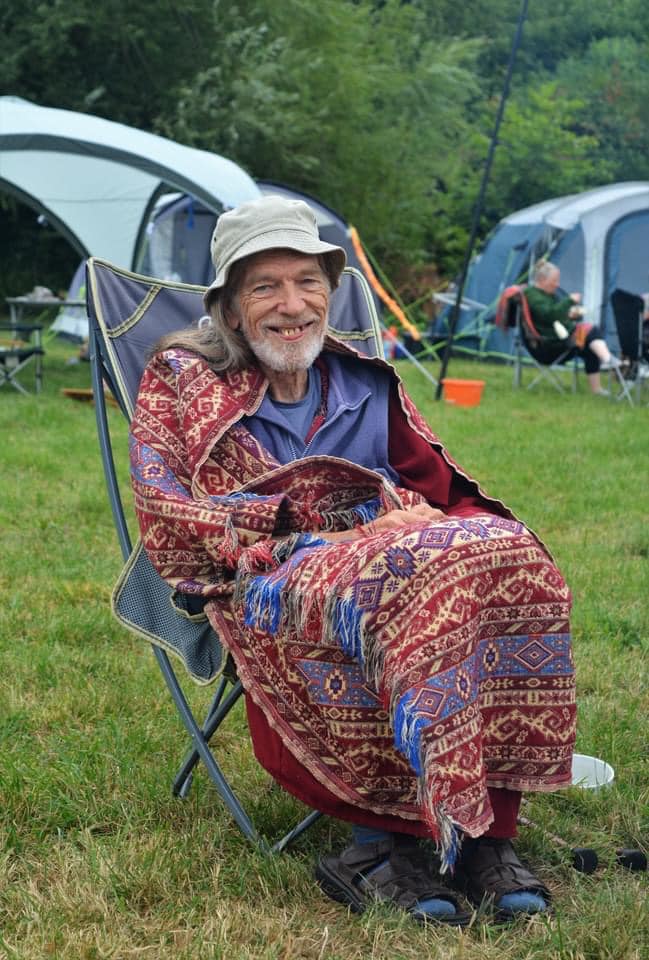
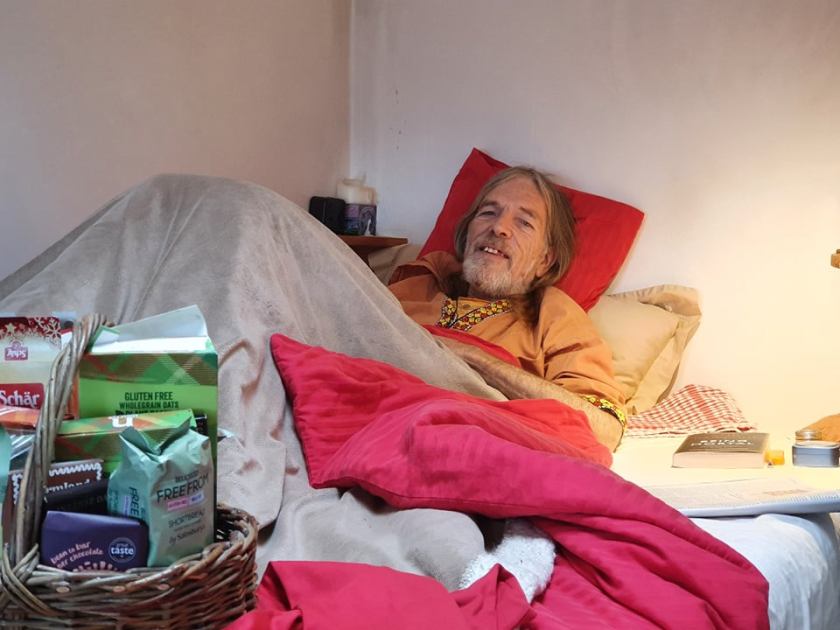
You get quite close to your helpers. I have a new helper who has been with me for a few weeks, and it’s working well, but it is still taking her time to figure out where everything is in my little house, and how I like things to be. She’s attentive to that, and that’s good, and we have interesting discussions too, because part of the benefit she brings me is some company (since I spend most of my time alone).

But it’s not just that. I have a wider group of friends, FoP – Friends of Palden. They help me in all sorts of big and little ways. But most of them don’t see me very often. So the first thing they do, and sincerely, is to ask me “How are you?”. That’s not the right thing to do. I need you to look at me, watch and witness me and tell me what you observe. If you ask me “How are you?” at different times of day, I will give quite different answers too.

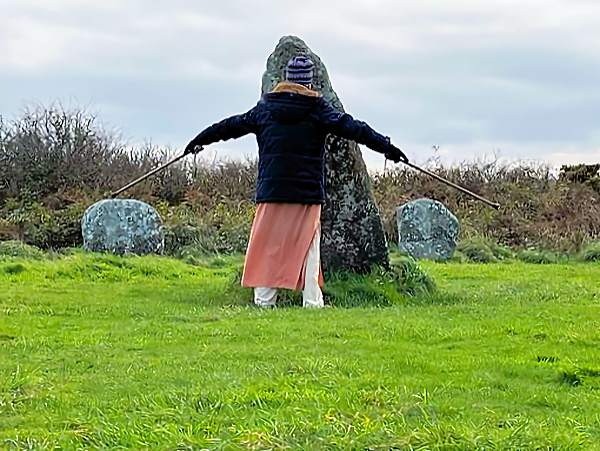
Besides, it’s not easy being asked how I am five or six times a day. I have to assess myself and give some sort of answer, and there are times when that works fine and other times when it’s actually rather difficult. Instead, you could tell me how you are. So, sometimes, when someone asks me “How are you?”, I just say, “I’m like this!”, opening out my arms. I invite you to make your own assessment, because your observations of me are more useful than my own observations of me.

Special qualities… well, one key quality is reliability. You see, if someone rings me up just before they’re due to come, saying “Oh, sorry, I’m too busy, can we make it next Tuesday instead?”, that can be tricky too. Well, yes, we can, and that’s kinda okay, but actually it makes quite a big difference, even if I can’t at this very moment say why, or give a list of things that needed doing. So it is good to have people coming along reasonably regularly. Not least because the number of e-mails and messages that can otherwise be generated can be staggering, when things lapse into ball-juggling flexi-territory.

Also, there’s the matter of the computer and phone. If I don’t respond, what does this mean? Am I in bed, gone out, sitting on the toilet or dead? Should someone check me out? Or perhaps they decide not to bother me. A helper who knows me well, with a little intuition on top, can usually figure this out. But if I am dead, then it helps to discover this before I start smelling too much.

Regularity also helps because of memory issues. It can be quite challenging and complicated managing a group of four, five or six people who are all in changeable states. So recently I’ve managed to sort things out rather differently. I’ve now got two ‘reliable regulars’ and then a number of occasionals and reservists, and that works well.

The two regulars cover me three days a week – they come for an hour or two on Tuesdays, Thursdays and Saturdays – and then the occasionals come when they can, or drive me to Treliske hospital (thirtyish miles), or take me out somewhere… or things like that, on a more flexible basis.

The funny thing is that one of my reliable regulars is called Claire, and the other is called Clare – just to confuse things! Perhaps my Anima is telling me something, though I’m not sure what.
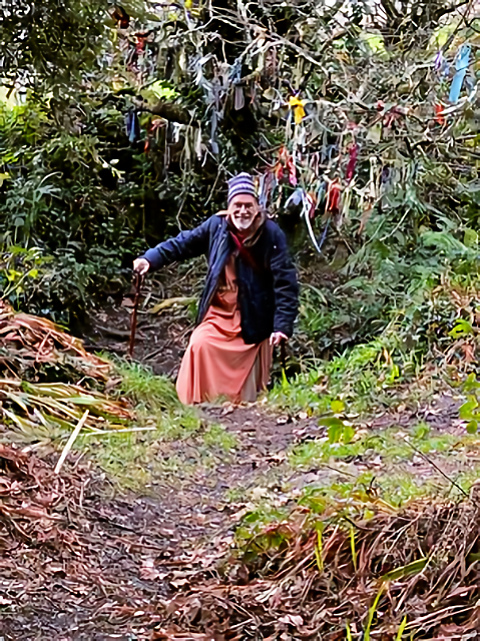
But actually, for it to really work, it’s necessary for a person to get to know me more closely than they normally would. This includes seeing me in my weak states, at times when I’m quite helpless, and I might need tenderness of a kind that wouldn’t usually happen with friends who come to socialise. Other times, I’m quite bright, cheerful and able, and there isn’t much for my helper to do, so we sit, drink tea and chat, and that’s really good too.

There’s something nice about this because I’m no longer seeking one-to-one relationship (been there, done that), which in this era of toxic maleness, makes me a reasonably safe bet. I’m not going to try it on. There’s also a difference between depending on help and emotional dependency – something that can get confused and tangly in close relationships.

Claire, who has worked with me for eighteen months now, has really got me sussed. When we go shopping she knows what I’m looking for, so she wanders off, comes back and puts things in the basket, with a knowing smile, and that’s really useful. She points things out to me and helps with the most difficult part at the end when we’re checking out.

She packs the bags and keeps the cashier entertained while I fumble around with cards, lists and last-minute memory-eruptions. I find that last bit really exhausting. Then she drives me home, puts stuff in the fridge, unpacks the bags, makes some tea and leaves me to rest and defragment. I’m happy with that. But that arises from the fact that she’s got to know me. She can read me off.

This matters a lot because my brains have been affected by chemotherapy – they call it chemo-brain. My executive functions – the left-brain stuff – are a lot weaker now. So although I’m quite brainy, I have difficulty figuring out certain things. It helps to have someone around who’s like a second brain, who will remind me to take my pills, or to be ready to go, or to remember to take something with me, or perhaps to tell me that my complexion is not very good today, or making useful observations and suggestions.

So if you’re in a situation rather like mine, as a net recipient of help, it’s worth giving some thought to the different kinds of help you might need, and the different kinds of people who will be good at giving it – and enjoying doing so. One male friend of mine, Kai, loves going shopping for me and he’s really good at it, and I can say to him, “Oh, just use your commonsense…” when he asks whether I’d prefer this or that, because I know he’ll get the right thing and, if he doesn’t, that’ll be interesting and useful too. On the other hand, he’s not so good at making tea, so I don’t expect it of him – I enjoy making tea for him instead. After all, this is about energy-exchange. I only get to see him occasionally (he’s a Gemini, travelling a lot), but this works well because both of us have identified how we slot into each other, given the circumstances we each have.
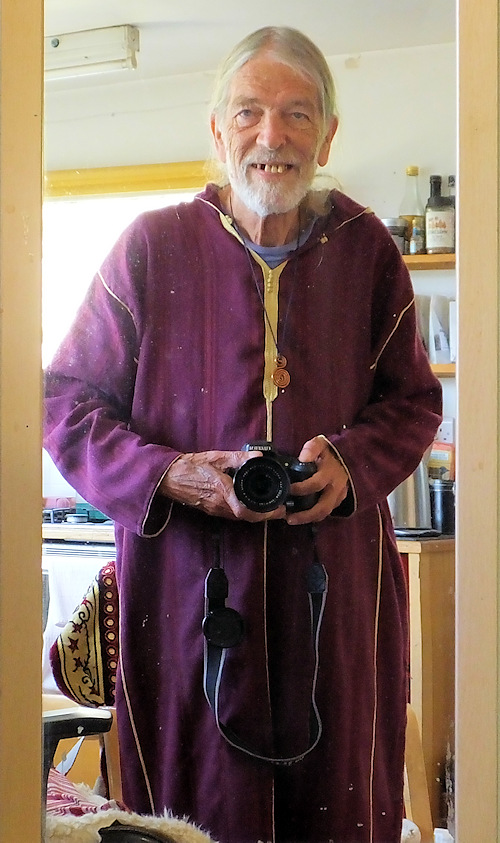
There’s a big sociological problem going on here. It’s this. Everyone is busy rushing around, racing timetables and to-do lists. They are time-poor. It’s a deep cultural and psychological thing in our society. This time-poverty sometimes makes things difficult. Occasionally I need a person to slow down to my speed, and at times it’s really good for them to do that, and they are grateful for it – it’s something I can give.

But people who are just fitting me into their busy timetable… well, that can be difficult. I remember, I did this once to a soul-sister with breast cancer – I’m sorry, Lily, but I was up to my neck in stuff and felt unable to stretch into your space. I realised this only when I got cancer and experienced others doing it to me. Us men, it can take us a while to realise these things, but we do get there in the end. Well, a lot of us do: toxic males make a lot of noise, but new men are more numerous than we appear to be.

This is to do with the way our society is today. We have become alienated and atomised as a society, and many of our family and community energy-saving mechanisms have deteriorated or disappeared. My own family is a case in point. I have four grown up children and seven grandchildren, and they’re all lovely people, and they do care, and they’ve got busy lives to pursue, and we live quite a long distance from each other and in two different countries. In truth, that’s mainly my fault, not theirs, since it was I who chose to live at the far end of Cornwall, a long way from everyone else!

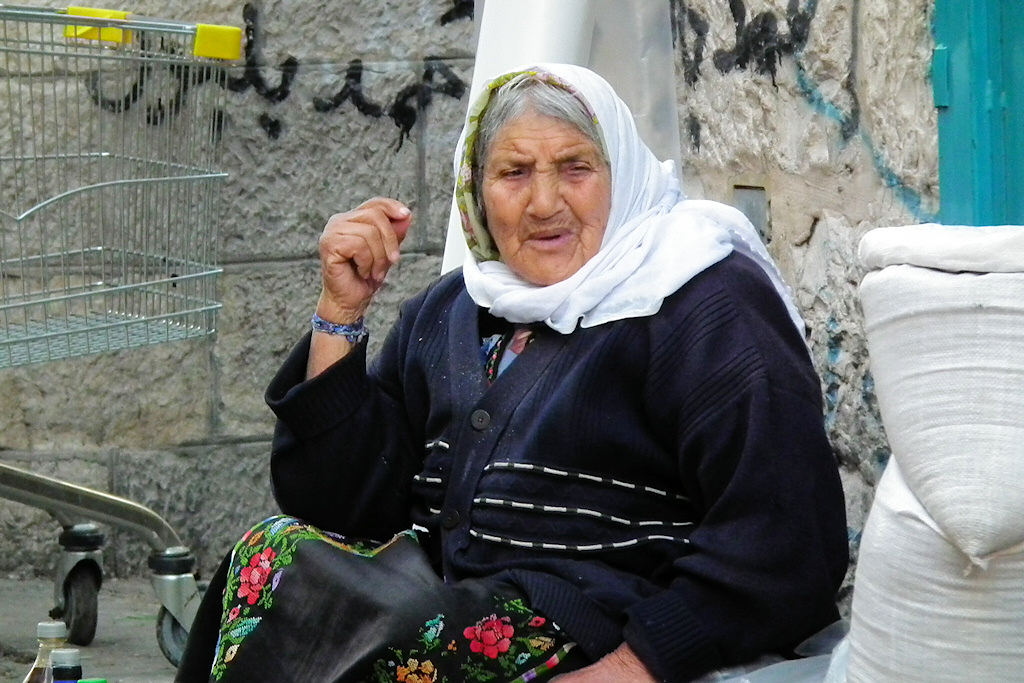
Living and working in Palestine taught me a lot. I’d been brought up in a NW European Protestant environment, where you’re supposed to pay for all that you receive and deserve all that you get. If you go to any Muslim country (including Iran), you quickly find out that it is offensive to try to pay for other people’s generosity or to return the favour. You are depriving them of the right to give. To them, everything comes from God and returns to God, so they’re just channelling the infinite beneficence of Allah. Hindus do this too. So you have to develop other ways of circulating the energy, and this has nothing to do with returning the favour or paying your way.

These are guilt-driven, obsolete Christian beliefs – all about indebtedness and original sin. The result is that we live in a mean-hearted, capitalist society made up of a few winners and lots of losers, which doesn’t really care for the weak and needy, because everyone is busy pursuing our own paths through life and, in the end, we don’t have enough time for each other!

Arabs taught me how to receive. This opens up channels of sharing and mutuality. It creates an inherently supportive society, a generosity economy where there is little need for professional carers or babysitters because the extended family or the community can handle it. I learned something about the Christian virtue of giving without counting the cost – a practice that works well in a society where everyone does it. But it’s more difficult in a society where only some do.

I might need help, but even in my needy condition, it’s also a matter of what I can offer. Support is a two-way thing. I can’t do a lot now, but the funny thing is that some of my helpers simply enjoy coming to sit in my nice, warm, radiation-free cabin, drinking tea, chatting and doing nothing much at all. They can slow down for a while before they have to return to the madding crowd or to shepherd their elusive teenagers around.

On a good day they might also have a lightbulb moment, arising from a conversation that we have over tea and biscuits. Yes, one thing that useless old codgers like me can still deliver is the occasional gem of insight and perspective, helping people remember that this is not the end of the world and that everything turns full circle in the course of time. It’s all alright, really, even when you don’t quite know why or how.

There’s some sort of energy-circulation going on with FoP and with friends and acquaintances further afield. I have soul-sister, Jo, in Oz, and we haven’t seen each other for thirty years, yet we’re still close. In some respects I feel a bit like a cosmic-energy server, operating in a psychic network of souls near and far that functions of its own accord, on a mysterious level where we get only faint intimations of what’s really going on between us.

Perhaps that’s why I spend a lot of time alone nowadays, to give space to tune in to all those people, dead or alive, who resonate on a similar soul-network to the one I’m on. Twenty years ago I lived at the bottom of Glastonbury Tor – a distinctly noisier kind of energy-place in comparison with West Penwith, where I live now, sitting on a granitic pile of crystals in the wild Atlantic.

I’ve said enough. I might return to this theme another time. There’s more to say, but I can’t think what it might be. Except for this…

At age fifty I realised that I had no capital or savings. So I chose to trust in building up my social and spiritual capital, and to work at it. I decided to make it as easy, pleasant and rewarding as I could for people to help me, when the time came that I would need help, and to stay useful right to the very end. Us Virgos, we need to feel useful. I’ve screwed up a good few times with this but, since cancer came to me in 2019, I’ve been much blessed with fine helpers and minders, and I’m really grateful for that. Including Lynne. I mean, really, really grateful, and thank you all for that. And the funny thing is that it all ends with a funeral!

Love, Palden
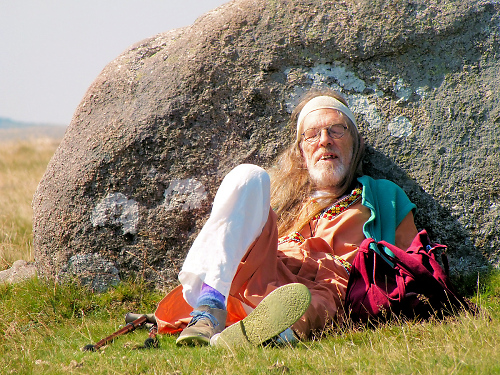
Uninspiration

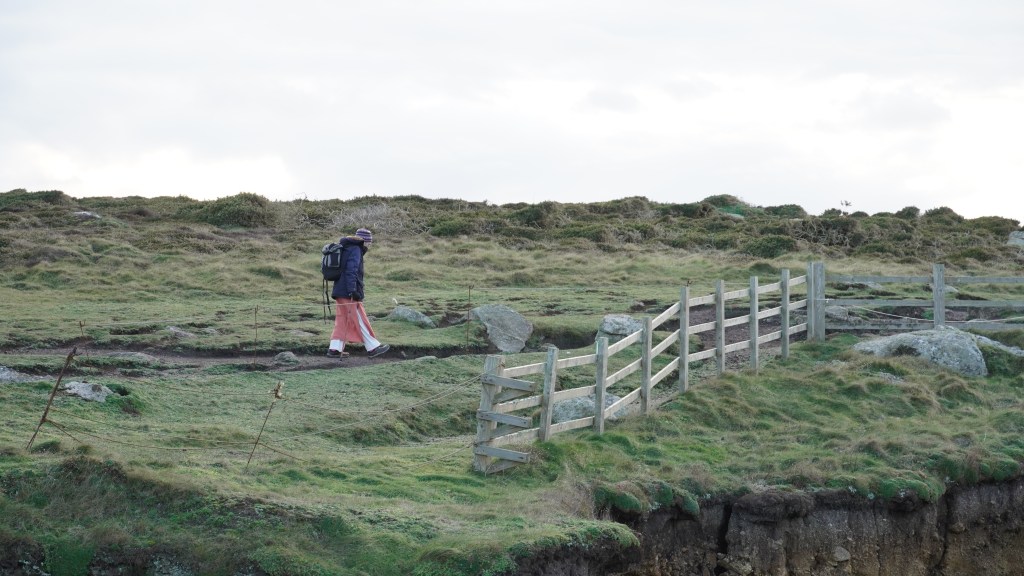
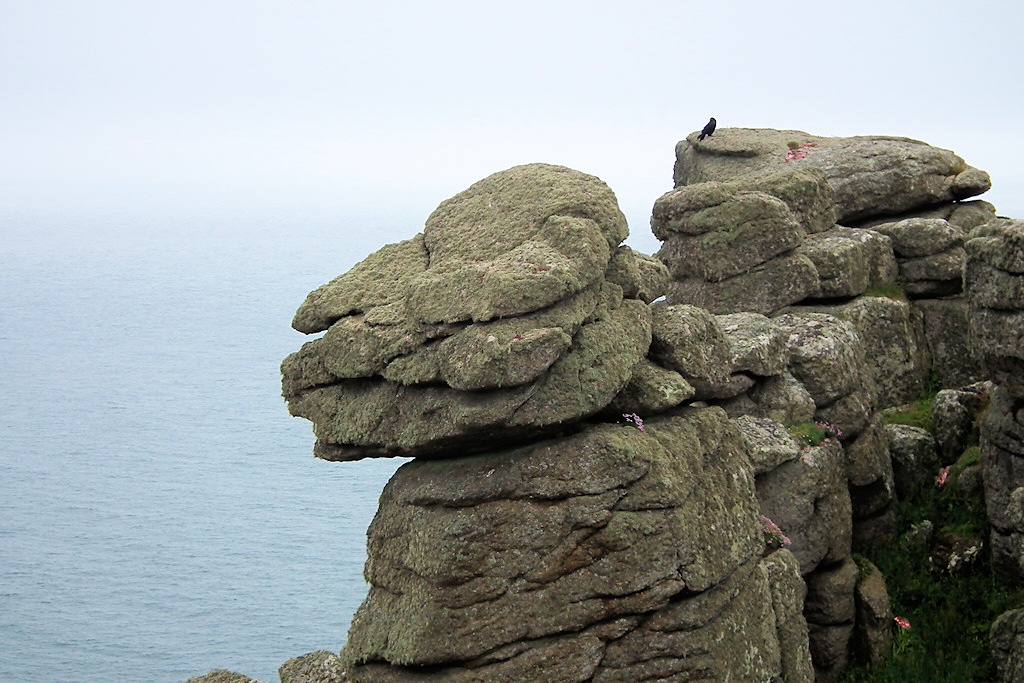
I can’t remember who gave me this pic, but thanks anyway! It is taken on the coast path from Land’s End to Pordenack Point – one of my favourite haunts.

Recently I’ve been feeling rather uninspired. Saturn and Neptune are in opposition to my natal Mercury, and I’m feeling it. Mercury is a key planet in my chart and, since the age of fourteen, for better and for worse, I’ve been a big communicator, and the struggle to clarify my ideas and make myself understood has been a key part of my growth. When I was a boy I was quiet and shy – would you believe? – and it took until my teenage years to find my voice and until age 36 to become good enough as a writer.

It’s kind of like drying up, this uninspiration. It’s a feeling that I’ve said all that I can say – and I’m not one for repeating myself. I’ve also been wondering how much people are interested – though this is often solved by spending time with someone to find out what’s going on for them.

And so I took another tack – after all I’m rather a workaholic, continually looking for new things to do to keep myself occupied. Nowadays, although I’m reasonably noisy online, I spend most of my life alone and quiet. In another world.

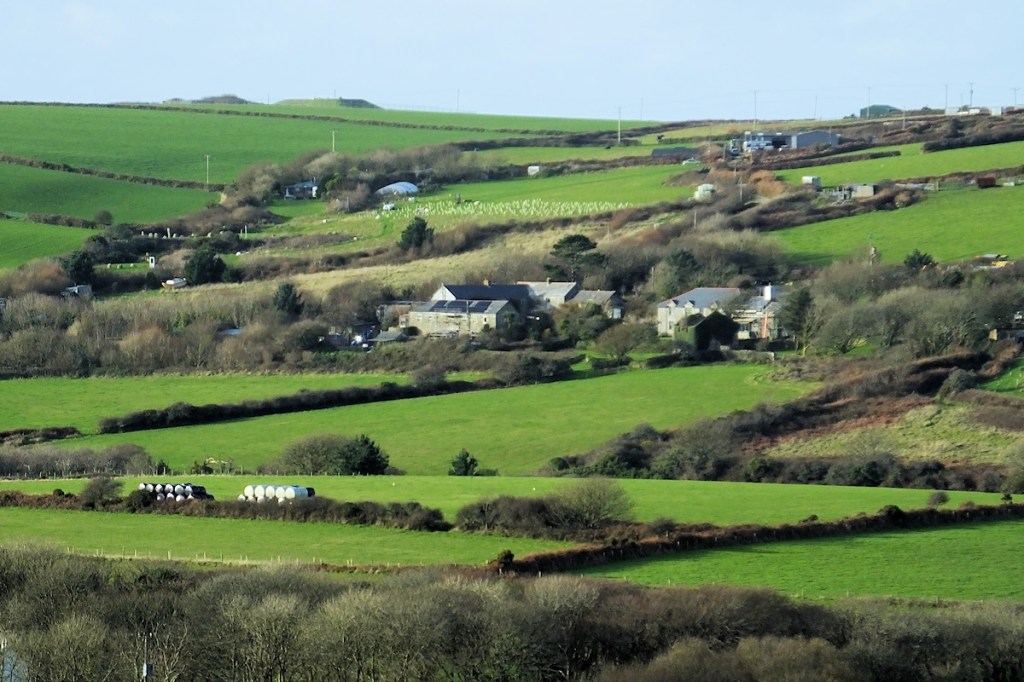
This is the farm where I live, in the far west of Cornwall

Over the last few years I’ve been turning my website into an archive. After all, it’s thirty years old now (started in 1994), and I’ve been adding bits to it every few years which, with a bit of tweaking has been gradually turned into an archive over the last two years. I don’t have money or property to leave to my descendants but, for what it’s worth, they are getting a digital estate, and I’ve often had the feeling that a few of my seven grandchildren might find some treasure there.

A while ago, I was tooling through some old radio programmes which I made twenty years ago, when I lived in Glastonbury, and they were surprisingly good. Especially since, in comparison to many of the talking-heads podcasts which are pouring out now online, the content was really rich, good, original and quite unique. This is partially because Glastonbury is a place which is a source of new ideas and initiatives, and some of the people living there are true originators in their fields.

It was not difficult to bring in old friends to provide interesting material for this programme. I called it This is the Light Programme. That’s a bit of an older generation joke: it refers to a time before about 1970 when BBC Radio had just three channels – the Home Service, the World Service and the Light Programme.

So I have been reviving many of the interviews in those programmes and creating a new section of my archive called Recycling Light – this was the Light Programme. The first few programmes will be coming out soon on the new moon, and I shall continue reworking more of them, making them ready to add to the list of Recycled Light programmes.

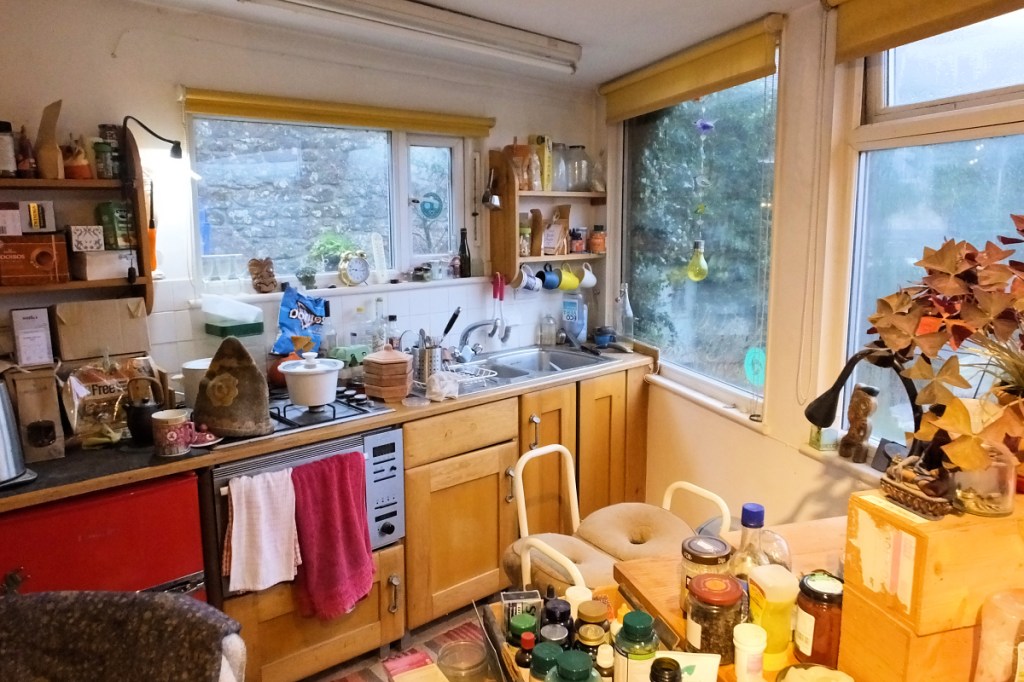
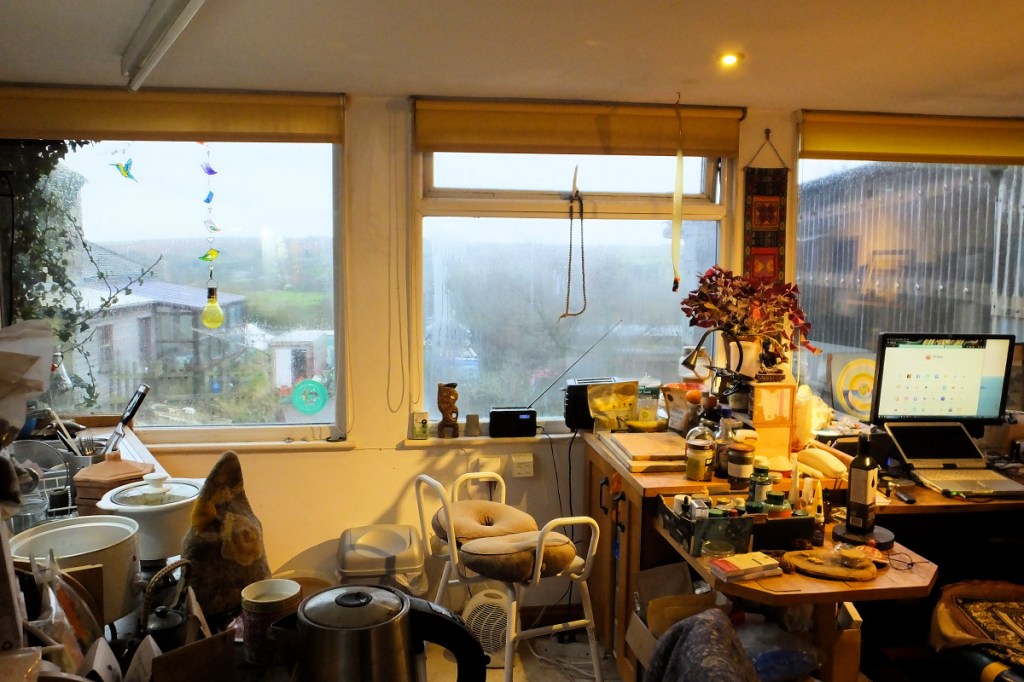
This is my kitchen

And yes, on the whole, when I post a blog or a podcast, I do it at astrologically auspicious moments – this matter of timing is more important than most people think. So this blog was uploaded with Jupiter rising, Mercury on the Midheaven and lots of planets in the tenth house. That’ll do.

I’m recycling these programmes because of the quality of the ideas coming through them. The first is the story of two Glastonbury characters who had been involved in the Middle East – one, Colette Barnard, was in Tehran at the time of the ayatollahs’ revolution in the late 1970s, and the other, Tom Clark, has been involved with funding and supporting progressive projects in the Middle East, particularly women’s and backchannel diplomacy projects. So the first programme is a really interesting interview with these two characters.

The second programme is an interview with Peter Taylor, a critical scientist, ecologist and shaman. He and I have been dialoguing for decades, cousins of the soul, sharing a political-spiritual activist approach to our respective areas of work. He used to be a scientific adviser to Greenpeace in the 1980s and also to government and United Nations bodies on ecological matters, and he is a detractor in the climate question and also one of the inventors and early advocates of the concept of rewilding, a concept which is now accepted but, thirty years ago, it was an entirely new idea and quite radical. What? Wolves? Beavers? Weeds and scrub? Well, yes.

The third programme involves two old friends who, like me, have been involved in researching alternative archaeology and prehistory. One, Sig Lonegren, is a dowser, who can find information about ancient sites which the majority of us have no access to at all. Now in his eighties, he has been a major contributor to the field of earth mysteries. The second, Bruce Garrard, has been doing a lot of thinking about the early origins of human society – particularly of the question of gender and the historic formation of gender roles. So they have interesting things to say.

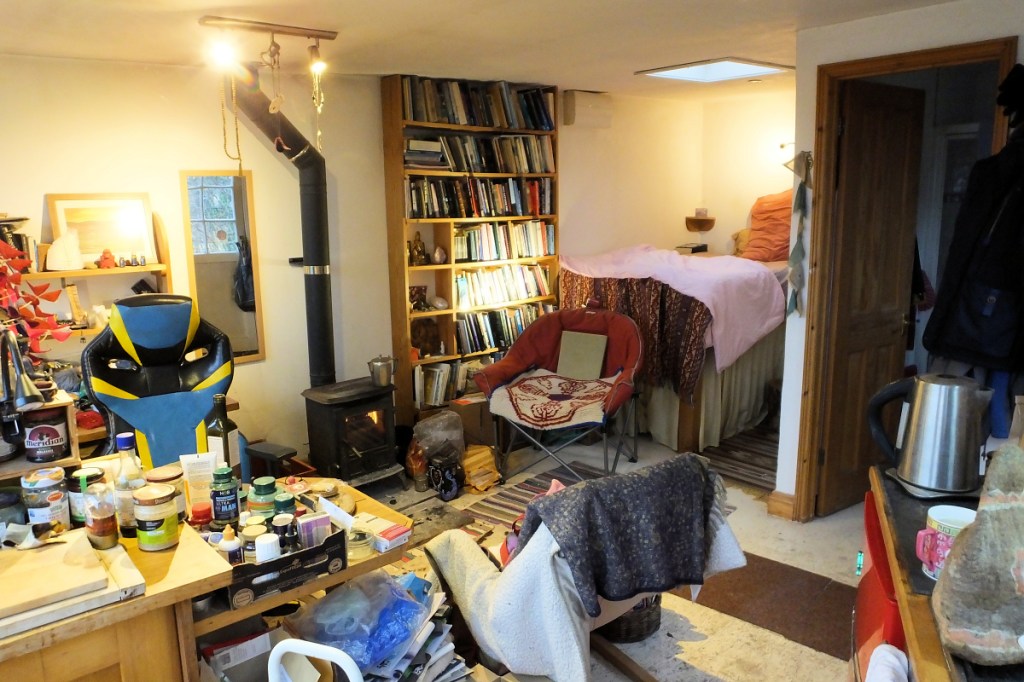
That’s where I rest and sleep. When resting I can watch the swallows, buzzards and jackdaws outside.

It was a great privilege to make that programme. It was weekly, and we did it for a year. Each programme was three hours long. Unfortunately I have had to take the music out, for rights reasons, and to rework it into a new format, but it turned out that this was a good thing to do. My son Tulki, who was then eleven years old, was the studio manager – he used to run the controls. He and I work well together. Now he’s turning thirty. Time moves on.

So in a few days time, I’m coming out with something new on my website. It’s become a really big site over the years, as I have added bits and chunks to it every couple of years. Partially it’s a manifestation of the story of my life, of being one who has advocated ideas which, in general, are right for the world, but which the world is not ready for or interested in accepting.

This has been the story of my life and that of many other people of my generation – particularly the drop-outs. We’ve had to live and work as ‘alternative types’, playing our part in society from the periphery, not from the centre.

When I was lying in a hospital bed with cancer six years ago, being eyeballed by Death and reviewing my life, I realised that I needed to leave as much as I could online, just in case it becomes relevant and useful in the future. Because the need can arise to refer back to the original people who first thought up the ideas which have become commonplace as time has gone on.

Many of the things that I’ve believed in and advocated have been roughly twenty to thirty years ahead of their mainstream adoption – or at least the beginning of it. So I’m leaving this archive in the hope that it becomes useful to someone in the future.

So when the new moon comes along I’ll be launching this new segment of my website called Recycling Light, and I hope you find it useful and interesting.

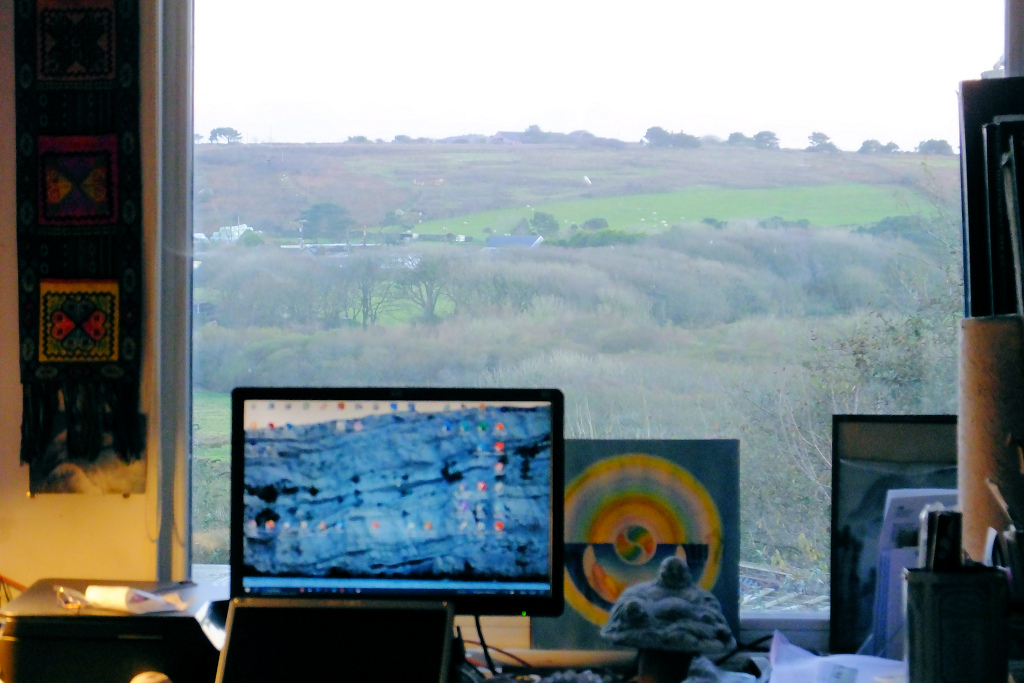
That’s the view from my bed. On that hill is an ancient site called Caer Bran – around 3,500 years ago it was the parliament site for the clans of Belerion, or West Penwith.

Now it’s time to have breakfast – before it’s lunchtime. And I have to work out what pills to take this morning. As a cancer patient I am given lots of pills, but if you adopt a holistic approach to cancer treatment, then it’s double trouble because there are loads of supplements and other therapies to take pills for too! Groan.

(Though if you follow this route, I recommend keeping the pharma drugs and the holistics separate – taking them at different times of day, with food between them – since they operate according to different principles and in some cases can conflict.)

There’s a gift in everything. A state of uninspiration has led to a state of audio-recycling.

With love, Palden
www.palden.co.uk

This is why my wee hoose is called The Lookout. On the right is my desk, where I do much of my work – such as this blog.

Clog-Popping

Once I encountered a paper bag, and on the side was printed, ‘Recycled materials – do come again’. Yes indeed, if that is your path. There’s also the option of going beyond.

But that depends a lot on what we do with the life we have, and the way we played our hand of cards.

This is one of the best blogs I’ve written and it’s time to give it another spin. It’s all about dying, and prepping for it while we’re alive.

With love, Palden

The Rigours and Gifts of Cancer

Ancient guardian at Pordenack Point, Cornwall. Busy watching.

Quite a few people have followed my outpourings because I’m a cancer patient with some deep and wide perspectives on it. I’m one of those who was told I had perhaps a year to live (and it felt like it), and here I still am, six years later.

I haven’t said much about cancer recently. Partially because I’ve said a lot already and tend not to repeat myself. However, there are recent friends and followers out there who haven’t had the full story.

I’m mulling it all over… and that’s part of the reason for relative silence on it. My cancer book ‘Blessings that Bones Bring’, available on my site, is undergoing a revision, and a new version will come out sometime – here in Cornwall we say ‘dreckly’. It needs to be shorter and more focused on what matters most to cancer patients and their helpers. Some new reflections are brewing, but my psyche moves slowly nowadays…

If you need something now, then go to my podcast page and look for the ‘Cancer and Dying’ section. To get a sense of the progression from earlier to later days, start from the bottom and work upwards. It’s here:

https://www.palden.co.uk/podcasts.html

There’s a lot about cancer here on my blog, but it’s all jumbled up. Here is one blog giving an overview of what happened for me and how I handled it: https://penwithbeyond.blog/2024/05/11/blessings-that-bones-bring/

I have an incurable blood cancer called Multiple Myeloma – it can only be managed and held at bay, medically. It affects the bones: the first sign, in my case, was that the four bottom vertebrae in my back collapsed and, from that day on, my life changed. Rather painfully at first.

I became a partially-disabled old crock. It was a soul-shift. I’m not sure whether I went down with cancer or went up with it. But it confirmed and tested a life-lesson I had already learned, that everything in life is a gift.

Repeat: everything in life is a gift. Especially at those times when it doesn’t feel like it.

Time spent in Palestine taught me that, though cancer took it to a new level. As a peacemaker, I distinctly disbelieve in the notion of ‘fighting cancer’ – and as it happens, I’m still alive, so there might be something in it.

Cancer is not a failure or an aberration – it is a gift. It is an awakener. It presents hard facts and profound choices. This is about free will at its deepest level. Surrender. Acceptance like you’ve never accepted before.

Living with cancer is very difficult, and that’s the point. It confronts us on why we’re here and what it’s all about.

I’m in a different life now, drawing on the mixed outcomes of the life I’ve had, but it feels like a different life. Funny, that.

Anyway, I woke up with this morning with the thought to reconnect with fellow cancer-experiencers, and something is brewing, and I just wanted to say that.

If you’re struggling through the darkness, just keep going. On a soul level, during times like that we make a lot of progress.

Love, Palden

Hell’s Bells

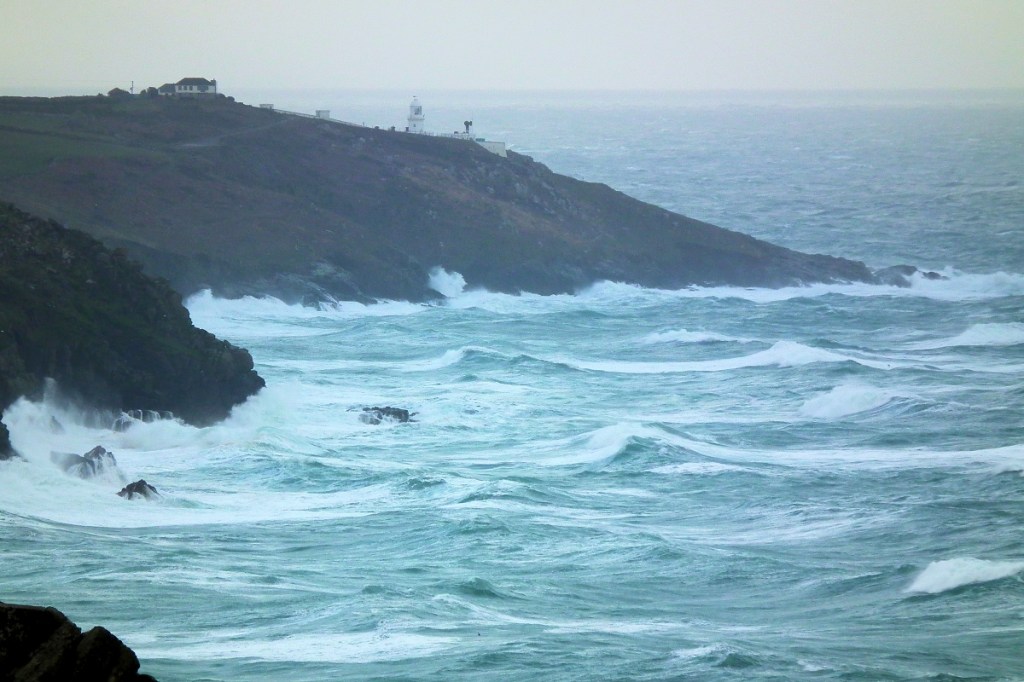
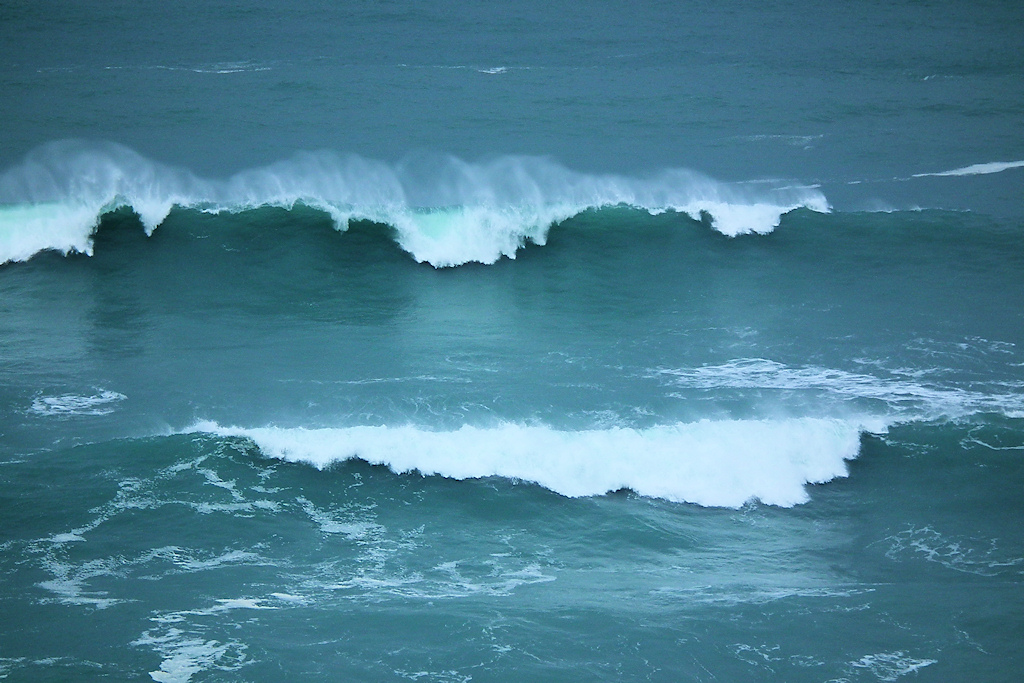
They came. And they went. They went scorching along the south coast of Britain toward the Netherlands. The storm gods, that is. It was a right old holy hoolie, a demonstration of the Power and the Glory for everyone in Cornwall to hide away from. And we did.

It’s one of those situations where you just have to huddle down, say your prayers and wait. One of those situations where even proudly hubristic secular rationalists start saying a prayer, just in case. You have to wait until it’s over, because it’s no longer in your power to do anything much else.

The winds were resolute, firm and consistent, not blustery or tricksy – they were forceful, merciless and thoroughly unrestrained. This was what in capitalism they call a hostile take-over. No consultation, no regard for human rights, no compassion: just the energy and might of a full-on Atlantic storm, a gift of the gods to remind us how small we are and how easy it is to wipe us out and dispose of us, if Nature so chooses.

Too often, we arrogant, self-centred, comfort-addicted humans forget this. It’s not that difficult for Nature to blink or cough, sending us beetling off to Heaven in our thousands, for the angels to sort out. Well, I’m heading that way anyway, sometime soon, and if the weather gods wish to take me today, getting in there first before the cancer gods get me, then what a way to go. I won’t complain. You have to get to Heaven somehow, after all, and in this there is no choice except for timing and method.

But it was okay. The lights went off and I sat in bed, reading in candlelight a novel about the Dreyfus Affair of 1890s France – as it happens, topically, a prime example of institutional anti-Semitism if ever there was one. Then I dropped off to sleep, with 100mph winds screeching over my little cabin, The Lookout.

They were coming from the northwest, and a hill stands there behind the farm, sheltering us from the Atlantic vastness, 3,000 miles of it, and it was okay. Had the winds been coming from the south, as in some of the storms of 2014, there would have been trouble on the farm. We were okay, but across Cornwall a lot of people were not, and many trees lost their lives. I found myself wondering what small birds do in super-storms like this, like the tits, dunnets and the robin who patronise the feeder outside my door.

Anyhow, I’m a survivor, and programmed up for it. Well, much of the time. The main dangers I have faced in my life have been from humans – control-freaky Israeli soldiers, nervy Palestinian freedom fighters, gritty ISIS terrorists and crack-addled Nigerian criminals – and the force of Nature has a more comforting side to it.

It is mighty, threatening and decisive, administering justice in a remarkably even-handed way and singling out all those things you’d failed to notice or do anything about during calmer times, making them fly. But it speaks the words of The Ultimate, and no one can argue with that – even The Donald, living as he does in a hurricane corridor called Florida, the land of the flowers, who badly needs to realise that he is not God and never will be.

But human dangers are another matter, and with them you’re dealing with a different, more capricious and regrettable kind of randomness.

When I woke up there was no power or water. Jon, the farmer, was clearing up the mess in the farmyard – the roof of his woodshed had radically repositioned itself. There was no phone signal, so a neighbour had driven to where there was a signal, finding out that we might, with luck, expect power back Friday afternoon. It took until Saturday afternoon.

Well and good. Except there’s one problem. Why is it that the power always returns just at that moment when you’re beginning to enjoy the calm and the candlelight?

But I do have a woodstove, and it soon was alight. There was the light of a lovely golden dawn over the valley, exhibiting another kind of Power and Glory from that of the night before. The birds were very quiet, probably a bit groggy after a long, trying midwinter night. There was no sign of the flight of geese who pass over the farm in the morning, hooting and croaking to the Void as if sadly lamenting the insecurity and non-attachment that migrating animals have to accept. They’d probably come from Greenland, Iceland or Norway, now wondering whether they might have been better to stay there.

So I pottered around. The worst that can happen is that the food in my freezer defrosts. No bombs are falling, and no earthquake-aftershocks are to be expected. Before long a saucepan was on the woodstove, warming up for the first pot of tea. I stumbled down into the farmyard and along the track to check a neighbour – yes, she was okay and huddling in bed with her dog. I came back, making my walking-stick work hard, poured the tea and read more of my book. Then I rooted around in the cupboards and found a Tilda pack of lemon and herb rice – and that went on the stove too, with some grapes thrown in.

One of the best meals I’ve ever had was during an Israeli lockdown on the West Bank. People in the rich world, all neurotic about our loss of freedoms, complained loudly during the Covid lockdowns, but with an Israeli lockdown, well, if you go out, you risk getting shot – it’s quite simple. Israeli troops are trained to shoot first and think later. In circumstances such as this, a kind of culinary gallows humour takes over and, using what you have in the cupboards, some amazing feasts can be had.

This is partially a perceptual issue. At a Palestinian refugee quarter outside Damascus, since I was a European with some diplomatic skills, I went out to see if I could find some food for the family I was staying with. We outsiders sometimes could get to places and negotiate things that others could not – though it would depend, of course, on the mood and values of any gun-toting man you met along the way, and whether they spoke English, German, Swedish or French. My ageing, sixty-something brains were having difficulty absorbing Arabic.

I usually managed to convince them I was a decent chap. Arabs are good at reading your body-language. Anyway, it was my lucky day and I came back with a shoulder-bag of bread – including, strangely, a plastic-wrapped pack of German pumpernickel. We had a true feast – of bread, with a few old, chewy olives thrown in. And, believe me, it was a wondrous and happy feast. Palestinians are well used to this kind of thing, though they have one weak point: they go through big coffee-withdrawal problems during lockdowns and hard times.

People often ask me what I used to do in Palestine and Syria. Well, I’ve done three books and an audiobook on the matter (links below), but the short answer is, things like this. Such as finding bread for a family to eat because, in the circumstances, I had the capacity to do so. It’s a small matter, finding food, but a meal can have a big effect on people’s mood and welfare. And you get to eat something too.

So a Cornish winter hoolie, well, it takes me back to that alert, resigned, improvisational, ready-to-run state that you get into when stuck in an emergency. You’re out of control of your fate, yet strangely in control too – though it’s necessary to leave the fear until later. In a funny sort of way it brings out the best in me. Comfortably normal regularity is not my forte, as my former partners can easily testify.

My computer battery is running out and I’ve said enough. I’ve been churning out verbiage for a whole lifetime, so no more is necessary. And, as usual, I’ve forgotten my tea and it has gone cold. So I’ll put my mug on the woodstove and, lo behold, in a few minutes it’ll be warm again. What simple delight can be found in small mercies.

And, as Arabs often say, Allahu Akbar, God is Great. Life is a wondrous thing. It’s a gift that’s worth cherishing while we have it. As something of an expert in other worlds and their characteristics, I can safely inform you that the tea on Earth is the best in the whole Universe. If you don’t believe me, your turn will come to find out.

However, compensations are available in Heaven. It’s a cool place to be, so don’t worry about the tea or other such things. Other things matter there. But just make sure that, when your own time comes, you’ve had enough of the experiences of this world to have, in another sense, truly had enough of them.

With love, Palden.

Pictures of Palestine: www.palden.co.uk/pop/
Palestine audiobook: www.palden.co.uk/bethlehemblog.html

Looking Within

This time of year it’s easy to feel battered by life. Things just get to be too much. This is part of the syndrome of modern times – we get overloaded and stressed, landing up in a routine of juggling too many balls, and we lose our way. We end up wondering what it’s all about and why we’re living our lives the way we do. This is an important truth point.

When I got cancer six years ago I had to look at what I had done in my life to bring it about, or to make myself vulnerable to it. We can blame such things on this or that but, in the end, it’s us. I realised that I had been both harmed and helped by moments like this – times when I was strung out on a busy and engaged life, pushing myself, trying to keep up with everything that was required of me, trying to do my best.

I was harmed because at times like this we actually generate the seeds of future illness. These are times of vulnerability, overstretchedness, worry and, if we are honest, times when we swim around in our guilt and fear, in unconscious stuff that we never have time to look at or to process through.

So we lay it down as a pattern, a pattern of fear which becomes a bit harder to look at another time. This is where the root causes of later illnesses or disabilities arise – in those stuffed-away, shadowy segments of our psyche where we don’t want to look. This is where we have power change our futures.

I was also helped by times like this. They give moments of self-examination and soul searching, an opportunity to pay attention, at the very time when we need to do so – even in the middle of busily stressful, dissonant and portentous junctures.

One of the greatest mass self-destruction errors of today is the setting aside of essential soul matters in order to tread the mill, to pursue our important agendas, in which we carry the weight of the world, fight our loved ones and get worked up over small things (like supermarket queues).

We lose our way. We lose our sense of the real reason why we’re doing all this business of being alive on a planet. I mean, what on Earth am I doing with my life?

It is very important, amidst these times of So Many Important Things, to give ourselves proper quality time, being quiet, giving ourselves timetable-free space, relaxing, yielding, taking it easy, changing the subject inside ourselves, and letting new information, energy, healing or blessing come into us.

This is a matter of allowing. It’s not about making it happen. Unless you really want to, you don’t have to pay large amounts of money to go on retreats or to exciting places in the mountains of Turkiye: it’s a matter of giving time and space now, today, even if just for an hour.

When I was examining myself and the causes of the cancer that I was suddenly given in 2019, I came to see the roots of my cancer in moments like this. It’s to do with those times when we have stuff coming up from deeper down, changes going on, truth emerging – and, we tell ourselves, we’re too busy, and we can’t give it the attention it is due right now. Later.

We often set aside these moments, these openings of doors. Thus we lay down patterns which can lead to future regret. Or at least to future times when conscience and consciousness are squeezed and wrung out of us, by force of circumstance. Times when our souls decide to present us with hard, inescapable truths.

It’s not about being perfect. The soul is forgiving, understanding, and it sits in an eternal place. We are here to learn. As humans we are a mixture of light and darkness. We are not here to be angels. We are here to make good in a difficult and challenging situation, and to do our best with the riddle of life and the deal we are given, to struggle our way through an obstacle course and a learning journey. This is what we came for.

This is planet Earth’s special gift: you get an amazing physical life in which you meet remarkable people and situations, and in return you undertake to learn some profound lessons – lessons about balancing the physical with the spiritual, daily-life routine and inner calling, and our own and others’ needs and preferences.

We should not feel bad and guilty about our failings, our hidden bits, and the things we come to regret. These are fuel for the fire of learning. That’s what we came for.

But it certainly does us a lot of good if we pay attention to releasing whatever needs releasing as closely as possible to the time that it happens, while it is in focus. It’s good to build a habit of moving forward, seeking out truth, applying all of the different kinds of growth-tricks we come to learn as we pursue our path through life.

If we build this habit it means that when the shit really does hit the fan, we have tools and experience to resort to, because we have built a growth habit, a truth habit.

It’s not that truth is always available at the moment when we seek it. Sometimes it takes time. Someone once said, a decision is truly made only at the time when you can chuckle about it. On the other hand, in every moment there is sufficient truth available for us to do enough of the right thing in the situation we find ourselves in.

This involves intuition – listening to the signs and signals within us. It involves listening to that inner voice which at times just says, ‘Be aware, be aware in this moment’. This is what you could call conscience.

Only sometimes does it give an answer about what to do, but it certainly gives a prompt to say ‘Be aware, this is a moment of choice’. If we pay attention to these moments, these moments of proto-truth, it expands our free will, our freedom of expression, our freedom to negotiate situations in the best way we can.

Sometimes we get it all wrong. And this is life. Because there can be deeper threads, deeper meanings going on underneath, and it is not uncommon that we find ourselves out of our depth, being stretched. Life gives us these moments of choice. This is what free will is. And sometimes we get it wrong.

That’s not the end of the matter. Because revelation and times of correction do come. Be patient. Sometimes we can make it up with the people who were involved, or we can correct or improve the situation, or we can own up in some way, and sometimes we can’t. But within ourselves, it is possible to change the story.

In every scrangle, we were half of the problem, and we can change our half, even in retrospect. This shifts shadows. Balance starts returning. Forget good and bad, right and wrong: what matters is movement, forwardness and progress. Sometimes this can involve taking the difficult path – a path of confrontation, pain, tears or apology. But this lands up becoming the easiest path.

Sometimes we cannot shift the shadow or resolve the situation. It might be too late, or the other party might refuse to forgive, or resolution might not be possible. But we can still look at our own side of the equation and get that bit right.

There is a simple rule by which to judge situations: treat others as you would like them to treat you.

If there are instances in the past that you regret, where you didn’t do your best, you can own up and rework them. It’s a de-guilting, forgiving process. And perhaps the judgements of rightness and wrongness made at the time were themselves incorrect.

In whatever proportions, you were both at fault and you were both right too. Remarkably, if you move on your side, sooner or later there will be movement on the other side. But don’t sit around waiting for it.

There can be resolution for the other person, or the other people who were involved, even if you don’t know whether it’s happening, or even after their death or yours. But in the fullness of time, if we release our side of the equation, then it loosens up the whole tangled cycle of co-bondage that lies behind and beneath the whole situation.

Some situations just cannot be understood or explained. But things happened that way. The world, as we have made it, is an incomprehensible place. So-called ‘mental illness’ is a simple consequence of living an a screwed-up, contradictory, insensitive world.

This is particularly important for those of us in late life. It’s about forgiving other people for what they did or they omitted to do, or that they did in ways which could have been different. It’s about forgiving world and societal situations because some, such as an earthquake, might have hurt a lot, but these are part of the formula, the equation, the deal we took on by being born, when we decided to have a life on Earth.

There’s also the matter of forgiving ourselves. Because in forgiving ourselves it loosens up the whole cobweb, the whole network of shared error, since we are not as separate as individuals as we frequently believe. We are all so intertwined. We breathe each other’s air.

There are various dimensions to this. There are things we definitely got wrong, and there are things other people judged were wrong which perhaps were not so, when seen from further away.

Then there are cultural issues where social judgments are implicitly made and accepted which, in the fullness of time, turn out to be to be very different. For me, for example, 900 years ago I believed in holy war, yet in this life I do not believe in war at all.

Then there are matters where we were wronged, yet we took on the guilt, the wrongness, because we were surrounded by unavoidable situations or people who misjudged us. Quite complex gestalts and constellations of human feeling can cause us to carry a psychological burden when in fact we might not have needed to carry it.

Some people spend their whole lives carrying far more guilt than indeed they should do, but in another way they mop up the free-flowing projections of other people and of society, absorbing it like sponges – sometimes with an ability to transform it, as nurses, carers, humanitarians or even inadvertent social healers, and sometimes they become victims of society and its ills and madnesses – the special needs cases.

In fact, the way things are going, the whole population of the world, currently around 8.2 billion, is becoming a special needs case. Help!

So if you’re feeling rather beat up at the moment, and if you’ve had enough, and if you’re feeling physically or emotionally vulnerable, it’s well worth staking out some time for yourself. Just tell everyone else to go away. Switch off your phone. It is to others’ advantage to support you in becoming a better person.

Whatever their dependencies and needs, these will be better fulfilled if you are in a good state. But if you are struggling inside with ghosts and demons, your generosity and good-natured side doesn’t shine genuinely and wholeheartedly.

If you’re lying in bed feeling unwell or wobbly right now, you might try listening to one of my podcasts about the inner doctors. Working on things like this can be really helpful, but often it’s only at these moments of vulnerability where we really perceive the need to pay attention to this kind of thing.

Also, it’s winter solstice – at least, here in the northern hemisphere – and a time for contemplation and reflection. Many people make this into a time of stress, spending vast amounts of money and overconsuming even if they don’t want to – all out of a sense of obligation to fulfil needs which were relevant in former, poorer times, when a feast was good and necessary, but which have lost so much relevance today. If gifts and treats are expected and taken for granted, they are not a gift, and the money might have been better spent supporting a family in Gaza.

There’s a big case of cognitive dissonance around all this. It is symbolised on Christmas Day when the day starts in a very human and open hearted kind of way, but then most people in countries like Britain start assaulting themselves with alcohol and overeating, also going through social situations which perhaps they might not want to go through, though they might feel obliged to do so. Don’t upset your grandmother, darling.

This sense of obligation to be happy, and to do all the right things, is, deep down, guilt-driven. Yet in order to have peace and goodwill on Earth, and every day of the year, and for evermore, which is surely what we all genuinely want, we need to free up all this guilt.

As you might by now tell, I don’t do Christmas, so unfortunately you will not be receiving a Christmas card from me. It’s not Scrooge mentality – it’s just a divergent Aspie’s preference. Before Christmas I am Scrooge, and after Christmas quite a few people, burping, tell me I’m lucky to have bypassed all that.

Here is a greeting to those who concur with me, and who will be spending Christmas mostly on their own – for perhaps you are the ones who can do some forgiving, pumping up the peace and the goodwill to all people, with an extra dollop of collective release and public mercy, without burying it in fats, and carbs and alcohols.

Here is a greeting to those who love Christmas too. It can be such a wonderful time of family and neighbourly gathering, and do it well. It’s special. Unplug the TV and get everyone to pile their phones in a box for the time you’re together. And get the kids doing the washing up – or, alternatively, making a valuable contribution of their choice. After all, we live in anti-authoritarian days, so options must be available, though I have not heard of a human right that entitles us to avoid earning our ticket.

Savour the Christmas plenty. I mean that. Because we’re coming into times when there might not be so much plenty, and it will be necessary to enjoy that too, and the gifts of grace that come with it. For when the economy goes up, society goes down, yet when the economy goes down, society goes up.

I think that was an economics and life lesson that the Prophet Jesus, peace be upon him, was trying to teach. It is likely that peace and goodwill in our world will rise as the global economy adjusts to the facts of its situation, and as humanity goes through an inner change that causes it to stop gulping up our world and shitting on it.

Not only that, but we will enjoy the new situation. There will be elements of relief to it. And defence expenditure, malware and security cameras will be things of the past, like holy war.

The world is in a process of acceleration and thawing, and it’s complex, and the bits are all bumping up against one another, and it looks as if things are getting worse with each passing year. No, they are getting better, though it is a painful and intricate process. Things are just starting up.

And the way they look now is not how it is going to be in the fullness of time. All things shall pass. All will be well, and in ways we cannot currently imagine. Hold that thought. All will be well.

Love, Palden

#followers #everyone #forgiveness #worldcrisis #mentalhealth #socialhealing #healingtheworld

The Tuareg of the Sahara

I’ve been working with a village of Tuareg for ten years, in a small people-sized support operation. They live in the Sahara desert, a day away from the historic city of Timbuktu in Mali.

We restocked their goats and camels after a terrible drought, helped them dig a new well and build a small village school.

But now I need to pull out – I can’t continue with things I used to be able to do. But I don’t want to abandon them.

So this pod tells the story, and about the dilemma of a humanitarian with a need to pass this on.

With love, Palden

Thanks to Constanze Küppers in Germany for prompting me to make this pod

Or find it on my podcast page at https://www.palden.co.uk/podcasts.html

Fingers

I find that, as I’m growing down, I’m going into transitional phases where things change and I have to review and revise what I can do and can’t do, and all sorts of other things in between. This get tricky when the abilities I’m losing are a deep part of my identity.

So, as a writer and communicator I’ve spent bazillions of hours, days and weeks banging away on typewriter and computer keyboards. But my fingers are losing their accuracy, and I can’t do it like I used to be able to.

It’s called peripheral neuropathy in medical speak – loss of feeling and coordination in the fingers and feet. It’s a funny sensation of non-feeling where feeling ought to be, a bit like music that’s turned down too low.

I’m getting an impression my blogs are too long for some readers – they’re a 15-minute read – and they tend to stretch synapses quite a bit.

So I think I’m going to do more podcasts. Or, in some cases, both.

Here’s my last blog, about pain, as a podcast, and you can find it on Spotify, Google and Apple Podcasts, such as here:

or on my podcast page here:

https://palden.co.uk/podcasts.html

And you’re welcome to lend it your ears!

Love, Palden

Paldywan stands on the power spot at Boscawen-un stone circle

Pain

This and the pics below were taken in Bethlehem, Palestine, in Dec 2012

I was talking to a friend about our different illnesses and she said, “You must be suffering more than I”. This made me think, because suffering cannot be quantified and I can’t really say ‘I am suffering more than you’. Or at least, if I do, I’m making judgements about that person and about me that don’t really hold up. With pain, it’s really difficult being objective – it all hangs around our capacity to accept, tolerate and handle it.

Pain is partially to do with what is happening and partially to do with how we’re perceiving and experiencing it. I knew this before cancer came my way, but I’ve found since then that it is more true than I thought. I don’t instantly reach for the painkillers – avoidance of pain charges its price too. I use them only when I’m worn down, needing a break, to stop myself going into a self-fulfilling pain loop.

It’s not easy. But we do make things more difficult than they need to be. We create more friction inside ourselves than we need to have. We take difficulty and pain as negative experiences, something bad, something wrong – often according to beliefs and predispositions that aren’t very good for us.

Yet pain isn’t wrong – there’s something strangely right about it, if we can but change our perspective and suspend judgement enough to see how this might be so. Too often we compare our pain with how we feel things ought to be, how they used to be or how they could be, and this has a way of increasing the pain. Because it turns us away from facing it.

It comes down to attitude. Attitude might or might not change our circumstances or their causes, but certainly it can change how we experience and handle it all.

I’ve learned a lot from people in conflict zones, especially Palestinians, who have developed such attitude over the generations, in both the personal and the social spheres. They’ve got tragically used to dealing with hardship and they’ve developed ways and means of surviving in situations where levels of hardship and suffering are high – such as sharing what they have and looking after each other. They aren’t angels and they make mistakes, but they’re better than we at protecting and helping each other, and making the best out of a bad set of circumstances.

Many people in the comfortable countries can get really upset over issues that are relatively small, such as a power blackout, a shortage, a traffic jam, or someone not doing what they said they would do. Tolerance levels are low, tight and sharp-edged. We have an unhelpful sense of entitlement to a problem-free life. So when the shit hits the fan we catastrophise it, mishandling it and often creating more problems than were needed.

In all of life’s situations there is a degree of choice, either to make a big deal over something or to square with it, accept it and do the best we can. The choice lies around the friction we put up. It’s an honesty process, and with pain we’re forced to face stuff we don’t like facing.

Spiritually, a key issue is this: we come to Earth to learn, get experience, go through it, learn from it and hone the soul. Because at the end of life, all you take with you is what you have become as a result of having lived a life. Pain is an intense kind of experience that has a way of grinding at us, drilling holes in us, attempting a takeover of our psyche and giving us a truth-and-reality experience.

It’s the price we pay for the pleasure of being in a body and the experiential access that it gives us to the wonders of the world. Without a body we cannot stuff chocolate, have orgasms, go on holiday or bliss out in a field of bluebells. Pleasure and pain, whether emotional or physical, are two ends of the same experiential spectrum, and you don’t get one without the other.

I had a remarkable experience six years ago when first stricken with cancer – a blood cancer called Multiple Myeloma, which erodes the bones and creates all sorts of trouble and pain. Since then I’ve had treatment, though there is no remission from Myeloma, and am now on a maintenance regime of medication, supplements and working on myself. I’m surprised to be alive, actually, though clearly there are reasons to be here.

The cancer came on quickly over a few months and I deteriorated rapidly. At times I was in extreme, 150% pain, immobilised, helpless, rendered into a wreck of a man, at death’s door. One day the pain was so intense that I couldn’t even raise my head from the pillow to drink – moving a millimetre made my bones grind and grate. But I had to drink anyway and tried moving.

The pain was so overwhelming that something in me popped out of my body and I saw myself from above – as a soul having an experience on Earth, lying there, all crippled and useless. There was something strangely comical about this. Something in me could see the poignant humour in it – here I was, suffering, more than I had ever experienced, and it was bizarre. I started chuckling. It really hurt to laugh. My then partner, looking on, thought I was losing my marbles.

The funny thing was that my experience of pain suddenly changed. It seemed to become more distant. I became more at peace with it. I was able to face it and accept it, from more of a distance – it was simply a fact, a situation. Something profound had shifted in the space of several minutes.

Over the next few weeks it decreased further and within a couple of months my pain levels were around 30%. Also, my boundaries had shifted. Previously, I could handle 20% pain without it getting to me too much, but afterwards I could handle 40-50% – my pain threshold had moved and it has stayed there since.

Over the last six years I’ve hovered around 10%, with a permanent, steady and stiff ache. I hardly notice it, having become used to it. Most of the time I accept it – except perhaps in the late afternoon when Sir Isaac Newton seems to switch up the Law of Gravity. But there are times when I do notice the pain and it gets to me, deep down – especially in winter. Usually these are times when my spirits are low and I’m feeling worn out with life.

So there’s something here about being spirit-propped. The pain, disability and precarity of a cancer patient have somehow thinned the membrane between me and spirit – a membrane that I used to try so hard to cross, while now it comes more naturally. There’s something to this about the perspective of experiencing life as a soul in a body, visiting Earth.

Pain hits us all, in all sorts of ways and degrees, and at various times. It can go deep, and we each have our crosses to bear.

For example, throughout my adult life I’ve experienced ‘political pain’ – the pain of being misunderstood and misjudged in public, and paying a high price for it (as a dissident and an Aspie-Autistic). It has impacted me immensely. It’s the pain of being wronged in the social and political sphere – sometimes by evolving facts and sometimes by the wrongdoings and micro-harms of others, or by the madnesses of crowds. Even so, this pain forced me to come to terms with the reality of it, to understand what was going on underneath and to forgive the people involved, and to understand and forgive myself too – and in late life, forgiveness has been a gift to the soul and a lightening of a burden.

The world’s pain levels are escalating in the 2020s, partially because so many souls are alive today having a human experience, and partially because life is getting tougher for everyone, everywhere. Outrageously tough situations such as we have seen recently in Gaza are just the tip of a very big iceberg.

And here’s the rub: no one is exempt. Hence, a generous and charitable attitude toward others in need is wise since the tables can turn. We might one day be glad to receive others’ help.

It’s our choice as to whether or not the future is going to bring hard times. We can make a big deal about things ‘going wrong’, or we can accept things and get on with it. In the end, many problems are not as big as we think they are. What might to one person be a disastrous crisis, to another person is just another boring night of bombing.

We create sufferings simply by complaining, being angry, feeling hurt, self-victimisation, or by doing things which are not the wisest. So the level of actual hardship and difficulty we face is a different matter to the way we handle it, and in the latter lies our choice.

Even so, for some on our planet, life is really hard and, in the short term, they don’t have many options – if, that is, they survive. This is not ‘their karma’: this is the world’s collective karma spilling over onto them.

One of the things I’ve noticed in my peacemaking work is that many of the peoples most beset by longterm war – Bosnia, Ireland, Afghanistan, Vietnam, Lebanon, Sudan, Palestine – can be the nicest people around, and it does not seem fair that such ‘karma’ should fall on them. The people most affected by climate change are mostly not the ones who created it, and the world’s poor are losers in a system steered by others. But even they are faced with occasions when choice becomes available.

If we follow a deeper path through life, over time it changes our emotional responses, perspective and priorities. We don’t need to consume as much, we don’t need to ricochet through life, we don’t need to deny ourselves tender moments with loved ones, and we don’t need to create as much waste and damage as we do.

Because something changes inside. It’s a slowly-distilling sense of basic trust, a simple knowing that, somehow, things are going to work out. Especially if we allow it. The issue isn’t about being perfect – it’s about learning from life’s lessons and making good outcomes out of difficult situations.

So this matter of hardship and suffering depends so much on where we’re looking from. While I have a blood cancer, I’m partially disabled and life is difficult, it doesn’t mean I’m sitting here suffering all the time. Though I must admit there are times when I do.

Sometimes, in down times my spirits seem lost in a fog of fatigue, but even then it’s a matter of being patient and letting it be. I can struggle against it, feeling as if I ought to be doing this or I wish I could do that, when in fact it’s okay to take it as it comes, to flop down in a dull state and let it be. I tend then to revive more easily next day. It’s just that I’ve have been given yet another cameo experience of being on planet Earth.

With love, Palden

Ocular Nutrition

Since it’s crap weather (here in Cornwall, at least), and winter seems to be coming on early (here in Cornwall, at least), you might like some vitamins for the ears (wherever you are, and however things are).

I’ve assembled my four audiobooks in one place, here…

https://www.palden.co.uk/audiobooks.html

They cover three different subjects:
Palestine,
Ancient Mysteries and
Living with Cancer.

Good for when you’re stuck in a traffic jam, stuck in bed, stuck in the kitchen or stuck on a train, or if you’re fed up with the radio, or simply if you’d like something interesting to listen to!

Cos I enjoyed doing it, with you in mind.

Love from me. Palden