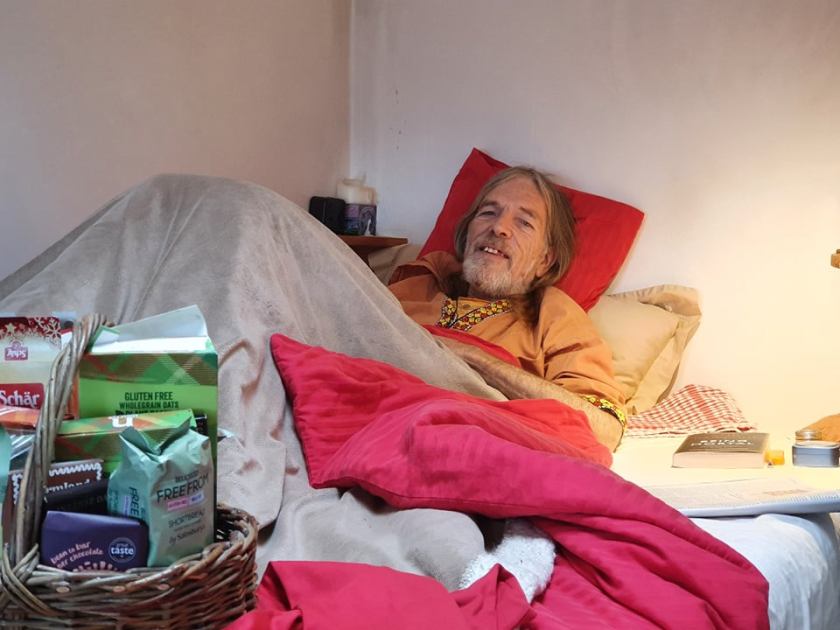
I rather love Sundays. It’s a bit strange, that, since I live and spend most of my time alone, so there’s not much difference between Sundays and other days. But there is a difference, on two counts. The first is that this is the day of the week that I take my cancer drugs – Ixazomib, Lanalidomide and Dexamethasone. I have a small breakfast, fast for two hours, take the drugs and then fast for another hour or so. Then I spend much of the rest of the day rather out of my head. But at least it’s legal.
The second is the Sunday meditation. By evening, the drug effects have worn off a bit, helped by a herb I take called Resveratrol (Japanese Knotweed, no less), which helps balance me out, and with absorption of the drugs.
I’ve been doing the meditation since the 1990s, almost without fail, around 1,500 times now. Yes, if committedly you do a meditation once a week, it adds up.
The numbers don’t matter but, during that time, some of those meditations will in some way be extra special, even life-shifting. Looking back over my life, though I’ve done a few things with it, my feeling is that these meditations have been one of the most significant things I have done, ever.
No one and nothing have been able to stop me, because it can be done at a bus stop, in the corner of a cafe or even when in distinctly unsupportive company. You just have to go quiet and lock on to the beam. I’ve even delivered a few public talks during the meditation, letting my friends upstairs drop ideas into me for conveying to the audience. I even did it once in Israeli detention at Checkpoint 500 outside Bethlehem, but it wasn’t serious and they let me out thanks to good behaviour. The tofu I was carrying, which I’d bought in Tel Aviv, looked to them like Semtex, but the officer in charge rather liked me, letting me go. I didn’t have the profile, vibe or age of a terrorist, he reckoned.
But, most weeks, it’s a day of return. Return to a certain perspective that comes with the meditation, even before it starts. It’s a bit like going home. Regardless of what has happened in the previous week, and regardless of my state of mind and heart, which at times are not at peace, I can lock back into the energy-space, the continuity, the flow of the meditation.
Yet it’s different every time too – it’s a parallel thread of sanity, of re-anchoring and of bathing in the blessing-field of the inner, deep-space overlighters who preside over the occasion. They do things to me, or sometimes they set tasks, or sometimes I’m just floating in their energy-world.
Sometimes I section up the meditation. It starts with a self-healing routine with my ‘inner doctors’, who scan me, flood me with light and sometimes perform operations. For this to work I have to clear my psyche, empty myself out, let them in and allow them to draw me up to their level.
Then we progress to ‘any other business’ – and this varies a lot from week to week. Often it involves seeing things going on at the time in a different light, or blessing and thanking those who have troubled me, or changing my position in an energy-constellation of relationships and situations, to unlock them, and to own up, at least to myself, about the ways I have contributed to creating or maintaining the situation. Even if it involves Donald Trump – poor man.
Then comes the work. If I don’t already know where to go, I ask my inner friends to send me to a world situation where I might be able to bring some release, healing and forwardness, or do some spiritual mop-up, or, a bit like a surveillance drone, connect them into the details of a situation so that they can do what they need to do with it. Recently this has concerned Iran, though I’ve done a lot with the two Palestines too.
Then it comes to an end and, amazingly, the blessing-field shuts off. This can be quite distinct, and always exactly at 7.30 GMT. If I’m sleepy I sometimes doze off at that time. Sometimes I go into a different kind of meditation, and sometimes I get up.
Then I spend the rest of the evening in a reflective state and, if I have thought ahead, by then a meal will have simmered its way to readiness in my slow-cooker. Or perhaps Claire or Selena, two members of Friends of Palden, bless them, have left some food in the fridge.
I’m so fortunate to have a small group of helpers who look after me, and I’m so grateful to them for that. It means so much to me, and I am so happy that they feel it is worth it. I’m also at present super-grateful to my former partner, who left four years ago, for the love and care she gave during my first two years of my cancer journey. I became too much for her. Sometimes we truly appreciate things and people when we no longer have them – and this emptiness can also be a gift if we make it so.
If you don’t know about the meditation, try here: www.palden.co.uk/meditations.html – and, if you wish, do join in. It’s your choice and your move. You might be meditating alone, physically, wherever you are, but you are in good company. Just do whatever meditation you normally do, except with us – this is about spiritual diversity.
Meditation times for different countries are below.
And now it is time for breakfast and pills! And for another day, feeding the birds, going for a staggery walk and delighting in the silence of my own company. Yesterday I felt unhappy being alone but today it is different: loneliness is a feeling while aloneness is a simple fact, and that feeling can be changed.
Because everything is a gift. As many of my Arabic friends would say, everything comes from and returns to Allah. We bathe in the wide-open field of the Vastness. And ever shall it thus be so.
Love from me. Palden.
———————
Current meditation times, on Sundays: GMT: UK, Iceland, Ireland & Portugal: 7-7.30pm W Europe: 8-8.30pm E Europe, Turkiye, Israel, Palestine, Egypt: 9-9.30pm Jordan, Syria, Iraq, Iran, UAE: 10-10.30pm Pakistan: midnight-00.30 Monday India: 00.30-01.00 Monday Oz: AEST 5-5.30am Monday NZ: 8-8.30am Monday Greenland: 5-5.30pm Brazil-Argentina 4-4.30pm Venezuela, Bolivia, Chile 3-3.30pm EST, Cuba 2-2.30pm CST, Mexico, Jamaica, Colombia 1-1.30pm PST, West Coast North America 11am-11.30am
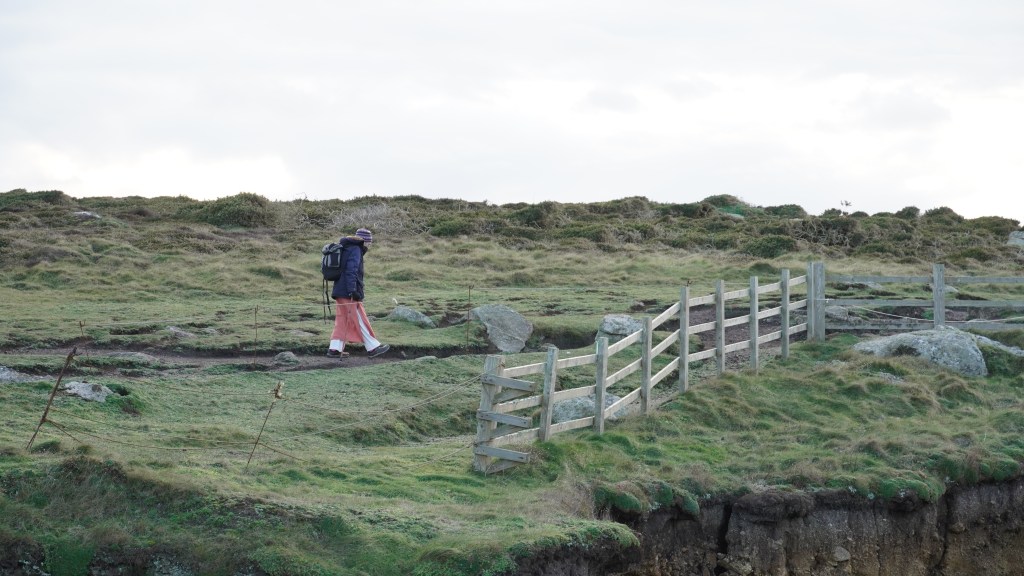
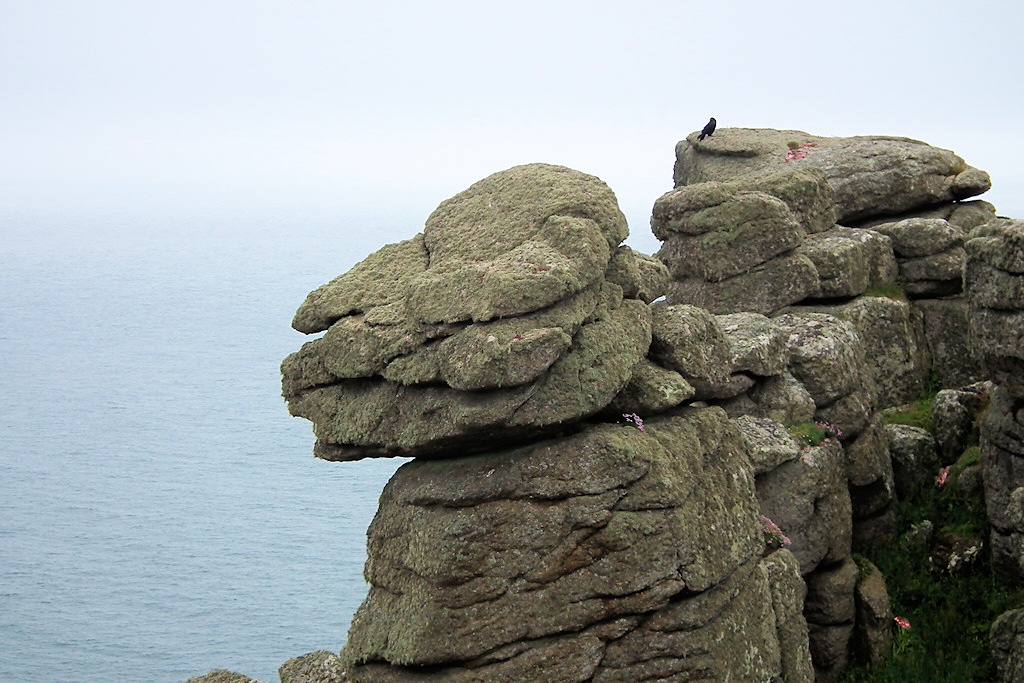
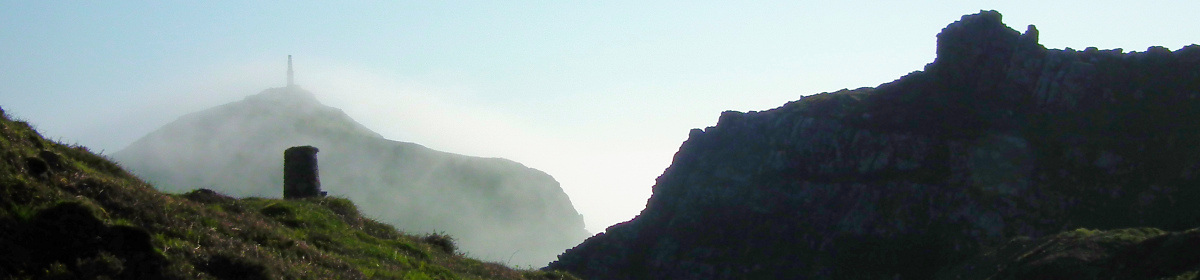
Ancient guardian at Pordenack Point, Cornwall. Busy watching.
Quite a few people have followed my outpourings because I’m a cancer patient with some deep and wide perspectives on it. I’m one of those who was told I had perhaps a year to live (and it felt like it), and here I still am, six years later.
I haven’t said much about cancer recently. Partially because I’ve said a lot already and tend not to repeat myself. However, there are recent friends and followers out there who haven’t had the full story.
I’m mulling it all over… and that’s part of the reason for relative silence on it. My cancer book ‘Blessings that Bones Bring’, available on my site, is undergoing a revision, and a new version will come out sometime – here in Cornwall we say ‘dreckly’. It needs to be shorter and more focused on what matters most to cancer patients and their helpers. Some new reflections are brewing, but my psyche moves slowly nowadays…
If you need something now, then go to my podcast page and look for the ‘Cancer and Dying’ section. To get a sense of the progression from earlier to later days, start from the bottom and work upwards. It’s here:
I have an incurable blood cancer called Multiple Myeloma – it can only be managed and held at bay, medically. It affects the bones: the first sign, in my case, was that the four bottom vertebrae in my back collapsed and, from that day on, my life changed. Rather painfully at first.
I became a partially-disabled old crock. It was a soul-shift. I’m not sure whether I went down with cancer or went up with it. But it confirmed and tested a life-lesson I had already learned, that everything in life is a gift.
Repeat: everything in life is a gift. Especially at those times when it doesn’t feel like it.
Time spent in Palestine taught me that, though cancer took it to a new level. As a peacemaker, I distinctly disbelieve in the notion of ‘fighting cancer’ – and as it happens, I’m still alive, so there might be something in it.
Cancer is not a failure or an aberration – it is a gift. It is an awakener. It presents hard facts and profound choices. This is about free will at its deepest level. Surrender. Acceptance like you’ve never accepted before.
Living with cancer is very difficult, and that’s the point. It confronts us on why we’re here and what it’s all about.
I’m in a different life now, drawing on the mixed outcomes of the life I’ve had, but it feels like a different life. Funny, that.
Anyway, I woke up with this morning with the thought to reconnect with fellow cancer-experiencers, and something is brewing, and I just wanted to say that.
If you’re struggling through the darkness, just keep going. On a soul level, during times like that we make a lot of progress.
Having done battle with the Furies of Storm/Hurricane Goretti, and by the grace of hard-working local tree surgeons and power engineers, I’m back online and able, yet again, to elbow you about the Sunday Meditation!
Usually I do it weekly on Facebook and occasionally here on my blog. From now on I shall do this more occasionally, since I’m slowly losing my capacity to sit easily at a keyboard and activate it in a manageable way.
That is, though I sound lucid and coherent, as a meticulous Virgo and retired editor I go over and over it at least five times, and that’s getting laborious. A life of service to keyboards is slowly grinding down as finger-coordination declines and brains slowly decouple from this World of Ten Thousand Things.
But meditation is another thing, and I’ll be there, regardless, at the appointed time, whatever the weather or circumstances, at least until my passing and possibly for a while afterwards. The times are below, and if you are so moved, you are welcome to find a place to park yourself and join a holy party! And if not this week, then another week.
It’s also a good, doable and undemanding life-habit to establish, since the blessing-channel will be open and operative at 7-7.30pm GMT whatever happens. Times in other timezones are below. For me, over the last thirty years, and having had a life with little regularity to it, it has been like a cosmic timecheck – one thing that has been constant and unchanging over time, whatever is going on and wherever I have been – even in car parks, trains, deserts and cow fields. Funny, that.
It’s easy. Meditate, contemplate, be mindful, go quiet, make prayer, go inner-journeying, drop out for half an hour, and do it in your customary way. There’s no prescribed method or mantra, no sign-up and no need to be online. Just be present. I sometimes call it ‘cosmic availability’. We’re just a bunch of bright souls sitting together in inner space, at an appointed time. It amplifies the outcomes.
It is overlighted by a collective of cosmic beings I’ve worked with for decades, the Council of Nine, and if you resonate with me, then you’ll probably resonate with them. But they don’t meddle with us. They put it this way: if you meddle too much with your children you’ll drive them against you, and that is what free will is all about. So they don’t meddle – they subscribe to the Prime Directive (and that Startrek concept came from them). But they do like to support us in exercising our free will – our true and deep free will. More about them here: www.palden.co.uk/nine.html
As for times of passing, it’s funny how things go. If you’re spiritually oriented then other forces tend to take over, and the timing of death is not just a medical matter involving normal probabilities. It’s now six and also four years since I should have died, medically speaking, but here I am, and though I experience deterioration and decline of capacities and fascinating changes of viewpoint, I have no idea at all whether I have weeks, months or years ahead. This weekend my ‘perceptual age’ is in my mid-90s, though on a good day it’s 80-85ish, and my physical age is 75.
Thanks to all of you who have flown alongside over recent times, and may it continue, and may it bring benefit to you and to our benightedly shining planet. This isn’t a resignation letter but it’s always good to say things that need saying while we still can – or perhaps, when in the mood! Perhaps the Furies shook me up.
Love from me, Palden.
Current meditation times, on Sundays:
GMT: UK, Iceland, Ireland & Portugal 7-7.30pm W Europe 8-8.30pm E Europe, Turkiye and the Levant 9-9.30pm Iran: 10-10.30pm Pakistan: midnight-00.30 Monday India: 00.30-01.00 Monday Oz: AEST 5-5.30am Monday NZ: 8-8.30am Monday Greenland: 5-5.30pm Brazil-Argentina: 4-4.30pm Venezuela, Bolivia, Chile: 3-3.30pm EST, East Coast North America, Cuba: 2-2.30pm CST, Mexico, Jamaica, Colombia: 1-1.30pm PST, West Coast North America: 11am-11.30am
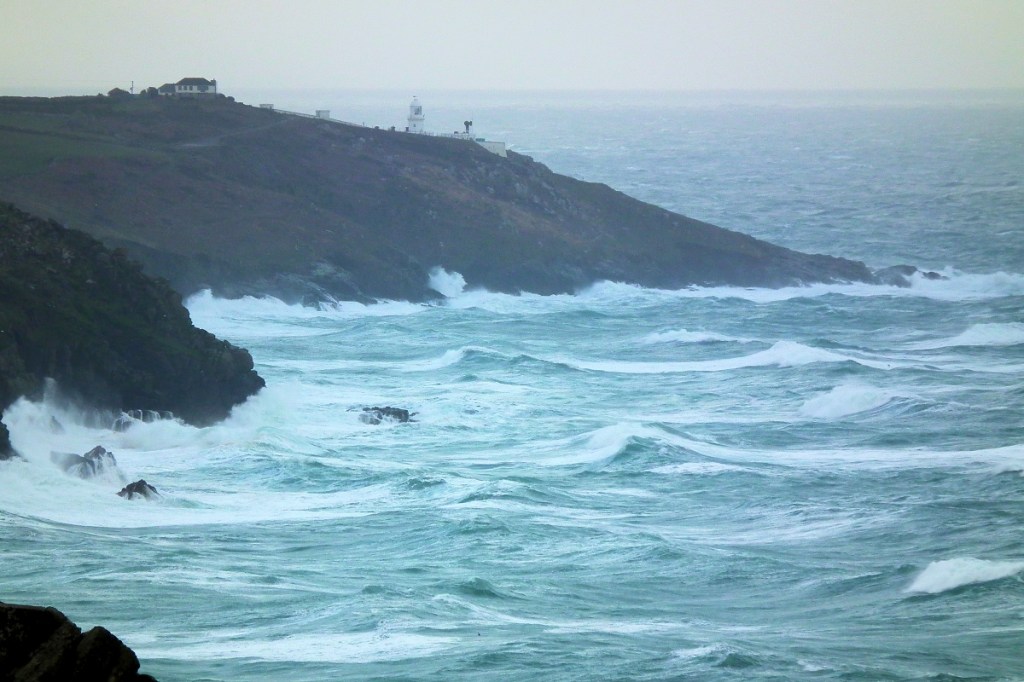
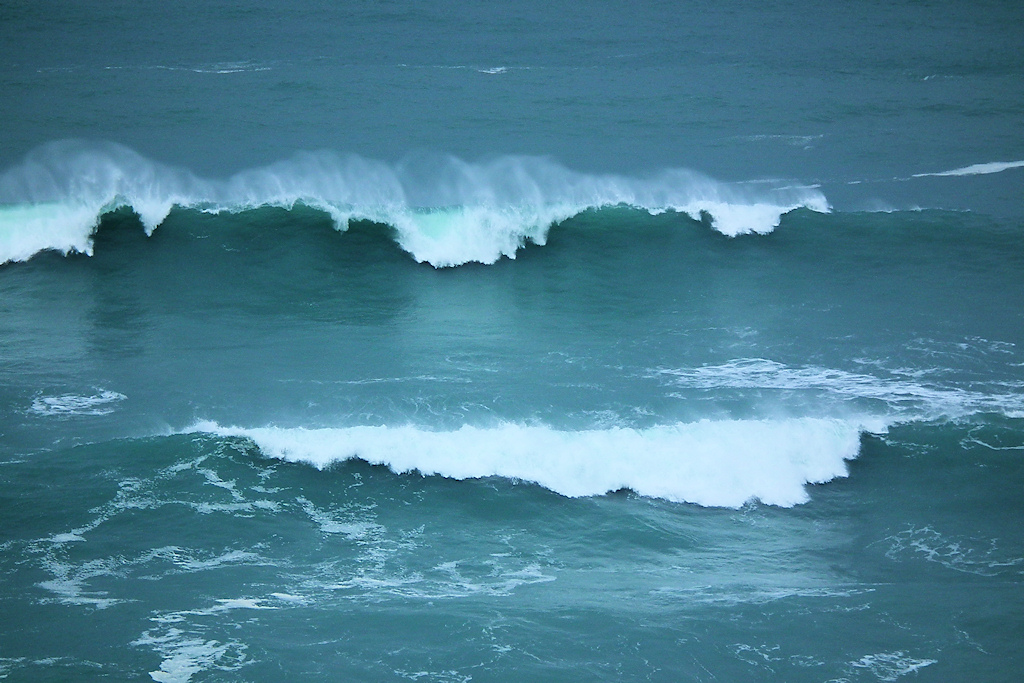
They came. And they went. They went scorching along the south coast of Britain toward the Netherlands. The storm gods, that is. It was a right old holy hoolie, a demonstration of the Power and the Glory for everyone in Cornwall to hide away from. And we did.
It’s one of those situations where you just have to huddle down, say your prayers and wait. One of those situations where even proudly hubristic secular rationalists start saying a prayer, just in case. You have to wait until it’s over, because it’s no longer in your power to do anything much else.
The winds were resolute, firm and consistent, not blustery or tricksy – they were forceful, merciless and thoroughly unrestrained. This was what in capitalism they call a hostile take-over. No consultation, no regard for human rights, no compassion: just the energy and might of a full-on Atlantic storm, a gift of the gods to remind us how small we are and how easy it is to wipe us out and dispose of us, if Nature so chooses.
Too often, we arrogant, self-centred, comfort-addicted humans forget this. It’s not that difficult for Nature to blink or cough, sending us beetling off to Heaven in our thousands, for the angels to sort out. Well, I’m heading that way anyway, sometime soon, and if the weather gods wish to take me today, getting in there first before the cancer gods get me, then what a way to go. I won’t complain. You have to get to Heaven somehow, after all, and in this there is no choice except for timing and method.
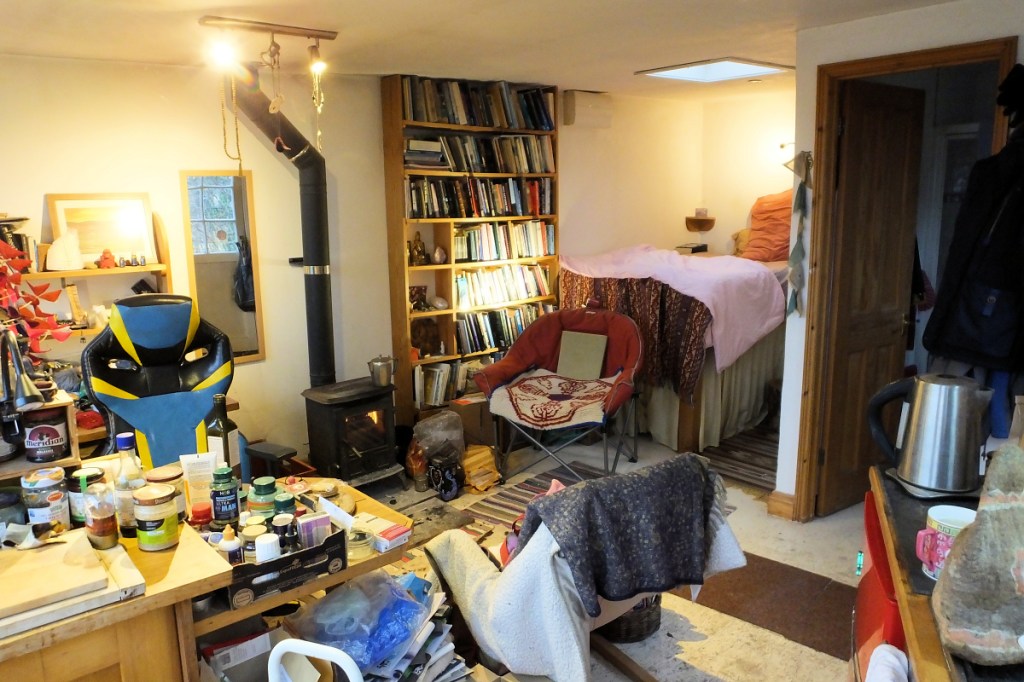
But it was okay. The lights went off and I sat in bed, reading in candlelight a novel about the Dreyfus Affair of 1890s France – as it happens, topically, a prime example of institutional anti-Semitism if ever there was one. Then I dropped off to sleep, with 100mph winds screeching over my little cabin, The Lookout.
They were coming from the northwest, and a hill stands there behind the farm, sheltering us from the Atlantic vastness, 3,000 miles of it, and it was okay. Had the winds been coming from the south, as in some of the storms of 2014, there would have been trouble on the farm. We were okay, but across Cornwall a lot of people were not, and many trees lost their lives. I found myself wondering what small birds do in super-storms like this, like the tits, dunnets and the robin who patronise the feeder outside my door.
Anyhow, I’m a survivor, and programmed up for it. Well, much of the time. The main dangers I have faced in my life have been from humans – control-freaky Israeli soldiers, nervy Palestinian freedom fighters, gritty ISIS terrorists and crack-addled Nigerian criminals – and the force of Nature has a more comforting side to it.
It is mighty, threatening and decisive, administering justice in a remarkably even-handed way and singling out all those things you’d failed to notice or do anything about during calmer times, making them fly. But it speaks the words of The Ultimate, and no one can argue with that – even The Donald, living as he does in a hurricane corridor called Florida, the land of the flowers, who badly needs to realise that he is not God and never will be.
But human dangers are another matter, and with them you’re dealing with a different, more capricious and regrettable kind of randomness.
When I woke up there was no power or water. Jon, the farmer, was clearing up the mess in the farmyard – the roof of his woodshed had radically repositioned itself. There was no phone signal, so a neighbour had driven to where there was a signal, finding out that we might, with luck, expect power back Friday afternoon. It took until Saturday afternoon.
Well and good. Except there’s one problem. Why is it that the power always returns just at that moment when you’re beginning to enjoy the calm and the candlelight?
But I do have a woodstove, and it soon was alight. There was the light of a lovely golden dawn over the valley, exhibiting another kind of Power and Glory from that of the night before. The birds were very quiet, probably a bit groggy after a long, trying midwinter night. There was no sign of the flight of geese who pass over the farm in the morning, hooting and croaking to the Void as if sadly lamenting the insecurity and non-attachment that migrating animals have to accept. They’d probably come from Greenland, Iceland or Norway, now wondering whether they might have been better to stay there.
So I pottered around. The worst that can happen is that the food in my freezer defrosts. No bombs are falling, and no earthquake-aftershocks are to be expected. Before long a saucepan was on the woodstove, warming up for the first pot of tea. I stumbled down into the farmyard and along the track to check a neighbour – yes, she was okay and huddling in bed with her dog. I came back, making my walking-stick work hard, poured the tea and read more of my book. Then I rooted around in the cupboards and found a Tilda pack of lemon and herb rice – and that went on the stove too, with some grapes thrown in.
One of the best meals I’ve ever had was during an Israeli lockdown on the West Bank. People in the rich world, all neurotic about our loss of freedoms, complained loudly during the Covid lockdowns, but with an Israeli lockdown, well, if you go out, you risk getting shot – it’s quite simple. Israeli troops are trained to shoot first and think later. In circumstances such as this, a kind of culinary gallows humour takes over and, using what you have in the cupboards, some amazing feasts can be had.
This is partially a perceptual issue. At a Palestinian refugee quarter outside Damascus, since I was a European with some diplomatic skills, I went out to see if I could find some food for the family I was staying with. We outsiders sometimes could get to places and negotiate things that others could not – though it would depend, of course, on the mood and values of any gun-toting man you met along the way, and whether they spoke English, German, Swedish or French. My ageing, sixty-something brains were having difficulty absorbing Arabic.
I usually managed to convince them I was a decent chap. Arabs are good at reading your body-language. Anyway, it was my lucky day and I came back with a shoulder-bag of bread – including, strangely, a plastic-wrapped pack of German pumpernickel. We had a true feast – of bread, with a few old, chewy olives thrown in. And, believe me, it was a wondrous and happy feast. Palestinians are well used to this kind of thing, though they have one weak point: they go through big coffee-withdrawal problems during lockdowns and hard times.
People often ask me what I used to do in Palestine and Syria. Well, I’ve done three books and an audiobook on the matter (links below), but the short answer is, things like this. Such as finding bread for a family to eat because, in the circumstances, I had the capacity to do so. It’s a small matter, finding food, but a meal can have a big effect on people’s mood and welfare. And you get to eat something too.
So a Cornish winter hoolie, well, it takes me back to that alert, resigned, improvisational, ready-to-run state that you get into when stuck in an emergency. You’re out of control of your fate, yet strangely in control too – though it’s necessary to leave the fear until later. In a funny sort of way it brings out the best in me. Comfortably normal regularity is not my forte, as my former partners can easily testify.
My computer battery is running out and I’ve said enough. I’ve been churning out verbiage for a whole lifetime, so no more is necessary. And, as usual, I’ve forgotten my tea and it has gone cold. So I’ll put my mug on the woodstove and, lo behold, in a few minutes it’ll be warm again. What simple delight can be found in small mercies.
And, as Arabs often say, Allahu Akbar, God is Great. Life is a wondrous thing. It’s a gift that’s worth cherishing while we have it. As something of an expert in other worlds and their characteristics, I can safely inform you that the tea on Earth is the best in the whole Universe. If you don’t believe me, your turn will come to find out.
However, compensations are available in Heaven. It’s a cool place to be, so don’t worry about the tea or other such things. Other things matter there. But just make sure that, when your own time comes, you’ve had enough of the experiences of this world to have, in another sense, truly had enough of them.
This time of year it’s easy to feel battered by life. Things just get to be too much. This is part of the syndrome of modern times – we get overloaded and stressed, landing up in a routine of juggling too many balls, and we lose our way. We end up wondering what it’s all about and why we’re living our lives the way we do. This is an important truth point.
When I got cancer six years ago I had to look at what I had done in my life to bring it about, or to make myself vulnerable to it. We can blame such things on this or that but, in the end, it’sus. I realised that I had been both harmed and helped by moments like this – times when I was strung out on a busy and engaged life, pushing myself, trying to keep up with everything that was required of me, trying to do my best.
I was harmed because at times like this we actually generate the seeds of future illness. These are times of vulnerability, overstretchedness, worry and, if we are honest, times when we swim around in our guilt and fear, in unconscious stuff that we never have time to look at or to process through.
So we lay it down as a pattern, a pattern of fear which becomes a bit harder to look at another time. This is where the root causes of later illnesses or disabilities arise – in those stuffed-away, shadowy segments of our psyche where we don’t want to look. This is where we have power change our futures.
I was also helped by times like this. They give moments of self-examination and soul searching, an opportunity to pay attention, at the very time when we need to do so – even in the middle of busily stressful, dissonant and portentous junctures.
One of the greatest mass self-destruction errors of today is the setting aside of essential soul matters in order to tread the mill, to pursue our important agendas, in which we carry the weight of the world, fight our loved ones and get worked up over small things (like supermarket queues).
We lose our way. We lose our sense of the real reason why we’re doing all this business of being alive on a planet. I mean, what on Earth am I doing with my life?
It is very important, amidst these times of So Many Important Things, to give ourselves proper quality time, being quiet, giving ourselves timetable-free space, relaxing, yielding, taking it easy, changing the subject inside ourselves, and letting new information, energy, healing or blessing come into us.
This is a matter of allowing. It’s not about making it happen. Unless you really want to, you don’t have to pay large amounts of money to go on retreats or to exciting places in the mountains of Turkiye: it’s a matter of giving time and space now, today, even if just for an hour.
When I was examining myself and the causes of the cancer that I was suddenly given in 2019, I came to see the roots of my cancer in moments like this. It’s to do with those times when we have stuff coming up from deeper down, changes going on, truth emerging – and, we tell ourselves, we’re too busy, and we can’t give it the attention it is due right now. Later.
We often set aside these moments, these openings of doors. Thus we lay down patterns which can lead to future regret. Or at least to future times when conscience and consciousness are squeezed and wrung out of us, by force of circumstance. Times when our souls decide to present us with hard, inescapable truths.
It’s not about being perfect. The soul is forgiving, understanding, and it sits in an eternal place. We are here to learn. As humans we are a mixture of light and darkness. We are not here to be angels. We are here to make good in a difficult and challenging situation, and to do our best with the riddle of life and the deal we are given, to struggle our way through an obstacle course and a learning journey. This is what we came for.
This is planet Earth’s special gift: you get an amazing physical life in which you meet remarkable people and situations, and in return you undertake to learn some profound lessons – lessons about balancing the physical with the spiritual, daily-life routine and inner calling, and our own and others’ needs and preferences.
We should not feel bad and guilty about our failings, our hidden bits, and the things we come to regret. These are fuel for the fire of learning. That’s what we came for.
But it certainly does us a lot of good if we pay attention to releasing whatever needs releasing as closely as possible to the time that it happens, while it is in focus. It’s good to build a habit of moving forward, seeking out truth, applying all of the different kinds of growth-tricks we come to learn as we pursue our path through life.
If we build this habit it means that when the shit really does hit the fan, we have tools and experience to resort to, because we have built a growth habit, a truth habit.
It’s not that truth is always available at the moment when we seek it. Sometimes it takes time. Someone once said, a decision is truly made only at the time when you can chuckle about it. On the other hand, in every moment there is sufficient truth available for us to do enough of the right thing in the situation we find ourselves in.
This involves intuition – listening to the signs and signals within us. It involves listening to that inner voice which at times just says, ‘Be aware, be aware in this moment’. This is what you could call conscience.
Only sometimes does it give an answer about what to do, but it certainly gives a prompt to say ‘Be aware, this is a moment of choice’. If we pay attention to these moments, these moments of proto-truth, it expands our free will, our freedom of expression, our freedom to negotiate situations in the best way we can.
Sometimes we get it all wrong. And this is life. Because there can be deeper threads, deeper meanings going on underneath, and it is not uncommon that we find ourselves out of our depth, being stretched. Life gives us these moments of choice. This is what free will is. And sometimes we get it wrong.
That’s not the end of the matter. Because revelation and times of correction do come. Be patient. Sometimes we can make it up with the people who were involved, or we can correct or improve the situation, or we can own up in some way, and sometimes we can’t. But within ourselves, it is possible to change the story.
In every scrangle, we were half of the problem, and we can change our half, even in retrospect. This shifts shadows. Balance starts returning. Forget good and bad, right and wrong: what matters is movement, forwardness and progress. Sometimes this can involve taking the difficult path – a path of confrontation, pain, tears or apology. But this lands up becoming the easiest path.
Sometimes we cannot shift the shadow or resolve the situation. It might be too late, or the other party might refuse to forgive, or resolution might not be possible. But we can still look at our own side of the equation and get that bit right.
There is a simple rule by which to judge situations: treat others as you would like them to treat you.
If there are instances in the past that you regret, where you didn’t do your best, you can own up and rework them. It’s a de-guilting, forgiving process. And perhaps the judgements of rightness and wrongness made at the time were themselves incorrect.
In whatever proportions, you were both at fault and you were both right too. Remarkably, if you move on your side, sooner or later there will be movement on the other side. But don’t sit around waiting for it.
There can be resolution for the other person, or the other people who were involved, even if you don’t know whether it’s happening, or even after their death or yours. But in the fullness of time, if we release our side of the equation, then it loosens up the whole tangled cycle of co-bondage that lies behind and beneath the whole situation.
Some situations just cannot be understood or explained. But things happened that way. The world, as we have made it, is an incomprehensible place. So-called ‘mental illness’ is a simple consequence of living an a screwed-up, contradictory, insensitive world.
This is particularly important for those of us in late life. It’s about forgiving other people for what they did or they omitted to do, or that they did in ways which could have been different. It’s about forgiving world and societal situations because some, such as an earthquake, might have hurt a lot, but these are part of the formula, the equation, the deal we took on by being born, when we decided to have a life on Earth.
There’s also the matter of forgiving ourselves. Because in forgiving ourselves it loosens up the whole cobweb, the whole network of shared error, since we are not as separate as individuals as we frequently believe. We are all so intertwined. We breathe each other’s air.
There are various dimensions to this. There are things we definitely got wrong, and there are things other people judged were wrong which perhaps were not so, when seen from further away.
Then there are cultural issues where social judgments are implicitly made and accepted which, in the fullness of time, turn out to be to be very different. For me, for example, 900 years ago I believed in holy war, yet in this life I do not believe in war at all.
Then there are matters where we were wronged, yet we took on the guilt, the wrongness, because we were surrounded by unavoidable situations or people who misjudged us. Quite complex gestalts and constellations of human feeling can cause us to carry a psychological burden when in fact we might not have needed to carry it.
Some people spend their whole lives carrying far more guilt than indeed they should do, but in another way they mop up the free-flowing projections of other people and of society, absorbing it like sponges – sometimes with an ability to transform it, as nurses, carers, humanitarians or even inadvertent social healers, and sometimes they become victims of society and its ills and madnesses – the special needs cases.
In fact, the way things are going, the whole population of the world, currently around 8.2 billion, is becoming a special needs case. Help!
So if you’re feeling rather beat up at the moment, and if you’ve had enough, and if you’re feeling physically or emotionally vulnerable, it’s well worth staking out some time for yourself. Just tell everyone else to go away. Switch off your phone. It is to others’ advantage to support you in becoming a better person.
Whatever their dependencies and needs, these will be better fulfilled if you are in a good state. But if you are struggling inside with ghosts and demons, your generosity and good-natured side doesn’t shine genuinely and wholeheartedly.
If you’re lying in bed feeling unwell or wobbly right now, you might try listening to one of my podcasts about the inner doctors. Working on things like this can be really helpful, but often it’s only at these moments of vulnerability where we really perceive the need to pay attention to this kind of thing.
Also, it’s winter solstice – at least, here in the northern hemisphere – and a time for contemplation and reflection. Many people make this into a time of stress, spending vast amounts of money and overconsuming even if they don’t want to – all out of a sense of obligation to fulfil needs which were relevant in former, poorer times, when a feast was good and necessary, but which have lost so much relevance today. If gifts and treats are expected and taken for granted, they are not a gift, and the money might have been better spent supporting a family in Gaza.
There’s a big case of cognitive dissonance around all this. It is symbolised on Christmas Day when the day starts in a very human and open hearted kind of way, but then most people in countries like Britain start assaulting themselves with alcohol and overeating, also going through social situations which perhaps they might not want to go through, though they might feel obliged to do so. Don’t upset your grandmother, darling.
This sense of obligation to be happy, and to do all the right things, is, deep down, guilt-driven. Yet in order to have peace and goodwill on Earth, and every day of the year, and for evermore, which is surely what we all genuinely want, we need to free up all this guilt.
As you might by now tell, I don’t do Christmas, so unfortunately you will not be receiving a Christmas card from me. It’s not Scrooge mentality – it’s just a divergent Aspie’s preference. Before Christmas I am Scrooge, and after Christmas quite a few people, burping, tell me I’m lucky to have bypassed all that.
Here is a greeting to those who concur with me, and who will be spending Christmas mostly on their own – for perhaps you are the ones who can do some forgiving, pumping up the peace and the goodwill to all people, with an extra dollop of collective release and public mercy, without burying it in fats, and carbs and alcohols.
Here is a greeting to those who love Christmas too. It can be such a wonderful time of family and neighbourly gathering, and do it well. It’s special. Unplug the TV and get everyone to pile their phones in a box for the time you’re together. And get the kids doing the washing up – or, alternatively, making a valuable contribution of their choice. After all, we live in anti-authoritarian days, so options must be available, though I have not heard of a human right that entitles us to avoid earning our ticket.
Savour the Christmas plenty. I mean that. Because we’re coming into times when there might not be so much plenty, and it will be necessary to enjoy that too, and the gifts of grace that come with it. For when the economy goes up, society goes down, yet when the economy goes down, society goes up.
I think that was an economics and life lesson that the Prophet Jesus, peace be upon him, was trying to teach. It is likely that peace and goodwill in our world will rise as the global economy adjusts to the facts of its situation, and as humanity goes through an inner change that causes it to stop gulping up our world and shitting on it.
Not only that, but we will enjoy the new situation. There will be elements of relief to it. And defence expenditure, malware and security cameras will be things of the past, like holy war.
The world is in a process of acceleration and thawing, and it’s complex, and the bits are all bumping up against one another, and it looks as if things are getting worse with each passing year. No, they are getting better, though it is a painful and intricate process. Things are just starting up.
And the way they look now is not how it is going to be in the fullness of time. All things shall pass. All will be well, and in ways we cannot currently imagine. Hold that thought. All will be well.
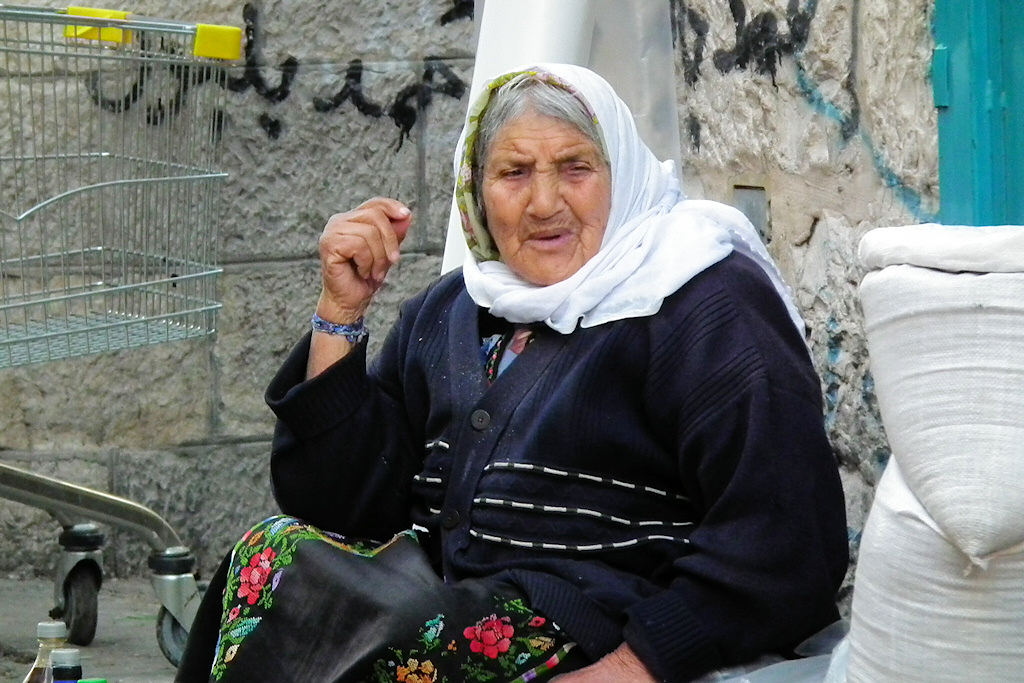
This and the pics below were taken in Bethlehem, Palestine, in Dec 2012
I was talking to a friend about our different illnesses and she said, “You must be suffering more than I”. This made me think, because suffering cannot be quantified and I can’t really say ‘I am suffering more than you’. Or at least, if I do, I’m making judgements about that person and about me that don’t really hold up. With pain, it’s really difficult being objective – it all hangs around our capacity to accept, tolerate and handle it.
Pain is partially to do with what is happening and partially to do with how we’re perceiving and experiencing it. I knew this before cancer came my way, but I’ve found since then that it is more true than I thought. I don’t instantly reach for the painkillers – avoidance of pain charges its price too. I use them only when I’m worn down, needing a break, to stop myself going into a self-fulfilling pain loop.
It’s not easy. But we do make things more difficult than they need to be. We create more friction inside ourselves than we need to have. We take difficulty and pain as negative experiences, something bad, something wrong – often according to beliefs and predispositions that aren’t very good for us.
Yet pain isn’t wrong – there’s something strangely right about it, if we can but change our perspective and suspend judgement enough to see how this might be so. Too often we compare our pain with how we feel things ought to be, how they used to be or how they could be, and this has a way of increasing the pain. Because it turns us away from facing it.
It comes down to attitude. Attitude might or might not change our circumstances or their causes, but certainly it can change how we experience and handle it all.
I’ve learned a lot from people in conflict zones, especially Palestinians, who have developed such attitude over the generations, in both the personal and the social spheres. They’ve got tragically used to dealing with hardship and they’ve developed ways and means of surviving in situations where levels of hardship and suffering are high – such as sharing what they have and looking after each other. They aren’t angels and they make mistakes, but they’re better than we at protecting and helping each other, and making the best out of a bad set of circumstances.
Many people in the comfortable countries can get really upset over issues that are relatively small, such as a power blackout, a shortage, a traffic jam, or someone not doing what they said they would do. Tolerance levels are low, tight and sharp-edged. We have an unhelpful sense of entitlement to a problem-free life. So when the shit hits the fan we catastrophise it, mishandling it and often creating more problems than were needed.
In all of life’s situations there is a degree of choice, either to make a big deal over something or to square with it, accept it and do the best we can. The choice lies around the friction we put up. It’s an honesty process, and with pain we’re forced to face stuff we don’t like facing.
Spiritually, a key issue is this: we come to Earth to learn, get experience, go through it, learn from it and hone the soul. Because at the end of life, all you take with you is what you have become as a result of having lived a life. Pain is an intense kind of experience that has a way of grinding at us, drilling holes in us, attempting a takeover of our psyche and giving us a truth-and-reality experience.
It’s the price we pay for the pleasure of being in a body and the experiential access that it gives us to the wonders of the world. Without a body we cannot stuff chocolate, have orgasms, go on holiday or bliss out in a field of bluebells. Pleasure and pain, whether emotional or physical, are two ends of the same experiential spectrum, and you don’t get one without the other.
I had a remarkable experience six years ago when first stricken with cancer – a blood cancer called Multiple Myeloma, which erodes the bones and creates all sorts of trouble and pain. Since then I’ve had treatment, though there is no remission from Myeloma, and am now on a maintenance regime of medication, supplements and working on myself. I’m surprised to be alive, actually, though clearly there are reasons to be here.
The cancer came on quickly over a few months and I deteriorated rapidly. At times I was in extreme, 150% pain, immobilised, helpless, rendered into a wreck of a man, at death’s door. One day the pain was so intense that I couldn’t even raise my head from the pillow to drink – moving a millimetre made my bones grind and grate. But I had to drink anyway and tried moving.
The pain was so overwhelming that something in me popped out of my body and I saw myself from above – as a soul having an experience on Earth, lying there, all crippled and useless. There was something strangely comical about this. Something in me could see the poignant humour in it – here I was, suffering, more than I had ever experienced, and it was bizarre. I started chuckling. It really hurt to laugh. My then partner, looking on, thought I was losing my marbles.
The funny thing was that my experience of pain suddenly changed. It seemed to become more distant. I became more at peace with it. I was able to face it and accept it, from more of a distance – it was simply a fact, a situation. Something profound had shifted in the space of several minutes.
Over the next few weeks it decreased further and within a couple of months my pain levels were around 30%. Also, my boundaries had shifted. Previously, I could handle 20% pain without it getting to me too much, but afterwards I could handle 40-50% – my pain threshold had moved and it has stayed there since.
Over the last six years I’ve hovered around 10%, with a permanent, steady and stiff ache. I hardly notice it, having become used to it. Most of the time I accept it – except perhaps in the late afternoon when Sir Isaac Newton seems to switch up the Law of Gravity. But there are times when I do notice the pain and it gets to me, deep down – especially in winter. Usually these are times when my spirits are low and I’m feeling worn out with life.
So there’s something here about being spirit-propped. The pain, disability and precarity of a cancer patient have somehow thinned the membrane between me and spirit – a membrane that I used to try so hard to cross, while now it comes more naturally. There’s something to this about the perspective of experiencing life as a soul in a body, visiting Earth.
Pain hits us all, in all sorts of ways and degrees, and at various times. It can go deep, and we each have our crosses to bear.
For example, throughout my adult life I’ve experienced ‘political pain’ – the pain of being misunderstood and misjudged in public, and paying a high price for it (as a dissident and an Aspie-Autistic). It has impacted me immensely. It’s the pain of being wronged in the social and political sphere – sometimes by evolving facts and sometimes by the wrongdoings and micro-harms of others, or by the madnesses of crowds. Even so, this pain forced me to come to terms with the reality of it, to understand what was going on underneath and to forgive the people involved, and to understand and forgive myself too – and in late life, forgiveness has been a gift to the soul and a lightening of a burden.
The world’s pain levels are escalating in the 2020s, partially because so many souls are alive today having a human experience, and partially because life is getting tougher for everyone, everywhere. Outrageously tough situations such as we have seen recently in Gaza are just the tip of a very big iceberg.
And here’s the rub: no one is exempt. Hence, a generous and charitable attitude toward others in need is wise since the tables can turn. We might one day be glad to receive others’ help.
It’s our choice as to whether or not the future is going to bring hard times. We can make a big deal about things ‘going wrong’, or we can accept things and get on with it. In the end, many problems are not as big as we think they are. What might to one person be a disastrous crisis, to another person is just another boring night of bombing.
We create sufferings simply by complaining, being angry, feeling hurt, self-victimisation, or by doing things which are not the wisest. So the level of actual hardship and difficulty we face is a different matter to the way we handle it, and in the latter lies our choice.
Even so, for some on our planet, life is really hard and, in the short term, they don’t have many options – if, that is, they survive. This is not ‘their karma’: this is the world’s collective karma spilling over onto them.
One of the things I’ve noticed in my peacemaking work is that many of the peoples most beset by longterm war – Bosnia, Ireland, Afghanistan, Vietnam, Lebanon, Sudan, Palestine – can be the nicest people around, and it does not seem fair that such ‘karma’ should fall on them. The people most affected by climate change are mostly not the ones who created it, and the world’s poor are losers in a system steered by others. But even they are faced with occasions when choice becomes available.
If we follow a deeper path through life, over time it changes our emotional responses, perspective and priorities. We don’t need to consume as much, we don’t need to ricochet through life, we don’t need to deny ourselves tender moments with loved ones, and we don’t need to create as much waste and damage as we do.
Because something changes inside. It’s a slowly-distilling sense of basic trust, a simple knowing that, somehow, things are going to work out. Especially if we allow it. The issue isn’t about being perfect – it’s about learning from life’s lessons and making good outcomes out of difficult situations.
So this matter of hardship and suffering depends so much on where we’re looking from. While I have a blood cancer, I’m partially disabled and life is difficult, it doesn’t mean I’m sitting here suffering all the time. Though I must admit there are times when I do.
Sometimes, in down times my spirits seem lost in a fog of fatigue, but even then it’s a matter of being patient and letting it be. I can struggle against it, feeling as if I ought to be doing this or I wish I could do that, when in fact it’s okay to take it as it comes, to flop down in a dull state and let it be. I tend then to revive more easily next day. It’s just that I’ve have been given yet another cameo experience of being on planet Earth.
Life has been quite a grind and a test recently. Living as a partially disabled cancer patient makes wading through life twice as difficult, and sometimes I get deeply weary with it. That’s been happening recently.
But there’s a weird psychological program in me that has meant that some of the best work I’ve ever done has been done during such periods, when my Saturnine tough-it-out programming gets activated by life and its grinding difficulties. I tend to tough it out by engaging myself in doing something. A project.
It’s an Aspie hyperfocus thing: if you can’t change your circumstances, change your mood by doing something creative and ultimately useful – even if it yields no immediate benefits. That’s how the program goes – for me, at least. Except there is one big benefit: it changes my mood. And, bit by bit, that can change everything.
That’s how, somehow, over the last forty years, I’ve managed to write fifteen or so books on quite a variety of subjects. Many were written amidst difficult circumstances, or arising out of them. The gratifying thing is that I still agree with pretty much everything I’ve written – or spoken about, broadcast or taught. I have few regrets about it. Which is quite remarkable, really.
Just recently I’ve been at it again. I had a crisis a month ago where I felt uninspired, feeling that I’d said everything I needed to say, and were people interested anyway? Well, as such crises do, it represented a deeper fermentation process going on in the nether recesses of my psyche, and an inner repositioning was going on, unbeknownst to me. I started looking at ‘outstanding issues’ and ‘unfinished bits’ in what I have done. After all, as a disabled oldie who spends more time alone than I would prefer, I do have lots of time.
Just yesterday, my friend Brian Charlton was here. He’s another Glastonbury defector now living in West Penwith – there’s a little secret cabal of us, actually. He lives the other side of St Just, our local village, and he is part a local support group, the ‘Friends of Palden’, that is a blessing in my life. He was on his weekly visit, and benignly badgering me about these unfinished bits. Very perceptive. I realised he was right. I needed to beaver away at clarifying and finalising the signals I’ve been putting out, and there are unfinished bits, and bits yet to evolve further, if life allows.
But there was more: I realised was already instinctively doing it, though I hadn’t realised it until then. It had started with two podcasts, both of which came up spontaneously, about Inner Doctors and Intuition. That got me flowing again, unblocking the logjam that had scrangled up my psyche. That’s one secret that many creators need to understand: if you get blocked up, do something, anything, to get yourself unblocked. And it’s best to forget what you think you ought to be doing, and to be spontaneous and creative instead – because that’s where the taproot of creativity lies.
Then suddenly I found myself starting doing a revision of one of my books, Shining Land, about the ancient sites of West Penwith. Well, there were some typos, readability issues and tweaks to attend to. So I thought. But as things progressed, I realised that new work I have done in the last few years, since I wrote the book, needed adding. I’d gained some new perspectives too, blessed as I am with lots of thinking time.
Most of the book has just needed tweaks and small improvements, but the chapter on Hill Camps has had a rewrite, adding my thoughts on Bronze Age circular enclosures such as Caer Brân, built around the 1800s BCE for tribal gatherings, and their significance. Also, I’ve added new material to the final part of the book, about Megalithic Geoengineering, breaking the last chapter into two and adding new work to both, about landscape temples, wildwood cover in the Bronze Age and ancient trackways in Penwith. And there are some new maps and pictures. I’ve worked on the indexing too (it’s rather tedious).
But here’s the rub. I can’t write books any more. My brains can’t do it. I can do blogs, podcasts and small projects, because they are done and dusted in a day or two. But books? No, they’re big projects. Even so, I can revise books I’ve written before, and the great virtue of revising a book is that the big thinking has already been done. So I can focus on style, details, text-flow, images, maps and new ideas. I can make it a better read.
I discovered this ten years ago when revising an astrology book first published in 1987, Living in Time. It was a good book but it had dated, with out-of-date examples in it from the 1960s to the 1980s. It also needed another spin, since times had changed and many more people were aware of what the book writes about. This is how Google’s AI assesses it:
“Power Points in Time is the title of a book by Palden Jenkins that explores the concept of time and its influence on various aspects of life, drawing on astrology and other cyclical patterns. It examines how understanding these patterns can provide insights into events, decisions, and even the meaning of life. The book uses examples like lunar phases, planetary alignments, and ancient festivals to illustrate how time can be understood as more than just a linear progression.“
Actually, that’s a pretty good summary. That’s the first time I’ve used AI in any of my writings, and it’s likely to be one of the last, since I am decidedly AI-free and Patreon-free in my outpourings. And, for better or worse, I prioritise eyeballs and ideas over monetisation too.
Gurnard’s Head
So I revised Living in Time and it came out in 2015 as Power Points in Time. I really enjoyed doing that revision, precisely because the big thinking had been done, so I could focus on other things. But there was another matter too: in 1987 I had pitched the book to people interested in astrology, though later I found that it was most popular with people interested in ancient sites – a different circle of readers. Meanwhile, over the quarter century that followed, I had developed a clearer idea of the combined importance of power points in space (ancient sites) and power points in time (peak periods). So I re-pitched the book toward this ‘power points’ idea.
Then a few years passed, and a big change came to my life – getting cancer and becoming disabled – and, reviewing my life, I realised I hadn’t written a book about ancient sites, even though, on and off, I had studied the matter for fifty years and had done a lot of research in Cornwall for ten years. So along came Shining Land – the ancient sites of West Penwith and what they say about megalithic civilisation. My core proposition was that ancient sites were built for conducting shamanic consciousness work, and that the 600ish ancient sites of West Penwith actually constituted one big, integrated ancient site.
By making a ‘landscape temple’ out of the whole cliff-bound Penwith peninsula, it was possible to raise this consciousness work to a higher level, to benefit not only the local area and its people but the whole planet. The planet is one being, that we have come to know as Gaia, and if the ancients got themselves into enough of an elevated state to do so, they could commune with Gaia, adding a human touch to her work as a planet-being.
They were practicing what I’ve come to call Megalithic Geoengineering. Big stuff. Planetary stuff. And, of course, there’s something to learn from this today.
Lesingey Round
So, you see, in health and life circumstances I have been labouring somewhat, though in other respects I’ve been quietly chiselling away at generating uplift and raising my spirits by doing those things that I can do, and being creative with it. It fires up my circuitry. Meanwhile I’m de-focusing on those things I can’t do and can’t have – things that weigh me down. As a result, a new, 2025 version of Shining Land will come out shortly as an online book. So there are results to this. Results germinated out of a time of hardship.
Two things happened to help turn things around. One was the spontaneous eruption of the ‘Inner Doctors’ podcast, which revived my creative spirits, and the other was a session with a homoeopath, my neighbour Anna Jenkins (no relation – we Jenkinses are a big Welsh clan). I think the remedies she prescribed have dislodged some fixities and rigidities within me. Well, to be honest, I cannot tell yet, because the last week has been low, lonely and dark and I cannot tell whether my cancer and demise are getting worse or whether this is what homoeopaths call a ‘healing crisis’. But I think I’ll opt for the latter.
It has more hope in it. And hope and belief are motivators. Not as an imposition on evolving reality, but as a way of intersecting fruitfully with it. Hopefully.
Changing the way we see things: inside every problem lies a solution, as long as we allow ourselves to see it.
Sometimes I struggle with that. So, in case you thought you were the only one in this vast universe who struggles with it, think again, for you are not alone.
A few days ago I thought out loud that I had little to say. Well, this turned out to be incorrect. Forgive me for that! Goes to show, I too have my illusions. Here’s a new Pod from the Far Beyond.
I went on a slow stagger down to the pleasantly unkempt woods below the farm where I live. I sat next to a big hazel tree that’s far older than me, where I usually go. It leans over and there’s a sitting place amidst its roots which is just right for me. It’s my outside broadcast studio, where quite a few podcasts have been made.
This one is all about the battle for the hearts and minds of humanity. This is something that is unfolding behind and beneath the torrent of worrying events that we experience today.
‘The path of excess leads to the palace of wisdom’. Thus said William Blake over two centuries ago. Well, true. But do we really need to pursue excess in order to achieve wisdom? It causes a lot of damage to our world and to hearts and minds. There is another way.
As a peacemaker (more correctly, a peacebuilder) there hasn’t been a lot of progress since the days of Vietnam and Northern Ireland – the issues I and many others of my postwar generation started out with. The warmakers are still very much at it.
But the matter is still open. We’re coming to the time. And this podcast is about that. It’s here on Spotify:
or on my podcast page, where you’ll also find 60-odd Paldy-podcasts on a range of subjects:
In the weeks and months to follow, I might well come up with further insights about the future. Despite everything, I’m still an optimist. Though we’re in a strange, perverse time of history where humanity is bring taught how not to do things, and it can seem as if everything is going wrong.
So here am I, a lifelong author and communicator, and I’ve been sitting here in recent weeks with nothing much to say. That’s unusual. It isn’t ‘writer’s block’: it’s a funny feeling of little to say. In my birth chart, Neptune and Saturn are opposing Mercury right now, so I guess this blog is expressing the essence of what that double transit is bringing.
I’m one of those authors who, if I have little that is meaningful to say, I don’t just rattle off material just to fill space, stay regular, fulfil expectations or contractual requirements. I go quiet instead. The best of my writing has always come when there’s a need. I wake up with it, and out it comes.
In life this has given rather uncanny gift which has been both a blessing and a bane: a strange capacity to articulate ideas and perspectives that other people were about to get, but they hadn’t got there yet. As if speaking to people from the future, pointing to how it’s going to be. Or might be. Or could be.
I haven’t always got this right, though there have been times I’ve got things very right. Sometimes I’ve perceived a possible reality that just didn’t happen that way, or I underestimated the influence of obstructors, or got my facts wrong, or suffered wishful thinking or over-optimism, or simply mis-estimated things.
Yet at times I’ve hit the nail right on the head, and it has sparked outcomes or affected people and situations far more than anticipated – sometimes going into the magical-miracle zone. Cosmic catalysis.
It’s a question of whether the benefits from things I got right have outweighed the misfires and problematicals. It feels as if this question is on the weighing scales at present. And, perhaps to prove the point, recently I’ve had little to say. It’s a pause for rumination. Or perhaps a reality-flip is going on. Or a reassessment.
A winding lane in Grumbla, Cornwall
My ongoing cancer saga continues. A new symptom has appeared in recent months: I’m losing the use of my legs. That’s what it feels like, though diagnosis is yet to come, following an imminent MRI scan of my pelvis and a diagnosis in the coming week. My legs are exhausted after a hundred yards, as if I’d just hiked forty miles. Even when just standing still, they turn to rubber, as if they’re about to give way.
It varies on whether it’s an Up day or a Down day. Down days have increased, when I have little energy, drive or inspiration. So something is going on.
It reminds me of six years ago when no distinct symptoms of cancer had yet appeared, but something wasn’t right. It wasn’t possible to put a finger on anything until my back suddenly gave way in August 2019. This was the first concrete symptom of a rapidly developing blood cancer, Multiple Myeloma. It’s ‘multiple’ because it has a range of disparate effects that vary greatly from person to person. This makes it difficult to diagnose.
So it took twelve long weeks to progress from a back-breakage to a cancer diagnosis, though this process was helped by a series of three inspired acts of intuition by, in succession, a cranial osteopath, a GP and a hospital specialist. Bless them all.
I can’t put my finger on what’s happening now, but something is happening. Astrologically, it concerns Mercury, and I’m a Mercurial person (a Virgo with a Gemini Moon). This feels neurological. There’s that ‘nothing to say’ syndrome too. And there’s more.
Rock art, Morvah, Penwith
It concerns ‘growing down’ – losing our powers. This demands a lot of acceptance – getting used to the fact that something is ending. Really ending. In the past I’ve been a cross-country runner and mountaineer, and I find loss of leg-power to be confronting.
Also, as an author, many people are retreating from their phones and social media habits and, thus, many of my readers are simply disappearing. The default answer is to spread into new online media and engage in networking and marketisation strategies. I’m getting loads of e-mails from online promoters who want to marketise my podcasts.
I’d love to reach more of the kinds of people who might benefit from my blogs and podcasts, but I’m not interested in all that promo stuff. My abilities are waning and I can’t manage the work that’s involved. I’m not seeking to set up a business or build my career. This lifelong content creator is sharing his end-of-life process, that’s all.
By nature I am, or was, an integrity-marketer, studiously avoiding falsities, glamours, competitiveness and deceptions in my approach. I used to be a whizzo at this, but not now – my time was 20-40 years ago. Nowadays, online media are changing so much – I can’t keep up, and get my head around all the details. Meanwhile, digital costs and charges are rising, and this obliges monetisation. I can’t do this any more, I don’t have what it takes to crank up a business and I don’t want to leave too many complexities for my son to sort out when I pop my clogs.
So where this goes is anyone’s guess. Anything that increases my workload or demands feats of memory and micro-management will simply not work. Anything I do needs to serve my health and wellbeing without weighing me down, and I’m already going at the maximum pace I can handle. So there’s a dilemma here.
Fresh sets of eyes peer out on the great wide world. In a few weeks they will fly thousands of miles.
Anyway, there’s something to learn from all this. It’s a matter of looking at what’s underneath. It’s about acceptance of What Is. It’s a reduction of options. This happens to those of us who experience a gradual, stepwise end-of-life decline instead of a sudden, drastic one – things narrow and shut down, bit by bit. It’s simply a matter of doing our best with what is, and what we’re capable of doing – there’s little or no option. It can be difficult and rather final, though there’s a joy and fulfilment in it too, if we choose to see the gift in it.
Earlier in my cancer saga I used to measure my condition in terms of perceived age. My physical age is currently 74, and normally I hover around 80-85 in perceived age, but in the last few days I’ve felt like 95 – energyless, wan, off-balance, needing someone to hold my hand, and wondering whether the latest rewrite of my will makes sense.
Yet I’m also transported into the eternal present, propped up in bed, hearing the singing of birds in a crisp, microsecond, sonorous, meaning-rich way, as if they’re teaching me something. Which they are.
They’re teaching me a very special something. A something that words cannot truly encompass because words reduce it. It’s a silence between each frame of life’s movie. A moment of seeing, a shifting of optic, a moment of existential tranquillity. It’s very quiet. It’s momentary yet vast. A glimpse of the Void. A taste of the Silence. A Neptunian slippage of consciousness into a temporary eternity.
So perhaps having little to say has its virtues. After all, I’ve managed to say something about it, so something must be happening right! It just goes to show, there is indeed a gift in everything.
I’m continually reminded of the extent to which the present is a gift. Everything comes from Spirit, from the Void, from what we call God, and everything returns to Spirit, to the Void and to God. And everything exists within them.
It doesn’t matter how we see the nature and meaning of life, the universe and everything – it’s still the same. We are the eyes, ears and hands of existence-consciousness-beingness. It’s dead easy to forget, to get lost in our stuff, but it remains true.
Some people are in the midst of nightmares right now. Some days ago I did a joint online presentation to a support group in Britain with Ibrahim Issa, director of the Hope Flowers School in Bethlehem, in the West Bank of Palestine. Western governments, aid agencies and donors have withdrawn a lot of support, so we’re having to do some remedying of that, especially since life in the West Bank is getting harder and harder.
I was amazed at his composure. Or perhaps he was just too tired. He and everyone around him had been kept awake through the night by missiles, planes and sirens. And fear.
Even so, they keep on at the school, driving by the seats of their pants – attending to the needs of the children, their families and the local community. On a shoestring.
The latest measure they’ve taken – since Israeli roadblocks all over town make movement difficult – is to take trauma-support services to the people, in a Volkswagen van. It’s a sort of trauma-ambulance, for people losing their rag because of the tensions, dangers and offensive experiences they’re living through.
In my contribution I mentioned the Arabic term, sumud – hanging in there, never giving up. The secret is to stay in the present, to make the best use of the gifts it yields. When the past is being obliterated and the future holds little to hope for, there remains the present – the only time we actually have agency.
My own body is gradually deteriorating – a new health issue is slowly immobilising me – yet I’m continually amazed at the gifts that life presents. One is this: lessons I’m learning from people younger than me. In this case, it’s Ibrahim, teaching-reminding me about the present moment. Doing what you can with whatever is available right now and making the best of it. Because the past is gone and the future is but an idea.
People bang on a lot about freedom of speech, though really we need to learn more about exercising our freedom of attitude.
In the immediately-impending future, on Sunday (times below, for different countries), there comes the Sunday Meditation, and you’re welcome to be present with it. It’s free, no sign-up, no strings, do it your way, and wherever you are.
Perhaps give some attention to feeling what it’s like to stand in the shoes of someone whose life could be snuffed out tonight, for no understandable reason or purpose. Hold their hand. There’s no shortage of available souls in need of good-hearted soul-company, in plenty of places. This is what we can do.
With love from me. Palden.
———————
Current meditation times, on Sundays: UK, Ireland & Portugal 8-8.30pm GMT W Europe 9-9.30pm E Europe, Turkiye and the Levant 10-10.30pm Brazil-Argentina 4-4.30pm CST, Mexico, Jamaica, Colombia 2-2.30pm EST, Cuba 3-3.30pm PST North America 12noon-12.30pm
You must be logged in to post a comment.