


This being Britain, as soon as the tourists went home, the sun came out. It seems to be a law of British meteorology. My wooden cabin, with its big windows, gets quite hot when it’s sunny. I sat outside today, soaking it up. One of the very best cancer medicines is sunshine – and it’s free. I need to rest, because I’m shagged out – my legs in particular. Yesterday – pat me on the back, please – I did it. And it well and truly did me.
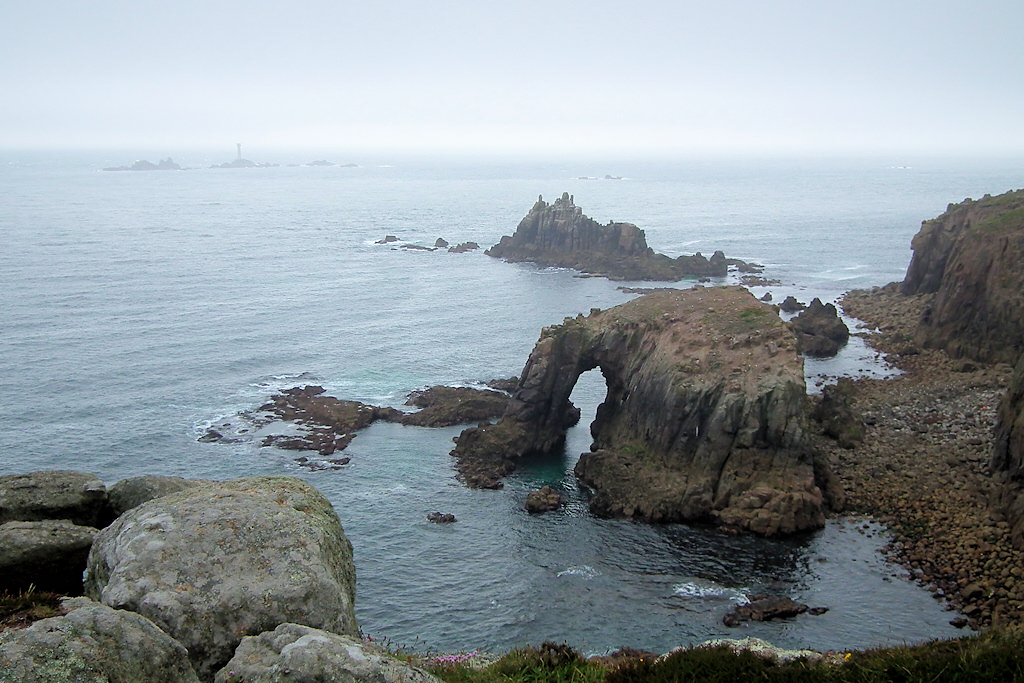
A friend, Kellie, came round and we did the hike from Land’s End to Carn Lês Boel [map here]. For me this was rather special – a personal pilgrimage to a special place. It’s the place where, if I could, I would dance my last dance. I go there whenever I need to say prayers and come home to my soul.
But it’s a long haul, for me in my condition – my walking sticks, serving as legs three and four, get tired too. It’s two miles each way, with a lot of up and down, but it feels like four. I was not at all sure I would make it, but part of me realised that this was my last chance – now or never. There’s a shorter route from Porthgwarra, but this route is special, and I wanted to do it while I could.

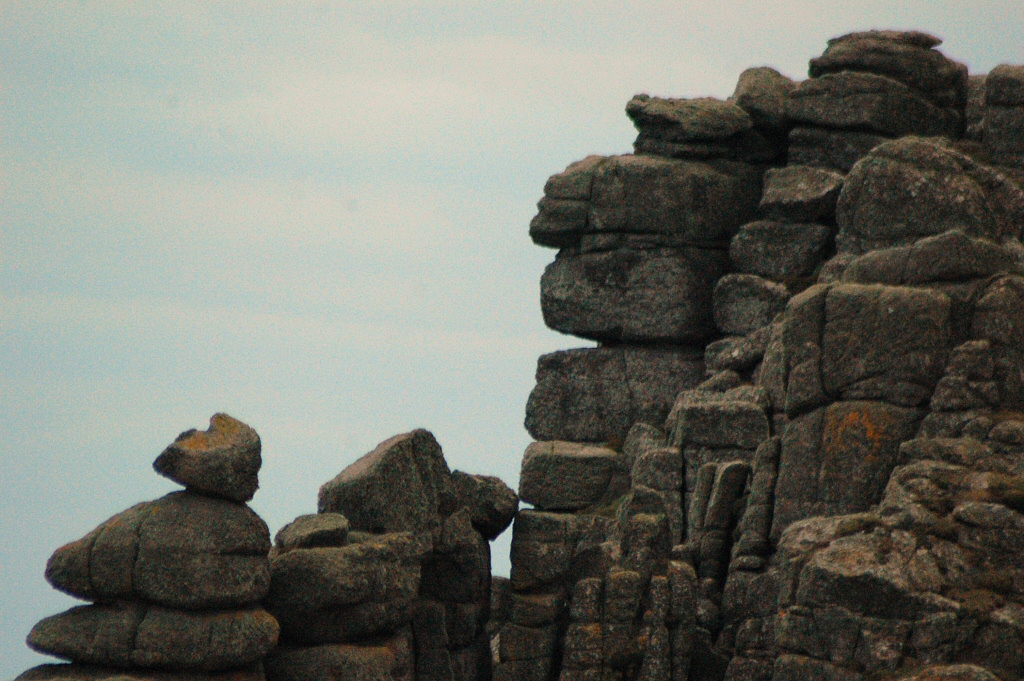
Heading south from the car park at Land’s End, first you come to Pordenack Point, a high cliff bastion which, from the first time I went there fourteen years ago, I knew to be a major clifftop sacred site. But back then there was little evidence of that – to local archaeologists it was just one more of Palden’s crazy, rather left-field ideas. That evidence has appeared since then. It’s a friendly, strangely homely place where you can sense happy gatherings, unions and reunions, even choral singing. The panorama over the sea is spectacular.

Pordenack has a prominently-placed chambered cairn, which would have been used 4,000 years ago as an initiatory chamber for deep retreats in this definitely cosmickle place. Also it would probably have been used for dying – it’s a great place for disincarnation, an esoteric spaceport for soul-takeoff toward the Western Heaven. Or it would have been a repository for relics and revered personages put there, at least for a while, to bless the landscape – rather like charismatic saints’ relics in medieval times.
The new discovery was that of a circular enclosure at Pordenack Point, perched on the edge of a near-vertical cliff. That changed things. It was found using LIDAR, a brilliant new form of aerial radar mapping that can pick up hidden remains under the earth’s surface.
Here comes the interesting bit: the enclosure is lined up exactly with two other circular enclosures inland – Castle an Dinas and Caer Brân (pronounced ‘Care Brain’). Both of these enclosures are large enough to host gatherings of a few hundred people, though at Pordenack the enclosure might hold twentyish people. These were all concerned with the coming together of people.
By my reckoning, Caer Brân – it’s just over the valley from the farm where I live – was the parliament and moot site for the tribes of Penwith in the bronze and iron ages. Archaeologists are far more cagey. It is right at the centre of the peninsula, at the intersection of two major trackways. One goes west-east from Sennen (for the Scillies) to Madron and upcountry, and the other, NE-SW, links all of Penwith’s stone circles, from the Nine Maidens and Tregeseal to Boscawen-ûn and the Merry Maidens. This trackway goes past four bronze age platform barrows at the top of Botrea Hill on our farm and over the valley to Caer Brân – I made a podcast about this trackway two years ago.
Castle an Dinas was a further gathering site further east, probably for the meetings of tin traders and for fairs and celebrations at Beltane and Lammas. This is deduced from two astronomical alignments emanating from the enclosure, aligned to the rising and setting points of the sun at those times – the sun rises over Trencrom Hill and sets over Conquer Cairn.
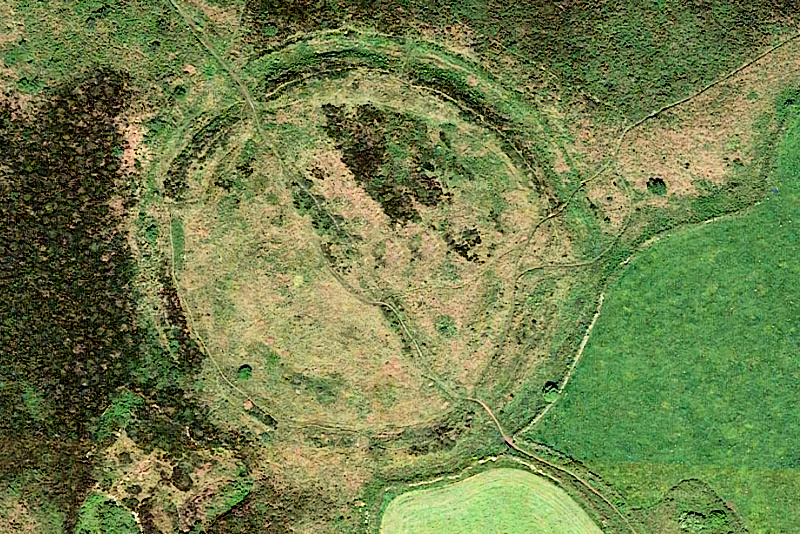
My feeling is that Caer Brân was rather more for formal and jurisdictional assemblies, while Castle an Dinas was more of a marketplace and social gathering site. Just up the hill from Caer Brân is Bartinney Castle, a hilltop circular enclosure with cairns inside it, which has a distinctly spiritual-religious character and a remarkable panorama. Legend has it that the Devil can never get at you inside the enclosure on Bartinney.
But, get this, three of these circular enclosures – Pordenack, Caer Brân and Castle an Dinas – are exactly aligned along a summer solstice sunrise orientation. Gatherings and festivals were really important to ancient peoples, and the people of the tribes of Penwith would come together at these enclosures at special times of the year.
In those days, folks weren’t as peopled-out and time-pressed as we are – there weren’t so many people around and, if you went anywhere, you walked. Much of the land was wooded, which gives a different space-perception to the open farmed landscapes we’re used to nowadays. Jumping in the car to visit friends wasn’t an option, so you met with them periodically, when you could, at gatherings like these, particularly at the solstices and cross-quarters.
You’d meet your relatives, distant friends, old acquaintances and new people too – at Castle an Dinas there would be interesting people from abroad, even in ancient times. There would be discussions, decisions, the making of deals and the settling of disputes. There would be trading, flirting, celebration, partying and morning-after hanging out, with moments of invocation, spectacle and holiness. They’d troop there from their living places around the peninsula, stay for 2-3 nights and troop back home again.

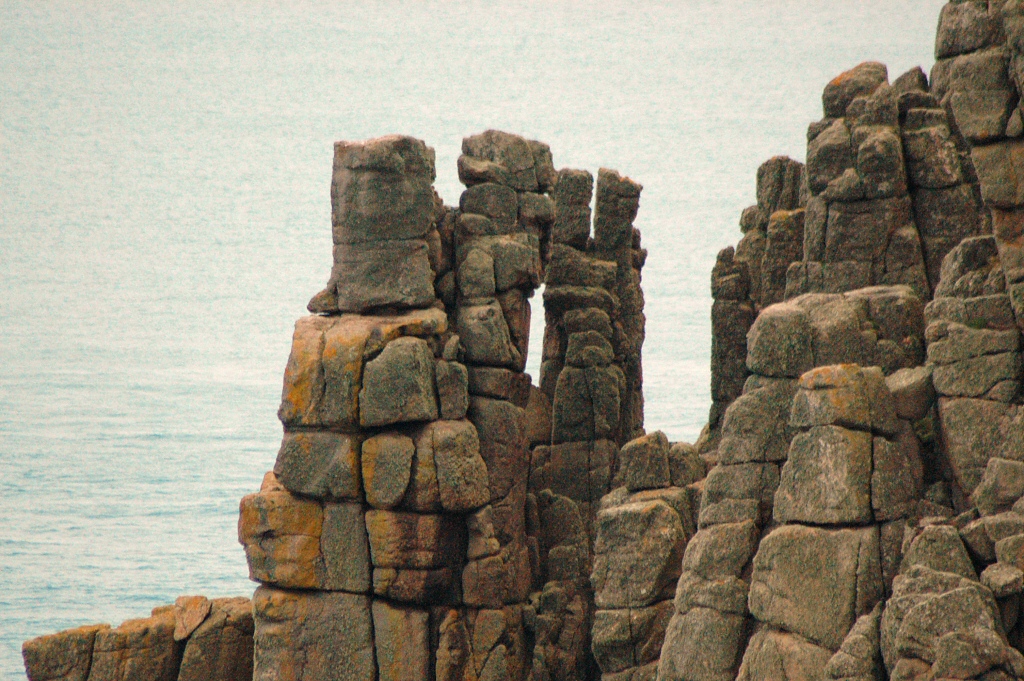
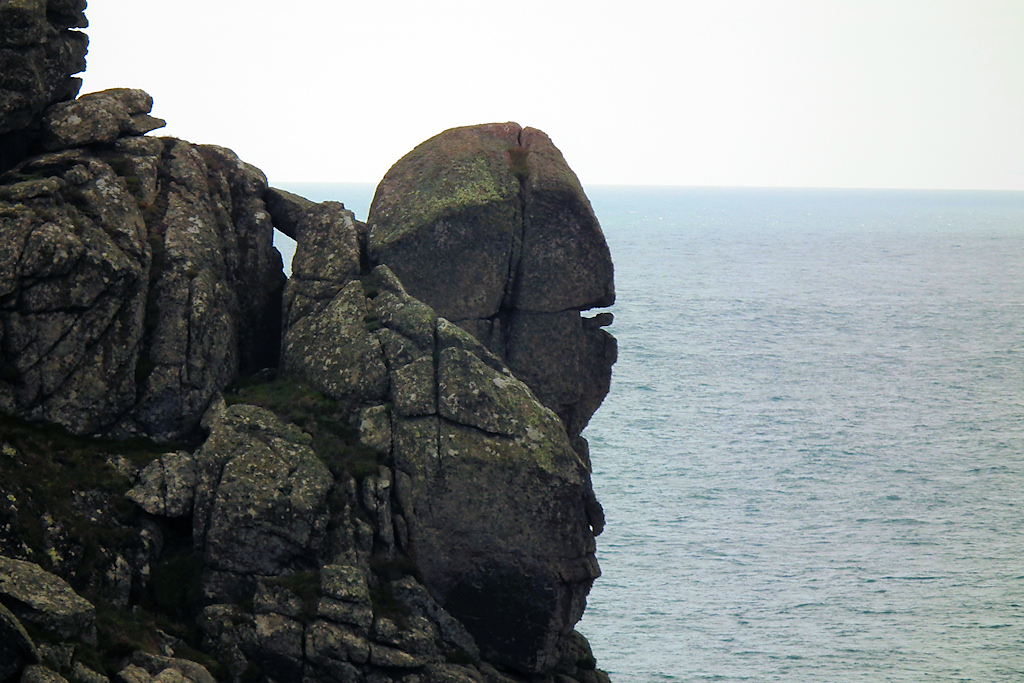
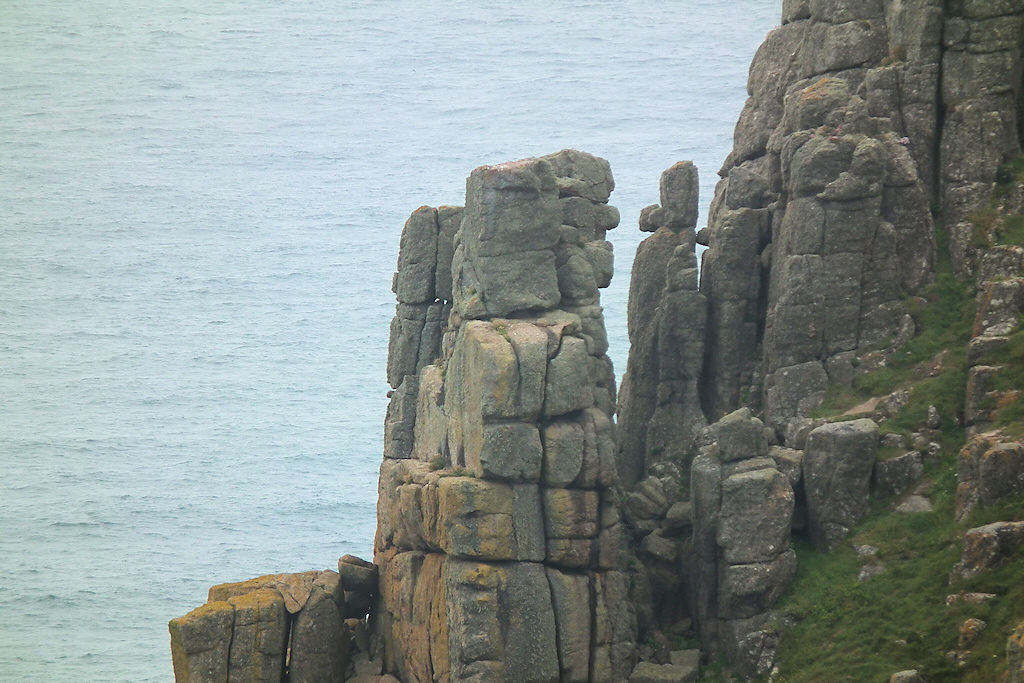
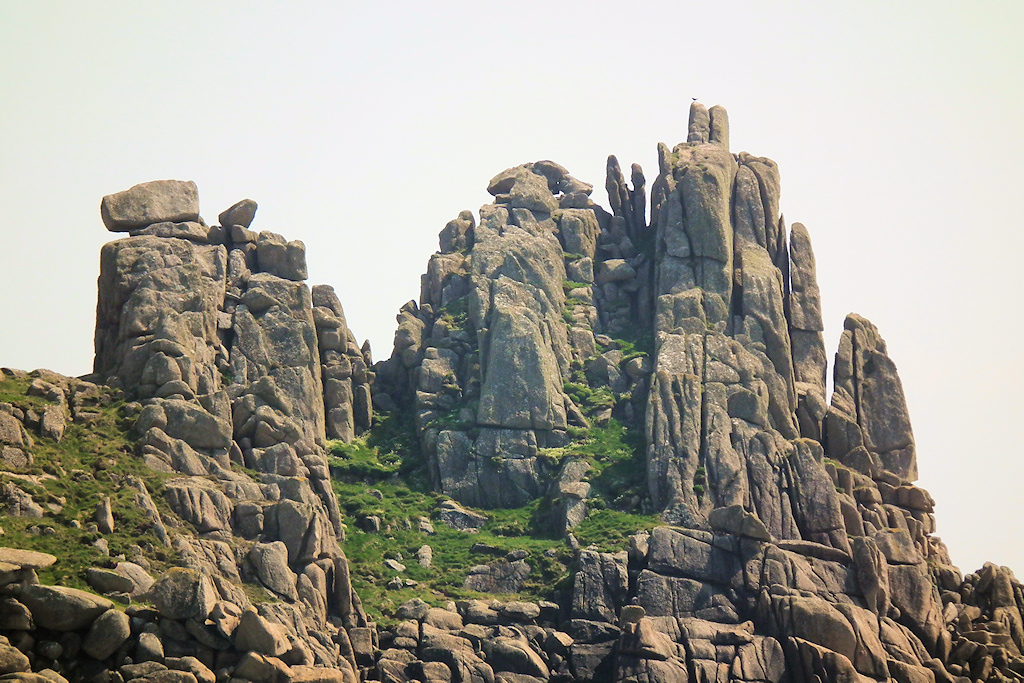
Pordenack Point is special not just for the above reasons. It hosts what must be one of the world’s largest collections of rock simulacra – natural rock shapes resembling ancient beings. There are whole gaggles and convocations of them – guardian rock-beings who face the vastness of the Atlantic at the far end of the Isles of Britain, holding the winds and waves at bay and protecting these isles from the storms, currents and weather gods. Some of the simulacra stand there chatting, and some are watchers, peering toward the far horizon. Some are Keepers of the Law, some are the Chanters of Intonations, and some are grumbly earth beings who resent the dwarvish bane they carry.
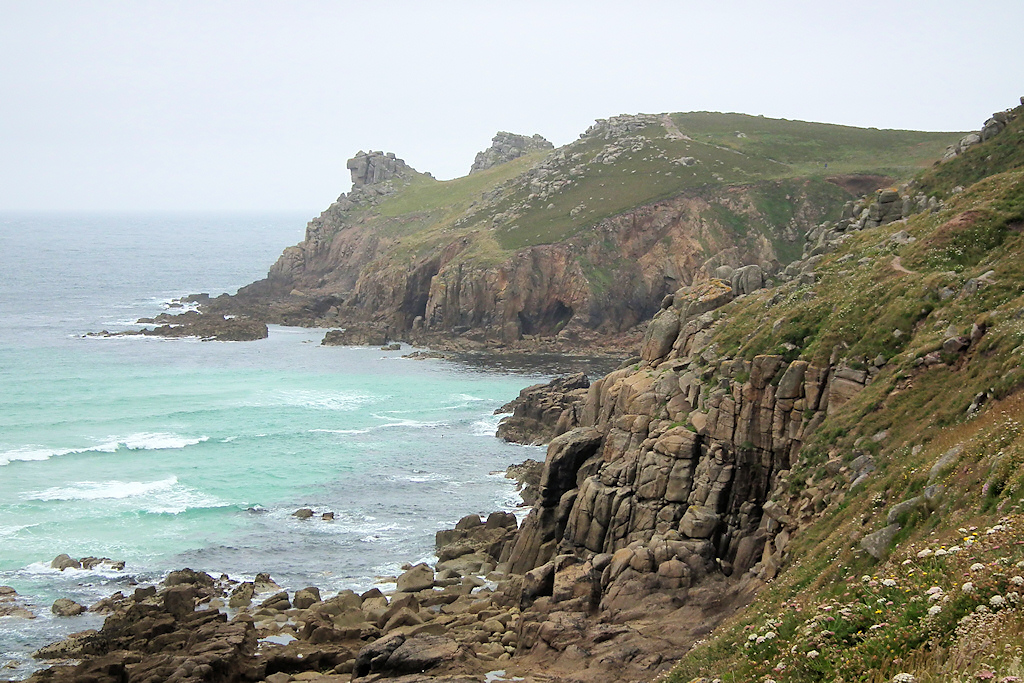
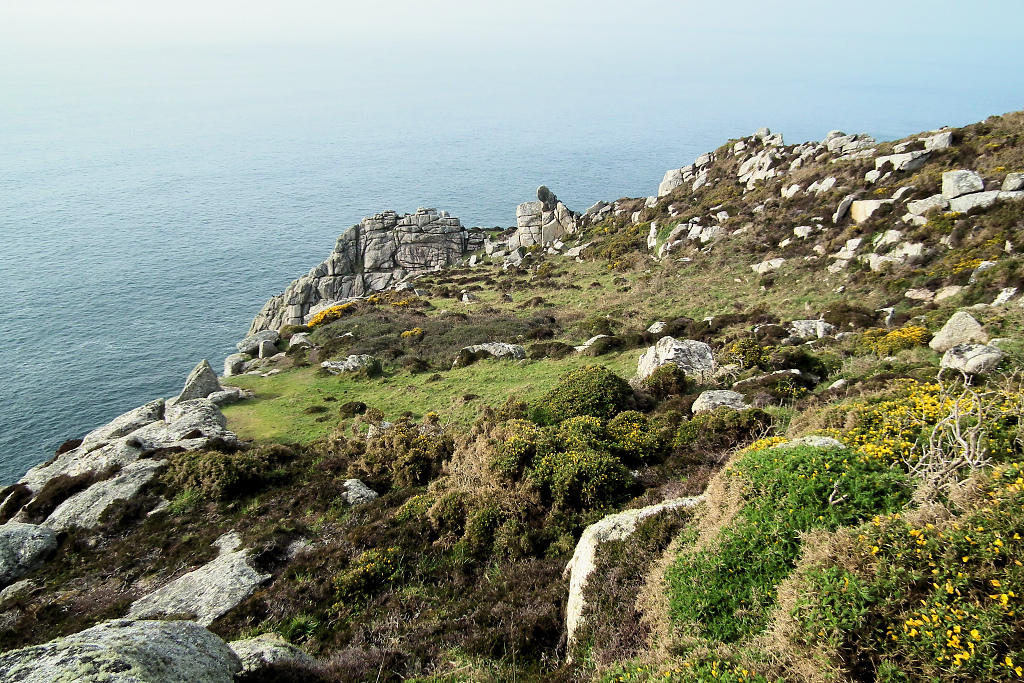
Then you head onwards to Carn Boel, the next headland along the coast. Carn Boel (‘headland of the axe’) and Carn Lês Boel (‘headland of the court of the axe’) form the bounding headlands of Porth Nanjizal (Nanjizal Bay, pronounced ‘Nanjizzle’). Carn Boel has a big outcrop with a hooked nose, on top of which is a rather magical stone and sitting place, looking out to sea. Perhaps a place for consulting ancient seers and soothsayers.
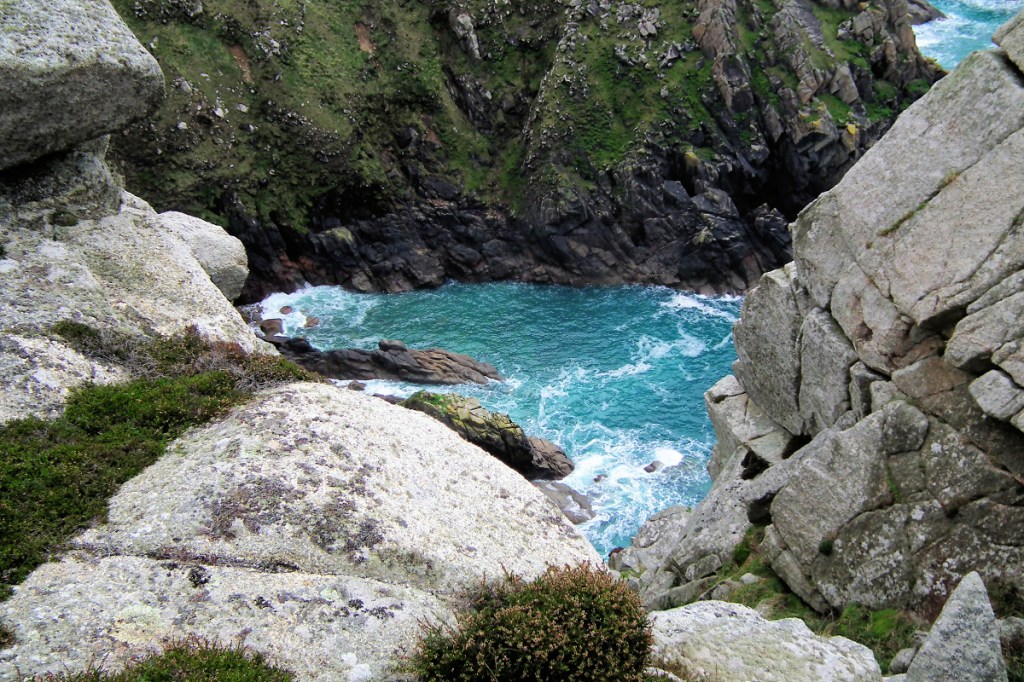
Then you follow a cliffside path – a bit challenging if you have vertigo – alongside Porth Nanjizal, past a fascinating granite outcrop called Carn Cravah. We had a good sit and a round of tea there – I was already having to pace myself because, since I got cancer four years ago, I have few energy reserves to draw on. So it’s an exercise in prana-management, energy-management, pushing myself but not pushing too much. Often there are seals hanging out in the water below, but they weren’t around yesterday, possibly because of all the humans frolicking happily in the water.

Then you get to Nanjizal, a lovely sandy cove. It lost all its sand in the storms of 2014, but the sand has returned now. It was quite busy. It was lovely to see children getting lost in the magic of the place and playing in the waves, without a care. At least half of the people present seemed to have foreign accents – central Europeans, accustomed to being landlocked, love Cornwall and its wide-open, oceanic coastline. Since Covid we’ve had a new wave of non-white, second-generation Brits coming to Cornwall, laying claim to the extremities of their homeland, to plant their hearts in the landscape and tune in to its roots, and I really like that – they’re welcome.
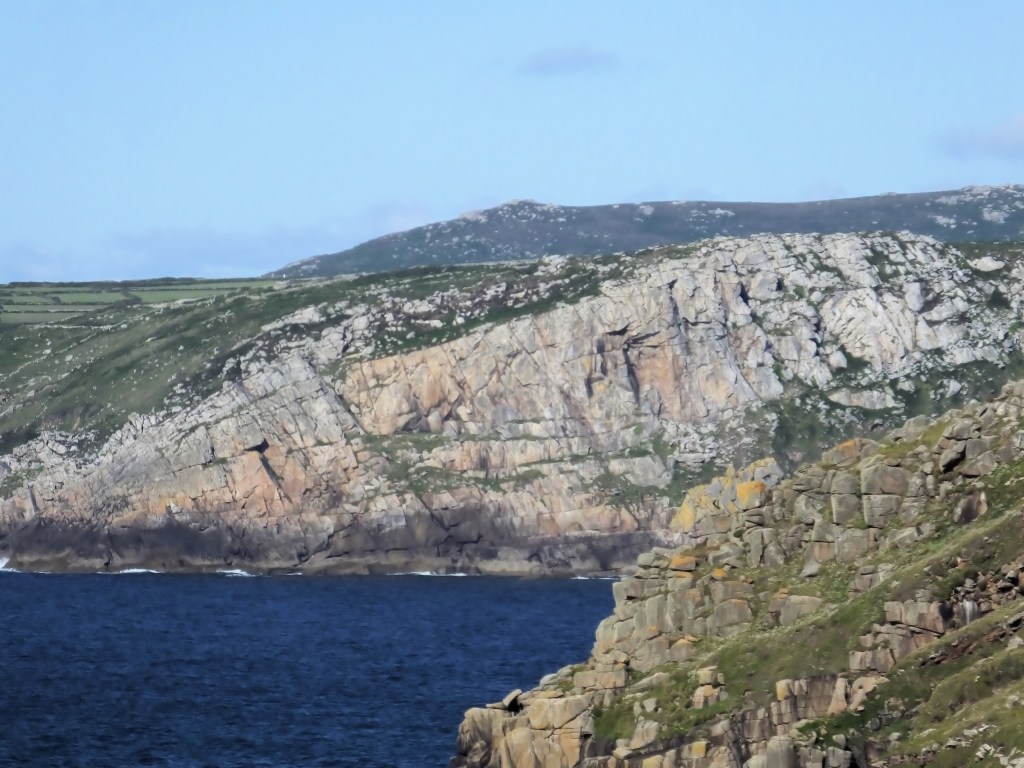
Then it’s a steep climb up endless steps to the top of Carn Lês Boel, a few hundred feet above the sea. This was a killer and I had to take it slowly, step by step, with two pauses and one sit. An old dog came puffing up the steps like a steam engine, gave me some friendly slobber and continuing on its way, followed by a puffing human, smiling as he passed at this old hippy sat there in his Arabic jalabiya.
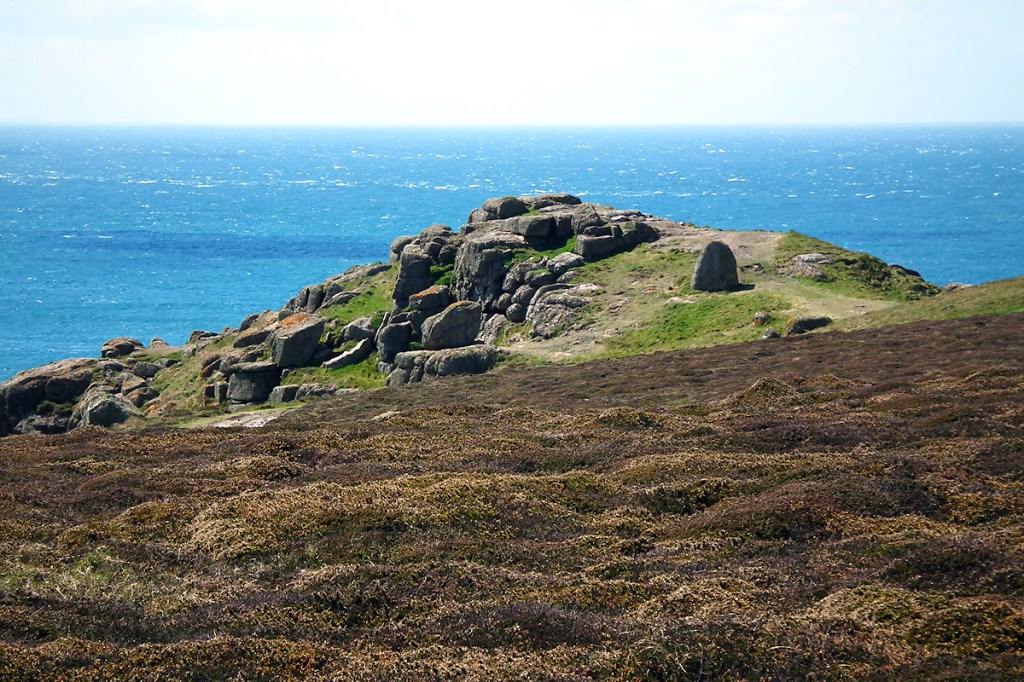
But I got up there. It was painful, but the Carn makes the price worth paying. Its energy-field is strong and uplifting. It’s a place of transformation and healing, with a lightening (levitational) and enlightening (uplifting) effect. You can feel it as you approach. There’s an ancient ditch crossing the neck of the Carn, marking the boundary of its sacred space – I stop there to ask permission to enter but the answer is always ‘Yes, welcome back‘.

Then there’s a gateway marked by two menhirs, one now fallen. At times, before cancer, I had a sneaky urge to come here one night with a few friends to re-erect it, but it never happened. The other gateway stone is a rare propped, crystalline granite menhir – raised up on small stones so that there’s a gap underneath, so that the menhir doesn’t itself touch the ground. The purpose of this is difficult to tell, but there’s quite a concentrated energy-field in the gap underneath. A similar thing happens at two other such stones: one at Trevean, half a mile away and probably built by the same builders at the same time, and the other a few miles up the coast at Carn Creis, amongst the Boscregan Cairns.
At the top of the carn is a rock platform with an energy-vortex that makes my body sway involuntarily when I stand on it. A nearby tipped-over stone probably stood on this vortex in former days. There’s another energy-centre further along the carn – a natural rock pile with a vortex emerging from the top – and, yesterday, over this and the first energy centre there were swarms of flying ants, swirling around psychedelically in the heat, following the flow of the energy-vortices.
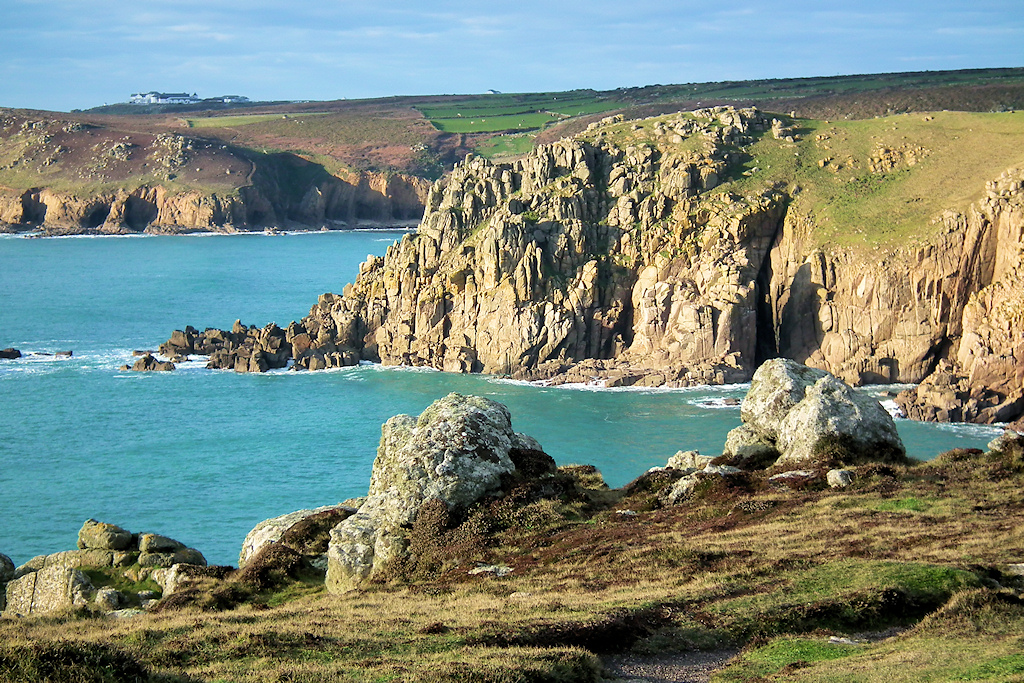
When I’m there I settle and eventually lie down, finding myself drawn deep inside the carn. Esoterically it feels hollow. It does have seal caves in it, but this is a different kind of hollowness, as if there is an enormous atrium of vastness and voidness underneath, Tardis-like and bigger than the already enormous carn itself. There’s a feeling of very ancient beings here – geological beings who were here long before humans were ever thought of. There’s also a wide-open, upwards-and-outwards, infinite-space feeling to the carn, with its oceanic vista. The next stop across the ocean, thousands of miles away, is the Yucatán peninsula in Mexico, the Mayalands.
Carn Lês Boel marks the western end of the Michael Line, a line stretching across southern Britain along its widest axis, crossing Glastonbury Tor, Avebury and other major sites along the way. That’s one reason why this site seems to me to be working at a higher level than many other sites around Penwith – the carn is on a global great circle energy-line.
I needed to come here because I feel I’m at a junction point. I’m drawing a blank on where the roads lead from here. Unusually for me, at present I see no future – no sense of where I’m going or what happens next, or even what I want or need. I’m not sure how to interpret this, but I see three possibilities. One is that I’m just plain blank and need to feel alright about that. One is that I am on the edge of something, a new chapter, the form of which I should not even try to pin down at this stage, in order to allow it the space and freedom to develop. Or the third possibility is that my life might end quite soon, and that I see no future in life because there isn’t one – the path leads through a threshold to another, less physical world.

I can accept any of these, for although I turn 73 on my birthday (Tuesday 5th September), and I’m not that old, I feel like a hundred years. Life has been an uphill grind in recent years and I feel rather worn out. Tired of pushing hard to get through life, tired of all the palaver and complexity. But I’m not set on that either. I’ll be wherever it is most useful for me to be.
I’m rather a mission-driven kind of chap, and if there is something meaningful and manageable for me to do here on Earth, then I’m up for it. But my life has developed a kind of emptiness. I miss my family, my partner and her family. In the wider world I am well liked but not greatly included. Regarding will-to-live, it does make a difference when there’s someone to live for, and perhaps I haven’t appreciated this sufficiently, earlier in life. I’m not good at doing nothing, staying alive just to stay alive, and I’m uninterested in watching TV, entertaining myself, feeding my face and living in glorious isolation. There’s more to life than this, and if there isn’t, then perhaps I’ll be better off going back home.
That’s why I went to Carn Lês Boel, to place myself before the Vastness, to make a ‘here I stand‘ life-statement, to ask a question and make a prayer. I chose the hard path to get there since it might be the last time I can do that route. It’s special to me because, this time in particular, I have to work at it, wear myself out, and that’s a quality that pilgrimages need to have. I needed to open myself up to whatever is to come. To ask for clues.
I didn’t get anything definite for an answer except for one thing: when leaving the carn I paused and asked, “Is this my last visit?” and the answer was definitely ‘No’. That perked me up. But instead of giving answers, this pilgrimage brought a change in me, a change of state. The questions started mattering less, and I came to a feeling that everything is alright, okay and perfectly in order.
Even so, I had to build myself up for getting back. Part of me didn’t want to leave. Another part of me knew that I had to start now, while I still had energy and before my body stiffened too much. Being on the carn had recharged and reconditioned me, and I knew I just had to apply mountaineer’s grittiness, persevering through the next bit to get myself home – well, back to Kellie’s car.
So I psyched myself up and went for it. My legs and back were hurting and my strength wasn’t great, but I just had to do it. At times like this, when I’m out in the wilds, I have a secret wish my dear son would winch me up into one of his helicopters and teleport me back to the farm. But this is Planet Earth, and he’s busy with other things.
This said, the whole trip was really worth it. Kellie was great company too – a right-on lady who’d been a road campaigner in the 1990s and who, I sense, stands on the edge of taking on a new mission of her own sometime soon. She’s one of those women whose kids are hitting twenty, who finds herself standing in front of a rather big, wide-open space. She was attentive to my needs, pace and timings, which was great, but she didn’t fuss over me, letting me stagger along at my own pace – and this old cripple likes that! She also seemed to like the Queen Mary’s Rose Garden tea that I brought in a flask. And I liked the lunch she had brought, which we had at Nanjizal Bay, just before climbing up to the carn. Thanks, Kellie – and I hope the trip was auspicious for you too.
Another person who came along, in spirit, was the Okomfo Akue Ayensuwaa – a new soul-sister I’ve never met, and queen priestess of the Ayensu River in the Gold Coast of West Africa. We have worked together on a shared mission for the last nine months and, while Kellie and I were doing this pilgrimage, Maa Ayensuwaa was at her shrine, accompanying us in spirit. This lady is deep, and if she so chooses she really is with you. There’s a Nepali seer who has also entered the equation, and we form a sparky triangle. I’ll tell you more about this and our story another time, when it’s safe and proper to do so.
Today, on the day following our walk, my legs ache, and I’m happy. Sometimes I have a question but it turns out that I don’t really need an answer. Sometimes it’s just a matter of changing my state. Something is reintegrating. What I love about visiting a power point like Carn Lês Boel is that it can transport me out of the confines and coordinates of my life and raise me to another level. I get more of a panoramic sense of life – a sense of context and meaning that seems to slot everything into place. It’s a shift of viewpoint that casts another light on things so that they look different – and this in turn leads to different outcomes.

On this walk something else came clear. There are advantages to being aged, especially if I accept it fully and completely. There’s no longer a need to hurry. It isn’t a time of goal-orientation but a time of allowing. The urge to get there, to achieve objectives, and to get on with the next thing, fades into the past – almost as if it was another life. As my physical powers have declined, my psyche has become more spacious since I’ve been obliged to drop many of the concerns, activities and preoccupations that used to fill it. It means that, with an undertaking such as walking to the Carn, I can take each stage, each footstep, as it comes. I just keep on going, step by step, neither pushing nor giving up, and I keep on going until, suddenly, I surprise myself by finding I’ve actually got there.
Life is nowadays more of a here-and-now thing – not least because the past is fading in memory, and there isn’t a lot of future ahead, and when I spend a lot of time alone, other people aren’t around me, keeping me attuned to the issues, struggles and woes they face. So I lose track of most people’s sense of reality, floating off in my own bubble. That makes the present time expand into more of a timeless zone. It has a beatific effect, adding an enlivening sparkle to life, giving a rather childlike sense of spontaneous discovery of every moment. The urge to get there, to reach the destination, to tick off everything on the list, is a compulsion that touches me much less than ever before.
Yet again, Carn Lês Boel gave a gift of time, out of time. At life’s junction-points it’s a good place to go, as if to clock in to the universe to renew my contract with the Great Wide and Wonderful, to go through a reassessment turnstile, to get worked over by the spirits of the ocean and vibrational field of this holy cliff sanctuary.
So that’s what I did on Saturday.
Lots of love from me, Palden
The photos here were taken on earlier trips – I wasn’t in a photographic mood yesterday.
Website and archive: www.palden.co.uk
Podcasts: www.palden.co.uk/podcasts.html
Audio Archive: www.palden.co.uk/podtalks.html






 Notes from the Far Beyond
You must be logged in to post a comment.