Aluna, the Void, the Lap of the Mother, out of which everything emerges.
I posted this video a few years ago and it’s worth another spin. Because it speaks of matters I talk about too, though the Kogi Mamas state it far more clearly and unequivocally. It concerns the basis of the way nature works, and it starts in the realm of spirit.
It concerns connecting the power points with each other – the Kogi call them Esuamas – and helping the Earth hum and sing as an energy-being, a conscious being. If she is happy, all will be well, and nature can fix itself when damaged. Ecological reintegration. Rewilding.
This is what we, ‘the younger brother’, are failing to do. Then we wonder why we get flash floods, droughts and storms. We do this by blocking up the energy centres and obstructing their connections.
So, to help the world it is necessary to unblock them.
The Kogi, descendants of the pre-Columban Tairona civilisation, live in the Sierra Nevada of northern Colombia. In a recent article about Caer Brân, a Bronze Age gathering site here in West Penwith, Cornwall, I mentioned the sense of enhanced centrality you can feel at many ancient sites – the feeling of being at the centre of everything – and the Kogi feel that too. It’s a key element in the energy-geography of an area like theirs or like Penwith. They feel that the mountain area where they live lies at the Heart of the World. And it does.
They feel they cannot carry the world any more. In this film, Aluna, they speak of making payments, paying back to the Mother, caring for her and keeping her happy. They practice land management and agriculture that does just this.
In my rants and ramblings about the Neolithic and Bronze Age landscape of Penwith, I suggest that the 600-odd ancient sites in Penwith actually constituted one big ancient site, one big cliff sanctuary. Ancient Penwithians sought to make the land and the wider world hum and glow. Hence the ancient name for Penwith, ‘Belerion’ – the shining or scintillating land. They did it by connecting up the energy-centres to amp them up, to make them operate as one.
The Kogis’ ideas are not unique to them. We in Britain have known them too, a long time ago. We have forgotten. But if, when the time and your mood are right, you watch this film, you too might remember.
A few days ago I thought out loud that I had little to say. Well, this turned out to be incorrect. Forgive me for that! Goes to show, I too have my illusions. Here’s a new Pod from the Far Beyond.
I went on a slow stagger down to the pleasantly unkempt woods below the farm where I live. I sat next to a big hazel tree that’s far older than me, where I usually go. It leans over and there’s a sitting place amidst its roots which is just right for me. It’s my outside broadcast studio, where quite a few podcasts have been made.
This one is all about the battle for the hearts and minds of humanity. This is something that is unfolding behind and beneath the torrent of worrying events that we experience today.
‘The path of excess leads to the palace of wisdom’. Thus said William Blake over two centuries ago. Well, true. But do we really need to pursue excess in order to achieve wisdom? It causes a lot of damage to our world and to hearts and minds. There is another way.
As a peacemaker (more correctly, a peacebuilder) there hasn’t been a lot of progress since the days of Vietnam and Northern Ireland – the issues I and many others of my postwar generation started out with. The warmakers are still very much at it.
But the matter is still open. We’re coming to the time. And this podcast is about that. It’s here on Spotify:
or on my podcast page, where you’ll also find 60-odd Paldy-podcasts on a range of subjects:
In the weeks and months to follow, I might well come up with further insights about the future. Despite everything, I’m still an optimist. Though we’re in a strange, perverse time of history where humanity is bring taught how not to do things, and it can seem as if everything is going wrong.
So here am I, a lifelong author and communicator, and I’ve been sitting here in recent weeks with nothing much to say. That’s unusual. It isn’t ‘writer’s block’: it’s a funny feeling of little to say. In my birth chart, Neptune and Saturn are opposing Mercury right now, so I guess this blog is expressing the essence of what that double transit is bringing.
I’m one of those authors who, if I have little that is meaningful to say, I don’t just rattle off material just to fill space, stay regular, fulfil expectations or contractual requirements. I go quiet instead. The best of my writing has always come when there’s a need. I wake up with it, and out it comes.
In life this has given rather uncanny gift which has been both a blessing and a bane: a strange capacity to articulate ideas and perspectives that other people were about to get, but they hadn’t got there yet. As if speaking to people from the future, pointing to how it’s going to be. Or might be. Or could be.
I haven’t always got this right, though there have been times I’ve got things very right. Sometimes I’ve perceived a possible reality that just didn’t happen that way, or I underestimated the influence of obstructors, or got my facts wrong, or suffered wishful thinking or over-optimism, or simply mis-estimated things.
Yet at times I’ve hit the nail right on the head, and it has sparked outcomes or affected people and situations far more than anticipated – sometimes going into the magical-miracle zone. Cosmic catalysis.
It’s a question of whether the benefits from things I got right have outweighed the misfires and problematicals. It feels as if this question is on the weighing scales at present. And, perhaps to prove the point, recently I’ve had little to say. It’s a pause for rumination. Or perhaps a reality-flip is going on. Or a reassessment.
A winding lane in Grumbla, Cornwall
My ongoing cancer saga continues. A new symptom has appeared in recent months: I’m losing the use of my legs. That’s what it feels like, though diagnosis is yet to come, following an imminent MRI scan of my pelvis and a diagnosis in the coming week. My legs are exhausted after a hundred yards, as if I’d just hiked forty miles. Even when just standing still, they turn to rubber, as if they’re about to give way.
It varies on whether it’s an Up day or a Down day. Down days have increased, when I have little energy, drive or inspiration. So something is going on.
It reminds me of six years ago when no distinct symptoms of cancer had yet appeared, but something wasn’t right. It wasn’t possible to put a finger on anything until my back suddenly gave way in August 2019. This was the first concrete symptom of a rapidly developing blood cancer, Multiple Myeloma. It’s ‘multiple’ because it has a range of disparate effects that vary greatly from person to person. This makes it difficult to diagnose.
So it took twelve long weeks to progress from a back-breakage to a cancer diagnosis, though this process was helped by a series of three inspired acts of intuition by, in succession, a cranial osteopath, a GP and a hospital specialist. Bless them all.
I can’t put my finger on what’s happening now, but something is happening. Astrologically, it concerns Mercury, and I’m a Mercurial person (a Virgo with a Gemini Moon). This feels neurological. There’s that ‘nothing to say’ syndrome too. And there’s more.
Rock art, Morvah, Penwith
It concerns ‘growing down’ – losing our powers. This demands a lot of acceptance – getting used to the fact that something is ending. Really ending. In the past I’ve been a cross-country runner and mountaineer, and I find loss of leg-power to be confronting.
Also, as an author, many people are retreating from their phones and social media habits and, thus, many of my readers are simply disappearing. The default answer is to spread into new online media and engage in networking and marketisation strategies. I’m getting loads of e-mails from online promoters who want to marketise my podcasts.
I’d love to reach more of the kinds of people who might benefit from my blogs and podcasts, but I’m not interested in all that promo stuff. My abilities are waning and I can’t manage the work that’s involved. I’m not seeking to set up a business or build my career. This lifelong content creator is sharing his end-of-life process, that’s all.
By nature I am, or was, an integrity-marketer, studiously avoiding falsities, glamours, competitiveness and deceptions in my approach. I used to be a whizzo at this, but not now – my time was 20-40 years ago. Nowadays, online media are changing so much – I can’t keep up, and get my head around all the details. Meanwhile, digital costs and charges are rising, and this obliges monetisation. I can’t do this any more, I don’t have what it takes to crank up a business and I don’t want to leave too many complexities for my son to sort out when I pop my clogs.
So where this goes is anyone’s guess. Anything that increases my workload or demands feats of memory and micro-management will simply not work. Anything I do needs to serve my health and wellbeing without weighing me down, and I’m already going at the maximum pace I can handle. So there’s a dilemma here.
Fresh sets of eyes peer out on the great wide world. In a few weeks they will fly thousands of miles.
Anyway, there’s something to learn from all this. It’s a matter of looking at what’s underneath. It’s about acceptance of What Is. It’s a reduction of options. This happens to those of us who experience a gradual, stepwise end-of-life decline instead of a sudden, drastic one – things narrow and shut down, bit by bit. It’s simply a matter of doing our best with what is, and what we’re capable of doing – there’s little or no option. It can be difficult and rather final, though there’s a joy and fulfilment in it too, if we choose to see the gift in it.
Earlier in my cancer saga I used to measure my condition in terms of perceived age. My physical age is currently 74, and normally I hover around 80-85 in perceived age, but in the last few days I’ve felt like 95 – energyless, wan, off-balance, needing someone to hold my hand, and wondering whether the latest rewrite of my will makes sense.
Yet I’m also transported into the eternal present, propped up in bed, hearing the singing of birds in a crisp, microsecond, sonorous, meaning-rich way, as if they’re teaching me something. Which they are.
They’re teaching me a very special something. A something that words cannot truly encompass because words reduce it. It’s a silence between each frame of life’s movie. A moment of seeing, a shifting of optic, a moment of existential tranquillity. It’s very quiet. It’s momentary yet vast. A glimpse of the Void. A taste of the Silence. A Neptunian slippage of consciousness into a temporary eternity.
So perhaps having little to say has its virtues. After all, I’ve managed to say something about it, so something must be happening right! It just goes to show, there is indeed a gift in everything.
A Bronze Age gathering place in West Penwith, Cornwall Palden Jenkins, June 2025
Recently I was at Caer Brân (pronounced Ker Brayne) on a Belerion Project field trip. Nowadays partially disabled, I hadn’t been there for years, even though, when I look out of my window from my desk, it’s on the ridge over the valley, less than a mile away. So I gaze at it a lot.
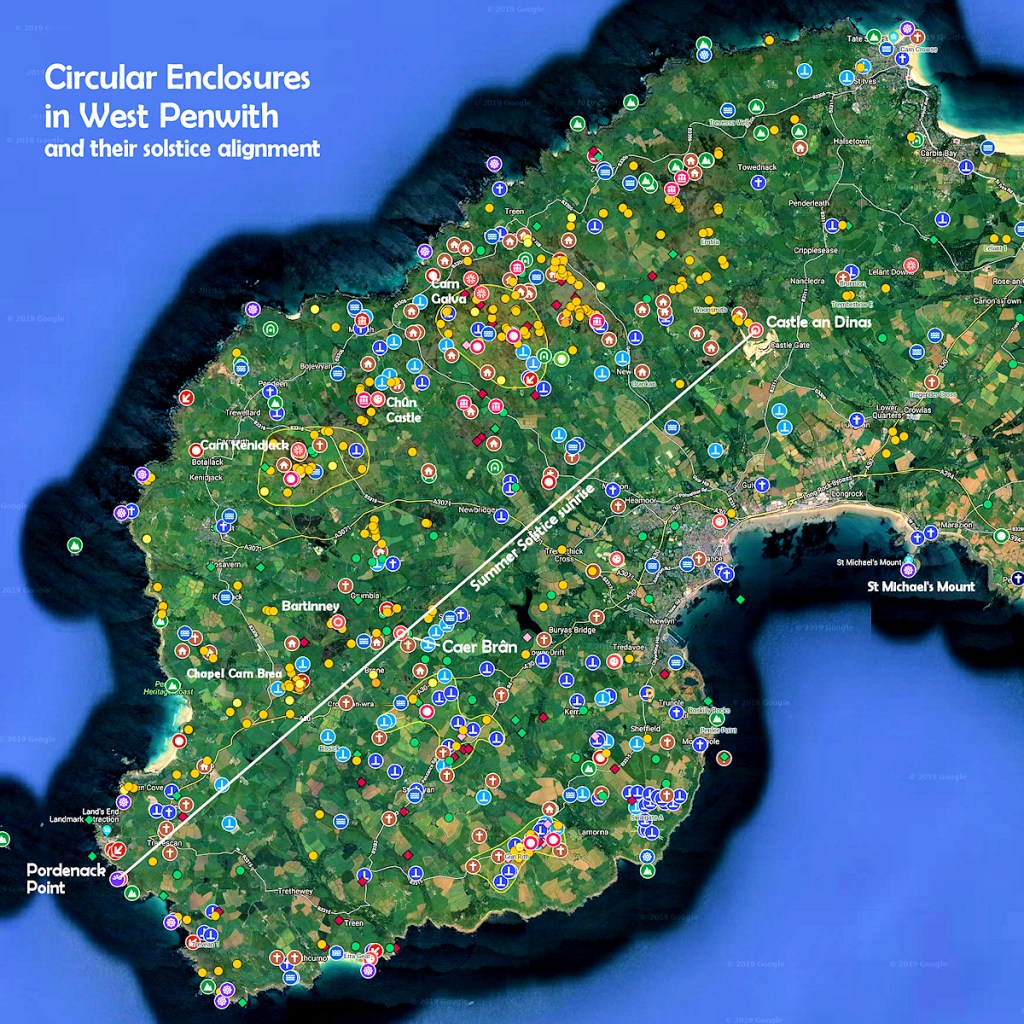
In former years I had come to the idea that, in the Mid-Bronze Age, Caer Brân served as a kind of parliament site for the whole of Penwith. This came to me after news came out some years ago about a circular enclosure, found using LIDAR scanning, on the cliffs at Pordenack Point, just south of Land’s End. This revealed something: Pordenack, Caer Brân and Castle an Dinas, three circular enclosures, were built in a straight line, oriented to the summer solstice sunrise.
This suddenly gave these three sites a lot more significance than had been seen previously.
However, if we take a line from the centre of the Pordenack clifftop enclosure to the centre of Castle an Dinas, it passes through Caer Brân though not accurately through its centre. It passes across the southeast side of Caer Brân, though within the enclosure. I’m not sure whether there is any meaning to that, but these details are worth observing.
At ancient sites, the main thing I do is a kind of psychic archaeology. That’s not as esoteric or complex as it sounds. All I do is sit there, relax, give it time, and I let feelings and ideas come up. It’s not a matter of trying, but of allowing. Often I use a pendulum, which helps engage both thinking and intuition. I do this in two ways, flipping between them: I use a pendulum while doing ‘intuitive free-thinking’ – it indicates when I’m ‘on track’ or ‘off track’ – and also I ask specific questions about details and dates, seeking a Yes/No answer. I note it all down or speak what’s coming up into a sound-recorder.
As an historian, I’m attentive to historic plausibility before jumping to conclusions arising from these ‘subjective’ researches. Mistakes can often be made in the interpretation of impressions and ideas, more than in their initial psycho-intuitive reception. It’s important to avoid allowing existing ideas, knowledge and preferences to shade and bias such findings, though it’s important afterwards to see how new insights fit with foregoing ones – if indeed they do.
If they don’t somehow fit, then the observation might either be incorrect or something is yet to be discovered that will make sense of it. In one case I had to wait twenty years. You get surprises. Findings might at first make no sense, or no concrete or logical evidence backs them up, but later on things can fall into place. So for much of the time they remain working hypotheses, not facts. One trick is to consider their plausibility and whether they shed light on anything else. Some archaeological findings suffer this problem, or their interpretation is conjectural – as is the case with a few seemingly authoritative statements on the signboard below Caer Brân (more below).
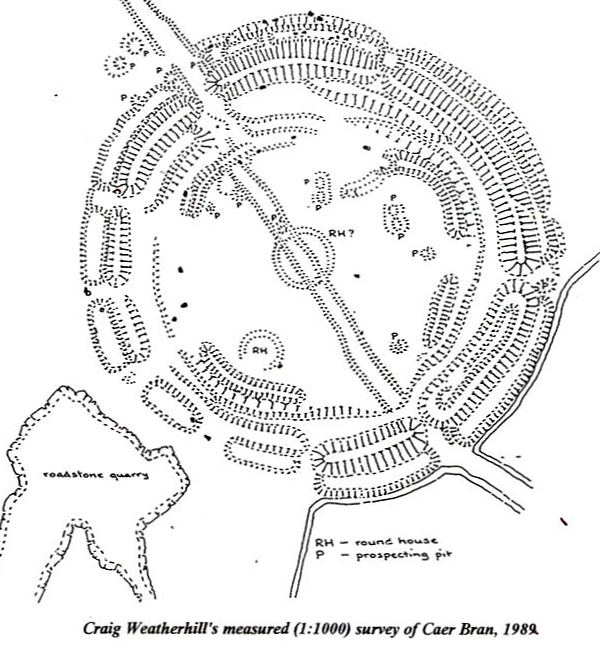
Craig Weatherhill’s survey of Caer Brân
Here are some findings from my recent visit to Caer Brân.
It seems to me that it is not the inherent earth energy of this place that matters, as is the case at a stone circle. There isn’t the same sense of energy here. It seems that the landscape positioning of Caer Brân matters more: there’s a strong visual connection with other key sites in Penwith and beyond, including Scilly, the Lizard and Carn Brea near Redruth. It has a wide, thirty-mile panorama.
Very noticeable are the sightlines from Caer Brân to Neolithic sites which, at the time of Caer Brân’s building, would themselves have been regarded as ancient – about 1,800 years older than Caer Brân.
All of Penwith’s Neolithic sites are visible except Trencrom Hill. Carn Kenidjack and Carn Galva poke above the horizon as if placed there by an enormous geological chess-player’s hand; Carn Brea is distant yet prominent; St Michael’s Mount sits resplendently down in Mount’s Bay. The Isles of Scilly hover in the gap between Chapel Carn Brea and Bartinney Castle. So visual connectedness with other sites was clearly important. Caer Brân is not prominently visible from these sites – it’s a one-way visibility.
Apart from sightlines, it has several alignments (leylines) associating it with other ancient sites, yet these are largely rather unspectacular except for two. Alignments don’t seem to be a dominant factor here – sightlines are more important. (Click for an alignments map of Penwith.)
One alignment (83) goes from the summit cairn on nearby Chapel Carn Brea through Caer Brân’s SW edge to St Erth church (on an Iron Age round that might be older) and finally it heads for the Neolithic tor of Carn Brea.
The other (199) goes from Cape Cornwall to Caer Brân, then to the Blind Fiddler menhir and Kerris Round, then over Mount’s Bay to Predannack Head, a clifftop site on the Lizard that feels a bit like a geomantic control tower – it’s worth a visit. The first alignment links two Neolithic hills and the second links two major cliff sanctuaries.
Caer Brân doesn’t feel like a high-energy place, though it does have atmosphere. However, as a former gathering place, it feels to me as if it misses the human attention and ‘hwyl’ that it once witnessed and hosted. (Hwyl is Welsh for fun and stirring, special experiences).
Archaeologists commonly use the term ‘ceremonial’ for sites like this, but this is inaccurate. This was a gathering place, a people place. The enclosure uphill on Bartinney Castle was clearly ceremonial and magical, but I believe Caer Brân was mainly social in character and purpose.
These two adjacent sites, hardly a mile apart, formed a pair – Bartinney more spiritual and Caer Brân more worldly. During their moots, people assembled at Caer Brân probably trooped up to Bartinney for the spiritual high point of their gatherings, or to seal the deal. Tradition has it that inside the enclosure on Bartinney evil cannot touch you.
Sancreed Beacon, Caer Brân and Bartinney, arrayed along a ridge, were part of a local landscape temple also comprising Botrea Hill, Chapel Carn Brea and Boscawen-ûn stone circle. This ridge seems to act as a kind of fulcrum for the whole of Penwith, and Chapel Carn Brea, Botrea Hill and Boscawen-ûn anchor and stabilise it on either side.
This is all about a geomantic quality we could call ‘perceptual centrality’ – the feeling that you’re standing at the centre of everything. This is common at many ancient sites: a subtle sense of emphasised hereness and nowness that is one of their key psycho-spiritual effects. It seems odd that Boscawen-ûn acts as a peripheral anchor to this string of three hills. Yet this is how it seems at Caer Brân, standing at the centre of its own psycho-geographic gravity-field. Yet at Boscawen-ûn, sitting at the centre of its own perceptual gravity field, it seems as if Caer Brân and Chapel Carn Brea are peripheral appendages to it.
Each major site in Penwith is a gravity-centre of psycho-geographic experience. In one sense this is a perceptual matter, while in another it’s a very real, a repeatable experience shared by many people. In a pre-literate society with no maps or aerial photos, people were psychologically part of their world and it was part of them. They perceived their world differently to us.
This was particularly so in the Neolithic. As the Bronze Age progressed, man-made landscape expanded in extent and people started developing more of a sense of mastery of nature rather than of being guests in it. Even so, their ancient sites were stretched over and fitted to nature and the landscape without imposing on them. Bronzies’ nature-interventions were largely sympathetic. Rampant resource exploitation came later in history.
On the signboard downhill from Caer Brân I think they got a few details wrong. They associate Caer Brân with Carn Euny, a nearby ancient settlement, suggesting that the villagers had built and used it. That’s logical, though I think it is incorrect.
The impression I get is that Caer Brân was a Penwith-wide social-infrastructure project. People were called up from all over Penwith to build it. It was to be a neutral space, owned or hosted by no individual clan. It was to act as a meeting place for all of the Penwithian clans, or their representatives. It’s possible there were around ten clans.
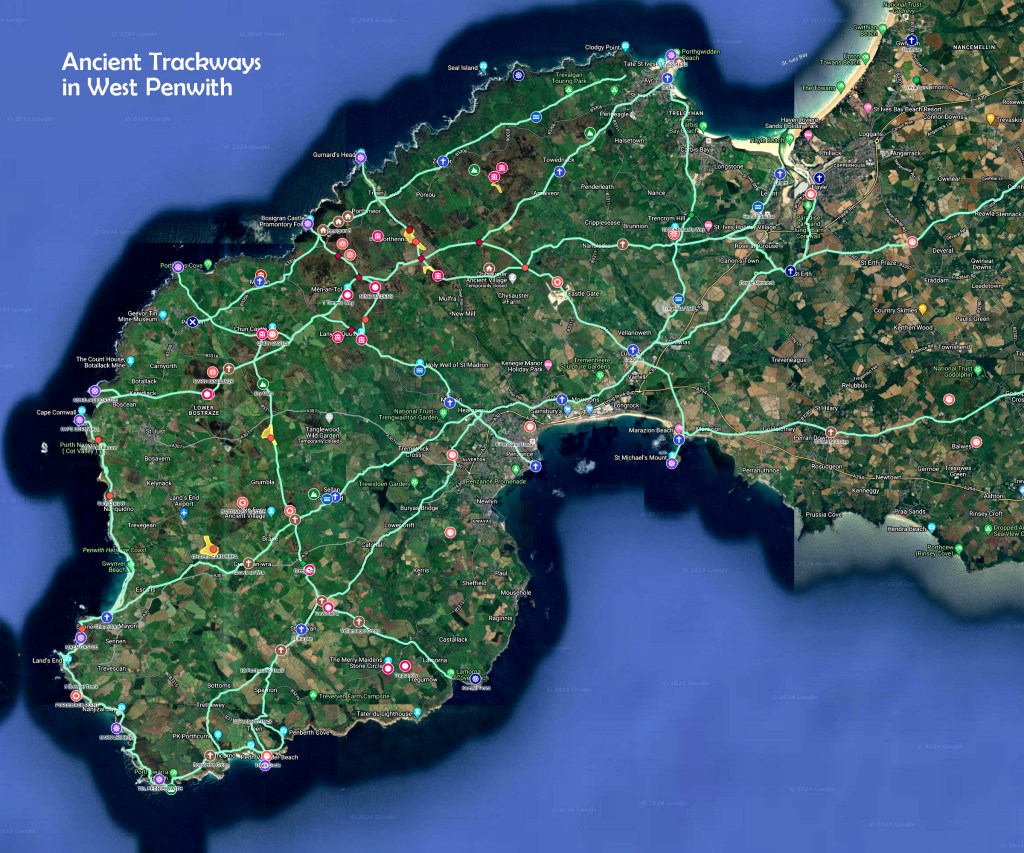
Its geographic centrality in Penwith and its location at the crossroads of two major ancient trackways are clues suggesting this (see trackway map below), together with the solstice alignment of the three circular sites. So while Carn Euny looks like a logical ‘owner’ of Caer Brân, I don’t think this was so. Neither was Castle an Dinas, Penwith’s other big gathering site, controlled by one clan. It is likely it was built around the same time as Caer Brân, and that they were built with different purposes in mind.
Using a pendulum, I asked how long it took to build Caer Brân: I got ‘two summers’. That was surprising: I expected longer (such as five years). This would have involved quite a mobilisation of available hands and backup support, including supplying tools and food and maintaining life’s normal demands back home. They wanted to get the job done quickly.
Perhaps there was an urgent need. Perhaps they had reached a kind of political juncture in Penwith, where a pressing need came up to reorganise things, reflecting emergent needs and realities. Or perhaps there was a generational shift in a time of social change and population growth, necessitating the building of new gathering places.
The signboard got one thing right: the ‘ring cairns’ inside Caer Brân are older than the enclosure. I date-dowsed them to the 2200s BCE, while the enclosure came 400ish years later in the 1830s. Except that the ‘ring cairns’ were roundhuts. The one in the centre of Caer Brân gave me the sense of a Hopi Kiva, a place for focused magical-spiritual work – I got the image of a crucible. It was placed there not because of a major energy-vortex at that place, but because of its visual, almost geometric connections with other places in the wider landscape.
I found that three main gatherings were held each year: on the fullmoons around Imbolc and Lughnasa, and another in early December. I asked why this third one was not at winter solstice and got a straight reply, ‘Everyone wanted to be at home then’. Well, indeed. And since fullmoons light up the night, often marking shifts in the season or in weather patterns, the Bronzies were probably not as concerned with exact cross-quarter days as with the fullmoons near to them. The moon provided no-cost solar-powered lighting. And a taste of magic.
The climate was a bit warmer then, less windy, stormy and Atlantic-dominated than it is now. This changed around the 1200s at the end of the Megalithic period – the jetstream moved south, bringing more wind, rain and changeable weather. It made sense in the Neolithic and Bronze Ages to be on panoramic hilltops like Caer Brân. In the Late Bronze Age after 1200ish, people moved downhill, abandoning or sidelining many of the megalithic sites.
Date dowsing suggests that Caer Brân was built in the 1830s BCE and was in use until the 1330s. This is longer than archaeologists reckon – it’s that signboard again. They give Caer Brân a short active life, on the basis that a gap in the ‘ramparts’ in the southwest of the enclosure represents an unfinished segment, and that, ergo, the enclosure was abandoned at the end of its construction.
This seemingly logical conclusion seems to me to be flimsy. Abandoning a project that is 95% complete is a bit strange. The abandonment idea was probably adopted in the days when archaeologists saw Caer Brân as a ‘hillfort’ built for defensive purposes. But, nationwide, the majority of hillforts were not built for this – especially in Penwith, where there are no signs of prehistoric conflict. There is no evidence of outright abandonment of Caer Brân either – it’s a best guess. No, I think that gap was deliberate. However, I cannot figure out why it was built so, and this question needs more work.
While we’re here, it’s worth observing that the second roundhut toward the southwest edge of the enclosure, marked on Craig Weatherhill’s survey, is also at the crossing point of four local alignments and close to the Pordenack to Castle an Dinas solar alignment, which crosses Caer Brân off-centre. From this we can surmise that this was probably no ordinary residential roundhut, instead having some sort of magical meaning. If alignments pass through a roundhut, in my experience it is likely that it was not residential in purpose.
In a moment of vision, I saw twentyish elders sitting in an arc, presiding over long discussions. I feel this was the political meeting place in Penwith. What came to me was this: it took until 1800 BCE to build Caer Brân because only by that date had the newly-colonised south of Penwith really been fully established. The south was colonised in the Bronze Age as population grew and bronze tools for clearing trees and land came into common use, probably around 2200-2000 BCE. A gradual southward population move would follow, shifting the balance of population. Until then the traditional power centre was around Chûn, Carn Galva and Zennor Hill in the north.
So by 1800 the centre of gravity had shifted south. The Boscawen-ûn and Merry Maidens stone circle complexes had been built, together with strings of menhirs, and the area had been opened up. By then, about half of Penwith was forested. Areas were cleared with landscape perspectives and sightlines in mind – these avenues highlighting features in the wider landscape were a key part of an ancient site and the geomantic thinking behind it. The Bronzies were not the nature-rapists that we moderns have become, and felling trees manually and harvesting their timbers was a big, slow job. They did it thoughtfully, needing to keep the gods and spirits happy too. So they felled trees selectively, creating a parkland landscape with open, grazed areas and patches of wildwood.
This is probably why it took until 1800 BCE for Caer Brân to be built. Only by then did people realise there was a need for it. Or perhaps only then did the perceived need override the inertia of carrying on as they’d always done. It’s the connectedness and centrality of this place that is a large part of its reason for being. But in the Neolithic and Early Bronze Age it was not central to people’s lives – it became so in the Mid-Bronze Age, by 1800 BCE.
Castle an Dinas, Penwith’s other big gathering site, is very visible from Caer Brân. The summer solstice sun rises above it. Clearly they were connected, though they probably served contrasting or complementary purposes. There is evidence of trading at Castle an Dinas, and it is likely that it hosted gatherings at other times of year such as Beltane and Samhain. Two astronomical alignments from its centre suggest this: one to Trencrom Hill and the other to Conquer Cairn. Gatherings were possibly held at summer solstice too – suggested by the solstice alignment from Caer Brân. I get the feeling there was more socialising and celebration at Castle an Dinas than at Caer Brân. Perhaps Castle an Dinas needs further investigation.
Caer Brân stood near the crossroads of two major trackways. So I think this is an ideal place for a kind of parliament, for decision-making moots and occasions for the settling of inter-clan issues. Decisions would not only have involved discussion but also deep-level processes, consultation with the gods and the ancestors – perhaps up on Bartinney. There would be meetings with relatives and old friends from around the peninsula, social rites, discussions and late-night ceilidhs around campfires – a festival for a few hundred people, for 3-4 days.
Downhill there’s a smaller, non-circular enclosure. I asked what this was for. A simple answer came: animals. I saw two possibilities. In between gatherings they probably kept animals in Caer Brân to graze and mow it, moving them down to the lower enclosure for the duration of a festival. Alternatively, when horses came into use around the 1500s, it was where they kept the horses. In other words, methinks the lower enclosure was built to serve practical purposes.
The Belerion Project is a citizen research project and stream of consciousness in West Penwith. We seek to encourage psycho-intuitive investigation of the ancient sites of West Penwith, and hopefully to make such work more systematic. It’s in its early stages at present. At minimum participants will acquire a habit of building up their skills in such intuitive work, and keeping and collating notes. Possibly, after a few years, a comprehensive body of work might emerge too – an energy survey and magical assessment of Penwith’s major ancient sites.
If it interests you to join the project and you live in or near Penwith, check out the Belerion link below and come on a field trip. This project can run alongside archaeological research and, I believe, contribute many clues. Of which I hope this study has a few!
So this has been a study of a site that is, I believe, underestimated in its significance and importance. It is very central in Penwith, and its main remains are simply a circular embankment in a prominent hilltop place. But I suggest that it was the place where people periodically assembled to discuss and sort out tribal matters concerning the whole of Penwith. And if not this, then what?
I’m continually reminded of the extent to which the present is a gift. Everything comes from Spirit, from the Void, from what we call God, and everything returns to Spirit, to the Void and to God. And everything exists within them.
It doesn’t matter how we see the nature and meaning of life, the universe and everything – it’s still the same. We are the eyes, ears and hands of existence-consciousness-beingness. It’s dead easy to forget, to get lost in our stuff, but it remains true.
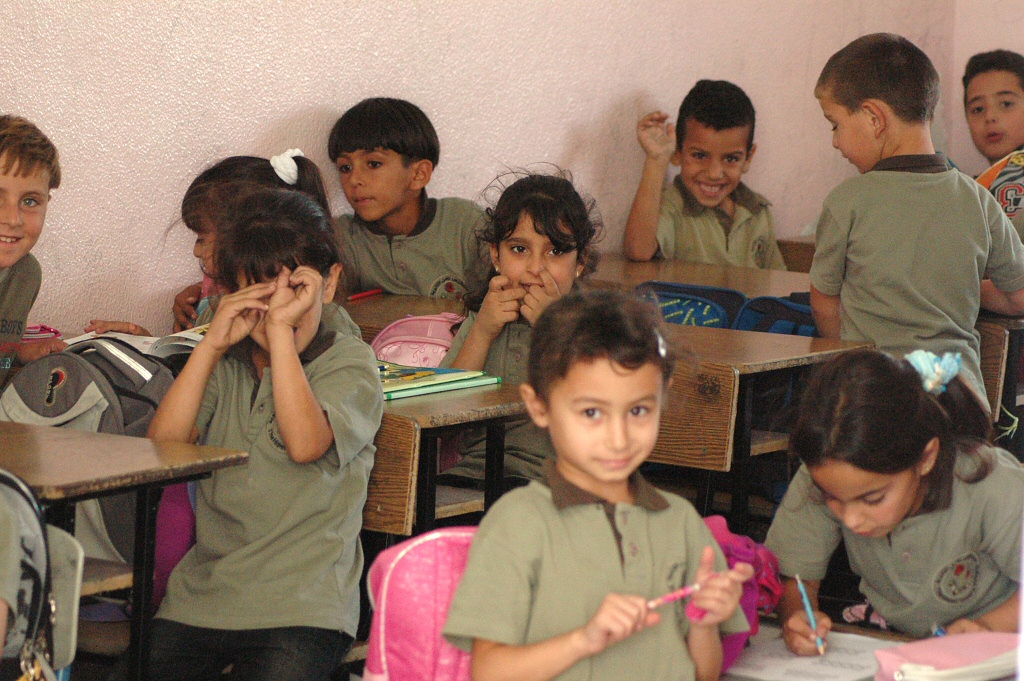
Some people are in the midst of nightmares right now. Some days ago I did a joint online presentation to a support group in Britain with Ibrahim Issa, director of the Hope Flowers School in Bethlehem, in the West Bank of Palestine. Western governments, aid agencies and donors have withdrawn a lot of support, so we’re having to do some remedying of that, especially since life in the West Bank is getting harder and harder.
I was amazed at his composure. Or perhaps he was just too tired. He and everyone around him had been kept awake through the night by missiles, planes and sirens. And fear.
Even so, they keep on at the school, driving by the seats of their pants – attending to the needs of the children, their families and the local community. On a shoestring.
The latest measure they’ve taken – since Israeli roadblocks all over town make movement difficult – is to take trauma-support services to the people, in a Volkswagen van. It’s a sort of trauma-ambulance, for people losing their rag because of the tensions, dangers and offensive experiences they’re living through.
In my contribution I mentioned the Arabic term, sumud – hanging in there, never giving up. The secret is to stay in the present, to make the best use of the gifts it yields. When the past is being obliterated and the future holds little to hope for, there remains the present – the only time we actually have agency.
My own body is gradually deteriorating – a new health issue is slowly immobilising me – yet I’m continually amazed at the gifts that life presents. One is this: lessons I’m learning from people younger than me. In this case, it’s Ibrahim, teaching-reminding me about the present moment. Doing what you can with whatever is available right now and making the best of it. Because the past is gone and the future is but an idea.
People bang on a lot about freedom of speech, though really we need to learn more about exercising our freedom of attitude.
In the immediately-impending future, on Sunday (times below, for different countries), there comes the Sunday Meditation, and you’re welcome to be present with it. It’s free, no sign-up, no strings, do it your way, and wherever you are.
Perhaps give some attention to feeling what it’s like to stand in the shoes of someone whose life could be snuffed out tonight, for no understandable reason or purpose. Hold their hand. There’s no shortage of available souls in need of good-hearted soul-company, in plenty of places. This is what we can do.
With love from me. Palden.
———————
Current meditation times, on Sundays: UK, Ireland & Portugal 8-8.30pm GMT W Europe 9-9.30pm E Europe, Turkiye and the Levant 10-10.30pm Brazil-Argentina 4-4.30pm CST, Mexico, Jamaica, Colombia 2-2.30pm EST, Cuba 3-3.30pm PST North America 12noon-12.30pm
Last Saturday, at the Pathways to the Past weekend in St Just, Cornwall, organised by CASPN, I gave a rather kaleidoscopic talk with copious maps about a big idea: Penwith as one big ancient site with 600 components to it.
If you were there, you might want to peer through the maps and hear it again. If you weren’t there and it interests you, well, you can hear it whenever you wish.
It’s two hours long, so save it for a rainy day or a quiet evening.
I really enjoyed giving this talk. It was great speaking to a group with local knowledge and an understanding of the subject.
If you don’t know Cornwall but you’re into ancient sites, you’ll still get something from this. For Penwith, dense with sites, is one of the fifteen or so key megalithic regions of the Isles of Britain.
At the other end of Britain is Orkney. Penwithians and Orcadians, between us, anchor Britain and stop it floating away.
I believe we’re coming to a time now where it will help to widen and deepen the spectrum of evidence we deem to be acceptable in studying prehistory, to see what else we find and come to understand. The schism between archaeology and geomancy is something best left in the twentieth century, methinks.
I’m not sure how many people join the Sunday meditations. In a way it doesn’t matter. I know and feel some people are there and joining in, including people doing it because of their own relationship with the same spiritual source as mine, the Nine.
Eitherwhichway, I’m always there, every single Sunday, whether or not I say so. Those of you who like to join in, whether often or occasionally, are welcome to continue. If you have no idea what I’m talking about, it’s all explained here:
and the meditation times for different countries are below.
As a cancer patient with my ups and downs, there are times when I cannot do my customary pep talk. However, even if I’m really unwell, I’ll still be there at the meditation. Even when I kick off my earthly clogs, you might even sense me there on the other side. It’s an inner commitment I made to the Council of Nine thirty years ago, and I just keep beavering away at it.
Whatever path you follow, it makes a difference if you stick with it for a long time, since nowadays there’s a spiritual commitment problem that itself is rather problematic for world transformation. We all need to step up, each in our own way, to contribute proactively to something much larger than ourselves – personal growth and fulfilment is only the start of the great pathless path through the gateless gate.
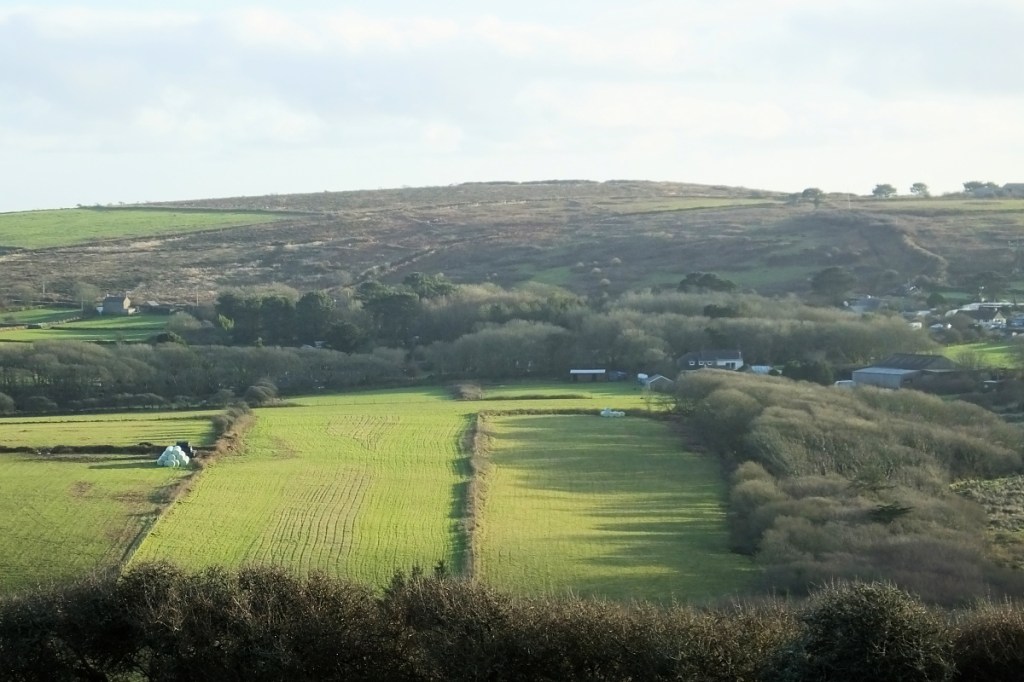
An ancient pathway on our farm, here in Cornwall
But that’s not what I wanted to write about. I want to give an astrologer’s insight. It’s all about Neptune in Aries, which started at the beginning of April 2025. It has been in Pisces since 2011 – a time of reality-slippage, geopolitical confusion, underlying transition, flailing beliefs, mental ill-health, tech dreams and military and climatic nightmares.
We have Neptune in Aries for 14-15 years until 2039. So this is a chapter, a phase, in which the world lives out Aries-type experiences, hopefully to progress them forward. On a 165 year cycle, Neptune last did this between 1861 and 1874 – the time of Abraham Lincoln, Gladstone and Disraeli, Bismarck, Queen Victoria, Karl Marx, and of roaring, steam-powered industrialisation, warfare, power battles, nationalism, early popular movements and Euro-American colonial expansion.
As Neptune trawls its way round the zodiac, chapter by chapter, it pushes us through periods of preoccupation with certain themes – the rise and fall of beliefs and perspectives which themselves influence the way the world sees things, acting out its anticipations, beliefs, fears and its light and its darkness. There’s a visionary side, a place where dreams and big ideas are born, of revelatory situations and realisations, and there’s an illusory and delusory side, mingled with fantasy, fakeness, projection, hypocrisy, glamour and horror. It’s all dreamstuff, yet it percolates into our reality, both helping and harming us and the wider world.
When Neptune is in Aries restlessness, impatience and frustration come up. Though there’s a lot of noise about freedom and identity, there’s a seeking for social-political-cultural examples to follow, align and identify with – it becomes a parade of leaders, public figures, accidental heroes/heroines (Florence Nightingale was one, last time round), who manifest the best and the worst of human possibility.
Some prominent people represent what is hoped for and dreamt of, or perhaps they represent integrity, genius or a human touch, with their finger on the pulse. Some represent what we most fear and dread, or they capture the hearts and minds of followers to promote or impose their own agenda. Either way, they have a lot of push, even of force – or also they reveal or portray themselves and their flock as victims, as the weak. This often gives rise to strong resistance and counter-measures – last time we had the rise of socialism and workers’ movements. It’s then a matter of how intelligent the wider public is in choosing what ideas and initiatives to subscribe to, and how clear their sight is to exert an influence on the strong.
I think you’ll be gtting the gist of this by now, and seeing how this is playing out round the world today. We’re seeing reformed terrorists gaining power as reformers, Popes calling out the status quo, dictators and billionaires acting out their fantasies, a massive generational change and an ongoing movie in which the best and the worst of human power-plays and moral choices process before us. This action-packed movie demands that we get off the fence to exert a moderating influence on those who lead the public discourse or precipitate evolving facts, whether helpful or harmful.
We’re getting an array of leaders and prominent figures who variously represent different aspects of these issues – and different people will see different facets of them, judging them differently. We’re getting a diversity of realities and viewpoints that partially clarifies things and partially adds confusion. It’s all a matter of perceptions and viewpoints, inspired sometimes with vision and purpose and sometimes with false hope or coloured by predisposition or prejudice. It’s a question of whether big ideas and beliefs attempt to override reality or whether reality clips them back to workable proportions.
There’s a conquering undertone to this – ranging from taking territory or power to overcoming obstacles and pioneering new possibilities. The bottom line is that, in the final analysis, there are no winners, and the idea of winning is inherently flawed. Victory is transitory, and everything turns to its opposite in the fullness of time.
Aries is ruled by Mars which, customarily seen as the God of War, in our time is showing itself also to be a God of Peace – a peace arising from stalemate and from the calculus that further conflict means that even the winner becomes a loser. There are limits to the extent to which the strong can push their agenda.
Each sign unconsciously faces its opposite – in this case, Libra, the sign of agreement-disagreement, values, fair-dinkum and relationship. Neptune was last in Libra in 1942-1956, leading to the formation of the United Nations and the ‘rules based’ order that is now disintegrating as the Global North loses its primacy and the Majority World accrues its true power in world affairs.
This has best been symbolised in Gaza, which in the end is a war between the People and the Megamachine, acting as a tipping point where the power of the Global North betrays itself and the Global South is challenged to find a unified position and agenda of its own, sufficient to replace the old order.
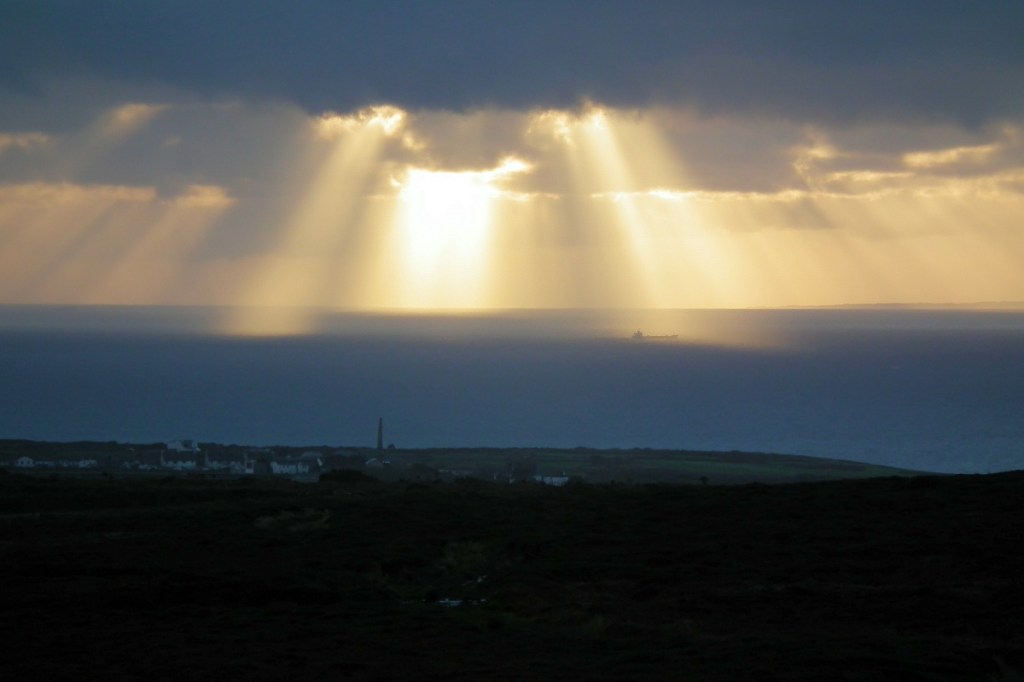
Thus spake Zarathrustra, looking over St Just toward Scilly
Underneath this lies a necessary historic tilting of all and everything, a slow and fundamental shifting from a competitive to a cooperative model in the very nature of society and civilisation. Multiplex issues are bound up with this, and we’re sliding into an avalanche of events that push those issues forward. This multiplicity of issues is pushing us out of our habits, avoidances and complacencies, demanding attention, backed up by the threat of unwanted consequences that will surely arise from inaction.
Historically, we’re surreptitiously entering a new chapter. Last year Pluto shifted into Aquarius and next year Uranus shifts into Gemini. Such shifts or ingresses create a change of themes, realities and atmospheres, which themselves indirectly prompt and colour events and developments. History moves slowly most of the time, though sometimes it moves really fast, and we’re entering such a period.
But it’s all in the way we see things and do things. We can make it easier or more difficult. Our problem is that we have a habit of entering the future facing backwards, of obeying fear, thereby complicating, undermining or blocking the very developments we deeply seek. Our own freedoms, benefits and rights can no longer impose themselves on the freedoms, benefits and rights of others or of nature, reality and the collective good. Change does not have to be as difficult as many people visualise. Its reward is eventual relief from the oppressions we already carry on our shoulders.
With love, Palden
PS. Here’s an example of a new leader who is taking on a big agenda and putting himself on the line. This man, part of the Megamachine and Old Order, is seriously acknowledging the agenda of a younger-generation military dictator who is playing a strong hand of cards. We’ll see more of these agenda-changers in coming years. https://www.youtube.com/watch?v=navBX2A37ls
———————
Current meditation times, on Sundays: UK, Ireland & Portugal 8-8.30pm GMT W Europe 9-9.30pm E Europe, Turkiye and the Levant 10-10.30pm Brazil-Argentina 4-4.30pm CST, Mexico, Jamaica, Colombia 2-2.30pm EST, Cuba 3-3.30pm PST North America 12-12.30am
This is mainly for my generational peers – if you’re in your 70s, 80s or 90s, your bones are getting creaky and your mind is getting sluggish.
In the life-cycle we’re given, we grow up and later we grow down. In steps.
It’s also about karma-clearance. Sorting out our stuff at the end of life, so that we don’t carry all of it with us when we go over to the other side – to the realm of the Ancestors.
I’ve been involved in humanitarian work, and recently I’ve needed to work on my patterns around givingness and compassion fatigue. Commitment. Success and failure in helping people. Deep heart stuff.
And it’s about acceptance. That’s one of the biggest learning experiences life ever gives us.
47 mins long. Introduced and outroduced by the birds of Grumbla in the Far Beyond, down’ere in Cornwall.
It’s the Sunday meditation again, and I have revived sufficiently from an illness that floored me last week to be able to elbow you about it! That is, you’re welcome to join us in the zone – times for different countries are below. It’s an open meditation space lasting half an hour. To quote Van Morrison: no guru, no teacher, no method – just you and me in the garden… Follow your own path, together with us following ours. We shall be blessed.
The illness was a fluey thing. My energy was low, and I’d been pushing hard and under pressure in my remote humanitarian work. So when I got cold and wet during a trip to Falmouth, my soul pulled the plug and I went down through it. Next day I was semi-conscious, stiff and hurting, with sluggish brains, wobbly balance, burning feet (peripheral neuropathy) and I was right out of it, gone, hardly here.
A pertinent sign at Gurnard’s Head, in West Penwith
My predominant emotion was grief, over things that have happened, and particularly over moral dilemmas and painful moments in my humanitarian work over the years. I’ve seen people face hardship, suffer and die who, in my estimation, should not have died, and at times I’ve been unable to help – often quite simply I did not have the funds needed for medical treatment for an amputation or to save a life.
This is a deep dilemma being faced by many humanitarians now, as governments blithely withdraw funding and the public shrugs its shoulders. For me, in late life, it has left traces of regret, even though I know that the net value of my work was positive overall, and there’s a lot I’m glad about.
But the illness enabled me to go deep, deep down to a place where the hidden roots of life’s experiences and events ferment and bubble. This is one of the big virtues of illness that many people try their best to avoid – the consciousness changes it can bring about. Sometimes our soul needs to cut us down and render us helpless, to help us work through something – burn through something. Whether or not we actually do this is a life-choice and an exercise of profound free will.
Seals asleep at Godrevy
It is an act of free will to choose to go through a turning in the deepest seat of consciousness. You have to go over the edge and take the plunge. Getting into the habit of doing this throughout our lives sets us up for one of life’s greatest and most moving of experiences – dying.
As you approach death, life tends to take you down in stages – a series of crunch moments or crises where your worldly powers and agency are reduced, your world shrinks, and you bodily functions deteriorate. This incremental withdrawal yields the possibility of a new seeing, a new understanding, if we so choose it. Though it involves perceiving truths that can at first be uncomfortable. Yet facing and accepting these revealings becomes a relief too, an understanding, a forgiveness. For this life had simply been a short visit on an ongoing pathway. It begins and it ends.
Sir George, looking straight at you
Back in the 1990s I was privileged to help and spend quality time with Sir George Trevelyan, who was in effect the grandfather of the New Age movement in Britain. Very much a man of the Twentieth Century, born in 1906 and dying in 1996, he was an aristocratic philanthropist, thinker and educator, planting the seeds of the new age and the green movement in the 1940s-70s. He was a four-planet Scorpio. At the very end, he died by decision, announcing that he should not be disturbed or given any food or drinks. He was gone in 4-5 days.
Here’s a video of him talking in 1988, in his eighties. Thank you, Sir George, for being you, for what you did with and for so many people, and for pointing the way in my life too.
Meanwhile, if you care to join today’s meditation… see you there!
Love, Palden
Current meditation times, on Sundays: UK, Ireland & Portugal 8-8.30pm GMT W Europe 9-9.30pm E Europe, Turkiye and the Levant 10-10.30pm Brazil-Argentina 4-4.30pm CST, Mexico, Jamaica, Colombia 2-2.30pm EST, Cuba 3-3.30pm PST North America 12-12.30am
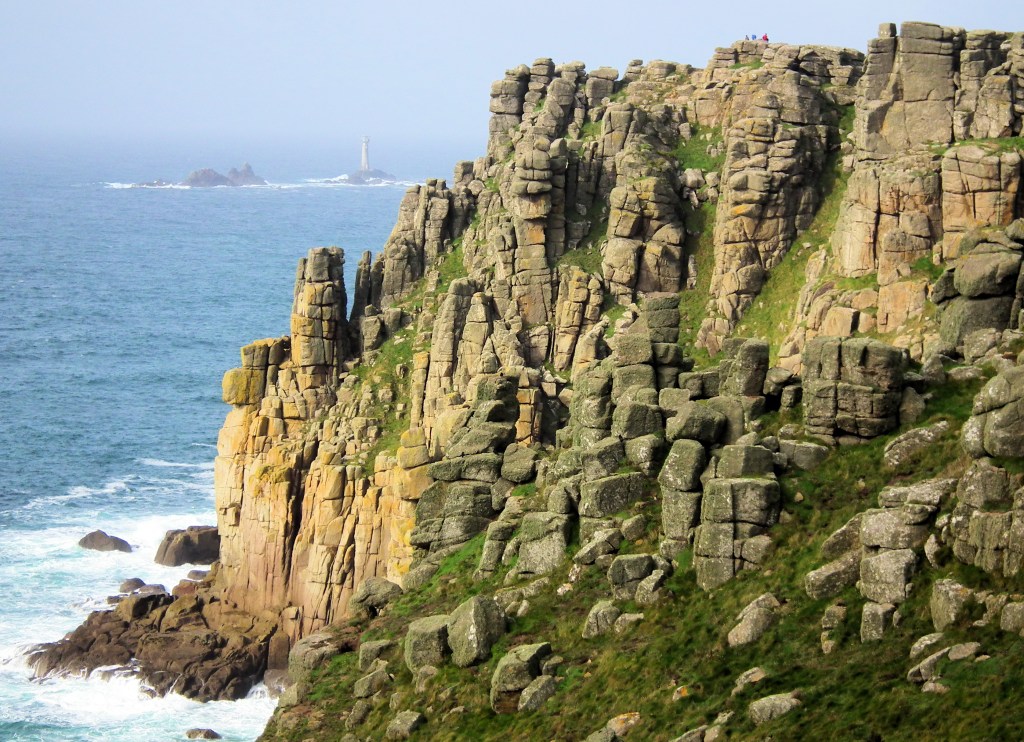
Kilgooth Ust or Cape Cornwall, with The Brisons behind
First things first…The Sunday Meditation continues, whether or not I announce it. Sometimes I can’t, and there’s no one to cover for me. Yet I’m always there meditating at the appointed time, and so are quite a few other people.
You’re welcome to join us. It’s a recipe-free open meditation, especially for independent souls who follow their own path or live relatively isolated from others. All you need is half an hour, a cushion and your inner presence. Join us in the zone. No need to be online.
I might not be able to do regular meditation calls from now on. A lot of things are happening and I’m rather overwhelmed! Much of it is good stuff, and some is difficult – mainly my humanitarian work.
I three-quarters wrote a blog about this, about compassion fatigue, but I’m not fully clear how to write about a few delicate issues, so that’s gone into in the ‘later or never’ pile. For me, as a lifelong author and editor, getting stuck on some writing is unusual and strangely frustrating!
Even so, things are happening.
– I’m doing a talk on Tuesday 15th April, 7.30 at Gwithti an Pystri, the Museum of Folklore and Magic in Falmouth (book ahead);
– then there’s a visit to Gloucester to see my old friend Ibrahim Issa from Hope Flowers School in Bethlehem, Palestine, on 2-4 May (I’m still looking for a driver-minder for that, or a workable way to get there and back);
– and a talk at the Pathways to the Past conference in St Just, Cornwall, on Saturday 24th May (I’m really happy about that);
– and another at the Just Live Camp near Morvah in Penwith a day or two after, on 25th or 26th May.
Then there’s the Belerion Project, about which I’m really happy too. It’s a research project into the subtle energy and psychoactive effects of the system of ancient sites in Penwith. We did our first field trip to Portheras Common Barrow recently and, despite weather challenges, it went really well. Thanks to everyone who came. The next is on Wednesday 7th May.
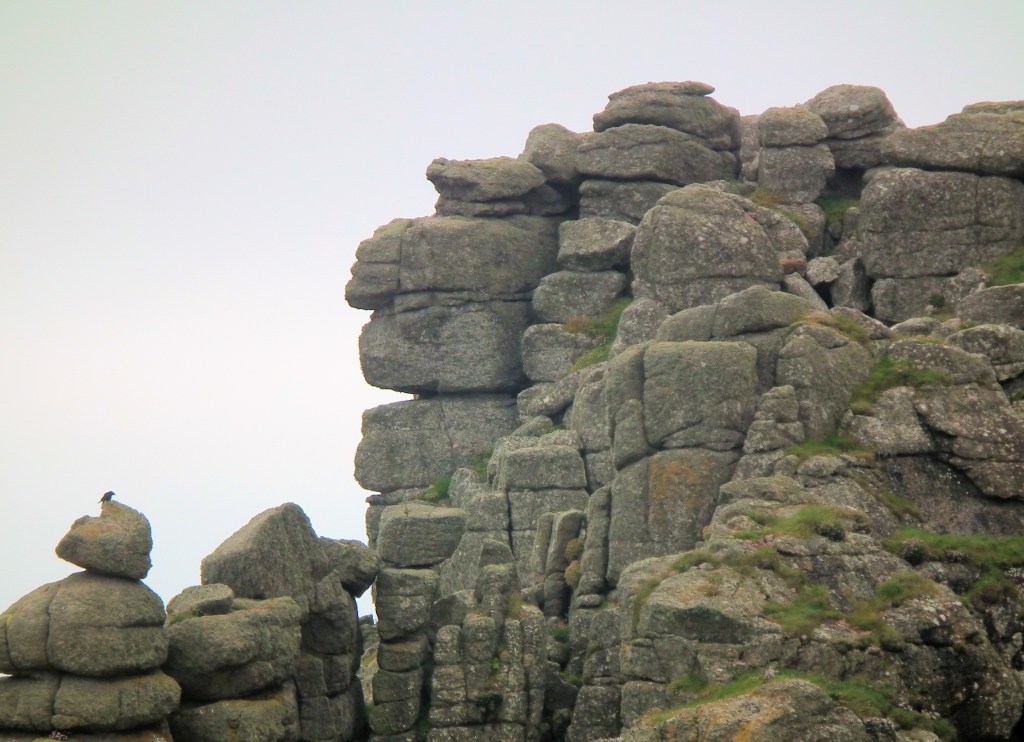
Carn Les Boel and Carn Barra
I’ve always been rather workaholicky but, age 75 and doing a cancer trip, recently I’ve been running at capacity. Just getting ready to go out can wear me out, requiring a rest, and everything requires twice the effort it took in pre-cancer days. My brains aren’t handling all the messages, chats and enquiries involved – apologies to people I fail to answer.
I’m a hyperfocused Aspie, you see – good at concentrating for hours in a right-brained way but bad at hopping from thing to thing in a left-brained way. Aged brains do get creaky and slow! This is a mixed gift that has come with cancer: I’ve done some of the best creativity of my life, though I have a decreased capacity for admin, lists, names, timetables and even time itself. Or remembering to have dinner.
That’s the way it goes. Ideally I need an assistant (who lives close by and knows me well – not online). But I cannot pay such a person. That’s been one of the issues of my life that I was trying to write about in the latest, as yet unpublished blog: I’ve never had an expense account to finance projects and missions. It’s mostly come out of my own pocket.
A plus with this is that I’ve pulled off some mighty stunts on a slim budget, and I’ve been a free agent, but it is wearing too, and many good things could have happened if I’d had better funding.
For those who suggest I should ‘just’ do some crowd-sourcing (takes ten minutes, it’s easy and the money floods in, haha), I ask, do you require soldiers to fund their service at the frontline? Soldiers are paid salaries and pensions while peacemakers are told it’s our choice, our risk and why don’t we get a proper job?
You might hear a thread of resentment there. That’s why I didn’t complete the blog. I’ve got stuff around it. It’s still happening now: I and others I’m working with in Ghana, Mali and Palestine are all being seriously obstructed by, would you believe, the actions, errors, denials and avoidances of two banks, one in USA and one in Australia.
It’s not simple, this game. Paldywan Kenobi stares down the banksters! Who’d have thought I’d get sucked into teaching banks how to be human, at my age? Oh, and dealing with a few crime gangs, Wagners and drug-addled murderers along the way, remotely from my eyrie here in Cornwall. Well, I’m quite good at it, actually, and many people give up on such things when things get big or dangerous. I tend to hang in there.
When you step into what used to be called The Great Work, the rules of normal life seem to levitate out of the window and disappear. Retirement is something other people do.
For astrologers, I’ve just gone through Saturn opposing my natal Saturn (and square Moon and Ascendant). So I’m doing Saturn, yet again. When I started my cancer trip five years ago, I thought I had 1-3 years left, so I put my rather mission-driven, saturnine sense of life-purpose to the side. But it has started up again!
Well, my dear old late Mum used to say, “There’s no rest for the wicked!”. Well, yes, perhaps so, or perhaps not. She was a do-gooder too, handing me down that pattern, bless her. In our self-centred times, it’s not a sensible strategy, doing good, but some of us choose it or get sucked into it anyway.
Compassion fatigue, versus ‘To give and not to count the cost’. Non-attachment to the fruits of our labours, versus ‘Give me the compensation you owe for your frigging corporate errors’. Yes, these things have been rattling around in my heart during those Saturn transits. Well, life is for the learning.
I’ve been reminding myself of something a young Berliner taught me while standing (as you do) in the Sinai Desert. I repeat this here, particularly for people infected with the Trump virus:
It’s okay in the end. If it’s not okay, it’s not the end.
Love from me – as you might sense, in a rather saturnine mood on this fullmoon!













 Notes from the Far Beyond
You must be logged in to post a comment.