

I’m away for two weeks, at the Oak Dragon Camp (I was its founder nearly 40 years ago) and speaking at the Glastonbury Symposium – so you won’t be hearing from me for a while! Recently I’ve been rendering my cancer book Blessings that Bones Bring into audiobook format, and that’s now complete.
Just in case you were desperate for something to read, haha, here’s a chapter from my 2012 book O Little Town of Bethlehem – Christmas in God’s Holy Land (here). Compared with the situation now, Palestine in 2011 was much better but, even then, people were beset with issues to deal with, and this excerpt gives some examples. It’s also about one of the key activities a foreigner visiting Palestine needs to be willing to do – listening. Bearing witness.

When I went to town to check out various friends, many of them were gloomy, beset with problems. It was one of those days. Each person had their own particular issues, but they all add up to a morass of collective difficulty which the customary Palestinian good humour cannot penetrate.
Naturally, our perception of life is made up of an interaction of circumstances and our feelings about them, and these are two rather different things. For Palestinians living under occupation, the circumstances side of the equation bites and scrapes harder than for most people across the world. Especially since the occupiers deliberately go about making life difficult, complex and insecure for the occupied, in military, administrative, legal and quite everyday ways. This is what Jeff Halper, a critical Israeli thinker, calls ‘the matrix of control’. The ultimate goal is to make Palestinians submit to Israeli rule, give up, go quiet and preferably leave the country.
But they don’t give up, despite the muddy mire of problems they can be beset with – or perhaps it’s a dust-storm where it’s impossible to see far and sand gets in the engine and all the moving parts. Palestinians have a life-philosophy which is admirable. But some days they go down into the doldrums and they need a good moan.
That’s one of the roles of foreigners who come here: bearing witness. This often means letting Palestinians have a good moan, describing to you with a full spectrum of feeling how difficult everything is. It can be quite challenging though if you have something in your own life that’s nagging you too – happily, this wasn’t the case for me today. So I was able to listen fully and, when a person ground to a halt, I could start up something that might change the context of things, so that they see the situation in a different way – for the difference between a situation and a problem lies in our state of heart and mind.
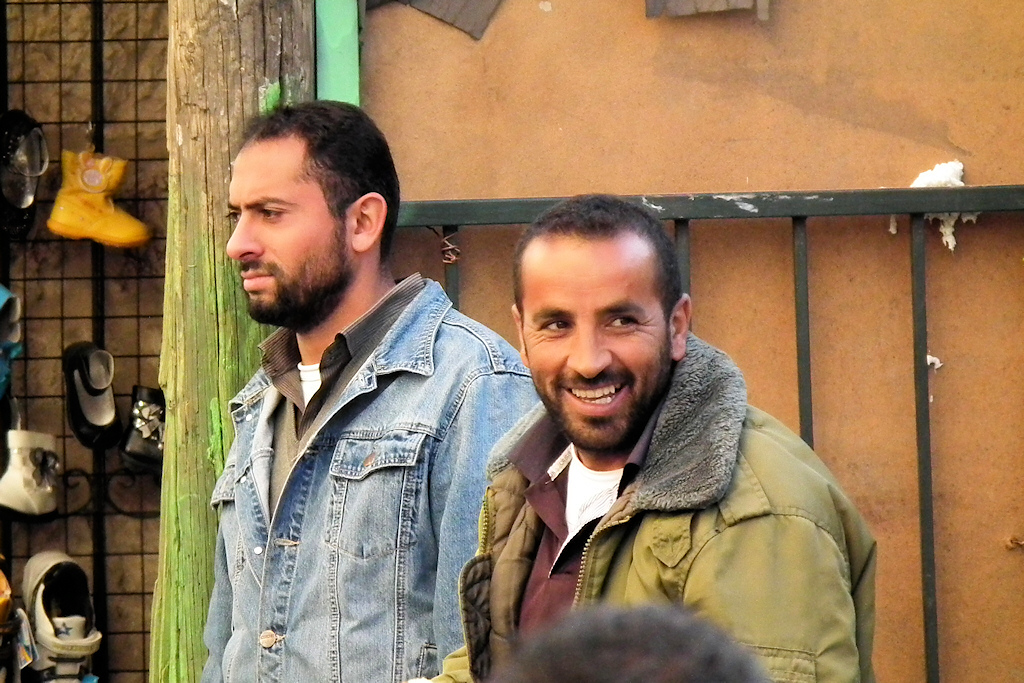
There’s a Christian grocer in town who stocks a lot of things I like, so I went to his place. While wandering around looking through the densely, intricately packed shelves, a guy comes in and starts up. I don’t understand much Arabic, but the tone of his voice translated easily – he was on a down day, overwhelmed. He and the grocer were so engaged in this man’s inventory of problems that I had to stand there patiently waiting to pay, listening too.
Little did he know, but in the process I did a little psychic healing on this man – smoothing out his aura, shifting the movement of his energy and the orientation of his aura from downward to upward and reconnecting him with his guardian angel. After a while, the grocer turned, noticed me, apologised and started totting up my buys. Suddenly, his friend said to him (it could have been), “And guess what…?”. The grocer grunted, to say go on, and the guy burst out laughing and said something. The grocer turns to me and said, “He tell me all these problem, and now he say his wife just got pregnant again – fifth. He say only now. Why not before, eh?”. Well, looks like the healing did something to loosen things up.
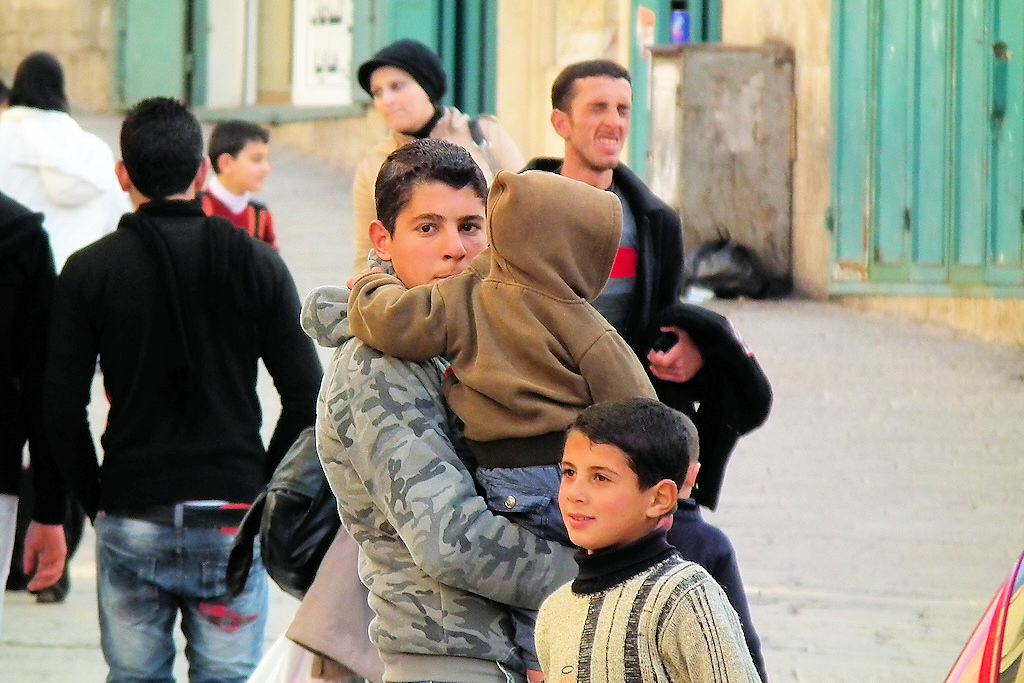
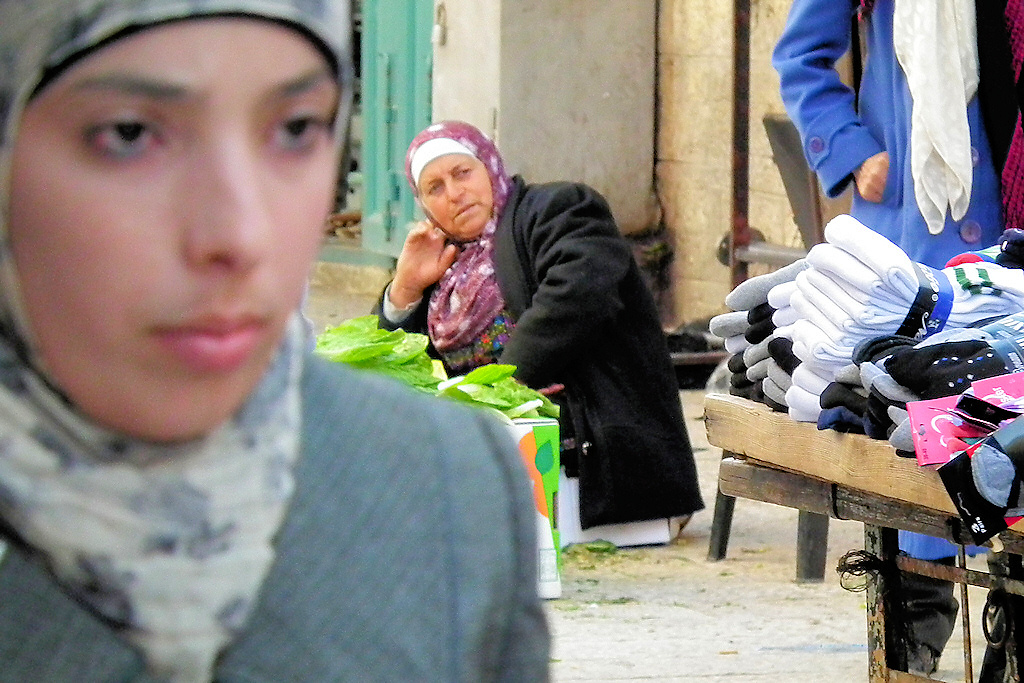
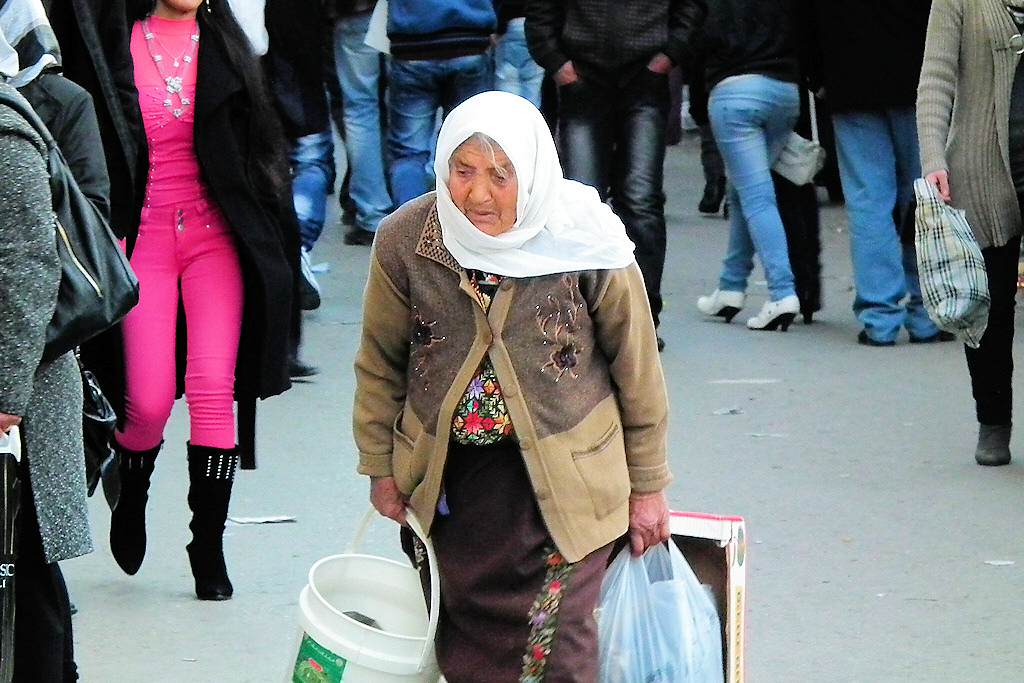
With goods in hand, I wandered off down Faraheih Street, turned left through the market, to be how-arre-youed and wherre-you-frommed by stall-keepers as I strolled past. Mid-afternoon, they were all sitting around wondering whether to close for siesta.

I’m always amazed that being British is regarded positively by Palestinians, despite what we’ve done in the past. Announcing Britaniyya to them always seems to elicit a good response. Perhaps they think we’re less bad than others, therefore good. Just as well. A Danish guy I met a few days ago had complained that Denmark is notorious for offensive cartoons of the Prophet Mohammed, and he often had to prove to people that he didn’t agree with it.
Down the passageway and some steps leading from the market I was accosted by a sweet-seller. He asked how arre you, as they do, and I joked back hamdulillah – thanks God (I’m okay). It was a joke because, last time I was here, I couldn’t manage responses in Arabic. He has a hand-pushed cart parked at the top of the main steps down toward the Omar Mosque and Manger Square. Palestinian sweets are gooey, rich, soft cakes of honey, almond and who knows what, often eaten by dropping a cubic inch of the stuff straight into the mouth and swilling it down with coffee. I got some, in order to augment my weight-gain programme. Yes, folks, one of the ways I differ from many people is that I’m thin and bony, so I actually have to eat calorie-rich things to gain weight.
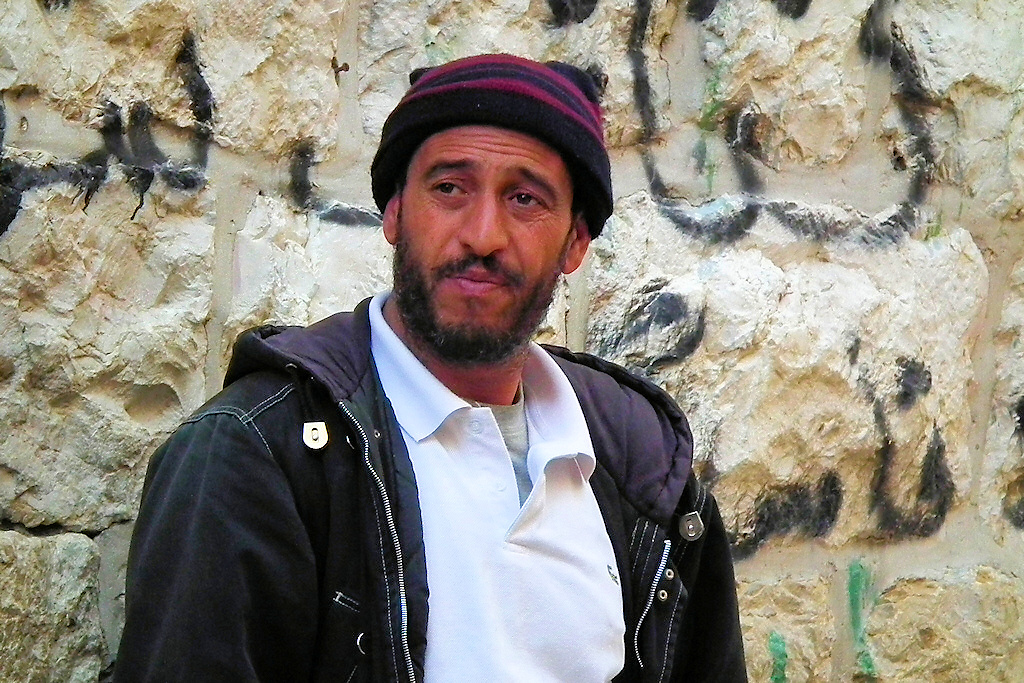
I then proceeded down the steps and met up with a shopkeeper I know who was sorely troubled by the lack of trade. The pilgrim and tourist business is down and the Israelis have creamed off most of the business. Most visitors come in shepherded groups for just a few hours in an Israeli coach from Jerusalem, visiting the Church of the Nativity and an approved souvenir shop, from which 30% of the takings are paid to the Israeli tour operators. Then they’re shuttled back to Jerusalem. The Israelis have niftily captured the income from Bethlehem’s pilgrimage tourism.
Independent travellers who arrive here – not exactly in floods – tend to run on a tight budget, so they aren’t big consumers. Norwegians seem to be the richest at present. Instead of money, these visitors mainly bring ‘witness’ and interaction, a social currency, worth perhaps more than money, if truth be known.
The shopkeeper complained that he had made only 100 shekels today – about £20 or $30. He thrust tea before me and carried on. Usually he has quite positive attitude, but this time he was struggling. I let him run with it, and it did him good. It does give them some assurance to be able to offload like this and to gain some understanding from another person – it helps them objectivise their lives.

Then I went round the corner to a café run by Adnan’s brother. I had falafel, hummus, pitta, salad and sage tea, as a late lunch. In came Adnan, plonking himself straight down and huffing. He starts up. His story is always complex, but he’s in the tourist souvenir trade too and he’s almost bankrupt. I know some of the things he could do to improve things (such as trading on eBay), and I have told him about them, but he doesn’t get it. He perpetually hopes things will work well next time, things will get better, but they don’t. Or someone else is making his life difficult and he wishes they would stop. So I usually let him blurt out his complaints, in the hope that some relief of pressure might lead him to form new conclusions.
The souvenirs he sells are lovely – especially if you’re a Christian. Lovely hand-carved olive-wood effigies of Jesus, Mary, the saints and the Nativity. Bedouin carpets, lovely Arabic dresses, inlaid boxes – all made within a few miles of here. But they don’t sell, the overheads are high, the checkpoints scare visitors away and, if your spirits are down, it’s a disaster.
Round and round in loops he goes. Adnan requires perseverance because he’s quite resistant. It’s the world that’s wrong, not him. But he appreciates the listening ear anyway, and soon we were talking about other things – mainly about the carpets his grandmother had diligently woven throughout her life, adorning the floors of many of his vast Bedouin family’s network of homes. Well, that’s that done. Now to see Jack, down in the Christian Quarter.
Jack is not a complainer, but he is in a sorry state. One year ago he had a major accident at work, fracturing his skull, haemorrhaging his brain and breaking some ribs. Then his wife, who had suffered MS, had died. Understandably, he had plummeted. His capacity to work is now much reduced, though he carries on all the same. He’s 52 and worn out. He works as a security guard for UNRWA, and he also clears out old wells and builds walls for a living. His spare-time obsession is billiards – his friends come round to play. He’s a real character – altruistic, humorous, maverick, but nowadays much faded. I cannot tell whether this is a low patch of life, or whether he’s on his way to dying. Bless him.
But he doesn’t moan. In fact, we started up a really good conversation, but it was still about his difficulties. He talked about how, at the bottom of some wells – many of them centuries old, some millennia old – there is no air and he has sometimes nearly suffocated. In a few others there are underground toxic flows of petrol or sewage, which he refuses to work with. At his work at UNRWA a few days ago, he was caught sleeping – not a good thing for a security guard – and given a warning. But they seem to like him too.

But then he started up telling his stories of former days. There was one time he took his wife to an Israeli hospital without having a permit. He managed to get her in by a combination of charm, bluster and play-acting and then, having sat with her for hours, made his way home. But in the lift he had a heart attack – he was found lying there by a doctor, who rushed him to a ward and saved him. When Jack came to, the doctor came to visit him and simply said, with a wry smile, “Next time, get a permit if you’re going to have a heart attack, won’t you?” The doctor fixed him a lift to a checkpoint, to get back home. You do indeed get remarkable acts of compassion in this strangely conflicted country.
Jack’s son came in, looking really annoyed – fuming, in fact. I understood he had had an argument with his sister in his grandmother’s house next door. He’s 21 and quite a special young guy – plays Liszt and Chopin on the piano and works with computer hardware – but he had recently flunked his mathematics at college and, for reasons I couldn’t quite fathom, could not re-take the exam. Which meant he couldn’t go to university, and they couldn’t afford it anyway. So he was in a state.
He sat there listening – his English is good – and then he perked up when he told me about the free trip he had had with the Salesian Brothers (a Catholic order) to see the Pope in Spain, visiting Italy on the way. He was selected from a large crowd of applicants and he was away for three weeks. He’s a Sagittarian, our Shukry, and travelling the world is what he would love to do – but he’s imprisoned behind walls instead, living in a world-famous city, Bethlehem, that’s strangely isolated. If I could wave a magic wand I’d love to fix him three years at the Royal College of Music in London. He deserves it, and his frustration at getting nowhere in life was probably the underlying cause of his argument with his sister.
Jack was falling asleep. The drugs the doctor had given him to deal with the after-effects of his brain haemorrhage last year make him drowsy. I told him to get to bed instead of forcing himself to stay awake. “Yes, doctor”, he replied, and we parted company. I made my way out, walking back through the narrow stone streets of the Old Town to Manger Square. Another shopkeeper tried waylaying me but, by this time, I was tired and I didn’t want tea. I wanted a taxi home.
But even then, the taxi-driver, whom I knew from previous years, had a tale to tell. One of his children had died – I think about a month ago. Of what, I don’t know, because the word he gave me was in Arabic. In limited English he said he had not had enough money for the hospital. I could tell by the tone of his voice he was cut up about it, probably feeling like a failed father.
When we got to the school at Al Khader, I asked him how much he wanted for the trip. Thirty, he said – the evening rate (usually it’s twenty shekels). I only had 25 in change, and otherwise only a 200 shekel note (£40), which he couldn’t change. So I dug around in my bag, leafing through my carefully-stashed collection of Euros, Swiss Francs, Pounds, Kronor and Dinars to find him a Jordanian ten dinar note. He smiled. This was worth 50 shekels. “God bless you, Mister Balden. I like you. Thanks God. Ma’assalam.” The only trouble is, I’m not a banker or an oil sheikh, but it was worth it – even a bit of money can raise the spirits sometimes.
Sometimes I wonder what good I bring by being here. It’s as if the mountain of life-obstacles people experience in this place is too large for someone like me to make a difference. But then, as the Dalai Lama is quoted to have said: “If you think you’re too small to make a difference, try spending a night in a room with a mosquito”.
With love, Palden
http://www.palden.co.uk



























 Notes from the Far Beyond
You must be logged in to post a comment.