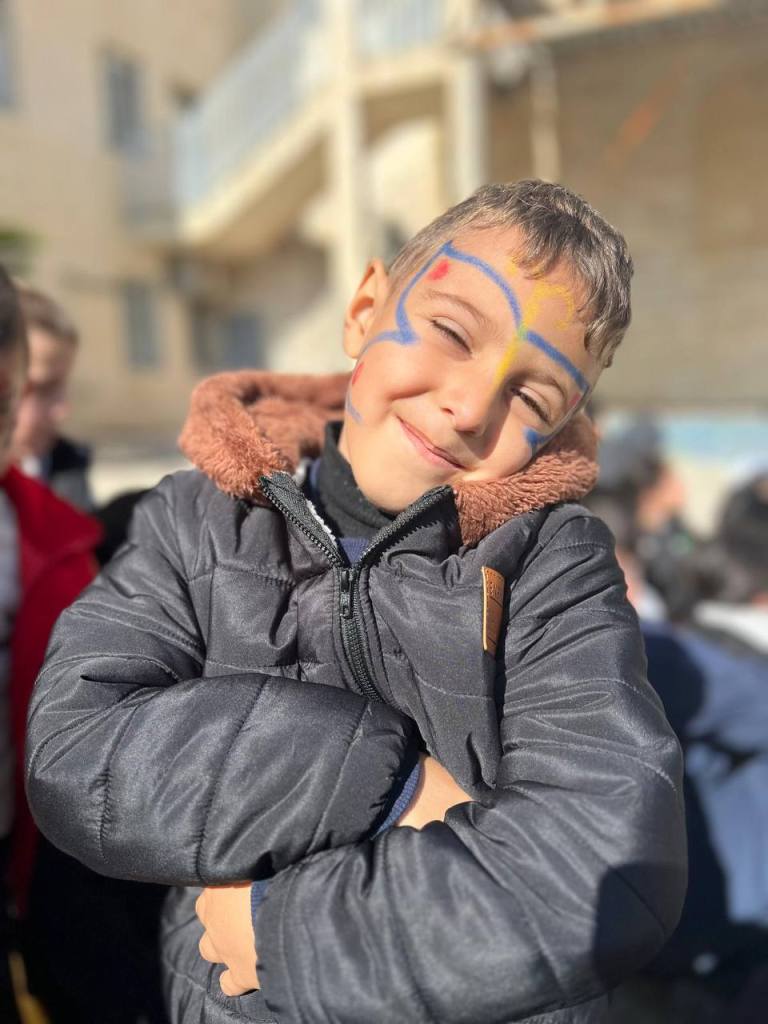
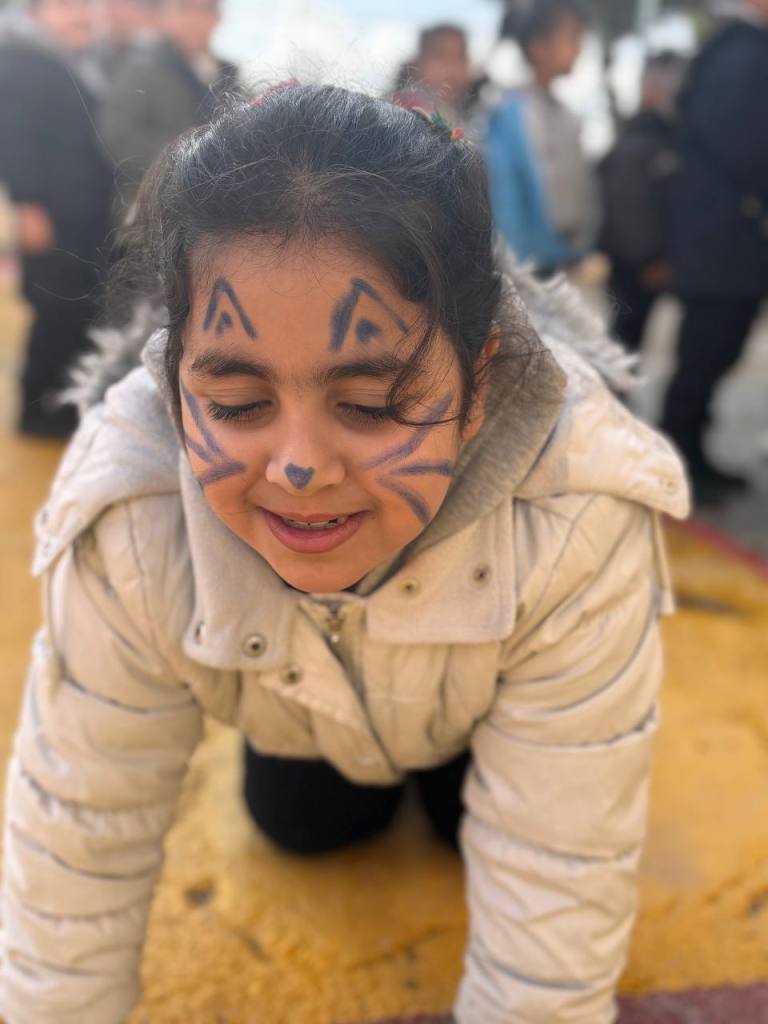
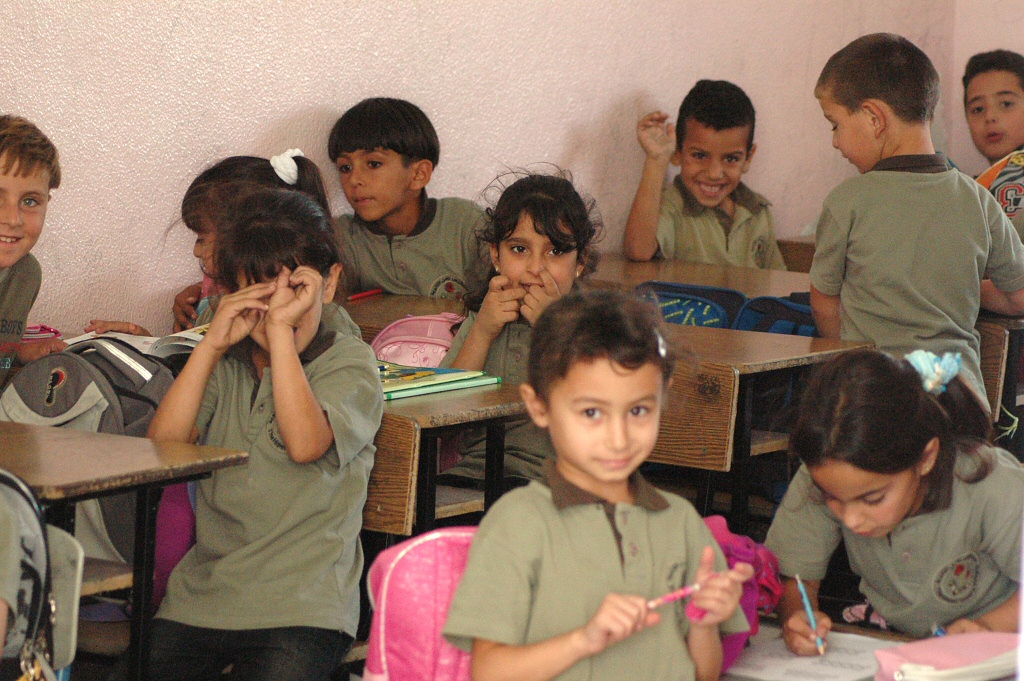
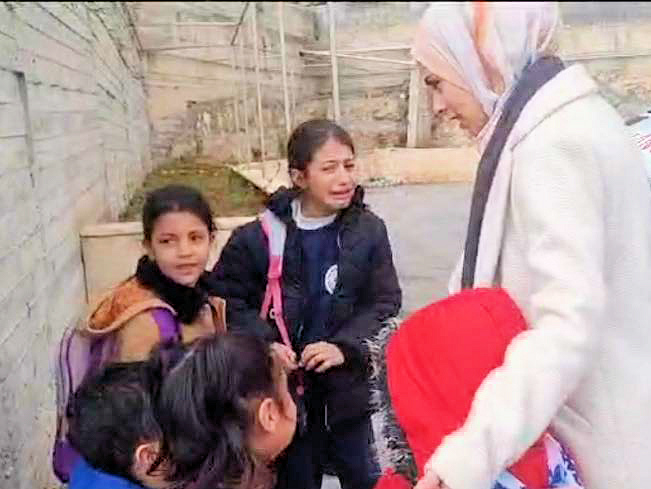
These are kids at the Hope Flowers School in Bethlehem, West Bank, Palestine, and these pics were taken in the last few days.
They are orphans from Gaza, and refugee and special needs kids from the West Bank. Apart from giving a good education under difficult circumstances, the school gives kids the tools to process their anger, loss, fear and trauma, so that they grow up knowing there is another way. Another way from what has happened over the last hundred years in Palestine and Israel.
Note the performers. These look like visiting Europeans. They are independent humanitarians: they set about brightening up the lives of people in places like Palestine and they make a big difference. They often fund themselves to do so, and travel cheap and crash on sofas. Some are performers, some hairdressers, some are welders and some are law graduates, artists and retired professionals. Have you ever considered doing something like this?
Forget Trump and Natanyahu: this is the human frontline, where the real work of peacemaking happens. These children are, I hope, the generation who will see a big change across the Middle East. The times of war need to end now: we must do things another way. And these are the people who will do it. That is my prayer for them.
Here’s the translation of the text that came with the pics:
In an atmosphere filled with fun and positive energy, the professor of physical education, Mr. Mustafa, organized a special recreational day for the students of the school, in cooperation with the refugee center, where play, art, and laughter came together in an unforgettable day ✨
⭕ A variety of events between animated games that enhanced activity and interaction, face painting added colors of joy to the faces of children, alongside a theatrical circus that presented pleasant performances that brought joy to the hearts🎪😊
Our students also participated in playing with parschute and other group activities that contributed to promoting a spirit of cooperation, active discharge, and building self-confidence in a fun and safe way 🌟
⛔ This day was an open space for joy and expression, and an integrated recreational educational experience that emphasizes the importance of play in supporting our children’s physical and psychological development 💚
ـــــــــ🍂ــــــ We learn for human well-being ــــــ🍂ــــــــ
To make a donation to Hope Flowers, go to this page for links to Hope Flowers’ supporting organisations in different countries: https://hopeflowers.org/wp/support/
Here’s a readable story about the history and philosophy of the school. It’s from my book Pictures of Palestine, and it’s called ‘Korea meets Palestine’. (Korea and Palestine were both divided in the same year, 1948.) https://www.palden.co.uk/pop/korea-meets-palestine.html
Since it’s crap weather (here in Cornwall, at least), and winter seems to be coming on early (here in Cornwall, at least), you might like some vitamins for the ears (wherever you are, and however things are).
I’ve assembled my four audiobooks in one place, here…
Good for when you’re stuck in a traffic jam, stuck in bed, stuck in the kitchen or stuck on a train, or if you’re fed up with the radio, or simply if you’d like something interesting to listen to!
I’m continually reminded of the extent to which the present is a gift. Everything comes from Spirit, from the Void, from what we call God, and everything returns to Spirit, to the Void and to God. And everything exists within them.
It doesn’t matter how we see the nature and meaning of life, the universe and everything – it’s still the same. We are the eyes, ears and hands of existence-consciousness-beingness. It’s dead easy to forget, to get lost in our stuff, but it remains true.
Some people are in the midst of nightmares right now. Some days ago I did a joint online presentation to a support group in Britain with Ibrahim Issa, director of the Hope Flowers School in Bethlehem, in the West Bank of Palestine. Western governments, aid agencies and donors have withdrawn a lot of support, so we’re having to do some remedying of that, especially since life in the West Bank is getting harder and harder.
I was amazed at his composure. Or perhaps he was just too tired. He and everyone around him had been kept awake through the night by missiles, planes and sirens. And fear.
Even so, they keep on at the school, driving by the seats of their pants – attending to the needs of the children, their families and the local community. On a shoestring.
The latest measure they’ve taken – since Israeli roadblocks all over town make movement difficult – is to take trauma-support services to the people, in a Volkswagen van. It’s a sort of trauma-ambulance, for people losing their rag because of the tensions, dangers and offensive experiences they’re living through.
In my contribution I mentioned the Arabic term, sumud – hanging in there, never giving up. The secret is to stay in the present, to make the best use of the gifts it yields. When the past is being obliterated and the future holds little to hope for, there remains the present – the only time we actually have agency.
My own body is gradually deteriorating – a new health issue is slowly immobilising me – yet I’m continually amazed at the gifts that life presents. One is this: lessons I’m learning from people younger than me. In this case, it’s Ibrahim, teaching-reminding me about the present moment. Doing what you can with whatever is available right now and making the best of it. Because the past is gone and the future is but an idea.
People bang on a lot about freedom of speech, though really we need to learn more about exercising our freedom of attitude.
In the immediately-impending future, on Sunday (times below, for different countries), there comes the Sunday Meditation, and you’re welcome to be present with it. It’s free, no sign-up, no strings, do it your way, and wherever you are.
Perhaps give some attention to feeling what it’s like to stand in the shoes of someone whose life could be snuffed out tonight, for no understandable reason or purpose. Hold their hand. There’s no shortage of available souls in need of good-hearted soul-company, in plenty of places. This is what we can do.
With love from me. Palden.
———————
Current meditation times, on Sundays: UK, Ireland & Portugal 8-8.30pm GMT W Europe 9-9.30pm E Europe, Turkiye and the Levant 10-10.30pm Brazil-Argentina 4-4.30pm CST, Mexico, Jamaica, Colombia 2-2.30pm EST, Cuba 3-3.30pm PST North America 12noon-12.30pm
This is another of my Palestine tales from 12-15 years ago, from a book called O Little Town of Bethlehem, which recorded a five-month stay in 2011-12. In my writings and photos at the time my aim was to humanise Palestinians. Because, like you and me, they’re real humans with real human lives to live.
———————
As the sun went down, a wonderful atmosphere settled upon Bethlehem. The town was in a genial mood – people chatting and hanging out in the streets. At Cinema, a busy intersection with taxis and taxi-vans, I saw a six year old girl standing on some steps simply singing out loud to the street. This was not only touching but also rather refreshing because, for some reason, Palestinians tend not to sing.
Aisha, an English friend who teaches English at the Hope Flowers Centre and stays at my place one night a week, uses the large, empty, echoey conference room in the school for practising opera – she’s an accomplished singer but, living in Ramallah and surrounded with people who would find opera rather strange, doing her scales and practicing her arias doesn’t quite work easily. So she loves practising at the school, where she won’t be heard – and the conference room echoes quite nicely too.
Nevertheless, a neighbour discretely enquired of me what was happening. I explained and he smiled. He’d seen opera on TV, and was interested when I said that operas were like plays sung out loud, with stories to them. I asked him why Palestinians tend not to sing, and he said back, “Since the Nakba we haven’t had much to sing about”. Well, true, but I know that’s not the real answer, which I am yet to find out.
The Nakba, by the way, was ‘The Disaster’, the 1948 war during which the Israelis staked out their nation militarily, by ethnically cleansing and killing the Arabic inhabitants of hundreds of villages and towns in what became Israel. In the space of a few months, the population of Bethlehem quadrupled with refugees and they have never gone home – there’s no home to go back to. As a symbolic act, refugee families keep the keys to their old, lost houses, like a family totem, proof of having torn-up roots in their own land.
This afternoon was one of those times when people set their cares aside and enjoy the moment. That’s one thing I like in Palestine: people do their best to keep their spirits up and enjoy life. There is no alternative. Or at least, the alternative, dwelling on your problems, is far worse.
As my friend Ghada once put it, at a time when she was feeling pessimistic a few years ago, “In Palestine we don’t have up days and down days, we have down days and worse days”. She was at that moment manifesting symptoms of the strange collective bipolarity Palestinians live by, thanks to their circumstances: generally they keep their mood positive in spite of everything, but when they lose their strength and fortitude, they plummet into deep despond. That was where she was when she said this.
Palestinians wear their emotions inside out: love and sadness, friendship and disgust, humour and anger, they share them openly, men perhaps more than women. Their feelings spill out liberally. Mercifully it’s their positive emotions they show most. I have never seen a sign of violence except on a couple of occasions when Israeli soldiers are around, acting provocatively, but even then Palestinians suppress it because they usually don’t feel like getting shot, beaten up, arrested or hounded. They got tired of that ten years ago, and it doesn’t achieve much.
But on a lovely, tranquil afternoon like today, there was still a problem. On the way home, passing through Deheisheh and Duha, there was smoke everywhere. People were setting fire to the skips in which they put their rubbish. They do this because civic rubbish disposal is patchy at the best of times, and the skips were full. It’s not only smoky but dangerous, since so much of their rubbish contains plastics and other toxic materials, and the slow smoulder of the rubbish means that it doesn’t even burn properly. They have a blind spot around this issue. When Westerners like me raise the matter, they shrug it off as if it is no problem. But it is a problem and a big one.
Before you disapprove of these apparently backward people, let me remind you that we in the West started seriously addressing issues such as this only 20-30 years ago, when it was already too late for us. Before that, we trusted in modernity and slavishly paid the price in smog, toxicity, fumes and ugliness. Even today, when I speak to Westerners of the dangers of mobile phones, microwave ovens, wireless internet and electro-smog, people smirk or frown, as if to say “Oh no, he’s one of them”, since this is a current blind spot. One day an enormous scandal will erupt about it and people will yell “Why weren’t we told? Who is responsible for all this?”. We are responsible. We know. But we don’t want to face it.
So blind-spots – areas of life that people deliberately ignore, ultimately to our own cost – are not unique to Arabs. In fact, Arabs look on Westerners as backward because we turn our backs on God – Europeans by becoming increasingly secular and Americans by turning God into a heavily-armed, consumptive patriot with conservative politics.
Every race and nationality covers its insecurities by looking on others as inherently deficient. The less contact they have with other kinds of people, the stronger the negative projection on outsiders – this is one reason for the separation wall, so that each side can project its fantasies about the other onto a concrete screen untainted by reality. This is why Iran is currently a bogeyman – no one goes there to meet the people, so it’s easy to dehumanise them.
This said, Palestinians must still address the issue of rubbish – creating less of it and disposing of it properly. Battery recycling, vegetable waste composting and plastics disposal? Forget it, it doesn’t exist here. But probably it will exist in 10-20 years’ time – Palestine is at a similar stage to the West in the early 1970s. Yet regarding social values, sharing and human warmth, Palestinians are advanced, at a stage that I hope the West will reach in a few decades’ time.
I went into town to do my shopping. I’ve been sitting slogging away at the computer for the last week, so I don’t have many events to report. The trouble with computers is that people hardly see the results of your work because it’s digitally concealed, distinctly not in your face. Much of the work is for people far and wide, so that people around you see little significance in what you’re doing – you’re just sitting at a computer, twiddling fingers and looking serious. I’ve been building a website, dealing with issues for Hope Flowers, doing bits of work and answering questions online – many questions, from many people.
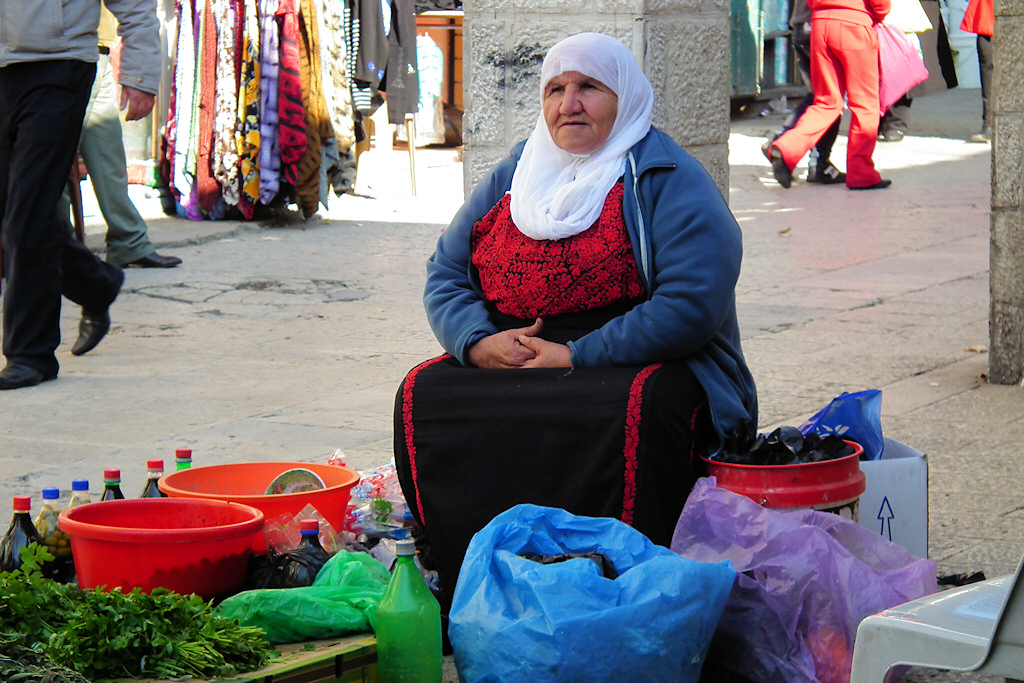
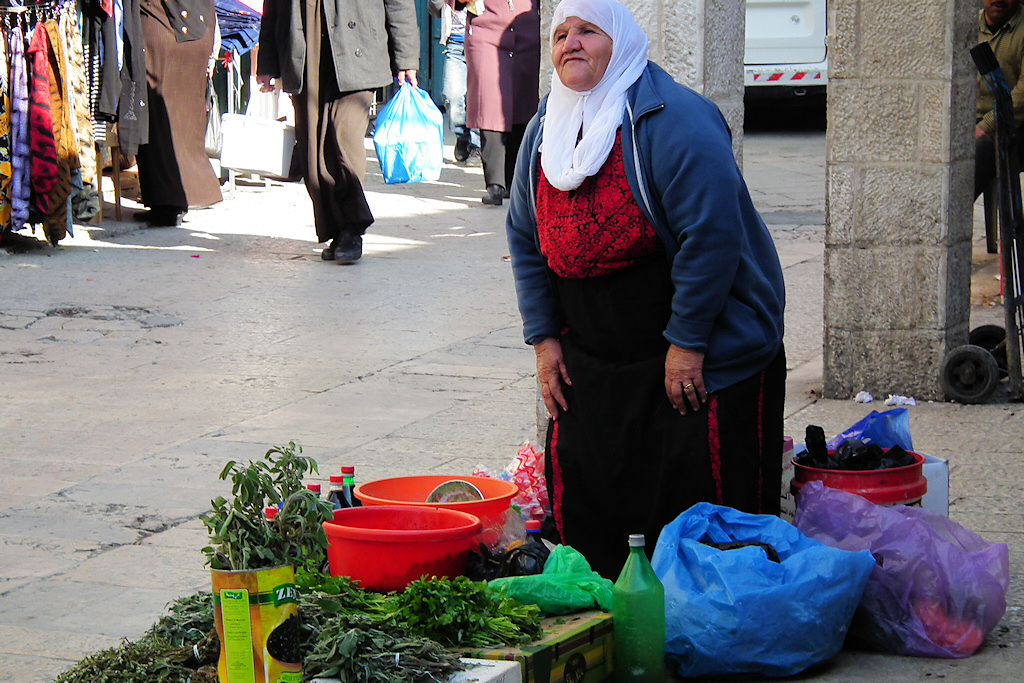
When shopping I went to an old lady I visit regularly. She has a small stall on the streetside in the Old Town. By stall, I mean a stool and a few boxes and bags. She sells herbs and figs. She’s a lovely old lady, clad in her embroidered traditional dress. She walks into town daily with her husband, who leads their donkey, which carries the herbs – then he returns home to work on the land, and he comes back to pick her up later.
Palestinians are big on herbs – they have mint or thyme in their tea and they eat parsley, sage, coriander, spinach and chillies copiously. I buy my herbs from her – big bunches of them, far too big to use on my own, for 1-2 shekels per bunch (20-40p in British money). She likes her pet Englishman. She eyes me closely when she thinks I’m not looking. I think she knows intuitively that I’m roughly the same age as she is, except she’s an old woman and I look younger – apart from a rather wrinkly face which has clearly seen some things. She hasn’t figured me out yet. Life wears out Palestinians.
Then I went down to the market to get vegetables. Two stallholders were trying to steal me off the stallholder I usually go to, but he has the best vegetables. One thing many Palestinians don’t quite understand is this. They tend to think one is obliged to shop with them out of a duty to support them – after all, fair’s fair, isn’t it? Well no, I’m a Westerner, and I go for the best stuff and the best deal. Sorry about that. Also, annoyingly, I buy things only when I need them.
The souvenir shopkeepers down in town think similarly. I’m a Westerner, therefore I have money, therefore I ought to buy from them. Not so. I buy presents only because there are people I know and love to whom I wish to give things, and I buy specifically for them. There’s also the question of how to get it back to England, so I cannot buy much. I’m not a buying machine – well, at least, not in my own head.
Dear reader, this might seem elementary, but it’s not so for Palestinians. This is a walled-off cooperation and mutual-support economy, an economy where everyone depends on everyone else for keeping each other alive, so the emphasis here is on supporting your fellow citizens by trading with them, to some extent whether or not you need what they’re selling.
Nevertheless, when one of the traders, a young chap of seventeen who helps his elder brother run a shop, moaned to me today about having no money to buy schoolbooks, I took pity on him. He had said there had been no business today, and he needed 50 Jordanian Dinars (250 shekels or £50) for the books tomorrow. He was worried and depressed. So I wandered off to do other chores, including raiding a bank machine, and slipped him 50 JDs on the way back. He lit up and hugged me, shedding a tear. Now he could get his books.
I told him that this is a life-lesson we all need to learn: solutions often come when you’ve given up. When you give up, it means you’re opening up to Allah, handing over your problems since you couldn’t solve them yourself. This money is a gift from Allah, through a random Englishman. So give thanks to Allah.
“You are a good man, Mr Balden. I pray that Allah, he will pick you up when you have a need.” Well thanks, I might need your prayer to come true one day. This young Palestinian, poor yet intelligent, has better English than some of the 17-year old Brits I know. Good luck to you, mate – I sincerely hope you get a future.
————————–
My three Palestine books are: – Pictures of Palestine (in print and as a downloadable PDF) – Blogging in Bethlehem (an audiobook and PDF) – O Little Town of Bethlehem (PDF only) Available here: http://www.palden.co.uk/pop/order.html
I’m away for two weeks, at the Oak Dragon Camp (I was its founder nearly 40 years ago) and speaking at the Glastonbury Symposium – so you won’t be hearing from me for a while! Recently I’ve been rendering my cancer book Blessings that Bones Bring into audiobook format, and that’s now complete.
Just in case you were desperate for something to read, haha, here’s a chapter from my 2012 book O Little Town of Bethlehem – Christmas in God’s Holy Land (here). Compared with the situation now, Palestine in 2011 was much better but, even then, people were beset with issues to deal with, and this excerpt gives some examples. It’s also about one of the key activities a foreigner visiting Palestine needs to be willing to do – listening.Bearing witness.
In the streets of Bethlehem, December 2011
When I went to town to check out various friends, many of them were gloomy, beset with problems. It was one of those days. Each person had their own particular issues, but they all add up to a morass of collective difficulty which the customary Palestinian good humour cannot penetrate.
Naturally, our perception of life is made up of an interaction of circumstances and our feelings about them, and these are two rather different things. For Palestinians living under occupation, the circumstances side of the equation bites and scrapes harder than for most people across the world. Especially since the occupiers deliberately go about making life difficult, complex and insecure for the occupied, in military, administrative, legal and quite everyday ways. This is what Jeff Halper, a critical Israeli thinker, calls ‘the matrix of control’. The ultimate goal is to make Palestinians submit to Israeli rule, give up, go quiet and preferably leave the country.
But they don’t give up, despite the muddy mire of problems they can be beset with – or perhaps it’s a dust-storm where it’s impossible to see far and sand gets in the engine and all the moving parts. Palestinians have a life-philosophy which is admirable. But some days they go down into the doldrums and they need a good moan.
That’s one of the roles of foreigners who come here: bearing witness. This often means letting Palestinians have a good moan, describing to you with a full spectrum of feeling how difficult everything is. It can be quite challenging though if you have something in your own life that’s nagging you too – happily, this wasn’t the case for me today. So I was able to listen fully and, when a person ground to a halt, I could start up something that might change the context of things, so that they see the situation in a different way – for the difference between a situation and a problem lies in our state of heart and mind.
There’s a Christian grocer in town who stocks a lot of things I like, so I went to his place. While wandering around looking through the densely, intricately packed shelves, a guy comes in and starts up. I don’t understand much Arabic, but the tone of his voice translated easily – he was on a down day, overwhelmed. He and the grocer were so engaged in this man’s inventory of problems that I had to stand there patiently waiting to pay, listening too.
Little did he know, but in the process I did a little psychic healing on this man – smoothing out his aura, shifting the movement of his energy and the orientation of his aura from downward to upward and reconnecting him with his guardian angel. After a while, the grocer turned, noticed me, apologised and started totting up my buys. Suddenly, his friend said to him (it could have been), “And guess what…?”. The grocer grunted, to say go on, and the guy burst out laughing and said something. The grocer turns to me and said, “He tell me all these problem, and now he say his wife just got pregnant again – fifth. He say only now. Why not before, eh?”. Well, looks like the healing did something to loosen things up.
With goods in hand, I wandered off down Faraheih Street, turned left through the market, to be how-arre-youed and wherre-you-frommed by stall-keepers as I strolled past. Mid-afternoon, they were all sitting around wondering whether to close for siesta.
An elder angel in the vegetable market
I’m always amazed that being British is regarded positively by Palestinians, despite what we’ve done in the past. Announcing Britaniyya to them always seems to elicit a good response. Perhaps they think we’re less bad than others, therefore good. Just as well. A Danish guy I met a few days ago had complained that Denmark is notorious for offensive cartoons of the Prophet Mohammed, and he often had to prove to people that he didn’t agree with it.
Down the passageway and some steps leading from the market I was accosted by a sweet-seller. He asked how arre you, as they do, and I joked back hamdulillah – thanks God (I’m okay). It was a joke because, last time I was here, I couldn’t manage responses in Arabic. He has a hand-pushed cart parked at the top of the main steps down toward the Omar Mosque and Manger Square. Palestinian sweets are gooey, rich, soft cakes of honey, almond and who knows what, often eaten by dropping a cubic inch of the stuff straight into the mouth and swilling it down with coffee. I got some, in order to augment my weight-gain programme. Yes, folks, one of the ways I differ from many people is that I’m thin and bony, so I actually have to eat calorie-rich things to gain weight.
I then proceeded down the steps and met up with a shopkeeper I know who was sorely troubled by the lack of trade. The pilgrim and tourist business is down and the Israelis have creamed off most of the business. Most visitors come in shepherded groups for just a few hours in an Israeli coach from Jerusalem, visiting the Church of the Nativity and an approved souvenir shop, from which 30% of the takings are paid to the Israeli tour operators. Then they’re shuttled back to Jerusalem. The Israelis have niftily captured the income from Bethlehem’s pilgrimage tourism.
Independent travellers who arrive here – not exactly in floods – tend to run on a tight budget, so they aren’t big consumers. Norwegians seem to be the richest at present. Instead of money, these visitors mainly bring ‘witness’ and interaction, a social currency, worth perhaps more than money, if truth be known.
The shopkeeper complained that he had made only 100 shekels today – about £20 or $30. He thrust tea before me and carried on. Usually he has quite positive attitude, but this time he was struggling. I let him run with it, and it did him good. It does give them some assurance to be able to offload like this and to gain some understanding from another person – it helps them objectivise their lives.
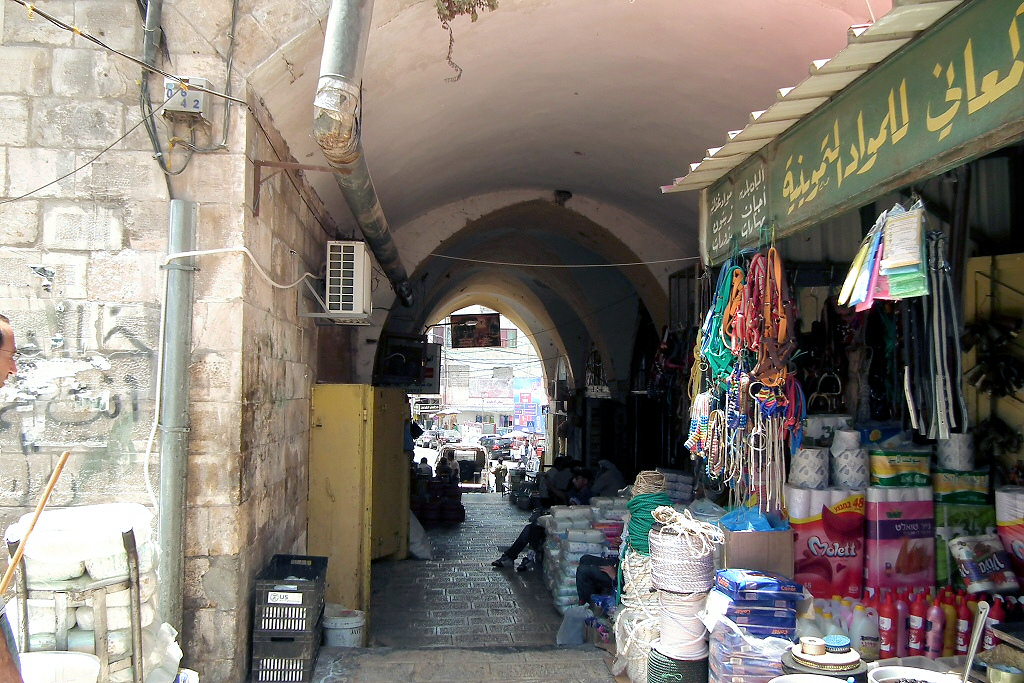
Street scene in Bethlehem Old Town
Then I went round the corner to a café run by Adnan’s brother. I had falafel, hummus, pitta, salad and sage tea, as a late lunch. In came Adnan, plonking himself straight down and huffing. He starts up. His story is always complex, but he’s in the tourist souvenir trade too and he’s almost bankrupt. I know some of the things he could do to improve things (such as trading on eBay), and I have told him about them, but he doesn’t get it. He perpetually hopes things will work well next time, things will get better, but they don’t. Or someone else is making his life difficult and he wishes they would stop. So I usually let him blurt out his complaints, in the hope that some relief of pressure might lead him to form new conclusions.
The souvenirs he sells are lovely – especially if you’re a Christian. Lovely hand-carved olive-wood effigies of Jesus, Mary, the saints and the Nativity. Bedouin carpets, lovely Arabic dresses, inlaid boxes – all made within a few miles of here. But they don’t sell, the overheads are high, the checkpoints scare visitors away and, if your spirits are down, it’s a disaster.
Round and round in loops he goes. Adnan requires perseverance because he’s quite resistant. It’s the world that’s wrong, not him. But he appreciates the listening ear anyway, and soon we were talking about other things – mainly about the carpets his grandmother had diligently woven throughout her life, adorning the floors of many of his vast Bedouin family’s network of homes. Well, that’s that done. Now to see Jack, down in the Christian Quarter.
Jack is not a complainer, but he is in a sorry state. One year ago he had a major accident at work, fracturing his skull, haemorrhaging his brain and breaking some ribs. Then his wife, who had suffered MS, had died. Understandably, he had plummeted. His capacity to work is now much reduced, though he carries on all the same. He’s 52 and worn out. He works as a security guard for UNRWA, and he also clears out old wells and builds walls for a living. His spare-time obsession is billiards – his friends come round to play. He’s a real character – altruistic, humorous, maverick, but nowadays much faded. I cannot tell whether this is a low patch of life, or whether he’s on his way to dying. Bless him.
But he doesn’t moan. In fact, we started up a really good conversation, but it was still about his difficulties. He talked about how, at the bottom of some wells – many of them centuries old, some millennia old – there is no air and he has sometimes nearly suffocated. In a few others there are underground toxic flows of petrol or sewage, which he refuses to work with. At his work at UNRWA a few days ago, he was caught sleeping – not a good thing for a security guard – and given a warning. But they seem to like him too.
Jack, Catholic wheelchair smuggler, in happier days
But then he started up telling his stories of former days. There was one time he took his wife to an Israeli hospital without having a permit. He managed to get her in by a combination of charm, bluster and play-acting and then, having sat with her for hours, made his way home. But in the lift he had a heart attack – he was found lying there by a doctor, who rushed him to a ward and saved him. When Jack came to, the doctor came to visit him and simply said, with a wry smile, “Next time, get a permit if you’re going to have a heart attack, won’t you?” The doctor fixed him a lift to a checkpoint, to get back home. You do indeed get remarkable acts of compassion in this strangely conflicted country.
Jack’s son came in, looking really annoyed – fuming, in fact. I understood he had had an argument with his sister in his grandmother’s house next door. He’s 21 and quite a special young guy – plays Liszt and Chopin on the piano and works with computer hardware – but he had recently flunked his mathematics at college and, for reasons I couldn’t quite fathom, could not re-take the exam. Which meant he couldn’t go to university, and they couldn’t afford it anyway. So he was in a state.
He sat there listening – his English is good – and then he perked up when he told me about the free trip he had had with the Salesian Brothers (a Catholic order) to see the Pope in Spain, visiting Italy on the way. He was selected from a large crowd of applicants and he was away for three weeks. He’s a Sagittarian, our Shukry, and travelling the world is what he would love to do – but he’s imprisoned behind walls instead, living in a world-famous city, Bethlehem, that’s strangely isolated. If I could wave a magic wand I’d love to fix him three years at the Royal College of Music in London. He deserves it, and his frustration at getting nowhere in life was probably the underlying cause of his argument with his sister.
Jack was falling asleep. The drugs the doctor had given him to deal with the after-effects of his brain haemorrhage last year make him drowsy. I told him to get to bed instead of forcing himself to stay awake. “Yes, doctor”, he replied, and we parted company. I made my way out, walking back through the narrow stone streets of the Old Town to Manger Square. Another shopkeeper tried waylaying me but, by this time, I was tired and I didn’t want tea. I wanted a taxi home.
But even then, the taxi-driver, whom I knew from previous years, had a tale to tell. One of his children had died – I think about a month ago. Of what, I don’t know, because the word he gave me was in Arabic. In limited English he said he had not had enough money for the hospital. I could tell by the tone of his voice he was cut up about it, probably feeling like a failed father.
When we got to the school at Al Khader, I asked him how much he wanted for the trip. Thirty, he said – the evening rate (usually it’s twenty shekels). I only had 25 in change, and otherwise only a 200 shekel note (£40), which he couldn’t change. So I dug around in my bag, leafing through my carefully-stashed collection of Euros, Swiss Francs, Pounds, Kronor and Dinars to find him a Jordanian ten dinar note. He smiled. This was worth 50 shekels. “God bless you, Mister Balden. I like you. Thanks God. Ma’assalam.” The only trouble is, I’m not a banker or an oil sheikh, but it was worth it – even a bit of money can raise the spirits sometimes.
Sometimes I wonder what good I bring by being here. It’s as if the mountain of life-obstacles people experience in this place is too large for someone like me to make a difference. But then, as the Dalai Lama is quoted to have said: “If you think you’re too small to make a difference, try spending a night in a room with a mosquito”.
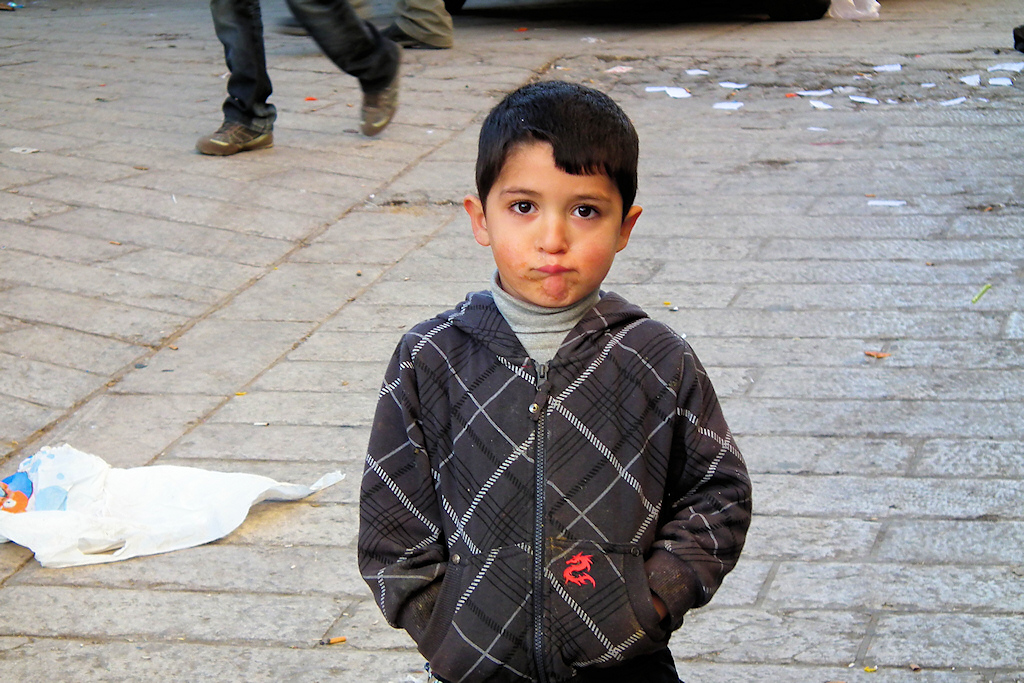
This young chap is now around 20 – as he’s grown up life has got worse, and I find myself wondering how he’s dealing with it.
In my audiobook and various of my postings you’ll have heard of Hope Flowers School in Bethlehem, Palestine (here’s a brief intro). I used to work there.
Here’s a newsletter from Ibrahim Issa, the school’s director. It gives a taste of what it’s like running a school in occupied Palestine at present.
With love, Palden
—————————-
Dear Friends,
Thank you for all your support and solidarity with the Hope Flowers School (HFS). I am trying through this letter, to share with you what happened on 6 December 2023 at the HFS. It is a bit long; I believe that some of you have received a big number of pictures and videos on that day.
It is almost 21 years ago, when James Bennet wrote an article in the New York Times about HFS: “Arab Coexistence school falls victim to violence” you can read this article on: https://www.nytimes.com/…/arab-coexistence-school-falls…
Between December 2002 and December 2023, HFS battle for Peace continues.
The school-day at HFS starts early in the morning. Children and staff start arriving at 07:15 A.m. It is quite difficult to predict the day and whether clashes between Palestinians and Israeli army will erupt that day. Clashes could erupt at any moment of the day. HFS staffs have to be prepared to act in case any violence erupts at a sudden.
Elegant vehicles, huh?
On Wednesday, December 6th 2023, in my way to HFS at 7:15 AM. I have to pass Deheisha refugee camp and Al Khader village. In my way I found tens of Israeli military vehicles and armed personal carriers about to enter the refugee camp and the village. Despite military presence on the way, but I managed to reach HFS at 07:30 A.m. The neighborhood of HFS was quite. I did not see any Israeli soldiers in the neighborhood.
I started to receive calls at about 07:45 from HFS staff that they could not reach the school because of Israeli army presence and clashes between the army and Palestinians. So we decided to start the school day with the absence of two staff members who could not reach the school.
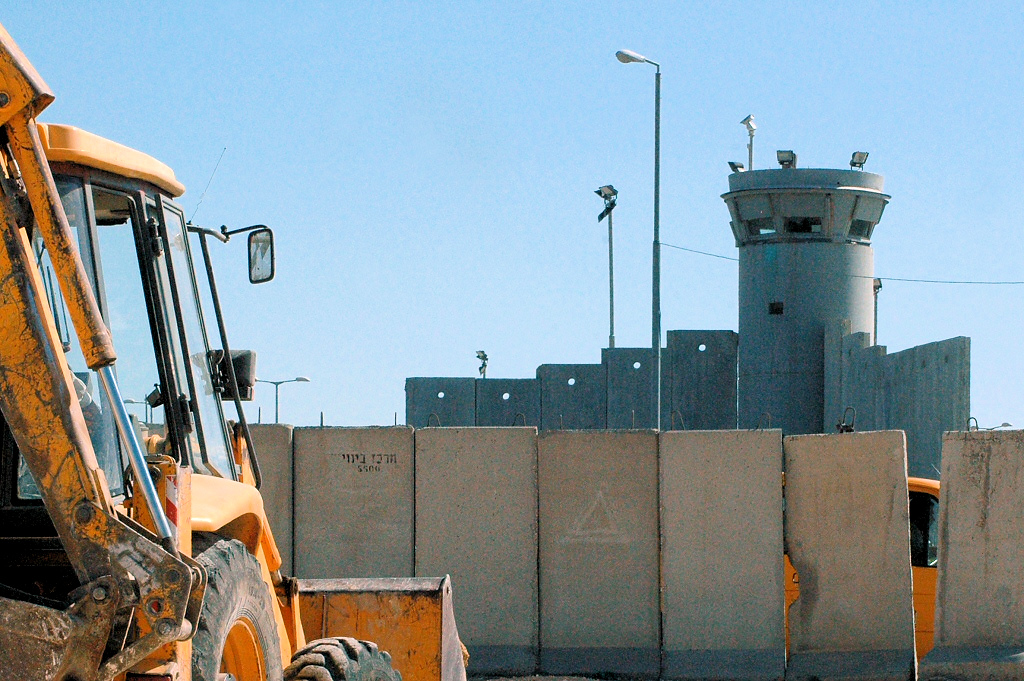
At 8:30 am, I was in my way from HFS to another meeting. On the corner of the school, I was stopped by tens of Israeli soldiers who were just arriving to the street and started to block the road with large concrete blocks using a bulldozer. The soldiers were very tense, especially I found myself with my car surrounded by big number of soldiers. The one soldier asked me to continue driving while another asked me to return backwards to HFS. I decided to stay unmoved because of unclearity in soldiers demands. Any wrong movement at this situation may be interpreted as an attack on soldiers and could kill me.
At this moment a military vehicle stopped next to me and there was apparently the commander of the unit. I talked to him in English and explained the situation that one soldier is asking to drive backwards and the other is asking me to drive forwards, I asked him if I could drive backwards (back to HFS), but he refused and asked me to continue driving forwards. He also instructed the soldiers to allow me moving forwards. I also told the army officer that I am a principle of a school located on the corner, and that I have 350 children aged 4-13 years old right now in the school with some children with special needs, and that I would appreciate if the army could give me 30 minutes to evacuate the school before they enter further in the neighborhood. The commander refused and he told me that in one hour they will finish their operation and that the army will reopen the road.
I cancelled my meeting and decided to stay nearby the HFS. I immediately called the staff at the HFS and asked them to take all measures (according to emergency plan) to protect the children and staff at the school and warned them that soldiers are in the neighborhood near the school.
At about 09:00 I received a call from vice-principle of HFS informing me that soldiers are near the school and that few armored vehicles have blocked the school parking and the main gate of the school and that leaving the school or entering the school is not possible.
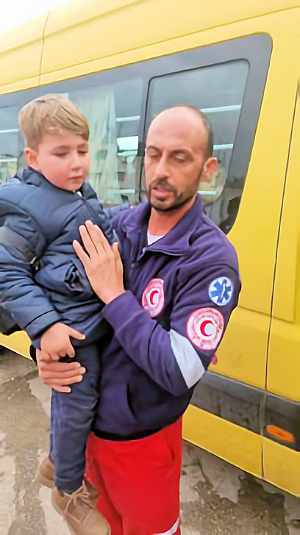
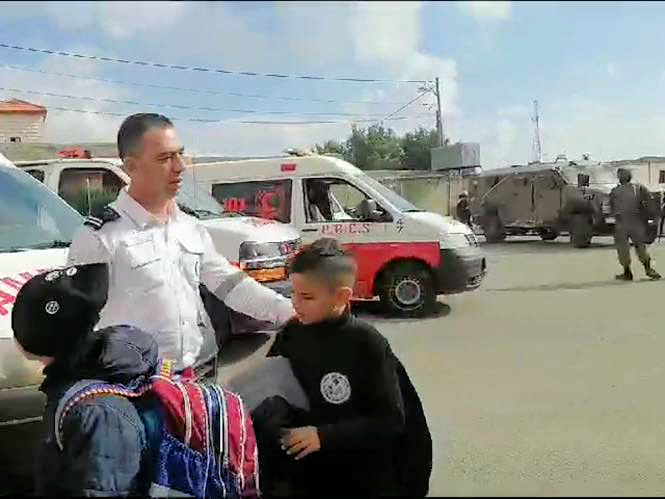
A paramedic comforts an upset boy
At 09:10 I received another call informing me that children with autism spectrum disorder (32 out of 358) are terrified and that social workers and staff need help to calm them down. Then I continued to receive calls from HFS informing me that children are totally in panic after soldiers started to fire teargas and heard of sounds of explosions nearby HFS due to clashing with Palestinian youth outside the HFS.
At this point I asked teachers and all staff of HFS to pay attention for the physical safety of children and to avoid sitting beside windows or even trying to look outside from the windows. I also informed the education department in Bethlehem that we have an emergency at HFS and explained the situation inside the HFS.
Everyone was concerned that the situation will get worse especially that some schools in Bethlehem and in the West Bank have encountered similar problems in the past few weeks.
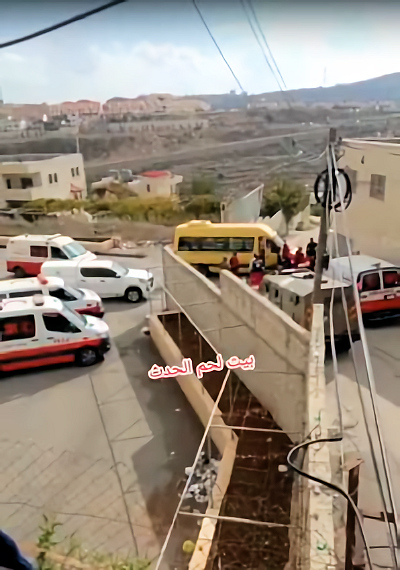
Some children have reacted strongly to fear like inability to breathe, others were crying, etc. Therefore, I asked the health department to help sending ambulances to help the staff to deal with stressed and fearful children at HFS. Indeed, 6 ambulances from Palestine Red Crescent Society arrived few minutes later, but the Israeli army prevented the ambulances to reach the HFS justifying that the area is “a military closed area”.
A teacher tries to calm the children
At this moment I started to realize the danger that children are in and started to call the Palestinian-Israeli military coordination office and asked them to speak to the Israeli military to allow the ambulances to reach the school. I decided to call other international organizations and asked them to urgently reach out for Israeli army to allow ambulances to reaching HFS.
The Israeli army has finally agreed to allow the ambulances to reach the school and finally allowed me to get back to the school in one of the ambulances. A detailed inspection of each ambulance was conducted by the army before it was allowed to move ahead. All ambulances were accompanied by an Israeli patrol.
At HFS, children were extremely fearful; in addition we were concerned that clashes between Palestinian and Israelis will erupt further.
Evacuation
Therefore, in consultation with the paramedics in the ambulances, we decided that it would be better to evacuate the whole school and take children to transport children to a safer place. The ambulances started to transport groups of children (maximum 10 in each ambulance accompanied by one teacher) to a nearby hospital.
Due to intensity of the situation, the general director of the education department arrived at HFS with one of the ambulances to support HFS’s staff and children. With the heroic work of paramedics of the Red Crescent society we managed to get all children and staff out safely.
A neighbour got shot. Well, he might have thrown stones at soldiers twenty years ago in the intifada, but he doesn’t have to die for that. He was just protecting his home.
During the evacuation, it was clear that a ‘demolition order’ was being carried out, and three neighbors’ houses right next to the school were razed to the ground by heavy demolition machines. Much violence was used by the army. Soldiers tried to prevent photos or videos from being taken, neighbors’ and teachers’ phones were roughly taken and broken. Three neighbors were injured, one seriously, he was shot in the head.
Some children have seen this happen. Hundreds of parents have heard about evacuation of the school. Parents started to reach the area of the school asking about their children. They were very scared. We asked parents to wait in hospital, you can imagine hundreds of parents were waiting every ambulance to arrive to see of their child/ren is/ are being safe. At the end of this difficult day, three families were left homeless, three people are injured, one of whom is in danger of life, and hundreds of children are further traumatized.
The impact of this violence on children, families is immense.
Teachers and counselors at HFS will have lots of extra work to do in trauma care in the weeks and months to come. It is therefore as urgent as ever that HFS work continue to provide trauma counseling for children and their families. We are very thankful for all of you who helped us on December 6th and many thanks for your solidarity and support to HFS.
The trauma counseling program at HFS aims to:
• To provide help for the children at the school and for families in Bethlehem to address the effects of the downward-spiralling cycle of violence and trauma that has arisen from violence and the occupation, and to remove the basis for future hostile behaviour.
• To create a model for wider use in Palestinian schools, to become a centre of excellence and dissemination for psychological support for people of the West Bank, and to share our accumulated knowledge and experience with the wider world.
Your support to HFS and trauma counseling program will be highly appreciated. Our battle for peace will continue!
Best regards, Ibrahim Issa, Director of HFS. hopeflowers@palnet.com www.hopeflowers.org Cell: +972(0)599294355
Here’s a story from Jenin, in happier times in 2011. It might give you a feel of the place as it is when life is more normal.
THE SPRING OF THE GARDENS, Jenin, 28-29th June
Jenin
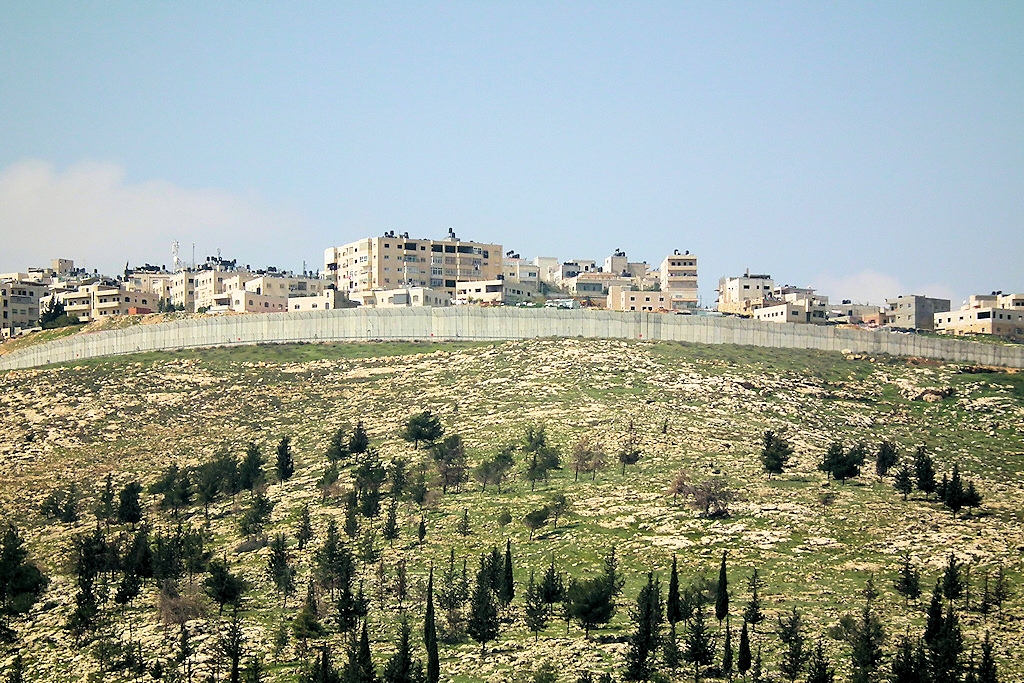
Jenin is perched on the north-facing slopes of the West Bank plateau, on the edge of a wide, green plain stretching west from Galilee toward Haifa and north toward Nazareth. The security wall separates Jenin from the Arabic towns of Afula and Nazareth in Israel, not very far away. This is Jesus country, and Mohammed, although Muslim, is enamoured of the Jesus stories here.
Jenin is lower than most West Bank towns – except Jericho, the world’s lowest town. You can feel it in the thicker, moister, softer Mediterranean air of Jenin. A friendly town of 40,000 or so, we made stops at a workshop, then at Mohammed’s family firm’s sizable warehouses and offices. More coffee – I was beginning to get jittery and strung out on the stuff. But another special moment was coming up.
Birqin
We went to the village of Birqin, west of Jenin, to see an ancient Christian church – apparently the world’s fourth oldest church, founded by the Byzantine empress Helena. Here Jesus had healed the lepers, in a biblical story. It was lovely inside, with richly-painted icons and Greek Orthodox paraphernalia. While the caretaker talked to Mohammed, I went into meditation, perched on a wooden pew – the place was tranquil and atmospheric, imbued with radiance.
While in that state, spontaneously I became aware of my mother, who had died 18 months earlier. Something in me suddenly wished, deep in my heart, that I could have brought her here. I don’t know where that feeling came from, but tears welled up inside, trickling down my cheeks. Cleansing tears, tears of release and healing forgiveness. I had always wished to share with her some of the remarkable spiritual experiences I have had in my life, but she never allowed it. She was quite a believer and she would have loved this church. Later I thanked the caretaker, and Mohammed too, for giving me this moment. Another level of resolution with my mother had taken place, unforeseen, yet a great blessing.
Mohammed had a lovely Palestinian wife who had lived in Germany with him, and a family with two girls and a newborn boy. I had a delightful evening with them. Ismael, my taxi-driver in Bethlehem, rang to find out if I was alright – that’s kind of him. He might also have been fishing for me to ask him to come and fetch me tomorrow, but I’ll make my own way back home to Bethlehem.
The market
Being in Palestine is a perpetual process of being waylaid and sidetracked. If you try to change or resist it, or if you attempt to hold on to even the best-laid of plans, you land up worn out and frustrated. If you go along with the flow of it, remarkable things can happen.
Mohammed took me on a tour of Jenin – the market, the main street, the old town – though really the tour consisted of a series of stopovers for Mohammed to have conversations with people in the street, and with cafe owners, the director of the musical conservatory and a former Marxist running a shop next door to it. Well, I’m here to plug into real life in Palestine, and it was an interesting process. If all I can do is to be a character in people’s lives, and they in mine, something has been achieved.
People accost you in the friendliest of ways, even in the middle of a busy street. I was standing in a corner in the market, training my telephoto on people walking past, quietly taking pictures, and a steady stream of people came up asking me where I was from, where I am working, whether I come from London (as if it’s the only place in Britain) and why I didn’t bring my wife (she doesn’t exist, but sometimes I tell them she’s back home, to make it simpler).
The former Marxist was interesting, an intensely ruminative man who struggles within himself to find a new picture of the world and where it is going, after the fall of the USSR and the shift of China to capitalism. He had gone to university in Russia, as a number of older Palestinians have done. “The past is our future”, he said, “and the future is already come”. He sold old relics. He asked me what I recommended for Palestine. I thought about it, knowing he was seeking original thinking, and then told him I thought Palestinians should avoid adopting the wider world’s ways and becoming a client state of Europe and America – otherwise known as ‘economic development’. Or at least, Palestinians should be more discerning about it.
Peace and freedom are the peace that makes traffic jams possible and the freedom to sit in them – Martin Bell, war correspondent
‘Development’ involves an adoption of modern, market-oriented, high-tech, capitalist ways. It is assumed A Good Thing, but this viewpoint comes from one angle only – profit, gain and the assumption that economic growth makes people happy. Culture, society, nature, spirituality and finer human qualities are conveniently overlooked. Palestine would do better to be a cultural originator, not a slavish adopter, finding its own solutions and modifying the best of others’ to suit its own core objectives. He thought this was a good answer.
You can see the price of economic development by the plastic bags that blow around in the wind across the streets and hills of the Holy Land. Shopkeepers give them to you even if you have a cloth bag to use. My cloth bag slings over my shoulder, freeing my hands but, no, everyone carries multiplicities of plastic bags, destined to harness wind power and fly freely once they’ve been used. Or they get burned, releasing PCB toxins. The march of progress comes down to seemingly small issues such as these. Palestinians tend unthinkingly to believe that anything modern is good – it isn’t always so.
A cobbler at the market
In the women’s empowerment courses back in Bethlehem they teach about the dangers of using plastics indiscriminately. For food use, Palestinians often use plastic bags that aren’t food-grade. Thus, invisibly and insidiously, the bags shed phthalates, PCBs and all manner of nasties into people’s food. On the course they teach about the dangers of those Alzheimers-stimulating nightmares called aluminium pans, and about microwaves that can cook you as well as the food, if you’re close. Palestinians use these without knowing their dangers, then wondering why Allah awards them with cancer. I’m sure he shakes his eschatological head in dismay.
I said to the Marxist that they ought to consider banning cars from at least some streets, giving the streets back to the people. That couldn’t happen, of course, and he said so – people wouldn’t agree with it. But they won’t support the idea unless they try it first, to see the difference. Manger Square back in Bethlehem is free of parked cars on Fridays and Sundays, and it’s wonderful – on Fridays hundreds of Muslims do their prayers in the square, and on Sundays churchgoers spill out of the Nativity Church to mill around, while boys kick balls and ride their bikes and people gather in gaggles to chatter.
Ottoman architecture in the Old Town
Oh well, Westerners nagging about environmental issues don’t necessarily help either. People need to discover these things for themselves, learning the connection between baby formula and their babies’ depleted immune systems, or between cancer and the pollution generated from burning plastic.
We left the Marxist, with his visible back pain, to continue with his struggle. One form of development aid would be really valuable here: squads of osteopaths and chiropractors. So many Palestinians are out of joint. Water dowsers would also be valuable, except that the Israelis would quickly deport them because they want control of Palestinians’ access to water.
Jenin is a pleasant town. I came with an image of it as rather squalid, intense and somehow parochial, given its reputation for Israeli army incursions and Palestinian resistance. But no, it’s relaxed, friendly and not as crowded and walled-in as Bethlehem. It has a large, wide-open hinterland with nary an Israeli in sight. Even the local Israeli settlements were vacated – perhaps the Jeninis had succeeded in their resistance. The separation wall is some miles away, leaving open farmland around the town.
Jenin is populated with many refugees who originate from Haifa, on the coast of what’s now Israel. It was once the most tolerant and multicultural town in historic Palestine but it was ethnically cleansed in the 1948 Nakba when it was taken by Israel. Many were killed and the remainder escaped to Jenin.
Tolerant people, if their tolerance is seriously betrayed by sectarian or racist separatism or violence, can become deeply distrustful as a result. Sarajevo in Bosnia is like this, as is Beirut in Lebanon. People’s faith in humanity is more seriously destroyed than it is in the case of people who distrusted others anyway as a matter of course. That’s why Jenin, in the second intifada around 2000, fought ferociously against the Israelis.
I saw a sign saying ‘Dear Haifa, we are returning’. Israelis might interpret this to mean driving Jews into the sea, but it doesn’t. The Palestinian ethos is not ethnically exclusive like that of Israelis. It doesn’t stop them wanting to go back to their foreparents’ home though, to return to what had been a truly multicultural port city.
Jenin is a fertile place with many water sources, and it’s greener than much of Palestine. Its name is derived from Ayn al Janin, ‘spring of the gardens’. But ‘progress’ has had its way. Mohammed, an eco-campaigner, showed me where springs had been canalised, then to dry up, and where trees had been felled and the water table had thus sunk, and where a mosque extension had caused some old fountains to cease flowing. Then people wonder why.
The music conservatory
This ‘progress’ ethos is adopted from abroad. It’s a progress that bulldozes away key resources such as underground water, farmland, clean air and balanced societies, undermining the true and full interests of a nation and its people, ruining everything with concrete and garbage.
Mohammed took me to a bare, wide-open place outside town which, he said, was being built as a result of corruption. It was the site of a new industrial park, as yet unbuilt, where the foundations of what looks like a future eight-lane highway had been laid over rich agricultural land. In development logic, it’s industry and commerce that are priority number one. This will lead to regret one day. Development and resulting crisis go hand in hand, with but a time-gap between them. Perhaps I’ll say that again. Development and crisis go hand in hand, with just a time-gap between them.
Eventually it was time to go home to Bethlehem. Mohammed had hosted me royally. He dropped me off at the taxi station, where I caught a service taxi – a ten-seater VW van – for Ramallah. These guys drive fast, but they do indeed get you there. I sat in the front seat. A young guy behind me was fascinated at what I was photographing, watching me closely as I turned my telephoto to focus on specific scenes, calculating my shooting carefully to avoid wires and roadside obstacles. I told him I was trying to catch a wide range of classic scenes, to build a website about Palestine. He said shukran jazilan, thank you very much, and the driver agreed. Afwan, it’s my pleasure. It really is. It’s an immense honour.
The checkpoints were all open. Things were improving year by year in Palestine and travel was getting easier. Just 5-6 years earlier this journey would have been a major expedition with no guaranteed arrival time – or no guarantee of arrival at all. Travelling to Ramallah from Jenin would have involved bringing out permits and passports at least five times.
Tel Aviv from Bir Zeit
The Samaritan landscape on the way from Jenin, past Nablus and down to Ramallah, is lovely. At Bir Zeit, Palestine’s Oxford, the uplands look west over the Israeli plains with wide-open vistas to the sea – to a Mediterranean which, though not far away, few West Bank Palestinians may visit.
Architectural glories at Qalandia
On arrival at Ramallah I bundled out, with ma’assalams (goodbyes) all round, and bundled straight into a service taxi for Bethlehem – again, luckily, in the front seat. We sped off down to Qalandia, the main Ramallah checkpoint for Jerusalem – a place where queues are guaranteed – but we passed it by and headed down the Jerusalem bypass road, weaving through valleys and up and down hills, down to the Jerusalem-Jericho ‘peace road’.
One wonders why aid donors don’t feel ripped off by the lack of progress in building peace. But it was guilt money, really: on some level aid-providers know they perpetuate injustice and conflict, simply by using money to soften the blow of Israeli occupation. So, really, though it appears that they are helping Palestinians, in reality they are helping Israelis by keeping Palestinians quiet.
The boundary between East Jerusalem and the West Bank
The desert mountains east of Jerusalem are hauntingly, barrenly, dramatically stunning. High limestone ridges, starkly bare of vegetation, sit there like a rock installation of God’s geological artistry – lacking vegetation due to millennia of sheep and goats and a good dose of recent climate change.
This is the land of the prophets, the stomping ground of Jesus and John, of the Essenes, Sufis and the Magi. The road does some tortuously sharp bends which everyone takes at speed. Israeli and Palestinian cars, with different coloured number plates, vie with each other and, generally, the Palestinians, free-range in driving style, get there first. It’s not all Israeli dominance in this crazy country!
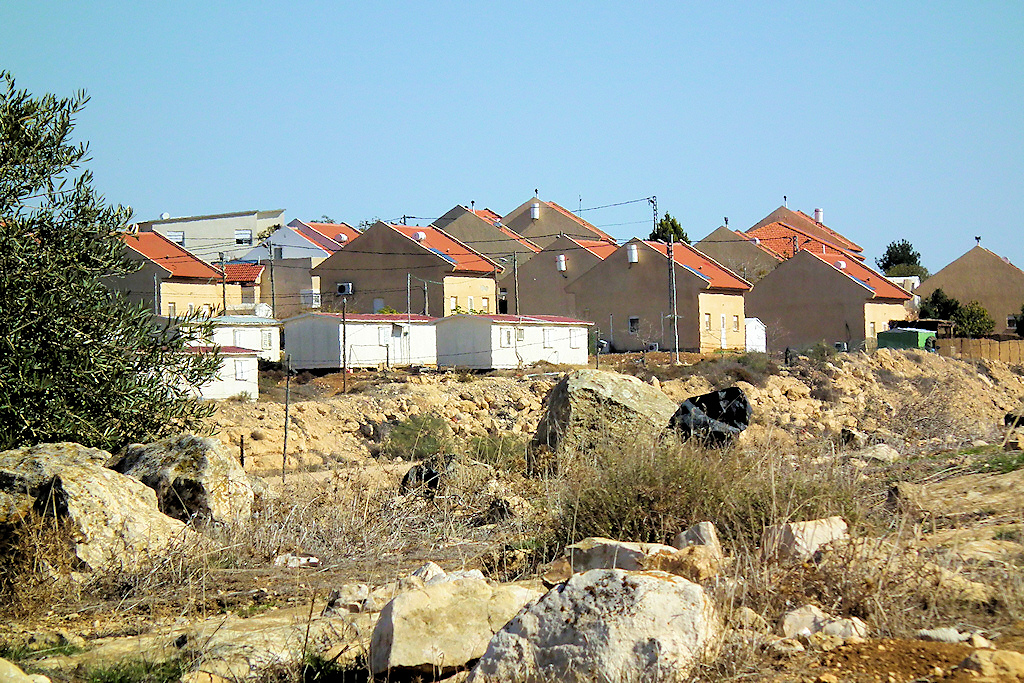
The 1990s Japanese-funded ‘peace road’. In front, the illegal Israeli settlement of Ma’ale Adumim, and in the distance, the Mount of Olives in East Jerusalem
Looking over the Judaean desert, with the Dead Sea and the montains of Jordan behind
I’m busy re-editing two of the three books I’ve written about Palestine (the first is here). Here’s a clip from the third, written in January 2012 when I was in Bethlehem on a five-month stint, and it might interest some of you. I’ll publish the second and third books online at some point soon.
On Saturday I went to a talk at the Alternative Information Centre in Beit Sahour (part of Bethlehem) about the Green Intifada. This was given by a British woman, Alice, who helps run a permaculture farm down below Beit Sahour called Bustan Qaraaqa. Here is one arena where the British and European alternative movement plays a significant role in Palestine and Jordan.
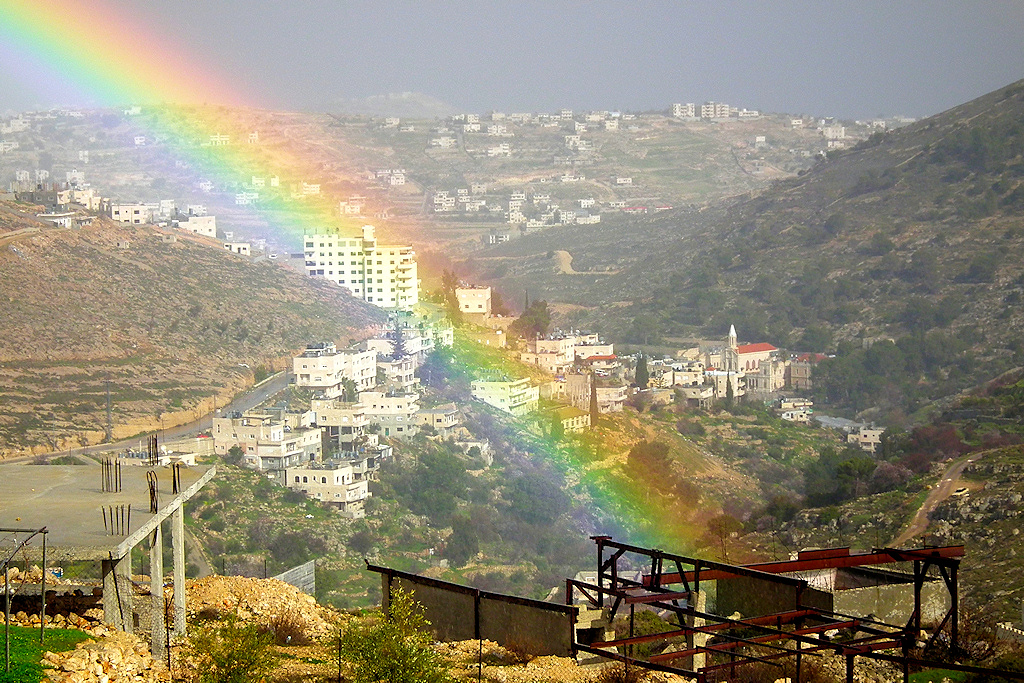
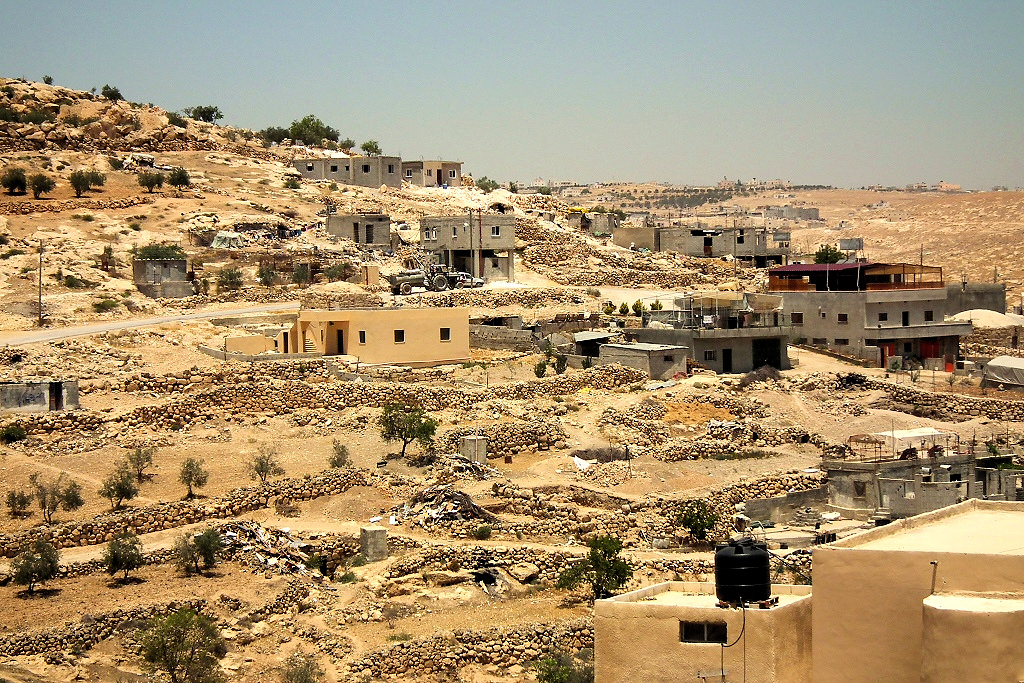
The village of Irtas, as seen from my kitchen window
Alice talked about the historic deforestation of the Middle East. It was recorded even in the Epic of Gilgamesh of 300 BCE, but it has been seriously rampant in recent times. Jordan’s forests were decimated a century ago to build the Hejaz railway from Damascus to Mecca, and Israel has focused on disabling Palestinians’ farming and food security for decades. Israel’s strategy has been to drive people off the land, especially in Area C, which is 62% of the West Bank, into the cities, ripping Palestinians away from their rural birthright.
This is happening right now in the Negev area of Israel, where Bedouin villages and lands are being destroyed and appropriated, and they’re being herded into townships to ‘civilise’ them and rip them away from their cultural roots. One Bedouin village has been destroyed by the Israelis and rebuilt by the Bedouin, helped by Israeli and international supporters, thirty times.
Palestine’s natural forests included oak, olive, cedar, pistachio, almond, fig, pine and moringa trees (moringa is both nutritional and medicinal). Many trees were domesticated and farmed long ago – figs in 9000 BCE, olives in 4000 and almonds in 3000. Sylvicultural products included frankincense, balsam and other medicinal extracts, and woodland-dependent herbs. The rise and fall of cultures in the Middle East has been intimately connected by historians with the health of forests.
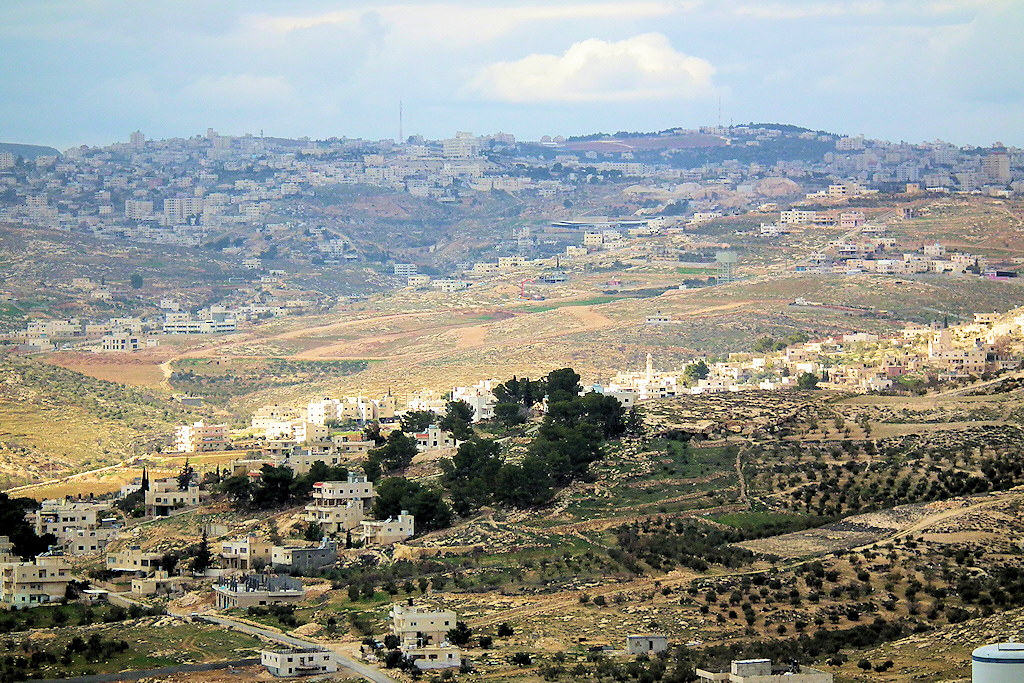
Looking toward Bethlehem from the Herodeon
What’s necessary is not just a revival of farmed trees but also a propagation of shade-inducing, humus-building, land-regenerating, soil-fixing un-farmed trees. This is difficult because the Israelis deliberately oppose and destroy such work – they often plant pine and eucalyptus plantations over old Palestinian villages and farmlands to judaise and ‘redeem’ the land. In doing so they also kill the sub-soil and render land useless to further farming by Palestinians.
When forests disappear, the water table sinks and rainfall declines, increasing desertification. Israeli settlement-building, often on hilltops, many of which were previously wooded, destroys water-sources, leading to rapid run-off and soil erosion lower down and causing rain to fail to infiltrate the ground and the water table.
They take water from the West Bank highland aquifers for irrigation and modern urban water-usage, charging Palestinians high rates when the sell it back to them and using the money to subsidise water prices for Israeli settlers. The Israeli offensive focuses systematically on disabling farmers and driving them off the land into towns or, preferably, out of the country.
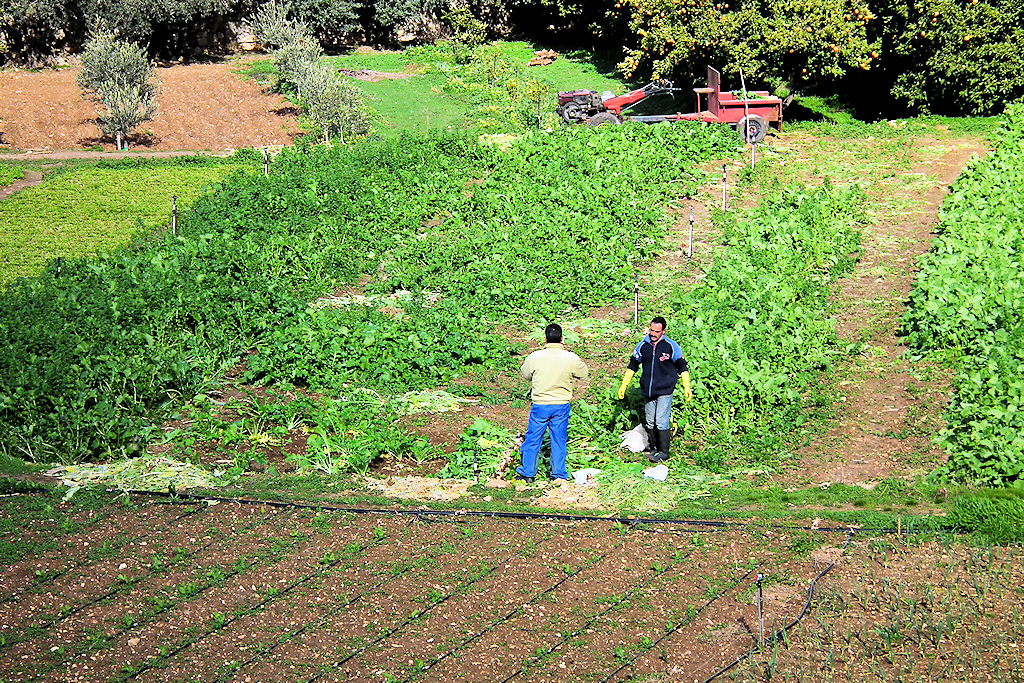
Irtas is Arabic, taken from the Greek word Hortas, which has the same root as ‘horticulture’. Irtas is a market-gardening village, founded 7,000 years ago.
Deforestation thus represents dispossession. But it started long ago, and one problem has been that, when armies have rampaged over the land – as in Roman times or during the Crusades – wrecking the land and destroying farming and village security, people stop investing effort in the longterm. They stop practising sylvicultural methods that would sustain the forests and farmland. Much of the hilly West Bank is festooned with ancient terracing which, if not maintained, falls apart, leading to soil erosion, land-defertilisation, loss of trees, lowering of water tables and agricultural decline.
So the revival of Palestine is intimately connected with a green intifada, a new kind of resistance movement that builds sustainability and re-fertilises the land. Except there’s a problem: Palestinians are hardly aware of the need for it. [I think this has changed quite a lot since I wrote this in 2012, especially amongst the young.] They tend to think that ecological action is superfluous to their more pressing human rights and material problems.
Ecology is something Westerners go on about which is irrelevant to them, or it’s a luxury consideration. Yet they suffer cancer from toxins, dense urban populations, land-loss, dependency on imported food, psychological damage arising from loss of emotional contact with wilderness and open space, a preponderance of litter and rubbish and a general social disempowerment which re-ruralisation could ameliorate.
So, somehow, it’s necessary to spark a new green awareness in Palestine, an awareness which gets incorporated into the resistance movement. By resistance I don’t mean warfare and polarisation but social-cultural revival amongst the Palestinian people, a strengthening of society such that, whatever is done to them, they have an increased resilience, adaptability and survival power.
Ecological revival is a core, not a peripheral issue: the whole world needs to understand this, but Palestinians in particular, with their special problem as an occupied, colonised people, need really to become leaders in this field. It is a strange yet karmic fact that both British people and Palestinians who have lived abroad and returned home become crucial catalysts of this.
This is the next level of the resistance movement in Palestine, the agenda for the coming generation. So good on you, Alice, for articulating this issue so clearly and doing your bit to spread the word – not least through the exemplary work they’re doing down at Bustan Qaraaqa.
Irtas. On the hill on the left is a Catholic monastery and in the distance on a hill is the illegal Israeli settlement of Efrat. Hope Flowers School is up the hill on the right, just outside the picture.
Before and after the lecture I met two delightful English ladies, ‘the witches of Beit Sahour’ – and Alice, a ‘green witch’ from North Wales, made a third. This was great, because suddenly I was with people with whom I could be open about things I usually remain quiet about.
Most Westerners and nearly all Palestinians don’t want to hear about my psychic work, about my being an astrologer, healer and political mystic, a dissident powered by vegetarian food, meditation and holistic attitudes, with a pedigree and a bunch of perspectives that are right off most people’s map. Not to mention the curled-copper, phi-ratio, anti-gravitational energy-harmoniser I wear round my neck, tucked under my shirt!
One of the witches asked me how I had started my involvement with Palestine. I thought a bit before answering and then came out with it. It was ETs and cosmic beings, the Council of Nine to be precise, in the early 1990s, that started the process. They put the situation on planet Earth into clear perspective, also clearly stating that I had an appointment with this land which I should follow up.
This was followed in the late 1990s by the late Pam Perry, a disabled Glastonbury astrologer, Pisces, who campaigned for Palestine by phone and laptop from her bed, who benignly tricked me into pursuing this sometimes-futile game, bless her. Together with Sheikh Bukhari, a Palestinian, and Eliyahu McLean, an observant Jew, we founded Jerusalem Peacemakers in 2002.
It was also a calling from at least three former lives involved in this region, always a as foreigner (as a Sumerian, a Nubian and a Kurd) yet playing a part in the history of the Jewish people, a jiggling of the soul and a grinding process in my heart which caused me to cut out of the bill-paying, treadmill-treading duties of a typical Westerner and to get involved with this mess. Well, my maternal grandfather was in General Allenby’s army of invasion in WW1, and my father fought in Egypt, so it’s in my genes too.
The ancient holy well at Irtas
They lit up when I told them this, and suddenly they came out with their own secrets about the consciousness and healing work they do. One of them is married to a Palestinian (a nice chap) and the other works as a legal advisor and researcher for a rights organisation in Bethlehem called Badil – but even there they keep quiet about their core beliefs. Their activities and beliefs are not deemed credible, whether from a Western-rationalist viewpoint, from a Muslim viewpoint or from a modernist-Palestinian viewpoint. So people like us keep quiet. But we had a profound sharing together, like a secret cabal, and it was refreshing.
We had a fine time in our corner at the AIC until it was time to go home – Bethlehem closes down early, and the chances of finding a taxi back to Al Khader decrease rapidly after 10pm. Nevertheless, as I wandered out, steeling myself for a long and chilly wait, a taxi drove past and stopped for me. It turned out, as is nowadays increasingly the case, this taxi-driver had carried me before in a former year, and we chattered on the way back, he in his broken English and me in my patchy Arabic, until we reached the school. The lift to the top floor was defunct, thanks to the recent electricity cuts, so I climbed the stairs. There was another electricity cut while I was writing this piece, and I gave thanks for being on a laptop with a good battery!
Hot water bottle time, and the customary shivering as my bed warmed up. Ah, I love living on Planet Earth – well, sometimes, at least. Other times, my guardian angels watch me, fascinated, as I struggle and persevere through the facts of worldly existence, and wondering what’s to come next.
Well, inshallah, I have a visitor from Glastonbury (Liz Pearson) coming to stay, and a report to write, and a load of other issues to get to grips with. Now it’s time to put the kettle on – classically bloody British behaviour. Would you care for a cup of tea in Bethlehem?
Ooops, the lights have just gone out again. The mobile phone network goes down too, at the same time. Well, one thing is for sure: it’s probably not the Israelis – it’s crummy power equipment, suffering a hangover after the wind and rain. A funny consequence of this is that many of my neighbours emerge from their houses when this happens, because their electric heaters and TVs have gone off! We really do need a green intifada, and PDQ.
Here’s something I wrote 12 years ago in a book I did about Palestine which was never published. A short interesting read from that time…
An Eclipse and a visit to At Tuwani, 16th June 2011
I discovered a setting on my camera that I didn’t know existed until the very end of the lunar eclipse. Eclipses can be times of revelation! It removed the problem, classic for digital cameras, where the contrast between the light and the dark sides of the moon is too emphasised for the subtle details of the moon’s pocked surface to be seen. Even so, witnessing the eclipse from my eyrie at the top of the school was a privilege.
When it started there was a full-scale racket going on in Al Khader – loud music and the customary summer evening pandemonium of this town, spiced with the barking of dogs and the croaking of geckos. But as a slice began to be cut from the moon, gracefully arching over the Israeli watchtower, the area fell silent. Traffic disappeared, the dogs went quiet and all became still. Except for the shutter of my camera. It was late by the time it was over.
Maram Issa (right)
That didn’t stop me waking up at 6.30 the next morning. I’m not sure why I’m waking up so early at present. But it permitted me to rise and process my photos, posting them on Facebook – and the ‘likes’ started rolling in. I had breakfast and waited for Maram, who was picking me up at nine. By ten, having filled time and had a conversation with Mohammed, the school’s educational director, I rang Maram. Oh dear, car troubles. A taxi arrived to pick me up, then a call came to say hold on to the taxi and stay there – we’re coming. Ibrahim’s car soon arrived and Maram and I bundled into the taxi while Ibrahim went into the school, lugging his laptop, bag and bundles of files.
Off we went down the main road toward Hebron. The area south of Bethlehem is interesting because Israelis and Palestinians live quite intermixed with each other, unseparated by the separation wall. This area lies inside the Green Line, the official boundary between Israel and Palestine. This is a collection of Israeli settlements called the Etzion Bloc, interspersed with old Palestinian villages. Or perhaps the other way round, since the Palestinian villages have been there far longer. It’s quite a green, agricultural area.
At Tuwani
We proceeded around Hebron, the third largest Palestinian city after East Jerusalem and Gaza City and the biggest in the West Bank, past Qiryat Arba, an Israeli settlement outside Hebron, into a hilly, rocky district that turned browner as we drove south. This much-disputed area is where the most assertive wing of the Israeli settler movement is, stage by stage, staking out its claim, and where many of the most outrageous settler atrocities take place. We were heading for a village, At Tuwani, where resistance to settlers is strongest. It’s also the place where the women’s embroidery project is located.
The settlement of Ma’on
As we neared the village Maram pointed out several Israeli settlements, such as Karmel and Ma’on, which periodically crop up in the news, home to some of the most assertive settlers that exist. They’re so aggressive that many Israelis disown them, and the Knesset (Israeli parliament) uncharacteristically declared these settlements illegal. That made no difference. This said, a schizoid situation holds sway whereby the Israeli government pays for the building of the settlements (with American money), and the army makes symbolic gestures to clear them, to respond to foreign pressures, while actually reinforcing them and doing donkey-work for them – such as clearing Palestinians off land the settlers want, helping destroy trees and farmland, and ‘defending’ settlers whenever Palestinians push back.
There’s a double American involvement here. American money supports these frontline settlements, and many of the settlers are of American origin. But on the other side, Americans like Whit help the Palestinians, as also do American humanitarians such as the Christian Peacemaker Teams, who accompany and protect Palestinians in risky situations. America fighting against itself in foreign lands? The West plays a strange double game, advocating peace and supplying weapons at the same time.
Whit
We attended a meeting of the women. Whit and Paula were with some of the women from Jaffa and the Israeli production organiser – a nice lady who sits in the more enlightened and principled sector of Israeli society. Whit spoke, various of the ladies spoke, I added my bit and a Palestinian activist spoke.
Then the activist took us on a tour. He first explained the situation. This was tragic stuff. These are old villages going back centuries. The people of Tuwani are simple folk, many of them illiterate. For the last twenty or more years they have been under pressure from the settlers, who have been chopping down olive trees, burning farmland, demolishing the local mosque and quite a few houses, beating up farmers and children, blockading the village and generally making life hell for the villagers so that they leave. The Israeli army has played its part: army units down here are filled with nationalist settlers, opting to be posted here to reinforce the settler incursions.
But the villagers aren’t budging, even though they have put up with a lot over the years. One of the things that makes the settlers pressure the villagers of Tuwani and equally makes the villagers resist them is that two mountain tracks lead through Tuwani to a number of other villages. If the settlers close down Tuwani, those other villages die too.
The men of Tuwani
We were taken up a rocky, dry hill – the trees had been burned down and uprooted by settlers – to see the settlement of Ma’on just over on the other side, a half mile from the village. This settlement was planted on the villagers’ own land. An outpost of caravans in the trees, away from the settlers, was pointed out – apparently these settlers were so radical and insistent that even the settlers of Ma’on had thrown them out.
Whit asked the Palestinian activist how he had got involved. The activist explained how, when he was young, he had witnessed his mother being beaten up by soldiers. Running to rescue her, he was peppered with bullets from settlers and troops, who shot around his legs as he ran. Later he got his mother to hospital. She told him not to be angry and fight back because she would then lose him – he would lose his life or freedom. He asked her what he then should do. She said she didn’t know, but please find another way.
So he studied and adopted non-violent direct action, eventually moving down here once his mother died. He was joined by the Christian Peacemakers and some Italian Catholic activists. I met one Italian who had been here two years, with whom I discussed the stresses and strains of regularly going back and forth between Palestine and Europe and interfacing two very different worlds. It was a brotherly sharing.
He said his time in Palestine was coming to an end because he wanted to get out before he was blacklisted and thrown out forever – and he needed to go home to earn money. As it was, he was here on three-month tourist visas, leaving every three months, returning to Italy for a month and then coming back – but this ploy wasn’t going to last much longer. He was sad about that. We commiserated about how we both had fallen in love with our friends in Palestine, missing them when we were away, yet neither of us could move here.
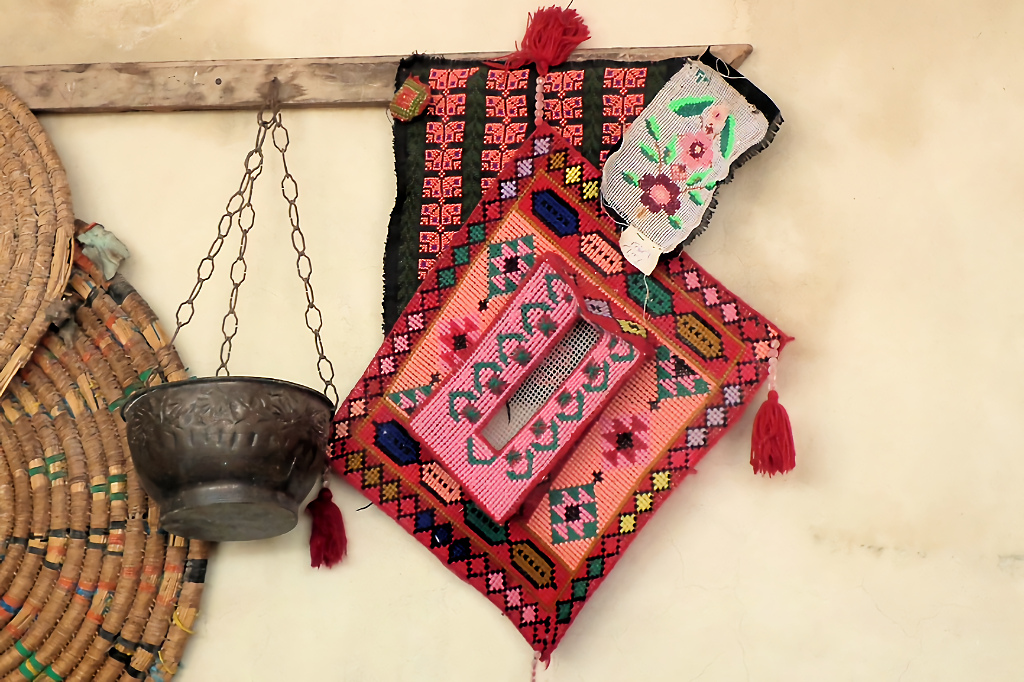
The villagers gave us lunch – far more than we could eat – and showed us other items of their work. Lovely embroidered dresses, bags, belts and other things. I bought a dress for each of my three grown-up daughters, crossing my fingers that the dresses would fit them and suit their tastes (in the end, I’m not sure they did). They weren’t suitable for ordinary wear – they require a graceful style of moving that doesn’t work in the West – or for party wear, but they’re useful for pottering around the house in a relaxed, off-duty kind of way. All of the money would go to the village women: as a foreigner, one must do judicious spending with a view to helping people stay alive.
I would have liked to stay longer, but by mid-afternoon it was time to go – Ibrahim had come to pick us up. I was sad to leave these people – they need reinforcement, interaction and solidarity. But my duties lay back in Bethlehem with Hope Flowers. So we cannonaded up the road past Hebron and I was dropped at the school. I took a break in the late-afternoon sun on the flat roof of the school, reading. Then back to work.
I was nearly half-way through my month-long stay. It was going to be challenging to finish everything. There were friends to visit too, in Hebron, Jerusalem and Jenin. Ah, time: I was reminded of its passing by the outbreak of the calling to prayers from the local mosques. This isn’t just a religious thing: it’s the way Muslims section up their day. Even I, an infidel Westerner, time my day by the muezzins’ amplified chanting – the calling to prayers divides the day into periods which, in this climate, work well.
The previous night, as the eclipse gathered strength and the world went quiet, one muezzin was chanting the ninety-nine names of God. I guess it’s ninety-nine because the hundredth is beyond expression. These ninety-nine names describe divinity in all its aspects. There is, to Muslims, but one God, with no other complications – no sons, holy ghosts, angels or cherubim – just Allah, with ninety-nine facets. By the way, Arab Christians, the very earliest of Christians, use the term Allah as well as Muslims – it’s not uniquely a Muslim term. And it is pronounced Al-Lah. The God.
As I concluded writing this piece, a donkey called out in accidental synchrony with the muezzin, croaking plaintively, reminding people it was there. Or perhaps this was Allah’s ninety-nine names elucidated in donkeyese. Great Spirit expresses itself in remarkable ways.
I wrote this piece while working at the Hope Flowers School in Bethlehem in the West Bank 12 years ago. Here’s the school’s website and here’s a piece I wrote about Hope Flowers and its history and background. For my 2012 book Pictures of Palestine – a humanitarian blogging from Bethlehem, go here.


























 Notes from the Far Beyond
You must be logged in to post a comment.