All about the warfare, strife and trouble we find ourselves in today – the thoughts of an old peace-freak.
A Palestinian Dove
It’s like a virus in the world psyche, ready to pounce on any population that’s losing its way, or damaged, or hurt, or susceptible.
Yet some societies are strong in themselves. Even if they are invaded and occupied, they are not beaten.
What stops many wars is a deep tiredness, a wish to go home and get a life. A societal consensus forms, building resistance to the virus of conflict – an unspoken immunity that decides not to go back there again.
In this episode there’s a moving contribution from two old friends, the late Jaki Whitren and John Cartwright of the Court of Miracles, the greatest rock band you never heard of. They’re making music in heaven now.
Introduced by a stream in Botrea Woods and outroduced by the wondrous birds of Grumbla, Cornwall.
A few days ago I thought out loud that I had little to say. Well, this turned out to be incorrect. Forgive me for that! Goes to show, I too have my illusions. Here’s a new Pod from the Far Beyond.
I went on a slow stagger down to the pleasantly unkempt woods below the farm where I live. I sat next to a big hazel tree that’s far older than me, where I usually go. It leans over and there’s a sitting place amidst its roots which is just right for me. It’s my outside broadcast studio, where quite a few podcasts have been made.
This one is all about the battle for the hearts and minds of humanity. This is something that is unfolding behind and beneath the torrent of worrying events that we experience today.
‘The path of excess leads to the palace of wisdom’. Thus said William Blake over two centuries ago. Well, true. But do we really need to pursue excess in order to achieve wisdom? It causes a lot of damage to our world and to hearts and minds. There is another way.
As a peacemaker (more correctly, a peacebuilder) there hasn’t been a lot of progress since the days of Vietnam and Northern Ireland – the issues I and many others of my postwar generation started out with. The warmakers are still very much at it.
But the matter is still open. We’re coming to the time. And this podcast is about that. It’s here on Spotify:
or on my podcast page, where you’ll also find 60-odd Paldy-podcasts on a range of subjects:
In the weeks and months to follow, I might well come up with further insights about the future. Despite everything, I’m still an optimist. Though we’re in a strange, perverse time of history where humanity is bring taught how not to do things, and it can seem as if everything is going wrong.
One of the themes of my life has been social healing – stimulating social and community psycho-spiritual growth. This took shape through the camps of the 1980s and 1990s, community events and early online social networking in Glastonbury and working at the Hope Flowers School in Bethlehem – it was, and still is, focused on trauma recovery and social reconstruction in the militarily occupied West Bank of Palestine.
Modernity has brought individualism with it – the development of an urban-industrial society required the breakdown of community bonds and social sharing. Nowadays so individuated, each responsible for our own lives whether or not we like it, we tend to over-personalise our hurts, complexes and issues. Some of us take more personal responsibility than is due too, out of compassion, guilt or charitable activism.
But this individualism arises from a social-cultural pressure, like an endemic viral infection that is well embedded in the rich world, though in some societies it has only recently hit them, not least through the medium of the mobile phone. Such societies start breaking down when the brainiest and most enterprising of their members start leaving, heading for cities, jobs and universities.
Many of our difficulties arise from being part of a society, a culture, and their institutions, values and customs – and their webs of power. So if, for example, you grow spiritually or in terms of human potential, people and situations can frequently obstruct or resist these changes in you, or cause you disadvantage, and it gets difficult, and profound choices arise.
One of them is: should I pursue my own path or should I stay in this situation to try to improve things over time? This is not easily answered – it’s not just a matter of selfishness, and it goes much deeper. Nowadays many people leave their communities in order to work in cities or abroad, and to send remittances back home to help the family, and they perceive it as their only option. Many people in Gaza would like to leave, but also they don’t want to leave their families (and the Egyptians charge $5,000 per person to get out of Gaza).
This is a dilemma that all of us variously face at times – a conflict between fitting in or doing your own thing that is a big factor in social churn, divorce, family and community breakup – and it has very mixed outcomes. This inner struggle is a side-effect of intense change.
Nelson Mandela, who took a big destiny on his shoulders, once wrote that he felt he had failed to resolve key dimension of this question: for him it was a conflict between duty to his family and duty to his people. I’ve faced this question quite a few times and, looking back, I still have mixed feelings about it.
But in recent decades, those of us who are more awake than most people have been faced with a barrage of cultural, social and institutional opposition to or rejection of the kind of beliefs we hold. These beliefs have a lot of variety, colour, contradiction and value to them, but in the end they all boil down to a key issue: whether or how much to prioritise either personal or collective benefit.
Another issue lurks behind this, summed up in Jesus’ words, ‘by their works shall you know them‘. Not ideas, advocacy, explanations, disinformation or ideology but actual actions and the way we walk our talk.
The future is not just about economics, resources, AI, ecosystems, carbon sequestering or even space travel. At the heart of all these issues lies the small matter of social healing. For me, it started off during ‘the Troubles’, a student uprising at the London School of Economics, where I was a student. [For a 15-min video about it, try this.] We got squelched. As I experienced this, feeling the impact of suppression of our movement for change, I saw also how we ourselves had screwed up our own cause. People had slipped into endless argument, disagreement and a confrontative approach to protest, and there were regrettable scenes mixed in amongst the brilliance, excitement and flowering that went on at the heart of our attempted revolution.
It wasn’t at the time clear to me exactly why and how this had happened, but it set me on a path. During the 1970s, in my twenties, I went through a lot of inner growth, learning more about awareness, psychotherapy and social dynamics. I went through my own process, where I found myself screwing up even when I didn’t mean to, and faced with a mountain of young person’s acute dilemmas that sometimes felt too big to handle.
At one stage, during my Saturn Return around age 29, I contemplated suicide. Actually it was a ruthless truth process and soul-searching, and it led me to committing to my calling. That calling wasn’t clear and distinct, but I had to make myself available and willing to be given a task. The shape and expression of it surfaced within a few years.
I had accumulated a bundle of experiences during my teens and twenties that made me feel like a jack of all trades and a master of none, but the fascinating thing was that when my mission did take shape, all of those skills and abilities gelled together, suddenly making sense. I had the full range of skills needed. It was as if life had been preparing me for it without my knowing.
Looking across St Ives Bay toward Godrevy lighthouse
Fast-forward to the 1980s, and something drove me to start the camps movement, as well as a stream of conferences and gatherings in Glastonbury that developed thereafter. I didn’t know this was going to happen – I was just driven, or shoe-horned, even to some extent tricked into it. The Great Cosmic Trickster has greater designs than we can see, and sometimes we must be thrown into things and presented with a choiceless choice.
It was an old friend, Jamie George, who did it. He asked me to help him organise a gathering in the Assembly Rooms in 1983. At the time they were threatened with demolition, and several of us set about creating events there, to bring energy into it and stop the demolition. One late-summer’s evening Jamie and I sat in his garden brainstorming it and coming up with an innovative formula for running the gathering. It’s what came to be called circle-working. Though it’s as old as the hills, ancient and archetypal, circle-working was not at that time practiced in our society, whether alternative or ‘straight’.
Time went on, Jamie beetled off, leaving me to it and, before long, I and a squad of Glastonbury friends I brought together were organising week-long holistic educational camps, usually for 100-500 people. Each had a theme (Astrology, Earth Mysteries, Music and Dance and, later, Arts and Crafts, Healing, Ceremony), with transformative intent, group process and a foundation of circle-working – mainly use of the talking stick.[3] We were improvising and innovating in a seat-of-the-pants kind of way, but it was dynamite.
In the 1990s I took this further with the Hundredth Monkey Project – consciousness-work camps specifically addressing world problems of the time, where we applied to world issues methods and ways drawn from the personal-growth sphere. Again, it was based on circle-working.
One of the big unexpected discoveries we made was this: by focusing on ‘world work’, personal growth was vastly accelerated as a by-product. The idea was to set aside our personal growth, to serve a greater sphere – the wider world. But for participants the personal growth implications were enormous. In fact, this led to an unforeseen problem, because each summer camp had such a transformative effect on participants that they tended not to return in later years – it had had such big consequences for them that they were already ‘cooked’ and busy getting on with what had started for them as a result of the camp.
But there was more. Here we come to the social healing bit. For me, it was a big learning. The idea with camps was to create an accelerated growth environment in which people could truly step back into themselves and flower as souls. In this we were very successful. It wasn’t just some people who experienced breakthroughs: it was everyone, without exception. Together, through social bonding and working at it together, we had lifted each other up – we had risen together.
Some of the best camps were those that were the most challenged. We had no shortage of weather events hitting us, and also, in 1986, we had the Chernobyl meltdown, which started on the very day that one of the camps began. Yet these experiences pulled us together by shoving us through the grinder. They forced everyone to become really sure why they were there. It generated commitment and group focus, hundred-percentness.
There was a classic moment in 1987, the morning after a Force Eight gale had ripped through on the very first night of a camp in Wales. We had downed all marquees and tents and crammed into the geodesic domes we had, since these were the only safe structures in a gale and monsoon. For some people this was a nightmarish experience – one of those dark, threatening nights with lashing rain and furious winds that can go on forever, bringing up loads of fear and desolation.
Next morning, the storm had gone. All was still, the sun was breaking through and everything was dripping and remarkably colourful, in a sopping, late-summer way. I was standing there outside, blinking and assessing the scene, having hosted fourteen people in my two-person dome. A new camper was standing with me, looking wan and pale, telling me she couldn’t handle this and she was going to go home.
I was quiet, wondering how to respond when, suddenly, from upfield, came a shout, “Tea, anyone?“, and one of the site crew processed down the field like a butler, with a big tray of mugs of tea. It was a poignant moment. The lady just broke down, crying her eyes out. And she loved her tea, and she stayed with us. And her life changed. She made a growth choice there and then – the atmosphere of the camp had prised her open. That’s just one story of many such epiphanies. Another camper once said, “This is what I have always dreamed of, but never thought it could actually happen“.
St Ives, from Hayle Towans
Though the success of the camps was very much teamwork, resting on the qualities and experience of our camp crews and the innate wisdom of participants, as the key instigator of all this I was going through big epiphanies too. Not just personal, but concerning this matter of social healing.
At every camp there would be a crunch-and-breakthrough point. At the early camps it often took about five days but later on it came after three or so, as the group atmosphere of the camps evolved. There was a point where people had settled into camping, been through a few days of it, and they were lighting up, feeling part of each other’s lives and gaining momentum. There was a rising feeling of this is it, that we were in the right place at the right time, doing the right thing. As if this was meant to be happening. As if this was a model for a future society, where everyone got on, worked together, served each other and enjoyed each other’s presence. The guards came down, shared trust rose, and a brightness started shining in people’s eyes.
And then, something would happen. Often it would come out of nowhere.
It could have been someone snoring through the night and disturbing others (a tolerance issue). One year, a person slept around and spread a sexual disease – a big controversy bringing up loads of stuff. Or it could be someone suffering withdrawal symptoms from meat – the food was vegetarian only. Or tents leaked in the night. Or kids got into a scrap. Or, one year, the Hippy Convoy arrived at the gate, pursued from Savernake Forest by police, demanding that we rescue them and give them a place to camp.
Of course, this fell on me and key members of the crew and facilitators to sort out – to deal with people placing blame or getting upset, and quite often it involved complex, reverberating community situations. But there was enough love and care around for these societal explosions to work through. We turned it into a group process to turn problems into assets. It wasn’t one person’s problem – it was our problem, and all of us were stakeholders, together.
I’m glad to say that, on the whole, we succeeded in this – especially by the 1990s at the M100 camps. This arose from a buildup of collective skill and experience that could contain and channel social energy in all sorts of ways. Also most participants were willing to go that way, contributing their own gifts and inputs, while the rest gave it a try, going along with it and soon realising that this was something amazing to be part of. It became a cauldron of mutualised contribution – powerful sharings and dynamics during talking-stick sessions, or in afternoon workshops, or around campfires.
This is how social healing works. It works particularly through the medium of crisis and shock, precipitated particularly by unforeseen things against which we have few defences. A recent example, in the news recently, was a ship that destroyed a bridge, killed people and blocked a major port in Baltimore, USA – something no one was prepared for. It’s the kind of event that says something. No doubt people will apportion blame for this disaster but, if we’re honest, if we want to have the fruits and luxuries of a developed civilisation, this is what will happen, no matter who actually does it.
It’s not them – it’s us. This truth lies at the nub of social healing. This is a key issue today in the collective psyche (with Pluto in Aquarius for two decades from 2023 to 2043): there are those who opt toward collective, mutually-empathetic solutions and those who resort to self-interest or sectoral interest. Both options have their costs and benefits. But the costs of self-interest are nowadays outweighing their benefits – so historically we’re heading toward more collective awareness.
Human society as a whole has an endemic case of PTSD. History has been traumatic, pretty much everywhere. The pain and behavioural aberrations that arise from this are rooted not just in past events that we know and remember, but also in collective experiences that are long forgotten.
I have written before about a time in Britain around 1200 BCE, over three millennia ago, when the people of Britain underwent a mass trauma which then played a large part in all that happened afterwards, including four invasions of our country over a thousand year period. This trauma happened at the end of the megalithic period around 1200. The megalithic period had stretched back 2,500 years up to that point. A spell was broken, a mainly-sustainable, cooperative, enspirited society fell, and it was replaced by insecurity, social decline, warlords, weaponry, territorialism and grief (also climate change). That’s big.
Today, many young people today won’t remember or care a lot about what happened in WW1 and WW2 – they’re consigned to history – but these two traumas are programmed deeply in their own genes, contributing to their current preoccupations and anxieties – they are descendants of survivors who went through a very hard time. In my own case, my mother spent two years under the Blitz in London and Swansea, my father lost a leg in Egypt, and my grandfathers were in the Battle of the Somme and the British invasion of Iraq and Palestine.
Yet the addictive consumerism that many young activists point out today was induced by trauma, horror and shortage, and the consequent urge, emerging in the 1950s-60s, to cover it all over with food, security, holidays and overconsumption.
So solving a major component of the ecological-climatic crisis involves deep social healing – the healing of trauma and its effects. Not just trauma, but cultural beliefs, intolerances and insecurities, identity and diversity issues and many more.
This healing process won’t happen overnight – it’s multi-generational. But we need to start it, and somehow keep it manageable by building up social processing mechanisms and a body of experience in all sectors of society which can ‘hold the energy’ and help it work through in ways that don’t turn destructive.
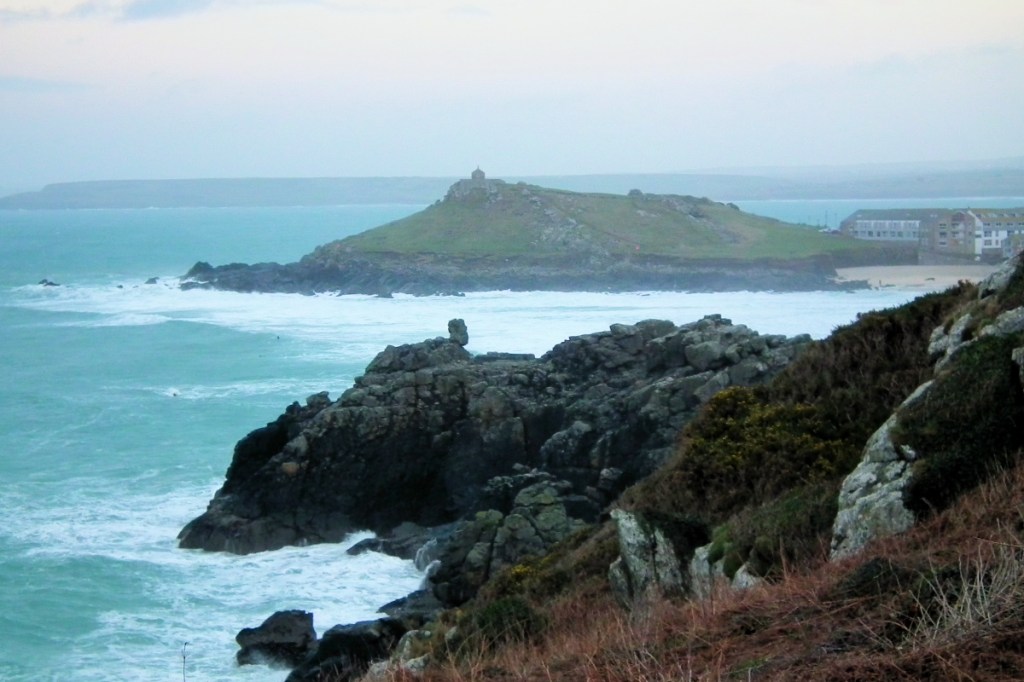
St Ives Head, a Neolithic and Iron Age cliff sanctuary
War is a critical issue, as part of this. I read recently that a study had shown that over 90% of Hamas fighters had experienced their fathers being killed. Little explanation is needed – it’s all about pain and how we respond to it. And, take note: if that had been you, you’d probably land up being such a fighter too. Either that, or you might become an exceptionally brave and driven peacemaker if you so chose – one of those who are rarely mentioned in the news.
The world teeters on an edge where a very big collective decision is needed, regarding war. While explosions and horrors go on, other big world issues cannot progress. The world’s sensitivities are dulled. Resources are misdirected into ‘defence’ and wasted in both destruction and reconstruction. Our moral compunction is overlaid with anger and dismay. Our capacity to see that we all sail in the same boat is obscured. We fall for the belief that other people and nations are against us and a danger to us. This is a mass-psychological complex.
There are elements in this world who wish to crank up this belief too – not heal it. Such a belief does have substance, but there are other ways of dealing with it. It’s not just a matter of diplomacy but one of deep social change. Some people deliberately stoke up division and conflict – our good friend Benjamin Natanyahu is a classic case, but he’s by no means unique. Such people have a vengeance to carry out on a world that has mistreated them. Or they’re on a power trip, though this often arises from past pain too. Or they and their oligarch-team are struggling to stay on top. Or they can’t drop the addiction to conflict (or the money).
The majority of people have grudgingly fallen for the habit of accepting division, conflict and war – they regret seeing their children die, but they still fall into this pattern of belief, even financing their own children’s deaths through their work and taxes. Some nations rely on a psychology of fear and division to justify their existence. Some oligarchies cannot exist without it.
In Britain, divide and rule, a power-imposition pattern taught to us a long time ago by our conquerors the Romans and the Normans and nowadays embodied in the ethics of the Conservative party, is a pattern arising from trauma. It’s not uncommon that imperialistic nations – Britain, Russia, China, Turkey, USA, Netherlands, France, Israel and others – generated the historic urge to conquer as a result of being conquered or oppressed themselves, further back in time.
But this is not the only option: Canada, Sweden, Norway, Denmark, Costa Rica, and to some extent Germany and Japan, tend the other way. None of these nations are angels, but they see things differently. Peacebuilding is not an impossible task.
Godrevy lighthouse
We don’t commit acts of warfare only militarily – nowadays economic and psychological warfare are big things.
On the economic front, we smug Brits, we run a neat string of offshore banking centres for the sequestering of wealth and the unaccounted processing of enormous transactions. That’s one of our specialisms – clean, kinda legal and smart corruption. Around one third of all the world’s money goes there. We have straight-laced, official, smart, seemingly law-abiding banks in the City of London, though those same banks have shadow subsidiaries in the Caymans, Belize, Virgin Islands, Singapore, Isle of Man or Jersey to handle the unaccounted stuff (everything from Apple profits to drug barons’ billions to Nigerian oligarchs’ money-stashes to corporate mega-transactions). Good business. However, not good for people and planet (or national government tax-takes).
These kinds of obstructions are not insurmountable: it requires people to hang together, clarify and state our collective wisdom and preference, and vote with our feet (or even fingers). It requires electoral swings, mass consumer choices, campaigns and also – this is the critical one that leads to real action and change – the right kind of response to events and defining moments.
We’ve had one recently with Gaza. All of the demos and campaigns of recent months have not really paid off in terms of ceasefires. But in terms of historic swings and consensual tiltings, Gaza represents a turning-point. The failure of popular will, globally, has consolidated a deeper shift underneath which is far more firm and solid. It’s not specifically about Gaza, though Gaza, following on from Mariupol and Aleppo, has triggered it. It’s about large-scale destruction itself, and people as victims of it. It comes at the same time as the film Oppenheimer and a range of other events that make this a defining moment or period. Doing blanket devastation of this kind will not be so easy in future.
A tide is turning, even if it takes a generation to do so. When tides are turning, nothing much happens except for powerful undercurrents and a buildup of potential for a full-flux tidal flow to follow. That’s what could be happening here. It depends on the world public to carry this through without sitting back, believing the job is done, or forgetting because of the pressure of other concerns.
Hence, in the Sunday meditations, I’ve sometimes suggested building and consolidating a certain thought or image, since strengthening such thoughts in collective consciousness – such as reconciliation or justice – is a key part of this process. It’s all a matter of where the centre of gravity, where the tilting point in the collective psyche, stands. Gaza has shifted it. The sacrifice Gazans are making is not entirely fruitless.
Forty years ago the Greenham Women surrounded the USAF cruise missile base at Greenham Common. They made a really strong point that hit home in the hearts and minds of many people. The base didn’t close right then because something larger was happening – the end of the Cold War, an historic process that came pretty quickly once it came. The base closed during the 1990s. The women’s action worked, even though most scepto-pundits continue to believe there was no relationship between the women’s protests and the geopolitical change that followed around seven years later. Or perhaps it was just chance. Yeah, sure. But there was a connection: the women put in the work on a psycho-spiritual level which gave a big shove of momentum, alongside the efforts of Solidarinosz in Poland and other movements bringing about the Velvet Revolutions. The Iron Curtain just so happened to come down – and in history, seven years is a blink of an eye.
This is how it works. It’s in the psyche of humanity, the collective unconscious. That’s how change comes. A strange twist might also be this: when the moment comes, the actual ignition-event that catalyses such a shift could be quite small and unexpected, in a place and from a source that most people don’t anticipate until it pops. Then suddenly a widlfire starts.
Remember the young Tunisian street seller, Mohamed Bouazizi, who set himself alight and sparked the Arab Revolutions? Martyrdom worked for him and he set alight a tidal surge across the Muslim world that has been tamped down for now but it has not gone out. It’s an historic process, and many threads and factors are involved.
Newton’s third law applies to the course of history: to every action there is an equal and opposite reaction. Yet, while the wheel turns round and round there is a net movement in a prevailing direction. This is one reason why we need to give thanks for the assholes and badguys of this world: they prompt us to pull our fingers out. Because if we don’t, they’ll carry on. They exist because we allow them to exist. They embody the ghouls and devils within the collective psyches of nations and the world, and it is here that, at root, change and immunity need to develop.
Historic processes can be accelerated, and one day in the coming decades (my astrologer’s guess is around 2048-65), we’re heading for a time of intensity, of going through the mangle. We’re already going through it, but there’s more to come, and it’ll get bigger. We can make this easier or more difficult – that’s the main option available. It depends how much we Earth humanoids decide to agree. Or at least to agree to disagree while cooperating over the essentials.
The big historic change we’re going through this century involves addressing issues that go back centuries and millennia. In essence, it’s a transformation from a competitive to a cooperative collective mindset, society and civilisation. Because we’re all in the same boat, and the boat is now rather crowded and unstable.
Every Sunday at 7-7.30pm GMT I and a morphing collection of people meditate together at the same time, wherever we live. The different times in different countries are below.
You’re welcome to join us. There’s no prescribed method or mantra: just do the kind of meditation, innerwork, prayer or mindfulness you usually do.
What connects us us that we’re doing it together and we’re all motivated to contribute to raising the energy and awareness level of our world, to aid in resolution of its compound issues.
Should it interest you, I’ve recently done a 30-min podcast sharing some thoughts on meditation, and that’s found here.
Come and join us, from a sitting place in your world, to be together in the zone. It happens once a week without fail, same time, same space. Join us whenever you can, and if you’re able to do it regularly you’ll find that something starts lifting off…
Saturn is currently in Pisces for two years – it returns here once every 28 years. The last times were 1965-66 and 1994-5. At these times terrible wars were going on (Vietnam and Bosnia) yet these were also times for the seeding of new things. Similar is the case today. These wars show humanity how not to do things, and they oblige deep-level decisions of principle.
In the Mid-1960s, today’s modern ‘global village’ period started, and in the Mid-90s was born the digital era and mass travel. Now we stand on the edge of another cycle taking us to 2053-54, when the Millennials will be old and today’s teenagers will be running around being busily middle-aged.
Pisces concerns the vision and the principles by which future developments will unfold. Saturn in Pisces is about doing the prep work before the action starts. It’s about seeds and their pre-germination arousing. It’s also about the matter of war and peace.
It’s a time for firming up the possibilities and groundrules for the next phase.
Perhaps the international figure who at present gives the most valuable running commentary on the state of the world and its prospects is Antonio Guterres, the UN Secretary General. His pleas frequently fall on closed ears, but he’s the one who is spelling it out globally, speaking for Saturn in Pisces.
With love, Palden.
Current meditation times, on Sundays: UK 7-7.30pm GMT W Europe 8-8.30pm E Europe and the Levant 9-9.30pm Brazil-Argentina 4-4.30pm EST, Cuba, Jamaica, Colombia 2-2.30pm PST North America 11-11.30am
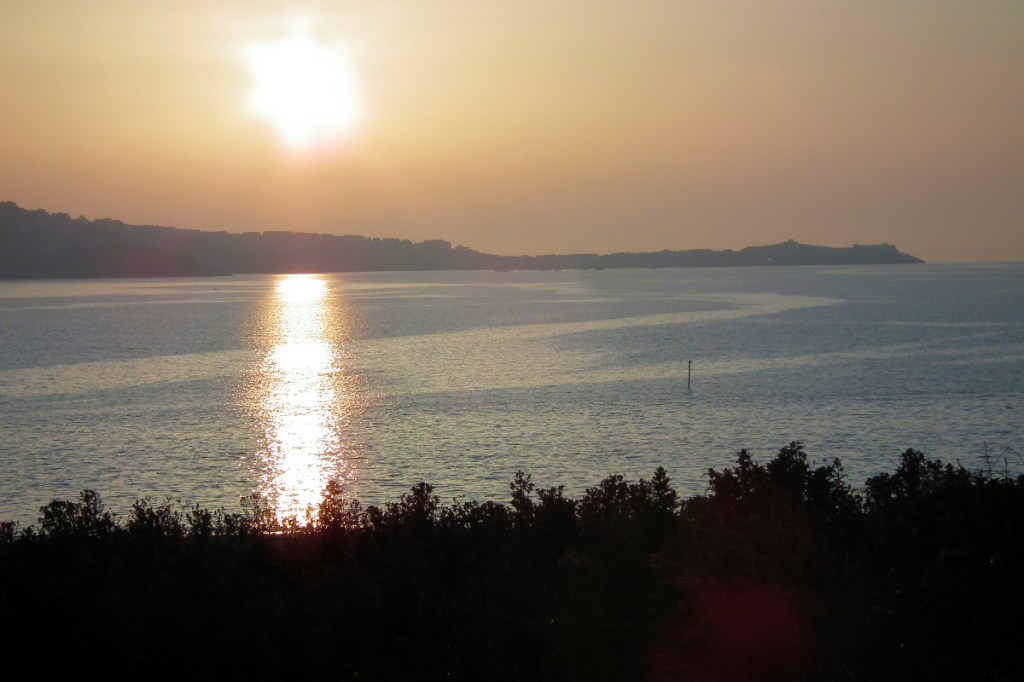
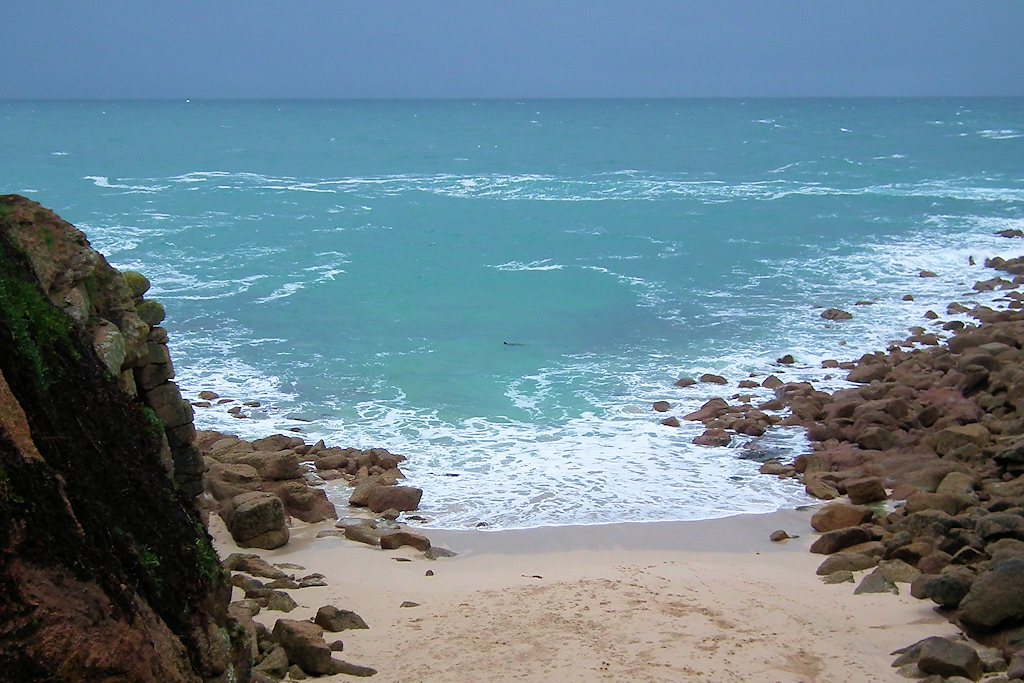
Pictures: looking out into the void from safe territory. Porthgwarra, West Penwith, Cornwall, looking out into the Atlantic. Look closely in the top picture, and you’ll see a seal there, and here it is, below.
A good friend of mine rang up this morning. She’s Jewish – some Zionists might call her a self-hating Jew – who shares the collective feelings and pathos of Jewry while having grave reservations about the behaviour of the state of Israel. She’s one of those thoughtful Jews who is brave enough to talk to someone like me, who has worked a lot with Arabs.
She comes round for tea and we have great discussions, both of us enjoying the contrasting insider knowledge we each have. Of course, what we face now, in and around Gaza, puts her in a really difficult position. She struggles with it inside herself and she talks with me about that struggle. If you have any empathy and conscience as a human, whatever position you take, it’s really difficult, this stuff.
A few days ago she was with a bunch of eco-activists with whom she’d worked for ages. They were vehemently pro-Palestinian in a way that she found difficult, because they were anti-Israeli. She’s not paranoid about anti-semitism, but it still hurts when people vehemently disapprove of your own people. Her friends had taken sides.
Fifteenish years ago in Palestine, I had a similar problem: I worked with Palestinians but I’m not anti-Israeli – I’m fundamentally pro-people. To me, helping Palestinians doesn’t mean opposing Israel – actually, I felt I was helping Israelis by helping Palestinians, but only a few Israelis would get what I mean by that. Seeing everything in a polarised, partisan way is, dare I say it, inherently hypocritical – it makes Them bad and Us good, as also does the current over-use and misuse of the term ‘terrorist’.
It’s a cover-up, a denial of responsibility, a projection. In my reckoning, it’s part of the problem. The partisan approach taken by the governments of UK, Europe and USA, which they believe to be a show of strength, is undermining the remaining, sagging respect that the Global South – the world’s majority – has for us, and this will lead to difficulties further down the line. We need to stop politicking and act like mature nations.
Citizen peacemakers from both sides, meeting at the All Nations Cafe. This photo was 12 years ago, but it’s still going, led by a brave former Israeli soldier
When working in Palestine I had some difficulty with zealous Palestine activists from abroad who commonly adopted a partisan position: within themselves they had declared war on Israel, even if expressing it only in the form of olive-picking and visiting frontline towns like Tulkarm, Hebron, Jenin or Nablus to witness the damage and the pain. I respect such people for their humane feelings, empathy and commitment but also I felt they needed to do more homework, to go a bit further in their understanding and feelings.
They made life more difficult for people like me – amongst other things driving Israelis against humanitarians. Many activists didn’t really like me, and my book Pictures of Palestine hasn’t been popular with many of them. In my teens in Liverpool I was wedged between Protestants and Catholics, and Mods and Rockers – I started my peacemaker education early! So this issue isn’t new.
The Matrix of Control. There are hundreds of these things around the West Bank
If we take sides, we start projecting a subjective and emotive image on the Other, upon which subsequent actions and atrocities are then justified. It makes Us right and Them wrong, so that We claim legitimacy in questionably punishing Them for their crimes. In and around Israel-Palestine, as soon as conflict breaks out, most people lock into this charged mentality, setting all other considerations aside.
It’s a form of psycho-emotional slavery, and the puppet-master controlling the strings is the Lord of Division. It’s an endemic mass-psychology that needs to polarise, dehumanise and denigrate the other side so that we can overcome the guilt and shame of performing wrongs in the furtherance of our own beliefs – even when those beliefs do not support committing such wrongs.
This mentality leads to consequences. As I write, Israeli forces are poised to start a ground invasion of Gaza. From the Israeli viewpoint, I can see why they are taking this approach: they need to eliminate Hamas, and they’re driven by a ‘never again’ feeling – never again do they want to be threatened and harmed in this way. Fair enough. Except there’s a problem. It’s unlikely to work.
Israelis may kill as many people as they like but they won’t be rid of the problem, because those who are left behind will be hurt. The pain passes down the generations. The cycle of uprisings has repeated itself roughly every twenty years since the 1930s, as each generation has grown up and sought to change things.
The damage done to people and to land is tragic – a ground invasion of Gaza will cost both sides very high. Innocent Palestinians will be mown down, and committed freedom-fighters will sacrifice their lives. Israeli troops will die, one by one, hit by snipers, booby-traps and innovative Gazan devices. Jewish and Palestinian mothers will rue the loss of their sons and daughters.
Israelis will not and cannot eliminate Hamas, even if, improbably, they eliminate all of its fighters and the main characters who head it up. They have not managed to do this before, and they are unlikely to achieve it now. All they can achieve is a costly delay until the next flare-up happens. The reason is this: every time Israel fires a bullet, it creates several new fighters taking up a gun – frustrated young men who seek a future and cannot have it.
The Matrix of Control: a flying checkpoint (upper left), imposed randomly and causing long queues on the roads.
Instead of getting depressed and committing suicide quietly to themselves, they join one of the militias, with the idea that their sacrifice might benefit their people. This isn’t so strange: my own father did this in WW2, volunteering his life for King and Country (except he survived, minus a leg).
Hamas was founded in the first intifada of the 1980s. Ironically, Israel secretly funded its founding, to counteract the Yasser Arafat’s PLO and divide Palestinians against each other. Well, that backfired. Hamas speaks for the embattled feelings of Palestinians and, if there were an election instead of a war, Hamas would most likely win. They won in 2006, in a free and fair election, undermined and annulled by Israel and the West – and they would win now.
To many Palestinians, Hamas represents the best of a very bad set of options – not least because it is relatively free of corruption, it has principles, and Hamas is resolute and cannot be bribed or arm-twisted into submission.
There’s a lot of maleness being displayed on both sides – a resolute, despairing, ultimately self-destructive maleness. But behind this lies a deep feminine-rooted emotion too – the urge to protect women and children from the monstrous ogres on the other side.
An old friend, Ibrahim Abu el-Hawa, peacemaker extraordinaire – some of you might know him
Here I wish to introduce a constructive thought and prayer, or two.
The problem with males is that, when we get worked up, we tend not to stop until we’ve achieved our objectives. It’s sexual: a man seeks a climax, through which all can be resolved and he can forget all his troubles. Except, when this orgiastic urge is driven by short-sighted urges such as control or revenge, it gets really destructive. In war and competition, masculinity doesn’t think much about the damage it might create while seeking that climax, and while we usually focus on winners, in competition most people lose.
There’s a secret here about males, to do with brinkmanship and danger. When it comes to the crunch, sometimes men go more crazy, and sometimes, when genuinely threatened, we start calculating our situation and seeing sense. Unless there is a miraculous and unusual philosophical change of heart, it needs to go up to the brink for us to get there.
Speaking astrologically, this is about the planet Mars. The lowest aspect of Mars fights to destroy – as with the Stalingrad-like scenes we’ve seen in recent decades. The default aspect of Mars fights to win – even though both sides ultimately lose, since victory is never as sweet as expected. The highest aspect of Mars is about coming to the crunch and realising there is no virtue in fighting and no enemy, because we’re all ultimately on the same side. The skillful playing of a game is more important than the winning of it. We suddenly realise we are all our own enemies, beating ourselves up.
So here’s a prayer and something to visualise. As I write we stand at a choice-point, before an expected ground invasion of Gaza. The urge to go to the brink is there, and no one will be dissuaded. This is a point of vulnerability and choice. Consequences will follow, whichever choice is made.
So visualise this crunch point as a potential breakthrough point and hold that thought, that feeling. Don’t be overcome with depression and helplessness, or get stuck on what you think ought to happen. These are of no use right now. If you were in a war zone, you’d get shot.
In war, one must take advantage of whatever situation that arises, as it arises. So apply your prayers to the situation as it stands, to help the universe twist events in a direction that somehow changes flow of the tide.
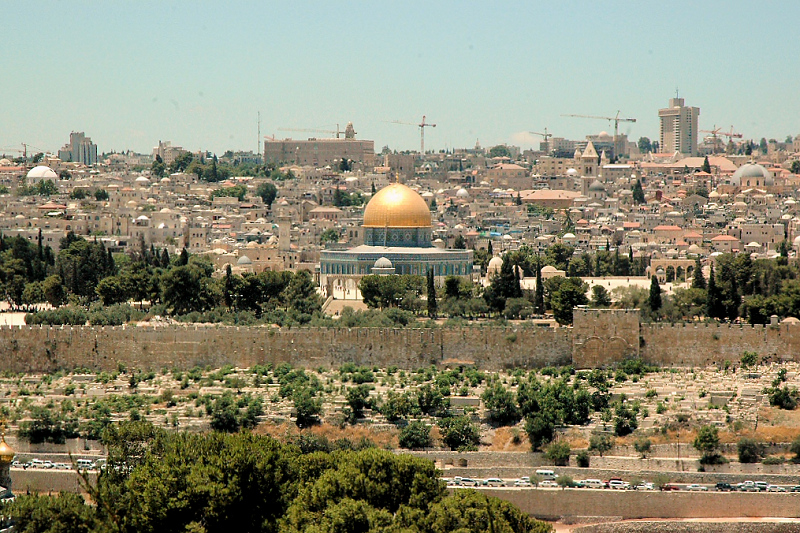
The Dome of the Rock and the Old City of Jerusalem, with Israeli West Jerusalem behind
We’re at a brief point of realisation that there actually are options. Fighting it out is unlikely to achieve the objectives either side has, and the costs will probably outweigh the benefits. The pain each side experiences will not be soothed.
Here’s another thought. Even if the warring parties do fight it out – and the above prayer will thus be seen to have failed – it’s a matter of stoking up positive energy for the longterm, to build up the potential for the pattern to change. Store it up in humanity’s collective psyche, so that this option is more available next time round, even if it doesn’t work this time round.
Building up the energy-potential for de-confliction is best done by making use of actual circumstances where these issues are acutely at stake. Brinkmanship-points like today’s are junctures where the collective psyche of humanity is at its most vulnerable. It’s under pressure and surprisingly open to making a change.
The seemingly irrevocable rush to conflict sets in motion forces and consequences that seemingly cannot be stopped, and this is the pattern that needs to change. We need a new, transitional pattern where, when the risk of conflict comes close, everyone gets it that there is or must somehow be another way. It’s all to do with agreeing to disagree, and doing something to reduce the intensity of disagreement.
I say transitional because, whatever dreamers might dream, we aren’t suddenly going to have world peace tomorrow. We have to deconstruct the patterns that make for conflict, generation by generation, building new replacement habits. We can do this over the coming decades by facing high-risk situations where our true will gets tested and we are forced to get clear – if necessary, under duress.
In Israel and Palestine, repeated conflicts have not achieved either side’s objectives. This one won’t either. If nothing changes, the next conflict comes in about four years’ time. So let’s get real here. There’s another way. It does require guts to pursue it – the guts to change the pattern and step back from disaster.
Al Aqsa Mosque in Jerusalem – Islam’s third-holiest place
Here’s the awkward bit: though both sides are responsible for their actions, in my estimation, Israel holds around 70% of the power, with greater freedom of action than the Palestinians. Saying this doesn’t make me anti-Israeli. Palestinians hold 30%, and Hamas have recently shown how they also have power to shift the agenda. But 70-30ish is the way the odds are stacked. This makes it more difficult to flip the pattern because ceasefires come when there’s some kind of equalisation of force and influence.
Firing munitions, however impressive, is no longer manly. We need to protect women, children, and also our rights, needs and fortunes, by thinking further and bigger and wider. It’s an emotional choice, made with extra power when we stand on the brink of disaster.
What’s important here is that, whatever happens, humanity learns. Even if the worst happens, this needs to be the last time. Something has to shift – the world is fed up with this, and we have other concerns.
This means that lessons need learning now, today, in these circumstances – emotionally, in the heart, womb and gut. Lives have been lost and are being lost, and the only way to redeem those deaths and make them more meaningful is to learn from them and change things. Only then do they serve a positive purpose in the long run. If people’s sacrifices on both sides are sufficient to build up a head of energy-potential for change, then may this be so. May that change come about.
Changing history takes time. Yet it happens in intense situations like this.
We Brits straddle a strange hypocrisy. In Ukraine our government supports the people (Ukrainians) against the Megamachine (Russia, as we currently perceive it). In Israel it supports the Megamachine, the Israeli government, against the people, the Palestinians (as many of us see it).
Though it’s not as simple as that, since there are real people on both sides of both conflicts. And while the British support for Ukrainians is pretty solid, our support for Israelis and Palestinians is equivocal, mixed and changeable – when people bother to pay attention. For most Brits, sympathies currently extend to people on both sides, with only a degree of rigid partisanship on either side of the spectrum.
Such partisanship is largely because of personal connections. Or it depends on which media people follow. Older people tend to sympathise with Israel (their reference point goes back to WW2 and the 1967 Six Day War), while younger people tend toward sympathising with Palestinians (their reference point goes back to the intifadas and repeated Gaza bombings).
My prayer is that the vengeful aspect of the Israeli psyche does not exceed itself. Israelis need to understand how to create peace and security around them without feeling a need for an iron wall mentality – those days are going, and painfully slowly. Actually, we all need to learn that lesson, but in Israel the iron wall mentality is exemplified.
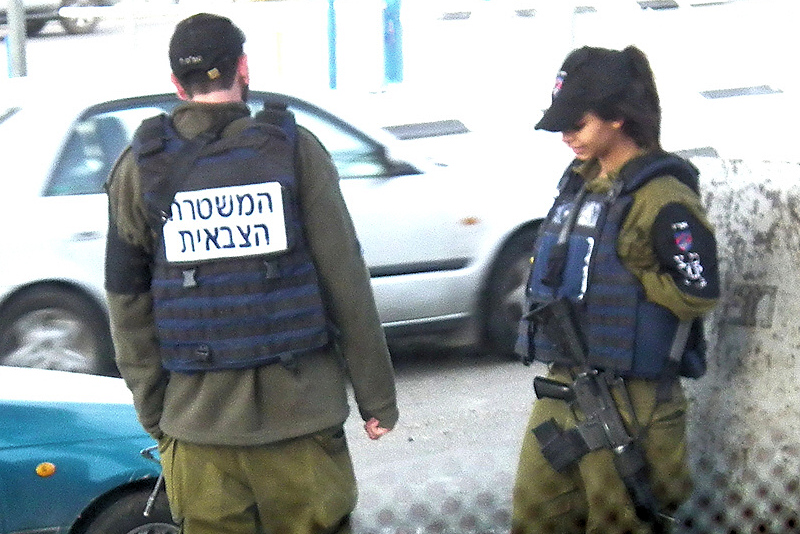
Many Israeli soldiers are quite okay people – and they like rock festivals too
The trouble is that, in a country surrounded with walls, fences and missile defences, supposedly to keep enemies and threats out, it imprisons Israelis themselves, inside their own bubble. Pretty much the only way out of the country is through Ben Gurion airport near Tel Aviv. It’s built on land owned up to 1948 by the Issa family, a refugee family who now run the Hope Flowers School in Bethlehem.
Regarding that, here’s a report from Ibrahim Issa, the school director, where I lived and worked in Bethlehem. Though in the West Bank, it is only about 45 miles from Gaza – three minutes in a warplane. In Bethlehem they can probably hear and even smell what’s going on over in Gaza.
Here’s Ibrahim (he’s around 40 in age now)…
AROUND THE SCHOOL It is extremely sad to see this escalation of violence and associated human suffering on both sides. We are safe until now, despite escalation in the area. Two days ago we had to evacuate the school. Hope Flowers School is located in Area C, which is Palestinian land under Israeli control – in the southwest part of Bethlehem. The school is located about 150 meters away from [the edges of] an Israeli settlement (Efrat).
One of the Palestinian rockets fired from Gaza fell about 50 meters from the school building and injured two boys from the neighborhood. One of them is already declared dead. Yesterday, Israeli settlers have been attacking Palestinians near the school. This situation is extremely scary for children at Hope Flowers, for teachers and certainly for families.
IN OUR FAMILY Fourteen members of my extended family have been killed today in Gaza. The grandparents, sons, daughters and grandsons are all killed in an airstrike.
ON THE WESTBANK Most schools have turned to online education. Hope Flowers School is doing that also for children who cannot reach the building anymore. Bethlehem is a totally closed-off area. We do not have fuel coming in; we do not have diesel to operate the school buses. I think it is a matter of days before everything stops totally, unless Israelis release the siege on Palestinian areas here in the West Bank. Food is also running out in the supermarkets. No food supplies are coming. It may be just a few days before people start to feel the shortage.
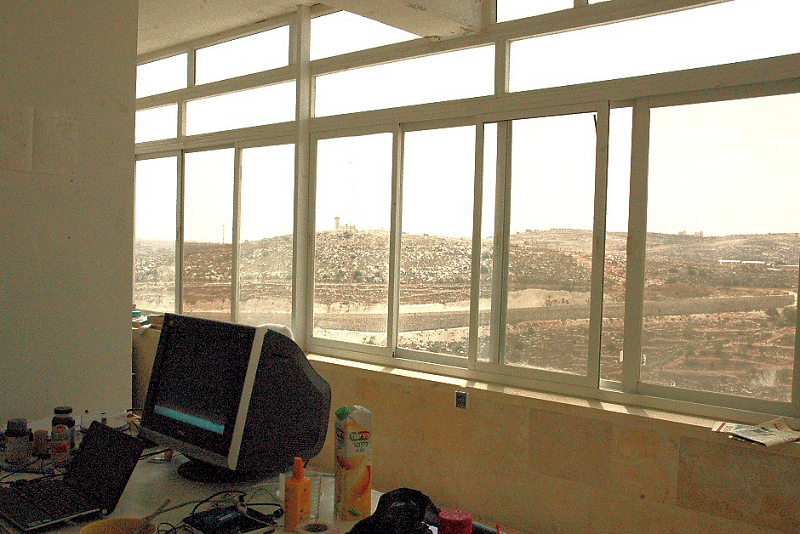
The view from my apartment at the school – over the valley you can see the security wall, an observation tower and, to the right, an ‘outpost’ that has now become a settlement
Palestinians are regrettably accustomed to adversity and crisis – that’s why a squad of Palestinians is advising the Ukraine government on social resilience and resistance. Over the decades many Palestinians went to university in Ukraine and Russia, so they know the deal there – about 6,000 Palestinians were in Ukraine at the outbreak of war in 2021.
MY OWN INNER CONNECTION
My Palestinian journey has been one where I have had to examine my biases and the contradictions in my viewpoints. They are very mixed.
My maternal grandfather was in Allenby’s invading force in WW1 in Iraq and Palestine, and my father fought in Egypt in WW2. I have Roma ancestry, and the Roma experienced holocaust tragedy as much as the Jews. I also have German (and Welsh) ancestry, and when my father was younger, ‘the only good German was a dead German’, according to the mad logic of war-thinking at that time. It’s not that long ago that towns and cities this country were blitzed like Gaza – my mother hid under the table nightly in Walthamstow, East London. So it’s in my genes and those of many of us.
Amidst the damage of urban war, ordinary life goes on. This is Hebron.
Here’s comes a seriously woo-woo bit, which some readers might not like. It’s something you can take either literally or metaphorically since, whether or not it’s true, I carry similar issues to those of a similar character to me, back in history. It is a past-life thing, going back to the time when I was working for the Council of Nine in 1991-93. At one stage, I asked them why they called me ‘Paladin Saladin’ – I had thought it was a kind of jocular rhyming name. They did after all crack jokes! They simply said, “You were he“.
This was like a bolt of lightning. As a historian I immediately knew what they were throwing at me. For some years afterwards I had a resistance to the idea. I recounted this to a close friend, Jean Gardner, a Glaswegian aged hippy, now in heaven, who had been a friend of R D Laing in the Sixties. She looked at me intently, got up, went to the bookshelf, leafed through a history book and gave it to me, pointing at a picture.
“Palden, you sit exactly like this. And look at the simple diet he had – exactly like yours, minus the tofu… and how he could be tough and also show mercy… and the way he was always giving away the money he had to people in need, and he was personally perpetually broke, even though he was the Sultan of Egypt and Syria.” When Jean spoke like this, her words had that deep, no-bullshit Glaswegian firmness. Woo. I had to acknowledge this and take it on.
The Nine also said I had been the slave to Abraham’s pagan father, Terach, back in Ur, around 1900 BCE. Abraham had a big argument with his father and smashed all his idols, at the time when he was adopting the idea of a One God – and presumably I was in on that moment. Servants are often privy to all sorts of stuff.
Then, they said I was a Nubian slave to Moses – yes, I waited for him at the bottom of the mountain. They finished by saying, “You have been involved with the Jews three times, always as a foreigner, and this is your fourth”. In this they were implying, ‘And what are you going to do now?‘. Five years later I was getting involved with Israel and Palestine, starting by being a co-founder of Jerusalem Peacemakers.
On my first visit to Jerusalem in 1991 I cried my eyes out in the back of a taxi driving along under the medieval city walls. I’d been here before, and I was all stirred up. We had walked out of the Church of the Holy Sepulchre, entranced by the strong atmosphere there, straight into a soldier situation – and that’s what’s really weird and intense in Jerusalem. The best and the worst in human experience can come at you in quick succession. Actually, Glastonbury is a bit like that, minus the guns. Both holy places are somehow deeply connected as places where light meets dark. You have to get used to the extreme ups and downs. Glastonbury trained me for Jerusalem.
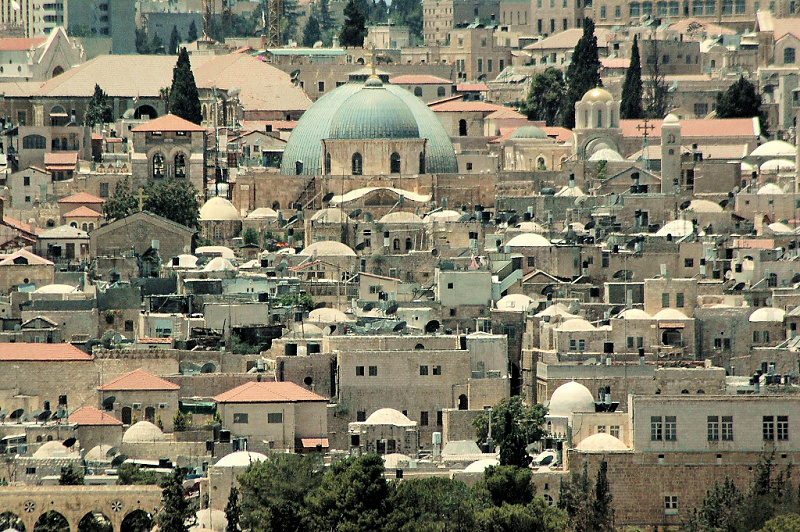
The Old City of Jerusalem
THE NINE’S THOUGHTS ON ISRAEL
Here’s a simple quote from the Nine [1]: “Do you have the understanding that Abraham was the father of two nations?” Biblical and Quranic tradition have it that the Arabs were descended from Ishmael and the Jews from Isaac, both sons of Ibrahim/Abraham. “Then you also understand that Allah is what those of Israel call Yehovah.“
The Nine didn’t regard the Jews as ‘the Chosen People’. They saw them as the People of a (big) Choice.
“They [as souls] came from a planet of strength. They came from [another world called] Hoova. They had strength within their character, and also the planet from which they came was a warlike planet – and in their seeding here [on Earth], they were asked to be at peace. But they have factors of doubt and questioning, which cause us difficulty. They have doubt, suspicion and deception – because of the place they come from [Hoova]. Part of the reason for their existence on this planet was to overcome that factor.
“It began when they left Ur [heading to Palestine]. Before that, they listened. But the descendants of Abraham lost their internal knowledge: they only kept the knowledge of who they were. In their need for survival, they did not accept total obedience [to the Covenant]. They were always making deals. Where one group would be in awe of Creation, the Hoovids would look at Creation as something to be utilised.
“The nation is fierce with pride, and from this grew the desire to help their own nation only – in the times before the man Jesus. So in effect our plan [the Covenant] was turned around. The people of Israel will eventually accept their responsibility. And yet in effect this is their salvation, because it shows the nations of planet Earth that they are a nation that will not be conquered. Also, even though they made an error, every nation has made an error.
“There were only two commandments for the nation of Hoova. Those two are: Thou shalt not worship false gods; Do unto others as you want others to do unto you. Those are the only two commandments given to the nation of Hoova.
“The nation of Israel has forgotten its heritage, its choosing and its Covenant. Abraham was told to go and spread his seed through all the planet Earth. Abraham was told to populate and to go forth, and yet this Covenant was not kept. The Hebrews did not go forth and mingle. If this nation had gone forth and mingled with the peoples of the world, then this the planet Earth would not be in such a serious state as it is at this time.”
There are peace-freaks in Israel too – many have done military service and know what they’re talking about when it comes to peace-building
In one of the interviews I had with the Nine, I asked this:
“The people of the north of Israel, the lost tribes, were taken away and dispersed by invaders. Were these people eliminated, or did they mix with the peoples of other lands?”
“They are all over the world and, as examples, some are in Afghanistan. There are some in Ethiopia, in the Phoenicians [Lebanese and Tunisians], in the people of the musical language written of by Caesar [the Celts], and in the Orientals [such as Kashmiris and Uighurs].”
I then asked, “You have said that the Hoovids came in order to mix with the people of planet Earth.”
“That is a truism, but they that stayed together did so because the others had been dispersed. If I would have a word of my own to say, would you like to hear? I will ask the Council if I may say it. They said I may say, but you may not be pleased with it. It is this. We would have one warning to people who are working with higher consciousness, to be very cautious about your attitudes toward the Hoovids: for it may very well be that you are a Hoovid also, yes. What we are attempting to say is that the majority of people that are involved in spiritual elevation contain the genes of Hoovids – so look upon what I say. How do you then place yourself in that?
“Look at all the world, in every nation, and see which negative characteristics developed that made that nation feel different to others. In your nation [Britain] you believed you were superior to other nations, and that your rightness was the rightness of rightness. And as you have now evolved beyond that, you give to others that same understanding [of seeing beyond tribal perspectives]. When people come to gather as many, and the clapping goes all around the world [across borders], all will be free of the bondage of their bringing forth [of their tribes, nationalities and cultures].
“The people of the nations of Ishmael [Arabs] are brothers and sisters with the nation of Israel. It is important that brothers not fight brothers, but in your world it seems to be your system. It is important for this message to be given to the nation of Israel, for they need to have the understanding that the powers of their mind create trouble when mixed with their fears. Your mind brings to you not what you want – it brings to you what you fear.
“The nation of Israel must look closely at what they fear. They want peace, but may we ask why they do not have peace? For what are their fears? It is what is in the hearts of the men and women of the nation of Israel that is most important. When the nation of Israel begins to fear less, then also it will begin to change.”
It’s really boring, spening a long shift inside one of those spy towers
HISTORY AND THE FUTURE: NOT A STRAIGHT LINE
Arabs have a different history to Jews. Arabs are not one people – they are mixed in origin, encompassing thousands of years, and some Palestinians are of Jewish origin. Multi-cultural and multi-ethnic by nature, they are united by speaking Arabic and sharing certian core beliefs. But after the diasporas, the Jews, having been decimated, dispersed and, in medieval-to-modern Europe, persecuted, have different shadows to contend with to Arabs. It even goes into depth-psychology: Arabs suffer shame while Jews suffer guilt. As do Europeans. And all of us suffer fear – big doses of it.
The Middle East has always been a crossing-point of the Old World, between Africa, Asia and Europe. Many peoples of the Old World have ranged across it over the millennia (even the Roma, coming from India). Nations with borders do not suit the region – it has usually come under large empires. It was the Europeans – the Brits and French – who sectioned up the Middle East around 1920, setting in motion much of the trouble that is happening today.
To solve the endemic insecurity and power problems of Israel, Egypt, Lebanon, Syria and Iraq, the whole region needs reuniting as a community of peoples without borders. This process is slowly, painfully starting, as the oil industry and its over-powered oligarchies begin to decline. A sign of this was the pan-Arabic revolutions around 2011 – suppressed, essentially, by oil money and the vested interests invested in it. The ‘Arab Street’ made its voice heard – sparked by a young vegetable-seller in Tunisia. The voice of The Street will return.
Middle Eastern administrative tradition involves ‘Millets’, a multicultural interlocking of peoples, each with their own customs and laws, who all lived in neighbouring communities across the same wide territory – in city quarters, villages and local areas. So the Jews, the Druze, Maronites, Copts, Kurds, Armenians, Alawites, Turkmen, Yazidis, the Shi’a and the Sunnis all rubbed shoulders, living within their own communities under their own laws. To some extent, whenever a new invader arrived, these millets survived and, as long as everyone paid their taxes, the imperialists left things that way. Until the British and French came along.
We British carry much historic responsibility for what’s happening in Palestine and Israel today.[2] I am rather disappointed that His Majesty’s Government has opted to side with Netanyahu’s Israeli government rather than taking a more humane, humanitarian approach, pressurising not only for a cease-fire but for a longterm resolution, backed with some muscle and sticking power.
The issue is the future, not the past. The core issue is the future of planet Earth and the global challenges before us. A crux issue amongst these is an end to war all over the world. That’s the only likely way the Israeli wars will end. War is no longer an appropriate way to settle our many differences. It’s swords to ploughshares time. Otherwise, there’s trouble. Speaking as an astrologer, probably that trouble comes in the 2030s.
If I’ve pressed anyone’s buttons by writing this stuff, please forgive me. I don’t insist on your believing either me or the Nine. I submit it for your consideration. It might give a few helpful perspectives.














 Notes from the Far Beyond
You must be logged in to post a comment.