Sunday Meditation again

Listen more closely to things than to people.

We spend so much time listening to talking heads, megaphone diplomats, clickbaiters and politicians, though here’s some news from Kay in Iceland, who’s in our group, about things (not people)…

——————

Reykjanes fissure eruption update: Both the flow rate and the parts of the fissure that are erupting have reduced markedly, and the general consensus is that it will stop within the next day or two.

Although the positioning of this eruption was rather convenient from the point of view of keeping infrastructure safe, it has not been without some consequences. The magma set vegetation on fire, and thus, pollution and smoke combined with volcanic gases being emitted. The wind direction pushed the gases and pollutants into Eyjafjörður, with Akureyri, the 2nd largest city in Iceland, being afflicted with a bizarre blue haze that has dulled visibility. Sulphur dioxide levels are above-normal but very safe, although some sensitive people may experience irritation. Hopefully, beautifully fresh and clean air and the wonderfully clear light that normally graces Akureyri will soon be restored.

——————

Now that’s something, isn’t it? Thanks, Kay.
Oh, and yes, it’s the Sunday Meditation this Sunday. If that twiggles your antennae and you wish to find out, it’s here (and times are below):

www.palden.co.uk/meditations.html

Thinking on it, I guess why Kay’s report twiggled my antennae is that it was distinctly parallel to my own life at present!

Even so, I plug on… I’ve just posted a new podcast about Inner Doctors. Haven’t got along to announcing it yet though (it’s rather laborious) – and it’s time for breakfast before it gets to lunchtime.

Love from me, Paldywan

———————

Current meditation times, on Sundays:
UK, Ireland & Portugal 8-8.30pm GMT
W Europe 9-9.30pm
E Europe, Turkiye and the Levant 10-10.30pm
Brazil-Argentina 4-4.30pm
CST, Mexico, Jamaica, Colombia 2-2.30pm
EST, Cuba 3-3.30pm
PST North America 12noon-12.30pm

Aluna

Aluna, the Void, the Lap of the Mother, out of which everything emerges.

I posted this video a few years ago and it’s worth another spin. Because it speaks of matters I talk about too, though the Kogi Mamas state it far more clearly and unequivocally. It concerns the basis of the way nature works, and it starts in the realm of spirit.

It concerns connecting the power points with each other – the Kogi call them Esuamas – and helping the Earth hum and sing as an energy-being, a conscious being. If she is happy, all will be well, and nature can fix itself when damaged. Ecological reintegration. Rewilding.

This is what we, ‘the younger brother’, are failing to do. Then we wonder why we get flash floods, droughts and storms. We do this by blocking up the energy centres and obstructing their connections.

So, to help the world it is necessary to unblock them.

The Kogi, descendants of the pre-Columban Tairona civilisation, live in the Sierra Nevada of northern Colombia. In a recent article about Caer Brân, a Bronze Age gathering site here in West Penwith, Cornwall, I mentioned the sense of enhanced centrality you can feel at many ancient sites – the feeling of being at the centre of everything – and the Kogi feel that too. It’s a key element in the energy-geography of an area like theirs or like Penwith. They feel that the mountain area where they live lies at the Heart of the World. And it does.

They feel they cannot carry the world any more. In this film, Aluna, they speak of making payments, paying back to the Mother, caring for her and keeping her happy. They practice land management and agriculture that does just this.

In my rants and ramblings about the Neolithic and Bronze Age landscape of Penwith, I suggest that the 600-odd ancient sites in Penwith actually constituted one big ancient site, one big cliff sanctuary. Ancient Penwithians sought to make the land and the wider world hum and glow. Hence the ancient name for Penwith, ‘Belerion’ – the shining or scintillating land. They did it by connecting up the energy-centres to amp them up, to make them operate as one.

The Kogis’ ideas are not unique to them. We in Britain have known them too, a long time ago. We have forgotten. But if, when the time and your mood are right, you watch this film, you too might remember.

https://youtu.be/ftFbCwJfs1I?si=CgtlNYLO-cFopmSH

Energy Lines and Power Points

Photo: Charly Le Mar

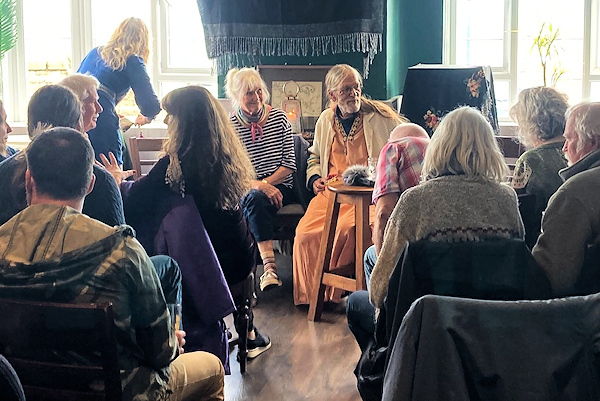
On Sunday, Ba Miller and I shared the floor in Penzance, speaking to a lovely crowd, on the occasion of the late Hamish Miller’s 97th birthday.

Ba herself is 91 – though, with me at 73, a mere stripling, we’re both beat-up and still going strong!

Ba told some anecdotes of what happened when they were following the Apollo and Athena lines from Ireland to Israel, and some really valuable dowsing tips (since it was also World Dowsing Day).

I talked about the energy-landscape of West Penwith, about building megalithic structures for consciousness-engineering and how Penwith is one big ancient site with hundreds of components.

A big thank you to Rachel, Lucy and Lyndz for initiating and organising it, and for their rousing spirit.

To hear our talk (1h 15m), go to my Audio Archive and look for ‘2024 PodTalks’:

palden.co.uk/podtalks.html

With love, Palden

Also: my latest book, Blessings that Bones Bring – a spirited Myeloma patient tells his cancer story, is coming out soon in digital PDF format, and before long as an audio book. Whether it gets published in print remains to be seen. I’ll let you know when it’s available.

A Trip to the Iron Age

One of Palden’s prehistory podcasts

The remains of the Courtyard House

This 30 minute podcast is recorded while sitting in the remains of an Iron Age Courtyard House, up the hill on the farm where I live.

It doesn’t look very exciting nowadays, though it’s a nice place – but then, if you were 2,000 years old, you might be a bit worse for wear too!

This podcast is all about what life was like in the Iron Age in Cornwall, two millennia ago, and the way people saw things then.

Looking into the yard of the courtyard house. Behind are Sancreed Beacon (left) and Caer Brân (centre right), and far behind them is the hill on which the Merry Maidens stone circle sits.

This was the Celtic period – though the Celts shared a culture, and they were not one people. In West Cornwall many were descendants of the indigenals of the Bronze Age.

It’s about life and reality systems in our time, and in the Iron Age, and also in the Bronze Age and the Neolithic – how people saw life and the world in each of these periods, and how their technologies reflected that.

With some insights into what we can learn from them now. This is important. As elder dowser Sig Lonegren often used to say, quoting his Seneca teacher Twylah Nitsch, ‘We seek not to emulate the ancient ones – we seek what they sought‘.

Listen on Spotify:
https://open.spotify.com/embed/episode/5sRfUDrjLuJq1S8gHSogtt

Or you’ll find it on my podcast page:
www.palden.co.uk/podcasts.html

(On the podcast page, check out ‘Ancient Civilisation‘ for more prehistory podcasts.)

With love from down’ere in Cornwall. Palden.

You can see Mount’s Bay and St Michael’s Mount from the courtyard house

Megalithic Penwith

Geomantic secrets. This is a telephoto shot of Carn Kenidjack, a Neolithic tor, seen from atop a barrow five miles away at Carn Les Boel, a cliff sanctuary. Here’s the rub: step off that barrow and you can no longer see Carn Kenidjack. That sightline is important.

Over the last month I’ve been doing a complete revision and rewrite of the Ancient Penwith website and, with relief, this morning, on the Piscean new moon, I uploaded it all.

www.ancientpenwith.org

This is the key map that illustrates my main point in this work: that Penwith was an integrated ancient site and cliff sanctuary covering the whole landscape. That integrated system was pegged out between the cliff sanctuaries and Neolithic tors of the peninsula.

I built the site in 2015-19 in connection with my researches into Penwith’s ancient sites and geomancy, leading out of the ancient sites and alignments maps I was also making at the time. Initially the maps covered West Penwith though, by 2019, I had extended it across the whole of Cornwall. The maps, together with fieldwork, were the basis of the research.

It’s a resource site focused on the alternative archaeology and geomancy of West Penwith, as I understand it. In a way it’s a bit like the course on that subject that I never taught. It’s now around 100 pages in size and quite comprehensive.

There will be tweaks and amendments in coming weeks. If you find glitches, errors or dead links, please tell me their page and location! Thanks.

I’m not sure how much longer I have to live (being a cancer patient) and God usually doesn’t tell you when your bucket-kicking initiation will come – so this rendering of the site might be a parting shot. Whatever is the case, do enjoy trawling through it. It’s for you.

Whether or not you agree with this kind of stuff, there are gems there for the finding, and archaeologists will definitely miss something if they omit to give it a trawl and a good think – and a feel too. It’s all a matter of what we consider to be viable and useful evidence, and what conclusions we draw from it.

Near-parallel alignments across West Cornwall

This work is probably incorrect in some details, but the overall points made suggest that this peninsular landscape was built over many centuries into a single large, integrated ancient site and cliff sanctuary. One symptomatic outcome of this is that it has never been forcibly invaded. Well, except perhaps by tourists during summertime.

Have fun! With love, Palden

Archaeoastronomy. The summer solstice sun setting between Trink Hill, left, and Rosewall Hill, right, as seen from the top of Trencrom Hill, a Neolithic tor. This isn’t man-made – this is natural. Think about it…