Looking Within

This time of year it’s easy to feel battered by life. Things just get to be too much. This is part of the syndrome of modern times – we get overloaded and stressed, landing up in a routine of juggling too many balls, and we lose our way. We end up wondering what it’s all about and why we’re living our lives the way we do. This is an important truth point.

When I got cancer six years ago I had to look at what I had done in my life to bring it about, or to make myself vulnerable to it. We can blame such things on this or that but, in the end, it’s us. I realised that I had been both harmed and helped by moments like this – times when I was strung out on a busy and engaged life, pushing myself, trying to keep up with everything that was required of me, trying to do my best.

I was harmed because at times like this we actually generate the seeds of future illness. These are times of vulnerability, overstretchedness, worry and, if we are honest, times when we swim around in our guilt and fear, in unconscious stuff that we never have time to look at or to process through.

So we lay it down as a pattern, a pattern of fear which becomes a bit harder to look at another time. This is where the root causes of later illnesses or disabilities arise – in those stuffed-away, shadowy segments of our psyche where we don’t want to look. This is where we have power change our futures.

I was also helped by times like this. They give moments of self-examination and soul searching, an opportunity to pay attention, at the very time when we need to do so – even in the middle of busily stressful, dissonant and portentous junctures.

One of the greatest mass self-destruction errors of today is the setting aside of essential soul matters in order to tread the mill, to pursue our important agendas, in which we carry the weight of the world, fight our loved ones and get worked up over small things (like supermarket queues).

We lose our way. We lose our sense of the real reason why we’re doing all this business of being alive on a planet. I mean, what on Earth am I doing with my life?

It is very important, amidst these times of So Many Important Things, to give ourselves proper quality time, being quiet, giving ourselves timetable-free space, relaxing, yielding, taking it easy, changing the subject inside ourselves, and letting new information, energy, healing or blessing come into us.

This is a matter of allowing. It’s not about making it happen. Unless you really want to, you don’t have to pay large amounts of money to go on retreats or to exciting places in the mountains of Turkiye: it’s a matter of giving time and space now, today, even if just for an hour.

When I was examining myself and the causes of the cancer that I was suddenly given in 2019, I came to see the roots of my cancer in moments like this. It’s to do with those times when we have stuff coming up from deeper down, changes going on, truth emerging – and, we tell ourselves, we’re too busy, and we can’t give it the attention it is due right now. Later.

We often set aside these moments, these openings of doors. Thus we lay down patterns which can lead to future regret. Or at least to future times when conscience and consciousness are squeezed and wrung out of us, by force of circumstance. Times when our souls decide to present us with hard, inescapable truths.

It’s not about being perfect. The soul is forgiving, understanding, and it sits in an eternal place. We are here to learn. As humans we are a mixture of light and darkness. We are not here to be angels. We are here to make good in a difficult and challenging situation, and to do our best with the riddle of life and the deal we are given, to struggle our way through an obstacle course and a learning journey. This is what we came for.

This is planet Earth’s special gift: you get an amazing physical life in which you meet remarkable people and situations, and in return you undertake to learn some profound lessons – lessons about balancing the physical with the spiritual, daily-life routine and inner calling, and our own and others’ needs and preferences.

We should not feel bad and guilty about our failings, our hidden bits, and the things we come to regret. These are fuel for the fire of learning. That’s what we came for.

But it certainly does us a lot of good if we pay attention to releasing whatever needs releasing as closely as possible to the time that it happens, while it is in focus. It’s good to build a habit of moving forward, seeking out truth, applying all of the different kinds of growth-tricks we come to learn as we pursue our path through life.

If we build this habit it means that when the shit really does hit the fan, we have tools and experience to resort to, because we have built a growth habit, a truth habit.

It’s not that truth is always available at the moment when we seek it. Sometimes it takes time. Someone once said, a decision is truly made only at the time when you can chuckle about it. On the other hand, in every moment there is sufficient truth available for us to do enough of the right thing in the situation we find ourselves in.

This involves intuition – listening to the signs and signals within us. It involves listening to that inner voice which at times just says, ‘Be aware, be aware in this moment’. This is what you could call conscience.

Only sometimes does it give an answer about what to do, but it certainly gives a prompt to say ‘Be aware, this is a moment of choice’. If we pay attention to these moments, these moments of proto-truth, it expands our free will, our freedom of expression, our freedom to negotiate situations in the best way we can.

Sometimes we get it all wrong. And this is life. Because there can be deeper threads, deeper meanings going on underneath, and it is not uncommon that we find ourselves out of our depth, being stretched. Life gives us these moments of choice. This is what free will is. And sometimes we get it wrong.

That’s not the end of the matter. Because revelation and times of correction do come. Be patient. Sometimes we can make it up with the people who were involved, or we can correct or improve the situation, or we can own up in some way, and sometimes we can’t. But within ourselves, it is possible to change the story.

In every scrangle, we were half of the problem, and we can change our half, even in retrospect. This shifts shadows. Balance starts returning. Forget good and bad, right and wrong: what matters is movement, forwardness and progress. Sometimes this can involve taking the difficult path – a path of confrontation, pain, tears or apology. But this lands up becoming the easiest path.

Sometimes we cannot shift the shadow or resolve the situation. It might be too late, or the other party might refuse to forgive, or resolution might not be possible. But we can still look at our own side of the equation and get that bit right.

There is a simple rule by which to judge situations: treat others as you would like them to treat you.

If there are instances in the past that you regret, where you didn’t do your best, you can own up and rework them. It’s a de-guilting, forgiving process. And perhaps the judgements of rightness and wrongness made at the time were themselves incorrect.

In whatever proportions, you were both at fault and you were both right too. Remarkably, if you move on your side, sooner or later there will be movement on the other side. But don’t sit around waiting for it.

There can be resolution for the other person, or the other people who were involved, even if you don’t know whether it’s happening, or even after their death or yours. But in the fullness of time, if we release our side of the equation, then it loosens up the whole tangled cycle of co-bondage that lies behind and beneath the whole situation.

Some situations just cannot be understood or explained. But things happened that way. The world, as we have made it, is an incomprehensible place. So-called ‘mental illness’ is a simple consequence of living an a screwed-up, contradictory, insensitive world.

This is particularly important for those of us in late life. It’s about forgiving other people for what they did or they omitted to do, or that they did in ways which could have been different. It’s about forgiving world and societal situations because some, such as an earthquake, might have hurt a lot, but these are part of the formula, the equation, the deal we took on by being born, when we decided to have a life on Earth.

There’s also the matter of forgiving ourselves. Because in forgiving ourselves it loosens up the whole cobweb, the whole network of shared error, since we are not as separate as individuals as we frequently believe. We are all so intertwined. We breathe each other’s air.

There are various dimensions to this. There are things we definitely got wrong, and there are things other people judged were wrong which perhaps were not so, when seen from further away.

Then there are cultural issues where social judgments are implicitly made and accepted which, in the fullness of time, turn out to be to be very different. For me, for example, 900 years ago I believed in holy war, yet in this life I do not believe in war at all.

Then there are matters where we were wronged, yet we took on the guilt, the wrongness, because we were surrounded by unavoidable situations or people who misjudged us. Quite complex gestalts and constellations of human feeling can cause us to carry a psychological burden when in fact we might not have needed to carry it.

Some people spend their whole lives carrying far more guilt than indeed they should do, but in another way they mop up the free-flowing projections of other people and of society, absorbing it like sponges – sometimes with an ability to transform it, as nurses, carers, humanitarians or even inadvertent social healers, and sometimes they become victims of society and its ills and madnesses – the special needs cases.

In fact, the way things are going, the whole population of the world, currently around 8.2 billion, is becoming a special needs case. Help!

So if you’re feeling rather beat up at the moment, and if you’ve had enough, and if you’re feeling physically or emotionally vulnerable, it’s well worth staking out some time for yourself. Just tell everyone else to go away. Switch off your phone. It is to others’ advantage to support you in becoming a better person.

Whatever their dependencies and needs, these will be better fulfilled if you are in a good state. But if you are struggling inside with ghosts and demons, your generosity and good-natured side doesn’t shine genuinely and wholeheartedly.

If you’re lying in bed feeling unwell or wobbly right now, you might try listening to one of my podcasts about the inner doctors. Working on things like this can be really helpful, but often it’s only at these moments of vulnerability where we really perceive the need to pay attention to this kind of thing.

Also, it’s winter solstice – at least, here in the northern hemisphere – and a time for contemplation and reflection. Many people make this into a time of stress, spending vast amounts of money and overconsuming even if they don’t want to – all out of a sense of obligation to fulfil needs which were relevant in former, poorer times, when a feast was good and necessary, but which have lost so much relevance today. If gifts and treats are expected and taken for granted, they are not a gift, and the money might have been better spent supporting a family in Gaza.

There’s a big case of cognitive dissonance around all this. It is symbolised on Christmas Day when the day starts in a very human and open hearted kind of way, but then most people in countries like Britain start assaulting themselves with alcohol and overeating, also going through social situations which perhaps they might not want to go through, though they might feel obliged to do so. Don’t upset your grandmother, darling.

This sense of obligation to be happy, and to do all the right things, is, deep down, guilt-driven. Yet in order to have peace and goodwill on Earth, and every day of the year, and for evermore, which is surely what we all genuinely want, we need to free up all this guilt.

As you might by now tell, I don’t do Christmas, so unfortunately you will not be receiving a Christmas card from me. It’s not Scrooge mentality – it’s just a divergent Aspie’s preference. Before Christmas I am Scrooge, and after Christmas quite a few people, burping, tell me I’m lucky to have bypassed all that.

Here is a greeting to those who concur with me, and who will be spending Christmas mostly on their own – for perhaps you are the ones who can do some forgiving, pumping up the peace and the goodwill to all people, with an extra dollop of collective release and public mercy, without burying it in fats, and carbs and alcohols.

Here is a greeting to those who love Christmas too. It can be such a wonderful time of family and neighbourly gathering, and do it well. It’s special. Unplug the TV and get everyone to pile their phones in a box for the time you’re together. And get the kids doing the washing up – or, alternatively, making a valuable contribution of their choice. After all, we live in anti-authoritarian days, so options must be available, though I have not heard of a human right that entitles us to avoid earning our ticket.

Savour the Christmas plenty. I mean that. Because we’re coming into times when there might not be so much plenty, and it will be necessary to enjoy that too, and the gifts of grace that come with it. For when the economy goes up, society goes down, yet when the economy goes down, society goes up.

I think that was an economics and life lesson that the Prophet Jesus, peace be upon him, was trying to teach. It is likely that peace and goodwill in our world will rise as the global economy adjusts to the facts of its situation, and as humanity goes through an inner change that causes it to stop gulping up our world and shitting on it.

Not only that, but we will enjoy the new situation. There will be elements of relief to it. And defence expenditure, malware and security cameras will be things of the past, like holy war.

The world is in a process of acceleration and thawing, and it’s complex, and the bits are all bumping up against one another, and it looks as if things are getting worse with each passing year. No, they are getting better, though it is a painful and intricate process. Things are just starting up.

And the way they look now is not how it is going to be in the fullness of time. All things shall pass. All will be well, and in ways we cannot currently imagine. Hold that thought. All will be well.

Love, Palden

#followers #everyone #forgiveness #worldcrisis #mentalhealth #socialhealing #healingtheworld
Us Together

Here’s a little medicine to help deal with all the hot air on the airwaves today – about, amongst other things, where the power really lies.

It’s a podcast I did in 2021, about the collective psyche. Yes, us lot.

https://podcasters.spotify.com/pod/show/palden-jenkins/episodes/Us-Together—the-collective-psyche-e19hajc

or you can also get it on the top right of this page:
https://palden.co.uk/podcasts.html

With love, Palden

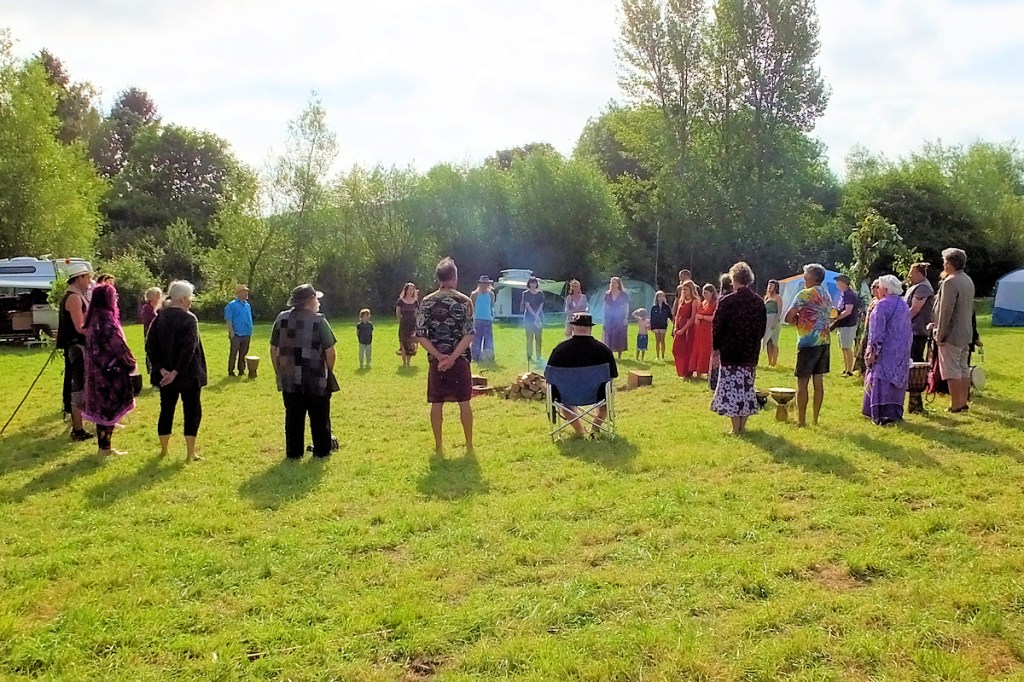
Pictures were taken at the Oakdragon Camps | http://www.oakdragon.org

Social Healing

Porthmeor beach, St Ives, Cornwall

One of the themes of my life has been social healing – stimulating social and community psycho-spiritual growth. This took shape through the camps of the 1980s and 1990s, community events and early online social networking in Glastonbury and working at the Hope Flowers School in Bethlehem – it was, and still is, focused on trauma recovery and social reconstruction in the militarily occupied West Bank of Palestine.

Modernity has brought individualism with it – the development of an urban-industrial society required the breakdown of community bonds and social sharing. Nowadays so individuated, each responsible for our own lives whether or not we like it, we tend to over-personalise our hurts, complexes and issues. Some of us take more personal responsibility than is due too, out of compassion, guilt or charitable activism.

But this individualism arises from a social-cultural pressure, like an endemic viral infection that is well embedded in the rich world, though in some societies it has only recently hit them, not least through the medium of the mobile phone. Such societies start breaking down when the brainiest and most enterprising of their members start leaving, heading for cities, jobs and universities.

Many of our difficulties arise from being part of a society, a culture, and their institutions, values and customs – and their webs of power. So if, for example, you grow spiritually or in terms of human potential, people and situations can frequently obstruct or resist these changes in you, or cause you disadvantage, and it gets difficult, and profound choices arise.

One of them is: should I pursue my own path or should I stay in this situation to try to improve things over time? This is not easily answered – it’s not just a matter of selfishness, and it goes much deeper. Nowadays many people leave their communities in order to work in cities or abroad, and to send remittances back home to help the family, and they perceive it as their only option. Many people in Gaza would like to leave, but also they don’t want to leave their families (and the Egyptians charge $5,000 per person to get out of Gaza).

This is a dilemma that all of us variously face at times – a conflict between fitting in or doing your own thing that is a big factor in social churn, divorce, family and community breakup – and it has very mixed outcomes. This inner struggle is a side-effect of intense change.

Nelson Mandela, who took a big destiny on his shoulders, once wrote that he felt he had failed to resolve key dimension of this question: for him it was a conflict between duty to his family and duty to his people. I’ve faced this question quite a few times and, looking back, I still have mixed feelings about it.

But in recent decades, those of us who are more awake than most people have been faced with a barrage of cultural, social and institutional opposition to or rejection of the kind of beliefs we hold. These beliefs have a lot of variety, colour, contradiction and value to them, but in the end they all boil down to a key issue: whether or how much to prioritise either personal or collective benefit.

Another issue lurks behind this, summed up in Jesus’ words, ‘by their works shall you know them‘. Not ideas, advocacy, explanations, disinformation or ideology but actual actions and the way we walk our talk.

The future is not just about economics, resources, AI, ecosystems, carbon sequestering or even space travel. At the heart of all these issues lies the small matter of social healing. For me, it started off during ‘the Troubles’, a student uprising at the London School of Economics, where I was a student. [For a 15-min video about it, try this.] We got squelched. As I experienced this, feeling the impact of suppression of our movement for change, I saw also how we ourselves had screwed up our own cause. People had slipped into endless argument, disagreement and a confrontative approach to protest, and there were regrettable scenes mixed in amongst the brilliance, excitement and flowering that went on at the heart of our attempted revolution.

It wasn’t at the time clear to me exactly why and how this had happened, but it set me on a path. During the 1970s, in my twenties, I went through a lot of inner growth, learning more about awareness, psychotherapy and social dynamics. I went through my own process, where I found myself screwing up even when I didn’t mean to, and faced with a mountain of young person’s acute dilemmas that sometimes felt too big to handle.

At one stage, during my Saturn Return around age 29, I contemplated suicide. Actually it was a ruthless truth process and soul-searching, and it led me to committing to my calling. That calling wasn’t clear and distinct, but I had to make myself available and willing to be given a task. The shape and expression of it surfaced within a few years.

I had accumulated a bundle of experiences during my teens and twenties that made me feel like a jack of all trades and a master of none, but the fascinating thing was that when my mission did take shape, all of those skills and abilities gelled together, suddenly making sense. I had the full range of skills needed. It was as if life had been preparing me for it without my knowing.

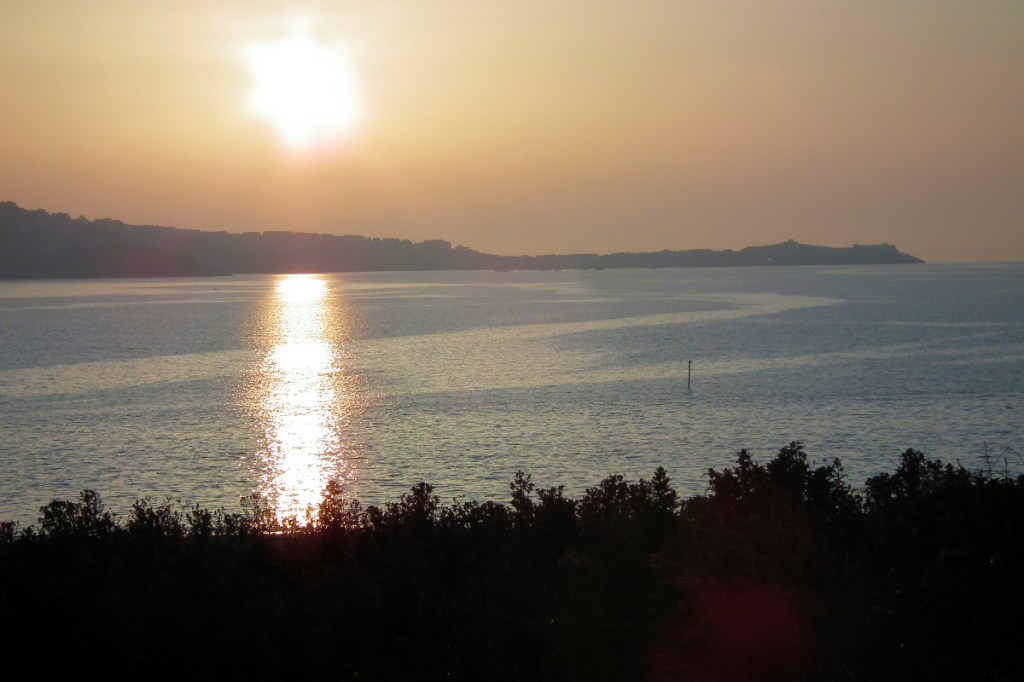
Looking across St Ives Bay toward Godrevy lighthouse

Fast-forward to the 1980s, and something drove me to start the camps movement, as well as a stream of conferences and gatherings in Glastonbury that developed thereafter. I didn’t know this was going to happen – I was just driven, or shoe-horned, even to some extent tricked into it. The Great Cosmic Trickster has greater designs than we can see, and sometimes we must be thrown into things and presented with a choiceless choice.

It was an old friend, Jamie George, who did it. He asked me to help him organise a gathering in the Assembly Rooms in 1983. At the time they were threatened with demolition, and several of us set about creating events there, to bring energy into it and stop the demolition. One late-summer’s evening Jamie and I sat in his garden brainstorming it and coming up with an innovative formula for running the gathering. It’s what came to be called circle-working. Though it’s as old as the hills, ancient and archetypal, circle-working was not at that time practiced in our society, whether alternative or ‘straight’.

Time went on, Jamie beetled off, leaving me to it and, before long, I and a squad of Glastonbury friends I brought together were organising week-long holistic educational camps, usually for 100-500 people. Each had a theme (Astrology, Earth Mysteries, Music and Dance and, later, Arts and Crafts, Healing, Ceremony), with transformative intent, group process and a foundation of circle-working – mainly use of the talking stick.[3] We were improvising and innovating in a seat-of-the-pants kind of way, but it was dynamite.

In the 1990s I took this further with the Hundredth Monkey Project – consciousness-work camps specifically addressing world problems of the time, where we applied to world issues methods and ways drawn from the personal-growth sphere. Again, it was based on circle-working.

One of the big unexpected discoveries we made was this: by focusing on ‘world work’, personal growth was vastly accelerated as a by-product. The idea was to set aside our personal growth, to serve a greater sphere – the wider world. But for participants the personal growth implications were enormous. In fact, this led to an unforeseen problem, because each summer camp had such a transformative effect on participants that they tended not to return in later years – it had had such big consequences for them that they were already ‘cooked’ and busy getting on with what had started for them as a result of the camp.

But there was more. Here we come to the social healing bit. For me, it was a big learning. The idea with camps was to create an accelerated growth environment in which people could truly step back into themselves and flower as souls. In this we were very successful. It wasn’t just some people who experienced breakthroughs: it was everyone, without exception. Together, through social bonding and working at it together, we had lifted each other up – we had risen together.

Some of the best camps were those that were the most challenged. We had no shortage of weather events hitting us, and also, in 1986, we had the Chernobyl meltdown, which started on the very day that one of the camps began. Yet these experiences pulled us together by shoving us through the grinder. They forced everyone to become really sure why they were there. It generated commitment and group focus, hundred-percentness.

There was a classic moment in 1987, the morning after a Force Eight gale had ripped through on the very first night of a camp in Wales. We had downed all marquees and tents and crammed into the geodesic domes we had, since these were the only safe structures in a gale and monsoon. For some people this was a nightmarish experience – one of those dark, threatening nights with lashing rain and furious winds that can go on forever, bringing up loads of fear and desolation.

Next morning, the storm had gone. All was still, the sun was breaking through and everything was dripping and remarkably colourful, in a sopping, late-summer way. I was standing there outside, blinking and assessing the scene, having hosted fourteen people in my two-person dome. A new camper was standing with me, looking wan and pale, telling me she couldn’t handle this and she was going to go home.

I was quiet, wondering how to respond when, suddenly, from upfield, came a shout, “Tea, anyone?“, and one of the site crew processed down the field like a butler, with a big tray of mugs of tea. It was a poignant moment. The lady just broke down, crying her eyes out. And she loved her tea, and she stayed with us. And her life changed. She made a growth choice there and then – the atmosphere of the camp had prised her open. That’s just one story of many such epiphanies. Another camper once said, “This is what I have always dreamed of, but never thought it could actually happen“.

St Ives, from Hayle Towans

Though the success of the camps was very much teamwork, resting on the qualities and experience of our camp crews and the innate wisdom of participants, as the key instigator of all this I was going through big epiphanies too. Not just personal, but concerning this matter of social healing.

At every camp there would be a crunch-and-breakthrough point. At the early camps it often took about five days but later on it came after three or so, as the group atmosphere of the camps evolved. There was a point where people had settled into camping, been through a few days of it, and they were lighting up, feeling part of each other’s lives and gaining momentum. There was a rising feeling of this is it, that we were in the right place at the right time, doing the right thing. As if this was meant to be happening. As if this was a model for a future society, where everyone got on, worked together, served each other and enjoyed each other’s presence. The guards came down, shared trust rose, and a brightness started shining in people’s eyes.

And then, something would happen. Often it would come out of nowhere.

It could have been someone snoring through the night and disturbing others (a tolerance issue). One year, a person slept around and spread a sexual disease – a big controversy bringing up loads of stuff. Or it could be someone suffering withdrawal symptoms from meat – the food was vegetarian only. Or tents leaked in the night. Or kids got into a scrap. Or, one year, the Hippy Convoy arrived at the gate, pursued from Savernake Forest by police, demanding that we rescue them and give them a place to camp.

Of course, this fell on me and key members of the crew and facilitators to sort out – to deal with people placing blame or getting upset, and quite often it involved complex, reverberating community situations. But there was enough love and care around for these societal explosions to work through. We turned it into a group process to turn problems into assets. It wasn’t one person’s problem – it was our problem, and all of us were stakeholders, together.

I’m glad to say that, on the whole, we succeeded in this – especially by the 1990s at the M100 camps. This arose from a buildup of collective skill and experience that could contain and channel social energy in all sorts of ways. Also most participants were willing to go that way, contributing their own gifts and inputs, while the rest gave it a try, going along with it and soon realising that this was something amazing to be part of. It became a cauldron of mutualised contribution – powerful sharings and dynamics during talking-stick sessions, or in afternoon workshops, or around campfires.

This is how social healing works. It works particularly through the medium of crisis and shock, precipitated particularly by unforeseen things against which we have few defences. A recent example, in the news recently, was a ship that destroyed a bridge, killed people and blocked a major port in Baltimore, USA – something no one was prepared for. It’s the kind of event that says something. No doubt people will apportion blame for this disaster but, if we’re honest, if we want to have the fruits and luxuries of a developed civilisation, this is what will happen, no matter who actually does it.

It’s not them – it’s us. This truth lies at the nub of social healing. This is a key issue today in the collective psyche (with Pluto in Aquarius for two decades from 2023 to 2043): there are those who opt toward collective, mutually-empathetic solutions and those who resort to self-interest or sectoral interest. Both options have their costs and benefits. But the costs of self-interest are nowadays outweighing their benefits – so historically we’re heading toward more collective awareness.

Human society as a whole has an endemic case of PTSD. History has been traumatic, pretty much everywhere. The pain and behavioural aberrations that arise from this are rooted not just in past events that we know and remember, but also in collective experiences that are long forgotten.

I have written before about a time in Britain around 1200 BCE, over three millennia ago, when the people of Britain underwent a mass trauma which then played a large part in all that happened afterwards, including four invasions of our country over a thousand year period. This trauma happened at the end of the megalithic period around 1200. The megalithic period had stretched back 2,500 years up to that point. A spell was broken, a mainly-sustainable, cooperative, enspirited society fell, and it was replaced by insecurity, social decline, warlords, weaponry, territorialism and grief (also climate change). That’s big.

Today, many young people today won’t remember or care a lot about what happened in WW1 and WW2 – they’re consigned to history – but these two traumas are programmed deeply in their own genes, contributing to their current preoccupations and anxieties – they are descendants of survivors who went through a very hard time. In my own case, my mother spent two years under the Blitz in London and Swansea, my father lost a leg in Egypt, and my grandfathers were in the Battle of the Somme and the British invasion of Iraq and Palestine.

Yet the addictive consumerism that many young activists point out today was induced by trauma, horror and shortage, and the consequent urge, emerging in the 1950s-60s, to cover it all over with food, security, holidays and overconsumption.

So solving a major component of the ecological-climatic crisis involves deep social healing – the healing of trauma and its effects. Not just trauma, but cultural beliefs, intolerances and insecurities, identity and diversity issues and many more.

This healing process won’t happen overnight – it’s multi-generational. But we need to start it, and somehow keep it manageable by building up social processing mechanisms and a body of experience in all sectors of society which can ‘hold the energy’ and help it work through in ways that don’t turn destructive.

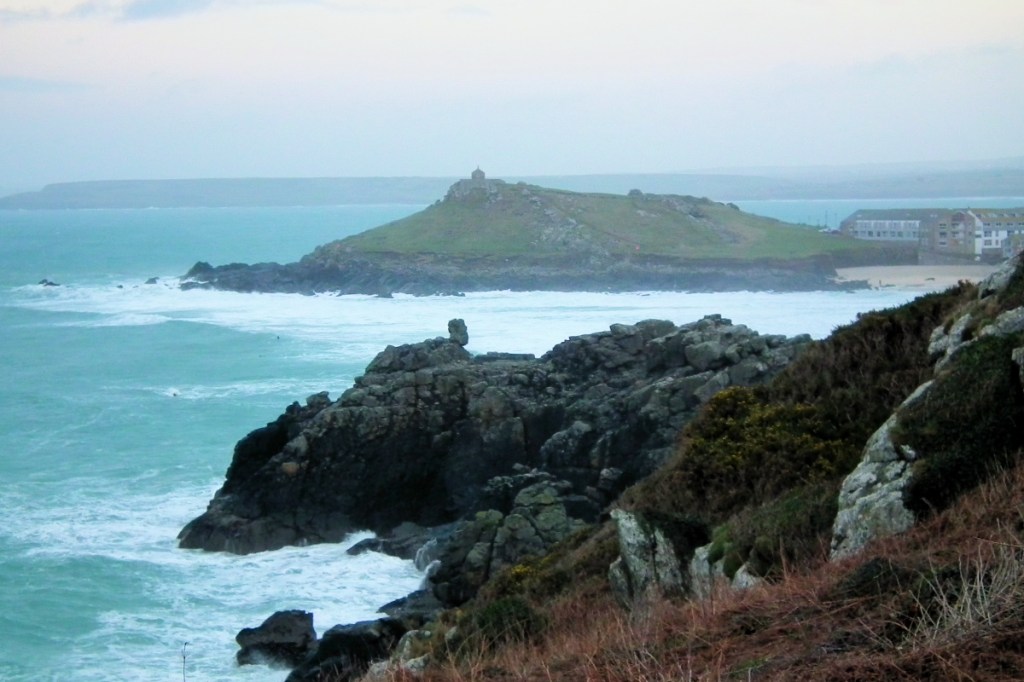
St Ives Head, a Neolithic and Iron Age cliff sanctuary

War is a critical issue, as part of this. I read recently that a study had shown that over 90% of Hamas fighters had experienced their fathers being killed. Little explanation is needed – it’s all about pain and how we respond to it. And, take note: if that had been you, you’d probably land up being such a fighter too. Either that, or you might become an exceptionally brave and driven peacemaker if you so chose – one of those who are rarely mentioned in the news.

The world teeters on an edge where a very big collective decision is needed, regarding war. While explosions and horrors go on, other big world issues cannot progress. The world’s sensitivities are dulled. Resources are misdirected into ‘defence’ and wasted in both destruction and reconstruction. Our moral compunction is overlaid with anger and dismay. Our capacity to see that we all sail in the same boat is obscured. We fall for the belief that other people and nations are against us and a danger to us. This is a mass-psychological complex.

There are elements in this world who wish to crank up this belief too – not heal it. Such a belief does have substance, but there are other ways of dealing with it. It’s not just a matter of diplomacy but one of deep social change. Some people deliberately stoke up division and conflict – our good friend Benjamin Natanyahu is a classic case, but he’s by no means unique. Such people have a vengeance to carry out on a world that has mistreated them. Or they’re on a power trip, though this often arises from past pain too. Or they and their oligarch-team are struggling to stay on top. Or they can’t drop the addiction to conflict (or the money).

The majority of people have grudgingly fallen for the habit of accepting division, conflict and war – they regret seeing their children die, but they still fall into this pattern of belief, even financing their own children’s deaths through their work and taxes. Some nations rely on a psychology of fear and division to justify their existence. Some oligarchies cannot exist without it.

In Britain, divide and rule, a power-imposition pattern taught to us a long time ago by our conquerors the Romans and the Normans and nowadays embodied in the ethics of the Conservative party, is a pattern arising from trauma. It’s not uncommon that imperialistic nations – Britain, Russia, China, Turkey, USA, Netherlands, France, Israel and others – generated the historic urge to conquer as a result of being conquered or oppressed themselves, further back in time.

But this is not the only option: Canada, Sweden, Norway, Denmark, Costa Rica, and to some extent Germany and Japan, tend the other way. None of these nations are angels, but they see things differently. Peacebuilding is not an impossible task.

Godrevy lighthouse

We don’t commit acts of warfare only militarily – nowadays economic and psychological warfare are big things.

On the economic front, we smug Brits, we run a neat string of offshore banking centres for the sequestering of wealth and the unaccounted processing of enormous transactions. That’s one of our specialisms – clean, kinda legal and smart corruption. Around one third of all the world’s money goes there. We have straight-laced, official, smart, seemingly law-abiding banks in the City of London, though those same banks have shadow subsidiaries in the Caymans, Belize, Virgin Islands, Singapore, Isle of Man or Jersey to handle the unaccounted stuff (everything from Apple profits to drug barons’ billions to Nigerian oligarchs’ money-stashes to corporate mega-transactions). Good business. However, not good for people and planet (or national government tax-takes).

These kinds of obstructions are not insurmountable: it requires people to hang together, clarify and state our collective wisdom and preference, and vote with our feet (or even fingers). It requires electoral swings, mass consumer choices, campaigns and also – this is the critical one that leads to real action and change – the right kind of response to events and defining moments.

We’ve had one recently with Gaza. All of the demos and campaigns of recent months have not really paid off in terms of ceasefires. But in terms of historic swings and consensual tiltings, Gaza represents a turning-point. The failure of popular will, globally, has consolidated a deeper shift underneath which is far more firm and solid. It’s not specifically about Gaza, though Gaza, following on from Mariupol and Aleppo, has triggered it. It’s about large-scale destruction itself, and people as victims of it. It comes at the same time as the film Oppenheimer and a range of other events that make this a defining moment or period. Doing blanket devastation of this kind will not be so easy in future.

A tide is turning, even if it takes a generation to do so. When tides are turning, nothing much happens except for powerful undercurrents and a buildup of potential for a full-flux tidal flow to follow. That’s what could be happening here. It depends on the world public to carry this through without sitting back, believing the job is done, or forgetting because of the pressure of other concerns.

Hence, in the Sunday meditations, I’ve sometimes suggested building and consolidating a certain thought or image, since strengthening such thoughts in collective consciousness – such as reconciliation or justice – is a key part of this process. It’s all a matter of where the centre of gravity, where the tilting point in the collective psyche, stands. Gaza has shifted it. The sacrifice Gazans are making is not entirely fruitless.

Forty years ago the Greenham Women surrounded the USAF cruise missile base at Greenham Common. They made a really strong point that hit home in the hearts and minds of many people. The base didn’t close right then because something larger was happening – the end of the Cold War, an historic process that came pretty quickly once it came. The base closed during the 1990s. The women’s action worked, even though most scepto-pundits continue to believe there was no relationship between the women’s protests and the geopolitical change that followed around seven years later. Or perhaps it was just chance. Yeah, sure. But there was a connection: the women put in the work on a psycho-spiritual level which gave a big shove of momentum, alongside the efforts of Solidarinosz in Poland and other movements bringing about the Velvet Revolutions. The Iron Curtain just so happened to come down – and in history, seven years is a blink of an eye.

This is how it works. It’s in the psyche of humanity, the collective unconscious. That’s how change comes. A strange twist might also be this: when the moment comes, the actual ignition-event that catalyses such a shift could be quite small and unexpected, in a place and from a source that most people don’t anticipate until it pops. Then suddenly a widlfire starts.

Remember the young Tunisian street seller, Mohamed Bouazizi, who set himself alight and sparked the Arab Revolutions? Martyrdom worked for him and he set alight a tidal surge across the Muslim world that has been tamped down for now but it has not gone out. It’s an historic process, and many threads and factors are involved.

Newton’s third law applies to the course of history: to every action there is an equal and opposite reaction. Yet, while the wheel turns round and round there is a net movement in a prevailing direction. This is one reason why we need to give thanks for the assholes and badguys of this world: they prompt us to pull our fingers out. Because if we don’t, they’ll carry on. They exist because we allow them to exist. They embody the ghouls and devils within the collective psyches of nations and the world, and it is here that, at root, change and immunity need to develop.

Historic processes can be accelerated, and one day in the coming decades (my astrologer’s guess is around 2048-65), we’re heading for a time of intensity, of going through the mangle. We’re already going through it, but there’s more to come, and it’ll get bigger. We can make this easier or more difficult – that’s the main option available. It depends how much we Earth humanoids decide to agree. Or at least to agree to disagree while cooperating over the essentials.

The big historic change we’re going through this century involves addressing issues that go back centuries and millennia. In essence, it’s a transformation from a competitive to a cooperative collective mindset, society and civilisation. Because we’re all in the same boat, and the boat is now rather crowded and unstable.

With love, Palden


Site: http://www.palden.co.uk
Blog: https://penwithbeyond.blog
Audiobook: http://www.palden.co.uk/audiobook.html
Podcasts: http://www.palden.co.uk/podcasts.html