

This started out as my usual weekly posting about the Sunday Meditation, but it turned into something else…

In Britain we currently have a kerfuffle about an anti-Semitic murder outbreak in Manchester, one of the most multicultural cities in our country. Though I’ve worked a lot with Palestinians, mercifully I’ve never been accused of anti-Semitism. Throughout my time working in the West Bank I had a lot to do with Israelis too – particularly former soldiers. A few of them helped me smuggle tofu from Tel Aviv through Checkpoint 500 outside Bethlehem – packaged tofu looks rather like Semtex, you see.
My grandfather was part of General Allenby’s British invasion force in Iraq and Palestine in WW1, and my father was in Egypt and Palestine in WW2. Some of my German ancestors were executed for opposing Hitler, probably at Sachsenhausen concentration camp for dissenters, and some of my Roma ancestors went down in the Holocaust. Jews have played a key part in my awakening, in this life and others. So I have some threads of personal involvement here.
But what matters is that all this concerns humans and the way we treat each other. We’ve reached a global-scale impasse where our mistreatment and exploitation really need to change – particularly, to start with, humanity’s self-destructive tendencies toward war and violence.
Early on in life, as I was beginning to awaken in my late teens, though I was then oriented toward ecological issues, I realised that we will not make significant progress with eco-stuff while we are committing acts of violation and warfare against each other. Such atrocities put the brakes on human and planetary evolution. Since then I have trodden a path with one foot in the spiritual sphere and one in the political – an awkward dualism if ever there was one, with deep and conflicting moral and human issues involved.
One basic thing holds universally for all people of all faiths, beliefs and inclinations, including seculars. It’s necessary to understand and to feel what it’s like being on the other side. That’s one reason I’ve been involved with Palestinians: they’re on the other side from me – or at least, from where I started in life. Stepping over that gulf has been one of the most rewarding aspects of my life. Stepping over not just in belief and viewpoint, but in practical terms and, on a few occasions, putting my life on the line.
It was Tibetans, another bunch of apparent perpetual losers, who shoe-horned me into this. They presented me with the option to take the Bodhisattva Vow, a vow to dedicate my life to the benefit of all sentient biengs. In this I cannot claim to have succeeded and I’ve made loads of errors, hurting people and getting things wrong in the process, though the centre of gravity of my life has tilted toward service as a result of taking the vow. And I’m really glad about that.
For me, there is a connection between the blood-and-thunder stuff of politics and what many might consider fluffy, useless, unrealistic stuff such as spiritual beings and extraterrestrials. It’s all about stepping over gulfs. Mentally and emotionally. Crossing that divide. ‘Going native’. Setting selfhood aside in order to open up sufficiently to empathise with those others over there, on the other side. In this, a statement by a Christian minister in Northern Ireland has had a big effect on me. It’s this…
It’s better to fail in something that ultimately will succeed, than to succeed in something that ultimately will fail.
It’s pretty profound, that. Write it on your toilet wall.

Back to anti-Semitism. So, in your thoughts and beliefs and the way you structure and apply them, use your discernment. When your finger is on the trigger, you have a choice. You can kill or harm that person (even if only in your private thoughts), but the memory will stay with you forever, no matter how much you repress it. That’s an example of something that succeeds in the short term though it will fail in the longterm.
Or you can spare them and turn the occasion into a massive, pattern-changing mutual learning-situation for both of you. That’s your choice. And there are consequences to everything that we do. And there are consequences also to those things we avoid and deny, or we fail or omit to do.
We live our lives on each other’s behalf. Humanity is one being, and we are micro-cells within that being. Humankind is on a path of accelerated growth, both in population and in spirit. We’re now being faced with the future and with a choice to carry on as before, or to step over a threshold into a rather wide-open and at times scary space. This comes to a crunch when we face the Other, the person or the people over there – the people we don’t like. They test our capacity to understand, accept and forgive – and to see ourselves more clearly.
Compassion means ‘with-feeling’, standing in others’ sandals and boots and feeling what it’s like. Agreement or sympathy are not required. Just feel what it’s like.
This isn’t about giving way, losing your precious sovereignty or getting guiltily floppy. It’s about a new kind of strength that requires discernment. There are things in our world that are wrong, regrettable and ultimately flawed, and we are challenged to stand up and do something about correcting those. Not just to wring hands and grind our angst over them, but actually to do something about it – at least within our own sphere of possibilities.
And there are situations where we need to stop, look and listen – we need to be willing to review our position, our habits, preferences and patterns, and make a change. If a stranger knocks on our door seeking help and refuge, what is our choice?
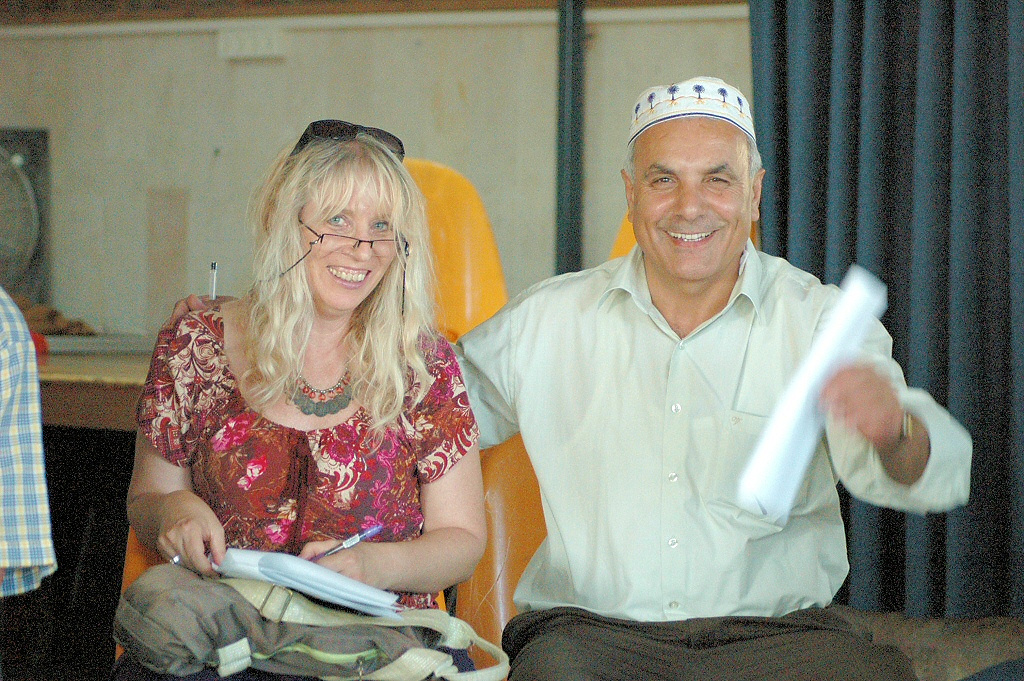
So, if you are pro-Palestinian in inclination, make a stretch and put yourself in the shoes of a variety of Israelis and international Jews. Feel what it’s like being them and being in the situation they find themselves in. And if you are pro-Israeli or Jewish, stretch over to feel what it’s like being a variety of Palestinians, whether in Historic Palestine or in the diaspora. And if you’re not bothered, feel what it’s like being bothered.
Because it’s good for you. It broadens your horizons. This is about humans – and you are one of this crazy, self-immolating species. Would you like being shot at or bombed? Would you like being hungry, having your home destroyed or seeing your father carted away at gunpoint?
Discernment is tricky to work with. Quite often I am approached for help, and I have to say No. That’s because helping them will overload my capacities and harm the people and things I am already working to help. Better to do small things well than big things badly. Guilt does not work in this context: if guilt is involved in altruism or political activism, things will go wrong. Guilt distorts true giving and sharing.
The world is polarising right now, more and more. We’re each and all faced with a question: are we ourselves adding to it, or are we bridging gulfs, whether with a smile or by giving our lives to something that builds bridges?
Jews have been victimised and persecuted for many centuries – particularly by Europeans claiming to be Christians and followers of that Jew called Jesus. Secretly, we Brits, though we righteously fought Hitler, we were quite happy to get rid of Jews and send them to Palestine, one of our colonies – though we’d have preferred them to go to Uganda. We taught those Jews all the means of oppression that we now see imposed by Israelis on their neighbours.
This doesn’t mean we should guiltily go along with what the Israeli state – Netanyahu and the Judaeans – currently do. Because this is about People and the Megamachine, and Israelis suffer this problem as much as anyone. There are young IDF soldiers who, today, are eating their hearts out over serving in Gaza or the West Bank. There are Israelis and diaspora Jews who are in a deep moral confusion and pain over this. It’s Christian fundamentalism more than Jewish extremism that is really driving the Gaza catastrophe.

In the West Bank, one thing that impressed me was that the majority of Palestinians didn’t dislike Israelis as such. Only a few Israeli friends would dare to visit me in the West Bank – the rest feared for their lives, and largely incorrectly. I forget the Arabic word for it, but what Arabs feel strongly about is not Jews, but assholes. They have a strong sense of the difference between a good person and an asshole. As a Brit, by rights I should have attracted the anger of some Arabs, because of history and what we were at that time doing in Iraq and Afghanistan, but I did not.
People would ask me whether I was a Christian, a Jew or a Muslim and, when I said No, they couldn’t figure out how I could be ‘a good man’. Well, the Hand of God moves in strange ways. But they were willing to rise up and stretch beyond their customary social judgements. That was a big teaching for me.
One Palestinian Christian, John, said to me that he felt pity for Israelis, despite all the wrongs they had done to him and his family, because many were Europeans, Americans and Russians who had gone through so much. “As a result, they are individuals, on their own, and they even question and defy God, while we Arabs have each other and we love Allah in ways you Europeans do not understand. We fight them because of our current pain, not because of the pain of the past – their pogroms and Holocaust. So, when the pain stops, we’ll stop. But they find it difficult stopping. If we stop, I fear that they will fight each other. So perhaps it is better they fight us.“
It’s also true that in times of bloodshed and violence, Palestinians polarise against Israelis, and those who don’t polarise have to keep their heads down. But when times of relative calm come along, Arabic attitudes tend to be more forgiving.
This is the secret that many Israelis fail to understand. If they let Palestinians get on with their lives and have a decent life, all will be well, and eventually Israelis and international Jews will have the safety and security they deserve. This will take time (perhaps three generations), and there will be mishaps, but this is how endless war and jeopardy will turn into mutual appreciation and cooperation, even if it takes time.
The Manchester killings happened on the Day of Atonement, giving them extra poignancy. It’s a day of recognition, understanding and forgiveness. A day of consciousness, awareness of options. The Council of Nine, a bunch of non-earthly cosmic beings I had the priviledge of working for, thirty years ago, put it very well. They said that Jews are not the Chosen People – they are People of the Choice. The choice to ‘obey the laws of God’ and the covenant that we as humans have with God or the world of spirit, or of nature.
They also said something else. Although Jews can be clannish, separative and exceptionalist, throughout history the vast majority have melted into the wider world population, through exile, intermarriage, conversion or change over the centuries. This means that you could have Jewish genes, even if you don’t know it. Think about it. I’m part-Welsh, and the Welsh claim historic connections with Jews, going back millennia.
So, if you have strong feelings about Israel and Jews, just remember, there’s something inside you that might need facing. All the things we blame Israel for now, well… actually we all do them and we and our ancestors have all done them in the past – so own up. It helps not to carry those patterns into the future. Because this concerns humans and the future of our planet.
Thus endeth today’s sermon!

As for the Sunday Meditation, you’re welcome to join. There is no mantra, no scripture, no method, no sign-up and no obligation – it’s just a group of us in various countries meditating together for half an hour on Sundays (times below), and doing it each in our own way, together. If needed, further details are here: www.palden.co.uk/meditations.html
May all beings be blessed, whether they are upstanding citizens or horrendous terrorists, on the right or the wrong side, and whether or not they have a right or an ability to defend themselves. For we all are here on Earth anyway and, in the end, we all seek happiness. And that’s the main thing. Oh, and, if you really want to find a cure for cancer, it’s forgiveness.
Love from me, Palden
If you seek further reading, try these:
- The Problem of Israel. (I wrote this article in 2008 for a Bangladeshi newspaper.)
- Brinkmanship. (An extract from Healing the Hurts of Nations, a book I wrote in 2003 at the time of the Iraq war.)
- A Palestine historic timeline. (The pages that follow it might interest you if you seek insights into Palestine’s history).
Current meditation times, on Sundays:
UK, Ireland & Portugal 8-8.30pm
W Europe 9-9.30pm
E Europe, Turkiye and the Levant 10-10.30pm
Brazil-Argentina 4-4.30pm
CST, Mexico, Jamaica, Colombia 2-2.30pm
EST, Cuba 3-3.30pm
PST North America 12noon-12.30pm
PS. In my last podcast I mentioned how I’m finding writing more difficult now, and this is still true. Normally I’d write a piece like this in 1-2 hours but this took six. But I did it. Or it did me.








 Notes from the Far Beyond
You must be logged in to post a comment.