Last Saturday, at the Pathways to the Past weekend in St Just, Cornwall, organised by CASPN, I gave a rather kaleidoscopic talk with copious maps about a big idea: Penwith as one big ancient site with 600 components to it.
If you were there, you might want to peer through the maps and hear it again. If you weren’t there and it interests you, well, you can hear it whenever you wish.
It’s two hours long, so save it for a rainy day or a quiet evening.
I really enjoyed giving this talk. It was great speaking to a group with local knowledge and an understanding of the subject.
If you don’t know Cornwall but you’re into ancient sites, you’ll still get something from this. For Penwith, dense with sites, is one of the fifteen or so key megalithic regions of the Isles of Britain.
At the other end of Britain is Orkney. Penwithians and Orcadians, between us, anchor Britain and stop it floating away.
I believe we’re coming to a time now where it will help to widen and deepen the spectrum of evidence we deem to be acceptable in studying prehistory, to see what else we find and come to understand. The schism between archaeology and geomancy is something best left in the twentieth century, methinks.
It’s funny how sometimes we fall into things unwittingly, then to find that they take up years of our lives. This is what happened with my research into the ancient sites of the area where I live, in West Penwith, Cornwall. It all started one day when I was sitting chatting with Cheryl Straffon, an archaeologist and goddess-oriented pagan who for decades has been a key person here, bringing together a full spectrum of prehistorians, from archaeologists to pagans, and editing Meyn Mamvro, a magazine about Cornish archaeology and earth mysteries.
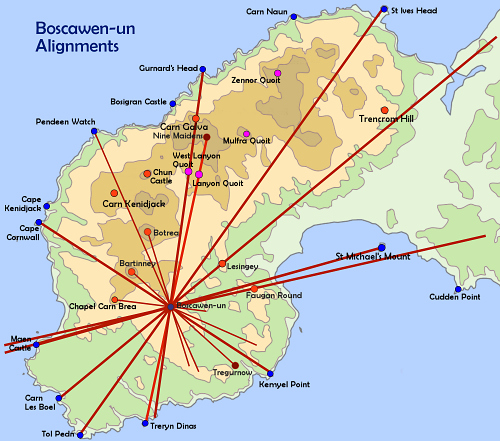
We were talking about John Michell who, in the 1960s-70s, brought the idea of leylines, sacred landscapes and earth mysteries to wider attention in a seminal 1969 book The View over Atlantis. John came to Penwith, doing fieldwork here to demonstrate his point, producing a catalogue of ninetyish ancient site alignments in Penwith, about which he wrote in his 1974 book The Old Stones of Land’s End.
I asked Cheryl whether anyone had made a map of the alignments John had found. No, she said. Hmmm. In former times, I had made a map of the alignments around Glastonbury… “Would it help if I made an alignments map of Penwith?“. “Oooh, yes, it would.“
I thought at first that it might be easier than it turned out to be. It landed up being seven years of work, starting in 2014, and it still gets tweaks and updates now. I’d had one of those falling-into-things moments, just then.
Carn Galva, a classic Neolithic Tor and the axis mundi or world centre of Neolithic Penwith – as seen from Caer Brân
Things had changed since I did the Glastonbury map, hand-drawn in 1982 and revised around 2003. Aerial satellite mapping had arrived on internet. For alignment-oriented geomancers like me this greatly changed the equation, opening up many new possibilities and making alignments maps easily accessible online to the public.
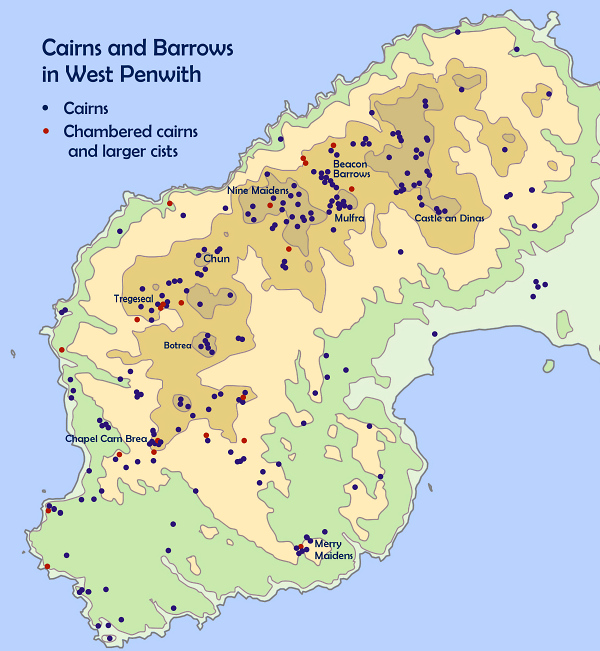
At the beginning it came clear that a genuinely useful map would need to show all of the known ancient sites in Penwith. But there are more than 800 of them, big and small, surviving or destroyed, so this was no small job. They were listed in a variety of online databases which, to complicate things, sometimes gave differing or inaccurate information, so every single site had to be examined closely.[1] I spent months trawling through these sources and building up a base map on which later to mark alignments. Later on I continued the mapwork to cover Scilly and the whole of Cornwall.
Some sites were difficult to confirm, being disappeared, disputed or subject to discussion. Some were visible in the field and others, now destroyed, were beyond trace, though many are mentioned in antiquarians’ records from former times – especially those of one called Dr William Borlase, who tramped around Penwith in the mid-1700s.[2]
Eventually I completed a map of Penwith’s sites. Then it was a matter of working through John Michell’s list of ninetyish alignments, plus others found since his time and listed in Meyn Mamvro.
One can argue till the end of time about the validity of megalithic alignments and sceptics love to do so, claiming an assumed authority of scientific rationality when, to me, all that these complaints demonstrate is that sceptics have not properly researched the matter. There is a simple, evidential, inescapable fact: ancient sites are commonly located in exact alignment with each other. This can be seen and checked by anyone on maps and in the field.
That’s the evidence, whether or not we have an explanation. It happens too much, too exactly and with too many supporting details to be a case of chance or randomness. There are discernable patterns to the specific nature of differing alignments – some are made up solely of cairns or menhirs (standing stones), or they link sites of similar antiquity, or they make some sort of sense in a wide variety of ways. Some alignments are even parallel.
If you look at the online map of Penwith’s alignments [3] it looks like a meaningless jumble with only a modicum of order to it. There’s a ridiculously large number of alignments and it’s difficult figuring out how and why the megalith builders went to the trouble of setting things up like this.
But when you look closer at individual alignments and the sites they connect, they begin making more sense. It’s worth remembering that the ancients walked everywhere, so a lot more happened for them in the space of a mile than it does for us, speeding along in our cars and looking at overview maps.
What is most interesting is that alignments stretch not just between man-made sites, but they also involve natural sites such as hilltops, carns (outcrops) and cliff promontories. The whole system is based on these prominent points – I call them ‘base sites’. The pattern of ancient sites is draped over the three-dimensional canvas of the Penwith landscape and arranged around it. There are also astronomically-oriented alignments and other factors such as energy-vortices, underground and overground energy lines, site intervisibility and even geometry that are involved in the positioning of ancient sites. [For more on this, here’s a talk by me.]
Entering Michell’s ninety alignments on the map, I found that only two were inaccurate and implausible, and I removed them. He had done good, accurate work. While making the map and checking the alignments, I started finding new ones and, before long, the list of alignments grew bigger. Some were found logically, by examining a chosen site to check for alignments, and some were found intuitively, happening on them ‘by chance’. After visiting sites around the fields and moors of Penwith, I would come home to examine their location and possible alignments, sometimes adding a few that way.
Late one evening I had a Eureka moment. I was thinking about Cape Cornwall, a conical-shaped headland in a marine context, and St Michael’s Mount, a conical-shaped island in a marine context (though originally it stuck out of the forest on dry land). They are rather similar. I wondered whether there was a connection. I looked on the map and, lo behold, a line between them intersected a collection of four Bronze Age barrows on top of the hill on the farm where I live!
Gosh. I had sat many times on those barrows.[4] They are not well-known because, being on what’s now a boggy heather-moorland hill, they look unimpressive, but their 360-degree panoramic location is spectacular. In the Bronze Age they would have been far more attractive, situated on sweet hilltop meadows – the climate was more agreeable 4,000 years ago than it is now.
Then I started looking for further alignments emanating from St Michael’s Mount and Cape Cornwall. Within an hour I had found quite a few. This doesn’t happen very often – I’ve never had such a big discovery of new alignments before or since. These proved to be a new kind of alignment that John Michell and others had not seen.
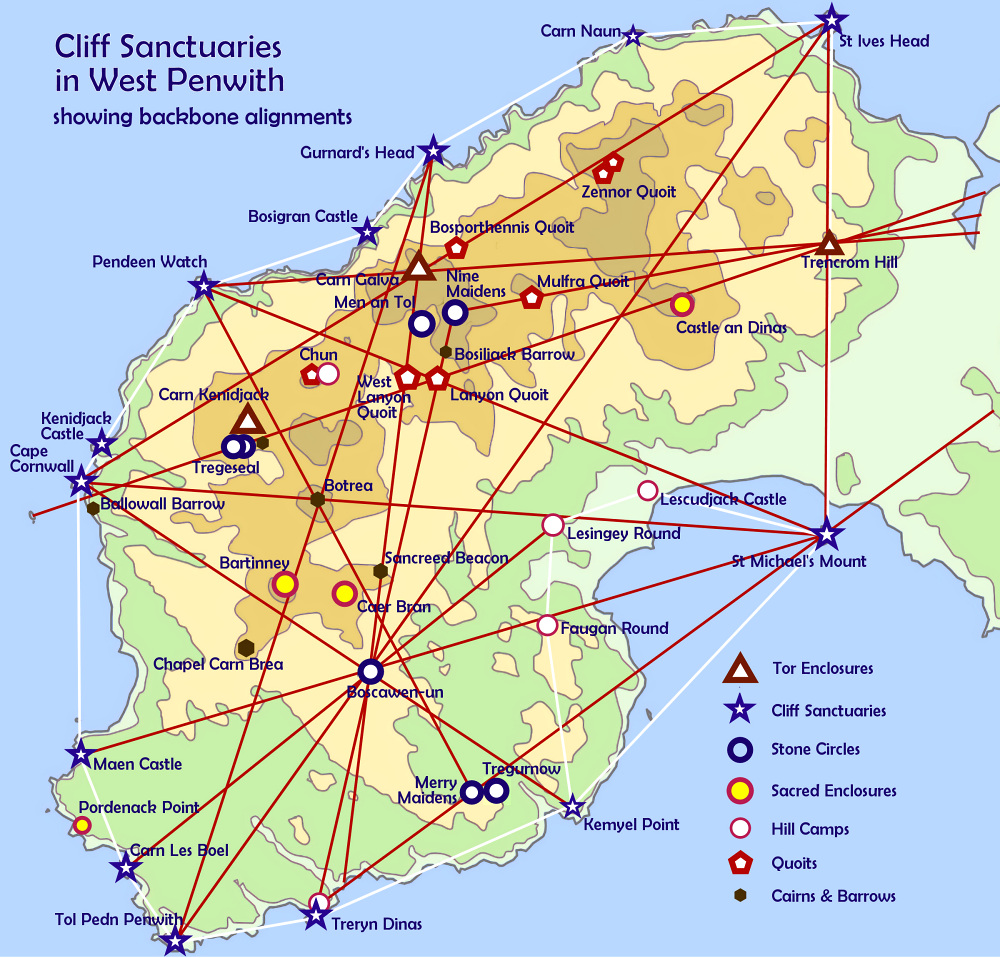
John was looking at constructed Bronze Age sites such as stone circles, menhirs, cairns and barrows, which were built from around 2400 BCE onwards. The new alignments I had found involved Neolithic sites from a millennium earlier, and natural sites such as granite tors and cliff headlands. These alignments acted differently to Michell’s Bronze Age ones, covering longer distances and with fewer points on them. I called them ‘backbone alignments’ – alluding to the main system of fibre-optic cables that connects the internet globally. Connecting Neolithic and natural sites, these alignments were clearly far older than John’s Bronze Age ones.
The very first constructed sites in Penwith, Neolithic tor enclosures, were built around 3700 BCE – over a millennium before the stone circles. There were four – Carn Galva, Carn Kenidjack, Trencrom Hill and St Michael’s Mount – and one outside Penwith that features in its landscape, Carn Brea near Redruth.
Many of the newly-discovered backbone alignments also stretched to what I call cliff sanctuaries. Archaeologists call them cliff castles – a term that persuades many people to believe they were used for defensive purposes, which I would argue they were not. They are customarily dated to the Iron Age around 300 BCE, long after the megalithic period, because Iron Age remains are found on them. But the new alignments, associating them with Neolithic sites, suggest they were much older in the first use. Neolithic artifacts have been found at some cliff sanctuaries, but these have not caused them to be properly re-dated to this early time.
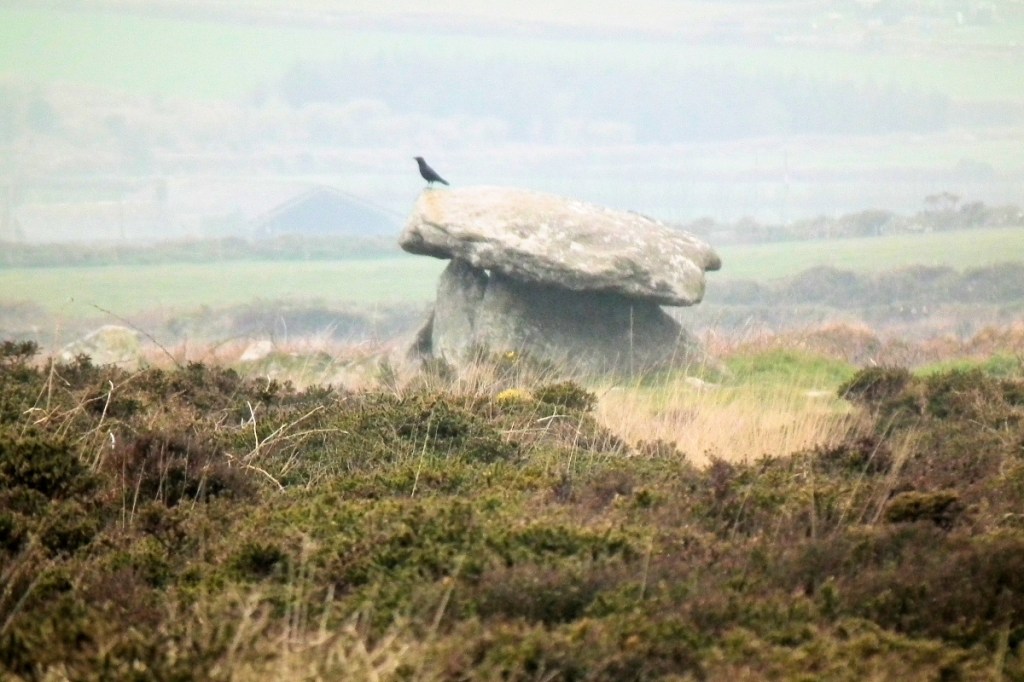
Then came the clincher. I found that Lanyon Quoit, one of the key Neolithic sites of Penwith, built around 3600 BCE, was located exactly at the intersection of three of these alignments. In other words, Lanyon Quoit could not have been placed where it is without these three alignments being known at the time – it was positioned to align with two cliff sanctuaries and three Neolithic tors. This definitely re-dates the cliff sanctuaries to the Neolithic, also making them far more important than they previously were understood to be.
Penwith’s four surviving stone circles are all located on backbone alignments. The Merry Maidens, for example, are located exactly on an alignment stretching between Carn Brea and St Michael’s Mount, both Neolithic tors, and Treryn Dinas, a cliff sanctuary. These three natural sites happen, strangely, to be aligned with each other (there are a number of such cases in Penwith). So the stone circle was located there to reinforce the alignment and to draw on the antiquity and earlier primacy of the three Neolithic sites, which came from what in the Bronze Age was a distant former time, some 1,500ish years before.
Eventually, the alignments map of Penwith became really busy with alignments – around 250 of them. They were all genuine alignments, accurate to within 10ft or 3 metres, checked and verified by three people – so this was not a product of sloppy mapping, wishful thinking or ley-hunting zeal.
Alignments are not energy-lines of the kind that is picked up by earth energy dowsers. They are different, even though overground energy lines, like alignments, are also straight. Some overgrounds coincide with alignments, but we yet need to find out the extent to which this is the case.
Trencrom Hill (foreground) and Carn Brea (background) – two Neolithic tors
I’m of the opinion that alignments are not actually lines that are detectable in the landscape. Some dowsers might disagree, but I think they might be picking up on overground energy-lines, or perhaps the thought that links the two sites involved. Instead, it seems that, when a new site was being built, it was simply aligned with other sites in order, presumably, to associate it with them. If you line up five or six objects on a table with gaps between them, aligning them nevertheless gives their distribution some order and coherence. Rendering order out of seeming chaos was important to the ancients. But aligned sites don’t seem to have a connecting current like overground energy-lines do.
It seems to me that aligned sites are instead programmed with the same algorithm, so that they pulsate and resonate with each other, as if tuned to each other. But there isn’t a ‘wire’ connecting them – it’s an internal, implicit connection. It works a bit like what physicists call ‘quantum entanglement’, and as an informational rather than an energetic relationship. An energetic relationship is created by energy-lines that dowsers identify, but alignments don’t do this. So we’re talking here about two different circuitries that each focused on the same ancient sites. And it’s the sites, not the lines, that matter most.
Many ancient sites are thus placed exactly where they are to align them with other sites, though there is no ‘pipe’ connection between them. Instead, they seem to be remotely associated, programmed with the same intent, frequency or behavioural patterns, so that they do similar things at similar times and in similar ways. But they aren’t necessarily directly connected, unless there is also an energy-line between them.
Thus, the Boscregan West cairn, a prominent clifftop cairn on Penwith’s west coast, is aligned with the Neolithic longbarrow on Chapel Carn Brea, and with the now-destroyed Tregurnow stone circle, which was part of the Merry Maidens complex. So these three sites, associated with each other, somehow co-resonated. Or, put another way, two Bronze Age sites, Boscregan cairn and Tregurnow stone circle, were plugged into a Neolithic site on Chapel Carn Brea.
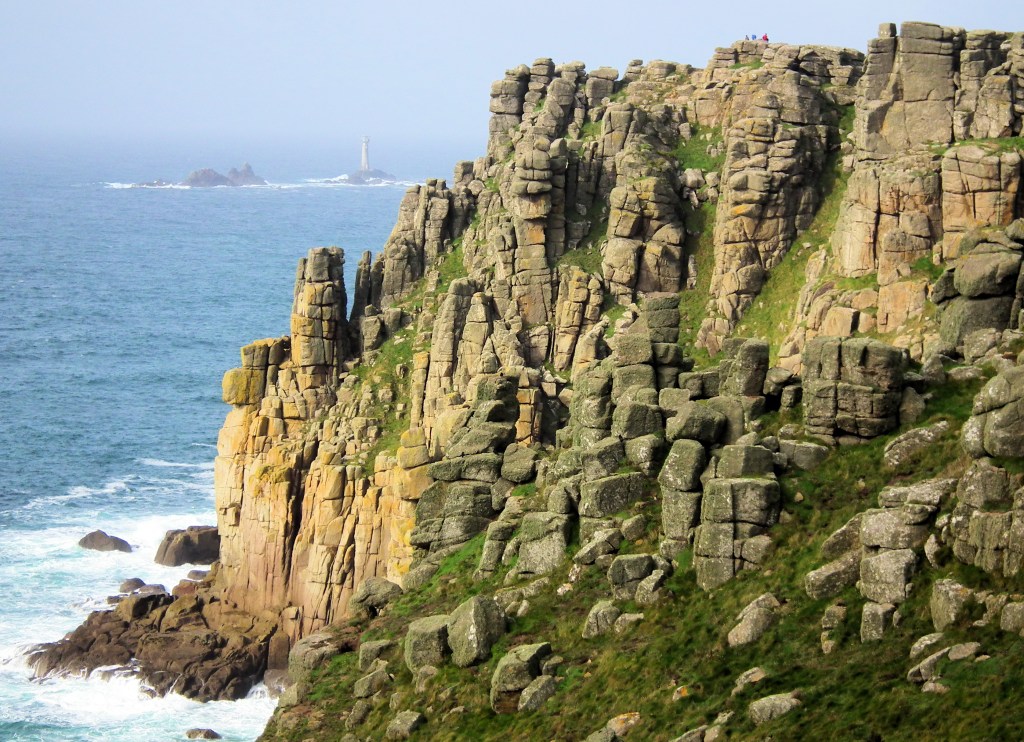
The cliff sanctuaries, embracing the Radiant Land
Interesting, huh? The megalith-builders had quite sophisticated ideas. They weren’t building ancient sites just to decorate the landscape or because it was a nice thing to do. It was a lot of work. They can only have done it because they perceived a definite benefit.
Here’s a much bigger idea. The density of sites and alignments in Penwith, and the way they seem to be integrated into complex relationships with each other, suggest that they operate as one big system. The fundamental substructure is marked out by backbone alignments (yellow on the map), and while the profusion of local alignments (red on the map) seems chaotic to our eyes, it has a certain order of its own. They all seem to make up one big system.
This leads us to the idea that Penwith is an integrated and perhaps super-charged landscape with hundreds of constituent components to it, big and little. That’s the way we should think about it, and not as a disparate scatter of separate sites. After all, Penwith’s ancient name is Belerion – the radiant land – and a place doesn’t pick up a name like that without good reason.
While Penwith’s stone circles and other sites are each modest in size when compared with Stonehenge, Avebury or Callanish, together they make up an enormous system contained by a necklace of cliff sanctuaries and studded with many subsystems. They constitute what can be regarded as a single, big ancient site that is draped over the peninsula’s natural topography and energy-centres.
Each stone circle has a complex or constellation of lesser sites around it – mainly menhirs and barrows. These supporting sites and the surrounding landscape vista exist as an integral part of the stone circle to amplify its purpose – a stone circle doesn’t exist in isolation. In the case of Boscawen-ûn and the Merry Maidens the surrounding agricultural landscape of hedges and fields obscures their wider complexes, but at Tregeseal and the Nine Maidens, located in wilder landscapes, they are more visible.
Tregeseal, for example, sits in a perceptual bowl of hills with a westward vista featuring the Isles of Scilly – almost as if the sweep of hills collects energy from the cosmos to funnel it toward the Scillies. Each stone circle is associated with a hill or tor that is visible from it and a key part of its landscape setting. These complexes are whole systems. In turn, they are aligned with other sites further away, knitting the whole of Penwith into a wholeness.
The stone circles are located on backbone alignments plugged into Neolithic sites – tors and cliff sanctuaries which, in the heavy-forested Neolithic, were the only places where people could get out of the wildwoods. This changed in the Bronze Age, with far more cleared land, which enabled the building of stone circles, menhirs and cairns, but the stone circles, as the ‘cathedrals’ of the system, drew their primacy, authority or blessing from earlier Neolithic sites.
They are key nodes planted in a landscape energy-system with a natural, topographic, geological and subtle-energy foundation. The system fashioned itself around the lay of the land. Here we come to the idea of landscape temples, or whole landscapes that have been developed and consecrated by amping up the natural energies inherent in the land. This was done not only through ‘megalithic geoengineering’ at sacred sites but also through repeated, longterm consciousness-work by successive generations of people. This was an advanced deep-shamanic culture. They imprinted their sacred sites and landscape with repeated and reinforced psychic traces of the shamanic and spiritual practices they conducted over many centuries. They loved the land that gave them a life to live.
An approximate timeline for megalithic Penwith
There is a key aspect of ancient sites that archaeologists miss, and without it ancient sites cannot truly be understood: it concerns earth energy and its psychoactive effects, especially when they are focused and enhanced at man-made ancient sites. These effects cannot easily be detected scientifically, but any person with a modicum of awareness can feel them when visiting sites. We become changed in mood and spirit, sometimes feeling inspired, healed or as if our problems have evaporated. Some people are changed for life – for me, five decades of preoccupation with ancient sites began in 1970 in the Ring of Brogar, a stone circle in the Orkney Isles off Scotland.
These psychoactive effects are a key factor that should be considered ‘legitimate evidence’, regardless of whether or not it can be measured or slotted into existing scientific frameworks. You do not need a doctorate to feel these effects: simply note your feelings and state of being before you enter and after you leave a stone circle. There will be a real change of feeling. Fascinatingly, it can also be quite different in quality and effect each time you visit.
This, I suggest, is a key reason why the ancients went to so much trouble heaving stones around, digging and piling up earth, and doing regular, intentional, collective consciousness work at ancient sites. They spent centuries building up a sophisticated landscape-wide energy-system, and they must have perceived this massive infrastructure investment to be beneficial and worth the effort.
If they had been deluding themselves, it is unlikely that the Bronze Age megalithic period would have lasted 1,200 years. Delusions don’t tend to last that long. There was something very sensible and realistic about the megalithic geoengineering they developed. With our planetary problems of today, we might do well to learn more about what they were up to.
Here’s a final thought. Since right now the world is rather obsessed with warfare, we might also ask ourselves how and why West Penwith is one of the few parts of Britain that has never been invaded – not by Romans, Saxons, Vikings or Normans. In later times Penwith was quietly regarded as lying ‘beyond the reach of the king’s men’. We’ve had some medieval Corsair raids and in the last century or so a seasonal tourist invasion, but Penwith has never actually been invaded. But that, of course, is pure luck and chance, isn’t it?
NOTES:
The main sources were: Heritage Gateway, Historic England, Cornwall Council, Megalithic Portal, Modern Antiquarian, Meyn Mamvro, The Holy Wells of Cornwall map, The Atlas of Hillforts and snippets from other books and sources.
This is a recording of a talk I gave on Wednesday 19th in Penzance, here in Cornwall. It would interest anyone who knows and loves West Penwith, and also folks interested in geomancy and alternative prehistory.
It’s about energy-fields, ancient site alignments and the geomancy of ancient sites. I make a radical proposition that the hundreds of sites in Penwith all constituted components of one enormous ancient site covering the whole peninsula.
A collection of interesting maps is provided with the recording of the talk, which is 1hr 48mins long.
To follow in autumn in Penzance, there will be four monthly AHA classes, covering activism (changing the world), prehistory (more about Magic Penwith), power points in time (astrology and the way the tides of time move) and extraterrestrials (about life off and on Earth).
I’m speaking at the Glastonbury Symposium on Sunday July 28th, and I return to Glastonbury on my birthday on 5th September. The subject is ‘Sludging through the Void with Muddy Boots – and why ETs have spindly legs‘.
If you want a really special experience, you might consider coming to the Oak Dragon Camp, Friday 26th July to Sunday 4th August in Somerset. I’ll be there. www.oakdragon.org
A podcast about ancient subtle energy technologies – and why they matter to us now
Here’s my latest podcast, about power points – in space and in time.
Ancient peoples had a way of penetrating the inner secrets of nature through working with power points. It was a high-level shamanistic culture, applied in medicine, resolving social issues, encouraging bioproductivity, climate control and log-distance communication.
And there’s something we can learn from that today.






 Notes from the Far Beyond
You must be logged in to post a comment.