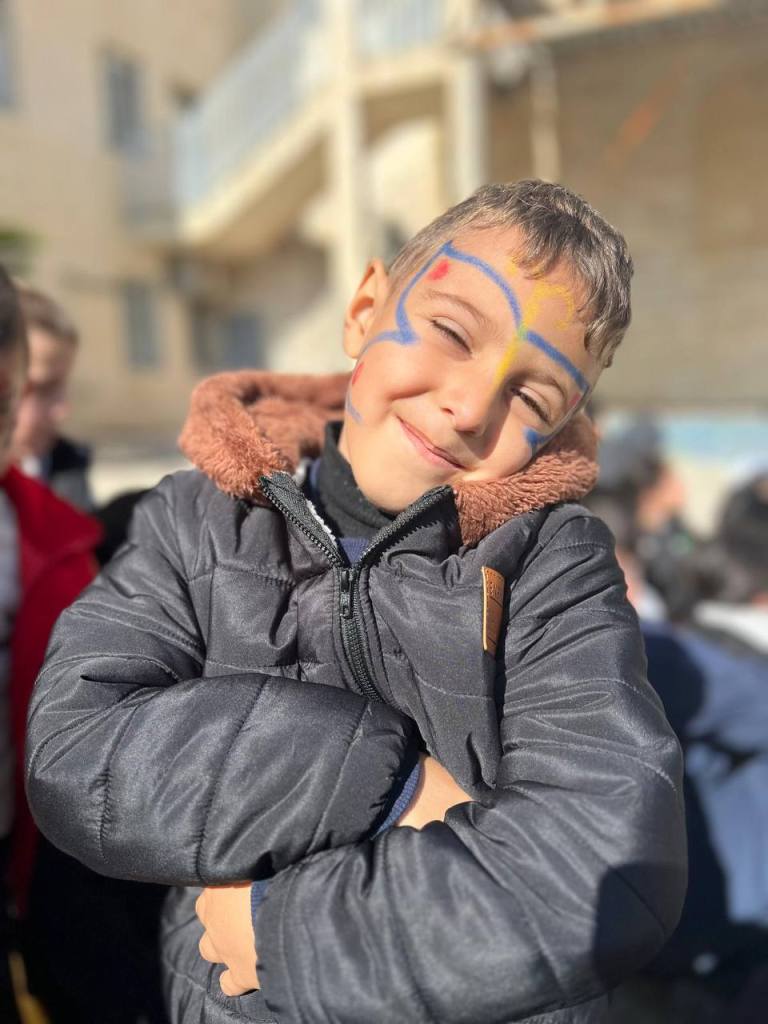
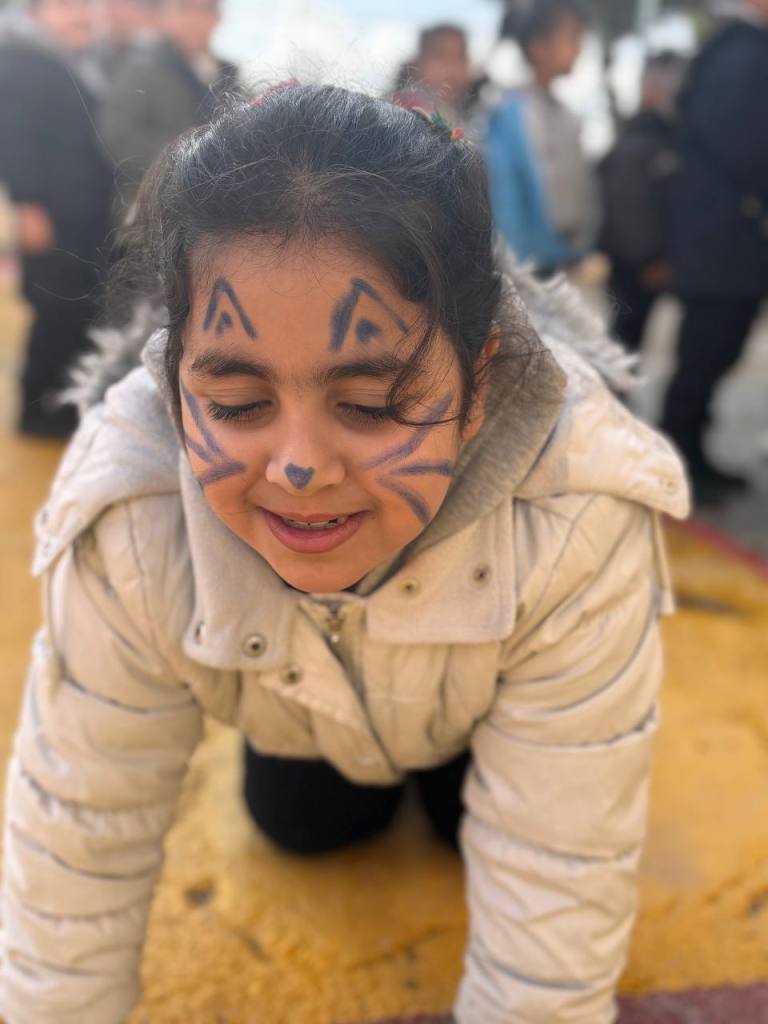
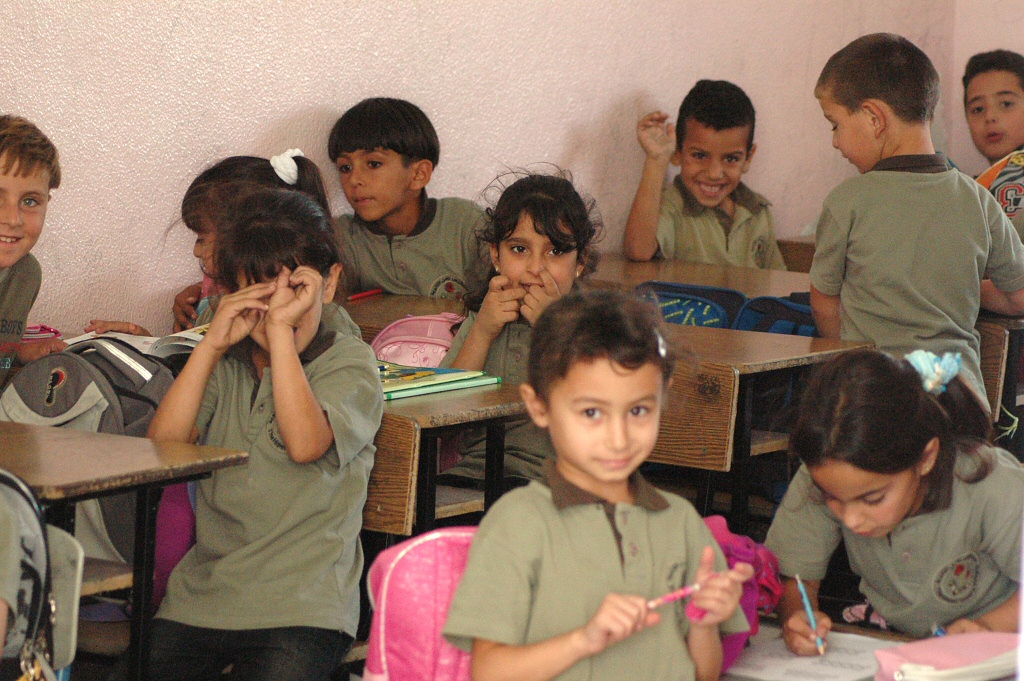
These are kids at the Hope Flowers School in Bethlehem, West Bank, Palestine, and these pics were taken in the last few days.
They are orphans from Gaza, and refugee and special needs kids from the West Bank. Apart from giving a good education under difficult circumstances, the school gives kids the tools to process their anger, loss, fear and trauma, so that they grow up knowing there is another way. Another way from what has happened over the last hundred years in Palestine and Israel.
Note the performers. These look like visiting Europeans. They are independent humanitarians: they set about brightening up the lives of people in places like Palestine and they make a big difference. They often fund themselves to do so, and travel cheap and crash on sofas. Some are performers, some hairdressers, some are welders and some are law graduates, artists and retired professionals. Have you ever considered doing something like this?
Forget Trump and Natanyahu: this is the human frontline, where the real work of peacemaking happens. These children are, I hope, the generation who will see a big change across the Middle East. The times of war need to end now: we must do things another way. And these are the people who will do it. That is my prayer for them.
Here’s the translation of the text that came with the pics:
In an atmosphere filled with fun and positive energy, the professor of physical education, Mr. Mustafa, organized a special recreational day for the students of the school, in cooperation with the refugee center, where play, art, and laughter came together in an unforgettable day ✨
⭕ A variety of events between animated games that enhanced activity and interaction, face painting added colors of joy to the faces of children, alongside a theatrical circus that presented pleasant performances that brought joy to the hearts🎪😊
Our students also participated in playing with parschute and other group activities that contributed to promoting a spirit of cooperation, active discharge, and building self-confidence in a fun and safe way 🌟
⛔ This day was an open space for joy and expression, and an integrated recreational educational experience that emphasizes the importance of play in supporting our children’s physical and psychological development 💚
ـــــــــ🍂ــــــ We learn for human well-being ــــــ🍂ــــــــ
To make a donation to Hope Flowers, go to this page for links to Hope Flowers’ supporting organisations in different countries: https://hopeflowers.org/wp/support/
Here’s a readable story about the history and philosophy of the school. It’s from my book Pictures of Palestine, and it’s called ‘Korea meets Palestine’. (Korea and Palestine were both divided in the same year, 1948.) https://www.palden.co.uk/pop/korea-meets-palestine.html
I’m continually reminded of the extent to which the present is a gift. Everything comes from Spirit, from the Void, from what we call God, and everything returns to Spirit, to the Void and to God. And everything exists within them.
It doesn’t matter how we see the nature and meaning of life, the universe and everything – it’s still the same. We are the eyes, ears and hands of existence-consciousness-beingness. It’s dead easy to forget, to get lost in our stuff, but it remains true.
Some people are in the midst of nightmares right now. Some days ago I did a joint online presentation to a support group in Britain with Ibrahim Issa, director of the Hope Flowers School in Bethlehem, in the West Bank of Palestine. Western governments, aid agencies and donors have withdrawn a lot of support, so we’re having to do some remedying of that, especially since life in the West Bank is getting harder and harder.
I was amazed at his composure. Or perhaps he was just too tired. He and everyone around him had been kept awake through the night by missiles, planes and sirens. And fear.
Even so, they keep on at the school, driving by the seats of their pants – attending to the needs of the children, their families and the local community. On a shoestring.
The latest measure they’ve taken – since Israeli roadblocks all over town make movement difficult – is to take trauma-support services to the people, in a Volkswagen van. It’s a sort of trauma-ambulance, for people losing their rag because of the tensions, dangers and offensive experiences they’re living through.
In my contribution I mentioned the Arabic term, sumud – hanging in there, never giving up. The secret is to stay in the present, to make the best use of the gifts it yields. When the past is being obliterated and the future holds little to hope for, there remains the present – the only time we actually have agency.
My own body is gradually deteriorating – a new health issue is slowly immobilising me – yet I’m continually amazed at the gifts that life presents. One is this: lessons I’m learning from people younger than me. In this case, it’s Ibrahim, teaching-reminding me about the present moment. Doing what you can with whatever is available right now and making the best of it. Because the past is gone and the future is but an idea.
People bang on a lot about freedom of speech, though really we need to learn more about exercising our freedom of attitude.
In the immediately-impending future, on Sunday (times below, for different countries), there comes the Sunday Meditation, and you’re welcome to be present with it. It’s free, no sign-up, no strings, do it your way, and wherever you are.
Perhaps give some attention to feeling what it’s like to stand in the shoes of someone whose life could be snuffed out tonight, for no understandable reason or purpose. Hold their hand. There’s no shortage of available souls in need of good-hearted soul-company, in plenty of places. This is what we can do.
With love from me. Palden.
———————
Current meditation times, on Sundays: UK, Ireland & Portugal 8-8.30pm GMT W Europe 9-9.30pm E Europe, Turkiye and the Levant 10-10.30pm Brazil-Argentina 4-4.30pm CST, Mexico, Jamaica, Colombia 2-2.30pm EST, Cuba 3-3.30pm PST North America 12noon-12.30pm
In my audiobook and various of my postings you’ll have heard of Hope Flowers School in Bethlehem, Palestine (here’s a brief intro). I used to work there.
Here’s a newsletter from Ibrahim Issa, the school’s director. It gives a taste of what it’s like running a school in occupied Palestine at present.
With love, Palden
—————————-
Dear Friends,
Thank you for all your support and solidarity with the Hope Flowers School (HFS). I am trying through this letter, to share with you what happened on 6 December 2023 at the HFS. It is a bit long; I believe that some of you have received a big number of pictures and videos on that day.
It is almost 21 years ago, when James Bennet wrote an article in the New York Times about HFS: “Arab Coexistence school falls victim to violence” you can read this article on: https://www.nytimes.com/…/arab-coexistence-school-falls…
Between December 2002 and December 2023, HFS battle for Peace continues.
The school-day at HFS starts early in the morning. Children and staff start arriving at 07:15 A.m. It is quite difficult to predict the day and whether clashes between Palestinians and Israeli army will erupt that day. Clashes could erupt at any moment of the day. HFS staffs have to be prepared to act in case any violence erupts at a sudden.
Elegant vehicles, huh?
On Wednesday, December 6th 2023, in my way to HFS at 7:15 AM. I have to pass Deheisha refugee camp and Al Khader village. In my way I found tens of Israeli military vehicles and armed personal carriers about to enter the refugee camp and the village. Despite military presence on the way, but I managed to reach HFS at 07:30 A.m. The neighborhood of HFS was quite. I did not see any Israeli soldiers in the neighborhood.
I started to receive calls at about 07:45 from HFS staff that they could not reach the school because of Israeli army presence and clashes between the army and Palestinians. So we decided to start the school day with the absence of two staff members who could not reach the school.
At 8:30 am, I was in my way from HFS to another meeting. On the corner of the school, I was stopped by tens of Israeli soldiers who were just arriving to the street and started to block the road with large concrete blocks using a bulldozer. The soldiers were very tense, especially I found myself with my car surrounded by big number of soldiers. The one soldier asked me to continue driving while another asked me to return backwards to HFS. I decided to stay unmoved because of unclearity in soldiers demands. Any wrong movement at this situation may be interpreted as an attack on soldiers and could kill me.
At this moment a military vehicle stopped next to me and there was apparently the commander of the unit. I talked to him in English and explained the situation that one soldier is asking to drive backwards and the other is asking me to drive forwards, I asked him if I could drive backwards (back to HFS), but he refused and asked me to continue driving forwards. He also instructed the soldiers to allow me moving forwards. I also told the army officer that I am a principle of a school located on the corner, and that I have 350 children aged 4-13 years old right now in the school with some children with special needs, and that I would appreciate if the army could give me 30 minutes to evacuate the school before they enter further in the neighborhood. The commander refused and he told me that in one hour they will finish their operation and that the army will reopen the road.
I cancelled my meeting and decided to stay nearby the HFS. I immediately called the staff at the HFS and asked them to take all measures (according to emergency plan) to protect the children and staff at the school and warned them that soldiers are in the neighborhood near the school.
At about 09:00 I received a call from vice-principle of HFS informing me that soldiers are near the school and that few armored vehicles have blocked the school parking and the main gate of the school and that leaving the school or entering the school is not possible.
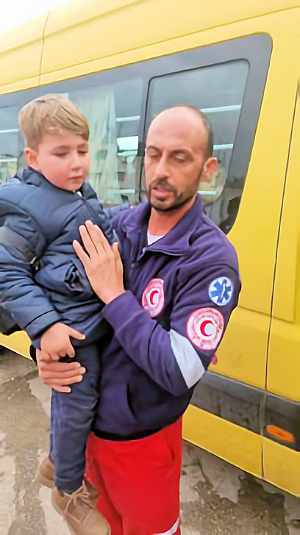
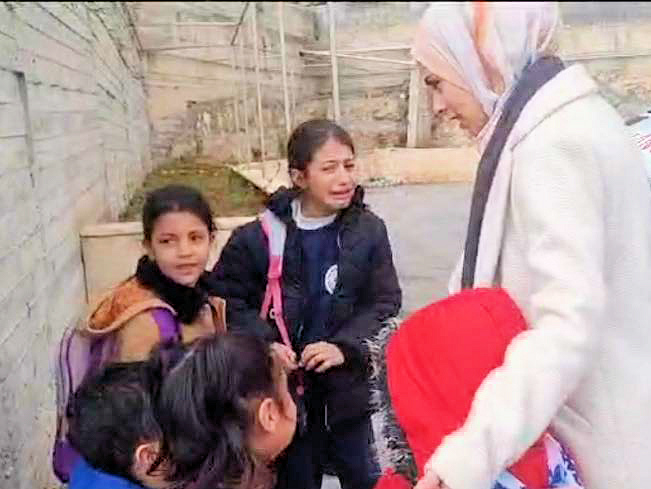
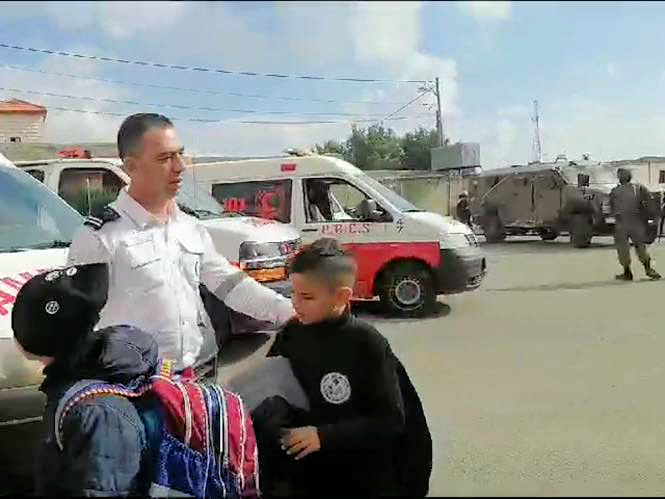
A paramedic comforts an upset boy
At 09:10 I received another call informing me that children with autism spectrum disorder (32 out of 358) are terrified and that social workers and staff need help to calm them down. Then I continued to receive calls from HFS informing me that children are totally in panic after soldiers started to fire teargas and heard of sounds of explosions nearby HFS due to clashing with Palestinian youth outside the HFS.
At this point I asked teachers and all staff of HFS to pay attention for the physical safety of children and to avoid sitting beside windows or even trying to look outside from the windows. I also informed the education department in Bethlehem that we have an emergency at HFS and explained the situation inside the HFS.
Everyone was concerned that the situation will get worse especially that some schools in Bethlehem and in the West Bank have encountered similar problems in the past few weeks.
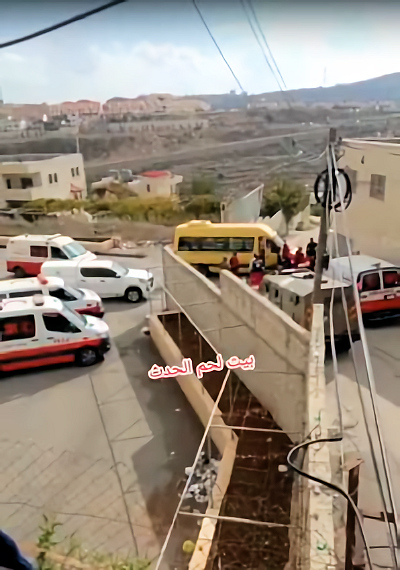
Some children have reacted strongly to fear like inability to breathe, others were crying, etc. Therefore, I asked the health department to help sending ambulances to help the staff to deal with stressed and fearful children at HFS. Indeed, 6 ambulances from Palestine Red Crescent Society arrived few minutes later, but the Israeli army prevented the ambulances to reach the HFS justifying that the area is “a military closed area”.
A teacher tries to calm the children
At this moment I started to realize the danger that children are in and started to call the Palestinian-Israeli military coordination office and asked them to speak to the Israeli military to allow the ambulances to reach the school. I decided to call other international organizations and asked them to urgently reach out for Israeli army to allow ambulances to reaching HFS.
The Israeli army has finally agreed to allow the ambulances to reach the school and finally allowed me to get back to the school in one of the ambulances. A detailed inspection of each ambulance was conducted by the army before it was allowed to move ahead. All ambulances were accompanied by an Israeli patrol.
At HFS, children were extremely fearful; in addition we were concerned that clashes between Palestinian and Israelis will erupt further.
Evacuation
Therefore, in consultation with the paramedics in the ambulances, we decided that it would be better to evacuate the whole school and take children to transport children to a safer place. The ambulances started to transport groups of children (maximum 10 in each ambulance accompanied by one teacher) to a nearby hospital.
Due to intensity of the situation, the general director of the education department arrived at HFS with one of the ambulances to support HFS’s staff and children. With the heroic work of paramedics of the Red Crescent society we managed to get all children and staff out safely.
A neighbour got shot. Well, he might have thrown stones at soldiers twenty years ago in the intifada, but he doesn’t have to die for that. He was just protecting his home.
During the evacuation, it was clear that a ‘demolition order’ was being carried out, and three neighbors’ houses right next to the school were razed to the ground by heavy demolition machines. Much violence was used by the army. Soldiers tried to prevent photos or videos from being taken, neighbors’ and teachers’ phones were roughly taken and broken. Three neighbors were injured, one seriously, he was shot in the head.
Some children have seen this happen. Hundreds of parents have heard about evacuation of the school. Parents started to reach the area of the school asking about their children. They were very scared. We asked parents to wait in hospital, you can imagine hundreds of parents were waiting every ambulance to arrive to see of their child/ren is/ are being safe. At the end of this difficult day, three families were left homeless, three people are injured, one of whom is in danger of life, and hundreds of children are further traumatized.
The impact of this violence on children, families is immense.
Teachers and counselors at HFS will have lots of extra work to do in trauma care in the weeks and months to come. It is therefore as urgent as ever that HFS work continue to provide trauma counseling for children and their families. We are very thankful for all of you who helped us on December 6th and many thanks for your solidarity and support to HFS.
The trauma counseling program at HFS aims to:
• To provide help for the children at the school and for families in Bethlehem to address the effects of the downward-spiralling cycle of violence and trauma that has arisen from violence and the occupation, and to remove the basis for future hostile behaviour.
• To create a model for wider use in Palestinian schools, to become a centre of excellence and dissemination for psychological support for people of the West Bank, and to share our accumulated knowledge and experience with the wider world.
Your support to HFS and trauma counseling program will be highly appreciated. Our battle for peace will continue!
Best regards, Ibrahim Issa, Director of HFS. hopeflowers@palnet.com www.hopeflowers.org Cell: +972(0)599294355
A number of people liked my previous blog about Palestine, and here’s a related one from the same unpublished 2011 book Blogging in Bethlehem. It’s about women’s empowerment courses at the Hope Flowers adult education centre in Deheisheh, Bethlehem.
Monday 6th June 2011, Bethlehem, Palestine
“Where is your wife?” I was being asked this by a lively young lady of about eighteen who wore the full niqab. Not many women in Palestine wear them (Palestinians don’t like religious extremism), and most of them are young. “Er, I have no wife…”. It was tricky to explain further. “Oh, I am sorry.” I guess she assumed I was a widower. It was one of those situations where cultures scrape against one another, and there was no opportunity right then to reconcile the dysjunction.
Niqab and hijab – daughter and mother
She liked me and spoke good English – a thoroughly modern young woman. Her sparkly eyes shone through the narrow gap in her niqab. Her mother, wearing a normal headscarf or hijab, came up, visibly proud of her rather intelligent daughter, who was busy explaining to me how Islam is the only truth and how I ought to become a Muslim. She pointed out some verses in the Qur’an (though it was in Arabic, so I pretended to understand) and, rather touchingly, she gave me her own pocket Qur’an. This was an honour, a gift from the heart, I could tell.
In an Islamic kind of way, this young lady is a feminist. Wearing the niqab demonstrates her reservations about modern ways and the sexual and psychological pressures modern women experience. She wasn’t doing it for her parents (I checked later) – it was her own teenage life-choice. This movement of young Islamic women has some parallels to the bra-burning feminists of my generation many years ago, declaring that they are not just the appurtenances of men.
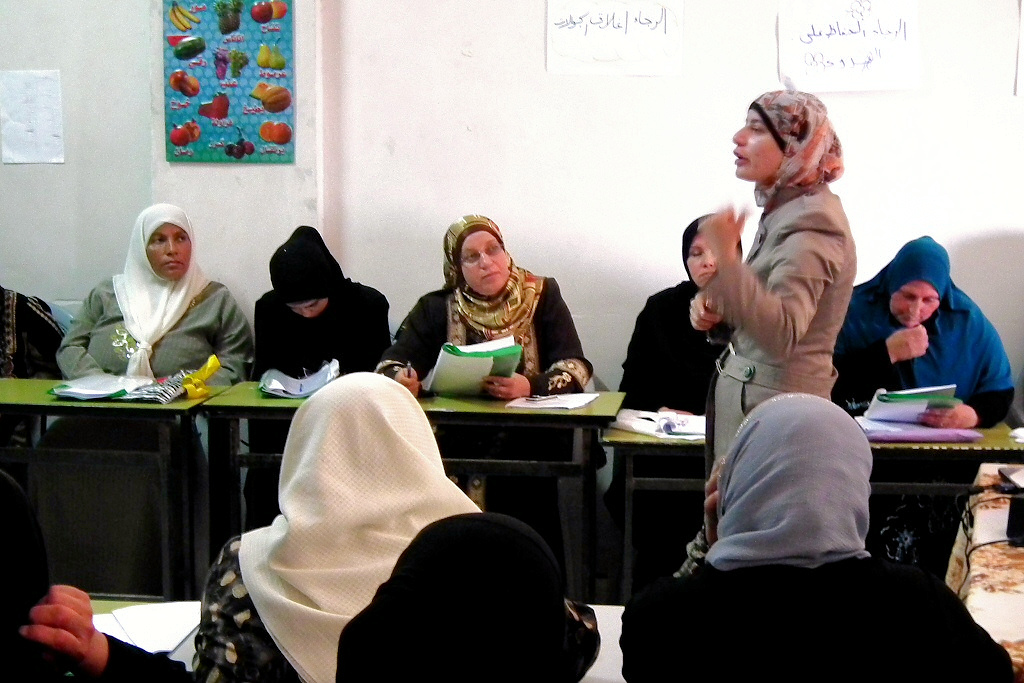
I had been at a women’s empowerment course at the Hope Flowers Centre for adult education at Deheisheh. Deheisheh is a part of greater Bethlehem (population 100,000), dominated by a large refugee camp, a community for the underprivileged. The Issa family had once lived there and worked their way out of it, and they deliberately put the centre there. The thirtyish women on the course came mainly from surrounding villages, with some from refugee camps and a number of educated women from Bethlehem. Some were illiterate and some had degrees, and Hope Flowers intentionally mixes them so that they can share the relative merits of both education and the lack of it. Apparently the educated ones initially had reservations, but these soon disappeared.
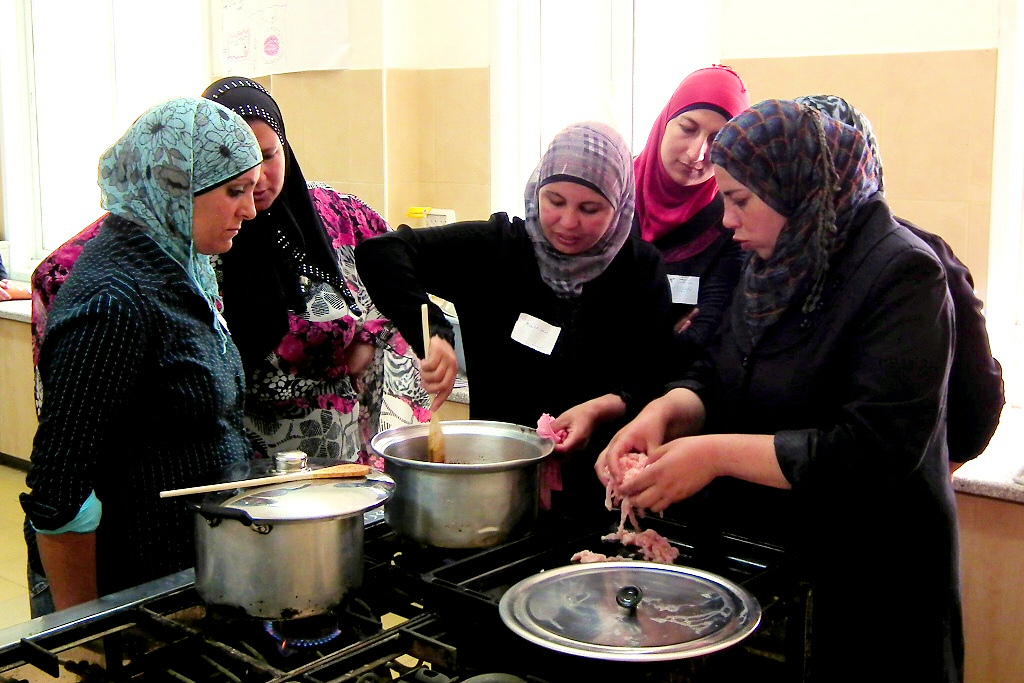
Today the subject was food hygiene. The purpose is to give women the necessary training to start cooperatives and create work for themselves. They were studying microbes, hygiene and infections, as well as nutritional issues, proteins, carbohydrates and balanced diets. They discussed the E. coli outbreak in Europe at that time, fascinated that even in hygienic, chlorinated Germany and Britain such infections could occur. I told them that this is one of the consequences of industrial-scale food production.
The lecturer, Ibrahim Afaneh, who had done his doctorate in Belfast in the late 1990s, was brilliant. He had them enthused. He knew his stuff about good practice and quality control in food production, and he had good teaching technique, eliciting the ladies’ engagement and existing knowledge, getting various of them to teach what they knew to the others. When someone made a good contribution, everyone would clap.
This is only one segment of the women’s course. Another concerns group counselling, family therapy and self-development. Tomorrow, Tuesday, I’m also going down to Yatta, south of Hebron, with Ibrahim Afaneh, to watch another course in progress. Many of these women are so poor that providing for their transport is a vital ingredient in guaranteeing attendance. But enthusiasm levels are so high that it strikes me the women don’t need much incentive, only help getting there.
Ibrahim Afaneh invited me to speak and, though I had reservations as a man about teaching on a women’s empowerment course, it was clear that, to them, this was a unique opportunity because I was behaviourally non-sexist, and they loved having me around. Ibrahim, who had lived some years in Britain and also had it in his nature, as many of the more liberal Palestinian men do, was pretty good at non-oppressive male behaviour too. He was training women to do his job.
I shared some of my knowhow acquired from being a longstanding wholefood vegetarian. They didn’t know that the best source of protein is nuts (plenteous in Palestine), or that sesame seeds and tahini, a dietary standard here, provide the full range of amino acids which themselves facilitate the absorption of other proteins. At one point I asked them what the most important ingredient in cooking is. They suggested quality sources of foodstuffs, hygiene in kitchens, balanced diets… and then, after a pause, one of the illiterate women said, in Arabic, immediately translated, “The whole of your being”. Yes! She was closest to the point I was making: love. “If you cook with love, you bring Allah into the food, you heal people and it’s just like painting a picture or making music.” They all laughed, nodded and clapped.
We had a great time. I took lots of photos. I shall write a report for the course’s UK funders, who have thus far provided 80,000 GBP over three years. A Quaker trust connected with Clark’s, the shoemakers, they fund women’s empowerment projects throughout the Muslim world. They are one of the few funding sources for Hope Flowers who have been steady, understanding, progressive and non-neurotic in their approach to funding.
Here I could see what was really happening at this course. These women aren’t fools, and they are not dazzled or easily tricked: they have a large fund of commonsense, they’re highly motivated and, were there anything spurious about these courses, they would leave like a shot. But no, they were excited, bubbling, rapt, eager to engage – and clearly their acquired knowledge would spread around their communities, leveraging the educational effect of the courses. Which is precisely what Hope Flowers sets out to do: it has a social philosophy of setting out to strengthen society.
Several women had turned up late, wanting to join, following reports from their friends. Maram (Ibrahim Issa’s wife), who runs the courses, told them the course was ending so there was no point, but they insisted and joined in. The young lady in the niqab and her mother were two of them, and later they emerged inspired. What I read from this was that observant Muslim women, while their ideas about self-development might not accord with those in the West, nevertheless are taking the modern world by the horns and striving to make something of it, but within their own context and way of seeing things. Modernity doesn’t involve just emulating the West.
Ibrahim Afaneh invited me to introduce myself. I told them I had started out in my adult life in the revolutions of the late Sixties, that I understood and supported the recent revolutions in the Arab world and, though I was British, I did not on the whole agree with the government and conventions of my own country. They loved that. So did I! I must confess that it is good to be welcomed and respected for this since, in Britain, being a dissident brings disadvantage, it’s a disqualifier and a source of disrespect. Being a dissenter here is seen as the sign of respect. But I felt duty-bound to bring them some tougher truths too.
Talking about proteins and nutrition, I mentioned how meat production uses up far more resources and land than what is involved in production of vegetable proteins. The seas are being fished out too. This is unsustainable. Something must change with protein consumption worldwide. Throughout history, most people have been 90% vegetarian and 10% meat-eating – meat and fish are dietary supplements, and their over-use today ruins the Earth. During my lifetime the world’s population had swollen from three to (in 2011) seven billion, and industrial meat-production and fishing cannot continue as they do if humanity is to survive in peace, justice and decency.
Much nodding: they knew this, but I think they appreciated someone articulating it clearly. I added that I had no stomach hanging out in front of me because of my chosen diet. Immediately there was excitement: it turned out that one-third of the women had lost weight in the last two months as a result of dietary changes they had made in connection with the course. One woman said, “Look, the happy in me!”. She had lost twelve kilos. This training had significant consequences for the ladies – and other segments of the course included counselling, family therapy and open discussion of women’s issues which, for many, was the first time they had encountered this. This was a liberation course, tailored to them.
Yatta. Here the women are generally older, re-starting their lives after being thrown off their land by settlers and army
Finally I said that they will know that peace and justice have come when men do a lot of the cooking and raising of families. This raised the roof! As a Western eccentric I can get away with saying things like this, but I’ve also been privileged to be part of an historic change in gender balances in the West, even though it has at times been hard, and men like me, only 25 years ago, were still branded as failures and wimps.
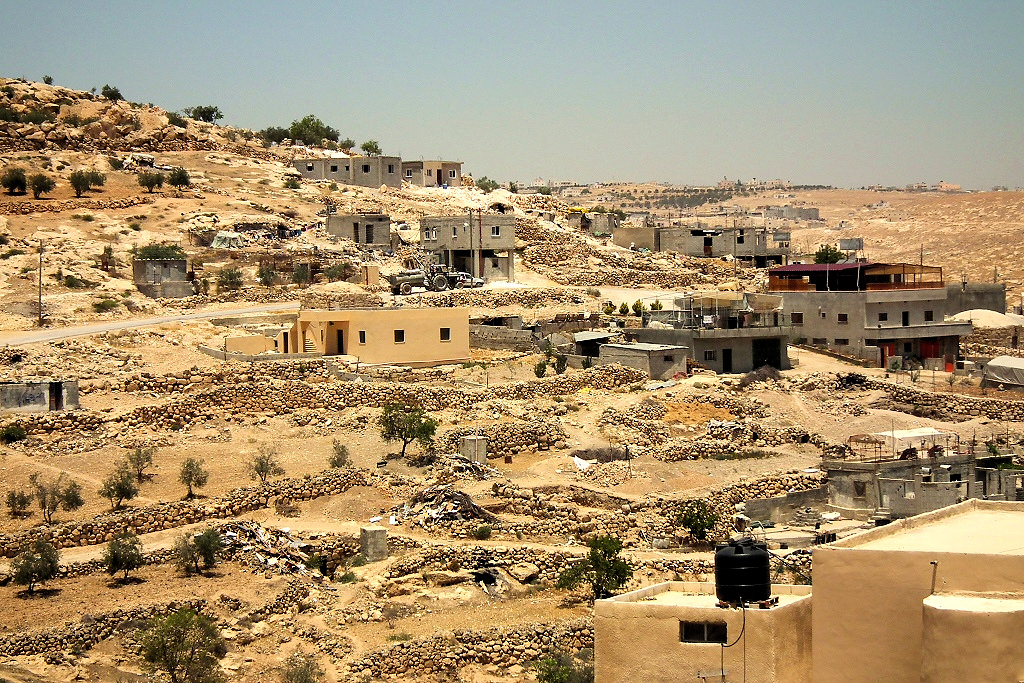
Tomorrow I go with Ibrahim Afaneh to Yatta, south of Hebron, to witness the women’s empowerment course there. Yatta is an area where there are many illegal land-appropriations by Israeli settlers, and Palestinians there feel ignored and marginalised, out of the world’s sight. The area has many Bedouin, who sit at the very bottom of the apartheid pile in this segmented land. Many of their villages are unrecognised and deemed illegal, especially when they stand in the way of Israeli expansion.
This afternoon, having only just arrived back in Bethlehem, I went around town buying pots, pans, utensils, a lamp and other bits for the apartment where I am staying. I had done this two years ago too, but they are all gone – dispersed no doubt around the building or down some community black hole. This is one of the challenges of operating in Palestine – it’s a high-level chaos zone, and if you like order, you’ve got problems. It’s partially to do with Arabic cultural elasticism, to put it politely, and partially to do with living under occupation. Conflict has thrown Palestinians into a mindset of perpetual firefighting, living quite spontaneously without plans, systems and rules. So, when someone walked into my apartment while it was empty, seeing something useful, they ‘just borrowed’ it – and perhaps someone else just borrowed it from them, and off it went and was put, no doubt, to good use somewhere else. I hope the kit that I have just bought stays in the apartment in future. I’m going to get a Bedouin rug too – make the place more comfortable.
Later I had another challenge. Arriving back home tired, it took me fifteen minutes to realise that the reason the kettle wouldn’t work was that the electric trip-switch had killed the power. Then, later, with cuppa in hand, I fired up my computer to start uploading my blog entry and found the internet router downstairs was dysfunctional too. Of course, predictably I had no key to access the router. Another exercise in existential flexibility. Hopefully I can do the uploading tomorrow morning before heading off to Yatta.
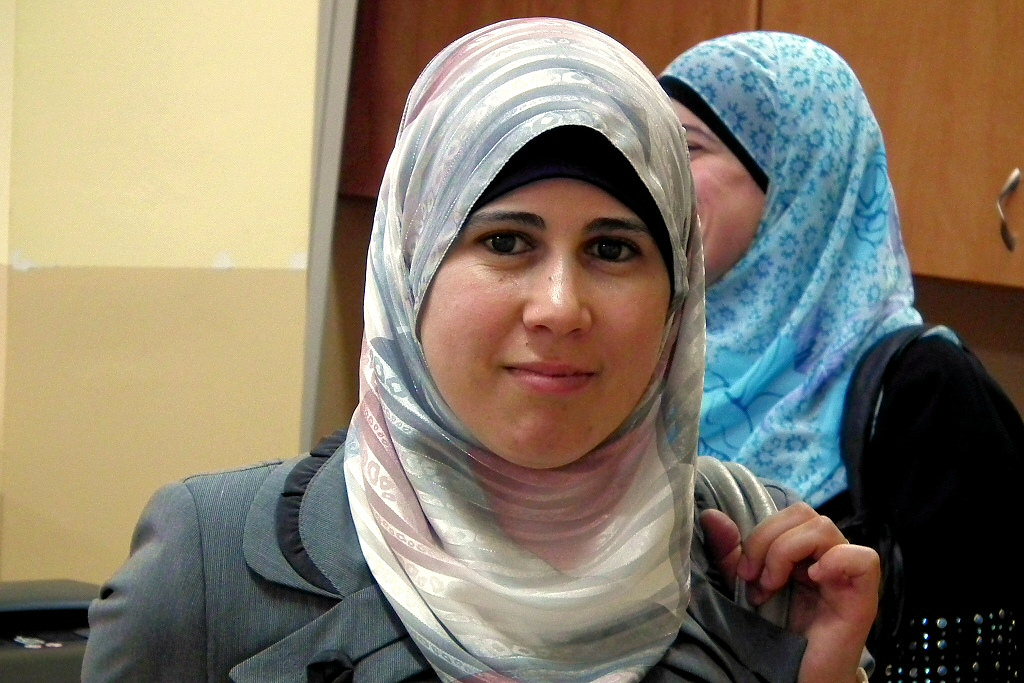
Trainee women’s empowerment teacher, Sana
We have internet apartheid here. Israel has hot fibre optics linking it with the West. But Palestinian internet goes by slower microwave transmission to Jordan – the Israelis won’t permit fibre optics or anything more than 3G mobile connectivity – then down to Dubai, where a big fibre-optic ‘pipe’ leads through Saudi Arabia to Egypt, under the Mediterranean and into Europe. Actually, it later passes just 2km from my home in Cornwall before heading out over the Atlantic to America. When President Mubarak, in his last days, shut down the Egyptian internet, you can bet there were high-level phone calls from Riyadh, Brussels and Washington DC instructing him not to shut down that pipe. Had he done so, the world could have pitched into another serious financial crisis. The Palestinians would probably have survived it better than most – survival is one of their acquired skills.
Here’s something I wrote 12 years ago in a book I did about Palestine which was never published. A short interesting read from that time…
An Eclipse and a visit to At Tuwani, 16th June 2011
I discovered a setting on my camera that I didn’t know existed until the very end of the lunar eclipse. Eclipses can be times of revelation! It removed the problem, classic for digital cameras, where the contrast between the light and the dark sides of the moon is too emphasised for the subtle details of the moon’s pocked surface to be seen. Even so, witnessing the eclipse from my eyrie at the top of the school was a privilege.
When it started there was a full-scale racket going on in Al Khader – loud music and the customary summer evening pandemonium of this town, spiced with the barking of dogs and the croaking of geckos. But as a slice began to be cut from the moon, gracefully arching over the Israeli watchtower, the area fell silent. Traffic disappeared, the dogs went quiet and all became still. Except for the shutter of my camera. It was late by the time it was over.
Maram Issa (right)
That didn’t stop me waking up at 6.30 the next morning. I’m not sure why I’m waking up so early at present. But it permitted me to rise and process my photos, posting them on Facebook – and the ‘likes’ started rolling in. I had breakfast and waited for Maram, who was picking me up at nine. By ten, having filled time and had a conversation with Mohammed, the school’s educational director, I rang Maram. Oh dear, car troubles. A taxi arrived to pick me up, then a call came to say hold on to the taxi and stay there – we’re coming. Ibrahim’s car soon arrived and Maram and I bundled into the taxi while Ibrahim went into the school, lugging his laptop, bag and bundles of files.
Off we went down the main road toward Hebron. The area south of Bethlehem is interesting because Israelis and Palestinians live quite intermixed with each other, unseparated by the separation wall. This area lies inside the Green Line, the official boundary between Israel and Palestine. This is a collection of Israeli settlements called the Etzion Bloc, interspersed with old Palestinian villages. Or perhaps the other way round, since the Palestinian villages have been there far longer. It’s quite a green, agricultural area.
At Tuwani
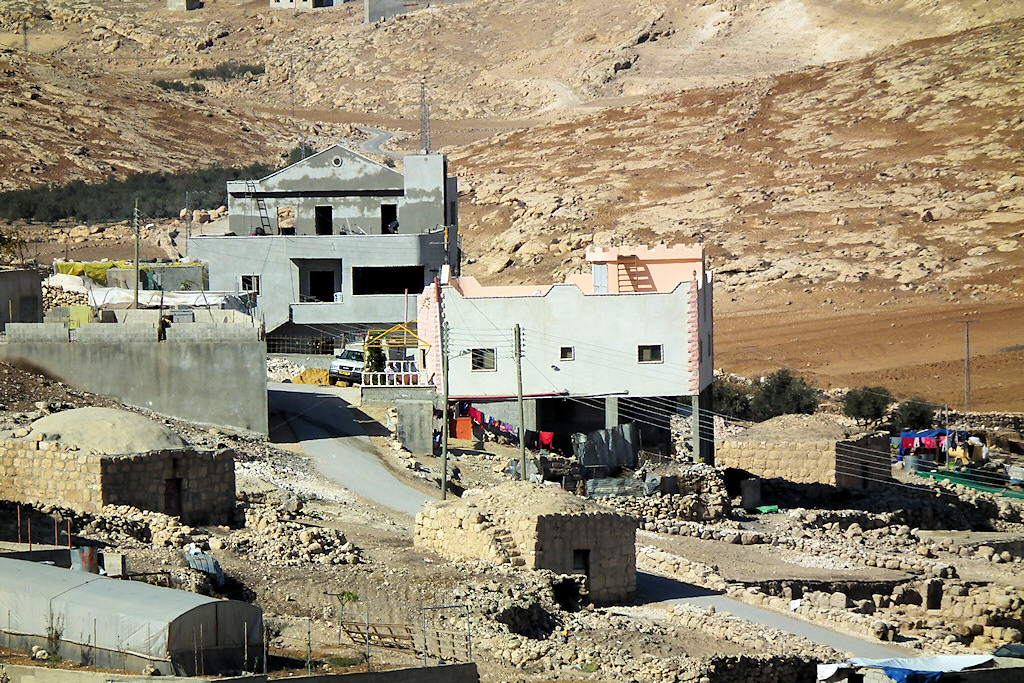
We proceeded around Hebron, the third largest Palestinian city after East Jerusalem and Gaza City and the biggest in the West Bank, past Qiryat Arba, an Israeli settlement outside Hebron, into a hilly, rocky district that turned browner as we drove south. This much-disputed area is where the most assertive wing of the Israeli settler movement is, stage by stage, staking out its claim, and where many of the most outrageous settler atrocities take place. We were heading for a village, At Tuwani, where resistance to settlers is strongest. It’s also the place where the women’s embroidery project is located.
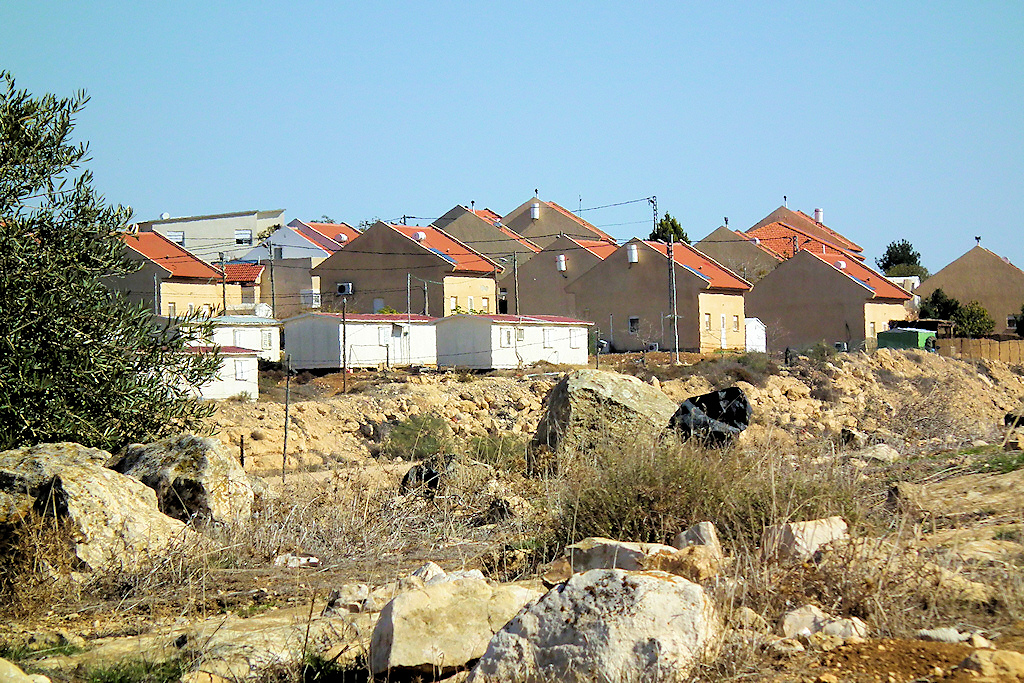
The settlement of Ma’on
As we neared the village Maram pointed out several Israeli settlements, such as Karmel and Ma’on, which periodically crop up in the news, home to some of the most assertive settlers that exist. They’re so aggressive that many Israelis disown them, and the Knesset (Israeli parliament) uncharacteristically declared these settlements illegal. That made no difference. This said, a schizoid situation holds sway whereby the Israeli government pays for the building of the settlements (with American money), and the army makes symbolic gestures to clear them, to respond to foreign pressures, while actually reinforcing them and doing donkey-work for them – such as clearing Palestinians off land the settlers want, helping destroy trees and farmland, and ‘defending’ settlers whenever Palestinians push back.
There’s a double American involvement here. American money supports these frontline settlements, and many of the settlers are of American origin. But on the other side, Americans like Whit help the Palestinians, as also do American humanitarians such as the Christian Peacemaker Teams, who accompany and protect Palestinians in risky situations. America fighting against itself in foreign lands? The West plays a strange double game, advocating peace and supplying weapons at the same time.
Whit
We attended a meeting of the women. Whit and Paula were with some of the women from Jaffa and the Israeli production organiser – a nice lady who sits in the more enlightened and principled sector of Israeli society. Whit spoke, various of the ladies spoke, I added my bit and a Palestinian activist spoke.
Then the activist took us on a tour. He first explained the situation. This was tragic stuff. These are old villages going back centuries. The people of Tuwani are simple folk, many of them illiterate. For the last twenty or more years they have been under pressure from the settlers, who have been chopping down olive trees, burning farmland, demolishing the local mosque and quite a few houses, beating up farmers and children, blockading the village and generally making life hell for the villagers so that they leave. The Israeli army has played its part: army units down here are filled with nationalist settlers, opting to be posted here to reinforce the settler incursions.
But the villagers aren’t budging, even though they have put up with a lot over the years. One of the things that makes the settlers pressure the villagers of Tuwani and equally makes the villagers resist them is that two mountain tracks lead through Tuwani to a number of other villages. If the settlers close down Tuwani, those other villages die too.
The men of Tuwani
We were taken up a rocky, dry hill – the trees had been burned down and uprooted by settlers – to see the settlement of Ma’on just over on the other side, a half mile from the village. This settlement was planted on the villagers’ own land. An outpost of caravans in the trees, away from the settlers, was pointed out – apparently these settlers were so radical and insistent that even the settlers of Ma’on had thrown them out.
Whit asked the Palestinian activist how he had got involved. The activist explained how, when he was young, he had witnessed his mother being beaten up by soldiers. Running to rescue her, he was peppered with bullets from settlers and troops, who shot around his legs as he ran. Later he got his mother to hospital. She told him not to be angry and fight back because she would then lose him – he would lose his life or freedom. He asked her what he then should do. She said she didn’t know, but please find another way.
So he studied and adopted non-violent direct action, eventually moving down here once his mother died. He was joined by the Christian Peacemakers and some Italian Catholic activists. I met one Italian who had been here two years, with whom I discussed the stresses and strains of regularly going back and forth between Palestine and Europe and interfacing two very different worlds. It was a brotherly sharing.
He said his time in Palestine was coming to an end because he wanted to get out before he was blacklisted and thrown out forever – and he needed to go home to earn money. As it was, he was here on three-month tourist visas, leaving every three months, returning to Italy for a month and then coming back – but this ploy wasn’t going to last much longer. He was sad about that. We commiserated about how we both had fallen in love with our friends in Palestine, missing them when we were away, yet neither of us could move here.
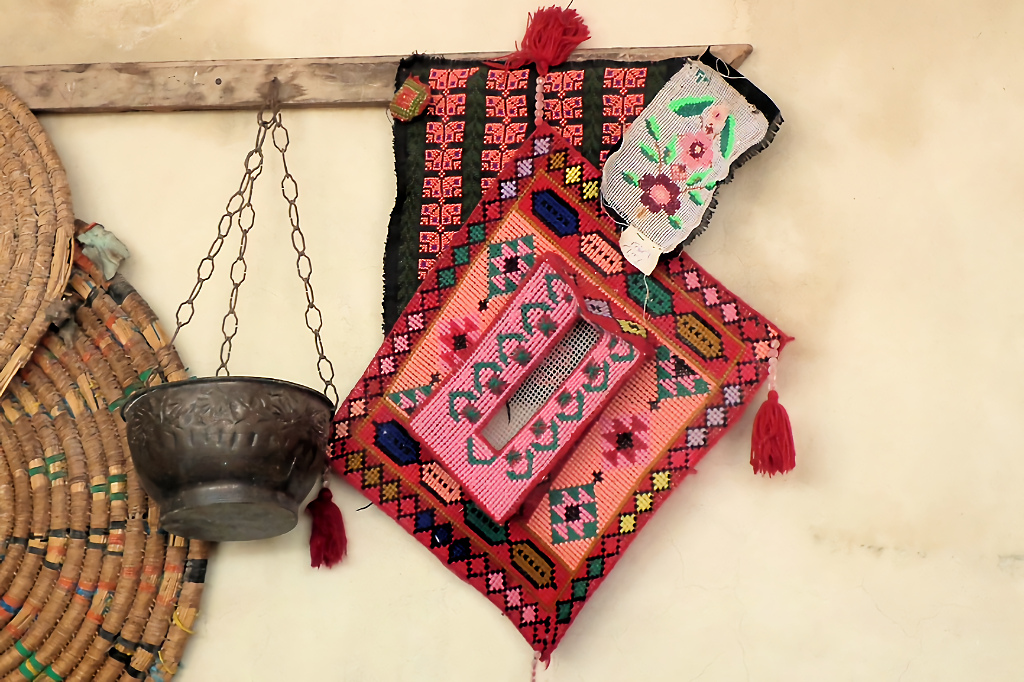
The villagers gave us lunch – far more than we could eat – and showed us other items of their work. Lovely embroidered dresses, bags, belts and other things. I bought a dress for each of my three grown-up daughters, crossing my fingers that the dresses would fit them and suit their tastes (in the end, I’m not sure they did). They weren’t suitable for ordinary wear – they require a graceful style of moving that doesn’t work in the West – or for party wear, but they’re useful for pottering around the house in a relaxed, off-duty kind of way. All of the money would go to the village women: as a foreigner, one must do judicious spending with a view to helping people stay alive.
I would have liked to stay longer, but by mid-afternoon it was time to go – Ibrahim had come to pick us up. I was sad to leave these people – they need reinforcement, interaction and solidarity. But my duties lay back in Bethlehem with Hope Flowers. So we cannonaded up the road past Hebron and I was dropped at the school. I took a break in the late-afternoon sun on the flat roof of the school, reading. Then back to work.
I was nearly half-way through my month-long stay. It was going to be challenging to finish everything. There were friends to visit too, in Hebron, Jerusalem and Jenin. Ah, time: I was reminded of its passing by the outbreak of the calling to prayers from the local mosques. This isn’t just a religious thing: it’s the way Muslims section up their day. Even I, an infidel Westerner, time my day by the muezzins’ amplified chanting – the calling to prayers divides the day into periods which, in this climate, work well.
The previous night, as the eclipse gathered strength and the world went quiet, one muezzin was chanting the ninety-nine names of God. I guess it’s ninety-nine because the hundredth is beyond expression. These ninety-nine names describe divinity in all its aspects. There is, to Muslims, but one God, with no other complications – no sons, holy ghosts, angels or cherubim – just Allah, with ninety-nine facets. By the way, Arab Christians, the very earliest of Christians, use the term Allah as well as Muslims – it’s not uniquely a Muslim term. And it is pronounced Al-Lah. The God.
As I concluded writing this piece, a donkey called out in accidental synchrony with the muezzin, croaking plaintively, reminding people it was there. Or perhaps this was Allah’s ninety-nine names elucidated in donkeyese. Great Spirit expresses itself in remarkable ways.
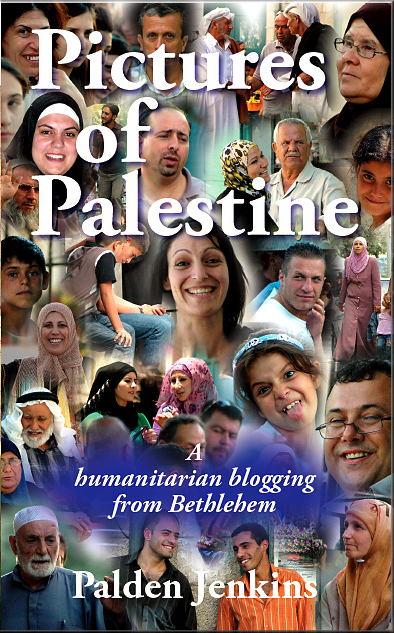
I wrote this piece while working at the Hope Flowers School in Bethlehem in the West Bank 12 years ago. Here’s the school’s website and here’s a piece I wrote about Hope Flowers and its history and background. For my 2012 book Pictures of Palestine – a humanitarian blogging from Bethlehem, go here.
Recently I haven’t been in the best of health and spirits and I shall write a blog about that soon, when my energy is right. But if you want clues, listen to my last podcast Popping Clogs and Kicking Buckets.
Meanwhile, I’ve begun a kind of preliminary goodbyeing process, and in the last 24 hours I’ve been wishing I could be back in Palestine, with friends and ‘family’ there. So I was moved this morning to post a chapter from Pictures of Palestine, to share this feeling with you.
(If you like this chapter, you can download a free PDF or e-book version on the site, or order the print version.)
It was written in 2009 but, while details in Palestine have changed, the situation has not, and this chapter in essence has not dated.
The Back-Roads of Palestine – arriving in Bethlehem
“Where you want go?” “Beit Lahem”.
“Where you from?” “Britaniyya.”
“Ah, my son, he in Leicester, doctor in hospital.” I’m never sure whether to be happy or sad when they say things like this, but most Palestinians seem quite happy that at least someone in the family is chasing a future abroad. It’s their family insurance policy.
I was the first to the yellow eight-seater VW service bus, so I would have to wait for more passengers to appear. That was fine – I wanted to assimilate being in Jericho again. Everyone was friendly. If ever you come to Palestine, be ready to be overwhelmed with hospitality – it’s quite moving and takes a while to get used to. It’s not a front. People come up and shake your hand, saying “Wilcome, wilcome to Falastin”, and they really mean it. They know it takes some resolve to get here.
I went off and found some Egyptian mango juice and Jericho springwater to guzzle. The dense Jordan valley heat was like an engulfing blanket but, being thin, I’m fine with that – it’s chilly, damp British weather I have a problem with! I went over to some guys standing around talking. The usual friendly questions. Where you from? What your name? Where you going? How many children you have? What you doing here? They’re often interested in my age, and eyebrows raise when I tell them – Palestinian men of my age often look older and more worn than I do.
I took photos of some of them – they seemed to love it. But some didn’t want it, gesticulating ‘No’ with a quick wave of the finger, and I knew why. It’s politics and security: they or their family have had trouble with the Israelis, or they supported Hamas or another faction, or they had a history, or their brother was in jail, or… Long ago I had been in similar straits and I know what it’s like: it’s not just that you want to avoid the gaze of the powers that be, but also that you don’t want to keep reminding your friends or even yourself that, rightly or wrongly, you’re toxic property.
Eventually the service taxi-van was full and we were off through the streets of Jericho, an ancient city with an 8,000 year history. We left the town, driving some miles up to the main Jerusalem highway and then turning right, following the road as it ascends through the Judean desert hills. It sweeps through the valleys, climbing up and up just to reach sea level, marked by a sign in Hebrew, Arabic and English. After making good progress, still uphill, we suddenly slowed down and pulled off near the Ma’ale Adumim interchange onto a bumpy, crowded road and into a scrappy Palestinian township near Al Azariya.
Ma’ale Adumim is one of the biggest Israeli West Bank settlements, a Jerusalem orbital town and an asset Israel is unlikely to abandon, whatever foreign politicians want. This new town and the roads servicing it, built on confiscated Palestinian land, split the West Bank into northern and southern halves, rendering Palestine territorially sub-functional as a nation.
But we were not going to Ma’ale Adumim. Instead, we hit a bumpy side-road which, for Palestinians, is a key trunk road linking the northern and southern West Bank. It weaves through a small town, then weaving along valleys and up and down the high hills, with sharp switchbacks, steep inclines and loads of traffic. In Britain we’d regard it as a back-country ‘B’ road, but actually it is ‘Palestine Route One’. Nowadays it is being modernised but in 2009 the only sign of its trunk road status was the density of traffic.
Some of the areas it drives through are poor and dilapidated, the houses quite scrappy, the land stony and dry. Garbage, wrecks and piles of rubble are heaped here and there – an alienated landscape where the locals have lost their care and pride. They’re probably rural refugees, thrown off land the Israelis have taken, such as at Ma’ale Adumim. It’s one of the tragic aspects of this country. But then, many Palestinians harbour little hope, so they’re unlikely to invest in longterm improvements. They half-expect the Israelis to come in some day, wreck everything again or drive them out, and they do have reason to anticipate that.
Yet there are some pretty nice houses along the road too, in other locations. Palestinians who are go-getters or beneficiaries of the PA or foreign agencies take great pride in their new-builds, many of which have a fine vista and attractive courtyards with flowering trees and bushes. It’s as if their optimism compensates for their others’ lack of it. It also reveals an emerging class divide between those who benefit from foreign subsidies and advantages and those who do not. Palestine has its haves and have-nots and they nowadays live in quite distinct economies.
The road is exciting to travel as it climbs up steep hills and tips into deep valleys, weaving through an impressive limestone upland landscape, passing through hilltop villages with prominent mosques and affording views stretching many miles. Yes, this is a trunk road – but it’s heartbreaking too. Privileged Israelis drive along their fast, wide highways while Palestinians have to heave up, down and around on side-roads like this: transportation apartheid. Although the West Bank is occupied by Israel, its cars have different number-plates from those of Israelis, conferring different driving and access rights. Go up the wrong road and you could, on a bad day, experience a sudden hail of bullets at worst, or interrogation at best.
It’s not easy, living under military occupation
We passed through only one checkpoint, which today was open. The Israeli soldiers leaned against their booths and bollards, talking to each other and idly gazing at passing traffic. Poor guys – what a job. There they stood sweating, posted in an unfriendly spot next to a Palestinian hilltop village, perpetually on guard against a foe who nowadays rarely materialises and might hardly exist.
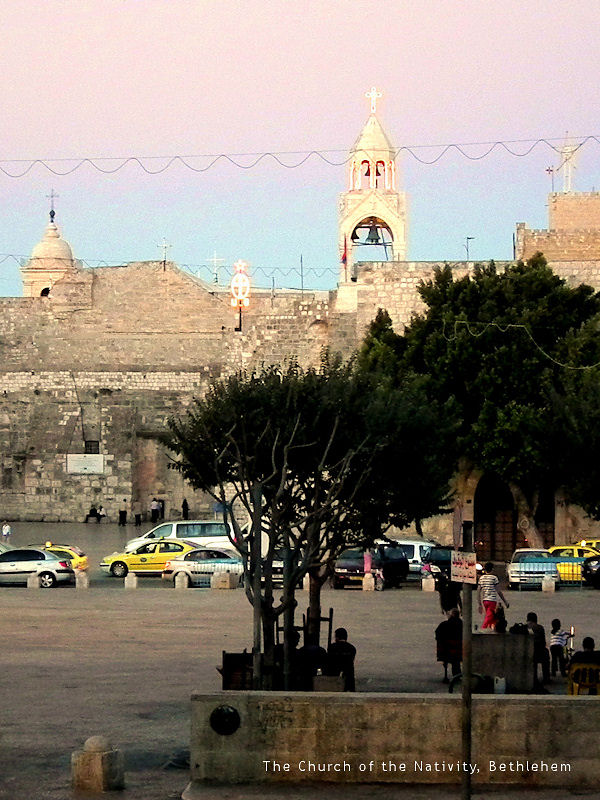
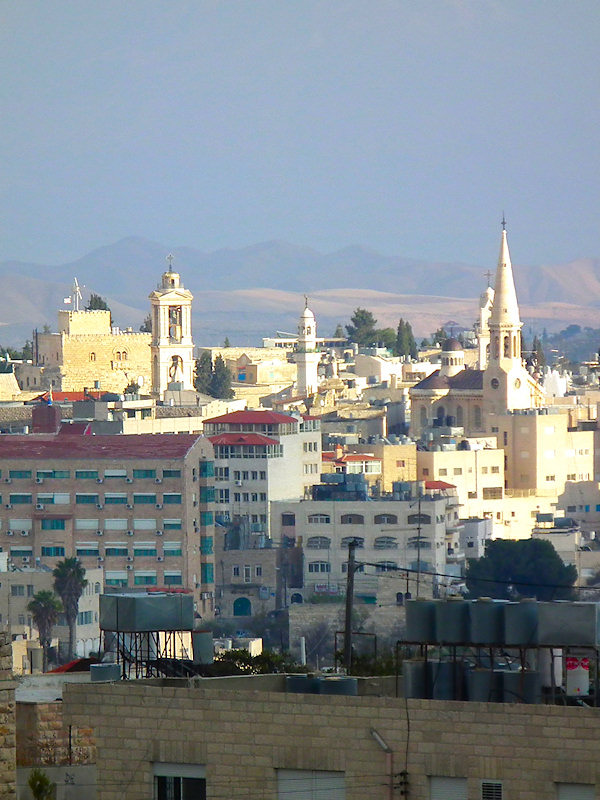
In the distance I could see the Herodeon, near Bethlehem, a prominent conical hill and ancient site going back millennia. It looks like a volcano but it was shape-enhanced in ancient times and contains, allegedly, the tomb of Herod the king. Naturally, we didn’t head straight toward it – our route was still sinuous and tortuous. After another twenty minutes we pulled into Beit Sahour – Shepherds’ Fields, referring to the Christmas story – near Bethlehem. The family that made up most of the passengers in the bus was dropped off right outside their gate. The remaining woman asked me, on behalf of the driver, where I wanted to be dropped. I decided to go to Manger Square in central Bethlehem to catch some food, take a rest and ascertain where Ibrahim Issa was to be found.
Church of the Nativity, Bethlehem
There I bundled out of the bus dragging my wheeled bag, my precious technology bag over my shoulder. Containing a netbook computer, camera and lenses, digital sound recording equipment, DVD and card readers, cables, plugs and adaptors, with room for travel papers, passport and a bottle of water, this technology bag is neat – but rather a wrench on the shoulder muscles.
The Christian taxi-drivers near the Nativity Church, seeing a Westerner – who of course must be rich – started hollering at me for my custom. You learn how to gesticulate ‘No’. One bright young driver with a pleasant face got my attention, though I still said no to him. I wanted to sit down and have something to eat. He shepherded me to a nearby café and within seconds a pitta stuffed with salad and falafel was set in front of me, along with fresh carrot juice. What a relief! All the taxi-drivers stood round asking questions and smiling, all very amiable once they’d realised I was no source of business for them right now.
I rang Ibrahim, but no answer. Did I have the right number? Hmmm, what next? Leaving my bag at the café, I went wandering. As I returned, the young taxi-driver signalled me: “I help you. What your name?”
He took me to the Hope Flowers School at the far end of Al Khader, west of Bethlehem, but it was locked and deserted. On the way I noticed that the town was in visibly better shape than on my last trip in 2005, just after the second intifada, during which the Israelis had wrecked Bethlehem and still then staged periodic incursions and searches. But now the separation wall had been built and Bethlehem, imprisoned behind it, was safer and more relaxed. The security wall protects Palestinians from Israelis as well as vice versa. This relaxation of tension was visible on the streets. Another sign of progress was the condition of the trees in the central reservation of the Hebron road leading to Al Khader.
These trees, planted in 2005 by the Earth Stewards, were all intact and growing! I had joined them – mostly Dutch, German and Austrian green activists – in a tree-planting project organised by Hope Flowers. Ibrahim had known the Earth Stewards when he lived in Holland in the 1990s and he had organised PeaceTrees as a joint project with them in Bethlehem, not just as an ecological but also as a social empowerment project. The trees’ continued existence showed that something had worked – the locals had got the message.
During the intifada people had lost hope. It had followed a period in the 1990s when peace and progress came close and then ebbed away, prompting the uprising, a mass expression of sheer frustration. Israeli measures taken against Palestinians were terrible and Bethlehem had been an epicentre of conflict – remember the shoot-out at the Church of the Nativity in 2002? By 2005, when the intifada had subsided, the locals needed jump-starting with initiatives to help them improve their lives and encourage them to invest energy in the future. The regular experience of seeing houses demolished, parts of town wrecked, buildings shelled and people carted off had given Bethlehemites a feeling of futility and pointlessness.
By planting a large number of trees in a very visible place – the main road’s central reservation – we caused mild fascination at first, followed by interest and questions. Then people joined in, then energy and enthusiasm grew. We wrapped up the project by saying, “If you don’t look after these trees, they will die, so it’s up to you” – and we left. The trees survived: someone had made sure they were watered and cared for. PeaceTrees had worked.
The Old Town of Bethlehem
As the young taxi-driver and I returned to central Bethlehem, he told me that he was a student of accountancy in Hebron and drove his uncle’s taxi to pay his way. He wanted to be my friend and I promised I would find him again. Subsequently I had a number of lifts with him, and only half the time did he charge me. He dropped me off and I headed up to Manger Square, standing there awhile, taking it all in. A wide, large square, milling with people.
A man approached, asking in quite good English whether he could help me. Adnan took me to his shop near the square, where he sold souvenirs – olive-wood religious objects, Arabic dresses, Bedouin rugs, decorative inlaid boxes and allsorts. Some of the woodwork was exquisitely carved and the rugs and clothing came in lovely colours, all with a very hand-made feel to them. Mint tea appeared and people came and went as we talked. Adnan discovered I was a webmaster and asked if I would help him make a website – I said I would consider it. He rang a friend who knew Ibrahim – an answer would come soon about where to find him.
I got out my computer and skyped my cousin, then my son and then my ladyfriend back in England, to tell them I’d got here. I wanted to share it with them. A small crowd gathered round, goggling at this visitor’s neat technology, and they said hello on Skype, all very thrilled. My son just said, “Cool”, and carried on tapping on his computer. Then he looked up and suddenly saw several faces looking at him through the screen.
“Who’re they?” “I’ve finally got to Bethlehem, and these are some of the kids here”. “Cool”, he repeated, in his perpetually unfazed way, still tapping keys.
My ladyfriend was dumbstruck at talking live to some real Palestinians. Palestinians are people you hear about on the news, you don’t expect to talk personally with them on Skype. Everyone helloed, and she helloed back. While I was talking to her, the calling to prayers started up – really loud, since we were right next to the Omar Mosque. She was visibly moved at the sound, as it hit her that I was really there. She and my cousin were serving as ‘ground control’ back in England, and it was fitting to share with them my first taste of returning.
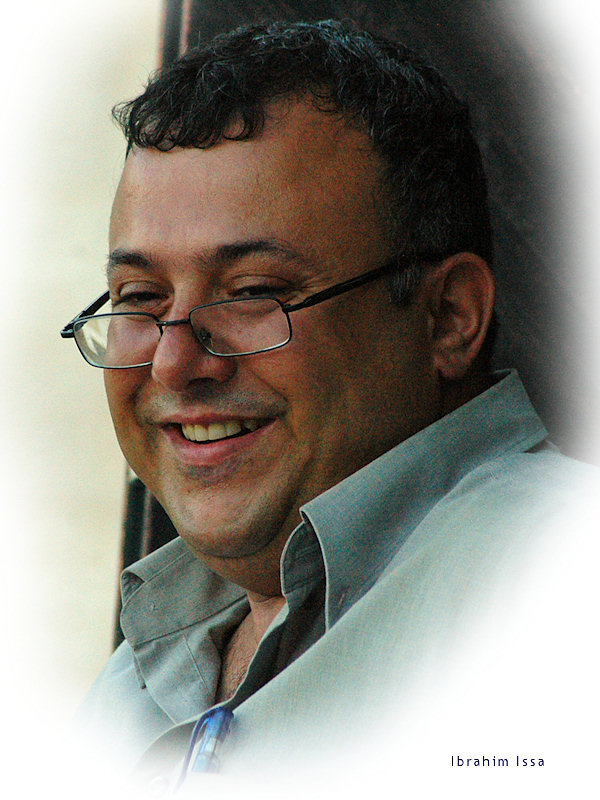
Eventually the grapevine worked and Ibrahim Issa came to fetch me. I’d last seen him five months earlier in England during one of his speaking tours. He had looked tired, not really wanting to stand on stages giving speeches, and I was concerned about him, wondering whether he was burning out. But today he was his sprightly self, at ease, smiling. He’s rotund, like a cuddly bear, with a character-filled face and a bright countenance.
I feel brotherly toward him, as if we had made some mutual contract way back in the mists of time, yet I’m old enough to be his father. We hugged in the middle of the street – much to the interest of onlookers – and looked at each other for a long moment. I knew he felt some relief that I was back and had probably wondered whether he would see me here again. Foreigners come and go, saying they will return, but only a few reappear.
Hope Flowers had started as a kindergarten in 1984 and by the late 1990s it was a school with 500 pupils. It shrank after 2000 during the second intifada, as the Palestinian economy tanked and hardship set in, but now the school is growing again and a community development centre was started in 2004. I’d been working with the school from Britain, running its website, writing and editing grant proposals, newsletters and outreach material. Now, one aim of my trip to the school was to re-work the website, then perhaps to edit some teacher-training manuals, possibly even help Ibrahim start writing a book about peace education. That was the idea.
The story of the Issa family and Hope Flowers is poignant. Ibrahim’s father Hussein, an advocate of non-violence, found himself in a dilemma some years ago when Ibrahim narrowly escaped paralysis, shot through the back by Israeli soldiers. Later, Ibrahim saw Palestinian radicals accuse his father of treason because of his commitment to reconciliation. The family was under attack from both Israeli troops and Palestinian radicals. Ibrahim knew the situation was complex but, to quote him, “The most painful thing for me as a child was that I couldn’t recognise the difference between a peace activist and a collaborator – it took years until I did. Palestinian radical groups also couldn’t recognise it. When I grew up I started to see the difference”. But some Palestinian radicals and Israeli Zionists still don’t see that difference, and this makes life risky for people who work for reconciliation.
In 1991 Ibrahim moved to Holland to get out of harm’s way. He studied engineering, got a job and became a permanent émigré. He attended courses on ecology, non-violence, community-building and psychotherapy too, mixing with interesting people, some of whom later came to do stints as volunteers at the school in Palestine. Then his father died unexpectedly in 1999 and Ibrahim was asked to return. This involved leaving a secure, promising Dutch life to jump back into the Palestinian frying pan, taking on a burden most sane people would turn down flat. I greatly admire his steadfastness.
Hope Flowers
Returning to Bethlehem in the midst of the second intifada, Ibrahim joined his sister and his mother in running the school. Later another sister, a teacher, joined them, as did Ibrahim’s new wife, once a kid at the kindergarten. They run the school with a remarkable team of teachers, managers and supporters. It felt right to work with these people – I like them all very much.
Now Ibrahim and I went to a café, had a drink and munched nuts, smoking apple-flavoured hubble-bubble from an ornate water pipe. We discussed what I would do during my three months’ stay. There was certainly a lot to be done and three months might not be long enough.
Ibrahim told me of difficulties he currently had with a faction in the Palestine Authority (PA). It was the product of an awkward public debate concerning the value of negotiating with the Israelis. Ibrahim, a committed peacemaker and bridge-builder who had had regular contact with peace-oriented Israelis, was under suspicion as a collaborator, and this was complex. The PA, seeking to establish control over an ungoverned non-country, had applied a mixture of Western regulations and Arabic bureaucracy, with not a few personal fiefdom issues thrown in, making life difficult for ordinary people. A peacemaker in a conflict-polarised society is susceptible to accusations of collaboration.
The discussion in Palestine about how to relate to the Israelis was heated and ongoing. Palestinians had bent over backwards to comply with international agreements as part of the 1990s peace process, and yet in Palestinians’ perception the Israelis hadn’t budged an inch on crucial issues such as settlement-building, land-seizures, Jerusalem or refugees. The result had been continued losses for Palestinians and a growing number of them were now convinced that negotiation and accommodation were pointless, even though very few wanted any return to conflict. Negotiation had been worth trying in the 1990s, but it had not delivered. It’s a tragic predicament: if you neither want to negotiate nor to fight, what do you do?
Hope Flowers had been teaching the kids Hebrew to help them understand the Israeli mindset. When the kids were older, this would help them deal with Israeli people and officials. The school set out to help the kids understand the perspectives of the very people who had killed or jailed their own fathers, uncles and relatives. This was not a matter of agreeing with or sucking up to the Israelis, as some suspected. It was a matter of following the old military adage, ‘know your enemy’. It was a key issue in preparing Palestinian children for a time when the nightmare of conflict ends – which it shall and must do one day. But in 2009 that day was receding and there was simmering frustration in the air.
Some Palestinian officials didn’t like what the school was doing and didn’t want Palestinians having connections with Israelis. Ibrahim, who had learned to be patient with Israeli arbitrariness and obstructionism, even having been arrested by them for allegedly harbouring terrorists, understood this viewpoint well. But as an educationalist and peace-builder, he stood up for dialogue with people on the other side just as his father had done.
Westerners, with a tendency to see things in black-and-white terms, oversimplify the intricacies of this situation, failing to understand such sharp dilemmas. “Why don’t Israelis and Palestinians just make peace?” Well, as Rabbi Lerner, a Jewish-American thinker, once pointed out, both sides suffer from PTSD, post-traumatic stress disorder – they’re super-touchy, super-reactive and suspicious – and untangling this mess isn’t as simple as outsiders would like it to be.
It had taken me some 20 years to understand the intricacies of the Israel-Palestine situation, and only visiting the place had brought better comprehension. I started as a peacemaker working on both sides, with the best of neutral intents, but found myself gravitating to the Palestinian cause. I was not turning against Israel, but I felt that they shot themselves in the foot by the hostile attitude they took toward Palestinians. I work where I can most assist, and while Palestinians seemed to appreciate my input many Israelis didn’t seem to think there was a need for me to be there. So I ended up working with Hope Flowers.
That’s also why I had sobbed from the soul when I arrived in Jericho earlier that day – there was something personal and emotional about all this. As a British dissident, I had had nonsensical and painful experiences that would shock many people, so I could empathise with the Palestinians’ dilemma. I saw Ibrahim’s dilemma too – that of a peace-bringer whose work is regularly screwed up, not just by Israelis but also by the double-standards of Westerners and the militancy of some Palestinians.
Perhaps Palestinians embody something that exists within many of us when we are repeatedly let down by forces beyond our control, when Murphy’s Law applies itself over and over, or when the narrow interests of the powerful few prevail incessantly over the needs of the majority. It’s a futile feeling that, whatever one does, nothing will really progress. This kind of thing happens everywhere but, in Palestine, people have internalised it and adapted to it more than is healthy for them.
I stayed at the Issa family’s place that night and next day Ibrahim took me to the school, where I was to stay in the volunteers’ accommodation on the top floor. Back again – and now to work.
Things don’t change a lot in Palestine, but one good thing that has changed is that Hope Flowers’ methods and philosophy is now being replicated across the Palestinian school system in the West Bank – this was a major breakthrough a few years ago. However, the school still struggles on financially under, as always, difficult constraints.




















 Notes from the Far Beyond
You must be logged in to post a comment.