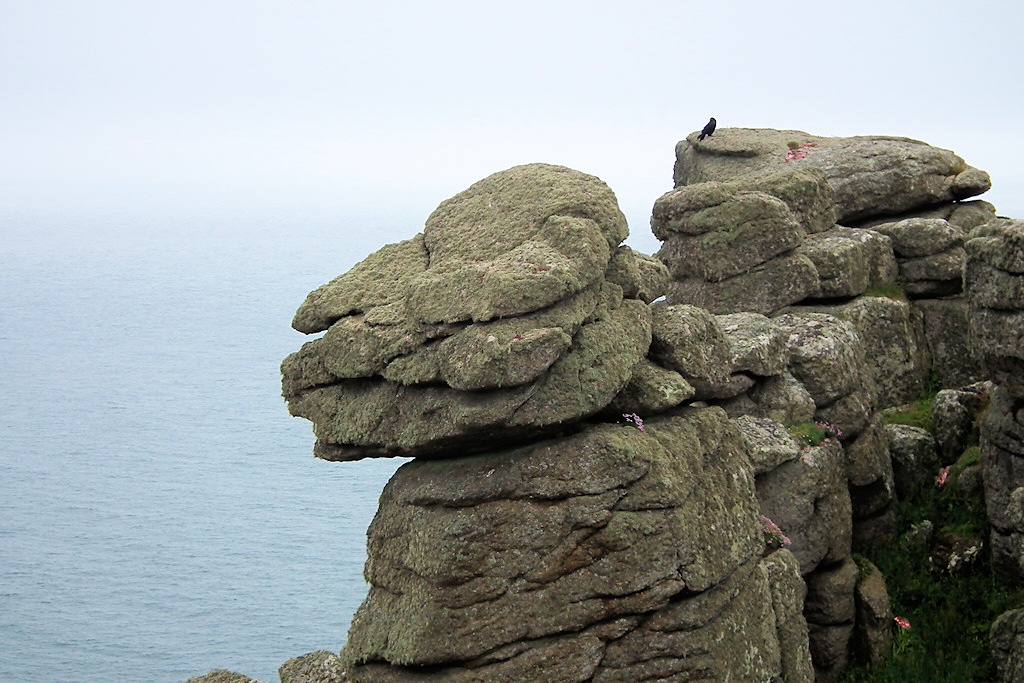
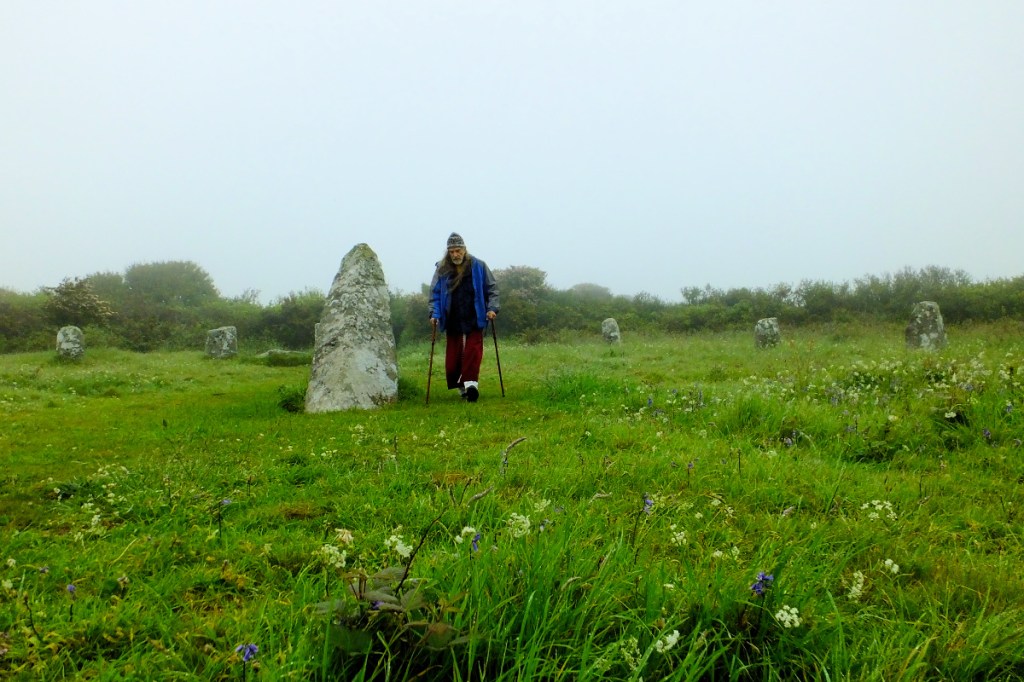
Ancient guardian at Pordenack Point, Cornwall. Busy watching.
Quite a few people have followed my outpourings because I’m a cancer patient with some deep and wide perspectives on it. I’m one of those who was told I had perhaps a year to live (and it felt like it), and here I still am, six years later.
I haven’t said much about cancer recently. Partially because I’ve said a lot already and tend not to repeat myself. However, there are recent friends and followers out there who haven’t had the full story.
I’m mulling it all over… and that’s part of the reason for relative silence on it. My cancer book ‘Blessings that Bones Bring’, available on my site, is undergoing a revision, and a new version will come out sometime – here in Cornwall we say ‘dreckly’. It needs to be shorter and more focused on what matters most to cancer patients and their helpers. Some new reflections are brewing, but my psyche moves slowly nowadays…
If you need something now, then go to my podcast page and look for the ‘Cancer and Dying’ section. To get a sense of the progression from earlier to later days, start from the bottom and work upwards. It’s here:
I have an incurable blood cancer called Multiple Myeloma – it can only be managed and held at bay, medically. It affects the bones: the first sign, in my case, was that the four bottom vertebrae in my back collapsed and, from that day on, my life changed. Rather painfully at first.
I became a partially-disabled old crock. It was a soul-shift. I’m not sure whether I went down with cancer or went up with it. But it confirmed and tested a life-lesson I had already learned, that everything in life is a gift.
Repeat: everything in life is a gift. Especially at those times when it doesn’t feel like it.
Time spent in Palestine taught me that, though cancer took it to a new level. As a peacemaker, I distinctly disbelieve in the notion of ‘fighting cancer’ – and as it happens, I’m still alive, so there might be something in it.
Cancer is not a failure or an aberration – it is a gift. It is an awakener. It presents hard facts and profound choices. This is about free will at its deepest level. Surrender. Acceptance like you’ve never accepted before.
Living with cancer is very difficult, and that’s the point. It confronts us on why we’re here and what it’s all about.
I’m in a different life now, drawing on the mixed outcomes of the life I’ve had, but it feels like a different life. Funny, that.
Anyway, I woke up with this morning with the thought to reconnect with fellow cancer-experiencers, and something is brewing, and I just wanted to say that.
If you’re struggling through the darkness, just keep going. On a soul level, during times like that we make a lot of progress.
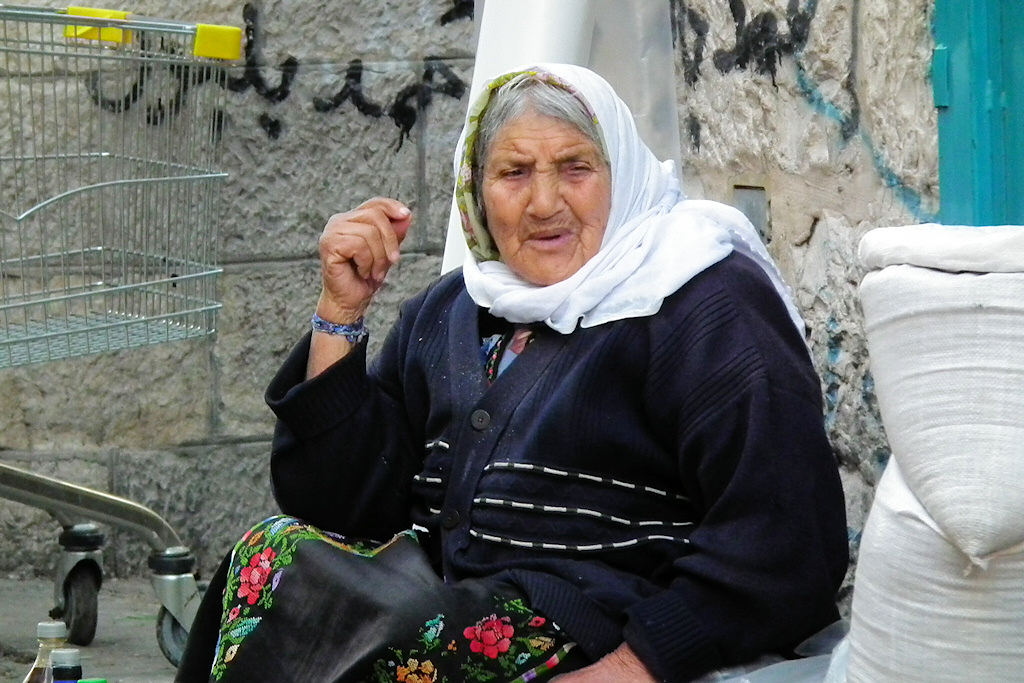
This and the pics below were taken in Bethlehem, Palestine, in Dec 2012
I was talking to a friend about our different illnesses and she said, “You must be suffering more than I”. This made me think, because suffering cannot be quantified and I can’t really say ‘I am suffering more than you’. Or at least, if I do, I’m making judgements about that person and about me that don’t really hold up. With pain, it’s really difficult being objective – it all hangs around our capacity to accept, tolerate and handle it.
Pain is partially to do with what is happening and partially to do with how we’re perceiving and experiencing it. I knew this before cancer came my way, but I’ve found since then that it is more true than I thought. I don’t instantly reach for the painkillers – avoidance of pain charges its price too. I use them only when I’m worn down, needing a break, to stop myself going into a self-fulfilling pain loop.
It’s not easy. But we do make things more difficult than they need to be. We create more friction inside ourselves than we need to have. We take difficulty and pain as negative experiences, something bad, something wrong – often according to beliefs and predispositions that aren’t very good for us.
Yet pain isn’t wrong – there’s something strangely right about it, if we can but change our perspective and suspend judgement enough to see how this might be so. Too often we compare our pain with how we feel things ought to be, how they used to be or how they could be, and this has a way of increasing the pain. Because it turns us away from facing it.
It comes down to attitude. Attitude might or might not change our circumstances or their causes, but certainly it can change how we experience and handle it all.
I’ve learned a lot from people in conflict zones, especially Palestinians, who have developed such attitude over the generations, in both the personal and the social spheres. They’ve got tragically used to dealing with hardship and they’ve developed ways and means of surviving in situations where levels of hardship and suffering are high – such as sharing what they have and looking after each other. They aren’t angels and they make mistakes, but they’re better than we at protecting and helping each other, and making the best out of a bad set of circumstances.
Many people in the comfortable countries can get really upset over issues that are relatively small, such as a power blackout, a shortage, a traffic jam, or someone not doing what they said they would do. Tolerance levels are low, tight and sharp-edged. We have an unhelpful sense of entitlement to a problem-free life. So when the shit hits the fan we catastrophise it, mishandling it and often creating more problems than were needed.
In all of life’s situations there is a degree of choice, either to make a big deal over something or to square with it, accept it and do the best we can. The choice lies around the friction we put up. It’s an honesty process, and with pain we’re forced to face stuff we don’t like facing.
Spiritually, a key issue is this: we come to Earth to learn, get experience, go through it, learn from it and hone the soul. Because at the end of life, all you take with you is what you have become as a result of having lived a life. Pain is an intense kind of experience that has a way of grinding at us, drilling holes in us, attempting a takeover of our psyche and giving us a truth-and-reality experience.
It’s the price we pay for the pleasure of being in a body and the experiential access that it gives us to the wonders of the world. Without a body we cannot stuff chocolate, have orgasms, go on holiday or bliss out in a field of bluebells. Pleasure and pain, whether emotional or physical, are two ends of the same experiential spectrum, and you don’t get one without the other.
I had a remarkable experience six years ago when first stricken with cancer – a blood cancer called Multiple Myeloma, which erodes the bones and creates all sorts of trouble and pain. Since then I’ve had treatment, though there is no remission from Myeloma, and am now on a maintenance regime of medication, supplements and working on myself. I’m surprised to be alive, actually, though clearly there are reasons to be here.
The cancer came on quickly over a few months and I deteriorated rapidly. At times I was in extreme, 150% pain, immobilised, helpless, rendered into a wreck of a man, at death’s door. One day the pain was so intense that I couldn’t even raise my head from the pillow to drink – moving a millimetre made my bones grind and grate. But I had to drink anyway and tried moving.
The pain was so overwhelming that something in me popped out of my body and I saw myself from above – as a soul having an experience on Earth, lying there, all crippled and useless. There was something strangely comical about this. Something in me could see the poignant humour in it – here I was, suffering, more than I had ever experienced, and it was bizarre. I started chuckling. It really hurt to laugh. My then partner, looking on, thought I was losing my marbles.
The funny thing was that my experience of pain suddenly changed. It seemed to become more distant. I became more at peace with it. I was able to face it and accept it, from more of a distance – it was simply a fact, a situation. Something profound had shifted in the space of several minutes.
Over the next few weeks it decreased further and within a couple of months my pain levels were around 30%. Also, my boundaries had shifted. Previously, I could handle 20% pain without it getting to me too much, but afterwards I could handle 40-50% – my pain threshold had moved and it has stayed there since.
Over the last six years I’ve hovered around 10%, with a permanent, steady and stiff ache. I hardly notice it, having become used to it. Most of the time I accept it – except perhaps in the late afternoon when Sir Isaac Newton seems to switch up the Law of Gravity. But there are times when I do notice the pain and it gets to me, deep down – especially in winter. Usually these are times when my spirits are low and I’m feeling worn out with life.
So there’s something here about being spirit-propped. The pain, disability and precarity of a cancer patient have somehow thinned the membrane between me and spirit – a membrane that I used to try so hard to cross, while now it comes more naturally. There’s something to this about the perspective of experiencing life as a soul in a body, visiting Earth.
Pain hits us all, in all sorts of ways and degrees, and at various times. It can go deep, and we each have our crosses to bear.
For example, throughout my adult life I’ve experienced ‘political pain’ – the pain of being misunderstood and misjudged in public, and paying a high price for it (as a dissident and an Aspie-Autistic). It has impacted me immensely. It’s the pain of being wronged in the social and political sphere – sometimes by evolving facts and sometimes by the wrongdoings and micro-harms of others, or by the madnesses of crowds. Even so, this pain forced me to come to terms with the reality of it, to understand what was going on underneath and to forgive the people involved, and to understand and forgive myself too – and in late life, forgiveness has been a gift to the soul and a lightening of a burden.
The world’s pain levels are escalating in the 2020s, partially because so many souls are alive today having a human experience, and partially because life is getting tougher for everyone, everywhere. Outrageously tough situations such as we have seen recently in Gaza are just the tip of a very big iceberg.
And here’s the rub: no one is exempt. Hence, a generous and charitable attitude toward others in need is wise since the tables can turn. We might one day be glad to receive others’ help.
It’s our choice as to whether or not the future is going to bring hard times. We can make a big deal about things ‘going wrong’, or we can accept things and get on with it. In the end, many problems are not as big as we think they are. What might to one person be a disastrous crisis, to another person is just another boring night of bombing.
We create sufferings simply by complaining, being angry, feeling hurt, self-victimisation, or by doing things which are not the wisest. So the level of actual hardship and difficulty we face is a different matter to the way we handle it, and in the latter lies our choice.
Even so, for some on our planet, life is really hard and, in the short term, they don’t have many options – if, that is, they survive. This is not ‘their karma’: this is the world’s collective karma spilling over onto them.
One of the things I’ve noticed in my peacemaking work is that many of the peoples most beset by longterm war – Bosnia, Ireland, Afghanistan, Vietnam, Lebanon, Sudan, Palestine – can be the nicest people around, and it does not seem fair that such ‘karma’ should fall on them. The people most affected by climate change are mostly not the ones who created it, and the world’s poor are losers in a system steered by others. But even they are faced with occasions when choice becomes available.
If we follow a deeper path through life, over time it changes our emotional responses, perspective and priorities. We don’t need to consume as much, we don’t need to ricochet through life, we don’t need to deny ourselves tender moments with loved ones, and we don’t need to create as much waste and damage as we do.
Because something changes inside. It’s a slowly-distilling sense of basic trust, a simple knowing that, somehow, things are going to work out. Especially if we allow it. The issue isn’t about being perfect – it’s about learning from life’s lessons and making good outcomes out of difficult situations.
So this matter of hardship and suffering depends so much on where we’re looking from. While I have a blood cancer, I’m partially disabled and life is difficult, it doesn’t mean I’m sitting here suffering all the time. Though I must admit there are times when I do.
Sometimes, in down times my spirits seem lost in a fog of fatigue, but even then it’s a matter of being patient and letting it be. I can struggle against it, feeling as if I ought to be doing this or I wish I could do that, when in fact it’s okay to take it as it comes, to flop down in a dull state and let it be. I tend then to revive more easily next day. It’s just that I’ve have been given yet another cameo experience of being on planet Earth.
So here am I, a lifelong author and communicator, and I’ve been sitting here in recent weeks with nothing much to say. That’s unusual. It isn’t ‘writer’s block’: it’s a funny feeling of little to say. In my birth chart, Neptune and Saturn are opposing Mercury right now, so I guess this blog is expressing the essence of what that double transit is bringing.
I’m one of those authors who, if I have little that is meaningful to say, I don’t just rattle off material just to fill space, stay regular, fulfil expectations or contractual requirements. I go quiet instead. The best of my writing has always come when there’s a need. I wake up with it, and out it comes.
In life this has given rather uncanny gift which has been both a blessing and a bane: a strange capacity to articulate ideas and perspectives that other people were about to get, but they hadn’t got there yet. As if speaking to people from the future, pointing to how it’s going to be. Or might be. Or could be.
I haven’t always got this right, though there have been times I’ve got things very right. Sometimes I’ve perceived a possible reality that just didn’t happen that way, or I underestimated the influence of obstructors, or got my facts wrong, or suffered wishful thinking or over-optimism, or simply mis-estimated things.
Yet at times I’ve hit the nail right on the head, and it has sparked outcomes or affected people and situations far more than anticipated – sometimes going into the magical-miracle zone. Cosmic catalysis.
It’s a question of whether the benefits from things I got right have outweighed the misfires and problematicals. It feels as if this question is on the weighing scales at present. And, perhaps to prove the point, recently I’ve had little to say. It’s a pause for rumination. Or perhaps a reality-flip is going on. Or a reassessment.
A winding lane in Grumbla, Cornwall
My ongoing cancer saga continues. A new symptom has appeared in recent months: I’m losing the use of my legs. That’s what it feels like, though diagnosis is yet to come, following an imminent MRI scan of my pelvis and a diagnosis in the coming week. My legs are exhausted after a hundred yards, as if I’d just hiked forty miles. Even when just standing still, they turn to rubber, as if they’re about to give way.
It varies on whether it’s an Up day or a Down day. Down days have increased, when I have little energy, drive or inspiration. So something is going on.
It reminds me of six years ago when no distinct symptoms of cancer had yet appeared, but something wasn’t right. It wasn’t possible to put a finger on anything until my back suddenly gave way in August 2019. This was the first concrete symptom of a rapidly developing blood cancer, Multiple Myeloma. It’s ‘multiple’ because it has a range of disparate effects that vary greatly from person to person. This makes it difficult to diagnose.
So it took twelve long weeks to progress from a back-breakage to a cancer diagnosis, though this process was helped by a series of three inspired acts of intuition by, in succession, a cranial osteopath, a GP and a hospital specialist. Bless them all.
I can’t put my finger on what’s happening now, but something is happening. Astrologically, it concerns Mercury, and I’m a Mercurial person (a Virgo with a Gemini Moon). This feels neurological. There’s that ‘nothing to say’ syndrome too. And there’s more.
Rock art, Morvah, Penwith
It concerns ‘growing down’ – losing our powers. This demands a lot of acceptance – getting used to the fact that something is ending. Really ending. In the past I’ve been a cross-country runner and mountaineer, and I find loss of leg-power to be confronting.
Also, as an author, many people are retreating from their phones and social media habits and, thus, many of my readers are simply disappearing. The default answer is to spread into new online media and engage in networking and marketisation strategies. I’m getting loads of e-mails from online promoters who want to marketise my podcasts.
I’d love to reach more of the kinds of people who might benefit from my blogs and podcasts, but I’m not interested in all that promo stuff. My abilities are waning and I can’t manage the work that’s involved. I’m not seeking to set up a business or build my career. This lifelong content creator is sharing his end-of-life process, that’s all.
By nature I am, or was, an integrity-marketer, studiously avoiding falsities, glamours, competitiveness and deceptions in my approach. I used to be a whizzo at this, but not now – my time was 20-40 years ago. Nowadays, online media are changing so much – I can’t keep up, and get my head around all the details. Meanwhile, digital costs and charges are rising, and this obliges monetisation. I can’t do this any more, I don’t have what it takes to crank up a business and I don’t want to leave too many complexities for my son to sort out when I pop my clogs.
So where this goes is anyone’s guess. Anything that increases my workload or demands feats of memory and micro-management will simply not work. Anything I do needs to serve my health and wellbeing without weighing me down, and I’m already going at the maximum pace I can handle. So there’s a dilemma here.
Fresh sets of eyes peer out on the great wide world. In a few weeks they will fly thousands of miles.
Anyway, there’s something to learn from all this. It’s a matter of looking at what’s underneath. It’s about acceptance of What Is. It’s a reduction of options. This happens to those of us who experience a gradual, stepwise end-of-life decline instead of a sudden, drastic one – things narrow and shut down, bit by bit. It’s simply a matter of doing our best with what is, and what we’re capable of doing – there’s little or no option. It can be difficult and rather final, though there’s a joy and fulfilment in it too, if we choose to see the gift in it.
Earlier in my cancer saga I used to measure my condition in terms of perceived age. My physical age is currently 74, and normally I hover around 80-85 in perceived age, but in the last few days I’ve felt like 95 – energyless, wan, off-balance, needing someone to hold my hand, and wondering whether the latest rewrite of my will makes sense.
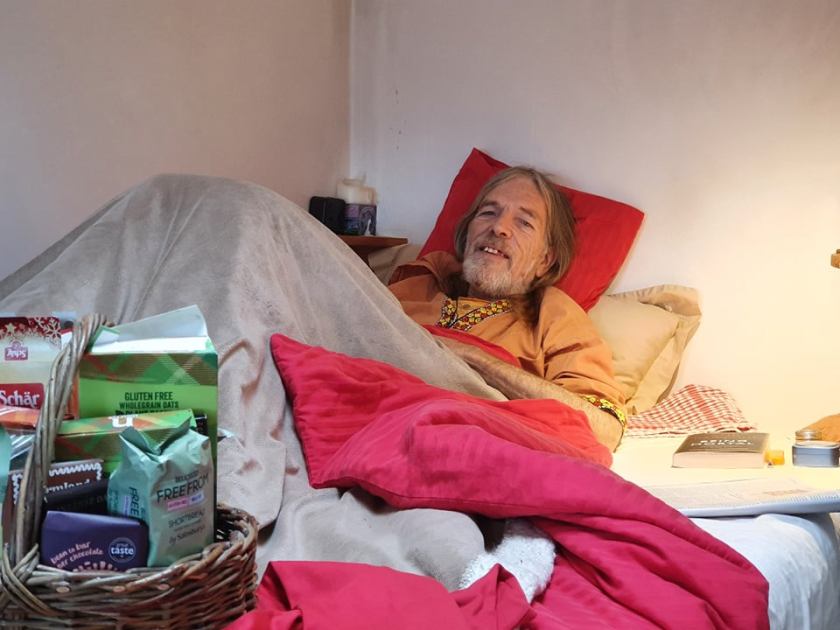
Yet I’m also transported into the eternal present, propped up in bed, hearing the singing of birds in a crisp, microsecond, sonorous, meaning-rich way, as if they’re teaching me something. Which they are.
They’re teaching me a very special something. A something that words cannot truly encompass because words reduce it. It’s a silence between each frame of life’s movie. A moment of seeing, a shifting of optic, a moment of existential tranquillity. It’s very quiet. It’s momentary yet vast. A glimpse of the Void. A taste of the Silence. A Neptunian slippage of consciousness into a temporary eternity.
So perhaps having little to say has its virtues. After all, I’ve managed to say something about it, so something must be happening right! It just goes to show, there is indeed a gift in everything.
This is mainly for my generational peers – if you’re in your 70s, 80s or 90s, your bones are getting creaky and your mind is getting sluggish.
In the life-cycle we’re given, we grow up and later we grow down. In steps.
It’s also about karma-clearance. Sorting out our stuff at the end of life, so that we don’t carry all of it with us when we go over to the other side – to the realm of the Ancestors.
I’ve been involved in humanitarian work, and recently I’ve needed to work on my patterns around givingness and compassion fatigue. Commitment. Success and failure in helping people. Deep heart stuff.
And it’s about acceptance. That’s one of the biggest learning experiences life ever gives us.
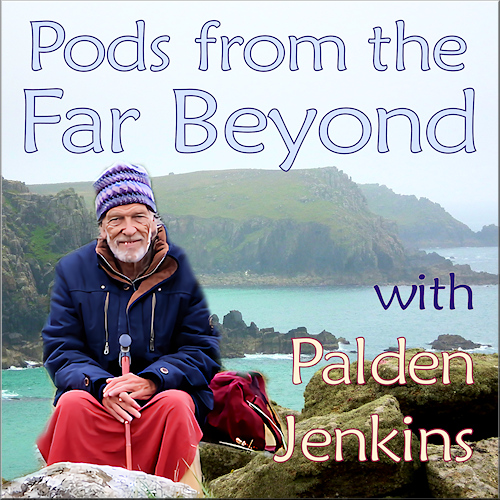
47 mins long. Introduced and outroduced by the birds of Grumbla in the Far Beyond, down’ere in Cornwall.
This is particularly for people affected by cancer or any other serious or terminal illness.
I’ve been a member of the Honourable Company of Cancer Patients for over five years now and, amazingly, I’m still alive, and against the odds. I have a blood cancer, Multiple Myeloma, and I didn’t expect to live this long.
I waded through the tough grind of chemotherapy and dealing with physical disablement. I went down, nearly fell through the cracks, and found myself emerging from a dark tunnel around three years ago.
I found myself starting a new life – well, kind of. I have no idea how long I am to live – it could be next month or five years. But I found a reason to be alive.
This podcast is not about the medical stuff: it’s about the experience of cancer and what it can do to us. Deep in our soul.
This is my fiftieth podcast from the far beyond. The birds in the intro and outro were recorded here on the farm early in the morning on 19th February 2025. To me, they’re medicine birds – especially the geese, who overwinter here.
I didn’t expect to be alive today. Yet here I am and here we are, and this is it. We’re a quarter of the way through the 21st Century.
Born mid-century in 1950, it’s rather an age-marker for me. In my twenties in the 1970s, I didn’t really expect that the world would still exist in 2025 – it seemed an age away, and back then the world’s prospects seemed very much at risk. They still are.
It feels as if I’ve lived several lives since then. A new one started in 2019. As a cancer patient since then, I haven’t expected to be alive now either. Five years ago it felt like I’d reached the end, with just one year left. My body was on its last legs, wrung out with pain, I felt like a ninety-something and it seemed as if my angels were close, eyeing me and laying the tracks to receive me.
Or perhaps they were hovering there discussing what to do with me next. Two years later, reviving from a crisis, I woke up one morning with a voice in my head, saying, “Ah, there’s something more that we’d like you to do…”.
Here I am, wondering what’s next. Life is still very provisional. I have a form of blood cancer that can’t be holistically melted away, medically cut out or irradiated. It has permanently changed my body, giving me partial disablement and about 7-8 different side-issues. It’s called Multiple Myeloma because it shows itself in many diverse forms in different people, though it particularly affects the bones – it’s also called Bone Marrow Cancer.
Things indeed are provisional: recently I took on a booking to speak at a conference in May and I wondered what state I’d be in then. However, I’m accustomed to performing in whatever state I find myself in, and if I’m wobbly and unwell I’ve found that, onstage, I can nevertheless be right on form, with my thinking, planning mind already nudged to the side. So unless I’m actually dead, the conference talk should be alright.
But I still get anticipations and, over Christmas, I worked through a good few of them – one being a fear that my cancer might be spreading and becoming something else, something more. I’m having tests later in January.
To be honest, the fear comes from a creeping feeling that whatever happens next might be too big for me, that I can’t handle it. It’s precipice-fear, ‘little me’ stuff, and the kind of fear a little boy gets when looking up at the big, wide world, feeling overwhelmed by the prospect of getting to grips with it all. I spent a few days grinding through this stuff. Then I started emerging from the other side as the newmoon came.
In life, having been through quite a lot of grinding and scraping, I seem to have made it through. So there’s a good chance I’ll make it through the next lot, somehow. They call that resilience. Though, for me, it’s as if that resilience is rooted in a strange mixture of wobbly vulnerability and an accumulated knowing that I’ve done it before and I can do it again.
If I work through my fear in advance, I tend to unmanifest whatever I fear because I’ve already faced it – or at least I start facing it and showing willing. Or it becomes changed, turning out differently and easier than it looked. Or it becomes advantageous to feel the fear and do it anyway, since it then becomes a nexus of breakthrough. I learned this in conflict zones: I’d shit bricks before I went and often I’d be dead calm and on form when I was in the middle of crunchy situations. There were only some cases of bullets flying (I was quite good at not being in places where trouble happened), but there’s a lot of chaos, tension, mess, pathos, pain and complication in conflict situations, and the psycho-emotional aspect of war was very much there.
Right now, I’m not as close to dying as I have been at various times in the last five years. Cancer came during 2019 with no detectable warning, so I didn’t have to go through anticipatory tremors about cancer beforehand, like some people have to when they’re given a diagnosis. I hadn’t felt good in the preceding six months, though it had seemed like a classic down-time that I would hopefully pull out of. But then one day my back cracked while I was gardening. The four lowest back-vertebrae had softened, and in that moment they collapsed. From that moment my life was irreversibly changed. Even after that, for two months it seemed like I had a very bad back problem, though eventually a brilliant specialist in hospital identified Myeloma. Already half-dead, the news hit me really hard – also hitting my then-partner and son, who were involved too.
But when disasters strike, I tend to be quickish to adjust, crashing through the gears of my psyche and getting really real – I don’t waste time fighting it once I realise it’s a full-on crisis. There I was, in total pain, hardly able to move, feeling wretched, and the doctors were saying I had perhaps a year or, if I was lucky, I might survive – they couldn’t tell. I wasn’t expecting this.
There’s something rather special about coming close to death. Everything simplifies dramatically, and many of life’s normal details and concerns evaporate. You’re faced with the simple, straight question of surviving or dying – and the meaning of life. Is this it? Is this the end?
This simplification is a necessary part of the dying process. Many of life’s details that we believe to be important are not actually so. On the other hand, certain experiences and life-issues come to the fore – things we’re glad about, things we regret, things we missed, things we sidelined, things we got right and things we screwed up.
Many of the things that people and society judged to be wrong, bad or inadequate… well, these are the judgements, narrownesses and prejudices of the time and the social environment we’ve lived in. Things that conventional society considers good – money, success, status, property, fame – become diminished, or they flip, turning inside out so that the price we paid for them reveals itself. We might have had a million, but were we wealthy in spirit? We might have a doctorate, but did we really understand? We might have taught a thousand people, but where have they gone?
It depends on how we respond to the arrival of death, and a key part of this is forgiveness of others and of the world, for what they did and didn’t do. There’s also self-forgiveness for all, or at least most, of the ways we have let ourselves down, got our hands dirty or avoided the main issues and the bottom-line truths. Forgiveness lets new, non-judgemental perspectives come through – seeing how things actually were, from all sides, as seen in front of the backdrop of posterity. This deep simplification and clarification is a necessary part of the dying process, and the more we can accept it and make it our own, the better things tend to go.
The more we have faced the music during our lives and amidst our life-crises, the easier this gets at death. Dying is a gradual, cumulative process for many of us, unless we pass away suddenly – it’s not just about our last breath. There’s the matter of dying before we die – going through at least some of those squeezy, grindy processes that we’ll meet at death while we’re still alive. It shortens the queue of issues that can come up around the moment of death.
When I was younger I thought that my growth would slow down in old age – this is not so. It’s going like the clappers. My capacity to process emotions and profound issues has slowed, though it has also deepened to compensate. Nowadays, when faced with a crunchy issue, I need more time to process it through. But there’s a cathartic element to it that makes it easier – a bit like writing a resignation letter and having done with the whole thing. So the big let-go and the forgiveness process seem to accelerate inner growth in the final chapter of life.
Strangely, in late life, recent memory fades relatively and longterm memory comes forward. The recent and the more distant past rearrange themselves, taking on a different perspective. I’ve found myself working through issues deriving from decades ago, together with lifelong patterns that are exposed by things happening now, and sometimes by feelings or memories that blurt up from the hidden recesses of my psyche. In late life we’re strongly encased in our patterns, laid down, routinised and reinforced over the decades, like clothing we can’t quite peel off.
After all, if you are, say, 72 years old, you’ve eaten over 26,000 breakfasts. There’s not a lot we can change because it’s already done. The consequences are with us and there’s no Undo button. But that stuckness in our karmic patterns can be repaired too, if we let it.
We can change our feelings, our standpoint, by learning from the lessons that life has thrust at us – the deeper, more abiding, more all-round lessons. In the end, there is no right or wrong to what has happened in life, though there certainly are consequences – and that’s where our choice and options lay. But it was done, time has moved on and the page has turned.
It was as it was, and now there’s the future, and whether we actually change our behaviours, beliefs and befallings. We need to sort it out with ourselves and with others, if that’s necessary and possible, or accept it, or change the way we feel about it, or own it, or drop it – or do whatever brings some sort of forwardness. That’s a key aspect of life on Earth: living in a perpetually-changing dimension of time and creating forwardness out of the situations we encounter along the way.
If only it were that simple. It’s so easy to forget and lose our way. We get brought back to it when we get to the end of our lives. What was all that for – that life? Am I happy with what happened? Have I become something more than what I was when I started? Did I do what I came here to do?
I’ve been a good boy and a bad boy. I’ve done things I feel happy about and things I regret. I’ve helped a lot of people and hurt a good few. Some things I got right and some things I misjudged. My feelings around all sorts of things have changed as life has progressed. Mercifully, it seems to get lighter as I sift through the piles of detritus left over from a life that has been lived, committing it to posterity one spoon-load at a time.
Though I’ve had a few close runs with dying since getting cancer, a funny thing has happened. I’ve gone through an unexpected inner rebirth – not ‘getting better’ but, as Evangelicals would put it, being born again. The consequence is that, as my spirit-propped condition has improved, life has become more complicated. Part of me seeks that, because I’m not one who can easily sit around weighing down seats, acting like a passive old crock with his head plugged into a TV. Being a passive care-recipient doesn’t turn me on at all.
Partially the complexity comes at me from the world around, even though it’s me unconsciously manifesting it – recently I’ve been getting five friend requests a day on Facebook, presumably because an algorithm decided I’m a somebody. Oh, thanks. I do like friends, but keeping track of it all is beyond me now. To me, a friend is someone who mutually brightens up my life like I might theirs. (Please ‘follow’ me instead!).
I’ve even been setting a few things in motion. Whether they will work is another matter, since I cannot organise them myself as I used to. The three main ones concern the Tuareg, the Sunday Meditation and the ancient sites of West Penwith.[1] My likely short shelf-life, being unpredictable, and the dysfunctions of my brains, make me thoroughly unreliable in organising things.
Also, there’s not a lot of point starting something if it subsides when I pop my clogs. So I’m scattering some seeds of possibility for other people to take care of, if they will, to see whether or not they take root. Which they might, or they might not, and that’s okay. As a reserve option I’m leaving a biggish archive of work online in case someone picks it up, sometime in the vastness of the future. There’s a remarkable loss of control that accompanies dying, and this is one aspect of it.
So dealing with complexities has been quite a big one. I’m asked “How are you?” seven times a day. The answer is, “Well, I’m like THIS, really!” Do you yourself do a systems-check seven times a day to monitor your condition, and can you articulate it in words each time? Even so, I appreciate your concern and good wishes, and I write these periodic blogs to let you know how I am. When they stop, you’ll know I’ve gone, or I’m on my way.
I’ve written before about dying being a gradual process, and I’d call myself seventy-ish percent dead at present, and stable (as it goes) – I go up and down each day. Today (Wednesday 1st January) I’m working myself up for a hospital visit tomorrow for a three-monthly check-up, and a generally friendly but virologically-dangerous period of waiting for it in waiting rooms. Meanwhile, my stalwart friend Claire will sit outside in her car, reading books and twiddling thumbs in a shopping-mall car park – very exciting. I have to work myself up for events like this, and the day after I’m often rather wiped out.
It’s worth thinking about this continuum. Yes, part of you is already dead. That is, part of you is in the otherworld, where your soul, in the timeless zone, is closer to eternity than you currently feel yourself to be. This is of course an illusion – it’s more a matter of where we place our awareness and what we give attention to while we’re alive. That’s one reason I do the Sunday Meditations: to give busy people a manageable, uncomplicated, regular time-slot in which to give the soul a little attention. Do it for a year and you’ll have done it fifty times. It’s like a weekly shot of cozmickle multivitamins. Good for helping face life and its rigours.
Oh, and by the way… lots of people use funny ways of talking about dying, as if not wanting to mention or face it. Like, ‘passing’. Be honest: it’s called ‘dying’. It happens to all of us, inescapably, and you’ve done it before. Even Elon Musk won’t be able to buy himself out of it, on Earth or on Mars. It’s an integral part of our life-cycle, just like getting born. In the Tibetan way of seeing things, the whole of our waking lives are equal in experiential magnitude to the apparently much shorter processes of getting born or getting dead. It’s all about experiential intensity.
During life, moments of crisis that come up can be rather like dying. They’re moments when time stretches in duration while compressing in intensity, when everything comes to a head, crunching together – and these climactic experiences are our training for the expanded moment of death, when we transit, float or squeeze ourselves into another world, whether in peace or struggling with it. How we deal with our crises in life has a big effect on how we deal with our dying. We can make it easier or we can make it harder. The funny thing is that, though dying involves a complete loss of control, it involves possibly the biggest choice and free-will opportunity of our lives since we got born.
My Mum did that. At the end of her life, at age 92, she just could not handle more hospital stays, medications, discomforts and indignities. She made a big decision to stop taking her medication, and she was gone in a few days. Good on you, Mum: you made that choice. It was a big choice, and you did it. Believe me, my Mum wasn’t into meditation and cosmic stuff at all but, in the end, she exercised her choice, a soul-choice. I have a feeling she has flowered in the otherworld.
If you have cancer or any longterm, life-changing ‘condition’, this might interest you. Or if you’re a friend, family member or helper. It’s an audiobook about my cancer process and what I’ve experienced and learned through it. There’s also a text version if you prefer reading.
I have a blood cancer called Multiple Myeloma – typically for me, it’s not one of the common cancers. It has particularly affected my bones, leading to a clutch of other issues too, partially disabling me. Hence ‘multiple’.
This book is for you who might seek a different, deeper, wider approach toward cancer, not so much medically as attitudinally. Here I simply share my experiences, which have worked for me, and it might well give you a few lightbulb moments.
Medically, I have done both chemotherapy and holistic remedies and helpers – a middle path – and my results are good thus far. But the main focus of this account is psycho-spiritual. Yet very real too.
It starts in September 2019, before diagnosis, shortly after my back cracked and my life changed. It covers four years. I guess the story ends whenever I leave my body and life behind. If I am able, I’ll keep writing until I no longer can, and a later edition might take the story to its end. We shall see.
Distilled from a blog, this book more or less retains its blog format, with adaptations and improvements. In a blog of this kind you write whatever comes up on the day, and it doesn’t have to follow from what you wrote before or lead on to what you write next. So that’s how this book unfolds – a bit diary-like, with thoughts and observations that came up as life went on.
As an avid, lifelong communicator, I have always sought to stimulate people’s own thinking, not simply to persuade them to adopt what I say or write. Some readers might find some of the ideas expressed here difficult to accept. If that is so, I hope these writings help you clarify your own way of seeing things. These are my perceptions and experiences, submitted to you for your consideration.
In a way I went down with cancer. In another way I went up with it. It is very much a matter of how we see things. This profound issue affects our experience of being alive with cancer or any other serious terminal illness. It affects the way we create our future, even if we’re seriously ill. Yes, you and I might be dying, but there still is a future, and not just in this body. At least, that’s what I’ve found.
So this is the story of my cancer journey. It’s free, with an option to donate. Gratitude to all of you who have been part of it and helped it along.
Wind-strafed heather on Bartinney Castle, West Penwith, Cornwall
I’ve just had my three-monthly phone conversation with the haematologist – she’s at the Royal Cornwall Hospital in Truro. One good thing about my particular cancer, Myeloma, is that it is easily tested and monitored with a blood sample (I had it two weeks ago). So we can do it over the phone. She’s always rather brisk – the poor woman probably gets fed up of the list of calls to make through the day, and with us cancer patients and our anxieties.
Anyway, I had been anticipating bad news. Well, not exactly bad, but not good either. I was hovering between optimism and pessimism.
This winter I’ve begun experiencing a kind of stress – partially due to circumstances but also because part of me feels vulnerable and undefended. No one has my back. It takes me back to experiences I had around the age of six-seven-eight. I remember the feeling of it. I was turning short-sighted, and as an unrecognised Aspie I felt like a stranger in a strange land and a fish out of water. My poor old Mum was always busy with other things, without paying much attention, and the world seemed so big and incomprehensible, and somehow I was expected to manage with all this.
Nowadays they might call that ‘learning difficulties’ but it isn’t really. It’s not a lack of intelligence but a bit too much of it. It’s a complex Aspie perception of the world that takes longer to compute – for me, it took until around age fourteen, when suddenly the other boys started calling me ‘Professor’ instead of ‘Speccy-Foureyes’.
Part of me feels like a seven year old – feeling a need to have someone holding my hand and shielding me from that big world out there. This is quite a change from earlier times in life when I had more confidence and a relative invincibility that was calm under duress and pretty competent – I’m a Virgo, after all, and us Virgos tend to be quite calm and serene, or we tend to be neurotic. Or perhaps both at different times.
So I was somewhere between nervous and calm over this phone call. It could decide many things. One thing in particular is that the next line of treatment – I’ve exhausted two out of five now – is Thalidomide. It’s a good cancer drug, the doctors say, but what makes me nervous is this: my mother took Thalidomide for morning sickness while pregnant with me, and I was very lucky to emerge into life with all my limbs and body-parts intact. Apparently, deformed bodies arise only if the drug is taken during a certain early week of pregnancy, and it wasn’t that week for me. However…
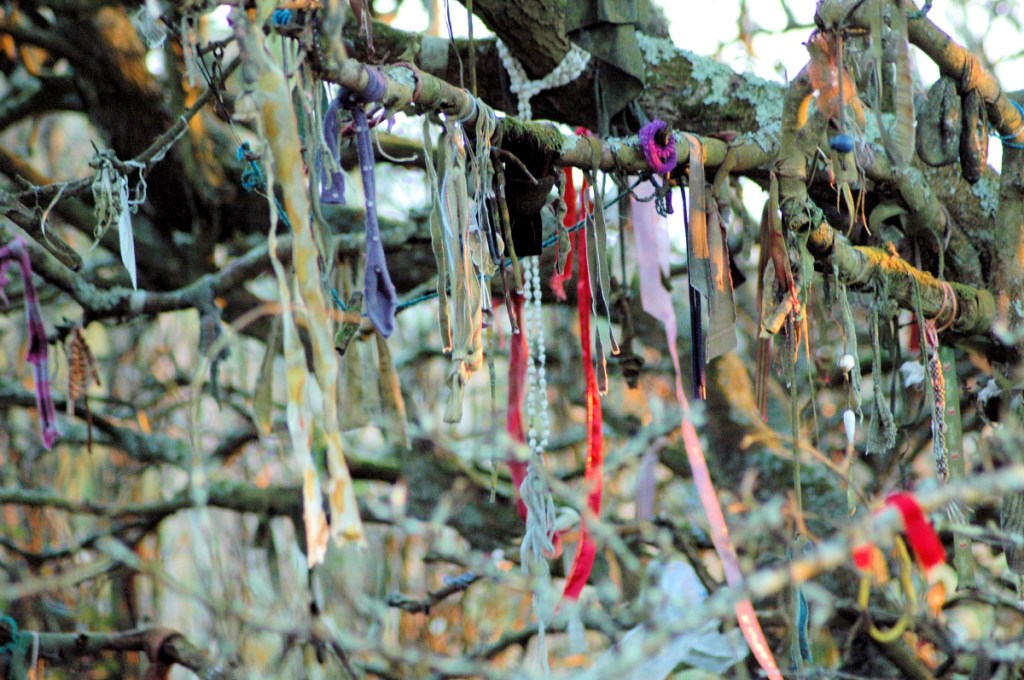
Prayer clooties at St Euny’s Well, near Carn Euny. But if you ever wish to tie a cloutie at a well, make sure it is natural and biodegradable, since the problems you weave into it will disappear as the cloutie rots away. And it doesn’t throttle the tree.
I have Asperger’s Syndrome, and I have wondered whether it’s related to the Thalidomide I took, second-hand, during gestation. The chemotherapy I had four years ago made me wonder about this – particularly the steroid Dexamethasone. The drugs seemed to amplify my Aspie symptoms. The behavioural transition prompted by these drugs helped lose me a partner and some friends. It has become more difficult to manage some of life’s tricky social situations, or deal with bureaucracy, or insensitive people, or hackers, or modern-times complexities.
But, on the plus side, this Aspie-amplification has led to a wave of creativity, perspective and original thinking. As you might perhaps have noticed, I’ve been churning out loads of stuff – mainly in the form of blogs, podcasts and books. That’s the other side of Aspergers – the Aspie genius, with an ability to excel in certain specific interests and gifts (though not necessarily in the full range of abilities that modern humans are supposed to cover). Also, there’s a certain blindness to human guile and manipulation, making us emotionally rather susceptible to getting caught in other people’s webs without realising it.
Many ‘neurotypicals’ judge Aspies to be emotionally neutral or feelingless. Truth is, we get so flooded and drowned in feelingful impressions that we short-circuit or melt down, showing little or no responsive expression except perhaps the look of a rabbit frozen in the headlights. Or a bit like Commander Data. The picture comes clear within hours, days or longer, but by then people have formed their conclusions and stomped off, often making big, inappropriate decisions on our behalf.
Over two years after we separated, I have only recently lightbulbed a bundle of key insights into my relationship with my former partner that I had just not seen before. I had sensed it unconsciously but I still didn’t see it. While talking to a friend I suddenly saw it – the whole pattern and network of connections, events, clues, mistakes and junction-points. It’s funny when that happens – everything suddenly becomes very different. Nothing changes, but everything changes, and a healing can occur.
Yet the paradox is that empathically I understand the workings of the human psyche and human emotions more clearly than many people, though not necessarily in my own personal sphere of life. Many would interpret this as a growth blockage, a refusal to open up to my emotions, but that’s not the case. It’s just that I operate with a different operating system that computes things in a different way, and neurotypicals have some advantages and Aspies have others.
The main problem is that neurotypicals are in the majority and neurotypical culture is dominant, even though today we’re presented with a rather chaotic and multidimensional spectrum of psychodiversity. NTs tend to define the rules and, being more rule-bound than Aspies, they tend to insist that everyone should behave like them, according to their criteria.
Victorian architecture, at Porthmoina Cove, Penwith
Anyway, the haematologist quite likes me – I’m an easy customer. She was pleased (yet again) with my results. I’ve had no cancer medication now for four months and, lo behold, there is no significant change in my readings.
So suddenly I’m feeling relieved. My wobbles were just that – wobbles. It means I won’t have to go on Thalidomide for the next few months at least – and I won’t have to do the rather long journey to the hospital either, once a month.
That’s good, because it comes back to that vulnerable, undefended feeling. My fear is that my Aspie tendencies will get switched up by Thalidomide. The bit that concerns me most is that I have no one to speak for me or cover my back. There are times when I blank out and (this might surprise you) have nothing to say, at precisely the moment when I need to fend for myself. Or I simply forget about something important, remembering it afterwards, and too late. Again, it’s that eight-year old feeling where there are quite a few things you can handle, but some things are too much. You need Mummy or Daddy, or someone, to come to the rescue.
But there’s a lesson here too, in trust. Things always work out alright. My anticipations were based upon the fear that my readings would deteriorate and they’d put me on the new drugs quite quickly. I have a few public speaking engagements coming up, and some anticipation about how well I’ll do on stage if I’m on new drugs. Or whether Thalidomide would lead to regrettable behavioural changes, just as the steroid Dex did. But there was no need to worry, and everything is alright. My readings are fine.
So is Paldywan the oratorical bard. Lacking anyone to talk to, a few days ago I went up the hill to the 2,000 year old ruin of a courtyard house and recorded two podcasts on the trot. And one of them, Ascension, comes out with this blog.
There’s a funny twist I discovered recently. In 2021 I contracted Osteonecrosis of the Jaw (ONJ), as a side-effect of some pharma drugs I had been on earlier. It caused pus to drip from my chin – urgh, yuk! It made me feel horrible and disgusting and, naturally, no one wanted to come near me. I asked myself about the inner meaning of this, digging up an image or a memory of having had leprosy sometime back in history, and being rejected by society. Rejection and exile are two karmic patterns of mine. When I twigged this, it made some sort of sense – deep memory was involved in the ONJ.
As time went on the ONJ subsided, becoming manageable. Then, a few days ago I was looking up the various uses of Thalidomide and the two specific ailments mentioned were leprosy and multiple myeloma (my kind of cancer). Ah, there’s a connection. I’ve been given a clue. Clues like this can act as keys to healing. It’s fascinating how intuition can know things long before the brains catch up.
I’ve started on some new holistic remedies – the main one is Resveratrol, a specific treatment for Myeloma. I’m back on Shitake Mushrooms as well. I have started some new supplements and remedies too, including one by Detox Trading in Devon called Happy Mix – it really does lift the spirits and, with the late spring we’re having, it has helped me emerge from wintertime blues and cabin-fever.
The Watcher. A simulacrum at Porthmoina Cove
I didn’t need to be worried about the haematologist’s verdict. Perhaps I am a neurotic Virgo after all. Though there’s something else here too… cancer has stripped away many of my defences, sensitising me to vibes, energies, situations and scrangles. There’s more emotional lava erupting as well. This makes me both more open and more vulnerable. Small things demand more processing than before, yet I’m less dulled by the very defences, built with the cement of trauma, that are designed to protect us from a rather tough and violating world. Life has become more colourful, textured and meaningful.
So a key cancer benefit – or a possibility, at least – is that cancer is a big jolt to become more human, to live more fully – even if physically constrained like me. In some respects it might be worth looking on cancer as an upgrade – and other terminal, serious and painful ailments too. From a soul viewpoint, at least.
It’s not a matter of primary importance how long we live – dying ‘before one’s time’ isn’t necessarily a failure or a shame. What matters is how we filled the time and space we were given, how we chose to experience the life we had and what contribution we made. In terms of soul evolution, three years with cancer can sometimes be equivalent to fifty years of normality.
But then, you don’t have to contract cancer for that to happen. It’s the way cancer hits you that matters, and what doors it opens – and whether we choose to go through them. This is regardless of how well or badly the cancer goes from a medical viewpoint. It’s the psycho-spiritual impact and the jolt that matters. It induces a cards-on-the-table focus of energy and of will-to-live.
It obliges us to face our shit, stuff, fears, failings and foibles. And regrets. On a deep level, that’s one reason why cancer is increasing in incidence: it’s one way in which the soul of humanity is serving us notice that we need to wake up. Or, at least, wake up more. Or you die. It’s a simple formula. It’s a bit like being in a war or crisis zone – the situation is terrible, but a crazy enspiritedness can take over, making you put your life on the line and getting you through to where you truly need to go.
My cousin Faith calls it a state of super-concentrated uncertainty. Or I’m reminded of the title of Alan Watts’ book of fiftyish years ago, called ‘The Wisdom of Insecurity‘.
Even so, I’m rather relieved to know that I’m cruising along on a cancer plateau and my results are okay. I felt it was so, but the confirmation is much appreciated. After all, it does help to know at least a little about what’s going to happen next. Should I buy a new computer or put some money down for my funeral? Um, I don’t know, but it might be the computer. Sometimes you just have to choose. And that’s what life on Earth is about.
With love, Palden.
[Written using human intelligence. Such as it is.]
PS: my cancer book is progressing, and recently I decided to release it as an audiobook too – better for people with fatigue and chemo-brain. I still haven’t found a really good title for it though. That’s most strange. I guess it’ll come in its own time.
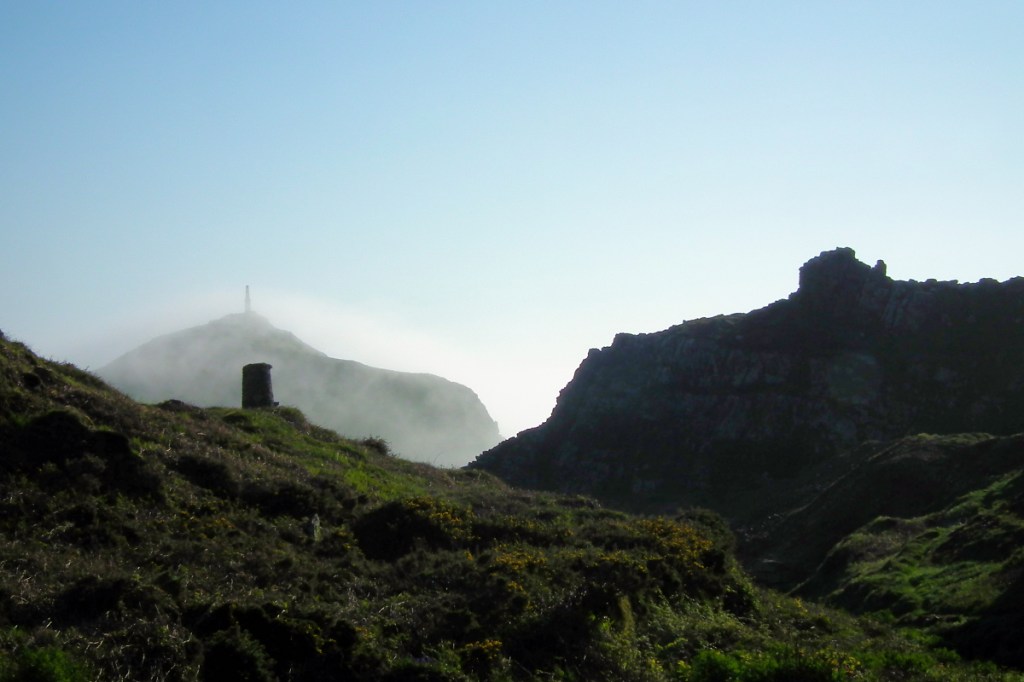
Chapel Carn Brea, the last hill in Britain, topped by bronze age and neolithic cairns
I’ve just started a job that I’ve been putting off for six months. I wasn’t clear about what I needed to do, and it’s a lot of work. And I’m supposed to be retired. But it came clear a few days ago, amidst a down-time when I was sitting here alone, feeling rather rudderless and wondering what to do. I decided to do a complete revision of a rather big website I wrote and created 6-9 years ago, Ancient Penwith. It’s about the ancient sites of West Penwith, here in Cornwall.
In some respects it’s more difficult to revise a website than to create a new one, because you have to take the existing material and re-shape it along completely new lines. But there’s a tendency to simply recycle the old stuff and stay in the same mind-frame as before. So each page is taking time for me to revise – one a day, and forty to go. I’m going to make the site briefer, more to-the-point, with more maps, pics and straight statements about the geomantic issues my research of the last ten years has aroused.
The detailed stuff has gone into a book, written and not yet published, called Shining Land. I can’t self-publish it – brain issues, and I want it to stay available after I die. So I’ll try finding a publisher when I get brain-space to focus on it.
That’s what it’s like. My psyche doesn’t process stuff like it once did. I can’t multitask and hop from thing to thing any more. When faced with memory issues I have to give myself full permission to utilise and trust my intuitive brain – intuition works by faster, more direct neural pathways than logic does, and that matters in ageing brains.
In this sense, being an educated Westerner is one of the causes of many old peoples’ brain-processing issues: we have been trained to disable and constrain a significant part of our brains, in order to fit into the requirements of the system we live in. Though, frankly, many people with dementia and Alzheimer’s are simply brain-tired, worn out, and we ought to recognise this instead of deluding ourselves that we can extend our busy lives forever.
It’s not just about slow brainz. It’s about a slowing psyche – the whole lot. It’s part of the life-cycle and a wonderful way of rounding out a life. Instead of facts and figures, you get understanding and you see things in a different light.
Here’s the summit cairn on the top of Chapel Carn Brea, a chambered cairn about 4,000 years old, for retreat, conscious dying and the energy-treatment of seeds and other items (many archaeologists would probably disagree)
Right now I am celebrating the second anniversary of the sudden separation of my partner and me, after six years together. I’ve been surprised how slowly I’ve moved through the stages of coming back to myself. It has been a struggle. On the other hand, since in a late-life context I’m in the last-chance zone, there has been far more stuff to get through, for this concerns all my relationships. My very first girlfriend, Jane, is dying too, in Northumberland. It’s all about finalising a life in which I’ve been involved with some amazing women and we’ve shared remarkable experiences. But I’m happy to say that, though I regret what happened two years ago, I made it through and I live to see another day.
I’m rather surprised I got through that. But then, that’s another gift of a lapsing memory: life and its experiences become more of a surprise. Well, I’ve got through 90% of releasing my partner and seem to have crossed a critical threshold in the last month or so. When a person refuses to talk and to debrief openly after a major life-crunch together, it opens up a new level of soul-searching, understanding, guesswork and forgiveness. It’s necessary to understand and release, regardless of whether the other person responds, helps or cares – otherwise it’s a weight around your own neck and emotionally a killer. It has been painful getting through this stuff but, in the end, something has cleared and a weight of bereavement has lifted. I’m happy about that, and I hope it’s happening for her too.
When a single issue such as relationship breakdown comes up, it widens out into other areas of life – those areas that remain unreconciled and which perhaps cannot be reconciled. One recent example, for me, has been watching much of my work in Palestine come to pretty much nothing. There’s something of it still there, but really it’s a matter of writing off this chunk of life and its efforts – letting it be. It’s in the ‘life’s a bitch, then you die’ department of reality.
In a way, all our big ideas, our plans, ambitions and efforts, come to nothing. It’s a fart in the void. This is not entirely true, but it’s an aspect of life that we do need to face. We’re locked in a groove of exaggerated, self-generated meaningfulness, desperate to explain our lives and justify our existences, when often the true meaning of our lives is completely different from what we believe. Quite often our track record is better than we ourselves tend to judge. After all, we’re all useless, error-prone shits, really, and it has taken us thousands of years to get to this point – and look where we’ve got to! We humans are the kinds of people our parents warned us about – or they should have done.
Fifty years ago I might have become a professor, but I became an independent polymath instead, covering quite a wide range of seemingly disparate subjects. I mean, what’s the connection between humanitarian work in Palestine and the geomancy of stone circles? What’s the connection between astrology and geopolitics, between ETs and the history of the Crusades, or between group circle-working and leylines?
For me, it’s all about reaching across rather large gaps and seemingly irreconcilable contradictions. I guess that’s one thing that drew me toward Israelis and Palestinians – if your aim is to bring peace to these poor people, that’s noble, but it’s highly unlikely to happen in your lifetime, so get used to it and soldier on anyway. That’s what I needed to learn. It took a few years, and my work out there lifted off as soon as I learned it.
Even so, things haven’t been working out well for me in recent years. Life has been an uphill struggle and I’ve had some rather earth-shaking experiences. In the last year, quite a few people under my care have died and I’ve faced some ridiculous challenges. Some think I ought to avoid such things but, in a way, for better or worse, this is my chosen life-path. It all hangs around the question of how deep into the water you’re prepared to go, and whether you trust that you can swim. Once you go deeper, you find out that you survive, so you go a bit deeper next time, and on it goes. Having someone shoot at you for the third time is not the same as the first.
Since October 2022 I’ve been involved in another irreconcilable problem that has weighed heavily. Recent news about the Post Office scandal here in UK has been heartening because I’ve been caught in a smaller but similar scandal. It’s a bank in Australia which, through corporate negligence, has caused the deaths of at least twelve people under my care. It is in denial of its responsibilities and has broken its promises. Like the PO scandal, the story sounds improbable and incredible. Even the consultant the bank brought in to help them with this problem recommended in our favour.
The short story is that, in October 2022, I got involved in a rescue operation in Ghana to save one of the company’s men, a Scotsman whom I knew. At the time I agreed to do it, it should have lasted 2-3 weeks. The anti-fraud security arm of the bank he worked for promised to pay all expenses if I acted as handler for this part of a larger operation – for them it was a confrontation with a large multinational crime gang. I have the right skills and experience, so I did it, in good faith.
In a crisis, there’s no time for written agreements: you either trust or you don’t trust the person, make a handshake deal and get on with it, since minutes matter. Despite repeated assurances of payment over twelve months up to September 2023, the bank has not paid. Twelve people have died as a result – some of you will remember Felicia and her child Phyllis, who died a year ago. And I am financially down. They owe Maa Ayensuwaa, me and a number of others £40,000 to help compensate all the damage done – not a vast amount.
During this time I met up with Maa Ayensuwaa, a native healer in Ghana with whom I’ve been working for the last year. Since December 2022 she and I have been alone on this, working to rescue people and both of us paying a high price for it. But we’re topping out now – the company has not managed to kill us, and neither has the crime gang.
The bank might not have intended to kill anyone, but its lack of integrity and its corporate dishonesty have killed people, and they’re continuing to err in this way even now, when a simple settle-up would not be difficult. Had they paid up as agreed at an early stage, many bad things would not have needed to happen – including Felicia’s and Phyllis’ deaths and the circumstances leading up to them.
Maa Ayensuwaa is now in Kumasi, Ghana, slowly reviving from a series of hospital operations for fibroids. Papa Nkum, her former student, and I are at present trying to find funds to get her home to her shrine at Nzema, to recuperate (£150). I’ve grown tired of fundraising. We need to get her home. It has been a long grind, keeping her alive, but we’ve done it. Gods bless her, she’s a tough cookie who seems to be able to hover around in the near-death state quite well without dying, and she’s made it through. If you feel any kind of connection with her, please send her supportive, healing vibes.
We’ve got through a crisis that neither Papa Nkum nor I reckoned we’d get through. He’s a good man. He has stood by her when others didn’t care – West Africans can be hard toward one another. But we’re quite a team, she, him and I, grossly underfunded yet resourceful and enduring. It’s quite an interaction too, between two native healers and one aged hippy – an esoteric bridge across cultures. We’ve learned a lot from each other.
The Mên an Tol, the Stone with the Hole
The issue here is about crossing gaps, reaching across cultural chasms and bridgebuilding between disparate realities that talk different languages and see things in fundamentally different ways.
The connection between humanitarian work in Palestine and the geomancy of stone circles is this. It’s about bridging gulfs. When you’re in a stone circle, you are communicating with an intelligence, genius loci, the spirit of the place. It has a very different viewpoint from you, and it’s a whole lot bigger and older than you. It’s a stretch, but the interaction is really helpful in both directions. Meanwhile, in Palestine: when in quick succession you find yourself in the company of a right-wing Israeli settler and a Muslim radical, you’re straddling a gap where the two live in very different worlds, even if living only a mile apart. It’s the same thing. It’s the vulnerability of doing the splitz.
What’s the connection between astrology and geopolitics? Well, astrology provides a way of seeing things that sheds light on the course of events, and it’s a source of hidden intelligence on the trends, tracks and timings that such events are likely to follow. It helps us understand the threads that move through history and the way they move and evolve. If astrology were used in international relations and intel gathering, diplomacy would work far better.
What’s the connection between ETs and the history of the Crusades? Well, the Crusades, for Europe, were a pattern-setting colonial adventure that have defined the history of the last thousand years, and we’re watching the latest round in Gaza and the West Bank right now. At the time of the Crusades, there was a choice between cultural interchange or cultural rivalry between the Muslim and Christian worlds, and rivalry and misunderstanding were chosen. If one person were responsible for that, it was Richard the Lionheart.
It created a gap not only between Muslims and Christians but a separatist mindset in Europeans. That is, we choose to call Hamas terrorists rather than freedom fighters. We call ETs ‘aliens’, with the expectation that they are hostile. We again say the word ‘Russia’ with an intonation and undertone that portrays Russians as ‘them’ – it’s a return to the safe hostile territory of the Cold War. Having an enemy helps us feel better about ourselves.
There’s another connection too, observed by none other than Ronald Reagan in Reykjavik nearly 40 years ago: if ETs suddenly presented themselves to us, our differences here on Earth would quickly dissolve. We’d have to change our mindset overnight. If we put up a fight, we’d lose, instantaneously – they wouldn’t even allow us to get to that point. Because it’s not about a winning-and-losing, threat-based mindset or expectation. At that very moment we as Earthlings would be challenged to do what we’ve long needed to do – cooperate and stand together. Standing against things is not the way to go.
I’ll say that again. Standing against things is not the way to go.
What’s the connection between group circle-working and leylines? Well, leylines constitute a subtle energy-system spanning the world, concentrated in certain areas (Britain and Palestine being two) and they act as network channels that pump up energy-centres dotted around the world. Group circle-working involves people sitting in a circle, using a talking stick and other methods of entering into a synergistic group-mind state. It is ancient, archetypal and very modern, the basis of deep, para-political democracy. In such a situation, a group can generate an amplified energy-field which can at times have pattern-changing effects around the world, somehow aiding or influencing events to turn in certain directions.
This is a shamanic principle that is a key principle today in the resolution of the world’s multiplex ills. ‘When three or more people are gathered in my name, there shall I be‘ – that’s ‘God’ talking in the Bible, and it’s true, and every single reader of this blog will have experienced this in some way, however you perceive divinity. This is what people did at power-centres, and that’s why they were built – to enter into advanced mass-consciousness states, to go into deep thought and to engage with the core intelligence of nature and the universe.
Spirit operates beyond the framework of time, space and dimension. We all have sisters and brothers of the soul, dotted around the world and the universe, with whom we are in regular communication on an inner level. We’re part of networks, lineages and soul-families and, consciously or not, energy passes through these connections. That’s one reason I like to run the Sunday Meditations – it’s not necessary even to do anything in the meditation. It’s more a matter of making ourselves meditatively available for whatever need there is, and much of it operates on a very deep level, of which sometimes we only get glimmers.
On Earth, we’re at a critical time where we need to understand that we really are all one. Sounds easy, but it involves a painful, drawn-out transition. We’re one human family living on one small world. We face a big emotional transition in which we shall have to learn to trust and agree more than ever before. Or, at least, we need to find ways of disagreeing and cooperating at the same time, and feeling good about each other. This concerns identities, nations, cultures and also species.
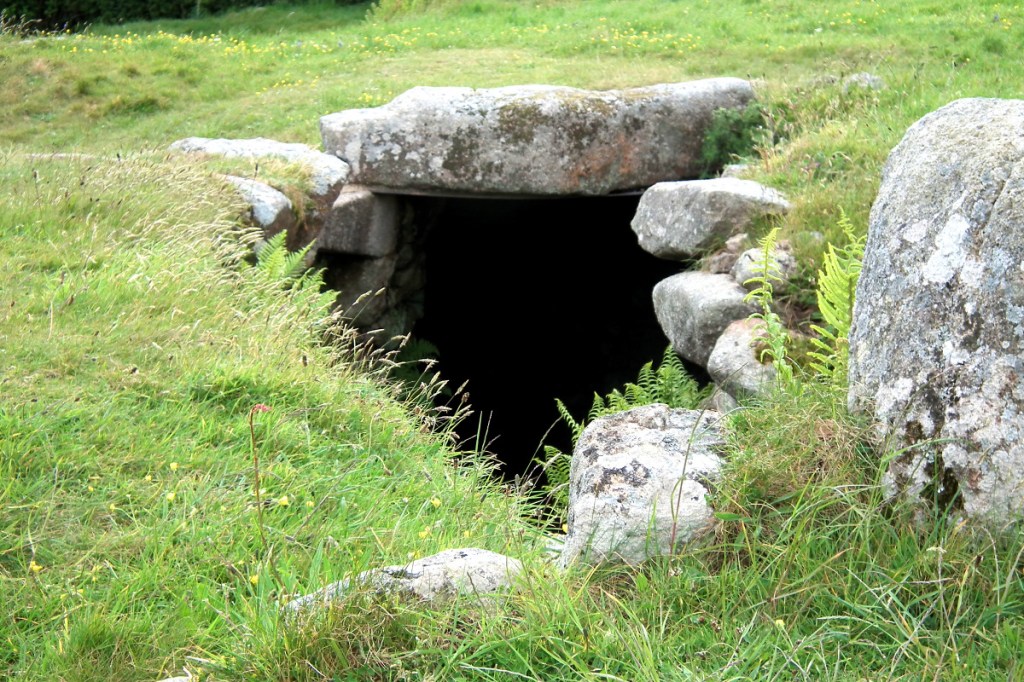
The iron age fogou at Carn Euny – a women’s space inside the heart of the village
It’s the bridging of gaps. Not only seeing and understanding those gaps, but stepping over them. We people in the rich world hold back more than is wise for us. We stay in our comfort zone, where we won’t be confronted with big moral issues that actually we need to confront, for the good of our souls. That’s why people are sailing to our shores on flimsy boats, sacrificing their lives to bring us this question.
I’ve repeatedly been faced with a question like this: “Is it better to give my last money to save a person’s life, or should I play safe and side-step the issue (and let them suffer or die)?”. The fear that causes us to turn away from facing such a question turns out to be unjustified, in my experience. It’s a question of undertaken risk and commitment – and such heat-of-the-moment choices introduce a new magic that is otherwise unavailable. I’ve found that, having faced this edgy question quite a few times over the years, I’ve managed intuitively to make good decisions, with but a few mistakes, and while it has involved making personal sacrifices, I survived – and so did they. And that’s the main thing.
It’s not what we get for doing things. It’s what we become by doing them.
Kilgooth Ust or Cape Cornwall, a neolithic cliff sanctuary
Wednesday was a bad-news day. I cried myself to sleep afterwards. I’m crossing a threshold. My cancer readings are beginning to rise. My medication is going to be changed. There are five options available, and this is the third. Part of me wants my Mummy to hold my hand while I go through the next stage. I shall lose my four-weekly nurses’ visits – the next phase involves pills, Lenidalomide (a form of Thalidomide). I lasted well for three years on the last form of medication, Dara, but it’s now losing efficacy.
I’ll have to go to hospital in Truro once a month. There will be medical side-effects, apparently. I’m feeling similar warning signs to those I had ten months before I was diagnosed with cancer – a feeling of being up against it, drizzled with feelings of hopelessness and garnished with a creeping tiredness – and a strange manic drivenness to work on creative projects. I’m doing Reishi, Astragalus, Vits C, D3, multivits, blueberries, cider vinegar, grapefruit seed extract, beansprouts and my friend Kellie’s multicoloured carrots, and took a break from blogging for some sun-medicine too.
This is the life of an eccentric cancer patient. Who knows how the next stage will develop? This year I would certainly love resolution of the bank issue and the ex-partner issue. It’s time, and life doesn’t have to be so difficult. I would love to help Maa Ayensuwaa to get back on her feet and do something for the Tuareg too (I need to find people to replace me). The Tuareg have had to send their young and their old people to a refugee camp over the border, since they are under threat from government troops, Wagner Group mercenaries and Jihadis. This isn’t the World War Three that some people seem to want, but things are escalating. Need is rising.
And here’s my quote of the day. It cropped up on a new friend’s FB page (shukran, Selina). It’s by Austrian psychologist Carl Jung. It applies to the whole of humanity as well as to individuals or nation peoples.
“Nobody can fall so low unless they have a great depth. If such a thing can happen to a person, it challenges their best and highest on the other side; that is to say, this depth corresponds to a potential height, and the blackest darkness to a hidden light.”
This is a note I posted on Facebook in response to feedback about this blog.
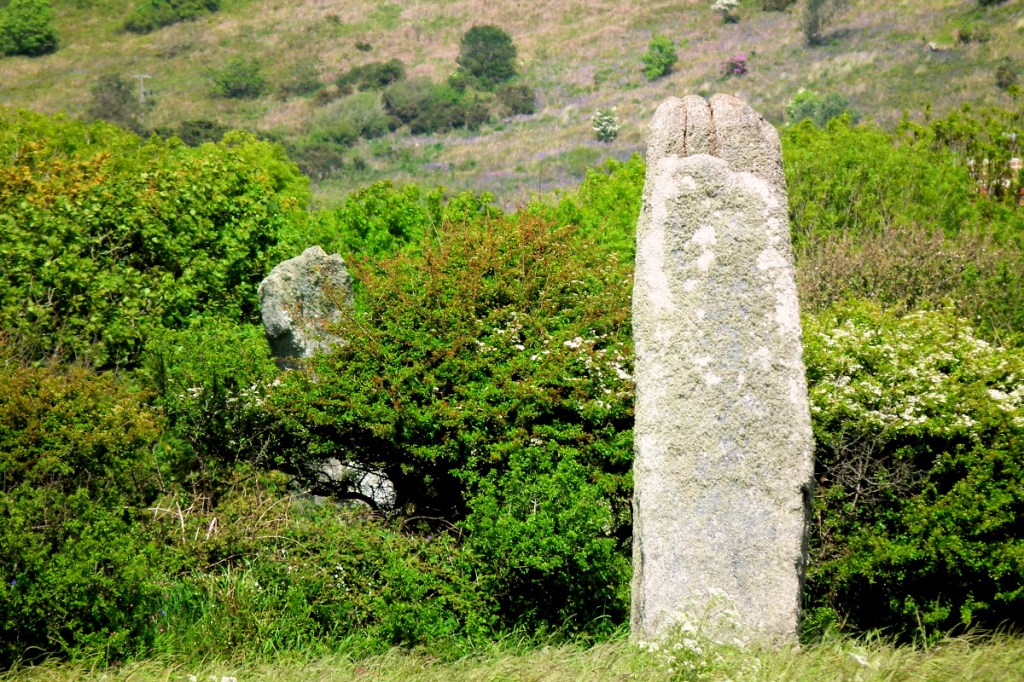
Neolithic placed stones on Zennor Hill, here in Cornwall
Thanks everyone, for your comments. While the compliments are heartening, what I find most interesting is the variety of ways my blogs go ding and clang with different readers in differing ways. That’s just fascinating.
With these blogs I don’t really have a clear intention. I’m just trying to record things that come up along the strange path of being a cancer patient with twiggling antennae and a lot of time on my hands to reflect, look at things from one step back, and to use my wordsmithing skills to try to squeeze them into written lines of verbiage.
Believe me, when I was young I struggled hard to write down my artesian aspie thoughts, and it took a long while – decades.
This is one of those things about living on Earth – stuff doesn’t come easily and we have to work at it. We have to serve time, slogging through loadsa shite to get really good at things. This is a key part of our soul-honing process and one of the big reasons why each of us chose to come here.
That’s what I’m trying to do. So I have cancer. So my challenge is to get good at cancer, to exploit its openings. Writing this blog is part of my medicine.
I don’t pre-think it. I’ll just sit on it until, one morning, I wake up with a nugget, a starting place – it kinda fizzles – and it comes out of the present. Which is how sometimes you’ll hear about my toilet challenges and other times it’s about meta-cozmickle panoramas.
Thanks for being with, and I’m really glad that the stuff that gets dredged up here brings insights, connects a few things together and reminds you of what you already know – though perhaps put differently so that it can be seen with another optic.
As someone said here, who knows if I am right? That doesn’t matter. What matters is to bounce things around because it helps our seeing, helps us see things from other angles, and it loosens us up.
Actually, I’d be quite glad and relieved to find out I’m wrong in many of the things I say and write, but I’m not sure whether I’ll be allowed that privilege. We shall see.












 Notes from the Far Beyond
You must be logged in to post a comment.