Once I encountered a paper bag, and on the side was printed, ‘Recycled materials – do come again’. Yes indeed, if that is your path. There’s also the option of going beyond.
But that depends a lot on what we do with the life we have, and the way we played our hand of cards.
This is one of the best blogs I’ve written and it’s time to give it another spin. It’s all about dying, and prepping for it while we’re alive.
Yes, you’ve probably done it before -getting dead, that is. While this involves falling into the Great Unknown, swimming in the Vastness, it’s in your personal bundle of knowhow, somewhere deep down.
This February 2025 Aha Class was about the process of dying and what happens afterwards. The talk comes in two parts. They’re here:
I’m drawing on personal experience. This is what it’s like from the inside – at least, as I have experienced it, and the way I see it.
The range of possible dying experiences is vast, actually, and tailor-made for every soul according to our karmic dispositions and where we have got to in the lifetime we’ve just had.
The audio recordings of this two-part talk are ready and out now. Save them for a good moment – this is a special one.
Next month’s Aha Class is about geopolitical healing – working inwardly with wars, disasters and the deeper levels of the issues at stake on our planet at present.
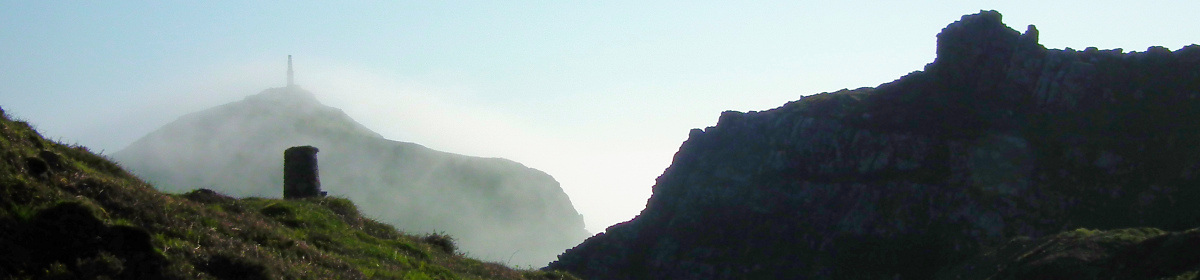
Pendeen Watch as seen from Bosigran Castle, Penwith, Cornwall
The amazing thing with dying is that it really is about setting sail into the Great Unknown. In aviation terms, it feels more like a landing procedure than a take-off procedure. Over the last twentyish years I’ve psychically tracked and handheld perhaps forty souls through the life-death transition – very interesting, rewarding and also wearing – and what has been striking has been the sheer variety of experiences people seem to have had while transitioning through death. For myself, the closer I come to dying, the more I find I’m needing to loosen up my preconceptions.
And my preconditions. Ultimately futile, they’re all about clinging on to the known. But it’s loss of control that is the key issue here, and it has already started. Dying is a challenge to go with the flow, to let be, to have done with it, to trust in the process and feel a way forward. Suddenly perspectives I harboured about life are changing and revealing themselves very differently. I have to ‘make a deal with God’ (as Kate Bush once sang).
It’s not binary. We aren’t either alive or dead. We’re all a mixture of both in varying proportions, all through life, and it changes slowly, sometimes in phases and sometimes suddenly. Medical thinking has it that death means clinical death, when your life-signs hit zero, but no, that’s a stage of dying. You still exist afterwards and you exist before, though you might be half-dead. When you’re on the other side, for a while you’ll see and hear people back in the land of the living whom you knew in life, though unless they are receptive to listening, they won’t see or hear you – and that can be tricky.
We’re all part-dead. I’m more dead than many of my readers, though there might be one or two who are more dead than me – hello! In February I think I went up to 95% dead – close – but by spring equinox I was down to 80%, and now I’d put myself at 70%. But only last week I had a lurch and drooped, getting older again for two days. This happens with cancer – you go up and down. Small things can have big effects.
Above Porthmoina Cove, Penwith
In the near-death experience I had at age 24 – I was unconscious for nine days – it permanently changed me. I was very different afterwards, having gone through substantial memory-loss and brain-changes. Some would call it a ‘walk-in’. When I first came to, I didn’t even recognise my parents, with no sense of where I was or the time we were in.
As I revived, the experience made me mission-driven, pushing me to do whatever it was that I had come here to do. It took about seven years after the NDE to ‘come back’ sufficiently, to be fully functional. After three more years, by 1983, my mission presented itself – I started the camps movement. Or it started through me.
The near brush I had with dying in February this year shook, squeezed and wrung me out. By April, to my surprise I was served new instructions. An astoundingly clear voice in my head said, “Ah, there’s something more we’d like you to do…” – and I both perked up and groaned at the same time. I crawled from the slough of despond in February to the beginnings of a new vision by May.
I have been presented with serving an emergent grandfather-type role in the lives of many people. Additionally, there’s something incomplete about the ‘world work’ – world healing-oriented group consciousness-work – I’ve been involved with since the 1980s. And my writing and podcasting are appreciated. So there are things to do. A few years ago I wouldn’t have anticipated this.
There’s something here about sinking into the deep dark and then reviving with an armful of light. Shaky as I am, I’m being given something new to do, even though time is not really on my side. Yet this fact is a motivator: it is urging me to do what I can do while I still can and to enjoy doing it.
It might be a swansong or the beginning of something – I cannot tell. I have osteonecrosis (a dying jawbone), peripheral neuropathy (feelingless feet), a deteriorating back, a troubled stomach, a low-level permanent ache, I’m sensitive to radiation and, even with my thin body, gravity weighs heavily. Oh, and I have a cancer of the blood and bones.
Life is hard in a way I’ve never encountered before, and sometimes it gets me down – this last six months I’ve had a bit too much of it. I nearly buckled. So, if this gets much worse, it could be a relief for me to go. Can you see how this might be a positive thing? Though it does look as if there are positive reasons to stay alive too.
If you want to meet me before I go, then I am still alive in a body and here I am – alone much of the time. I serve good tea. Leaving it to another time, another year, might not be the best thing. Yes, when I go a gap will be created by my absence, but another kind of presence is possible which, in the end, might be valuable too. After all, here on Earth time and geography keep us separate anyway. There comes a point where a soul has done enough for this lifetime. We need to be released. But we haven’t gone away.
Bosigran Castle
I had a good friend, Mike Blackwood, who died a seemingly sad death on booze, drugs and despair. Uncomfortable in this world, he was a spirited man, a solid part of our team in the camps of the 1980s – the site manager for many of them. When I heard of his death, I tracked him over to the other side and he was in the ‘holding bay’ – a buffer zone you go to initially, to process the life you’ve just left and make yourself ready to go further. In terms of Earth time, this often takes weeks, though it varies greatly. The funeral can be a key moment. But not always.
Well, in the holding bay, Mike was tripped out of his skull on acid and having a great time – he had loved happenings, festivals and raves during his life. He was blissfully happy, flowering, glowing, almost Buddha-like. This was a surprise, but that’s what you get in this game. I returned a day or two later and, unusually, he had completely gone beyond. He didn’t wait around for his funeral.
I guess he was relieved to end his life. I felt happy for him. It just goes to show how the judgements made of our behaviours and our lives on Earth don’t necessarily match who and how we actually, truly are, deep down. Sometimes, in the education of our souls, we need to plumb the depths and go where others fear to tread. Our judgements about the rightness or wrongness of others’ lives can clatter badly on the cobblestones of reality. Mike’s death was characteristic of him, and probably a relief for him. The manner of people’s deaths always seems to be true to character.
Ruth, my mother, couldn’t really handle death, even at age 92. Born during WW1, her generation trained themselves to survive, but it could not go on forever. Around death, she had that confusion many people have – an ill-considered mixture of Christian heaven-and-hell stuff and secular it-all-goes-blank stuff. Neither is very useful. She died and, not knowing how to handle it, went straight to sleep, curled up and unresponsive.
This felt okay at first because of what she’d been through, though after a while I got a feeling she wasn’t facing the fact of being dead. Her funeral was approaching and, since she was a popular figure, I wondered what to do. I wanted her to witness people’s love and regard for her. On the day of the funeral I tried waking her up but she wouldn’t surface. I made a prayer, feeling a bit clueless.
Then came a solution. Her little terrier Pepper, who had died some years earlier, came along, yapping at her. She woke up and my mother was able to witness her funeral, with Pepper on her lap. I think she was surprised at the gratitude and recognition that came her way from the crowd. Bless her, she hadn’t appreciated the value of the contribution she had made during life. “It’s only me”, she would say when she rang up or came through the door. Only you?
She and I had some leftover issues at the time she died, but the changes she went through after death allowed her to encompass her strange son and the person he was. All was forgiven between us. It happened one day when I was in Palestine. I experienced her strongly while at an ancient church at Burqin, near Jenin in the West Bank – the place where Jesus healed the lepers – and found myself deeply wishing I could have brought her there.
In her life she would never have entertained the idea of coming to Palestine, but she loved old churches. She came in spirit and I felt her there with me. I shed tears of release, and I think she did too. All that lay between us was made good and each of us came to fully understand why we had entered each other’s lives. Thank you, Jesus, for that. Ironically, it was a Muslim friend, Wael, who had brought me there to meet the Prophet Jesus – and my Mum.
What’s interesting here is that, today, I’m going through a lot of early-life patterns of vulnerability, unsupportedness and loss, and feeling like a five year old – mother stuff – while being completely at peace with my Mum. We smile to each other occasionally.
Going home. On the slopes above Bosigran Castle.
When my old philosopher friend Stanley Messenger died, he wasn’t interested in witnessing his funeral – as a mystic Christian, psychic and Anthroposophist, he didn’t like the conventional church funeral his family organised.
I sat there in a pew with Stanley gruffly urging me to take over the service, while the vicar was up there trotting out the usual stuff. I told Stanley to stay and watch, because the people present did care about him. Actually, when we were all sitting in the pub afterwards, he was happier because it was informal, and I sensed him around, communing with us.
In the weeks that followed he loitered in the ‘holding bay’, sitting enjoying a pleasant landscape and a blissful absence of worldly hassles, still looking frail. In the last few years of life he had dementia, which can dissipate a person’s selfhood, so I guess he lacked momentum to go further in the dying process. After a while I came along, took his hand and pulled him up what seemed like a lot of steps until we reached the ‘pearly gates’ – the full transition point into the after-death state. He was met by people who welcomed him and took him in – I think one was Rudolf Steiner himself, whom Stanley had known when he was a young man. Goodbye, Stanley, and thanks for being you – see you again.
My cousin Faith’s husband Albert was a good-hearted man, rather secular and empirical in viewpoint though gentlemanly and worldly-wise with it, and I think at first he thought me weird and extreme. Then he got prostate cancer and started changing, slowly becoming more open, doing tai chi and becoming more attuned to matters of spirit. Just before he died, he was clearly edging into the otherworld, far away and in a state of grace. I had been working with him remotely but came to visit in his last days.
At one point his eyes opened slightly, he saw me, and he gave me the thought, “You’re here?!” Then after a pause he thought, “But you were there”. I could sense him computing that. “Yes”, I thought back, “I went there to pull you over”.
He had seen me on the other side, and here was I on this side, with him at the hospice. That’s not supposed to happen, or is it? He had a peaceful death. My cousin Faith really did well with him – he expired with her hugging him. She felt his last breath. After a while she got up, went out into the hospice garden, and a heron flew in, did two loops round the garden and sailed off past the trees – heaven was signalling.
I had helped sort out his connection with the otherworld, making sure there was someone to meet him, and myself going over to give him a hand. Since his death we have nodded and smiled whenever he has popped up – he’s even done me a few favours that only someone on his side of reality can do.
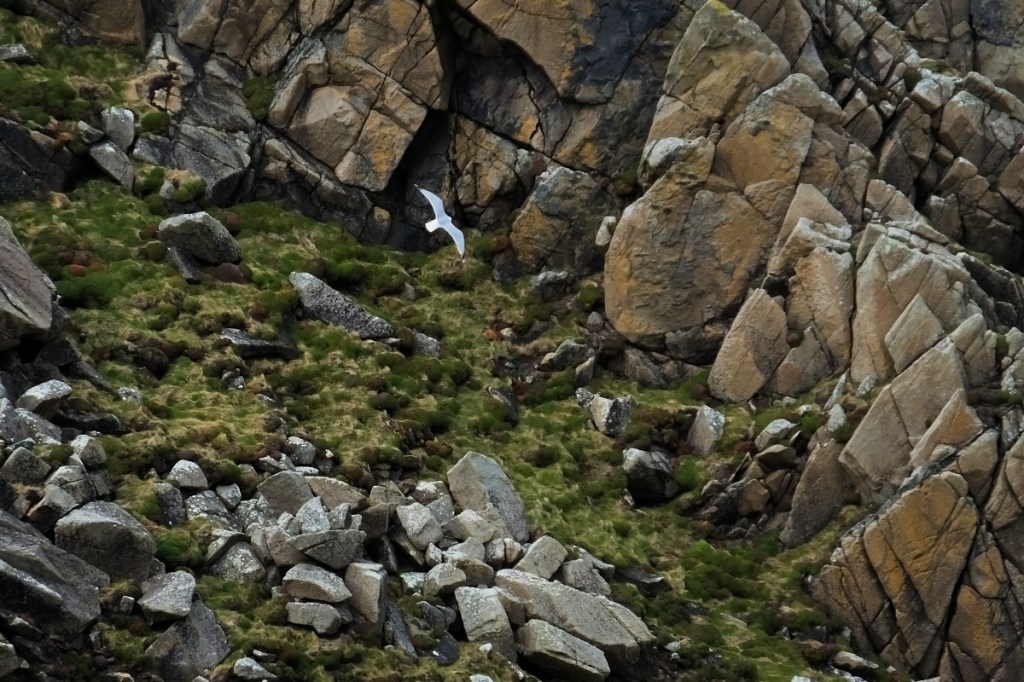
Jaggedy granite at Bosigran
Often I’ve been able to say who will be there waiting. It melts the last doubts and resistances people might have. When I told my Dad that his brother Laurie, who died in WW2, would be there, he went quiet and a tear came to his eye. Something in him knew this was true. From that moment I sensed that he felt alright about going – his long lost brother would be there.
On the day before he died he was unconscious. I held his hand, telling him all I knew about what would next happen to him, and what to do. I knew he could hear me and took it in. A while after his death he and I had a psychic chat and he thought to me, “You’ve done your duty to your father by becoming my father”.
In my twenties he had felt I had let him down by making the dissident life-choices I made at the time. My parents had done their level best but they could never quite encompass me – their strange boy who became a hippy revolutionary, a disappointment and embarrassment. In my mother’s eyes the only sins I had failed to commit were running off with a black woman and being gay – such was the moral atmosphere of the late 1960s. Poor them, they must look down on me now and think, “OMG, is he still at it, getting himself into trouble, even at his age?”. But I think they now understand why I’m like that and why I had been their son.
What happens in death has a lot to do with how we deal with life. If during life we are willing to own up when necessary, then owning up in death gets a lot easier. Life on Earth is such a screwed-up and tacky thing that we’re all damaged, up to our eyeballs in karmic cobwebs. Living in a body on Earth isn’t and cannot be about being perfect – it’s about getting through. It’s about leaving the world a slightly better place than when we started – not only because it’s good and right to do so but also in case we need to come back. Or in case other members of our soul-tribe need to come here. Or for the sake of our grandchildren and everyone else who shares our world.
At death you can’t do anything more about anything. Life was as it was, and that’s that. The task is to come to peace, to hand in your resignation without reservation – well, as much as possible. There’s a good chance an emergent feeling of relief will help with this. It involves releasing and forgiving, letting be. It’s too late to do anything. So working on at least some of the issues we’re likely to meet at death is well worth doing before we get there.
There’s more. The better we’re able to get through our life-crises and make them good during life, the more we establish a pattern of dealing well with crisis. When death comes, it makes dying easier because the ‘growth choice’ has become a habit we can latch onto at the moment of death – instead of the ‘fear choice’. The more we are centred, flexible and okay about handling life, the more we will handle death and ride the wave.
At death it matters who we truly are and what we have become – no glosses or pretences are available any more. It’s an honesty process, yet also a relieving and healing process in which a weight is lifted off us – the weight of being who we were, with our character traits, habits, stuck bits and karmic patterns. A lot of forgiveness and understanding comes. But look at this another way…
When we die we’re entering a new world. As with this world, the way we are born into that world greatly affects what happens afterwards. When we sally forth to the other world, if we die well and do our best with it, we’ll start well on the next bit. By ‘dying well’ I don’t mean the right circumstances – it could even be a car crash – but the right approach when we encounter it. Even if it is a car-crash, or you get shot, time stretches immensely in that moment, and there can even be a surprising calmness about it. In such a circumstance, your soul pops out of your body before the impact hits you and you will feel no pain. People who die in wars, shocks or tragedies get scooped up by soul-paramedics and helped quickly.
Dying is like an examination to test what we’ve truly learned and worked out in life. It affects subsequent decisions about what we’ll take on next – our next incarnate life on Earth, if that is our path, or whatever happens instead, if that is our path.
Our soul-family, soul-tribe and angels help us get things sorted out. It’s a process, and it involves referencing all of our existences and their overall storyline and purpose. It concerns the role we play in our soul-tribe and the agenda, priorities and evolution of our tribe. We aren’t solely individuals but part of something much larger. There’s bliss, relief, healing, love, rest, fellowship, education and soul-melding to be had too, in the after-death state.
A deep choice is presented. The choice lies between opening up to such a path or walling ourselves into an imaginal reality that carries us off somewhere else – if perhaps we believe that we don’t deserve better, or if we can’t let go of the identity, feelings and attachments we had in life. Then we might well get another round of life, with a bleed-through of elements from the past that can be both helpful and difficult, until a turning in the deepest seat of consciousness redirects us to our true, core path.
Above Porthmoina Cove – rock climbers love it
Part of our reason for being here on Earth is to evolve and train ourselves as super-trooper souls – souls who’ve been through the mill, shed blood, sweat and tears and learned lessons from it – experiences that aren’t available elsewhere. It’s one helluva training – a ton of both difficult and joyous stuff is to be found here on Earth, and we have a profound option to become greater souls through wrestling with it.
There’s something many ancient peoples instinctively knew: the souls of the living and the souls of the dead walk alongside each other in parallel worlds, helping each other out. We’re in the same tribes and networks, all still here. You can talk to your Mum (not anytime, but sometimes). They knock on our heads every now and then. It’s important to take note, to listen within and to answer when the souls of the dead call.
After I’ve gone, if any of you feel me twiggling the top of your head, please acknowledge it and signal back. It depends on whether you pick me up sufficiently, giving it full credence, and whether it is in your scope and growth to respond.
It’s not uncommon for anyone with a dash of intuition and receptivity to pick up on the dead – go on, own up, you’ve experienced this yourself, actually. Search back in your memory and you’ll find it. So if you get a buzz from me after I’ve gone, please work on the basis that I am actually there.
In life, it’s not primarily what we do that matters – it’s how we do it, and how much we make it good in the end. As an astrologer, there’s one prediction I can safely make, for no charge: you are all going to die. The choice lies in how we do it. That involves the full and proper exercising of free will. Whatever your faults, you’re a fine person. Don’t you forget it. I’ll try not to either. As a Virgo, I’m so bloody self-critical that I have to remind myself.
With love, Palden
Crossing the divide
I have reposted this blog from two years ago, and it’s also part of my cancer book Blessings that Bones Bring. While reading out out loud for the audiobook version of the book, it struck me as a really good piece. So here it is again.





 Notes from the Far Beyond
You must be logged in to post a comment.