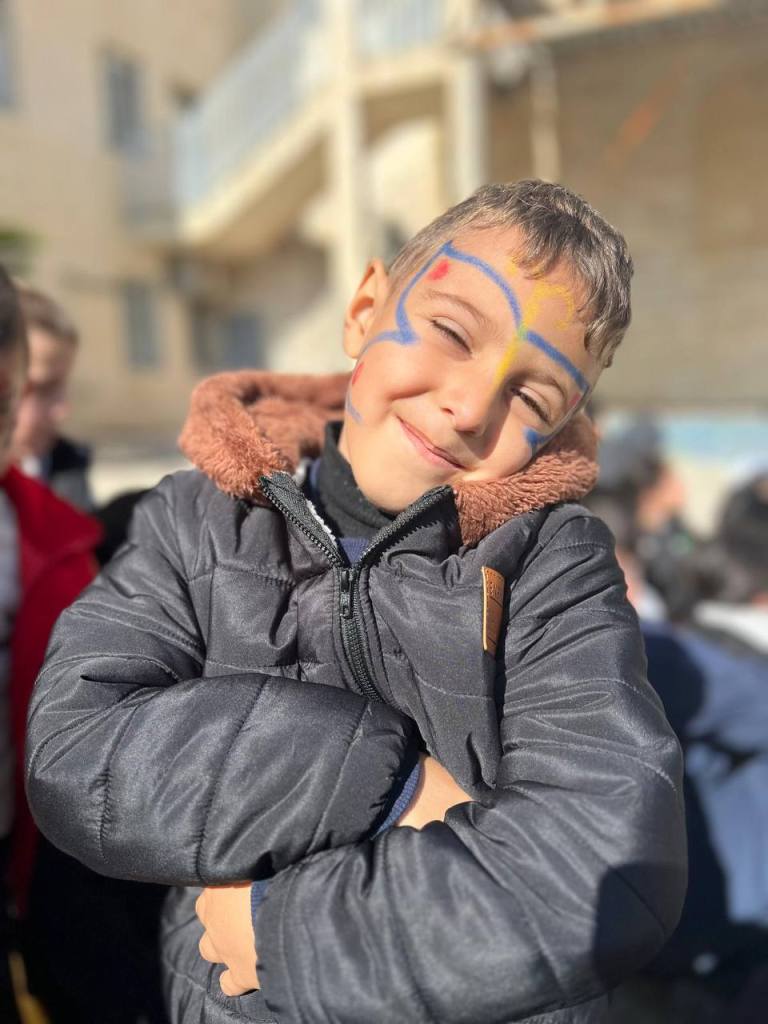
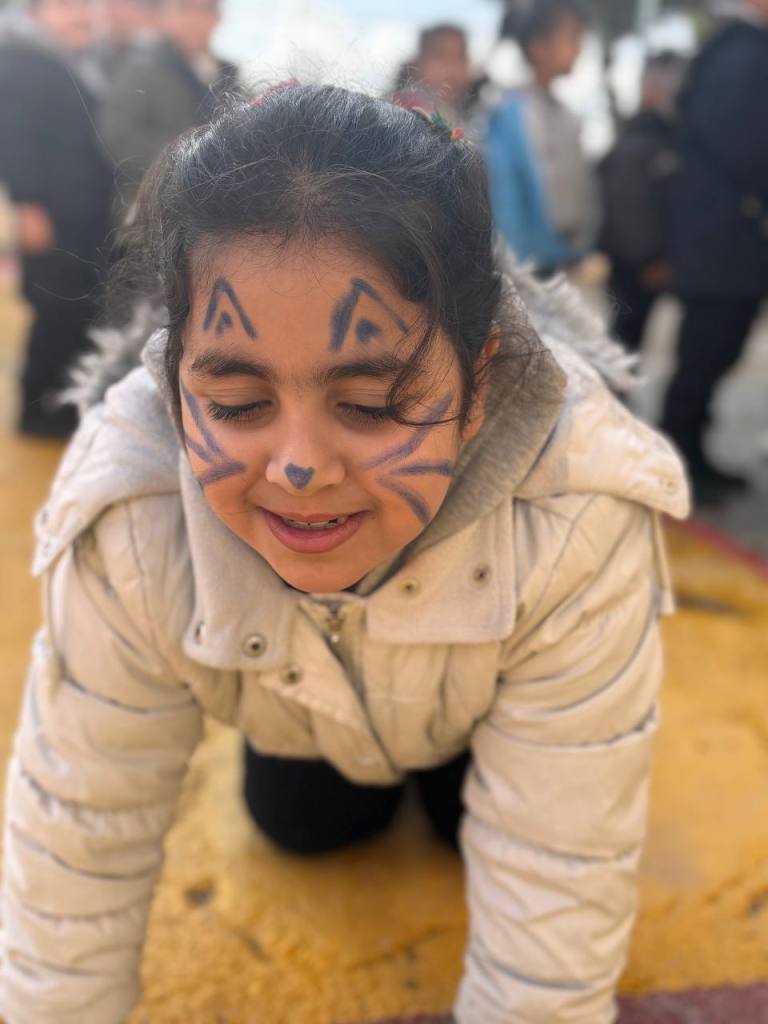
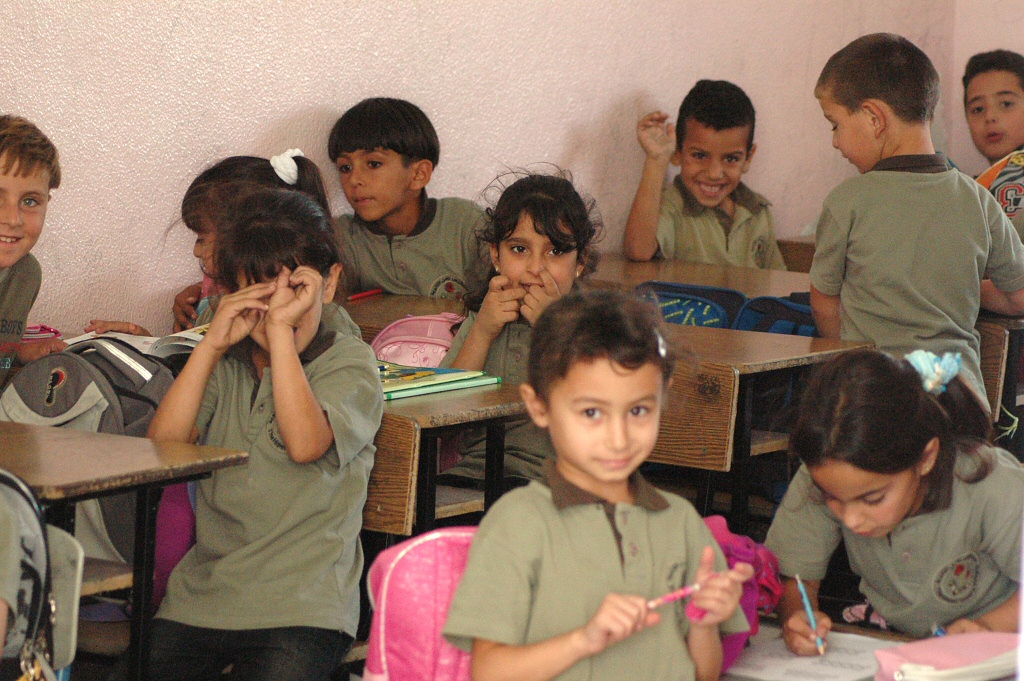
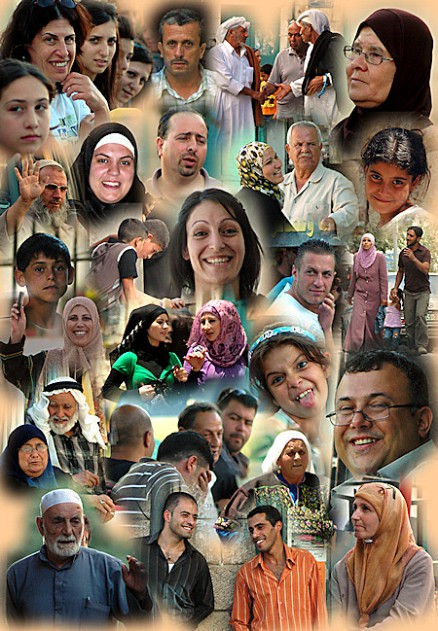
These are kids at the Hope Flowers School in Bethlehem, West Bank, Palestine, and these pics were taken in the last few days.
They are orphans from Gaza, and refugee and special needs kids from the West Bank. Apart from giving a good education under difficult circumstances, the school gives kids the tools to process their anger, loss, fear and trauma, so that they grow up knowing there is another way. Another way from what has happened over the last hundred years in Palestine and Israel.
Note the performers. These look like visiting Europeans. They are independent humanitarians: they set about brightening up the lives of people in places like Palestine and they make a big difference. They often fund themselves to do so, and travel cheap and crash on sofas. Some are performers, some hairdressers, some are welders and some are law graduates, artists and retired professionals. Have you ever considered doing something like this?
Forget Trump and Natanyahu: this is the human frontline, where the real work of peacemaking happens. These children are, I hope, the generation who will see a big change across the Middle East. The times of war need to end now: we must do things another way. And these are the people who will do it. That is my prayer for them.
Here’s the translation of the text that came with the pics:
In an atmosphere filled with fun and positive energy, the professor of physical education, Mr. Mustafa, organized a special recreational day for the students of the school, in cooperation with the refugee center, where play, art, and laughter came together in an unforgettable day ✨
⭕ A variety of events between animated games that enhanced activity and interaction, face painting added colors of joy to the faces of children, alongside a theatrical circus that presented pleasant performances that brought joy to the hearts🎪😊
Our students also participated in playing with parschute and other group activities that contributed to promoting a spirit of cooperation, active discharge, and building self-confidence in a fun and safe way 🌟
⛔ This day was an open space for joy and expression, and an integrated recreational educational experience that emphasizes the importance of play in supporting our children’s physical and psychological development 💚
ـــــــــ🍂ــــــ We learn for human well-being ــــــ🍂ــــــــ
To make a donation to Hope Flowers, go to this page for links to Hope Flowers’ supporting organisations in different countries: https://hopeflowers.org/wp/support/
Here’s a readable story about the history and philosophy of the school. It’s from my book Pictures of Palestine, and it’s called ‘Korea meets Palestine’. (Korea and Palestine were both divided in the same year, 1948.) https://www.palden.co.uk/pop/korea-meets-palestine.html
Thirtysomething years ago I had the privilege of working with a bunch of (for want of a better term) cosmic beings called the Council of Nine, compiling and editing a book for them, ‘The Only Planet of Choice‘. They dropped in loads of remarkable insights and here’s a bundle or two of them. Some readers might think this stuff far too way out, or utter garbage – so use your freedom of thought and intuitive discernment here.
Planet Earth is very different from other worlds. One factor affecting this is its gravitational density and the intense physicality of our lives on Earth. This has had a troublesome, diversionary and downward-pulling effect on human consciousness, with the result that we tend to forget why we came and what we are here for. We get lost in the daily round and in our psycho-emotional stuff, losing our connection with spirit. It has made human history into something we can be proud of and also we ought to be ashamed of it.
Over the centuries and millennia we have institutionalised this situation, making it our default behaviour, such that waking up to the heart of the matter has become an exceptional, dissenting thing to do, with difficulties and sanctions attached. This is further exacerbated by historical factors such as the control agendas of dominant elements in society and the compromised submissiveness and conformity of the majority. We’ve given power to fear, guilt and shame, clamping our spirits and clipping our wings.
There’s another issue too. As a planetary race, we did not start our evolutionary journey together as one tribe or family, originating from one single source, as is the case (according to the Nine) with many worlds, cultures and civilisations throughout the universe. Humanity has physically evolved in a Darwinian sense, with periodic non-Darwinian seedings and tweaks from outside, as part of a hybridisation project. Such discreet interventions have helped us evolve in consciousness, culture and technology too, though in quirky and sometimes dangerous ways.
The aim was to breed a new kind of conscious being that could be at home in denser and more experientially-diverse conditions than ever before. The idea was to draw influences and souls from throughout the universe, throwing us together on one planet, in the hope that we might co-create something new, different and never done before. We were to become a new kind of individualised, enspirited, dense-physical, humanoid-type being.
So Earth has become rather like a New York or a Singapore in experiential terms – naturally and intentionally multicultural. Living in different cultural realities and localised mini-worlds, we have been bumping up against one another throughout history, becoming changed in the process. The end-game of the modern phase of Earth’s history is to get all these cultures and individuals to come together as one planetary race – a race that is capable of managing its own world and making something of it.
So now, by 2025, we have created a world system, criss-crossed with cables, shipping and air lanes, and humanity now needs to catch up with all that this means. Nationalist and isolationist feelings are a symptom of a stop-the-world reaction to this historic mega-trend. As usual, we walk into the future facing backwards, more concerned about what we’re losing than what we’re gaining.
Also, life on Earth is always a mixed bag, and experiencing this is part of the grinding process that hones the soul. It faces us with choices – sometimes big and deep ones – and that’s what we came for.
They called for volunteers – this wasn’t conscription – saying that living on Earth would be difficult though potentially rewarding – a fast-track way of honing the soul. We would be given individualised free-will – a capacity to do whatever each of us feels best. As incoming souls, we felt that we could maintain consciousness sufficiently to fulfil our purposes in signing up for this project. At first we had that kind of clarity about life that you sometimes get when you’ve been on holiday, done ayahuasca or been on a meditation retreat – but then, when you get home, the pressures and complications start, and the main agenda gets set aside for another day, when there’s time… and we get lost again.
Over time, more and more souls came, as individuals and as groups, creating a population explosion in modern times. It has become a mass-migration, rising into billions, and fresh souls are still coming. (At one point the Nine said that Earth’s optimum population is around 200 million, not 8-10 billion, though they also reckoned we could manage such high numbers if we did it right.)
We now have a situation where we have billion of souls on one planet, yet in very different worlds. Multiplicities of them. This diversity happens on the same street, even within families. Diversity doesn’t have to mean dissonance yet currently dissonance is strong, and this matter is going critical. Not least because, on a deep psycho-spiritual level, dissonance makes divide-and-rule easier, and arguing has become pandemic in scale.
The consequences of dissonance have been highlighted in Gaza. Palestine/Israel is a microcosm of the whole world – divided, and not just two ways. This microcosm business is a key reason why this conflict matters so much to so many people. It holds the world down. Around 12 million people are holding 8,300 million back. Yet equally, if it is resolved, it could lift up the whole world. And this isn’t really just about Israelis and Palestinians – at root it’s about people and the Megamachine.
Neither is it a simple equation of one side as badguys and the other side as goodguys – it’s far more subtle and convoluted. Yet it polarises around Israelis and Palestinians because we have a habit of dehumanising others, lumping them together into a mass of horrible, fundamentally different people who threaten our happiness or our very existence.
Israelis and Palestinians, bless them, live in very different worlds, to the extent that people on either side just cannot see what it’s like being on the other side – except for some brave souls on both sides who are willing to step outside the confines of groupthink. We all variously do this dehumanising thing, justifying ourselves by making others wrong, but Israelis and Palestinians have an acute and persistent case of it.
They aren’t even in the same conflict, though they live close together in one small ‘holy’ land. It all boils down to the way we see things – especially when we get het up, losing our patience and tolerance.
This is why, in peacemaking, it isn’t possible to propose nice, sensible diplomatic solutions to which everyone can easily agree and comply, point by point, so that we can all go home and forget it. They’re fighting different wars, committing different suicides. This stuff, this shadow, goes so much deeper.
Plenty of shadows lurk in the collective psyche of virtually every country and social grouping worldwide – some of these ghosts are dormant, some simmer and some are heating up.
At present, globally there are few encouraging signs of mass healings and breakthroughs, and this leads to a creeping sense of disillusionment and disappointment across humanity.
If anything, the main factor currently pacifying conflicts seems to be exhaustion – sheer weariness. That’s not resolution and healing, but it can allow feelings to cool to manageable levels. Social-cultural healing can take decades, but there comes a point where both sides see that healing is cheaper than the price of continued conflict.
So it’s all a matter of what happens after open conflict ends, and whether a momentum of progress can be built up. It requires a time of confidence-building where each side has to restrain itself, even during touchy moments. In some respects this demands more bravery than in times of war, since there’s a courageously resilient madness to warfare that subsides with peace, once people get used to sleeping safely in their own beds.
Deep down, many Palestinians understand the pain Israelis feel over the pogroms and the Holocaust, but it was Europeans who did this, yet Arabs are being punished. The Arabs of Gaza, the West Bank, Jerusalem and Israel are divided by circumstance, permits and walls. There’s a tug-of-war between negotiators (Fateh) and resistance fighters (Hamas), and neither is winning or compromising. Recent events have stumped the negotiators and decimated the resisters, and many Palestinians feel rudderless and stuck in a tightening vice of diminishing options. Top to bottom, Palestinians are hurt, dismayed, upset, unsure what to do next.
Meanwhile, Israelis feel deeply hurt and shocked, and for entirely different reasons. Zionists, centred in Jerusalem, are hurt and angry since their God-given right to the land of ‘Greater Israel’ is being obstructed by an interfering world filled with Jew-haters – and Arabs ought to get out of the way. Meanwhile the ‘peace camp’ centred in Tel Aviv, themselves hurt, diminished and stumped, have lost much of their trust in everything and everyone, preferring life inside a missile-protected beachside bubble.
Historic Jewish insecurities have genuinely been reawakened, with some Israelis lashing out, others recoiling in dread and many stuck, confused and afraid. Something fundamental has dislodged in the Israeli and the international Jewish psyche, and something ill-judged and disproportionate has welled up in the attitudes of non-Jews toward Jews.
Israelis and Palestinians sit in fundamentally different worlds, each with different ways of dehumanising the other. As do those who support either side, around the world. Palestine activists need to stop belly-aching about genocide and rights and actually support real-life Palestinians directly with friendship, money and contact. Meanwhile, those who bang on about anti-Semitism need to forget it, and those who deny or ignore it need to remember it, deep in their hearts.
It’s a reality-conflict, projected on others yet reflecting what’s going on inside all of us. It’s about far more than just Palestinians and Israelis.
But there’s a flipside. Conflict and hardship can be so crazy, tough and senseless that it leads to a kind of rapid de-traumatisation, an epiphany, a deeper change of heart and optic. This happened after WW2, with the founding of the UN, the EU, the welfare state, the beginning of decolonialisation and of the urbanised modernity we now take for granted.
That ‘rules-based order’ is now getting shaken up and we have entered a slippery phase in which things are accelerating to a point where none of us really knows where we stand any more. We’re being forced to let go of past structures, habits, heroes and normalities. We’re being ground down.
The key issue is that we need to get on with each other.
Otherwise nothing else can get resolved. So, from a planetary-evolutionary viewpoint we’re at a really critical tipping point in history. We have come from very different worlds across the universe, developing very different cultures here on Earth, and we now have urbanised ourselves into multicultural melting-pots – 60% of humanity lives in artificial cities over half a million in size. This, plus increasing global migration, is humanity meeting up with itself.
The whole universe is watching, and it means a lot to them – not least because we’re their relatives. They will not intervene unless it is absolutely necessary (think of the ‘prime directive’) because intervention will override the purpose of the whole planetary project – to find out what happens in a dense-physical world run according to free-will rules.
Besides, I don’t think they really know what to do with us. They really need us to sort ourselves out.
We humans have become hyper-reactive, complex and dangerous – we even fight over toilet rolls. When they give us prompts, gifts and clues – subtle interventions – as a whole we tend to ignore, corrupt or misuse them. Or we resist. Or we create complex diversions and avoidances.
It’s all to do with seeing beyond our own little worlds, stretching ourselves and seeing things from another viewpoint. This is difficult right now, since our divisiveness has gone viral. Every society has a kind of concussion, dogged by past trauma and by the intensity of change happening now in these times. All societies have a consensus problem, a solidarity problem and a leadership problem. Old answers aren’t working, even though we keep grasping for them. Yet, strangely, this parlous situation is a necessary part of the change process – and there’s further to go.
We no longer need a rules-based order. We need an integrity-based order.
Some are moved to weaken and destroy the old rules-based order, but on the whole they do not know how to create a system based in integrity. Meanwhile, oligarchies cannot reform systems from which they themselves benefit, and which protects them from a latently angry world public.
So change needs to start from bottom up, and increasingly, fitfully, valiantly this is happening more and more. But to do so, ‘the mass of humanity’ needs to develop a certain maturity, forgiveness and a set of basic common standards. The Hindu rule of ahimsa or non-harming is one such standard.
This is why the imagery of devastation emanating from Gaza stirs so many people worldwide. Such devastation has been seen before but Gaza hits a nerve in the global psyche – especially in the Global South. Gazans have hit bottom. A fuse is close to blowing in the world psyche and in the geopolitical arena. Gaza is like a magnifying glass, exposing all sorts of agendas, shadows and cobwebs underneath.
At present there’s even a possibility of a sudden, house-of-cards tectonic change in world geopolitics – as a pragmatic and rapid adaptation to an avalanche of facts. This might lead to coffee and toilet roll shortages: it will affect everyone and force changes that, if truth be known, really need to happen.
We humans are up against the consequences of letting things pass when we know we should have drawn a line, many times throughout history. The ‘war to end all wars’ should have been like it said on the tin. We’ve got ourselves into a global-scale historic mess, imprisoned in self-created default behaviours, laws, regulations, systems and self-defeating patterns.
This has framed itself around Israel-Palestine because it’s not just about Palestinians and Israelis. It’s about the world’s capacity to decide what’s best. This hundred-year conflict would not exist without the interventions and manipulations of foreign powers that have fuelled it and failed repeatedly to address it. Too many bombs, too little wisdom.
It boils down to a touchy geopolitical question that we face in coming decades: the capacity of nations and the ‘international community’ to interfere in the sovereign affairs of individual nations, when necessary. And who decides?
Take this a level deeper, and it concerns our capacity as a planetary race to run and organise our planet. Doing so involves facing all of the big and small problems we have – an enormous task, yet it’s unavoidable. This would be a critical step in human evolution – a rite of passage and a triumph of global solidarity, based in disagreeing agreeably, bridging differences and staying focused on the main priority – getting the world back on track and making it a safe, fair and happy enough place to be.
There is a solution to all of this that the Nine mentioned quite often, and it isn’t new. It’s a simple, easy-to-understand yet profound method for achieving an integrity-based order, and it applies to everyone, at all levels of the human pyramid.
Treat other people as you wish to be treated yourself.
If we did just this, Earth would be a very different place.
Here are some thoughts on the current vexatious world situation and some of the threads that lie behind it. It’s all about the incremental North-to-South shift of world power, about people against the Megamachine, and Gaza and Israel, the decline of the West, and a few things like that.
Are we entering the future facing forwards or facing backwards? This is a key question in our time.
Listen on Spotify (it’s also on Apple and Google Podcasts):
Should it interest you, here are two relevant articles I’ve written in former times: + An astrological article I wrote about the 2020s, written back in 2020: https://penwithbeyond.blog/2020s/ + And here’s something I wrote in 2011 when in Bethlehem during the Arab Revolutions, about Hamas and its relationship with Fateh (the Palestine Authority in the West Bank). It’s pertinent now, for those of you who are into more in-depth thinking around Palestine. www.palden.co.uk/pop/hamas-and-fatah.html
This is a change of course. I’d like to take you on a spiritual humanitarian mission to Gaza, in this weekend’s meditation on a rather strong newmoon. It’s here, as a podcast, and it takes around half an hour:
Something prompts me to share this with you. It’s something I’ve been working with for years, and with others (such as https://flyingsquad.org.uk ). It’s spiritual humanitarian aid and inner work to help progress things in our world.
I’ve worked quite a lot in Palestine itself, and that’s why repeatedly I suggest connecting with real people there, whether online, in meditation or by actually visiting. They’re just like you and me. Here’s an audiobook about life in Palestine when I was there twelve and more years ago, in better times than now – it explains a lot: https://www.palden.co.uk/bethlehemblog.html
So many feel deeply frustrated that they can’t do anything much to help people in and around Gaza and the West Bank.
This is one way to work with this feeling, to make something of it. It’s good to make the best out of a bad situation. This is one thing Palestinians teach the world: how to hang in there.
If you haven’t done this kind of thing before, then follow this guided meditation as a starting place. I encourage you to be imaginative, to follow your own way and path, to develop this over time, and to be fully human with the people you meet on journeys such as these. It’s an energy-exchange.
You can do it on your own, or you’re welcome to join the Sunday Meditation each or any Sunday – it’s free, with no complication.
It’s simply a circle of good souls in various countries who meditate together each week. I have a feeling it would be good for the group to work with Gaza for a few weeks. https://palden.co.uk/meditations.html
This is special. With love. Palden
——————— Current meditation times, on Sundays: UK, Ireland & Portugal 8-8.30pm W Europe 9-9.30pm E Europe, Turkiye and the Levant 10-10.30pm Brazil-Argentina 4-4.30pm CST, Mexico, Jamaica, Colombia 2-2.30pm EST, Cuba 3-3.30pm PST North America 12noon-12.30pm
Since it’s crap weather (here in Cornwall, at least), and winter seems to be coming on early (here in Cornwall, at least), you might like some vitamins for the ears (wherever you are, and however things are).
I’ve assembled my four audiobooks in one place, here…
Good for when you’re stuck in a traffic jam, stuck in bed, stuck in the kitchen or stuck on a train, or if you’re fed up with the radio, or simply if you’d like something interesting to listen to!
I’m continually reminded of the extent to which the present is a gift. Everything comes from Spirit, from the Void, from what we call God, and everything returns to Spirit, to the Void and to God. And everything exists within them.
It doesn’t matter how we see the nature and meaning of life, the universe and everything – it’s still the same. We are the eyes, ears and hands of existence-consciousness-beingness. It’s dead easy to forget, to get lost in our stuff, but it remains true.
Some people are in the midst of nightmares right now. Some days ago I did a joint online presentation to a support group in Britain with Ibrahim Issa, director of the Hope Flowers School in Bethlehem, in the West Bank of Palestine. Western governments, aid agencies and donors have withdrawn a lot of support, so we’re having to do some remedying of that, especially since life in the West Bank is getting harder and harder.
I was amazed at his composure. Or perhaps he was just too tired. He and everyone around him had been kept awake through the night by missiles, planes and sirens. And fear.
Even so, they keep on at the school, driving by the seats of their pants – attending to the needs of the children, their families and the local community. On a shoestring.
The latest measure they’ve taken – since Israeli roadblocks all over town make movement difficult – is to take trauma-support services to the people, in a Volkswagen van. It’s a sort of trauma-ambulance, for people losing their rag because of the tensions, dangers and offensive experiences they’re living through.
In my contribution I mentioned the Arabic term, sumud – hanging in there, never giving up. The secret is to stay in the present, to make the best use of the gifts it yields. When the past is being obliterated and the future holds little to hope for, there remains the present – the only time we actually have agency.
My own body is gradually deteriorating – a new health issue is slowly immobilising me – yet I’m continually amazed at the gifts that life presents. One is this: lessons I’m learning from people younger than me. In this case, it’s Ibrahim, teaching-reminding me about the present moment. Doing what you can with whatever is available right now and making the best of it. Because the past is gone and the future is but an idea.
People bang on a lot about freedom of speech, though really we need to learn more about exercising our freedom of attitude.
In the immediately-impending future, on Sunday (times below, for different countries), there comes the Sunday Meditation, and you’re welcome to be present with it. It’s free, no sign-up, no strings, do it your way, and wherever you are.
Perhaps give some attention to feeling what it’s like to stand in the shoes of someone whose life could be snuffed out tonight, for no understandable reason or purpose. Hold their hand. There’s no shortage of available souls in need of good-hearted soul-company, in plenty of places. This is what we can do.
With love from me. Palden.
———————
Current meditation times, on Sundays: UK, Ireland & Portugal 8-8.30pm GMT W Europe 9-9.30pm E Europe, Turkiye and the Levant 10-10.30pm Brazil-Argentina 4-4.30pm CST, Mexico, Jamaica, Colombia 2-2.30pm EST, Cuba 3-3.30pm PST North America 12noon-12.30pm
This is another of my Palestine tales from 12-15 years ago, from a book called O Little Town of Bethlehem, which recorded a five-month stay in 2011-12. In my writings and photos at the time my aim was to humanise Palestinians. Because, like you and me, they’re real humans with real human lives to live.
———————
As the sun went down, a wonderful atmosphere settled upon Bethlehem. The town was in a genial mood – people chatting and hanging out in the streets. At Cinema, a busy intersection with taxis and taxi-vans, I saw a six year old girl standing on some steps simply singing out loud to the street. This was not only touching but also rather refreshing because, for some reason, Palestinians tend not to sing.
Aisha, an English friend who teaches English at the Hope Flowers Centre and stays at my place one night a week, uses the large, empty, echoey conference room in the school for practising opera – she’s an accomplished singer but, living in Ramallah and surrounded with people who would find opera rather strange, doing her scales and practicing her arias doesn’t quite work easily. So she loves practising at the school, where she won’t be heard – and the conference room echoes quite nicely too.
Nevertheless, a neighbour discretely enquired of me what was happening. I explained and he smiled. He’d seen opera on TV, and was interested when I said that operas were like plays sung out loud, with stories to them. I asked him why Palestinians tend not to sing, and he said back, “Since the Nakba we haven’t had much to sing about”. Well, true, but I know that’s not the real answer, which I am yet to find out.
The Nakba, by the way, was ‘The Disaster’, the 1948 war during which the Israelis staked out their nation militarily, by ethnically cleansing and killing the Arabic inhabitants of hundreds of villages and towns in what became Israel. In the space of a few months, the population of Bethlehem quadrupled with refugees and they have never gone home – there’s no home to go back to. As a symbolic act, refugee families keep the keys to their old, lost houses, like a family totem, proof of having torn-up roots in their own land.
This afternoon was one of those times when people set their cares aside and enjoy the moment. That’s one thing I like in Palestine: people do their best to keep their spirits up and enjoy life. There is no alternative. Or at least, the alternative, dwelling on your problems, is far worse.
As my friend Ghada once put it, at a time when she was feeling pessimistic a few years ago, “In Palestine we don’t have up days and down days, we have down days and worse days”. She was at that moment manifesting symptoms of the strange collective bipolarity Palestinians live by, thanks to their circumstances: generally they keep their mood positive in spite of everything, but when they lose their strength and fortitude, they plummet into deep despond. That was where she was when she said this.
Palestinians wear their emotions inside out: love and sadness, friendship and disgust, humour and anger, they share them openly, men perhaps more than women. Their feelings spill out liberally. Mercifully it’s their positive emotions they show most. I have never seen a sign of violence except on a couple of occasions when Israeli soldiers are around, acting provocatively, but even then Palestinians suppress it because they usually don’t feel like getting shot, beaten up, arrested or hounded. They got tired of that ten years ago, and it doesn’t achieve much.
But on a lovely, tranquil afternoon like today, there was still a problem. On the way home, passing through Deheisheh and Duha, there was smoke everywhere. People were setting fire to the skips in which they put their rubbish. They do this because civic rubbish disposal is patchy at the best of times, and the skips were full. It’s not only smoky but dangerous, since so much of their rubbish contains plastics and other toxic materials, and the slow smoulder of the rubbish means that it doesn’t even burn properly. They have a blind spot around this issue. When Westerners like me raise the matter, they shrug it off as if it is no problem. But it is a problem and a big one.
Before you disapprove of these apparently backward people, let me remind you that we in the West started seriously addressing issues such as this only 20-30 years ago, when it was already too late for us. Before that, we trusted in modernity and slavishly paid the price in smog, toxicity, fumes and ugliness. Even today, when I speak to Westerners of the dangers of mobile phones, microwave ovens, wireless internet and electro-smog, people smirk or frown, as if to say “Oh no, he’s one of them”, since this is a current blind spot. One day an enormous scandal will erupt about it and people will yell “Why weren’t we told? Who is responsible for all this?”. We are responsible. We know. But we don’t want to face it.
So blind-spots – areas of life that people deliberately ignore, ultimately to our own cost – are not unique to Arabs. In fact, Arabs look on Westerners as backward because we turn our backs on God – Europeans by becoming increasingly secular and Americans by turning God into a heavily-armed, consumptive patriot with conservative politics.
Every race and nationality covers its insecurities by looking on others as inherently deficient. The less contact they have with other kinds of people, the stronger the negative projection on outsiders – this is one reason for the separation wall, so that each side can project its fantasies about the other onto a concrete screen untainted by reality. This is why Iran is currently a bogeyman – no one goes there to meet the people, so it’s easy to dehumanise them.
This said, Palestinians must still address the issue of rubbish – creating less of it and disposing of it properly. Battery recycling, vegetable waste composting and plastics disposal? Forget it, it doesn’t exist here. But probably it will exist in 10-20 years’ time – Palestine is at a similar stage to the West in the early 1970s. Yet regarding social values, sharing and human warmth, Palestinians are advanced, at a stage that I hope the West will reach in a few decades’ time.
I went into town to do my shopping. I’ve been sitting slogging away at the computer for the last week, so I don’t have many events to report. The trouble with computers is that people hardly see the results of your work because it’s digitally concealed, distinctly not in your face. Much of the work is for people far and wide, so that people around you see little significance in what you’re doing – you’re just sitting at a computer, twiddling fingers and looking serious. I’ve been building a website, dealing with issues for Hope Flowers, doing bits of work and answering questions online – many questions, from many people.
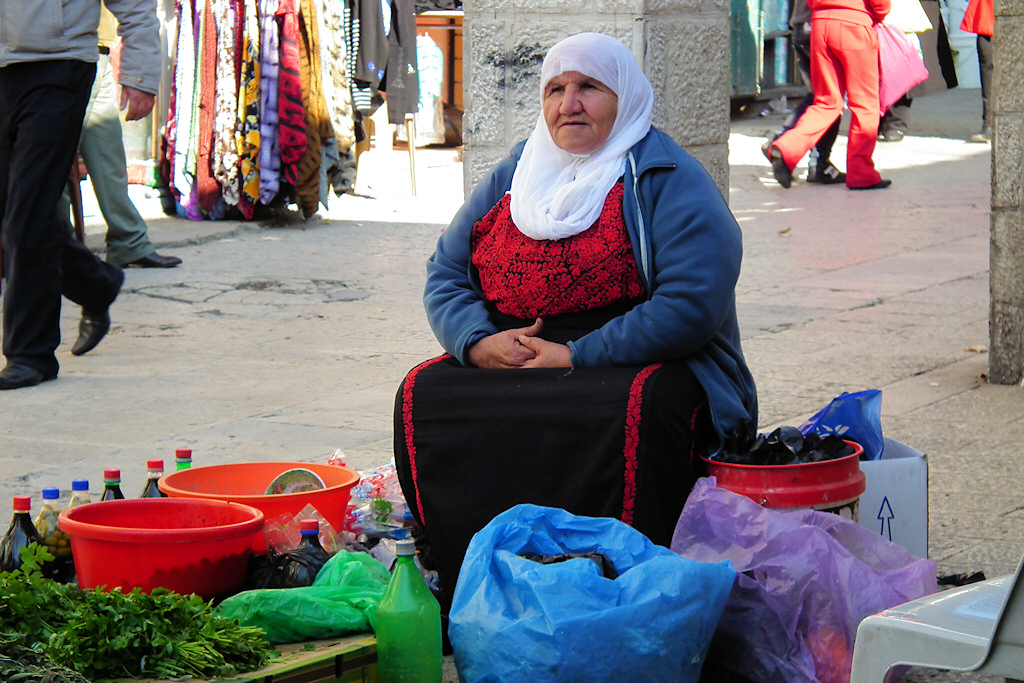
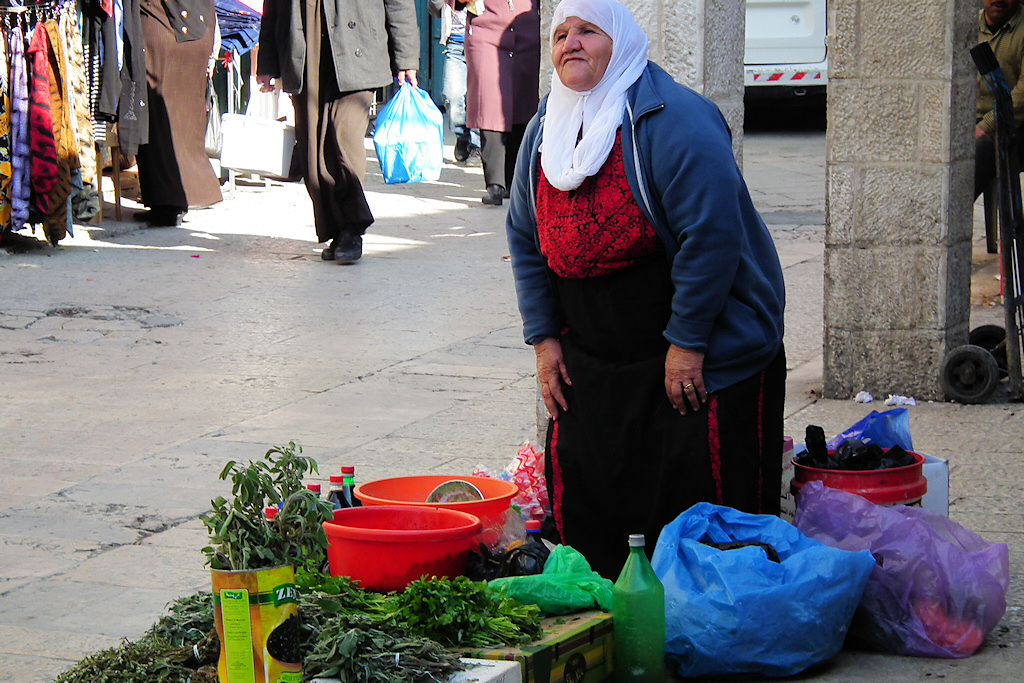
When shopping I went to an old lady I visit regularly. She has a small stall on the streetside in the Old Town. By stall, I mean a stool and a few boxes and bags. She sells herbs and figs. She’s a lovely old lady, clad in her embroidered traditional dress. She walks into town daily with her husband, who leads their donkey, which carries the herbs – then he returns home to work on the land, and he comes back to pick her up later.
Palestinians are big on herbs – they have mint or thyme in their tea and they eat parsley, sage, coriander, spinach and chillies copiously. I buy my herbs from her – big bunches of them, far too big to use on my own, for 1-2 shekels per bunch (20-40p in British money). She likes her pet Englishman. She eyes me closely when she thinks I’m not looking. I think she knows intuitively that I’m roughly the same age as she is, except she’s an old woman and I look younger – apart from a rather wrinkly face which has clearly seen some things. She hasn’t figured me out yet. Life wears out Palestinians.
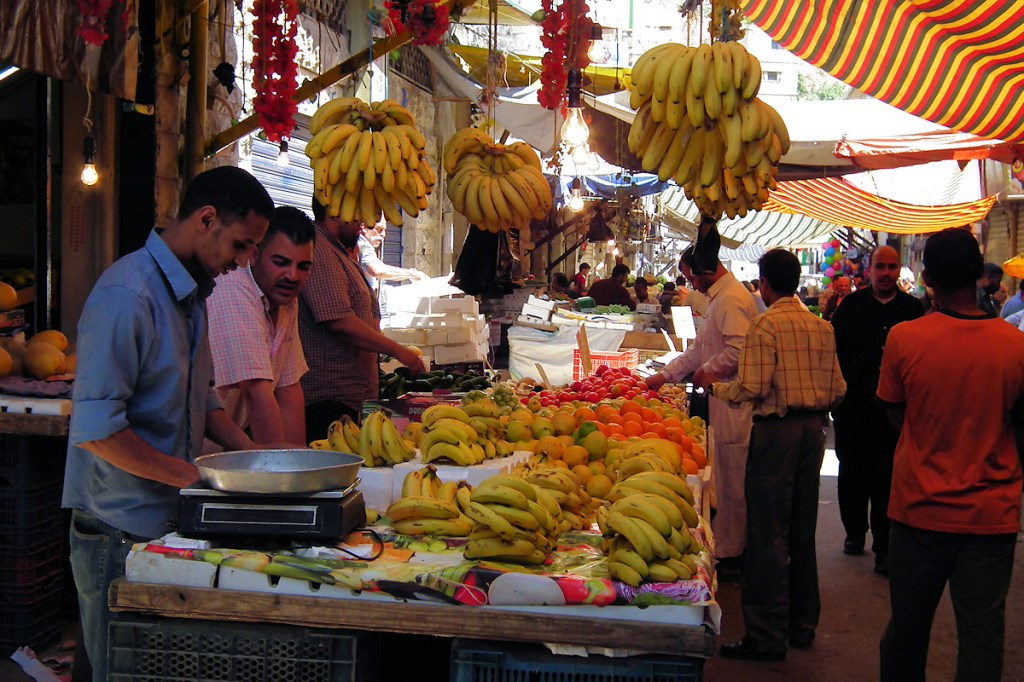
Then I went down to the market to get vegetables. Two stallholders were trying to steal me off the stallholder I usually go to, but he has the best vegetables. One thing many Palestinians don’t quite understand is this. They tend to think one is obliged to shop with them out of a duty to support them – after all, fair’s fair, isn’t it? Well no, I’m a Westerner, and I go for the best stuff and the best deal. Sorry about that. Also, annoyingly, I buy things only when I need them.
The souvenir shopkeepers down in town think similarly. I’m a Westerner, therefore I have money, therefore I ought to buy from them. Not so. I buy presents only because there are people I know and love to whom I wish to give things, and I buy specifically for them. There’s also the question of how to get it back to England, so I cannot buy much. I’m not a buying machine – well, at least, not in my own head.
Dear reader, this might seem elementary, but it’s not so for Palestinians. This is a walled-off cooperation and mutual-support economy, an economy where everyone depends on everyone else for keeping each other alive, so the emphasis here is on supporting your fellow citizens by trading with them, to some extent whether or not you need what they’re selling.
Nevertheless, when one of the traders, a young chap of seventeen who helps his elder brother run a shop, moaned to me today about having no money to buy schoolbooks, I took pity on him. He had said there had been no business today, and he needed 50 Jordanian Dinars (250 shekels or £50) for the books tomorrow. He was worried and depressed. So I wandered off to do other chores, including raiding a bank machine, and slipped him 50 JDs on the way back. He lit up and hugged me, shedding a tear. Now he could get his books.
I told him that this is a life-lesson we all need to learn: solutions often come when you’ve given up. When you give up, it means you’re opening up to Allah, handing over your problems since you couldn’t solve them yourself. This money is a gift from Allah, through a random Englishman. So give thanks to Allah.
“You are a good man, Mr Balden. I pray that Allah, he will pick you up when you have a need.” Well thanks, I might need your prayer to come true one day. This young Palestinian, poor yet intelligent, has better English than some of the 17-year old Brits I know. Good luck to you, mate – I sincerely hope you get a future.
————————–
My three Palestine books are: – Pictures of Palestine (in print and as a downloadable PDF) – Blogging in Bethlehem (an audiobook and PDF) – O Little Town of Bethlehem (PDF only) Available here: http://www.palden.co.uk/pop/order.html
It’s amazing to be part of a revolution – even if it’s temporary. The relief of getting rid of an oppressive regime creates an expanded nowness, a special moment of intensified significance, before the serious stuff that follows inevitably sets in. There’s a shedding of a deep sense of social burden and self-suppression, of unwilling, shoulder-shrugging complicity with something that few were happy with. In Syria, those who took the regime’s side did so because they saw it as the lesser of two evils, or they made a living or gained advantage through it.
But when the cork pops, a deep collective-emotional eruption bursts out, spreading like wildfire around the country, even spreading around the world. It reminds people everywhere, on a deep, hardly-conscious level, that it is possible to change things from the bottom up, that society has power.
It’s also emotionally tragic to be part of a failed revolution – a dashing of hope and faith, a reimposition of fear and oppression, a paroxysm of despair. It can crush spirits. It nearly did so with me – I was part of flower power and a student uprising at the LSE in London – but after a lot of pain and process the experience ended up making me more resilient.
Forty years later in 2011 in Amman, Jordan, I met some Egyptians and Syrians, fresh from their uprisings, proud and uplifted to have been part of them, yet fearful. They were in Amman because they had been chased out of their own countries, regarded as dangerous. The repression of both uprisings had polluted the joy and impetus of revolution, and these guys were vexed about what to do.
I told them that, in the case of the uprising I had been a part of, though we were beaten and broken, the flowering of issues and dynamics that emerged during that short yet long time had withered but not died. It re-emerged slowly over the years, filtering in through society’s back door. Those of us committed to change had continued quietly, developing our green ideas, healing methods, lifestyle changes, music, feminism, back-to-nature instincts and our psycho-spiritual transformations, and it was a all matter of time before these infiltrated wider society – and it still is. Here I was, four decades later, still here, still working for the change I believed in.
I reminded them that change is deep and it is not truly fulfilled by a revolution, which merely clears the way for whatever happens next. It would take time and it would be difficult, but the lava-streams of change would work under the surface, seeping out or erupting over time and over the generations. What makes the spirit of revolution survive, like a dormant seed buried in the soil? Well, whatever its faults, it was essentially right, and it constituted the direction that humanity needs to follow. History takes time to unfold, but time is on the side of change. The issues that bubble up in such change-moments are bigger and more historically-transformative than we often see at the time, and this process takes time. For me, in late life I’ve come to accept that it can take longer than a lifetime.
Now, in Syria, here we have it – the consequences of 2011. The Syrians of the Arab Spring are 12 years older and a new generation has grown into adulthood. Media outlets round the world are wrong to harp on about terrorism and Al Qaeda – they don’t see where the true roots of this lie. They suspect Islamism of malign, threatening things, when Islamism itself is simply a philosophy and social reform movement, the behaviour of which depends very much on the people doing it.
The Taliban in Afghanistan, while dominated by old Muhajedin fighters from former decades, is also stocked with thoughtful, pragmatic, younger and more travelled people who will inherit the reins. Hamas in Gaza was far more (as it goes) progressive, liberal and socially competent than outside commentators and their paymasters wish to see, and the Israeli killing of Ishmael Haniyeh a few months ago, Hamas’ leader, meant the loss of one of the world’s better political leaders. In my humble opinion.
When so-called terrorists have a constituency of local support, and when they are fighting on their own turf for the liberation of their land and people, they are freedom fighters. Terrorists lack empathy, caring little for the people they live amongst, their agenda is geopolitical and ideological and their method is to use violently dramatic actions to create fear and terror, to scoop up media attention. One well-executed bombing can set the world on edge.
HTS is not a terrorist organisation and neither are most of the other militias in Syria (though one or two might be). Other countries would be wise not to oppose or obstruct the new regime – though perhaps it will need moderating with sweeteners. The uprising in Syria is locally-driven, in distinction to the ongoing conflict in Syria since 2011, which has been a viper’s nest of external intervening powers, influencers and financiers. Now their influence is weakened, withdrawn or undermined.
When I went there in 2014 there were about seven sides to the conflict and it was terribly confusing. I went briefly to Deraa and Yarmouk Palestinian refugee camp outside Damascus. Since it was likely that I’d be thrown out of Palestine by the Israelis, under suspicion, and banned for at least ten years, I felt a need to do something else. When asked to visit Yarmouk by a Palestinian tribe with refugee relatives in Syria, I decided to help them, as a kind of courier and emissary.
But it finished me off. Things happened that deeply affected me. Perhaps also I was in denial,lready feeling burned out, with elements of PTSD accumulated over previous years. But this finished me off. I lost my hope and patience in Syria, afterward feeling lost in a smothering cloud of dismay and disappointment. It was the last humanitarian mission I did. I wasn’t happy about that. But life had other designs.
I spent the following years on a self-healing path in Cornwall, doing remote humanitarian work (such as with the Tuareg in Mali), prehistoric research and walking the cliffs and moors. A loving relationship from 2016 to 2022 brought me back to life. Only when I went down with cancer in 2019 was I healed of the clamping shadows I had been struggling with – they were subsumed by the prospect of death, which prompted an enormous inner let-go of all and everything, bringing something of a spiritual breakthrough and a rapid process of forgiveness of myself, others and life.[1]
This is deep stuff. When, as an individual, you ‘lose your fear’ and come out into the streets in an uprising, you align with a collective tidal surge of vision, emotion, ideas and spirit that feels truly like a springtime, a release. All sorts of amazing things happen. People come alive, emerging out of the woodwork, progressing a long way and finding a new mission in life. People’s lives change in bulk, and a rising tide of hope lifts up even those people who normally are sunk in a life of drudge, stuck in a state of reluctant complicity. The splintered social dissonance that allows oppressive regimes to gain and hold power melts away, and there’s an eruption of resonance, mass concurrence and shared wishes. This resonance-field fizzes and sparkles, motivating people to do quite remarkable things.
But it all depends on what happens next. It depends on the new leaderships that take power and, even more, on the wisdom, patience and fortitude of crowds. Once the change happens, eveyone wants normality to be restored – the economy, public services, reconstruction, and freedom from excessive and unnecessary obstructions in daily life – though this is not simple and fast. After the joy of change, there’s a lot of hard work to be done.
The wisdom of crowds… this is a delicate matter. After regime change in Sudan, the democratic movement did quite well for a time. There was a maturity to the way that people dealt with their tender democratising situation after a long period of dictatorship. But it was delicate, involving a lot of mutual trust, and there are people who manipulate unstable, transitional situations to their own advantage – they can act quicker and more decisively than collectivities of people. They have a contrarian need to break the magic ring of mutualised social power, aiming to restore public dissonance at any cost. In Sudan, it became a slugging match between two oligrchies, each headed by generals, each supported by different outside powers and financing. The democratic movement was killed off, tragedy ensued, and it continues today. Most of the world isn’t interested. Hope is not currently available in Sudan.
Ten years ago I was involved with a small group called the Flying Squad.[2] We did geopolitical healing work and, by 2014, the group had been working together for sixteen years – so we had some experience. It involved a weekly group meditation, wherever we were, and three or four weekend meetings each year – and membership involved committing to 100% presence and involvement in all meditations and meetings, to take group synergy to a higher level.
We did a lot of work with Syria and its uprising and civil war, even travelling to Greece to get closer. There were times when we felt we were getting somewhere in our efforts, but each time a new set of events would re-ignite the situation and make things worse – often prompted by outside intervention by state and non-state actors. Were we getting things wrong? Or was this simply an intractable situation?
This was a big learning. As a planetary healer, you have to learn and accept that sometimes it doesn’t work. There was a point where, in our inner investigations, we discovered an enormous ancient telluric ‘worm’ or dragon in the Euphrates valley in Syria and Iraq, and it was deeply upset. We tried to ease its concerns and help it clarify its aims – it was deeply unhappy about the fighting, oppression and oil extraction in its patch. After we did this work there was indeed a brief pause in events, providing a glimmer of hope, but it soon was dashed by new developments.
We had to learn that there are some things you cannot help. The reasons often emerge later, even years later. Sometimes we can be too restless, short-termist and attached to immediate outcomes. It’s unwise and even egocentric to expect results, just because you feel you’ve put your heart and soul into it and, by rights, it should work. But there can be reasons why it doesn’t work. The idea of creating a ceasefire in Gaza, for example, while desirable, doesn’t actually resolve the problem and its causes, and it might not bring a fundamental healing of a bad situation.
Deep down, countries like Syria and its neighbours are developing a social immunity to conflict and oppression. This is at street-and-village level, and it’s a semi-conscious thing fermenting underneath. The key mechanism is that a society must reach a level of exhaustion with war and oppression, to the extent that it firmly and behaviourally no longer permits it. Society stops responding to the methods that oppressors and warring factions use to divide people and set them in fear. This is pretty much the case in Lebanon nowadays – they’ve had enough of strife, havig been through many decades of it.
The seat of such social power rests a lot with women: if women collectively no longer accept a bad situation and are tired of going along with what men are doing, the violence ends, sooner or later. It’s a buildup of firm and settled emotional consensus. This was one of the key dynamics of the peace that came to Northern Ireland in the 1990s – women put pressure on men to make a change. They just stopped making sandwiches for them and washing their underpants.
There’s another force at work that generates this immunity. After a while, everyone just wants to go home, sleep in their own bed, be with their family and feel safe. This is another rather feminine feeling. When fighters get tired, conflict ends, somehow. It’s a deep tiredness with the privations and dangers of war and oppression. It’s what made the Syrian soldiers recently melt away as the militias advanced – they were fed up. They’d lost the sense of purpose that soldiers need to have if they are to put themselves in the way of danger.
So we now have a full-on situation in Syria. A lot hangs around the international community and the way it responds. A lot hangs on leaderships and their behaviour. A lot hangs on social solidarity, forgiveness of the past, de-corruption and a buildup of trust and integrity in society.
We’ve had a lot of failed uprisings in recent times – in Myanmar, Belarus, Hong Kong, Iran, Venezuela and Sudan – but something has recently changed. Astrologically, Pluto has moved from spending 16 years in Capricorn – a sign that generally hangs on to stability and convention and doesn’t like change – to spending 20 years in Aquarius. The emphasis has shifted from the prevalence of governments and institutions to the prevalence of crowds and public attitudes.
There is a possibility here of a real turning of the page. Not just the replacement of a Captagon-driven, oppressive narco-regime with an Islamist one, but also a change in Islamism itself, and a change in the behaviour of the public. All over the world, the style of governance of countries has come into focus – both democratic systems and authoritarian regimes are in trouble, and people at the top no longer sit securely in their seats. We shall see.
I’m wondering how the Palestinians in Syria (around 450,000 of them) feel about all this. Assad had treated them well, in comparison to many other countries, so they were grateful for that, but the Palestinians could not accept his violent response to the 2011 uprising, and this put them in a difficult situation. Palestinians do not like Muslim extremists either – Al Qaeda or the Islamic State – and in the last twelve years of instability they have come under attack from various directions. I hope they’re feeling some relief today.
This has stirred me quite deeply and personally – helped by the winds and storms raging here in Cornwall in the last two days. It’s a glimmer of hope. It reminds me of the Iranian Revolution of 1979. At that time I was contemplating suicide – the only time I’ve ever felt that feeling. I felt blocked by life from every direction. Everything seemed to be going wrong. But, on the weekend when I might have done it, the Iranian Revolution happened, and this suddenly gave me a spark of hope. It went bad soon after, but on that weekend it looked as if something quite big was changing. I forgot suicide. For me, amidst a dark night of the soul, it was a turning-point: my soul was asking me to make a big and deep commitment to my life’s work. It involved the end of a marriage, the loss of my children and a return to Britain after a time of exile in Sweden.
It was the beginning of a new path in life that brought me to where I am now, affecting thousands of people along the way. For better or worse, that is, since there are times when I’ve screwed up too. However, the posterity-perspective of late life seems to be telling me that it was, on balance, positive. Just above my desk is a Healing Buddha with a little sign at its feet which says ‘Time is a Healer’. Well, yes, though it’s also a decider, an accounting, a process of judgement by posterity. We ourselves can only make an accounting, but time, the wider world and other people judge the balance of benefit our lives have brought.
The same goes for revolutions and regime changes. The Assad and Makhlouf families and the deposed Syrian oligarchy have a lot of accounting to do, and history is unlikely to be sympathetic – as with Saddam Hussein, Ghaddafi and possibly, in future, Netanyahu. Together with many others, too many to name. But, in our own smaller lives, we face an accounting too since many of us are guilty of a shared crime that also needs to end: to quote 18th Century philosopher Edmund Burke, ‘For the triumph of evil it is necessary only that good people do nothing‘. That is a crime we all variously have a stake in.
However, here’s something. We need to be careful about the way we label some people as goodguys and others as badguys. We get dictators because we didn’t stop them coming. So, instead of focusing all the blame on them – or all the Trumps and Al Fayyads of the world – we ned to remember to look at our own part in the equation. As old Jesus once said: ‘Let the one who is without guilt cast the first stone‘.
The building of social capital and the amassing of power to the people involves a lot of deep forgiveness.
Twelve years ago I wrote a piece in one of my Palestine blogs about the British period of occupation of Palestine. For some of you, it might throw some light and perspective on how this mess in the East Mediterranean all started.
This morning I fell upon it and it struck me that it might be useful re-posting it now.
So, if it interests you, try this (it’s a five minute read):
It’s a chapter from one of the three Palestine books I wrote back then. This chapter is from ‘O Little Town of Bethlehem‘, a book that hasn’t been published in print but it’s available as a PDF, as is ‘Blogging in Bethlehem‘. ‘Pictures of Palestine‘ was published in print though. They’re all available through the PoP site.
It’s funny. Having cancer has been a bit like a fast-track course in spiritual transformation. Well, on good days, and if I choose to see it that way. Perhaps it’s the down-payment for this course that makes a big difference: it’s not about paying money, it’s about giving up your life to a fate you have little control over. If you’re going to gain anything from the cancer process, you have to offer up your life because something greater is making the critical decisions and you are to an extent helpless. Higher powers are taking over. HP Source is placing a call.
Yet a gift can come with it: a certain strength underneath, arising from the fact that you could pop your clogs tomorrow. Or the next day. Or anytime. There’s little way of knowing. Which makes planning tricky: you have to have fallback strategies in case the preferred option – regularity and a longer life – doesn’t work. Every day plans B and C have to be treated as equally likely probabilities. Some good soul takes me out and, half-way through, I can’t handle it and need to lie down or go home, flaked out, batteries emptied. Plan B strikes again.
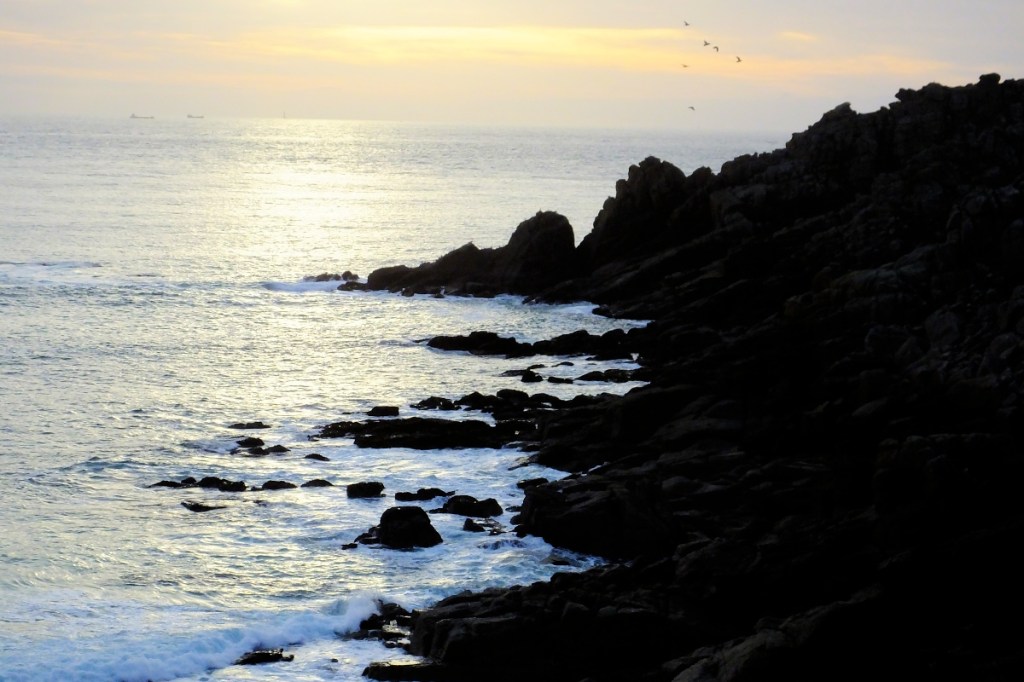
Recently we’ve had a lot of sea fog. West Penwith, right at the end of Cornwall, is where three sea-masses meet, from the English Channel, the Atlantic and the Celtic Sea, and their swirly interactions, plus humid air from the tropics, at times make for lots of fog. So we’ve had white-outs. The world disappears – recently, for days on end. It has been rather a struggle: I’ve been ‘under the weather’, literally. Stuck in my reality-bubble, rattling the bars of my cage. I’m obliged to deal with myself, and my shadow keeps following me around.
Yet where there’s fog, clarity can come. I found this a few years ago when I had two years of fatigue and brain-fog. Behind it was a gift, an imperceptible, emergent seepage of clarity. Things came back into focus after what seemed like a long time lost in space. Something similar happened this morning. I had a realisation, waking up at dawn to find that the fog had cleared and it was going to become a golden morning.
Neptune seems to be at work (I’m emerging from six years of Neptune transits), surreptitiously peeling off multiple layers to reveal things underneath that seem new and revelatory, yet they’ve been there all the time. It’s all a matter of seeing – and of curtains and the opening thereof. What’s behind the curtains was always there, yet it’s not there until we see it.
This is a key element in the building of the Great Illusion. We fail to see what’s actually there. Yet one of the strange gifts of life is that things such as serious or terminal illness, or other earth-shattering shocks, losses, disruptions and hard truths, reveal to us things that were always there – or perhaps visible if only we had looked ahead. We manifest them unconsciously.
Major illnesses and life’s hammer-blows derive from the unconscious, from the places we don’t see or want to see, and from the stuff we’ve tamped down or avoided. A lot of this is to do with memory – not just conscious memory of events and experiences, but emotional scars, body-armouring, touchy spots and no-go areas impressed on us through earlier-life traumas or repetitive experiences that we don’t want to remember, or we have needed to forget. But sooner or later they come up anyway.
This is what the Israelis fail to see, in their war with Gaza. By devastating the lives of Gazans they’re feeding gallons of trauma to over two million people, many of them young. This will produce a predictable crowd of new ‘terrorists’ (freedom fighters) in about 10-15 years’ time, though it will also yield a crowd of new saints – true peacemakers who have seen through the destruction game, even though they were on the losing side. Those saints could be more deeply confronting to future Israelis than fighters, because fighters are the same old thing while peacemakers in large numbers will not be easy for Israelis to deny or gainsay.
It’s exactly five years since my back cracked and my life changed in my former partner’s back garden, while clearing some tussocks and piling up logs. Three months later I was diagnosed with bone marrow cancer and, since then, life has been very different, in all sorts of ways. I used to be a night-owl and now I’m an earlybird. I used to have a really good stomach and now it’s a problem (Saturn in Virgo). I used to be a really good driver and now I cannot drive a car (Sagittarius rising and Moon in Gemini). I used to be fit and now I’m an old crock. The details are many. A lot has changed.
Something has been troubling me, and this morning I understood it, thanks partially to the clearing of the fog. I understood a contradiction in myself, and where its roots lie. It’s this: although my attitude to life has strengthened as I’ve got to grips with cancer, and it’s quite strong, and it protects me, I’m also much more vulnerable and affected by things, physically and emotionally, than I once was, and this weakens me, making me a bit like a leaf in the wind.
Many of my defences, insensitivities and fallbacks have disintegrated, and small things make a bigger impact than before. Several times a month, especially when out on walks or expeditions in the wider world, I have to go into ‘survival mode’ – a gritty ex-mountaineer’s approach to getting back home, regardless of how I feel or however worn out I am. I stagger on, running on two cylinders, totally focused on hanging in there, keeping my energy moving and getting home.
It’s an act of faith and against-the-odds, Mars-in-Scorpio determination – though in other contexts, some see this resoluteness as stubbornness. But it keeps me going and gets me home – or, at least, to the welcome car seat of whoever has taken me out adventuring.
It gets tricky, though. Quite a few people say I look really well when, underneath, I’m feeling like a turdy morass of aching, creaky detritus. I guess it’s one of the side-effects of handing my life over, to be propped up by spirit more than ever before. It can create a funny kind of deception since dealing with adversity can sharpen and brighten my spirits, even if adversity is grinding away and slowly eroding my sometimes tenuous grasp on life. Yet that vulnerability can cause a marshalling of energy that helps me through. It’s mind-control really.
The secret lies in activating levitational forces through staying focused and subscribing to positive thinking. Not the self-delusion or self-persuading wishful-thinking that denies pain and hardship, desperate to see things through rose-tinted glasses, but a deep conviction that all is well and it really is okay – even when you don’t know whether it is okay or when you don’t feel at all positive. This is not a conviction of the brain but a calm certainty of the cells and bones.
Psychologist Jean Piaget once said that intelligence is not about about what you know, it’s about what you do when you don’t know. So, when I’m faced with difficulty – I’m cold and wet, people are talking too long and my back is killing me – I’m faced with a choice. I can either have a hard time, grinding away through my pains and difficulties, or I can allow it to be as it is, accepting that the right thing is happening and it’s okay and I’ll get through it somehow. That’s the difference between gravitational and levitational thoughts and beliefs.
There are times when even this doesn’t work and I just need to lie down and give up, realising that I’ve lost the battle that day. But it’ll be okay in the long run, somehow. Inshallah, ‘if it is the will of the God’.
And if it isn’t, that’s okay too. Because everything comes for a reason. Seeing that reason can sometimes take time, but it’s quite safe to assume that it is something to do with the education of our souls. Now this is quite a belief-transformer. It changes good and bad, success and failure, ease and difficulty into something else. All experiences are fodder and vitamins for the soul, if we see them to be so.
Including dying – which all of us are irrevocably destined to do anyway, somehow, sometime. ‘Life’s a bitch, then you die‘. They didn’t quite tell you that when they called for volunteers for the Planet Earth experiment. However, they needed volunteers since, having gone along the path of overpopulation, we need to experience its consequences quickly so that we learn that lesson and get it over with. And the extra hands on deck might even persuade us to realise we are one planetary race, all stuck on the same boat and desperately needing not to rock it too much.
I realised this, about fodder for the soul, three years ago. I asked myself what I would be doing if I didn’t have cancer. The straight answer that came up was, “Just carrying on…“. I would be ticking over, continuing with everything I had been doing beforehand, and letting the clockwork of my life slowly run down. I would not be having the cancer experience which, despite the cost, the loss and the pain, had given me a new and completely changed chapter of life and a bizarre kind of spiritual boost that I hadn’t quite anticipated.
We all have to square with death sometime, and a cancer diagnosis (or similar) certainly brings that on. Many cancer patients avoid it, leaning on the medical profession to save them from facing death’s hungry jaws, and thereby delaying doing the spiritual spadework that will stay on their bucket list, whether or not they like it.
Our culture, believing we have only one life, regards death as a failure and an ending, repeatedly saying “Sorry for your loss” to the bereaved as a regret-laden default response. But actually such an attitude protects people from contemplating death, and it’s detrimental, and it costs our medical systems billions. As a culture, we’re shit scared of something that’s perfectly natural. We do this with birth too.
From clinical death onwards, a person is regarded to exist only as a memory, a reputation or a legacy, not as a person or a soul. Ashes to ashes and dust to dust – hmm, what a materialistic statement. In truth, home is what we on Earth, at a stretch, would call the Otherworld. Here on Earth we’re in foreign territory – we’re colonist occupiers, believing we own the place. Well, no, it’s not dust to dust but Heaven to Heaven, with a dusty, earthly interlude in between. During our waking hours, at least.
Earth is a dangerous place because it kills us eventually. Yet we can make the best of it. We live in parlous, vexing times, and the world coin is spinning in the air. We’re in a battle for the hearts and minds of humanity – or for what’s left of them, after all that people’s hearts and minds have gone through in recent times. We’re entering a phase that I wouldn’t exactly call decisive – that comes later, in the late 2040s – but I would call it informative, revelatory, creative and critically developmental. Laying the tracks for the next bit, up to 2050.
Informative in the sense that we’re entering a period of seeing, re-framing and discovery in the late 2020s, amidst a torrent of events that are placing many big questions on the line for us to confront and sort out. Critical developmentally because a lot of new stuff is likely to emerge, and many old realities will fade into obsolescence. We’re moving fast down some intensifying rapids, and it’s risky and dodgy. Yet by 2030 we’ll have moved a long way, probably without really realising it.
Astrologically this is something that doesn’t happen very often. The three major outer planets, Uranus, Neptune and Pluto will be co-thrumming for a few years, and the formation is shaping up now. When a thrum starts up, dead matter gets shaken out and new patterns take shape amongst the strengthened resonance fields. In the next few years Uranus in Gemini (shifts, flips and reversals of ideas) will sextile (60degs) Neptune in Aries (strong individuals and either inspired or mad initiatives), which is sextiling Pluto in Aquarius (crowds, masses, majorities, tribes and matters of belonging). A trine (120degs) links Uranus with Pluto, making a triangle.
This thrum and resonance, this signal-resolution, will shake many things through and sound the bell. It could be called ‘cultural florescence under distress’. It’s in its pre-rumbles now, and a lot is likely to happen in the next 5-6 years. Not so much dramatic events, though we’ll still get these because we do need shaking up, but a strong torrent of developments. Developments where we wake up one day to realise that a lot has suddenly changed, while we were busy doing other things.
As in ‘Life is what happens when you’re busy making other plans‘. I’m reminded of my aunt Hilary, who was closely involved with Alan Turing at Bletchley Park: they thought they were deciphering Hitler’s codes, and they were, but they’ll be remembered by history for playing a key part in the invention of the computer and the early conceptualisation of artificial intelligence. What we believe is happening and what is actually happening can be quite different things.
The last time we had something similar to this triangle was around 1771. A lot was happening in terms of new inventions (steam engines), social change (urbanisation and industrialisation), ideas (technology and the Rights of Man), empire-building (the taking of India) and the emergence of the modern world, but it hadn’t quite gone critical – it was progressing fast and heading toward a series of critical junctures that went from the American Revolution of the 1780s through to full-on industrial revolution by the 1820s. The modern world was emerging fast – with its dark satanic mills, globalising tendencies and humanity’s departure from its agricultural past.
So, unfasten your safety belts: they are attached to past knowns. Keep the anchors down and you won’t go with the tides.
I had a cricket for a teacher yesterday. It had hopped into my house the day before and I’d heard it rustling around all evening. I was unable to find it – they hide in corners and move only when you aren’t there. It went quiet next day and I thought it had died – I’d probably find its shrivelled corpse sometime. But, half way through the morning, it hopped staight onto my left shoulder! Having the sudden arrival of such a primeval critter, bright green, weird and three inches long, rather surprised me, making me jump. It hopped onto the head and shoulders of a nearby metal Healing Buddha who looks after my kitchen. And it looked at me, intently. And I looked at it.
The cricket was asking me to liberate it. It didn’t know how to get out. It addressed me personally, knowing I was probably its last resort. Now that’s intelligence. I have a jar for such occasions, since I get a number of insect and bird incursions. I managed to place the jar over the cricket and a card underneath, taking it out and depositing on a young oak tree I’m growing in a pot. Ah, freedom. Try not to do it again, Cricket!
It rather touched me that it had demonstrably asked for help. This had happened once before, a few years ago, but I didn’t quite believe it then. The cricket communicated well and got the help it needed, from an alien species – me. Thank you, Cricket, for your visit. You taught me about inter-species communication across language barriers, and ways to ask for help.
Weakness can lead to a new kind of strength. It’s the strength of despair, of dread, susceptibility and weariness. Some of the greatest of guiding intuitions can arise at such points. It’s a cards-on-the-table thing. There’s something to learn here from the people of Gaza. The poignant, painful paradox they present to the world is shifting global attitudes, deep down. They’re making a sacrifice for humanity. This kind of devastation – worst in Gaza but happening elsewhere too – is up on our screens presenting an important issue that needs sorting out. What lies beneath and behind this is an incremental shift of power from the rich minority to the world’s vast majority in Asia, Africa and South America.
It isn’t announcing itself as such, but this is what’s happening, and we’ll realise it after it has already happened. There’s further to go on this question but, before long, inshallah, it will no longer be possible for oligarchies and their armies to impose such destruction on the world and its people. That involves an historic change, affecting lots of things. And it’s the kind of surreptitious shift that’s happening in the next few years, methinks. And God bless the people of Gaza, for what they are doing for the world.
The cricket made a leap of faith onto my shoulder, and it found salvation. I’m learning more about leaps of faith. It seems to me that gifts of grace are the one of the fruits of leaps of faith.
And guess what. As I finish this blog there’s some rustling amongst the muesli packets on the shelf in my kitchen – it’s another cricket!














 Notes from the Far Beyond
You must be logged in to post a comment.