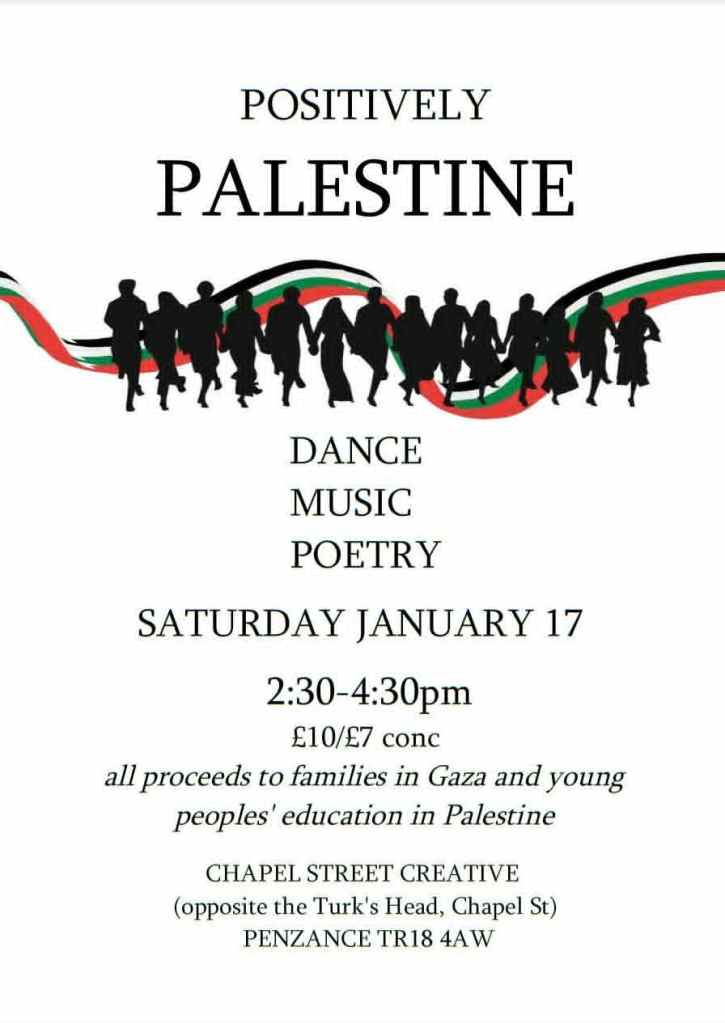
This is a short talk I gave recently in Penzance, Cornwall, during a Palestine-support event.
Many of us get caught up in the big issues around Palestine, often paying a lot of attention to our own countries’ or international politics and inadvertently forgetting actual Palestinians in places like Gaza. Anyway, the politics is a nightmare that’s going nowhere anytime soon.
This is about making friends with an actual Gazan, taking a person-to-person approach. It can have a bigger effect that you might at first imagine. And the friendship and benefit goes both ways.
In the talk I recommend a website run by Gazan young people: www.wearenotnumbers.org – check it out.
Thanks to Gershon Baskin of Jerusalem – a good-hearted Israeli – for a quote from his recent writing. Well done Adam Stout and Alison Dhuanna for organising the event – and thereby raising 600 GBP to help a few Gazans.
A correction: to get out of Gaza costs $5,000, and it is paid to the Egyptians at Rafah Crossing, who pay the Israelis, and both take their cut. It’s just as bad, whatever the excuse and whoever does it – exploiting people in need.
With love, Palden
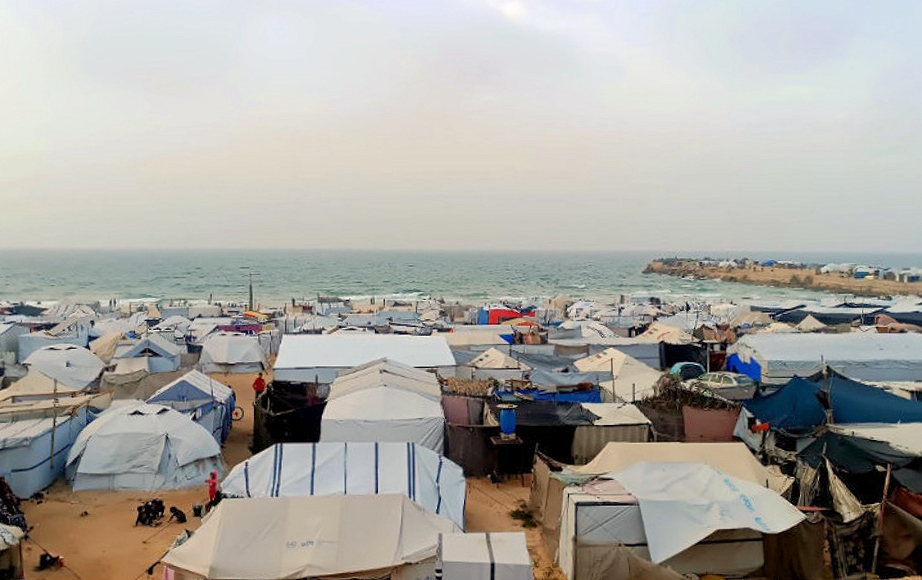
By the seaside. Photo by Refaat Ibrahim of wearenotnumbers.org
I’ve always been an optimist, deep down inside – a Jupiter in Pisces type. I’ve felt this underlying optimism ever since I was young – not rigidly, but because I keep coming back to it after periodic times of despair over the state of the world, to which, for my growth, I’ve been karmically tied all my adult life. It’s over fifty years since John Lennon sang, outrageously at the time, that we should give peace a chance. I cannot say there has been a lot of visible progress.
However, underneath, something has changed. Many of the ideals of 50-60 years ago are in fits and starts becoming pragmatic policy strategies, and the balance of opinion at street and village level across the world has over the years quietly tilted against war. The strength and clarity of this consensus is yet to be tested, but hints of it are visible in world opinion over Gaza. We’re approaching that test.
Hair-raising world situations and crises have a way of arousing public feeling to a sufficient extent that a mountain of inertia, of helpless addiction to conflict, could actually start moving before long. Ukraine and Gaza have jogged us that way and there’s further to go. Trouble is, a consensus often takes shape in the background while vested interests act more quickly. This formula worked when Pluto was in Capricorn, from 2008 until now, but things are changing. With Pluto in Aquarius, we’re likely to have situations arising where vested interests find themselves encircled.
Polarisation, demonisation and dehumanisation are pre-requisites for conflict, and here the media and social media play an outsize role. If we truly believe in peace, then these three issues need tackling inside ourselves.
The information war is now as important as the military war. Since social media appeared, Palestinians have had more of a level playing-field. In the last conflict, young Gazans won the info-war on points, and this is one reason why Gazan phone networks are disabled now. Israel meanwhile fails to realise that, apart from military overkill, its determined, uncompromising certainty in pursuing its cause undermines it in the eyes of much of the world.
We’re getting too accustomed to witnessing blood sacrifices. We live in a thoroughly amoral world system and, collectively, by omission, we have failed to stop them happening. The system is rigged in such a way that, though we might choose peace, justice and ecological priorities, we undermine them simply by shopping at supermarkets, driving cars and using phones and computers.
I keep repeating Edmund Burke’s 250 year old quote: “For the triumph of evil it is necessary only that good people do nothing“. It’s true.
So we get the cruel destruction of people, cities and landscapes in ‘theatres’ such as Syria, Ukraine and Gaza – hellish nightmares that everyone hoped we’d left behind long ago. We’ll get more of this unless there’s a fundamental change. Such a change might start happening in the second half of this decade.[1] But, as with many of the world’s key issues, it won’t just happen. It has to be pushed, firmly and consistently.
It’s important that this pressure for change doesn’t become a new social conflict, a new cause for social and political polarisation. Battling over it will lead to delays and complications we can’t afford. The movement for peace needs to avoid adopting the methods of war and confrontation: success comes through building a rising tide of solidarity, consensus and cooperation. It needs longterm commitment and mass momentum, and if it is to succeed, the people of Earth need to get behind the project of saving our world. Global peacebuilding is a key part of that.
In relation to the current conflict in Is-Pal, taking sides is understandable, yet it is part of the problem. The problem arises from polarisation itself, not from the perceived goodness or badness of either side. What is under-reported here is an indistinct but nevertheless a majority global consensus tilting against war and devastation, by anyone, against anyone and for whatever reason.
The destruction we’ve seen in Gaza, Mariupol (Ukraine) and Kobani (Syria) in recent years have nudged this sleepy consensus along. Humane empathy is bubbling up in collective consciousness, especially amongst the young, the power-holders of future decades. But is it strong enough to overcome the resigned belief that conflicts are an unavoidable yet necessary evil?
Behind this lies a bigger problem. Governments of all kinds are out of step with their people. Defence and international relations, even in democracies, are managed by godfathers who decide the ‘national interest’ on our behalf. So, in future, matters of war and peace boil down to a bigger question: who decides?
Majorities in the Global South and also the Global North are proving to be pro-people in attitude. Current wars have taken on a people-against-the-Megamachine optic: we see high-tech war machines ranged against crowds and communities of people, mowing them down. With Pluto entering Aquarius for the next 15 years, this meme is strengthening – we’re watching it happen in Gaza.
Here’s an astrologer’s warning. From 2025-6 until 2038 Neptune is in Aries, an awkward period in which we’ll be faced with a key cause of war: big guys and strongmen who take it upon themselves to determine our future, often at the expense of majorities.
In Sudan we see a country being wrecked by two competing military leaders and their oligarchies. In Ukraine we see two very different kinds of strongman ranged against one another – Putin and Zelensky. In Israel we see a remarkably cynical prime minister taking on the whole world, convinced of his own rightness. In Gaza, Hamas is a resistance movement which, though it has its prominent leaders, is more horizontal than a hierarchy – more like a cooperative and rather like the Jewish terror organisations of the 1940s, Haganah, Lehi and Irgun.
Hamas will never remove the state of Israel, and they know it (they aren’t fools): Israel is here to stay. So are the Palestinians – here to stay. Israel will not eliminate Hamas because, even if it kills most of the current Hamas leadership, its actions generate new supporters and fighters willing to continue, whatever the cost, now and in twenty years’ time. That is, unless something big changes to make Palestinian lives better.
Big leaders and strongmen… Like that of war, this question has been allowed to drift because we were all too busy doing other things. This is one of the big challenges we must face globally if we are to avoid becoming a failed planet. However, here’s some good news: in the late 2020s and the 2030s we’re likely also to see a new crop of benign, altruistic leaders – of whom there have been too few in recent times. We could also see leaders who look as if they have solutions but they don’t, and visionary leaders with good solutions and a good way of asking people to face the music and grasp the nettle.
Palestinians are in a terrible mess. They have a strange mixture of social unity and political disunity, and they’re at a diplomatic disadvantage, poorly represented. ‘Palestine’s Mandela’, Marwan Barghouti, has sat in Israel jail for twenty years. The future of Gaza is now likely to be decided by outsiders. One sad fact here (many will disagree) is that the future governance of Gaza is best left in the hands of Hamas. The Palestine Authority, Israelis or international bodies are unlikely to get things right since they will simply perpetuate Palestinians’ position as dissatisfied victims.
Israelis have got themselves into a thorough mess too. They have landed themselves in a war on five fronts – against Gazans, West Bank Palestinians, Arab Jerusalemites, Arab Israelis and Hezbollah in Lebanon. They have an enormous domestic disagreement over the future direction of their country, which risks civil war or a separation of the country into an Israel and a Judea. Peace-oriented Israelis are having a hard time right now.[2]
By destroying Gaza Israel has raised a big question: who will pay the necessary mega-billions for its reconstruction? If there’s a risk of further destruction, governments, NGOs and investors will have little interest in an insecure investment that won’t pay off. Construction contracts will be valuable to Israeli companies, and plenty of cheap labour is available, but since Israel’s economy is tanking it will rely on foreign investment, during a time when the international community has plenty of bills to pay. It makes Israel accountable – it must promise to avoid destroying Gaza again.
And where and how will Gazans survive and get a decent life? A strong minority in Israel wants Palestinians simply to disappear – to Egypt, Jordan or anywhere – and this has been a hidden agenda for some interests in Israel since the late 1940s. But if this were possible, it would already have happened. Palestinians are good at standing their ground, whatever Israelis and the world throw at them.
Even if all Palestinians obligingly left, Israel would not be safe and secure – it would still be at war with itself, it would have unhappy neighbours and a further two million unhappy Palestinian refugees staring at it, and it would be internationally isolated (since USA is a fitful partner). Meanwhile the world is tired of holding its nose, paying Israel’s bills and accepting Palestinian refugees. Seen from outside, peace and security for Israelis have been destroyed by Israel’s own actions.
For Israel to feel safe and secure it must play its part in creating the right conditions. Palestinians need a decent life where they can be happy, make progress, do well, feel free and feel safe. The threat to Israel will then diminish – not without problems and crunch-points, but in the course of a generation of calming, it will happen.
This conflict exposes a key global issue we consistently fail to address. Who decides things at the global level? Gaza has now gone global. Perhaps this was Hamas’ hidden strategic aim: to put the cat amongst the pigeons internationally. It has exposed Israeli dependency on support and cover from abroad, and it has dragged neighbouring countries and the UN system into the debate over the future of Gaza. In effect it has made Israel lose its control of Gaza and even of itself. Confusing self-defence with revenge, Israel has alienated the world, lost its Middle Eastern neighbours’ trust and come under USA’s thumb. Even though Hamas’ strategy and actions are highly questionable, Israel has outclassed it in the badness stakes.
Who decides? This is a big, awkward international problem. Our haphazard, under-powered system of international decision-making is inadequate. The UN, the only international body we have for dealing with global affairs, is hamstrung by its incapacity to act independently. There is a growing need, though no capacity, for international bodies to overrule the decisions and actions of individual countries if they harm the wider world.
This is a minefield, but it’s a question we must sort out in coming decades. Gaza has become a nexus-point in a bigger argument between the Global South and North. However much Hamas intended it, this is what it has achieved.
The solution doesn’t lie in the past, in differing historic narratives and arguments about who did what, who suffers more and what God thinks about land-distribution. It lies in the future, and on the capacity of two peoples to live together sharing the same small space. Actually, we aren’t talking about two peoples, but more like seven or eight. Conflicts like this hold back the rest of the world and, if the world is to progress, disagreements must in future be resolved by means other than war.
The Middle East, the historic crossing-place of Eurasia, is filled with multiple ethnic groups, all with a history. For millennia it has been ruled by single systems – empires – where ethnic groups lived alongside each other in neighbouring villages and city quarters, each having quite distinct identities, laws and customs, without dividing the region into the separate territorial nations we have now. Today’s countries, introduced by the British and French around 1920, have had multiple nightmares ever since. As the hydrocarbon age ends, if it is sensible the Middle East will pull together, led probably by the Gulf States, and conflicts will tend to dwindle because its natural state is to be united in one multicultural system where everyone has rights and no one is excluded.
For that to happen, peace in Is-Pal must come first – it’s critical. It’s also difficult, after the damage that has been done. Peace is at root a consensual, emotional, people-scale thing, not just a diplomatic, business solution. It requires forgiveness, trust-building and a calming period of at least a generation. Hatchets must be buried. Lives reconstructed. Justice restored. Pain dealt with in another way. People need the space and calm to experience the advantages of peaceful coexistence.
It’s the same with the wider world: everyone needs to get a clear feeling that, whatever the costs and disruptions of change, change is better than non-change. In all departments of life. It won’t be easy, but it’s easier than the alternative.
Israel and Palestine act as a microcosm of the world. When peace comes to this small, benighted and strangely holy land, it will be because the world is itself coming to peace. The Is-Pal conflict is a key conflict, locally and worldwide, acting as a focus-point for a much-needed process of global peacebuilding. Without global peace we are unlikely to survive – Earth will become like Gaza.
Even so, I’m still an optimist. Optimism might be a sad pathology, but don’t bank on it. Just because things are bad and disillusionment is rife, this doesn’t mean this sad state of affairs will continue forever. Bizarrely – and this is a tragic point – the worse it gets, the more likely we might be to make fundamental changes. Perhaps this is the hidden psychology of the Israelis and Palestinians: unconsciously both sides feel out of control, driven by deep feelings and a kind of self-destructive despair, crying out for help and support.
Also, this is a gift they are giving the world, highlighting our helplessness in dealing with conflict and its causes. The extent of the current tragedy takes Israelis and Palestinians close to a brink, an epiphany point. People on both sides need somehow to realise that their existing strategies aren’t working.
So my prayer is that current momentous events in and around Gaza become a catalyst, a turning point, a tidal shift, both in Is-Pal and globally. A turnaround that seeds conditions in which a more lasting, true peace may come. Not just a ceasefire but a comprehensive solution. Actually it’s about justice, a correction of extreme imbalances, which will lay the foundations for peaceful coexistence. It is possible to do this by mid-century. It falls on a younger generation to do it since, sadly, my generation hasn’t succeeded. And they will succeed, since war is now obsolete as a way of settling our differences, and we need simply to accept that.
With love, Palden
————-
My next blog will be on more personal matters. Also, I’ve been quiet because I’ve been assembling a book for cancer patients and their helpers, drawn from my blog over the last four years. Thanks to those of you who have encouraged me to do this. Called Bones, it’ll be ready in due course (in Cornwall we say ‘dreckly’) as a free online PDF and possibly later as an audiobook. It’s in consultation stage at present with two special soul-sisters, Sian and Faith (thank you), and awaiting a final editorial trawl. Definitely dreckly.
I’ve written a trilogy of books about Palestine – the West Bank. I wrote them in 2009-2012 and not much has changed since then except people getting older. I feared the books would go out of date but they haven’t, really, apart from details. One is available in print and all are available free as online PDFs. www.palden.co.uk/pop/
These are Palestine Authority soldiers, not Israelis
If you wish to understand the psy-ops and propaganda war that’s going on, it’s worth reflecting on the word hasbara, a Hebrew word often translated as ‘explaining’, but it means a lot more than that. The hidden agenda behind hasbara is to say things that are the opposite to the way they actually are, and to project on the other side qualities that actually are your own, blaming them for what is happening and thus justifying any actions that are taken in response.
A classic hasbara word is ‘defence’, as in ‘defence forces’, which is only part of the truth, concealing the less popular aspect of it. Israelis ascribe ‘defence’ to themselves and ‘attack’ to its neighbours, when actually, for both, it cuts both ways.
This shadow-stuff is common in international relations – creation of often unfair images of other countries or peoples in order to bolster one’s own projected image. They are the bad guys and we are the good guys. It gets exaggerated during times of conflict – and the basis of conflict is a sundering of consensus and a dangerous polarisation between sectors of society, nations or blocs. It can be used to justify actions that otherwise are unacceptable or atrocious. Every nation does it in some way, though Israelis are really good at it, as are Americans and British.
So if you look at what you read and hear with this in mind, you’ll understand things in a new way. Sides in a conflict project negatively on each other, demonising and dehumanising each other, to justify their own offensive or outrageous actions.
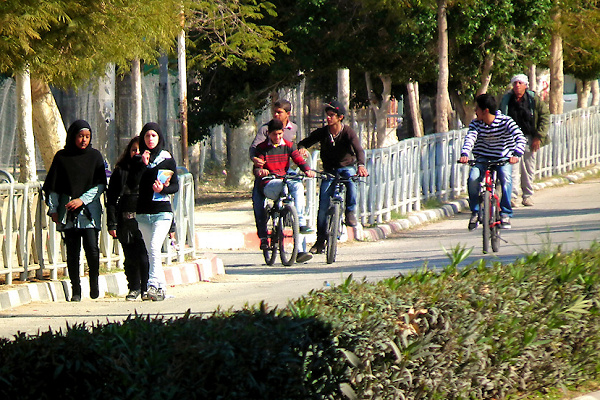
An ordinary day in peacetime Jericho
If Israel, Hamas and the ‘international community’ truly seek peace and a fulfilment of their needs, the dialogue needs to change. The terminology, the attitudes, the dehumanisation, the unreasonableness, the accusations and the anger. It starts with a change of heart. This is at present slimly possible though highly unlikely – there are too many vested interests and set agendas involved, of many kinds. So the current Gaza conflict will likely remain unresolved, as have previous conflicts. Not that it is easy or quick to resolve – incrementally, it will take generations. Recent events could serve as a turning-point, but I do not detect a necessary will to change.
However, the people with the biggest cards, regarding peacemaking, are Israel and the American bloc, closely followed by the Middle Eastern nations. It starts with a realisation amongst Israelis that they will fail to create longterm security while they are damaging new generations of Arabs and thus creating new enemies for the future. They cannot eliminate Hamas or the constituency it reflects and, in Gaza, there is no one capable of replacing Hamas as a government.
Also, Hamas have not actually been bad as a government (given that people in most countries have problems with their governments), and it needs recognising that they are an Islamist social reform party with a military wing, not a military force with an appended political wing.
A crow at Tel-es-Sultan, the remains of ancient Jericho, going back 7,000 years
But both sides need to change their views – their whole optic.
Palestinians are not extremists, though they are in an extreme situation and thus they react extremely. But they dislike Muslim fundamentalism, ISIS, Al Qaeda or even the wearing by women of the full face-covering. Most Israelis are not extremists either but, when they feel under attack, they can be overwhelmed with insecurity, fury and vengeance. This has deep historical roots and, while it’s understandable, it doesn’t help the future. It makes Israel overreact, with the longterm effect of perpetuating the insecurity that Israelis so much want to be free of.
It makes Arabs overreact too. Most Arabs accept that Israel is there, wishing it to withdraw to the 1948 borders (perhaps with a few trade-offs) and to become a good neighbour. But when they see Israel’s military actions, they become emotionally reactive and the rather over-worn and unworkable idea of driving the Israelis into the sea is reborn.
So somehow there needs to be a massive act of mutual trust and respect of a kind that very few Israelis, Palestinians or neighbouring Arabs could accept. Things are so touchy that it could break down over the slightest incident. And there are interest groups, both high-up in the geopolitical sphere and on the ground, who are dead set on perpetuating and enforcing the existing mindset they already hold.
The ancient spring at Jericho – the reason why the town is there and has been there for 10,000 years. It’s the oldest continually inhabited town in the world
At present I see only two possibilities: calming and exhaustion.
Calming means an incremental stepping back and reduction of conflict, by agreement. This could be achieved either on the ground, through the upwelling of a suppressed aspect of public sentiment on both sides, particularly amongst women, to apply deconfliction pressure from within each society. Or it could be achieved diplomatically, but this would require all those countries that matter to agree on one strategy, applying strongly both to Israel and the Palestinians. Don’t hope too hard for this, but it is always possible. As Sir Steven O’Brien, a diplomat, said on the radio (Saturday 4th Nov), “Diplomacy always fails until it succeeds“.
Then there is exhaustion. A conflict ends when there is an equalisation between forces, such that both sides perceive that they cannot win. This can happen militarily, but neither side in this conflict is likely to be able to win clearly, and there is a high price-tag to it.
Here the Palestinians have a slight advantage since their attitude of ‘sumud’ – perseverance and hanging in there – has more lasting power than Israeli rage. They lose every conflict, trying to draw down the world’s sympathy by suffering massive damage – a kind of collective martyrdom – but they also stop the Israelis from winning, every time. Meanwhile, the international community watches, fruitlessly spluttering and wringing its hands.
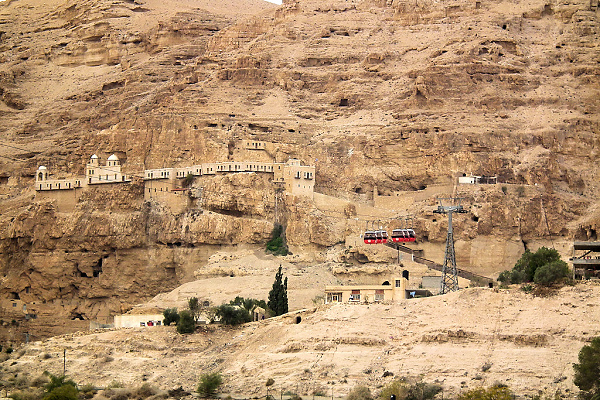
The Greek Orthodox monastery at the Mount of Temptation, Jericho (where Jesus did his forty days and forty nights).
It’s all nicely complex, and there is a counter-argument to every argument, and there are no easy answers. But it looks like we’re following the exhaustion track. This is also what’s happening in Ukraine.
The real battle lies between those who encourage polarisation and violence and those on the receiving end of them. Both sides can live together, and they shall. They do live together, even though they are strangely divided.
Palestinians aren’t angels and they’ve made mistakes but the burden of power and error weighs heavily on the Israeli side. Israel has long had superiority in weapons, money, connections, PR, chutzpah and forcefulness. Israelis don’t see things this way, seeing themselves as endangered victims. This is not unique amongst nations, but for Israel it’s extreme and the effects impact heavily on their victims and the wider world.
The Israeli project – to provide a safe haven for Jews – is a noble thing. Historically, Jews have suffered immensely, especially from the actions of Europeans. This doesn’t justify their oppressing Arabs today or doing to others many of the things that once were done to them. Israelis don’t see themselves as oppressors – they are the oppressed, busy protecting themselves.
Israelis have a lot to be proud of. They built a nation in decades. From their perspective, Arabs have attacked and menaced them and Israelis have bravely held off such threats – this was the narrative I learned as a teenager in 1967 at the time of the Six Day War, during which the Israelis occupied the Palestinian territories as if by accident, pre-emptively defending themselves (we were told).
Westerners fail to understand that this is where the power really lies in Middle Eastern society
In later life, I discovered that this, like the previous one of 1948, involved severe ethnic cleansing and uprooting of Palestinians, razing and occupying villages and parts of towns, and the killing of thousands of largely defenceless people. The awful fate visited on Jews by Europeans was visited by Jews on Palestinians. In the long arc of Jewish history this is tragic.
Only some early Israelis were perpetrators. Many were accomplices who shut their eyes, went along with things or obeyed orders, to an extent tricked by their leaders. Or they felt unable to encompass the situation, complain or do anything about it – they were simply thankful to be in Israel. Some protested but didn’t get far, others felt that the ills taking place were regrettable but unavoidable, while others just didn’t look. Zionists defined Israel’s character and future as a state, locked into an endless military vortex.
It could have been done differently. As they immigrated in the earlier 20th Century, Jews could have been integrated more with Palestinians – there would have been difficulties, though arguably fewer difficulties than actually arose. The British administration of the 1920s-1940s could have exercised less of a divide-and-rule approach. When the UN partitioned Palestine, favouring Jews, the Israelis could have made do with the territory they were allocated – they were given 56% and took 78%. They could have traded land for peace in the 1970s or 1990s.
None of these options would have been perfect, but some sort of peaceful and productive coexistence could have arisen, leading to a sounder long term future for everyone. But the path Israel chose lacks foresight, and the results come back to haunt them today.
Israeli feelings of existential threat arose from deep-seated vulnerabilities following the Jews’ terrible history in Europe. But the threat from Palestinians and other Arabs has been less a conquering aggression, more a largely ineffective response to Israeli force and expansion. A sense of threat does not have to be the case now. When Israel upsets its neighbours, or when it refuses to budge on issues crucial to Arabs, it naturally creates an unhappy response.
Thus, Israel becomes its own worst enemy: while intending to reinforce Israeli security, it generates antipathy and threats instead, undermining that security. The ethnic cleansing of 1948 would be consigned to history if it didn’t continue today. Hezbollah would be no threat if Israel hadn’t invaded Lebanon so devastatingly, not long ago. Israeli actions caused the founding of both Hamas and Hezbollah. Hamas and other militias in Gaza would not fire rockets if Israel let up on its siege of Gaza.
Zionism sees Israel’s own interests and expansion as paramount. Whatever means are used, whatever the wisdom of it, and whatever costs are incurred, Israel’s growth must go on. The notion that Israelis’ needs and security could be helped by acknowledging the needs and security of others doesn’t enter the equation, except amongst a dedicated but much shrivelled Israeli peace camp.
In the long term, if anything weakens Israel, it is Zionism, since it undermines the sympathy the world has toward Jews. Only a proportion of Israelis actively subscribe to Zionist sentiments, though acquiescence to them increases when Israel feels threatened, which happens regularly. Zionism is a norm drummed into Israelis from an early age.
Judaism is one thing and Zionism another. The Zionist mentality builds concrete walls and fences around Israel in self-protection, and in so doing Israelis become separated from the world, increasingly failing to see the wider world’s viewpoint. Zionists accuse critics of anti-Semitism, labelling Jewish detractors as ‘self-hating Jews’. Thereby, balanced dialogue is blocked.
But here comes a key proposition. If both Israelis and Arabs saw things another way, opening up to the notion that their fellow humans sit in the same boat as they, and if Israel ramped down its military expansionism, permitting some restitution of the ills which have occurred since 1948, then, over time, threats to Israel will subside, and the country and its population will become more safe and secure.
Most Palestinians and Arabs don’t want to fight. The idea that they want to destroy Israel is nowadays somewhere between a myth and an expletive uttered by Arabs when tempers are hot. Similarly, in Britain in WW2, it was the case that ‘the only good German is a dead German’.
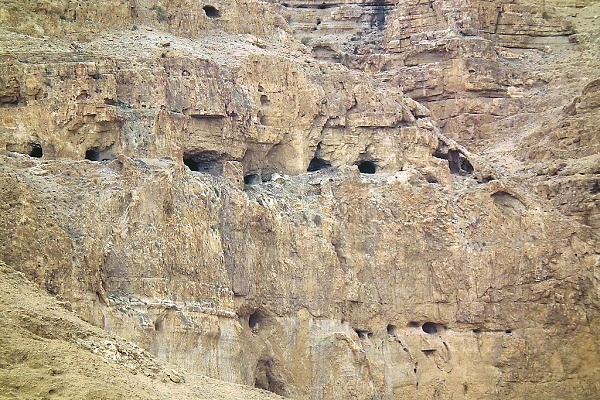
Early Christian hermits’ caves at the Mount of Temptation
Most Palestinians and Arabs accept the existence of an Israel within the pre-1967 borders – an enormous concession they signed up to thirty years ago in the 1993 Oslo Accords. Even Hamas has stated that it will recognise Israel within such boundaries. Palestinians just want a fair deal and a decent life. Peace will never be a perfect deal, but it will be better than the current situation.
Israel cannot afford to remain militarised forever: it has poor people, social problems, enormous water-shortages, a risk of coastal flooding, toxicity, pollution and all the kinds of problems that pervade most modern countries.
It claims to be the only democracy in the Middle East (that’s hasbara) yet the nation is riven with disagreement over the nature of democracy, the constitution and the purpose of the nation, reflected in a succession of demonstrations and indecisive elections. It also shares the Global North’s dwindling prestige and power. After all, Israel’s population is only one third of the Egyptian city of Cairo.
Even if Israel won every war it undertakes, this doesn’t make for a happy, healthy nation. It needs to make friends with its neighbours because it needs them, and they need Israel. They have a lot to offer each other. They share Middle Eastern space. It’s a multicultural space.
Israelis need a safe and peaceful future. Many are not fully aware of what goes on in their name, or they shruggingly accept the ‘security reasons’ they are given. Many feel powerless, or they maintain a comfortable indifference ‘living inside the bubble’. Others adopt extreme, partisan views, as if everyone is against Jews and a strident, hammer response is always needed.
Since the late 1990s, the centre of gravity of Israeli politics has headed rightwards, and a harsh minority dominates the public discourse. The rule of dominant interests, while not unique to Israel, maintains a perpetual state of near-conflict.
Israel could come to regret many aspects of the years since its founding. It soils its nest by pushing its case uncompromisingly, thus creating enemies and the opposite longterm effects to what it genuinely seeks. Its reliance on force, bombing, assassinations, land-grabs and ill-treatment of Arabs builds up new, avoidable problems, fostering new generations of opponents.
We need a new habit of peaceful coexistence. This will take a generation or even seven, but it is important.
The Holy Land is a multi-ethnic, multi-faith land and a fascinating place. Sanctity is elusive and each faith defines sanctity differently, but it’s safe to say that ongoing conflict is not one of its characteristics. Positive change matters for the whole world – Israel and Palestine form a bottleneck in the world’s process of change.
Security is developed by building up a nation’s internal feelings of alrightness, community and integrity. It is built by cultivating collective happiness and creativity, giving people a sense of a positive, mutually-beneficial future. This is the real national interest, the guarantee of Israel’s future.
Once there was an old rabbi who had been praying for peace daily at the Western (Wailing) Wall in Jerusalem, for decades. When asked by an admiring journalist what it was like, he simply replied, “It’s like talking to a stone wall“.
With love, Palden
For better or worse, written using HI (human intelligence, aka brainz)
I woke up this morning with ‘philanthropist‘ going round my head. So I decided to look up how it was defined.
“A person who seeks to promote the welfare of others, especially by the generous donation of money to good causes.” Oxford University Press. Interestingly, they found that the greatest use of the word in Britain was in the 1850s, the peak of the Victorian era and the industrial revolution, declining gradually until it sank a lot during WW1 and afterwards, and it started slightly picking up only since 2005ish.
“A philanthropist is someone who donates substantial resources, often including time and expertise but always including substantial financial resource, to a particular cause, area or social issue.” That’s the Charities Aid Foundation in UK.
“Anyone can be a philanthropist and be more effective at making a difference. Here’s how. A philanthropist is a person who donates time, money, experience, skills or talent to help create a better world. Anyone can be a philanthropist, regardless of status or net worth.” That’s a bit closer to where I stand. It comes from an American organisation called Fidelity Charitable.
Another source defines three types of philanthropy: relief, improvement and social reform. In my work in places like Palestine, I’ve focused mainly on social reform – a longer term perspective that builds conditions leading to improvement. This is trans-generational when it comes to questions of mass trauma-healing – which is the approach taken by the Hope Flowers School that I worked with in Bethlehem. Their motto is, ‘every act of violence begins with an unhealed wound‘ – so the task is to make progress on healing those wounds. The school originally had Muslim, Christian and Jewish children but, in 2001, during the intifada, the Jews withdrew, largely for safety reasons – understandable, though regrettable.
According to the Borgen Project, “Philanthropic people show selfless concern for the welfare of others and venture to alleviate the struggles of others without seeking anything for their own personal benefit. Truly philanthropic acts are done without expectation of compensation or recognition of one’s efforts.” This might be so, but this ‘without expectation’ bit doesn’t cover the expenses incurred, and covering my expenses has always been problematic. When in the Middle East, I still had to pay my rent and bills back home, as well as covering travel, living costs and helping needy people. I still do this with the remote work I do now from my desk at home.
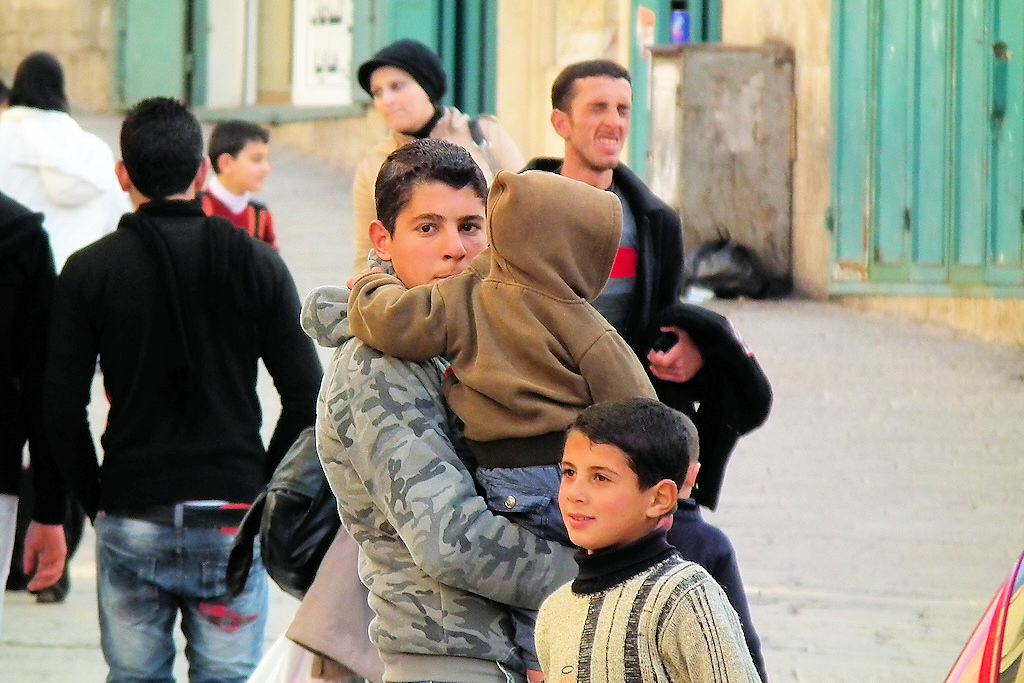
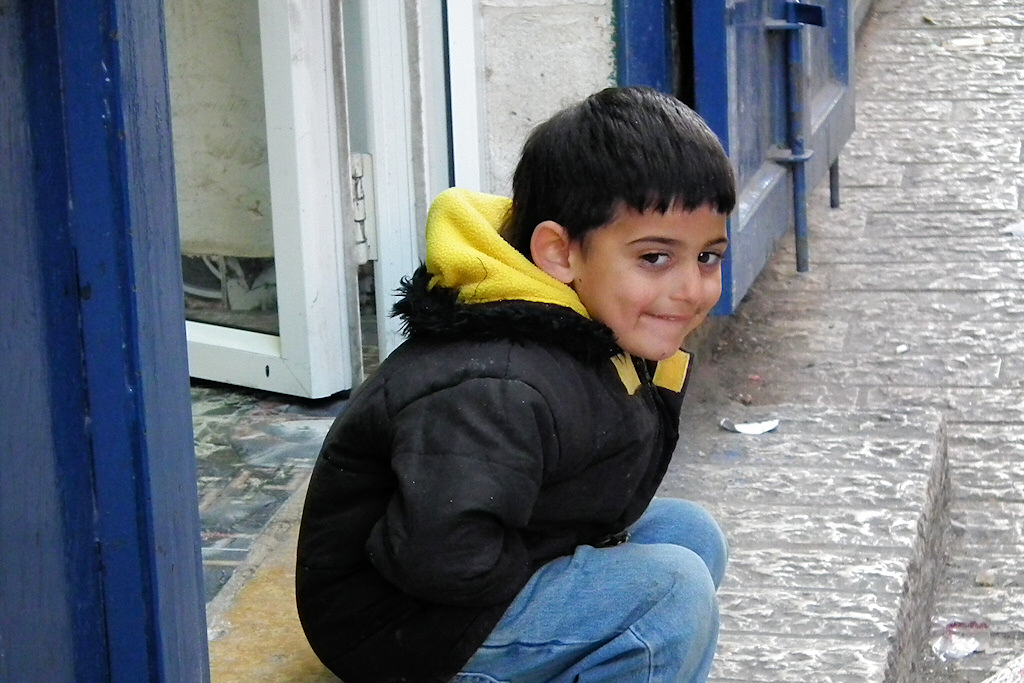
I met this guy in Bethlehem. He’s now 20ish. I wonder what he thinks right now?
In this life I have not been a financial philanthropist. Many people believe that donating money is the only form of philanthropy, but also, out in places where there is need, everyone tends to drive, elbow and oblige me to raise, funnel or fix money. They perceive this as their primary need, and that’s true in the short term and not necessarily true for the longterm background conditions I’m best at working with.
This has tended to smother and detract from what I’m best at doing – human and spiritual input and multilevel intelligence. The thinking needed for fundraising and admin is very different from that of healing and magical-spiritual work, and I cannot do everything. This has been an ongoing dilemma.
It hasn’t helped me support myself either. People tend to think that, since such work is a chosen vocation, I needed no support or already had the funds. The prevailing thinking is that, if you’re doing well financially, this enables you then to act philanthropically – and only then. For many people this point never arrives, so they don’t do it. But it needs to come from a deeper place, from a sense of calling. That’s what was the case for me and, in late life, I’m really glad I did it, even though I’m quite poor now as a result.
Carn Barra, West Penwith, Cornwall.
When in Palestine and Israel, there were two main age-groups of volunteers and activists from abroad, most of them self-financing. One group was around age 25-35 (and 60% female) and one was around sixty (and 60% male). The thirtysomethings were doing it out of principle, setting aside career progress for what they believed in – though for some it was a voluntary internship to help a career in the NGO sector. Some had law, business and accountancy degrees, working in ‘lawfare’ – legal improvement of the rights of Palestinians and helping Palestinian NGOs function.
The sixtysomethings were good-hearted types, often retired from careers in education, social work or healthcare, who had raised and despatched their kids, perhaps they were newly divorced, and they had the resources and long-accumulated wish to at last pursue their calling in a place like Palestine. Both of these age-groups were committed, brave and valuable people, nevertheless driven by slightly different motivations. Many of the older ones contributed to the relief and improvement areas, while many of the younger ones contributed to reform.
There’s an innate philanthropy built into Palestinian society. It’s an attitude. It’s shared by some but not all Israelis – particularly those brought up in kibbutzim or living in settlements. It’s a kind of generosity economy, where everyone is brought up with an ethic of mutual help and contribution. This is social resilience, and when society is under duress it really works. This is something we in Europe need to learn – it’s in our group memory but it has lapsed.
When a young person thinks about their future career, they don’t think of personal ambition as much as the contribution they can make, and the likely slots that will appear in their clan or neighbourhood in future – whether as a dentist, embroiderer, car mechanic or even a professor. If the local midwife is growing older, a younger one will be thinking of replacing her in ten years’ time.
The holy well on Trencrom Hill, guardian hill of West Penwith
Over the decades I’ve banged on a lot about life-purpose, helping and empowering people to identify and pursue it. Here comes a repeat quote, but it’s important. The Council of Nine (who thirty years ago jogged me into working with Israel-Palestine) were asked whether there was one thing that could change and transform the world. They simply said, “If everyone pursues their life purpose“.
This gets bigger. They didn’t say this but, by extension, omitting to pursue our life-purpose, or withholding it, for whatever reason, is a soft version of a current major concern: crimes against humanity. It is the indifferent, inherently self-serving ethic of Western and, increasingly, global culture, that permits situations such as Gaza to happen. Because we don’t stop it.
People expressed surprise and horror at the precipitate actions of the Gazans when they broke out and violated so many Israelis, starting off the current round of trouble. Anyone who actually watches anything more than the urgent splutterings of the headlines knew something like this would come. It continues a long, long story and it didn’t happen out of the blue.
The surprise arises from global indifference, which prefers stuff like this would just go away. To be fair though, there’s also a surfeit of other events, tragedies and concerns competing for attention. Israeli hubris was caught napping. The main surprise here was the strategy and audacity of it. I do not encourage violence and have been a lifelong peace-freak, but are we really to believe that the Palestinians, generally unheard, blocked and disregarded, are supposed to act like polite gentlefolk, shrugging shoulders and nobly accepting their lot without a whimper? How would you like to be a 20 year old in Gaza, with no future? Or his or her parents?
Palestinians. They’re terrorists, as you can see
Today, the Gazans are so hungry, thirsty, desperate and traumatised that it would not surprise me if there were another mass breakout, into Israel or Egypt – of mothers, families, grandparents and youngsters seeking food, water and safety. Later, Europeans will duly complain when another wave of refugees comes to our shores, but our endemic indifference has caused much of this. Refugees arrive in Europe and America to give us a gift, a gift of humanness, empathy and philanthropy. Amazingly, it has even been found scientifically that it makes us happier. Indeed, there’s more to life than comfort and security.
I am not saying ‘admit anyone who claims asylum’, but I am saying we need to be more philanthropic, to understand that changes are happening even to us, and to act longterm to deal with the sources of the problem. In the case of Gaza it concerns the historic and current issues arising for the locals from the arrival and behaviour of the state of Israel, and the wider global issues that allowed this to happen the way it did. In Britain, two key fomenters of this problem are the Foreign Office and the media.
So, life-purpose. Are we here simply to pay our bills, tread our mills, keep investors happy and, at the end, collect our pensions? This is a personal question for every single soul. We need to ask ourselves, ‘Am I rising to my full potential as a human philanthropist? Or a human anything, for that matter?’. The answer is both yes and no, and the yes bit needs acknowledging and the no bit needs some attention. [For an audio talk by me, try this.]
Here’s something interesting that I discovered. I have long known I have healing abilities but in Britain I have chosen not to work as a healer, except as an astrologer (a perceptual healer) and a community activist (a social healer). But when I went to Palestine, witnessing the needs of people there, I suddenly started doing healing work – spiritual healing, mainly, and remote healing. On people’s backs, stomachs, wounds, hearts and spirits. What surprised me was that my abilities were dramatically amplified – people were genuinely and visibly healed, and deeply so. They’d approach me later to say so, and I was much moved, rather shocked by that. It was as if the scale of need pulled out almost miraculous superpowers.
But there’s a difference. In Britain, when I’ve done such work, while people do benefit, they tend to continue with the life-patterns that caused the problem. From a healer’s viewpoint, that’s not very satisfying. But in a crisis zone, where despair, danger and dire need are big drivers, I found people really did take on board whatever I said or did, and they were so grateful, and they helped me back. Also, it was liberating to work without charging.
Sitting on the wind. Godrevy, Cornwall
I’ve never liked charging for healing or transformative work – how do you value the fixing of a major issue or the saving of a life? Twenty years ago, as an astrologer I charged £60-70 for a two-hour session but I needed £250. I did a lot for free or underpriced, because there was a need. I’d have felt happier with a salary, like a doctor, so that charging didn’t enter the equation. The ethics and politics of our time did not allow it – after all, astrologers are charlatans, aren’t we?
If you were a Palestinian in Gaza right now, you’d be enacting your life-purpose – whatever you’re best at. The same is happening for some Israelis. That’s how people survive. When the chips are down, you do what’s needed, regardless. If you can clear rubble, cook, minister to people or mind the kids, that’s what you do. No qualifications or vetting needed – just do it, if necessary till you drop.
Saturn is in Pisces: this concerns philanthropy. Without it, the world would be a much sorrier place. Philanthropy is not an option: it is a necessity, like sewage disposal. Crises such as Gaza – and they’re coming at us quite a lot nowadays, and it won’t slow down – shine a light on our life-purposes, for each and every one of us.
What am I here for, really? What am I doing about it? Our calling is programmed in us from the beginning. We know it. It is inherent, not learned in courses or demanding a qualification – it’s a natural, inbuilt gift and skill. It comes easily. Yes, we are all innately talented. If we let it out.
With love, Palden
A young Bethlehemite friend, now in his twenties
PS. I’m blogging a lot at present and it’s not really planned. It’ll die down again! If something comes up, I start blogging and, typical Aspie, I don’t stop until I’m done. There’s stuff going on in places where parts of my heart lie and, since I can’t get to Is-Pal (or West Africa), this is how I let it out. Together with psychic-spiritual work and handholding certain individuals in the thick of it.
At present, I am ‘holding’ Maa Ayensuwaa (on the right), a native healer in Ghana, who is lying in hospital, lacking painkillers and hoping money will come along to pay for an operation for fibroids – it’s wear and tear from helping people and going without. I can help her only in spirit, though our connection is such that (I hope) it works.
We Brits straddle a strange hypocrisy. In Ukraine our government supports the people (Ukrainians) against the Megamachine (Russia, as we currently perceive it). In Israel it supports the Megamachine, the Israeli government, against the people, the Palestinians (as many of us see it).
Though it’s not as simple as that, since there are real people on both sides of both conflicts. And while the British support for Ukrainians is pretty solid, our support for Israelis and Palestinians is equivocal, mixed and changeable – when people bother to pay attention. For most Brits, sympathies currently extend to people on both sides, with only a degree of rigid partisanship on either side of the spectrum.
Such partisanship is largely because of personal connections. Or it depends on which media people follow. Older people tend to sympathise with Israel (their reference point goes back to WW2 and the 1967 Six Day War), while younger people tend toward sympathising with Palestinians (their reference point goes back to the intifadas and repeated Gaza bombings).
My prayer is that the vengeful aspect of the Israeli psyche does not exceed itself. Israelis need to understand how to create peace and security around them without feeling a need for an iron wall mentality – those days are going, and painfully slowly. Actually, we all need to learn that lesson, but in Israel the iron wall mentality is exemplified.
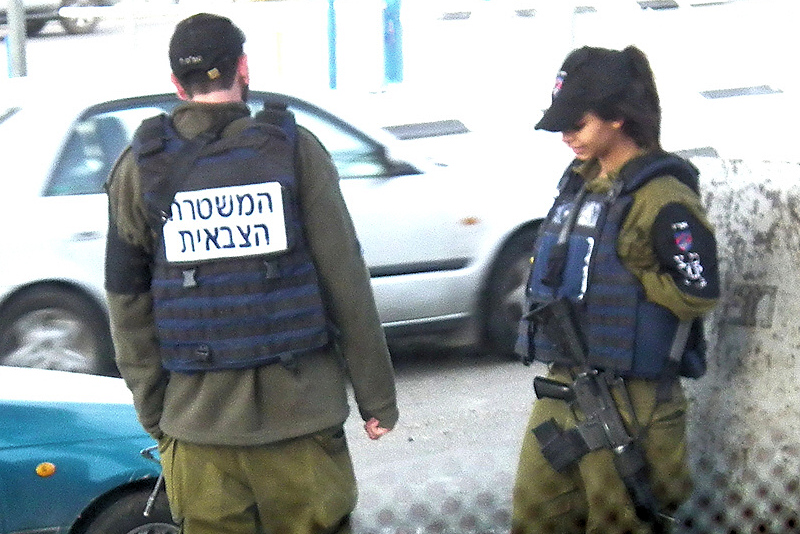
Many Israeli soldiers are quite okay people – and they like rock festivals too
The trouble is that, in a country surrounded with walls, fences and missile defences, supposedly to keep enemies and threats out, it imprisons Israelis themselves, inside their own bubble. Pretty much the only way out of the country is through Ben Gurion airport near Tel Aviv. It’s built on land owned up to 1948 by the Issa family, a refugee family who now run the Hope Flowers School in Bethlehem.
Regarding that, here’s a report from Ibrahim Issa, the school director, where I lived and worked in Bethlehem. Though in the West Bank, it is only about 45 miles from Gaza – three minutes in a warplane. In Bethlehem they can probably hear and even smell what’s going on over in Gaza.
Here’s Ibrahim (he’s around 40 in age now)…
AROUND THE SCHOOL It is extremely sad to see this escalation of violence and associated human suffering on both sides. We are safe until now, despite escalation in the area. Two days ago we had to evacuate the school. Hope Flowers School is located in Area C, which is Palestinian land under Israeli control – in the southwest part of Bethlehem. The school is located about 150 meters away from [the edges of] an Israeli settlement (Efrat).
One of the Palestinian rockets fired from Gaza fell about 50 meters from the school building and injured two boys from the neighborhood. One of them is already declared dead. Yesterday, Israeli settlers have been attacking Palestinians near the school. This situation is extremely scary for children at Hope Flowers, for teachers and certainly for families.
IN OUR FAMILY Fourteen members of my extended family have been killed today in Gaza. The grandparents, sons, daughters and grandsons are all killed in an airstrike.
ON THE WESTBANK Most schools have turned to online education. Hope Flowers School is doing that also for children who cannot reach the building anymore. Bethlehem is a totally closed-off area. We do not have fuel coming in; we do not have diesel to operate the school buses. I think it is a matter of days before everything stops totally, unless Israelis release the siege on Palestinian areas here in the West Bank. Food is also running out in the supermarkets. No food supplies are coming. It may be just a few days before people start to feel the shortage.
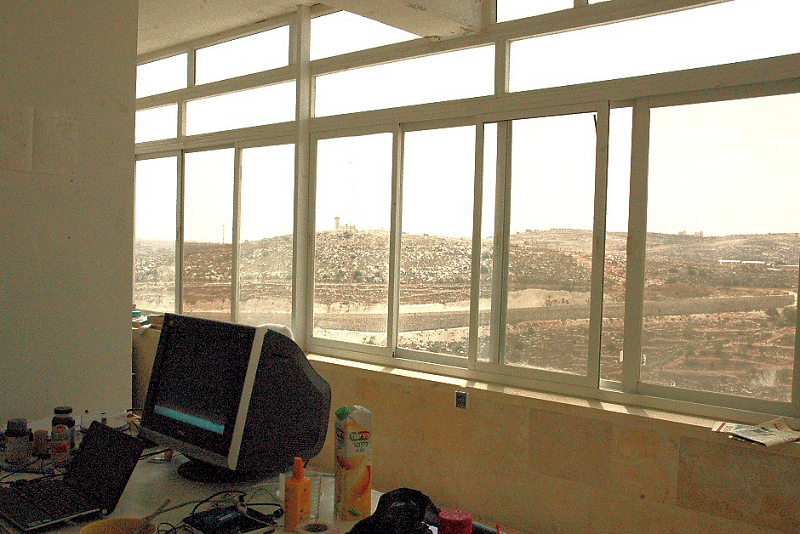
The view from my apartment at the school – over the valley you can see the security wall, an observation tower and, to the right, an ‘outpost’ that has now become a settlement
Palestinians are regrettably accustomed to adversity and crisis – that’s why a squad of Palestinians is advising the Ukraine government on social resilience and resistance. Over the decades many Palestinians went to university in Ukraine and Russia, so they know the deal there – about 6,000 Palestinians were in Ukraine at the outbreak of war in 2021.
MY OWN INNER CONNECTION
My Palestinian journey has been one where I have had to examine my biases and the contradictions in my viewpoints. They are very mixed.
My maternal grandfather was in Allenby’s invading force in WW1 in Iraq and Palestine, and my father fought in Egypt in WW2. I have Roma ancestry, and the Roma experienced holocaust tragedy as much as the Jews. I also have German (and Welsh) ancestry, and when my father was younger, ‘the only good German was a dead German’, according to the mad logic of war-thinking at that time. It’s not that long ago that towns and cities this country were blitzed like Gaza – my mother hid under the table nightly in Walthamstow, East London. So it’s in my genes and those of many of us.
Amidst the damage of urban war, ordinary life goes on. This is Hebron.
Here’s comes a seriously woo-woo bit, which some readers might not like. It’s something you can take either literally or metaphorically since, whether or not it’s true, I carry similar issues to those of a similar character to me, back in history. It is a past-life thing, going back to the time when I was working for the Council of Nine in 1991-93. At one stage, I asked them why they called me ‘Paladin Saladin’ – I had thought it was a kind of jocular rhyming name. They did after all crack jokes! They simply said, “You were he“.
This was like a bolt of lightning. As a historian I immediately knew what they were throwing at me. For some years afterwards I had a resistance to the idea. I recounted this to a close friend, Jean Gardner, a Glaswegian aged hippy, now in heaven, who had been a friend of R D Laing in the Sixties. She looked at me intently, got up, went to the bookshelf, leafed through a history book and gave it to me, pointing at a picture.
“Palden, you sit exactly like this. And look at the simple diet he had – exactly like yours, minus the tofu… and how he could be tough and also show mercy… and the way he was always giving away the money he had to people in need, and he was personally perpetually broke, even though he was the Sultan of Egypt and Syria.” When Jean spoke like this, her words had that deep, no-bullshit Glaswegian firmness. Woo. I had to acknowledge this and take it on.
The Nine also said I had been the slave to Abraham’s pagan father, Terach, back in Ur, around 1900 BCE. Abraham had a big argument with his father and smashed all his idols, at the time when he was adopting the idea of a One God – and presumably I was in on that moment. Servants are often privy to all sorts of stuff.
Then, they said I was a Nubian slave to Moses – yes, I waited for him at the bottom of the mountain. They finished by saying, “You have been involved with the Jews three times, always as a foreigner, and this is your fourth”. In this they were implying, ‘And what are you going to do now?‘. Five years later I was getting involved with Israel and Palestine, starting by being a co-founder of Jerusalem Peacemakers.
On my first visit to Jerusalem in 1991 I cried my eyes out in the back of a taxi driving along under the medieval city walls. I’d been here before, and I was all stirred up. We had walked out of the Church of the Holy Sepulchre, entranced by the strong atmosphere there, straight into a soldier situation – and that’s what’s really weird and intense in Jerusalem. The best and the worst in human experience can come at you in quick succession. Actually, Glastonbury is a bit like that, minus the guns. Both holy places are somehow deeply connected as places where light meets dark. You have to get used to the extreme ups and downs. Glastonbury trained me for Jerusalem.
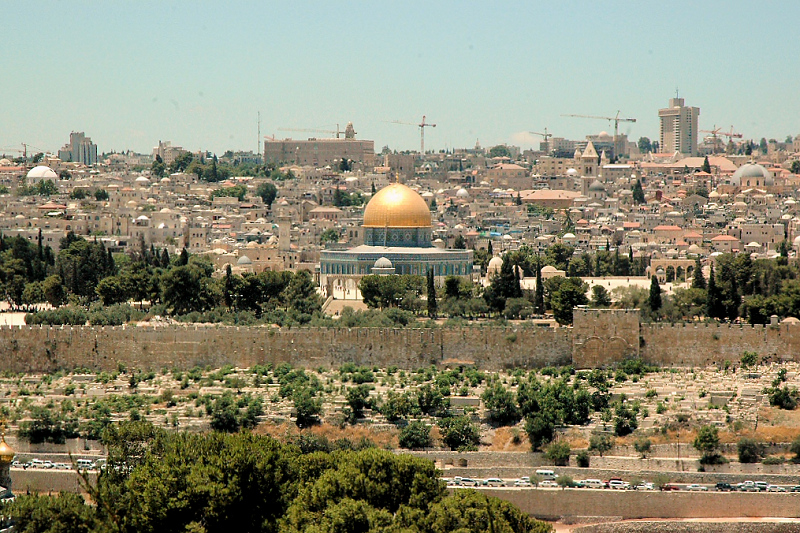
The Old City of Jerusalem
THE NINE’S THOUGHTS ON ISRAEL
Here’s a simple quote from the Nine [1]: “Do you have the understanding that Abraham was the father of two nations?” Biblical and Quranic tradition have it that the Arabs were descended from Ishmael and the Jews from Isaac, both sons of Ibrahim/Abraham. “Then you also understand that Allah is what those of Israel call Yehovah.“
The Nine didn’t regard the Jews as ‘the Chosen People’. They saw them as the People of a (big) Choice.
“They [as souls] came from a planet of strength. They came from [another world called] Hoova. They had strength within their character, and also the planet from which they came was a warlike planet – and in their seeding here [on Earth], they were asked to be at peace. But they have factors of doubt and questioning, which cause us difficulty. They have doubt, suspicion and deception – because of the place they come from [Hoova]. Part of the reason for their existence on this planet was to overcome that factor.
“It began when they left Ur [heading to Palestine]. Before that, they listened. But the descendants of Abraham lost their internal knowledge: they only kept the knowledge of who they were. In their need for survival, they did not accept total obedience [to the Covenant]. They were always making deals. Where one group would be in awe of Creation, the Hoovids would look at Creation as something to be utilised.
“The nation is fierce with pride, and from this grew the desire to help their own nation only – in the times before the man Jesus. So in effect our plan [the Covenant] was turned around. The people of Israel will eventually accept their responsibility. And yet in effect this is their salvation, because it shows the nations of planet Earth that they are a nation that will not be conquered. Also, even though they made an error, every nation has made an error.
“There were only two commandments for the nation of Hoova. Those two are: Thou shalt not worship false gods; Do unto others as you want others to do unto you. Those are the only two commandments given to the nation of Hoova.
“The nation of Israel has forgotten its heritage, its choosing and its Covenant. Abraham was told to go and spread his seed through all the planet Earth. Abraham was told to populate and to go forth, and yet this Covenant was not kept. The Hebrews did not go forth and mingle. If this nation had gone forth and mingled with the peoples of the world, then this the planet Earth would not be in such a serious state as it is at this time.”
There are peace-freaks in Israel too – many have done military service and know what they’re talking about when it comes to peace-building
In one of the interviews I had with the Nine, I asked this:
“The people of the north of Israel, the lost tribes, were taken away and dispersed by invaders. Were these people eliminated, or did they mix with the peoples of other lands?”
“They are all over the world and, as examples, some are in Afghanistan. There are some in Ethiopia, in the Phoenicians [Lebanese and Tunisians], in the people of the musical language written of by Caesar [the Celts], and in the Orientals [such as Kashmiris and Uighurs].”
I then asked, “You have said that the Hoovids came in order to mix with the people of planet Earth.”
“That is a truism, but they that stayed together did so because the others had been dispersed. If I would have a word of my own to say, would you like to hear? I will ask the Council if I may say it. They said I may say, but you may not be pleased with it. It is this. We would have one warning to people who are working with higher consciousness, to be very cautious about your attitudes toward the Hoovids: for it may very well be that you are a Hoovid also, yes. What we are attempting to say is that the majority of people that are involved in spiritual elevation contain the genes of Hoovids – so look upon what I say. How do you then place yourself in that?
“Look at all the world, in every nation, and see which negative characteristics developed that made that nation feel different to others. In your nation [Britain] you believed you were superior to other nations, and that your rightness was the rightness of rightness. And as you have now evolved beyond that, you give to others that same understanding [of seeing beyond tribal perspectives]. When people come to gather as many, and the clapping goes all around the world [across borders], all will be free of the bondage of their bringing forth [of their tribes, nationalities and cultures].
“The people of the nations of Ishmael [Arabs] are brothers and sisters with the nation of Israel. It is important that brothers not fight brothers, but in your world it seems to be your system. It is important for this message to be given to the nation of Israel, for they need to have the understanding that the powers of their mind create trouble when mixed with their fears. Your mind brings to you not what you want – it brings to you what you fear.
“The nation of Israel must look closely at what they fear. They want peace, but may we ask why they do not have peace? For what are their fears? It is what is in the hearts of the men and women of the nation of Israel that is most important. When the nation of Israel begins to fear less, then also it will begin to change.”
It’s really boring, spening a long shift inside one of those spy towers
HISTORY AND THE FUTURE: NOT A STRAIGHT LINE
Arabs have a different history to Jews. Arabs are not one people – they are mixed in origin, encompassing thousands of years, and some Palestinians are of Jewish origin. Multi-cultural and multi-ethnic by nature, they are united by speaking Arabic and sharing certian core beliefs. But after the diasporas, the Jews, having been decimated, dispersed and, in medieval-to-modern Europe, persecuted, have different shadows to contend with to Arabs. It even goes into depth-psychology: Arabs suffer shame while Jews suffer guilt. As do Europeans. And all of us suffer fear – big doses of it.
The Middle East has always been a crossing-point of the Old World, between Africa, Asia and Europe. Many peoples of the Old World have ranged across it over the millennia (even the Roma, coming from India). Nations with borders do not suit the region – it has usually come under large empires. It was the Europeans – the Brits and French – who sectioned up the Middle East around 1920, setting in motion much of the trouble that is happening today.
To solve the endemic insecurity and power problems of Israel, Egypt, Lebanon, Syria and Iraq, the whole region needs reuniting as a community of peoples without borders. This process is slowly, painfully starting, as the oil industry and its over-powered oligarchies begin to decline. A sign of this was the pan-Arabic revolutions around 2011 – suppressed, essentially, by oil money and the vested interests invested in it. The ‘Arab Street’ made its voice heard – sparked by a young vegetable-seller in Tunisia. The voice of The Street will return.
Middle Eastern administrative tradition involves ‘Millets’, a multicultural interlocking of peoples, each with their own customs and laws, who all lived in neighbouring communities across the same wide territory – in city quarters, villages and local areas. So the Jews, the Druze, Maronites, Copts, Kurds, Armenians, Alawites, Turkmen, Yazidis, the Shi’a and the Sunnis all rubbed shoulders, living within their own communities under their own laws. To some extent, whenever a new invader arrived, these millets survived and, as long as everyone paid their taxes, the imperialists left things that way. Until the British and French came along.
We British carry much historic responsibility for what’s happening in Palestine and Israel today.[2] I am rather disappointed that His Majesty’s Government has opted to side with Netanyahu’s Israeli government rather than taking a more humane, humanitarian approach, pressurising not only for a cease-fire but for a longterm resolution, backed with some muscle and sticking power.
The issue is the future, not the past. The core issue is the future of planet Earth and the global challenges before us. A crux issue amongst these is an end to war all over the world. That’s the only likely way the Israeli wars will end. War is no longer an appropriate way to settle our many differences. It’s swords to ploughshares time. Otherwise, there’s trouble. Speaking as an astrologer, probably that trouble comes in the 2030s.
If I’ve pressed anyone’s buttons by writing this stuff, please forgive me. I don’t insist on your believing either me or the Nine. I submit it for your consideration. It might give a few helpful perspectives.



















 Notes from the Far Beyond
You must be logged in to post a comment.