Living consciously with cancer | and some thoughts and interests | Palden Jenkins
Author: Palden Jenkins
A pedigree Sixties veteran with a track record. Supposedly retired with bone marrow cancer, I'm still at it. Innovative projects, inspiring ideas, yardages of verbiage, copious photos, lots of audio.
The seventh Aha Class, in Penzance, Cornwall Weds 12th March, 6.30pm, at The Hive
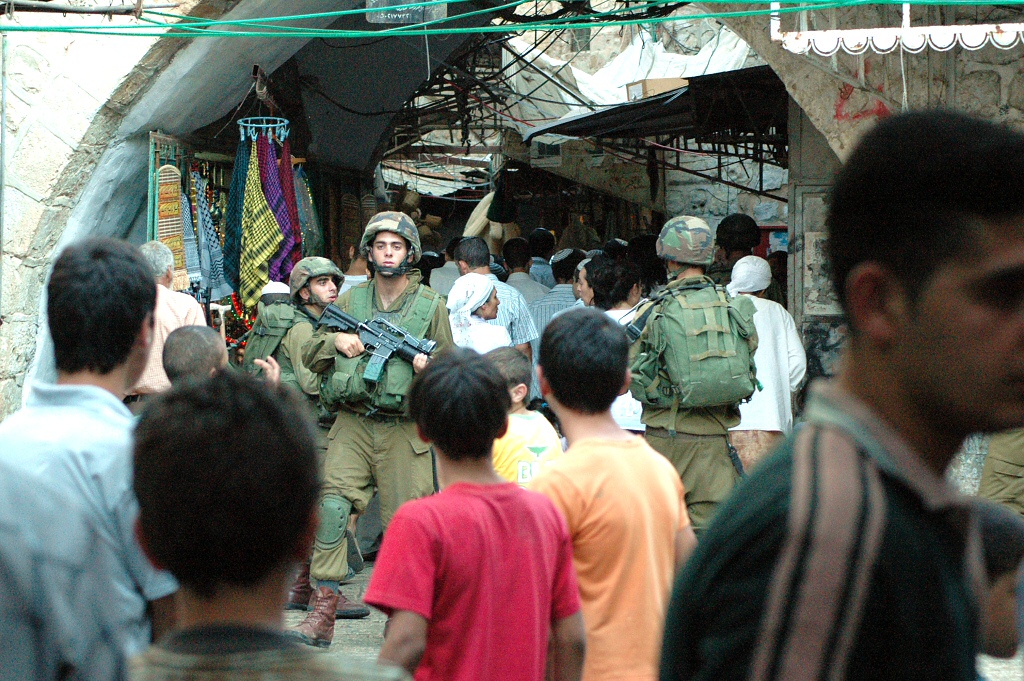
A settler incursion and tricky situation in the historic souk in Hebron, Palestine
Inner journeying, meditation, remote healing and peace-building. Doing our bit toward tackling the world’s problems – instead of wringing hands and feeling helpless.
In recent times many of us have been moved to join meditations, prayers and link-ups when major crises break out. Waves of mass empathy and concern over such crises can have a wide and deep psycho-spiritual influence – it goes deeper than mere ‘public opinion’.
Praying for peace or showering light over a benighted area are good, though often they are of a generalised nature. They can affect the collective psyche and sometimes help swing things.
But it’s possible to get closer in. It’s possible to penetrate actual situations and play a more targeted part in them – literally rescuing people or souls, or participating in situations, meetings and crux-points at the frontline of human experience.
That’s what this evening is about. This might be a valuable inner tool to add to your repertory. This is not ‘lightworking’ but spiritual humanitarian work – bringing in truckloads of spirit, rescue and healing.
This is not simple. It carries responsibilities, and it’s not a matter of imposing our wishes – benign or biased – on world situations. The key issue is to help humanity learn, to become more aware in making the choices it makes, for the longterm resolution of what are often deep-seated problems.
In the first half of this evening, I’ll outline considerations and issues involved in such work, how we choose issues and crises and work with them, and the blessings, delusions and dangers involved and what it’s all for.
In the second half we’ll go on an inner journey to work with a particular area of focus that is currently afoot in the world. (And, first time round, we won’t be working with polarised Trump-related issues!)
You might or might not wish to go into this kind of work but, even if you don’t, world situations do come up at times, touching our hearts, to which we respond, and inner journeying (conscious dreaming) is one way we can play a part in world affairs as situations arise. Once you get the gist of it, it can be applied in areas that interest you – socio-cultural, ecological, geopolitical or simply encouraging forward-moving change.
If you’ve done this kind of thing before, this class might help you clarify a few things and take it a step further. If it’s new territory, it’s a good place to start.
Since most of you will not be able to come, audio recordings will be posted online within days after the class (no charge) – just follow the link below. Recordings of all of the Aha Classes can be found here.If geopolitical healing interests you, you might find this site useful: The Flying Squad.
Some days I have days where inspiration-levels droop, so I rattle off a podcast or a blog, if I can muster up a gem to start with – a starting thought. It’s a way of getting inspiration-channels moving, and sometimes something good comes out. Not always – I have quite a few rejects.
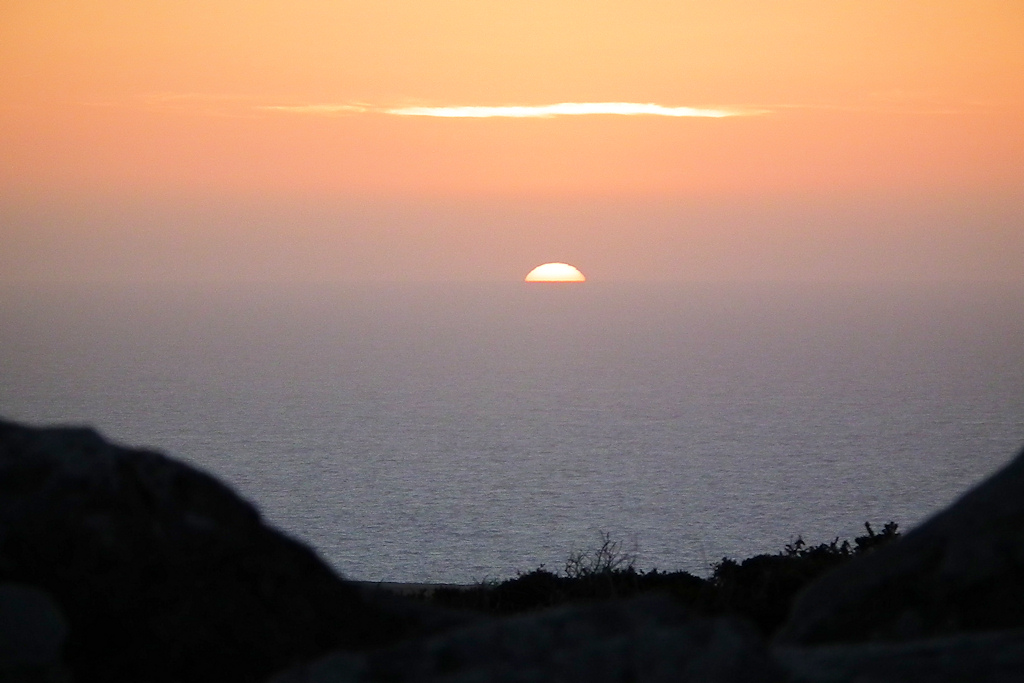
A few days ago I was feeling a bit like that – the cancer drugs were affecting me, I’d been on my own too much, it was raining and foggy, and I was casting around for a spark to give me some ignition. Oldies sometimes need a bit of that – ignition. And going to rest in bed isn’t that inspiring once you’ve done it for some years. Yes, even with the amazing view I have out of the window from my bed.
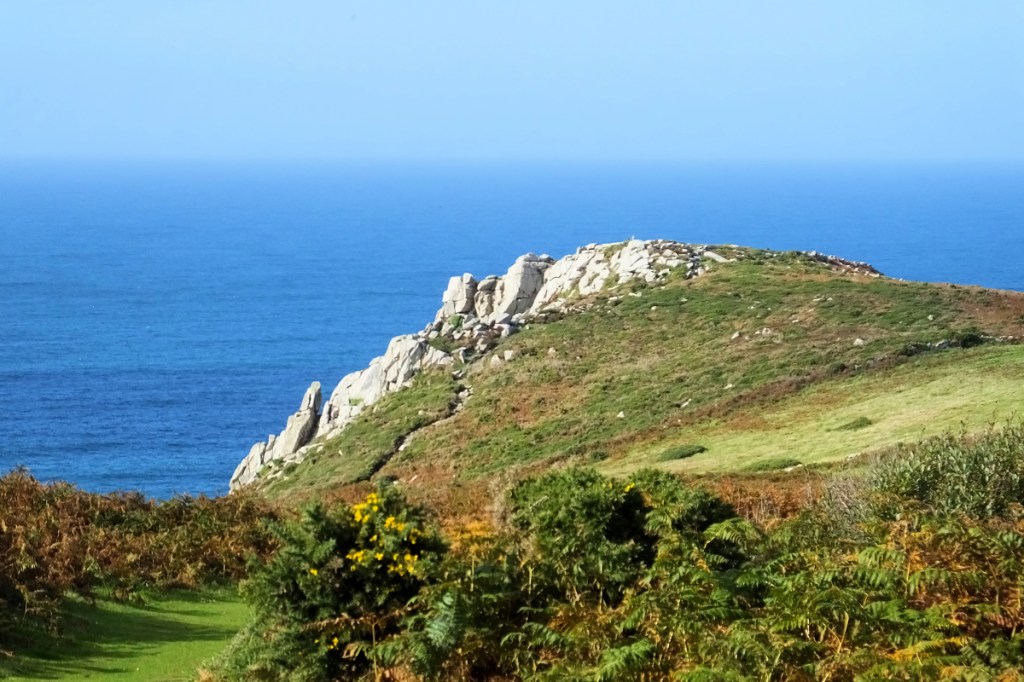
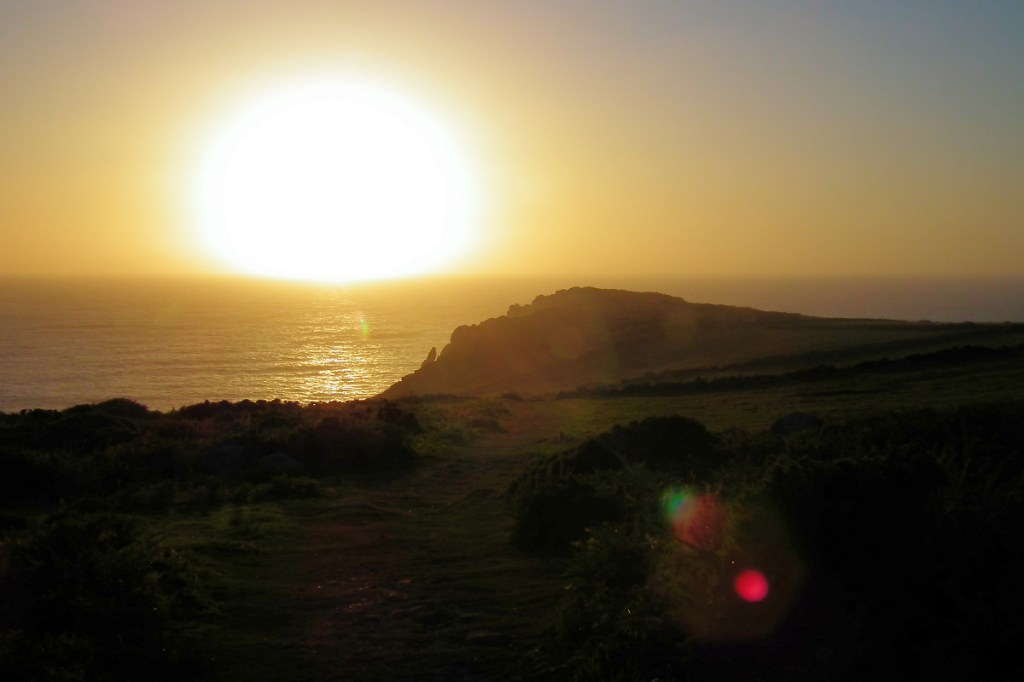
Bosigran Castle, a cliff sanctuary, West Penwith, Cornwall
It has been one of my pathologies in life – a wee ability to ignite people and things, providing a spark that sets things in motion. This is part of the role of an astrologer, but I’m one of those who has got his fingers in various pies over the decades, for all sorts of reasons. Some of these spark-moments I hear about or see the results of, often years later, and some I hope have happened anyway, somewhere, sometime, whether or not Schroeder’s Cat was watching, and unbeknownst to me. I’m happy about that. It has been a privilege to participate in people’s lives in that way.
I’m still at it – helping our proud nation raise, widen and deepen its true productivity levels, the true GDP of our people, through helping people fix their souls, and periodically managing to pass them occasional keys that open doors. Except nowadays I’m doddering around like an old fogey on sticks, wondering when the next seat is likely to appear. I go at about one-third of the pace of most people. I’ve passed my best-before date, so at times I have to work at finding a spark to ignite the old creativity-plugs.
I made a deep, bone-level decision during this winter. I’d been building up for it ever since getting stricken with cancer in late 2019. Perhaps it wasn’t a decision, more a confirmation or full acceptance of something I knew was the case but perhaps didn’t have the confidence to really go the whole way. It was like a conversion.
I decided that I shall not die for medical reasons.
Before you start overthinking and wondering what I mean, I mean this… I’ll die because it’s time and I’ve had enough, I’ve done what I came to do and to be (well, more or less), and because the angels no longer need to prop me up, and because I’m ready and cooked. Whenever that happens, I imagine I’ll go out quite quickly – y’know, an armchair job, or in my sleep, or a quick illness.
We shall see. Or perhaps tha angels might pull another trick and give me another lesson to learn. Sorry, mate, you don’t always get what you want! And what do you mean by ‘a good death’ anyway? Are you kidding?
Anyway, there’s not far to go – it’s months or a few years, as far as I can tell. But this isn’t to do with time. It’s to do with the fulfilment of all that needs fulfilling. Or a decent enough amount of it to lay it all to rest and hand in my cards.
There’s another thing too: dying is a part of life, not different from it, or a disjunction. It’s not ‘things going wrong’. It’s a continuity, a transition into another state, and the bits need to be in place for that, ideally. But once the bits are in place, you need to do it, to give permission for the tide to lift you up and take you away.
However, as you might already have found, our ideals often lead us along trackways that lead us all over the place – life on Earth is really complex and easy to get lost in. The path is rarely as straight and simple as it looked on the map. Or perhaps ideals trick us into doing things we’d run away from otherwise.
Who knows when I’ll drop off my perch? Do you know when or how you’ll drop, yourself? Probably not. I’ve been an astrologer for fifty years and I can’t answer that one. I don’t even try.
We don’t exist as individual selves as much as we would like to believe. We Westerners value ourselves very highly – y’know, it’s 400 Palestinians exchanged for six Israelis. And we make a big deal when people pop their clogs and remind us of our own impermanence, frailty and helplessness. We make stone memorials to them, as if to keep them pinned down in our world. We think of dying as a loss, as things going wrong, as loved ones leaving us.
In life we’re supposed to be on top of things – clearing that list, keeping to the timetable, doing what’s required, being responsible. But in the other world, well, that’s irrelevant. It’s necessary to allow ourselves to immerse and drown in the void and float through the vortex, to that far-off place where you no longer need to pay bills or fill in forms.
Ah, correction… unless you create that reality for yourself up there too! This can arise out of the illusion that, as long as we’re doing something, we must be alive. So we keep trying to do things, even when death is busy netting us.
But the big secret is, when you get there, to that expanded moment when your heart stops, there is nothing more you can do about all that, about that life you had. It’s over. Kaputt. Gesloten. Finito. Gone.
Then you’re in another world.
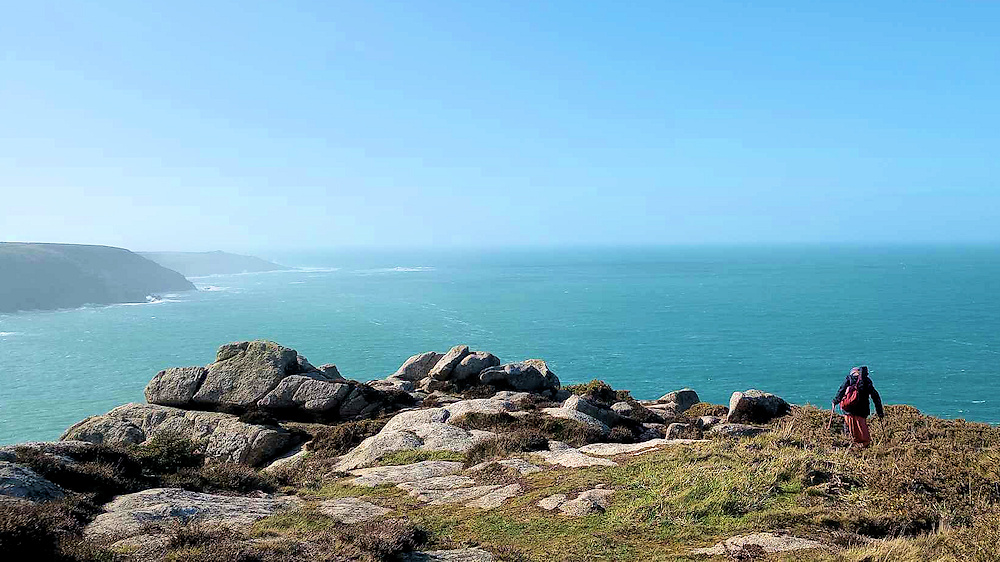
Palden at Bosigran, recently. Photo by Selina al-Mukhtar.
The fascinating thing is that we have karmic threads that permeate our lives and crop up in all sorts of ways in those lives. Since the soul does not exist within the experiential and sequential narratives of time, it lives all of its lives, from its viewpoint, at the same time. No time. Therefore, there is interchange and multilogue going on between our different lives, both on Earth and off it, and continually.
Think about it for a while… that’s rather a big thought.
For me, one of those karmic threads over several lives has been about calling together groups, clans, armies and throngs. This is a bit weird, because I’m quite a hermit too, or I prefer beavering away in the background. I’m not always doing that pulling-people-together trip, but in certain lives I’ve had that (shall we call it) calling or duty. In the life I’m now speaking from, it was called ‘The Camps’, and a number of readers will have been at them in former decades. And they still progress whether I’m there or not. Loads of other gatherings, groups, circles and networks too, and not only in this lifetime.
Some good people were key souls in making the camps happen – sister and brother souls who formed a constellation of energy and logistics to pull off a miracle. I dropped in the seed-idea, which was quietly formulated with a small number of people in our kitchen at the time, bless their souls, who ended up ‘holding the energy’ at the camps. A few are dead now, and others ageing. I get the feeling we’ll find ourselves meeting up again upstairs though.
In unconscious anticipation of this, the name of the cafe at the very first three seasons of camps around Glastonbury in the mid-eighties was called ‘Pie in the Sky’. Precisely. You’re welcome to come along, when you get to heaven.
Bosigran Castle as seen from Pendeen Watch direction
Anyway, when I started writing this it was intended to be a few paragraphs. As you see, it turned into more than that. But then, with loads of planets in Pisces right now, whaddya expect except slippery, bouncy dollops of the Great Unknown? So you got this diatribe. Apologies – I’ll go away in a moment. Nevertheless, it’s AI-free and much better than just re-posting neat memes with someone else’s pictures in the background. I hope.
The idea was to tell you about a new podcast. Recently I’ve been going on a bit about other worlds, other millennia, flying souls and random outbursts of imagineering and, this time, I thought I’d say a few things about life on Earth. If you’ve been there, or if you find yourself there now, it might give you a few interesting perspectives, while you’re busy doing the ironing or trying to figure out how to fix your car.
Or not, as the case may be. Who knows? Eitherwhichway, the pod is what came out of my brainbox and voicebox one rainy day when no one was looking. Except for the robin who sits outside eyeballing me expectantly and wondering what I’m doing.
Oh, and by the way, remember the Sunday meditations. They happen every Sunday on a cushion near you. Follow the link below if you need details. Keep it simple. Just do it.
Love from me. Paldywan.
The found sounds at the beginning and end are from recent early mornings on the farm in West Penwith, Cornwall.
This is particularly for people affected by cancer or any other serious or terminal illness.
I’ve been a member of the Honourable Company of Cancer Patients for over five years now and, amazingly, I’m still alive, and against the odds. I have a blood cancer, Multiple Myeloma, and I didn’t expect to live this long.
I waded through the tough grind of chemotherapy and dealing with physical disablement. I went down, nearly fell through the cracks, and found myself emerging from a dark tunnel around three years ago.
I found myself starting a new life – well, kind of. I have no idea how long I am to live – it could be next month or five years. But I found a reason to be alive.
This podcast is not about the medical stuff: it’s about the experience of cancer and what it can do to us. Deep in our soul.
This is my fiftieth podcast from the far beyond. The birds in the intro and outro were recorded here on the farm early in the morning on 19th February 2025. To me, they’re medicine birds – especially the geese, who overwinter here.
Yes, you’ve probably done it before -getting dead, that is. While this involves falling into the Great Unknown, swimming in the Vastness, it’s in your personal bundle of knowhow, somewhere deep down.
This February 2025 Aha Class was about the process of dying and what happens afterwards. The talk comes in two parts. They’re here:
I’m drawing on personal experience. This is what it’s like from the inside – at least, as I have experienced it, and the way I see it.
The range of possible dying experiences is vast, actually, and tailor-made for every soul according to our karmic dispositions and where we have got to in the lifetime we’ve just had.
The audio recordings of this two-part talk are ready and out now. Save them for a good moment – this is a special one.
Next month’s Aha Class is about geopolitical healing – working inwardly with wars, disasters and the deeper levels of the issues at stake on our planet at present.
Without uncertainty there would be no faith. I heard that on the radio this morning. It’s true.
Faith is not just about religion – it’s about beliefs of all kinds. Even belief (or disbelief) in that voracious phantasm called Donald Trump. Uncertainty makes us build a body of interconnected, multi-level beliefs, a world-view, by which we attempt to navigate the mizmaze of reality we’re presented with when we get born on earth and attempt to live out our lives.
This is where change starts, in our beliefs. Occasionally they need shaking up because they can coagulate into set ways and conventions that are not ultimately helpful. This applies to us as individuals and to human collectivities.
If we wish to contribute to changing things and making the world good, we can do so on many different fronts, whether working with overarching principles or with the building of buildings. This is where meditation comes in, because its realm is that of spirit, beliefs and the roots of human thought, feelings and actions.
We can have revolutions or other radical changes, but where revolutions fail is that basic beliefs don’t automatically change with them – though things can indeed get shaken up, stimulating uncertainty and thus a potential reformulation of collective belief and faith. Change needs to start both from above and below.
In meditation, by generating positive vibes and working within the vibrational field of collective human awareness, we’re working with change from the bottom up. We might not see things that way – we might simply be wishing to calm down, or do our practice, or pray for healing or peace – but that’s what happens anyway.
Whatever we seek in meditation, it’s worth adding a prayer that we help humanity raise its level, to look again at its realities, to see things in new ways and to become more conscious. Just this creates world change.
That’s my thought for the day (or the week).
Last week I lost my internet for three days, so no message was possible. So much for uncertainty! But as always I was there in meditation at the appointed time and I felt others of you there too.
You’re welcome to join us in the Sunday meditation. Just join us at the appointed time (see below) and do your meditation in your own usual way, together with us. If you’d like more information, click here:
On Wednesday 12th February I’ll be doing another Aha Class here in Penzance, Cornwall, and it’s called ‘Getting Dead, and what happens afterwards‘. Since many of you don’t live in Cornwall, audio recordings of the class will be online within a week afterwards. If the thoughts I wrote above are of interest to you, the next Aha Class in March will be about inner aid and geopolitical and planetary healing, consciousness work to help the world progress and to participate spiritually in specific world crises and issues. It will include an inner journey to do some work on that front.
With love from me, Palden
—————-
Current meditation times, on Sundays: UK, Ireland & Portugal 7-7.30pm GMT W Europe 8-8.30pm E Europe, Turkiye and the Levant 9-9.30pm Brazil-Argentina 4-4.30pm EST, Cuba, Jamaica, Colombia 2-2.30pm PST North America 11-11.30am
This is about the ancient sites of West Penwith in Cornwall, where I live. It runs through the prehistory of this area from the Mesolithic, through the Neolithic and the Bronze Age to the Iron Age, featuring particularly the megalithic periods of the Neolithic and Bronze Age – the time of the quoits, menhirs and stone circles.
It will be of interest to locals in Cornwall, or people from elsewhere who visit our ancient sites, or people with a general interest in prehistory and megalithic times.
It’s in four episodes – and for binge-listeners there’s a three-hour omnibus edition. If you prefer reading, there’s a PDF version of this short book that can be read on-screen or printed out.
Originally it was part of my book Shining Land, about the ancient sites of West Penwith, but I took it out because it made Shining Land too long. It works well on its own.
Britain has had two periods of national greatness. One was the 250-year empire-building period in relatively recent times, and the other was the Bronze Age and a megalithic civilisation that lasted a thousand years. This is its story, as it happened in West Cornwall, one of the hubs of megalithic activity in NW Europe 4,000 years ago.
If this interests you, I hope you enjoy the book! It’s free to stream or download.
The next Aha Class on Weds 12th Feb 2025 at The Hive, Penzance, Cornwall.
Receiving cancer into my life five years ago, I’ve looked in the face of death several times, and quite experientially. In fact, at present I’m surprised, even rather disoriented, to be alive. But it didn’t start there – this has been an evolving theme of my life. So in this Aha Class I’ll be sharing some insights and perceptions I’ve picked up along the way.
I had a life-changing near-death experience at age 24 – accidental food poisoning (hemlock, actually). I was unconscious for nine days, awakening with much of my memory wiped clean. Not long afterwards I met up with Tibetan Lamas, who taught their perceptions of life and death, about the bardos, the differing realms of existence, of which life is but one. Frankly, their blessings and kindness kept me on the rails during a very difficult time.
Then I became involved with campaigning for home-birth, following the births of two of my daughters. To me, a good natural birth made inherent sense with no need for rational explanation. Later in life I was even able to communicate with a soul before his birth, and he talked to me about what it was like being in his (to us) little world.
Later, from the 1990s onwards, I found myself working psychically with dying people, helping them over to the other side. Some were people I knew, and others were in conflict zones experiencing tricky deaths. Having been to the edge of death myself, I was able to help them transition – holding their hand and going over with them. It was remarkable how variable their experiences were. I was also part of a group (the Flying Squad) in which amongst other things we did psychic soul-rescue work in earthquake and disaster zones.
Since getting cancer five years ago, I’ve been hovering close to the threshold myself a few times. This has been a true education. Hovering on the boundaries really made me aware of the contrasting issues in both worlds. I feel reasonably comfortable about dying: in my way of seeing things, I’ll be going home. Well, at least for a while. I’m a bit beat-up and in need of deep healing.
I see things from the viewpoint of reincarnation. Looking at things this way, getting born, being alive and getting dead take on a new light. There’s something of us that continues through all of this. A newborn baby is not a blank slate devoid of character, and a person who dies doesn’t just stop existing – it’s a journey of the soul. Not only this but, as many of you might have found, being a witness to a birth or a death can be a wondrous and spirit-showered experience in its own right.
Dying is like an assessment of where we’ve actually got to after living a life. In the end it’s our own assessment, though it might take the shape of St Peter, or a wrathful deity, or a wise old angel. It comes from a place of truth, perspective and far-seeing that dawns in us during the dying process. This dawning can happen before, during or after clinical death, depending on where we are at – in terms of what we have truly become. This sounds serious, though it can also be joyful and a relief. It all depends on what we have done with our lives and where we have come to with it all.
This isn’t about judgements like ‘right’ and ‘wrong’. It’s about seeing the true and full range of causes and consequences arising from all that we have been part of – what we have done and not done during those defining moments, those periods of time and those dramas we were in. There’s an understanding, a forgiveness, a grace and mercy to it. We come to understand why things went that way.
Dying before we die: this can make the dying transition easier, decongesting the process. Getting stuff sorted before we go – and not just writing our will, but clarifying things in our heart and soul, in truth and ‘before God’. We all need to do a reckoning, a forgiveness, a resolution and a releasing, with ourselves, people and the world.
It was as it was. What have I learned from it and what have I become? I’ve made mistakes and done things I’m not happy about, and it’s a process of owning up and squaring with it. In some cases I’ve done things to rebalance or rectify things, and in others I have not. Even with unresolved issues, it’s necessary to accept their unresolution.
There’s also a balancing factor – the things we’ve done that we can be happy with, that brought forwardness to others and the world, some of which we did precisely to redeem our own shadows, to pass through a karmic gateway. Part of this reckoning involves acknowledging our strong points and things we are glad about.
So this talk is for anyone facing death, or witnessing it in a person close to them, or feeling bereaved, or working with dying people, or preoccupied with the deep-seated questions that life and death raise. Actually, if truth be known, that’s everyone, but we have room for thirty-fiveish people at the Aha Class! It will be recorded and posted online afterwards.
I take a rather left-field and spiritualistic approach to all this. Whether or not you agree, I hope this talk might help get you into the zone, elasticise some ideas and set some things in motion. In our modern Western culture we have a big taboo around questions of birth and death, and this is very strange and not to our advantage. Even so, every one of us got born (well done) and every one of us is heading for the exit (good luck). So perhaps it’s worth giving this matter a little attention.
Do come if you can. If you can’t, the audio recording is posted online about a week afterwards.
This is another of my Palestine tales from 12-15 years ago, from a book called O Little Town of Bethlehem, which recorded a five-month stay in 2011-12. In my writings and photos at the time my aim was to humanise Palestinians. Because, like you and me, they’re real humans with real human lives to live.
———————
As the sun went down, a wonderful atmosphere settled upon Bethlehem. The town was in a genial mood – people chatting and hanging out in the streets. At Cinema, a busy intersection with taxis and taxi-vans, I saw a six year old girl standing on some steps simply singing out loud to the street. This was not only touching but also rather refreshing because, for some reason, Palestinians tend not to sing.
Aisha, an English friend who teaches English at the Hope Flowers Centre and stays at my place one night a week, uses the large, empty, echoey conference room in the school for practising opera – she’s an accomplished singer but, living in Ramallah and surrounded with people who would find opera rather strange, doing her scales and practicing her arias doesn’t quite work easily. So she loves practising at the school, where she won’t be heard – and the conference room echoes quite nicely too.
Nevertheless, a neighbour discretely enquired of me what was happening. I explained and he smiled. He’d seen opera on TV, and was interested when I said that operas were like plays sung out loud, with stories to them. I asked him why Palestinians tend not to sing, and he said back, “Since the Nakba we haven’t had much to sing about”. Well, true, but I know that’s not the real answer, which I am yet to find out.
The Nakba, by the way, was ‘The Disaster’, the 1948 war during which the Israelis staked out their nation militarily, by ethnically cleansing and killing the Arabic inhabitants of hundreds of villages and towns in what became Israel. In the space of a few months, the population of Bethlehem quadrupled with refugees and they have never gone home – there’s no home to go back to. As a symbolic act, refugee families keep the keys to their old, lost houses, like a family totem, proof of having torn-up roots in their own land.
This afternoon was one of those times when people set their cares aside and enjoy the moment. That’s one thing I like in Palestine: people do their best to keep their spirits up and enjoy life. There is no alternative. Or at least, the alternative, dwelling on your problems, is far worse.
As my friend Ghada once put it, at a time when she was feeling pessimistic a few years ago, “In Palestine we don’t have up days and down days, we have down days and worse days”. She was at that moment manifesting symptoms of the strange collective bipolarity Palestinians live by, thanks to their circumstances: generally they keep their mood positive in spite of everything, but when they lose their strength and fortitude, they plummet into deep despond. That was where she was when she said this.
Palestinians wear their emotions inside out: love and sadness, friendship and disgust, humour and anger, they share them openly, men perhaps more than women. Their feelings spill out liberally. Mercifully it’s their positive emotions they show most. I have never seen a sign of violence except on a couple of occasions when Israeli soldiers are around, acting provocatively, but even then Palestinians suppress it because they usually don’t feel like getting shot, beaten up, arrested or hounded. They got tired of that ten years ago, and it doesn’t achieve much.
But on a lovely, tranquil afternoon like today, there was still a problem. On the way home, passing through Deheisheh and Duha, there was smoke everywhere. People were setting fire to the skips in which they put their rubbish. They do this because civic rubbish disposal is patchy at the best of times, and the skips were full. It’s not only smoky but dangerous, since so much of their rubbish contains plastics and other toxic materials, and the slow smoulder of the rubbish means that it doesn’t even burn properly. They have a blind spot around this issue. When Westerners like me raise the matter, they shrug it off as if it is no problem. But it is a problem and a big one.
Before you disapprove of these apparently backward people, let me remind you that we in the West started seriously addressing issues such as this only 20-30 years ago, when it was already too late for us. Before that, we trusted in modernity and slavishly paid the price in smog, toxicity, fumes and ugliness. Even today, when I speak to Westerners of the dangers of mobile phones, microwave ovens, wireless internet and electro-smog, people smirk or frown, as if to say “Oh no, he’s one of them”, since this is a current blind spot. One day an enormous scandal will erupt about it and people will yell “Why weren’t we told? Who is responsible for all this?”. We are responsible. We know. But we don’t want to face it.
So blind-spots – areas of life that people deliberately ignore, ultimately to our own cost – are not unique to Arabs. In fact, Arabs look on Westerners as backward because we turn our backs on God – Europeans by becoming increasingly secular and Americans by turning God into a heavily-armed, consumptive patriot with conservative politics.
Every race and nationality covers its insecurities by looking on others as inherently deficient. The less contact they have with other kinds of people, the stronger the negative projection on outsiders – this is one reason for the separation wall, so that each side can project its fantasies about the other onto a concrete screen untainted by reality. This is why Iran is currently a bogeyman – no one goes there to meet the people, so it’s easy to dehumanise them.
This said, Palestinians must still address the issue of rubbish – creating less of it and disposing of it properly. Battery recycling, vegetable waste composting and plastics disposal? Forget it, it doesn’t exist here. But probably it will exist in 10-20 years’ time – Palestine is at a similar stage to the West in the early 1970s. Yet regarding social values, sharing and human warmth, Palestinians are advanced, at a stage that I hope the West will reach in a few decades’ time.
I went into town to do my shopping. I’ve been sitting slogging away at the computer for the last week, so I don’t have many events to report. The trouble with computers is that people hardly see the results of your work because it’s digitally concealed, distinctly not in your face. Much of the work is for people far and wide, so that people around you see little significance in what you’re doing – you’re just sitting at a computer, twiddling fingers and looking serious. I’ve been building a website, dealing with issues for Hope Flowers, doing bits of work and answering questions online – many questions, from many people.
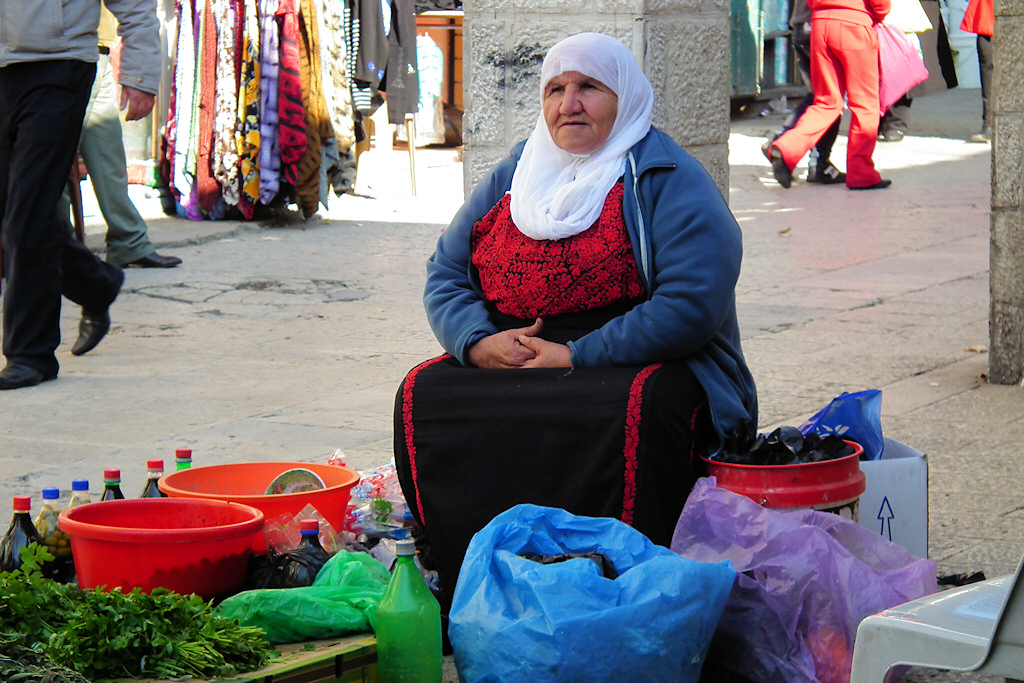
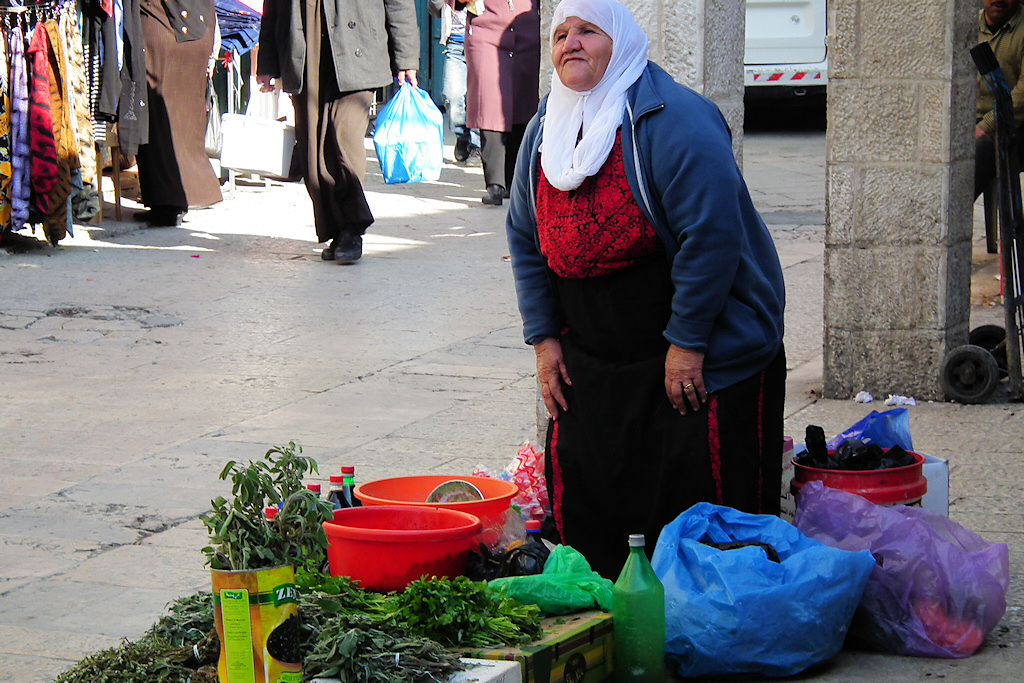
When shopping I went to an old lady I visit regularly. She has a small stall on the streetside in the Old Town. By stall, I mean a stool and a few boxes and bags. She sells herbs and figs. She’s a lovely old lady, clad in her embroidered traditional dress. She walks into town daily with her husband, who leads their donkey, which carries the herbs – then he returns home to work on the land, and he comes back to pick her up later.
Palestinians are big on herbs – they have mint or thyme in their tea and they eat parsley, sage, coriander, spinach and chillies copiously. I buy my herbs from her – big bunches of them, far too big to use on my own, for 1-2 shekels per bunch (20-40p in British money). She likes her pet Englishman. She eyes me closely when she thinks I’m not looking. I think she knows intuitively that I’m roughly the same age as she is, except she’s an old woman and I look younger – apart from a rather wrinkly face which has clearly seen some things. She hasn’t figured me out yet. Life wears out Palestinians.
Then I went down to the market to get vegetables. Two stallholders were trying to steal me off the stallholder I usually go to, but he has the best vegetables. One thing many Palestinians don’t quite understand is this. They tend to think one is obliged to shop with them out of a duty to support them – after all, fair’s fair, isn’t it? Well no, I’m a Westerner, and I go for the best stuff and the best deal. Sorry about that. Also, annoyingly, I buy things only when I need them.
The souvenir shopkeepers down in town think similarly. I’m a Westerner, therefore I have money, therefore I ought to buy from them. Not so. I buy presents only because there are people I know and love to whom I wish to give things, and I buy specifically for them. There’s also the question of how to get it back to England, so I cannot buy much. I’m not a buying machine – well, at least, not in my own head.
Dear reader, this might seem elementary, but it’s not so for Palestinians. This is a walled-off cooperation and mutual-support economy, an economy where everyone depends on everyone else for keeping each other alive, so the emphasis here is on supporting your fellow citizens by trading with them, to some extent whether or not you need what they’re selling.
Nevertheless, when one of the traders, a young chap of seventeen who helps his elder brother run a shop, moaned to me today about having no money to buy schoolbooks, I took pity on him. He had said there had been no business today, and he needed 50 Jordanian Dinars (250 shekels or £50) for the books tomorrow. He was worried and depressed. So I wandered off to do other chores, including raiding a bank machine, and slipped him 50 JDs on the way back. He lit up and hugged me, shedding a tear. Now he could get his books.
I told him that this is a life-lesson we all need to learn: solutions often come when you’ve given up. When you give up, it means you’re opening up to Allah, handing over your problems since you couldn’t solve them yourself. This money is a gift from Allah, through a random Englishman. So give thanks to Allah.
“You are a good man, Mr Balden. I pray that Allah, he will pick you up when you have a need.” Well thanks, I might need your prayer to come true one day. This young Palestinian, poor yet intelligent, has better English than some of the 17-year old Brits I know. Good luck to you, mate – I sincerely hope you get a future.
————————–
My three Palestine books are: – Pictures of Palestine (in print and as a downloadable PDF) – Blogging in Bethlehem (an audiobook and PDF) – O Little Town of Bethlehem (PDF only) Available here: http://www.palden.co.uk/pop/order.html
Yes, that’s the drug I’m on today, together with Lenidalomide, Dexamethasone, Apixaban and Aciclovir – it’s enough to make pharma-paranoiacs run a mile. Many have been the messages I’ve had which recommend all sorts of alternative means of staying alive. No doubt well intentioned, I nevertheless find myself writing back to ask whether they have actual experience of what they recommend – which has mostly not been the case. Most seem to think I have a ‘normal’ cancer, without actually knowing I have Multiple Myeloma, an incurable blood cancer and definitely not normal.
I’ve listed all the holistic supplements, remedies and methods that I use in my cancer treatment in my book and audiobook ‘Blessings that Bones Bring‘. With a philosophy of counting my blessings, I’m doing both pharma and holistics, and it works, and the ideological contradiction between them that many people set up for themselves is something I gladly omit to subscribe to.
Just as well really – I’m alive against the odds. But the biggest medicine of all is this. If you are practicing your life-purpose, the reason why you came here to Earth, as a priority, then you’re likely to stay alive until it’s reasonably complete – whatever that means. However, here’s the rub: for some people, dying and the manner of their death can also be part of that life-purpose. Princess Di was an example.
It’s an initiation. You might be a smart-arse with a masters or a doctorate, but they will not qualify you for this. What’s needed is every single cubic inch of humanity you have in you. It comes at you, takes away your control and takes you off, out of your body to another place.
Or perhaps you believe it all goes dark and the you that is you somehow suddenly stops being you – you’ve become a useless pile of dust returning to the dust. Well, good luck with that, though you might be heading for a few surprises. In my experience, the journey doesn’t stop there. Just as well really.
I do have a strange tendency to believe that there’s more to existence than that. The last five years, since cancer gave itself to me, have reinforced that belief. If indeed it is a belief. After all, do I believe in breakfast? Do I believe in trees, rain and sunshine? I’ve been really close to dying, several times. Actually, I shouldn’t be alive – and that’s not a medical opinion but my own observation. I’ve made it through thanks to a series of miracles, a few acts of faith and a strange capacity to rebirth myself. Plus the prayers and goodwill of friends, the blessings of guardian angels, and… work. Yes, work. Working at the reason why I came, and whether I’ve done enough of it to feel satsified with a job well enough done.
Much to my surprise. I wasn’t expecting to be alive after five years, and it leaves me in rather an open space. I thought that at most I had three years, and now I’m on extra time. It’s a matter of figuring out how to make plans while knowing that I’m vulnerable enough, and my grip on life is tenuous enough, to pop my clogs tomorrow or the next day.
For me, it’s a matter of taking charge of my death. It’s my decision – not anyone else’s. Except perhaps for those angels. A year ago, my haematological specialist at the Royal Cornwall hospital said to me, “Well, Mr Jenkins, I don’t know what you do, and I don’t want to know but, whatever you’re doing, keep on doing it“. Indeed, I did, and I’m still here. I’m an easy customer for her – I get few complications, I’m uncomplaining though I’m also calm and clear about certain issues, and she leaves me to my own devices. No, not toxic digital devices, but devices such as intuition… and inner doctors.
Yes, I’ve got some inner doctors. I called them in at an early stage. My angels shunted a few in, too. Once a week, I have a session with them (and at no charge). I go into myself, breathing myself down into a deep state, and I open myself up to them, and there they are. They examine and scan me – using psychospiritual technologies that make Startrek look primitive. I feel them umming and aaahing over things, and consulting, and sometimes I’m flooded with light, or they insert a light-tube into me, or they focus on an organ, and often I’m not at all sure what they’re doing but I can feel them doing it.
At times they raise me up to their level and it feels so friendly, inclusive and welcoming there. I kinda hover there, on my back, held in the middle of their energy-field and jiggled, poked, massaged and blessed by invisible forces. After a while they drop me back down again.
It’s funny how it works. The doctors at Treliske have been worrying about the fact that I’ve been a lifelong smoker – it helps my brains and, as a psychic, also helps me stay on Earth – since I am not a foodie, which is the other way many psychics stay on Earth. So I was to go in for a lung scan. But during my last session with the inner doctors, I did two things. One was to ask for their help in cleaning out my lungs and removing anything that’s unhelpful, and the second was to offer myself up and release all hopes, fears and expectations, to get to a state of full acceptance that, whatever is to happen will happen, and it will be good.
So they flooded my lungs with light and I felt them doing something there. I continued with this in the days that followed but, the day before the scan, the thought came, “Hmmm, this needs more time…“. Claire, a trusty helper from over the hill, took me for the scan. I walked into chaos – the power had gone off – but eventually, on the second interview, the nurse said, “Ah, Mr Jenkins, I’m sorry to say that we can’t scan you because you had a PET scan last August and we cannot scan you more than once a year“. I quietly chuckled. Yes indeed, this needs more time, and I’d just been given it. The nurse didn’t notice me looking upwards and smiling. This is how it sometimes works.
I thanked her for her consideration, saying I am electrosensitive and it matters to me. “Ah, that’s interesting“, said she, proceeding to ask questions as if she knew about it. This was refreshing: in the last five years only one doctor has indicated interest. He showed me a paper in The Lancet which correlated incidences of Multiple Myeloma with proximity to nuke stations. Since then I’ve met other Myeloma patients who have worked operating radar systems, driving nuclear-waste trains from Sellafield, working as high-tension power cable or mobile phone engineers, or as programmers who’ve used a lot of wi-fi…
Once information about EM-radiation is finally made public, everyone will no doubt bleat, “But why weren’t we told?”. To which the answer is: “Why didn’t you feel it and use your commonsense? Did you think it would be alright to irradiate yourself all day and every day without consequence?”.
Well, we humans… we find quite intricate ways of limiting our possibilities and making life difficult. The same applies to me. However, while I have my own self-immolating patterns, I’ve also looked after myself and now find myself still alive as a result – if proof be needed. I’m definitely glad that, at an early age (21) I went vegetarian and changed my life – it has paid off. Yes, I got cancer, but my capacity to deal with it is far greater than most people’s, because on the whole I’ve had a good diet and lifestyle, having built up a good reserve stock of resilience.
But here’s what in the end is the key bit: I’ve been following a growth path, with fewer diversions and denials than most ‘average’ people. If you live on purpose and in purpose, it gives you distinct reasons for staying alive.
But even then, the stories of our lives are multiplex and not limited to being alive in a body. Many of us aren’t even fully installed in our bodies, even when emotionally attached and afraid of losing them. The Council of Nine put it quite well…
“Your Planet Earth is the most beautiful that exists in the universe. It has a physical variety that no other planet has. It has a varied climate that no other planet has. In all the universe there is no planet in existence that has the physical characteristics of Planet Earth. It is the rarest of beauties, and it does attract souls which, once they have come, would like to come back again. This has created a bottleneck of souls recycling on Earth.
“It is of a different nature from any other planet. It has aspects of all planets: it is like a composite of the Universe, with all the positive and all the negative aspects, and all in between, and this is what attracts souls.
“It has with it a gravitational pull that is different from other planets, and because of this a soul begins to feel a physicalness. Souls become adapted to their physical bodies, and they forget the freedom and pleasures they have without it.
“The Earth was created to be a paradise. When souls achieve harmony it will become a paradise again. Planet Earth is the only one of its kind, the only planet of free [individualised] choice in the entire universe, the planet created for the balancing of the spiritual with the physical – in other words, the creating of paradise.“
To some extent this ‘paradise’ business is an attitude of mind. In a funny sort of way, since getting cancer and becoming partially disabled I’ve been happier than before. It’s all to do with how we deal with the life we’ve been given. Nowadays, a lot of people do a lot of complaining about life, as if it’s all someone or something else’s fault. But my best recommendation is, just go to Gaza, Yemen, Sudan, Belarus, Syria, Ukraine, Xinjiang or Myanmar – there are plenty of options – and do a full-spectrum re-assessment. You might find that you come to feel differently about things. That’s what happened to me.
Yeah, life’s a bitch, then you die. However, here’s another gem from the Nine: no one is here by accident.
So, you see, even on pharmaceutical cancer drugs, you can do something with it to make it good. That’s where that free, individualised choice truly lies. It’s on us, not anyone or anything else.
It’s funny how sometimes we fall into things unwittingly, then to find that they take up years of our lives. This is what happened with my research into the ancient sites of the area where I live, in West Penwith, Cornwall. It all started one day when I was sitting chatting with Cheryl Straffon, an archaeologist and goddess-oriented pagan who for decades has been a key person here, bringing together a full spectrum of prehistorians, from archaeologists to pagans, and editing Meyn Mamvro, a magazine about Cornish archaeology and earth mysteries.
We were talking about John Michell who, in the 1960s-70s, brought the idea of leylines, sacred landscapes and earth mysteries to wider attention in a seminal 1969 book The View over Atlantis. John came to Penwith, doing fieldwork here to demonstrate his point, producing a catalogue of ninetyish ancient site alignments in Penwith, about which he wrote in his 1974 book The Old Stones of Land’s End.
I asked Cheryl whether anyone had made a map of the alignments John had found. No, she said. Hmmm. In former times, I had made a map of the alignments around Glastonbury… “Would it help if I made an alignments map of Penwith?“. “Oooh, yes, it would.“
I thought at first that it might be easier than it turned out to be. It landed up being seven years of work, starting in 2014, and it still gets tweaks and updates now. I’d had one of those falling-into-things moments, just then.
Carn Galva, a classic Neolithic Tor and the axis mundi or world centre of Neolithic Penwith – as seen from Caer Brân
Things had changed since I did the Glastonbury map, hand-drawn in 1982 and revised around 2003. Aerial satellite mapping had arrived on internet. For alignment-oriented geomancers like me this greatly changed the equation, opening up many new possibilities and making alignments maps easily accessible online to the public.
At the beginning it came clear that a genuinely useful map would need to show all of the known ancient sites in Penwith. But there are more than 800 of them, big and small, surviving or destroyed, so this was no small job. They were listed in a variety of online databases which, to complicate things, sometimes gave differing or inaccurate information, so every single site had to be examined closely.[1] I spent months trawling through these sources and building up a base map on which later to mark alignments. Later on I continued the mapwork to cover Scilly and the whole of Cornwall.
Some sites were difficult to confirm, being disappeared, disputed or subject to discussion. Some were visible in the field and others, now destroyed, were beyond trace, though many are mentioned in antiquarians’ records from former times – especially those of one called Dr William Borlase, who tramped around Penwith in the mid-1700s.[2]
Eventually I completed a map of Penwith’s sites. Then it was a matter of working through John Michell’s list of ninetyish alignments, plus others found since his time and listed in Meyn Mamvro.
One can argue till the end of time about the validity of megalithic alignments and sceptics love to do so, claiming an assumed authority of scientific rationality when, to me, all that these complaints demonstrate is that sceptics have not properly researched the matter. There is a simple, evidential, inescapable fact: ancient sites are commonly located in exact alignment with each other. This can be seen and checked by anyone on maps and in the field.
That’s the evidence, whether or not we have an explanation. It happens too much, too exactly and with too many supporting details to be a case of chance or randomness. There are discernable patterns to the specific nature of differing alignments – some are made up solely of cairns or menhirs (standing stones), or they link sites of similar antiquity, or they make some sort of sense in a wide variety of ways. Some alignments are even parallel.
If you look at the online map of Penwith’s alignments [3] it looks like a meaningless jumble with only a modicum of order to it. There’s a ridiculously large number of alignments and it’s difficult figuring out how and why the megalith builders went to the trouble of setting things up like this.
But when you look closer at individual alignments and the sites they connect, they begin making more sense. It’s worth remembering that the ancients walked everywhere, so a lot more happened for them in the space of a mile than it does for us, speeding along in our cars and looking at overview maps.
What is most interesting is that alignments stretch not just between man-made sites, but they also involve natural sites such as hilltops, carns (outcrops) and cliff promontories. The whole system is based on these prominent points – I call them ‘base sites’. The pattern of ancient sites is draped over the three-dimensional canvas of the Penwith landscape and arranged around it. There are also astronomically-oriented alignments and other factors such as energy-vortices, underground and overground energy lines, site intervisibility and even geometry that are involved in the positioning of ancient sites. [For more on this, here’s a talk by me.]
Entering Michell’s ninety alignments on the map, I found that only two were inaccurate and implausible, and I removed them. He had done good, accurate work. While making the map and checking the alignments, I started finding new ones and, before long, the list of alignments grew bigger. Some were found logically, by examining a chosen site to check for alignments, and some were found intuitively, happening on them ‘by chance’. After visiting sites around the fields and moors of Penwith, I would come home to examine their location and possible alignments, sometimes adding a few that way.
Late one evening I had a Eureka moment. I was thinking about Cape Cornwall, a conical-shaped headland in a marine context, and St Michael’s Mount, a conical-shaped island in a marine context (though originally it stuck out of the forest on dry land). They are rather similar. I wondered whether there was a connection. I looked on the map and, lo behold, a line between them intersected a collection of four Bronze Age barrows on top of the hill on the farm where I live!
Gosh. I had sat many times on those barrows.[4] They are not well-known because, being on what’s now a boggy heather-moorland hill, they look unimpressive, but their 360-degree panoramic location is spectacular. In the Bronze Age they would have been far more attractive, situated on sweet hilltop meadows – the climate was more agreeable 4,000 years ago than it is now.
Then I started looking for further alignments emanating from St Michael’s Mount and Cape Cornwall. Within an hour I had found quite a few. This doesn’t happen very often – I’ve never had such a big discovery of new alignments before or since. These proved to be a new kind of alignment that John Michell and others had not seen.
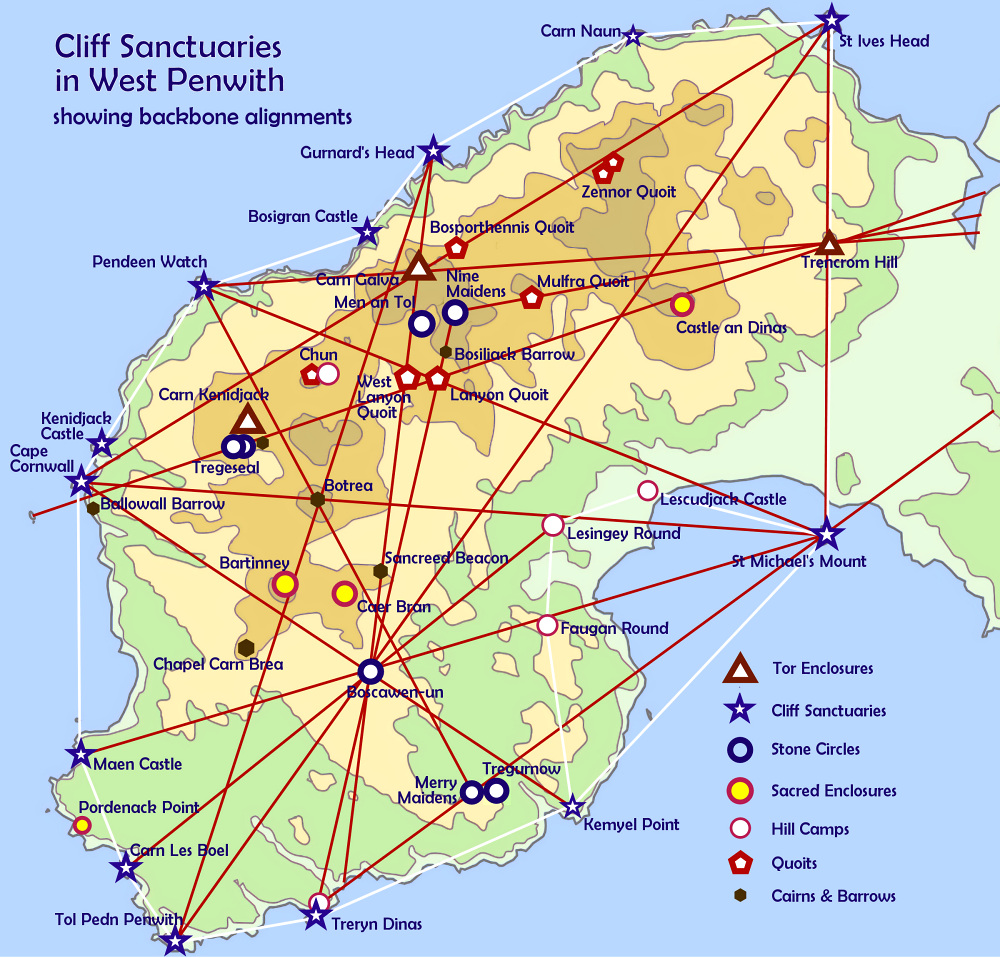
John was looking at constructed Bronze Age sites such as stone circles, menhirs, cairns and barrows, which were built from around 2400 BCE onwards. The new alignments I had found involved Neolithic sites from a millennium earlier, and natural sites such as granite tors and cliff headlands. These alignments acted differently to Michell’s Bronze Age ones, covering longer distances and with fewer points on them. I called them ‘backbone alignments’ – alluding to the main system of fibre-optic cables that connects the internet globally. Connecting Neolithic and natural sites, these alignments were clearly far older than John’s Bronze Age ones.
The very first constructed sites in Penwith, Neolithic tor enclosures, were built around 3700 BCE – over a millennium before the stone circles. There were four – Carn Galva, Carn Kenidjack, Trencrom Hill and St Michael’s Mount – and one outside Penwith that features in its landscape, Carn Brea near Redruth.
Many of the newly-discovered backbone alignments also stretched to what I call cliff sanctuaries. Archaeologists call them cliff castles – a term that persuades many people to believe they were used for defensive purposes, which I would argue they were not. They are customarily dated to the Iron Age around 300 BCE, long after the megalithic period, because Iron Age remains are found on them. But the new alignments, associating them with Neolithic sites, suggest they were much older in the first use. Neolithic artifacts have been found at some cliff sanctuaries, but these have not caused them to be properly re-dated to this early time.
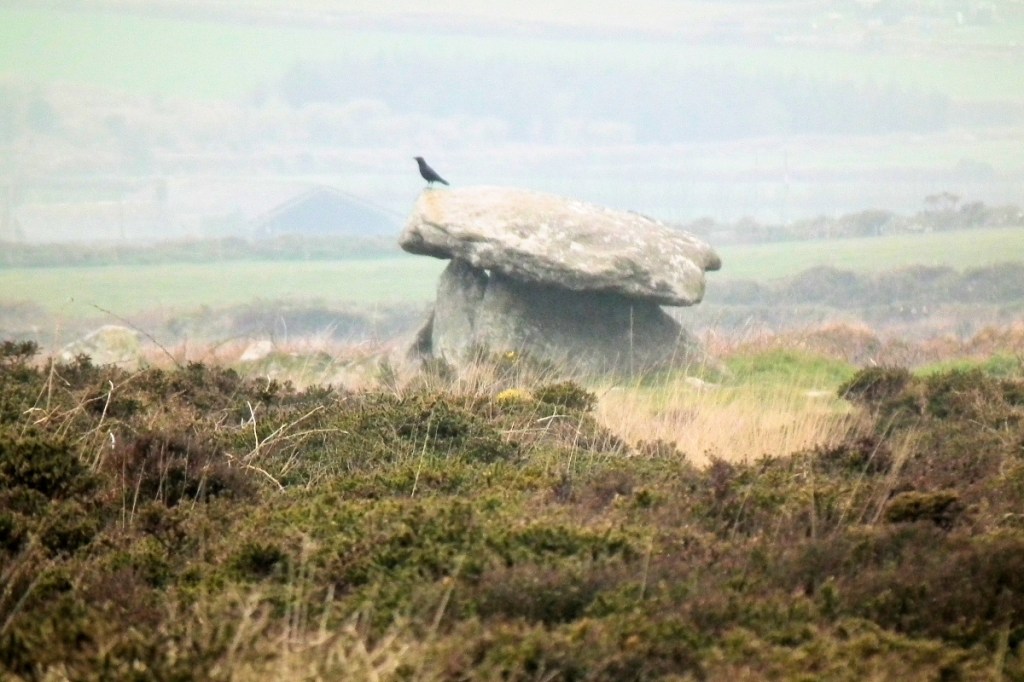
Then came the clincher. I found that Lanyon Quoit, one of the key Neolithic sites of Penwith, built around 3600 BCE, was located exactly at the intersection of three of these alignments. In other words, Lanyon Quoit could not have been placed where it is without these three alignments being known at the time – it was positioned to align with two cliff sanctuaries and three Neolithic tors. This definitely re-dates the cliff sanctuaries to the Neolithic, also making them far more important than they previously were understood to be.
Penwith’s four surviving stone circles are all located on backbone alignments. The Merry Maidens, for example, are located exactly on an alignment stretching between Carn Brea and St Michael’s Mount, both Neolithic tors, and Treryn Dinas, a cliff sanctuary. These three natural sites happen, strangely, to be aligned with each other (there are a number of such cases in Penwith). So the stone circle was located there to reinforce the alignment and to draw on the antiquity and earlier primacy of the three Neolithic sites, which came from what in the Bronze Age was a distant former time, some 1,500ish years before.
Eventually, the alignments map of Penwith became really busy with alignments – around 250 of them. They were all genuine alignments, accurate to within 10ft or 3 metres, checked and verified by three people – so this was not a product of sloppy mapping, wishful thinking or ley-hunting zeal.
Alignments are not energy-lines of the kind that is picked up by earth energy dowsers. They are different, even though overground energy lines, like alignments, are also straight. Some overgrounds coincide with alignments, but we yet need to find out the extent to which this is the case.
Trencrom Hill (foreground) and Carn Brea (background) – two Neolithic tors
I’m of the opinion that alignments are not actually lines that are detectable in the landscape. Some dowsers might disagree, but I think they might be picking up on overground energy-lines, or perhaps the thought that links the two sites involved. Instead, it seems that, when a new site was being built, it was simply aligned with other sites in order, presumably, to associate it with them. If you line up five or six objects on a table with gaps between them, aligning them nevertheless gives their distribution some order and coherence. Rendering order out of seeming chaos was important to the ancients. But aligned sites don’t seem to have a connecting current like overground energy-lines do.
It seems to me that aligned sites are instead programmed with the same algorithm, so that they pulsate and resonate with each other, as if tuned to each other. But there isn’t a ‘wire’ connecting them – it’s an internal, implicit connection. It works a bit like what physicists call ‘quantum entanglement’, and as an informational rather than an energetic relationship. An energetic relationship is created by energy-lines that dowsers identify, but alignments don’t do this. So we’re talking here about two different circuitries that each focused on the same ancient sites. And it’s the sites, not the lines, that matter most.
Many ancient sites are thus placed exactly where they are to align them with other sites, though there is no ‘pipe’ connection between them. Instead, they seem to be remotely associated, programmed with the same intent, frequency or behavioural patterns, so that they do similar things at similar times and in similar ways. But they aren’t necessarily directly connected, unless there is also an energy-line between them.
Thus, the Boscregan West cairn, a prominent clifftop cairn on Penwith’s west coast, is aligned with the Neolithic longbarrow on Chapel Carn Brea, and with the now-destroyed Tregurnow stone circle, which was part of the Merry Maidens complex. So these three sites, associated with each other, somehow co-resonated. Or, put another way, two Bronze Age sites, Boscregan cairn and Tregurnow stone circle, were plugged into a Neolithic site on Chapel Carn Brea.
The cliff sanctuaries, embracing the Radiant Land
Interesting, huh? The megalith-builders had quite sophisticated ideas. They weren’t building ancient sites just to decorate the landscape or because it was a nice thing to do. It was a lot of work. They can only have done it because they perceived a definite benefit.
Here’s a much bigger idea. The density of sites and alignments in Penwith, and the way they seem to be integrated into complex relationships with each other, suggest that they operate as one big system. The fundamental substructure is marked out by backbone alignments (yellow on the map), and while the profusion of local alignments (red on the map) seems chaotic to our eyes, it has a certain order of its own. They all seem to make up one big system.
This leads us to the idea that Penwith is an integrated and perhaps super-charged landscape with hundreds of constituent components to it, big and little. That’s the way we should think about it, and not as a disparate scatter of separate sites. After all, Penwith’s ancient name is Belerion – the radiant land – and a place doesn’t pick up a name like that without good reason.
While Penwith’s stone circles and other sites are each modest in size when compared with Stonehenge, Avebury or Callanish, together they make up an enormous system contained by a necklace of cliff sanctuaries and studded with many subsystems. They constitute what can be regarded as a single, big ancient site that is draped over the peninsula’s natural topography and energy-centres.
Each stone circle has a complex or constellation of lesser sites around it – mainly menhirs and barrows. These supporting sites and the surrounding landscape vista exist as an integral part of the stone circle to amplify its purpose – a stone circle doesn’t exist in isolation. In the case of Boscawen-ûn and the Merry Maidens the surrounding agricultural landscape of hedges and fields obscures their wider complexes, but at Tregeseal and the Nine Maidens, located in wilder landscapes, they are more visible.
Tregeseal, for example, sits in a perceptual bowl of hills with a westward vista featuring the Isles of Scilly – almost as if the sweep of hills collects energy from the cosmos to funnel it toward the Scillies. Each stone circle is associated with a hill or tor that is visible from it and a key part of its landscape setting. These complexes are whole systems. In turn, they are aligned with other sites further away, knitting the whole of Penwith into a wholeness.
The stone circles are located on backbone alignments plugged into Neolithic sites – tors and cliff sanctuaries which, in the heavy-forested Neolithic, were the only places where people could get out of the wildwoods. This changed in the Bronze Age, with far more cleared land, which enabled the building of stone circles, menhirs and cairns, but the stone circles, as the ‘cathedrals’ of the system, drew their primacy, authority or blessing from earlier Neolithic sites.
They are key nodes planted in a landscape energy-system with a natural, topographic, geological and subtle-energy foundation. The system fashioned itself around the lay of the land. Here we come to the idea of landscape temples, or whole landscapes that have been developed and consecrated by amping up the natural energies inherent in the land. This was done not only through ‘megalithic geoengineering’ at sacred sites but also through repeated, longterm consciousness-work by successive generations of people. This was an advanced deep-shamanic culture. They imprinted their sacred sites and landscape with repeated and reinforced psychic traces of the shamanic and spiritual practices they conducted over many centuries. They loved the land that gave them a life to live.
An approximate timeline for megalithic Penwith
There is a key aspect of ancient sites that archaeologists miss, and without it ancient sites cannot truly be understood: it concerns earth energy and its psychoactive effects, especially when they are focused and enhanced at man-made ancient sites. These effects cannot easily be detected scientifically, but any person with a modicum of awareness can feel them when visiting sites. We become changed in mood and spirit, sometimes feeling inspired, healed or as if our problems have evaporated. Some people are changed for life – for me, five decades of preoccupation with ancient sites began in 1970 in the Ring of Brogar, a stone circle in the Orkney Isles off Scotland.
These psychoactive effects are a key factor that should be considered ‘legitimate evidence’, regardless of whether or not it can be measured or slotted into existing scientific frameworks. You do not need a doctorate to feel these effects: simply note your feelings and state of being before you enter and after you leave a stone circle. There will be a real change of feeling. Fascinatingly, it can also be quite different in quality and effect each time you visit.
This, I suggest, is a key reason why the ancients went to so much trouble heaving stones around, digging and piling up earth, and doing regular, intentional, collective consciousness work at ancient sites. They spent centuries building up a sophisticated landscape-wide energy-system, and they must have perceived this massive infrastructure investment to be beneficial and worth the effort.
If they had been deluding themselves, it is unlikely that the Bronze Age megalithic period would have lasted 1,200 years. Delusions don’t tend to last that long. There was something very sensible and realistic about the megalithic geoengineering they developed. With our planetary problems of today, we might do well to learn more about what they were up to.
Here’s a final thought. Since right now the world is rather obsessed with warfare, we might also ask ourselves how and why West Penwith is one of the few parts of Britain that has never been invaded – not by Romans, Saxons, Vikings or Normans. In later times Penwith was quietly regarded as lying ‘beyond the reach of the king’s men’. We’ve had some medieval Corsair raids and in the last century or so a seasonal tourist invasion, but Penwith has never actually been invaded. But that, of course, is pure luck and chance, isn’t it?
NOTES:
The main sources were: Heritage Gateway, Historic England, Cornwall Council, Megalithic Portal, Modern Antiquarian, Meyn Mamvro, The Holy Wells of Cornwall map, The Atlas of Hillforts and snippets from other books and sources.



















 Notes from the Far Beyond
You must be logged in to post a comment.