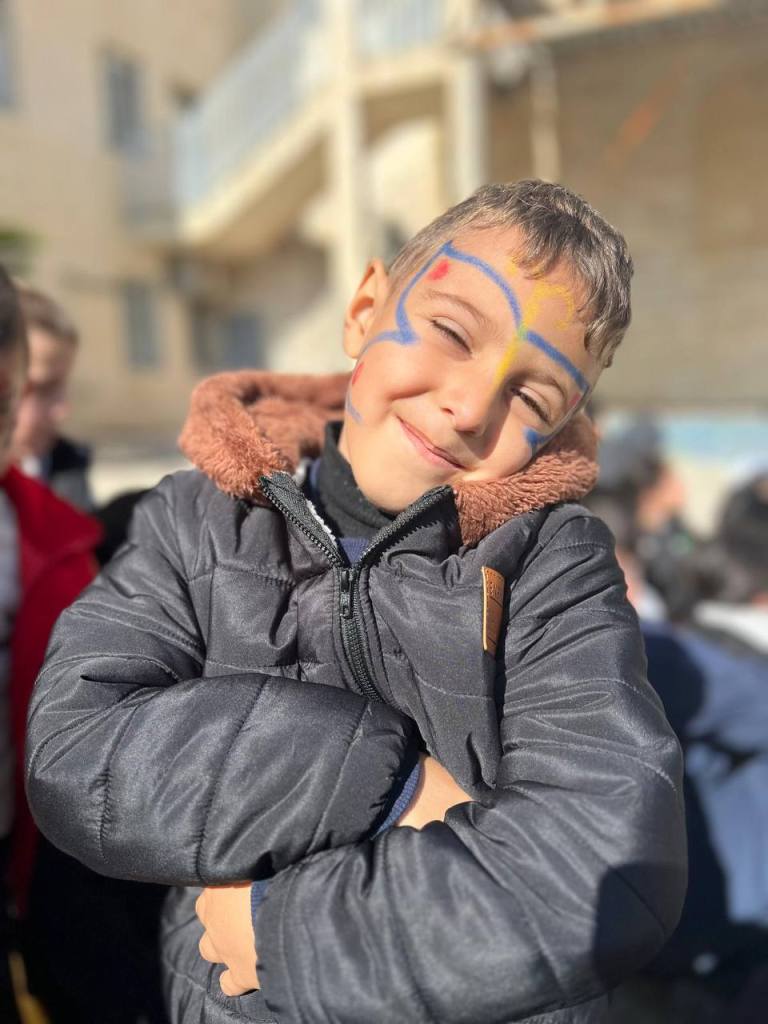
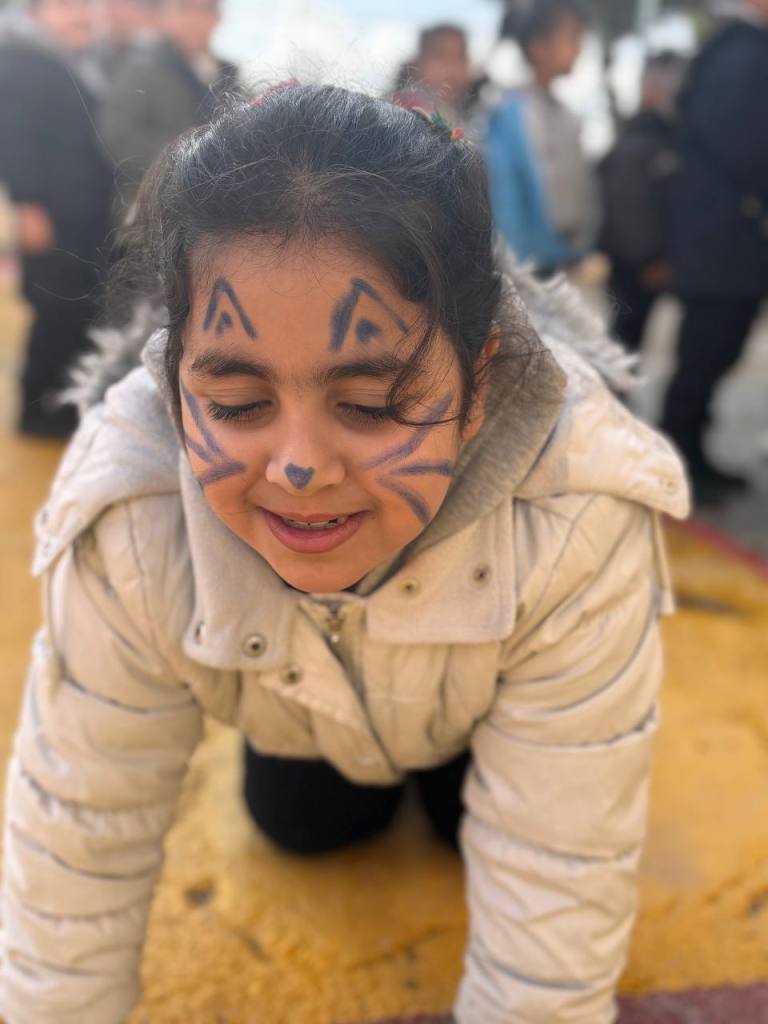
These are kids at the Hope Flowers School in Bethlehem, West Bank, Palestine, and these pics were taken in the last few days.
They are orphans from Gaza, and refugee and special needs kids from the West Bank. Apart from giving a good education under difficult circumstances, the school gives kids the tools to process their anger, loss, fear and trauma, so that they grow up knowing there is another way. Another way from what has happened over the last hundred years in Palestine and Israel.
Note the performers. These look like visiting Europeans. They are independent humanitarians: they set about brightening up the lives of people in places like Palestine and they make a big difference. They often fund themselves to do so, and travel cheap and crash on sofas. Some are performers, some hairdressers, some are welders and some are law graduates, artists and retired professionals. Have you ever considered doing something like this?
Forget Trump and Natanyahu: this is the human frontline, where the real work of peacemaking happens. These children are, I hope, the generation who will see a big change across the Middle East. The times of war need to end now: we must do things another way. And these are the people who will do it. That is my prayer for them.
Here’s the translation of the text that came with the pics:
In an atmosphere filled with fun and positive energy, the professor of physical education, Mr. Mustafa, organized a special recreational day for the students of the school, in cooperation with the refugee center, where play, art, and laughter came together in an unforgettable day ✨
⭕ A variety of events between animated games that enhanced activity and interaction, face painting added colors of joy to the faces of children, alongside a theatrical circus that presented pleasant performances that brought joy to the hearts🎪😊
Our students also participated in playing with parschute and other group activities that contributed to promoting a spirit of cooperation, active discharge, and building self-confidence in a fun and safe way 🌟
⛔ This day was an open space for joy and expression, and an integrated recreational educational experience that emphasizes the importance of play in supporting our children’s physical and psychological development 💚
ـــــــــ🍂ــــــ We learn for human well-being ــــــ🍂ــــــــ
To make a donation to Hope Flowers, go to this page for links to Hope Flowers’ supporting organisations in different countries: https://hopeflowers.org/wp/support/
Here’s a readable story about the history and philosophy of the school. It’s from my book Pictures of Palestine, and it’s called ‘Korea meets Palestine’. (Korea and Palestine were both divided in the same year, 1948.) https://www.palden.co.uk/pop/korea-meets-palestine.html
This started out as my usual weekly posting about the Sunday Meditation, but it turned into something else…
A Palestinian bagpipe band in Manger Square, Bethlehem – a leftover from British Mandate days
In Britain we currently have a kerfuffle about an anti-Semitic murder outbreak in Manchester, one of the most multicultural cities in our country. Though I’ve worked a lot with Palestinians, mercifully I’ve never been accused of anti-Semitism. Throughout my time working in the West Bank I had a lot to do with Israelis too – particularly former soldiers. A few of them helped me smuggle tofu from Tel Aviv through Checkpoint 500 outside Bethlehem – packaged tofu looks rather like Semtex, you see.
My grandfather was part of General Allenby’s British invasion force in Iraq and Palestine in WW1, and my father was in Egypt and Palestine in WW2. Some of my German ancestors were executed for opposing Hitler, probably at Sachsenhausen concentration camp for dissenters, and some of my Roma ancestors went down in the Holocaust. Jews have played a key part in my awakening, in this life and others. So I have some threads of personal involvement here.
But what matters is that all this concerns humans and the way we treat each other. We’ve reached a global-scale impasse where our mistreatment and exploitation really need to change – particularly, to start with, humanity’s self-destructive tendencies toward war and violence.
Early on in life, as I was beginning to awaken in my late teens, though I was then oriented toward ecological issues, I realised that we will not make significant progress with eco-stuff while we are committing acts of violation and warfare against each other. Such atrocities put the brakes on human and planetary evolution. Since then I have trodden a path with one foot in the spiritual sphere and one in the political – an awkward dualism if ever there was one, with deep and conflicting moral and human issues involved.
One basic thing holds universally for all people of all faiths, beliefs and inclinations, including seculars. It’s necessary to understand and to feel what it’s like being on the other side. That’s one reason I’ve been involved with Palestinians: they’re on the other side from me – or at least, from where I started in life. Stepping over that gulf has been one of the most rewarding aspects of my life. Stepping over not just in belief and viewpoint, but in practical terms and, on a few occasions, putting my life on the line.
It was Tibetans, another bunch of apparent perpetual losers, who shoe-horned me into this. They presented me with the option to take the Bodhisattva Vow, a vow to dedicate my life to the benefit of all sentient biengs. In this I cannot claim to have succeeded and I’ve made loads of errors, hurting people and getting things wrong in the process, though the centre of gravity of my life has tilted toward service as a result of taking the vow. And I’m really glad about that.
For me, there is a connection between the blood-and-thunder stuff of politics and what many might consider fluffy, useless, unrealistic stuff such as spiritual beings and extraterrestrials. It’s all about stepping over gulfs. Mentally and emotionally. Crossing that divide. ‘Going native’. Setting selfhood aside in order to open up sufficiently to empathise with those others over there, on the other side. In this, a statement by a Christian minister in Northern Ireland has had a big effect on me. It’s this…
It’s better to fail in something that ultimately will succeed, than to succeed in something that ultimately will fail.
It’s pretty profound, that. Write it on your toilet wall.
Two West Bank Palestinians chatting with an Israeli settler
Back to anti-Semitism. So, in your thoughts and beliefs and the way you structure and apply them, use your discernment. When your finger is on the trigger, you have a choice. You can kill or harm that person (even if only in your private thoughts), but the memory will stay with you forever, no matter how much you repress it. That’s an example of something that succeeds in the short term though it will fail in the longterm.
Or you can spare them and turn the occasion into a massive, pattern-changing mutual learning-situation for both of you. That’s your choice. And there are consequences to everything that we do. And there are consequences also to those things we avoid and deny, or we fail or omit to do.
We live our lives on each other’s behalf. Humanity is one being, and we are micro-cells within that being. Humankind is on a path of accelerated growth, both in population and in spirit. We’re now being faced with the future and with a choice to carry on as before, or to step over a threshold into a rather wide-open and at times scary space. This comes to a crunch when we face the Other, the person or the people over there – the people we don’t like. They test our capacity to understand, accept and forgive – and to see ourselves more clearly.
Compassion means ‘with-feeling’, standing in others’ sandals and boots and feeling what it’s like. Agreement or sympathy are not required. Just feel what it’s like.
This isn’t about giving way, losing your precious sovereignty or getting guiltily floppy. It’s about a new kind of strength that requires discernment. There are things in our world that are wrong, regrettable and ultimately flawed, and we are challenged to stand up and do something about correcting those. Not just to wring hands and grind our angst over them, but actually to do something about it – at least within our own sphere of possibilities.
And there are situations where we need to stop, look and listen – we need to be willing to review our position, our habits, preferences and patterns, and make a change. If a stranger knocks on our door seeking help and refuge, what is our choice?
Israelis and Palestinians can and do have fun with each other
So, if you are pro-Palestinian in inclination, make a stretch and put yourself in the shoes of a variety of Israelis and international Jews. Feel what it’s like being them and being in the situation they find themselves in. And if you are pro-Israeli or Jewish, stretch over to feel what it’s like being a variety of Palestinians, whether in Historic Palestine or in the diaspora. And if you’re not bothered, feel what it’s like being bothered.
Because it’s good for you. It broadens your horizons. This is about humans – and you are one of this crazy, self-immolating species. Would you like being shot at or bombed? Would you like being hungry, having your home destroyed or seeing your father carted away at gunpoint?
Discernment is tricky to work with. Quite often I am approached for help, and I have to say No. That’s because helping them will overload my capacities and harm the people and things I am already working to help. Better to do small things well than big things badly. Guilt does not work in this context: if guilt is involved in altruism or political activism, things will go wrong. Guilt distorts true giving and sharing.
The world is polarising right now, more and more. We’re each and all faced with a question: are we ourselves adding to it, or are we bridging gulfs, whether with a smile or by giving our lives to something that builds bridges?
Jews have been victimised and persecuted for many centuries – particularly by Europeans claiming to be Christians and followers of that Jew called Jesus. Secretly, we Brits, though we righteously fought Hitler, we were quite happy to get rid of Jews and send them to Palestine, one of our colonies – though we’d have preferred them to go to Uganda. We taught those Jews all the means of oppression that we now see imposed by Israelis on their neighbours.
This doesn’t mean we should guiltily go along with what the Israeli state – Netanyahu and the Judaeans – currently do. Because this is about People and the Megamachine, and Israelis suffer this problem as much as anyone. There are young IDF soldiers who, today, are eating their hearts out over serving in Gaza or the West Bank. There are Israelis and diaspora Jews who are in a deep moral confusion and pain over this. It’s Christian fundamentalism more than Jewish extremism that is really driving the Gaza catastrophe.
John, a Palestinian Christian, outside his souvenir shop in Bethlehem, now closed by Israeli soldiers. I wonder how and where he is now?
In the West Bank, one thing that impressed me was that the majority of Palestinians didn’t dislike Israelis as such. Only a few Israeli friends would dare to visit me in the West Bank – the rest feared for their lives, and largely incorrectly. I forget the Arabic word for it, but what Arabs feel strongly about is not Jews, but assholes. They have a strong sense of the difference between a good person and an asshole. As a Brit, by rights I should have attracted the anger of some Arabs, because of history and what we were at that time doing in Iraq and Afghanistan, but I did not.
People would ask me whether I was a Christian, a Jew or a Muslim and, when I said No, they couldn’t figure out how I could be ‘a good man’. Well, the Hand of God moves in strange ways. But they were willing to rise up and stretch beyond their customary social judgements. That was a big teaching for me.
One Palestinian Christian, John, said to me that he felt pity for Israelis, despite all the wrongs they had done to him and his family, because many were Europeans, Americans and Russians who had gone through so much. “As a result, they are individuals, on their own, and they even question and defy God, while we Arabs have each other and we love Allah in ways you Europeans do not understand. We fight them because of our current pain, not because of the pain of the past – their pogroms and Holocaust. So, when the pain stops, we’ll stop. But they find it difficult stopping. If we stop, I fear that they will fight each other. So perhaps it is better they fight us.“
It’s also true that in times of bloodshed and violence, Palestinians polarise against Israelis, and those who don’t polarise have to keep their heads down. But when times of relative calm come along, Arabic attitudes tend to be more forgiving.
This is the secret that many Israelis fail to understand. If they let Palestinians get on with their lives and have a decent life, all will be well, and eventually Israelis and international Jews will have the safety and security they deserve. This will take time (perhaps three generations), and there will be mishaps, but this is how endless war and jeopardy will turn into mutual appreciation and cooperation, even if it takes time.
The Manchester killings happened on the Day of Atonement, giving them extra poignancy. It’s a day of recognition, understanding and forgiveness. A day of consciousness, awareness of options. The Council of Nine, a bunch of non-earthly cosmic beings I had the priviledge of working for, thirty years ago, put it very well. They said that Jews are not the Chosen People – they are People of the Choice. The choice to ‘obey the laws of God’ and the covenant that we as humans have with God or the world of spirit, or of nature.
They also said something else. Although Jews can be clannish, separative and exceptionalist, throughout history the vast majority have melted into the wider world population, through exile, intermarriage, conversion or change over the centuries. This means that you could have Jewish genes, even if you don’t know it. Think about it. I’m part-Welsh, and the Welsh claim historic connections with Jews, going back millennia.
So, if you have strong feelings about Israel and Jews, just remember, there’s something inside you that might need facing. All the things we blame Israel for now, well… actually we all do them and we and our ancestors have all done them in the past – so own up. It helps not to carry those patterns into the future. Because this concerns humans and the future of our planet.
Thus endeth today’s sermon!
As for the Sunday Meditation, you’re welcome to join. There is no mantra, no scripture, no method, no sign-up and no obligation – it’s just a group of us in various countries meditating together for half an hour on Sundays (times below), and doing it each in our own way, together. If needed, further details are here: www.palden.co.uk/meditations.html
May all beings be blessed, whether they are upstanding citizens or horrendous terrorists, on the right or the wrong side, and whether or not they have a right or an ability to defend themselves. For we all are here on Earth anyway and, in the end, we all seek happiness. And that’s the main thing. Oh, and, if you really want to find a cure for cancer, it’s forgiveness.
Brinkmanship. (An extract from Healing the Hurts of Nations, a book I wrote in 2003 at the time of the Iraq war.)
A Palestine historic timeline. (The pages that follow it might interest you if you seek insights into Palestine’s history).
Current meditation times, on Sundays: UK, Ireland & Portugal 8-8.30pm W Europe 9-9.30pm E Europe, Turkiye and the Levant 10-10.30pm Brazil-Argentina 4-4.30pm CST, Mexico, Jamaica, Colombia 2-2.30pm EST, Cuba 3-3.30pm PST North America 12noon-12.30pm
PS. In my last podcast I mentioned how I’m finding writing more difficult now, and this is still true. Normally I’d write a piece like this in 1-2 hours but this took six. But I did it. Or it did me.
A few days ago I thought out loud that I had little to say. Well, this turned out to be incorrect. Forgive me for that! Goes to show, I too have my illusions. Here’s a new Pod from the Far Beyond.
I went on a slow stagger down to the pleasantly unkempt woods below the farm where I live. I sat next to a big hazel tree that’s far older than me, where I usually go. It leans over and there’s a sitting place amidst its roots which is just right for me. It’s my outside broadcast studio, where quite a few podcasts have been made.
This one is all about the battle for the hearts and minds of humanity. This is something that is unfolding behind and beneath the torrent of worrying events that we experience today.
‘The path of excess leads to the palace of wisdom’. Thus said William Blake over two centuries ago. Well, true. But do we really need to pursue excess in order to achieve wisdom? It causes a lot of damage to our world and to hearts and minds. There is another way.
As a peacemaker (more correctly, a peacebuilder) there hasn’t been a lot of progress since the days of Vietnam and Northern Ireland – the issues I and many others of my postwar generation started out with. The warmakers are still very much at it.
But the matter is still open. We’re coming to the time. And this podcast is about that. It’s here on Spotify:
or on my podcast page, where you’ll also find 60-odd Paldy-podcasts on a range of subjects:
In the weeks and months to follow, I might well come up with further insights about the future. Despite everything, I’m still an optimist. Though we’re in a strange, perverse time of history where humanity is bring taught how not to do things, and it can seem as if everything is going wrong.
The seventh Aha Class, in Penzance, Cornwall Weds 12th March, 6.30pm, at The Hive
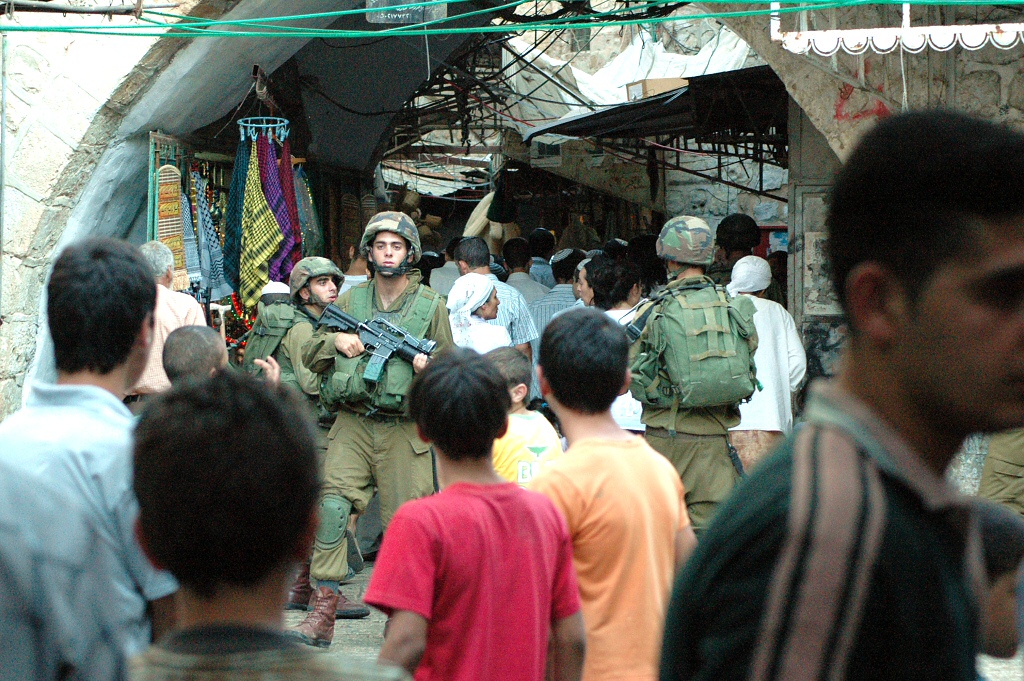
A settler incursion and tricky situation in the historic souk in Hebron, Palestine
Inner journeying, meditation, remote healing and peace-building. Doing our bit toward tackling the world’s problems – instead of wringing hands and feeling helpless.
In recent times many of us have been moved to join meditations, prayers and link-ups when major crises break out. Waves of mass empathy and concern over such crises can have a wide and deep psycho-spiritual influence – it goes deeper than mere ‘public opinion’.
Praying for peace or showering light over a benighted area are good, though often they are of a generalised nature. They can affect the collective psyche and sometimes help swing things.
But it’s possible to get closer in. It’s possible to penetrate actual situations and play a more targeted part in them – literally rescuing people or souls, or participating in situations, meetings and crux-points at the frontline of human experience.
That’s what this evening is about. This might be a valuable inner tool to add to your repertory. This is not ‘lightworking’ but spiritual humanitarian work – bringing in truckloads of spirit, rescue and healing.
This is not simple. It carries responsibilities, and it’s not a matter of imposing our wishes – benign or biased – on world situations. The key issue is to help humanity learn, to become more aware in making the choices it makes, for the longterm resolution of what are often deep-seated problems.
In the first half of this evening, I’ll outline considerations and issues involved in such work, how we choose issues and crises and work with them, and the blessings, delusions and dangers involved and what it’s all for.
In the second half we’ll go on an inner journey to work with a particular area of focus that is currently afoot in the world. (And, first time round, we won’t be working with polarised Trump-related issues!)
You might or might not wish to go into this kind of work but, even if you don’t, world situations do come up at times, touching our hearts, to which we respond, and inner journeying (conscious dreaming) is one way we can play a part in world affairs as situations arise. Once you get the gist of it, it can be applied in areas that interest you – socio-cultural, ecological, geopolitical or simply encouraging forward-moving change.
If you’ve done this kind of thing before, this class might help you clarify a few things and take it a step further. If it’s new territory, it’s a good place to start.
Since most of you will not be able to come, audio recordings will be posted online within days after the class (no charge) – just follow the link below. Recordings of all of the Aha Classes can be found here.If geopolitical healing interests you, you might find this site useful: The Flying Squad.
The first two audio instalments of my 2011 book Blogging in Bethlehem are now available, and the remaining five will come out once a week over winter (inshallah). The written version is available too.
I hope you enjoy them. It’s free, no strings.
Well, that lot took 20 hours to make, but I got through it quite quickly. That’s one advantage of hyperfocus and living alone. Rain drumming on the roof has stopped play for now. Just as well, really – I had my cancer treatment yesterday/Weds and I’m all floppy and wobbly.
I’m enjoying doing it though. The story comes from better times in Palestine in 2011, but it gives a sense of real life and some of the positive things happening there, and the social and cultural strengths of Palestinians. I miss friends there and would love to go back, but this is beyond my physical scope and financial ability now. So this is a way to be with them in spirit.
Jeez woz ‘ere. Looking over the Judaean Desert toward the Dead Sea and Jordan
Last night (Sunday 22nd October) I had a very profound meditation, more like trance – I was carried away and ‘out of it’, surfacing far later than the usual time, after more than an hour. I felt quite at peace. This morning I feel quite changed – a bit wobbly yet feeling alright too. A few thoughts came up this morning that might be of interest or value.
It’s important to remember that those who are killed in disasters like this are well dealt with. They are withdrawn before pain or horror cloud their passing. They are pulled out in micro-seconds and instantly taken into care, as appropriate to each soul. They don’t seem to experience the impact of whatever hits them or whatever is the cause of their death. If they do experience it, they are detached from it, without accruing psycho-emotional damage. They witness it (for the soul-learning therefrom) but they are put into a kind of state of grace and objectivity where they are not damaged by it. It’s a kind of fast-tracking transitional process.
I’m more concerned about the living and what they are going through.
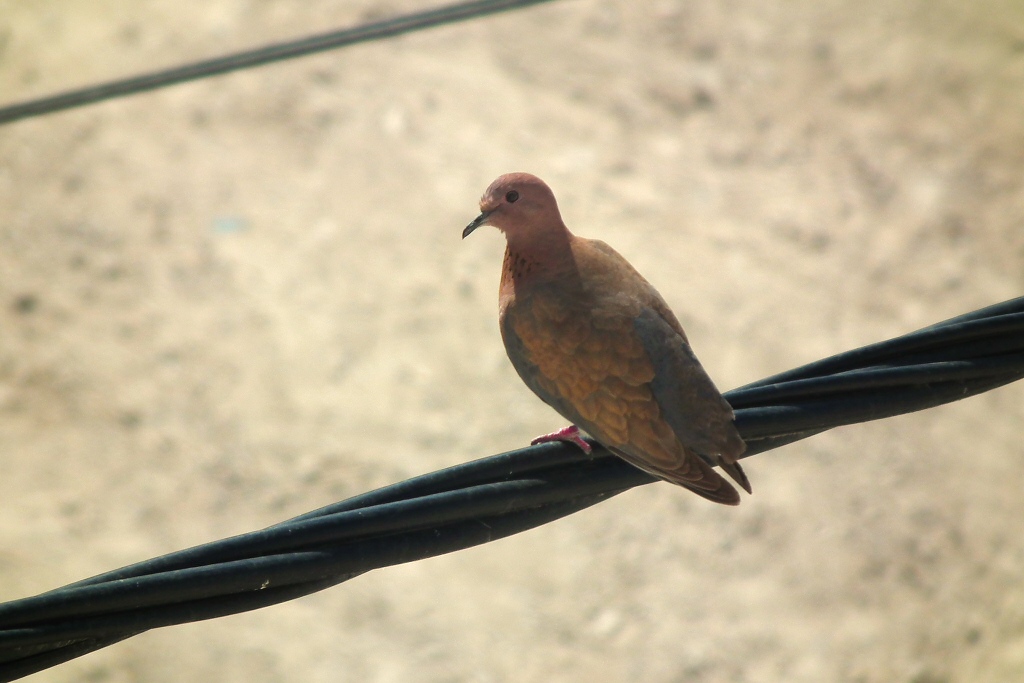
A Palestinian dove
There are Christians in Gaza as well as Muslims – and also seculars, who are often forgotten. Many of the Christians belong to ancient pre-Catholic, pre-Orthodox churches. (By the way, Arab Christians also call God Allah – which means ‘the God’, to distinguish it from a pantheon of gods.)
Yet I find Christians can have more difficulty passing over – more of a struggle – than Muslims, who seem to have a clearer sense of returning to Allah. Perhaps Christians and Jews have more of a feeling of distance and separation from God, involving more striving, more doubt, more questioning, while Muslims seem to have more inner confidence in their relationship with Allah. Not totally, yet they seem inherently more inclined that way. Hence, perhaps it is the case that they manage dying a bit more easily. In my observation. Speaking as an aged-hippy esotericist with Buddhist inclinations.
If you’re tracking Gaza inwardly, remember the people of the West Bank and the Palestinians in Israel and Jerusalem. ‘Arab Israelis’ are 20% of the population of ‘Israel proper’ and 40% of the population of Jerusalem. Some are Christians and many are Muslims – and they’re both friendly to each other. Arab Israelis aren’t dying in numbers, but they’re going through extreme discrimination and insecurity. Meanwhile, the West Bank is simmering and in danger of boiling over.
However, as an individual, while being aware of the complexity of this situation, it’s better to do small things well than big things badly, so give attention to those aspects of this situation that you are drawn to. Between us, we’ll cover a variety of things.
A boy in Jenin. He knows the sound of flying bullets.
This is big – a paroxysm of human madness where the heat gets high and the light grows dim. Negative influences are having a field day and, to some extent, we cannot stop this and must let the fire burn out. We cannot really affect what actually happens (the forces at play are big and complex), but the secret lies in seeing if we can flip, ease or assist the way it happens, so that there are glimmers of light, more opportunities for redemptive things to happen amidst a disaster.
There’s a lot of opinion and propaganda flying around. Well, in the ‘fog of war’, everyone is right and everyone is wrong. So take note of what people say and understand what lies behind it for them, while also observing your own responses, biases and predilections. Don’t necessarily block off from it, but try to avoid buying into the frenzy. Form judgements slowly. This is a battle of thoughts and feelings, intermixed with anger, and it’s good to try to hold that perspective.
It is possible to hold such a perspective while still having your own personal leanings – if, for example, you are Jewish, or you empathise with Arabs, or you have friends on one or both sides, or whatever. It is possible to run these in parallel, at least for the duration of this madness-epidemic. It’s an awareness exercise.
Barr al-Khalil or the Judaean Desert
This part of the world is often called ‘the Holy Land’. Yet holiness manifests itself there in emphatically unholy, paradoxical terms. It is a magnified microcosm of the whole planet, like a crucible, and Earth’s core issues are all present there. It’s a very small patch of land, the same size as Wales, Albania or New Jersey, in which there is immense complexity, intensity and confusion.
Still, there’s a lot of light there, and the contrast makes the issues so much starker. As a microcosm, what happens there affects everywhere else far more than its size and population would otherwise suggest. It has a similar population to Tajikistan, Togo, Sierra Leone, Laos, Austria, Portugal and Greece, Virginia or Washington state.
The situation in Is-Pal is very much affected by influences from elsewhere – not just military and economic but much deeper, more profound and hidden.
This includes positive influences too: there has been no shortage of Native American medicine wheels, Tibetan pujas, Bah’ai prayers and interfaith ‘encounters’ in this land, and while I was there I met amazing people from all over – even Siberia, Indonesia and the Amazonas. Amongst Israelis and Palestinians there are amazing people. Do not fall for the idea that this is just a simple two-sided battle of hearts and minds – it is multiplex, and the quality of souls in the ‘holy land’ is surprisingly high.
Young peacemakers from a variety of countries, with the mayor of Al Aqaba (who was injured in the first intifada in the late 1980s – he spent ten years in Israeli jail too)
To some extent we must let it play out, and to some extent we can bring some relief, space and blessing to this conflagration. This is a classic high-magnitude soulquake. Above all, stay steady. Keep returning to centre. Stay benign and well-wishing. If you get steamed up and in a mess, go take a walk, get some space and let the knots within you unravel – and take that relieving walk on behalf of those who cannot.
As Pluto enters Aquarius, we’re entering at least 15 years of ‘the battle for the hearts and minds of humanity’. This conflict is one such situation and there will be more, so get used to it and try to work with it. Because it is necessary. As is the case with Is-Pal right now, many of the world’s problems arise from issues we have not tackled and sorted out before. Chickens are coming home to roost in droves, in every department of life and every country. Issues are being brought to our awareness through the events manifesting in our time. These are the material through which we work out these issues.
There will come a point in coming decades when we get to The Big Issue. In this sense we are being given a gift, a collective training, through being given escalating waves of crisis to face. We’re being loosened up and forced to think, to see things in different ways from before, and from a larger perspective.
Palestinian kids on the whole have good fathers
In this sense, something right is happening here – we’re at a ‘never again’ point. This isn’t about cease-fires: this is about ending war and oppression, historically, and events like this will repeat until we get it and do it.
Oh, and by the way, put in a prayer for people in the UN and NGO sectors, from all over the world, who represent a neutral, global viewpoint in the conflict, and who take the strain in very practical ways. For some of them, it’s at great risk to themselves and, for others, it’s round the clock, every hour of the day and night. Stressful and often unthanked – they’re holy warriors.
With love, Palden.
Marwan Barghouti, regarded as Palestine’s Mandela. He’s been in Israeli jail for the last 20 years and they’re likely to keep him there. A mural on the separation wall at Qalandia, West Bank
In the 1990s I ran some meditation camping retreats called the Hundredth Monkey Project (M100). We worked in a circle of 70-80 people with world issues. We didn’t prescribe meditative methods but, to help people get oriented and give them ideas, a method was suggested as a basis to work with. If this interests you, it’s here: www.palden.co.uk/cs06-m100meditation.html
If you’re a member of a group working with issues such as these, then you might be interested in this material about talking-stick processes: www.palden.co.uk/cs07-talkingstick.html















 Notes from the Far Beyond
You must be logged in to post a comment.