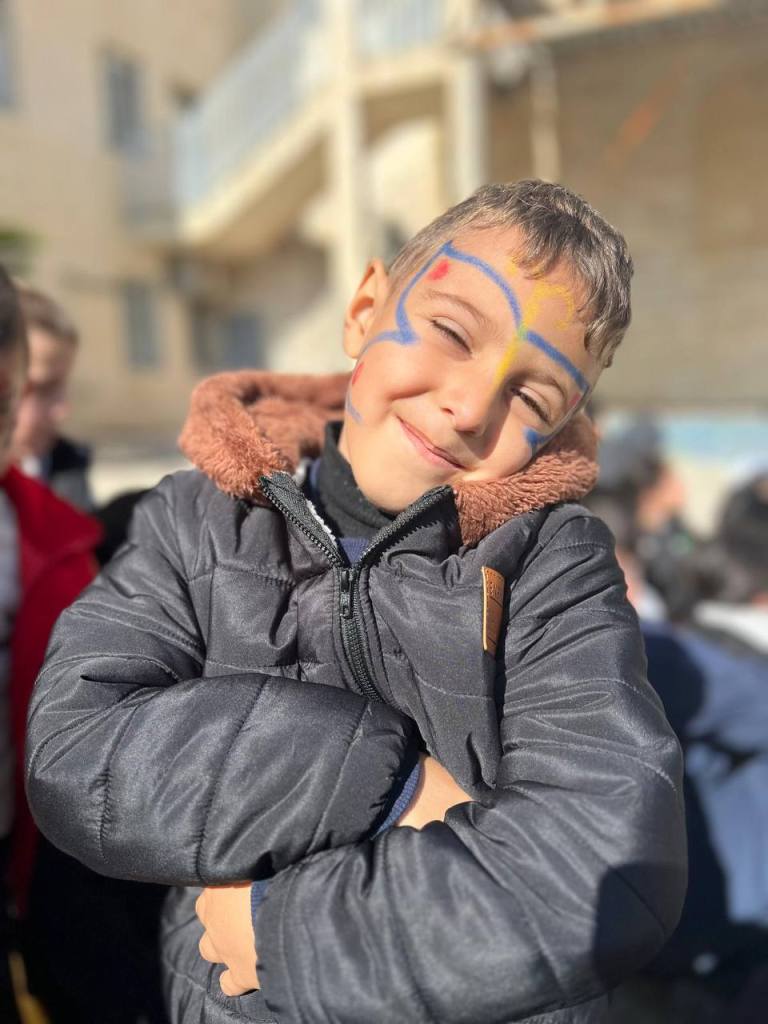
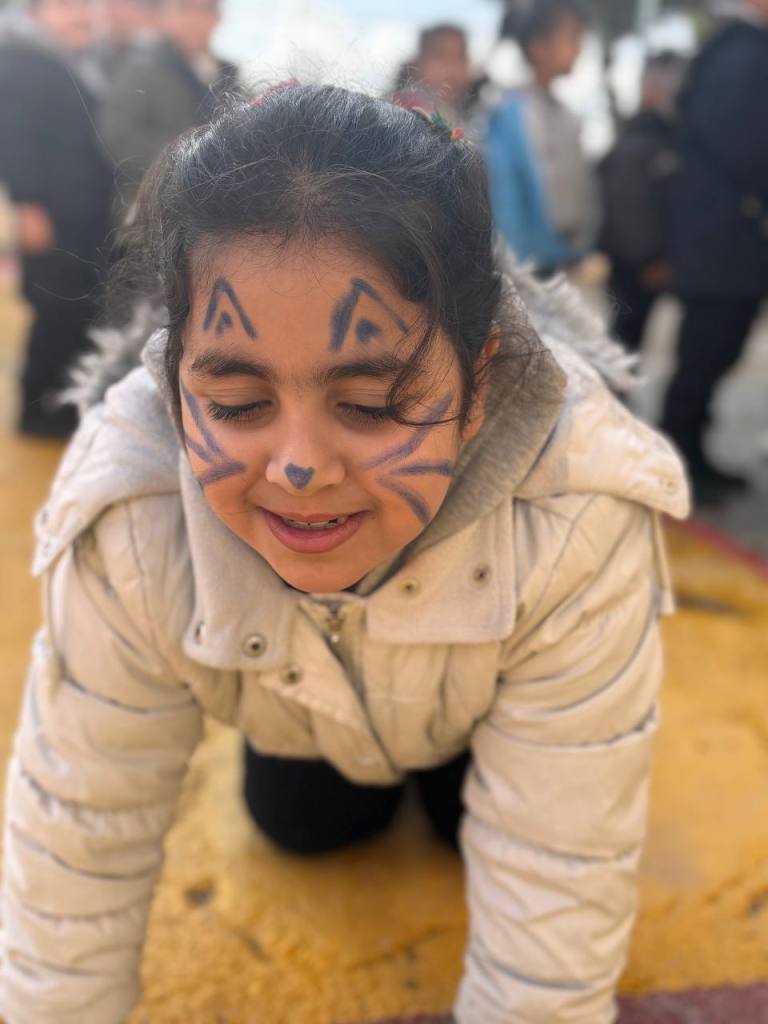
These are kids at the Hope Flowers School in Bethlehem, West Bank, Palestine, and these pics were taken in the last few days.
They are orphans from Gaza, and refugee and special needs kids from the West Bank. Apart from giving a good education under difficult circumstances, the school gives kids the tools to process their anger, loss, fear and trauma, so that they grow up knowing there is another way. Another way from what has happened over the last hundred years in Palestine and Israel.
Note the performers. These look like visiting Europeans. They are independent humanitarians: they set about brightening up the lives of people in places like Palestine and they make a big difference. They often fund themselves to do so, and travel cheap and crash on sofas. Some are performers, some hairdressers, some are welders and some are law graduates, artists and retired professionals. Have you ever considered doing something like this?
Forget Trump and Natanyahu: this is the human frontline, where the real work of peacemaking happens. These children are, I hope, the generation who will see a big change across the Middle East. The times of war need to end now: we must do things another way. And these are the people who will do it. That is my prayer for them.
Here’s the translation of the text that came with the pics:
In an atmosphere filled with fun and positive energy, the professor of physical education, Mr. Mustafa, organized a special recreational day for the students of the school, in cooperation with the refugee center, where play, art, and laughter came together in an unforgettable day ✨
⭕ A variety of events between animated games that enhanced activity and interaction, face painting added colors of joy to the faces of children, alongside a theatrical circus that presented pleasant performances that brought joy to the hearts🎪😊
Our students also participated in playing with parschute and other group activities that contributed to promoting a spirit of cooperation, active discharge, and building self-confidence in a fun and safe way 🌟
⛔ This day was an open space for joy and expression, and an integrated recreational educational experience that emphasizes the importance of play in supporting our children’s physical and psychological development 💚
ـــــــــ🍂ــــــ We learn for human well-being ــــــ🍂ــــــــ
To make a donation to Hope Flowers, go to this page for links to Hope Flowers’ supporting organisations in different countries: https://hopeflowers.org/wp/support/
Here’s a readable story about the history and philosophy of the school. It’s from my book Pictures of Palestine, and it’s called ‘Korea meets Palestine’. (Korea and Palestine were both divided in the same year, 1948.) https://www.palden.co.uk/pop/korea-meets-palestine.html
This is a change of course. I’d like to take you on a spiritual humanitarian mission to Gaza, in this weekend’s meditation on a rather strong newmoon. It’s here, as a podcast, and it takes around half an hour:
Something prompts me to share this with you. It’s something I’ve been working with for years, and with others (such as https://flyingsquad.org.uk ). It’s spiritual humanitarian aid and inner work to help progress things in our world.
I’ve worked quite a lot in Palestine itself, and that’s why repeatedly I suggest connecting with real people there, whether online, in meditation or by actually visiting. They’re just like you and me. Here’s an audiobook about life in Palestine when I was there twelve and more years ago, in better times than now – it explains a lot: https://www.palden.co.uk/bethlehemblog.html
So many feel deeply frustrated that they can’t do anything much to help people in and around Gaza and the West Bank.
This is one way to work with this feeling, to make something of it. It’s good to make the best out of a bad situation. This is one thing Palestinians teach the world: how to hang in there.
If you haven’t done this kind of thing before, then follow this guided meditation as a starting place. I encourage you to be imaginative, to follow your own way and path, to develop this over time, and to be fully human with the people you meet on journeys such as these. It’s an energy-exchange.
You can do it on your own, or you’re welcome to join the Sunday Meditation each or any Sunday – it’s free, with no complication.
It’s simply a circle of good souls in various countries who meditate together each week. I have a feeling it would be good for the group to work with Gaza for a few weeks. https://palden.co.uk/meditations.html
This is special. With love. Palden
——————— Current meditation times, on Sundays: UK, Ireland & Portugal 8-8.30pm W Europe 9-9.30pm E Europe, Turkiye and the Levant 10-10.30pm Brazil-Argentina 4-4.30pm CST, Mexico, Jamaica, Colombia 2-2.30pm EST, Cuba 3-3.30pm PST North America 12noon-12.30pm
All about the warfare, strife and trouble we find ourselves in today – the thoughts of an old peace-freak.
A Palestinian Dove
It’s like a virus in the world psyche, ready to pounce on any population that’s losing its way, or damaged, or hurt, or susceptible.
Yet some societies are strong in themselves. Even if they are invaded and occupied, they are not beaten.
What stops many wars is a deep tiredness, a wish to go home and get a life. A societal consensus forms, building resistance to the virus of conflict – an unspoken immunity that decides not to go back there again.
In this episode there’s a moving contribution from two old friends, the late Jaki Whitren and John Cartwright of the Court of Miracles, the greatest rock band you never heard of. They’re making music in heaven now.
Introduced by a stream in Botrea Woods and outroduced by the wondrous birds of Grumbla, Cornwall.
This is another of my Palestine tales from 12-15 years ago, from a book called O Little Town of Bethlehem, which recorded a five-month stay in 2011-12. In my writings and photos at the time my aim was to humanise Palestinians. Because, like you and me, they’re real humans with real human lives to live.
———————
As the sun went down, a wonderful atmosphere settled upon Bethlehem. The town was in a genial mood – people chatting and hanging out in the streets. At Cinema, a busy intersection with taxis and taxi-vans, I saw a six year old girl standing on some steps simply singing out loud to the street. This was not only touching but also rather refreshing because, for some reason, Palestinians tend not to sing.
Aisha, an English friend who teaches English at the Hope Flowers Centre and stays at my place one night a week, uses the large, empty, echoey conference room in the school for practising opera – she’s an accomplished singer but, living in Ramallah and surrounded with people who would find opera rather strange, doing her scales and practicing her arias doesn’t quite work easily. So she loves practising at the school, where she won’t be heard – and the conference room echoes quite nicely too.
Nevertheless, a neighbour discretely enquired of me what was happening. I explained and he smiled. He’d seen opera on TV, and was interested when I said that operas were like plays sung out loud, with stories to them. I asked him why Palestinians tend not to sing, and he said back, “Since the Nakba we haven’t had much to sing about”. Well, true, but I know that’s not the real answer, which I am yet to find out.
The Nakba, by the way, was ‘The Disaster’, the 1948 war during which the Israelis staked out their nation militarily, by ethnically cleansing and killing the Arabic inhabitants of hundreds of villages and towns in what became Israel. In the space of a few months, the population of Bethlehem quadrupled with refugees and they have never gone home – there’s no home to go back to. As a symbolic act, refugee families keep the keys to their old, lost houses, like a family totem, proof of having torn-up roots in their own land.
This afternoon was one of those times when people set their cares aside and enjoy the moment. That’s one thing I like in Palestine: people do their best to keep their spirits up and enjoy life. There is no alternative. Or at least, the alternative, dwelling on your problems, is far worse.
As my friend Ghada once put it, at a time when she was feeling pessimistic a few years ago, “In Palestine we don’t have up days and down days, we have down days and worse days”. She was at that moment manifesting symptoms of the strange collective bipolarity Palestinians live by, thanks to their circumstances: generally they keep their mood positive in spite of everything, but when they lose their strength and fortitude, they plummet into deep despond. That was where she was when she said this.
Palestinians wear their emotions inside out: love and sadness, friendship and disgust, humour and anger, they share them openly, men perhaps more than women. Their feelings spill out liberally. Mercifully it’s their positive emotions they show most. I have never seen a sign of violence except on a couple of occasions when Israeli soldiers are around, acting provocatively, but even then Palestinians suppress it because they usually don’t feel like getting shot, beaten up, arrested or hounded. They got tired of that ten years ago, and it doesn’t achieve much.
But on a lovely, tranquil afternoon like today, there was still a problem. On the way home, passing through Deheisheh and Duha, there was smoke everywhere. People were setting fire to the skips in which they put their rubbish. They do this because civic rubbish disposal is patchy at the best of times, and the skips were full. It’s not only smoky but dangerous, since so much of their rubbish contains plastics and other toxic materials, and the slow smoulder of the rubbish means that it doesn’t even burn properly. They have a blind spot around this issue. When Westerners like me raise the matter, they shrug it off as if it is no problem. But it is a problem and a big one.
Before you disapprove of these apparently backward people, let me remind you that we in the West started seriously addressing issues such as this only 20-30 years ago, when it was already too late for us. Before that, we trusted in modernity and slavishly paid the price in smog, toxicity, fumes and ugliness. Even today, when I speak to Westerners of the dangers of mobile phones, microwave ovens, wireless internet and electro-smog, people smirk or frown, as if to say “Oh no, he’s one of them”, since this is a current blind spot. One day an enormous scandal will erupt about it and people will yell “Why weren’t we told? Who is responsible for all this?”. We are responsible. We know. But we don’t want to face it.
So blind-spots – areas of life that people deliberately ignore, ultimately to our own cost – are not unique to Arabs. In fact, Arabs look on Westerners as backward because we turn our backs on God – Europeans by becoming increasingly secular and Americans by turning God into a heavily-armed, consumptive patriot with conservative politics.
Every race and nationality covers its insecurities by looking on others as inherently deficient. The less contact they have with other kinds of people, the stronger the negative projection on outsiders – this is one reason for the separation wall, so that each side can project its fantasies about the other onto a concrete screen untainted by reality. This is why Iran is currently a bogeyman – no one goes there to meet the people, so it’s easy to dehumanise them.
This said, Palestinians must still address the issue of rubbish – creating less of it and disposing of it properly. Battery recycling, vegetable waste composting and plastics disposal? Forget it, it doesn’t exist here. But probably it will exist in 10-20 years’ time – Palestine is at a similar stage to the West in the early 1970s. Yet regarding social values, sharing and human warmth, Palestinians are advanced, at a stage that I hope the West will reach in a few decades’ time.
I went into town to do my shopping. I’ve been sitting slogging away at the computer for the last week, so I don’t have many events to report. The trouble with computers is that people hardly see the results of your work because it’s digitally concealed, distinctly not in your face. Much of the work is for people far and wide, so that people around you see little significance in what you’re doing – you’re just sitting at a computer, twiddling fingers and looking serious. I’ve been building a website, dealing with issues for Hope Flowers, doing bits of work and answering questions online – many questions, from many people.
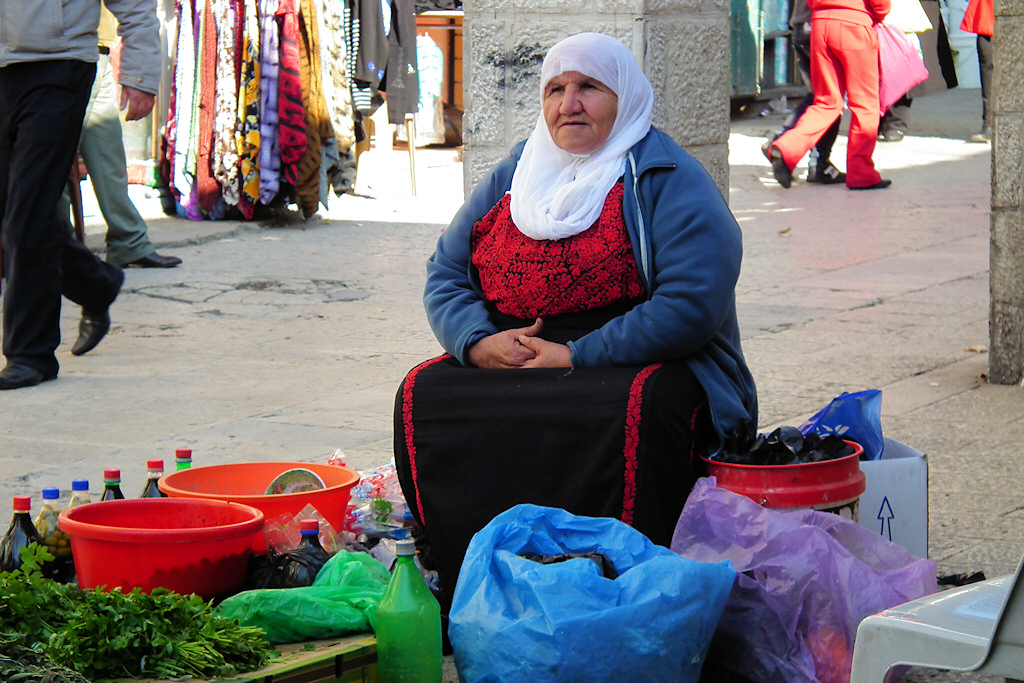
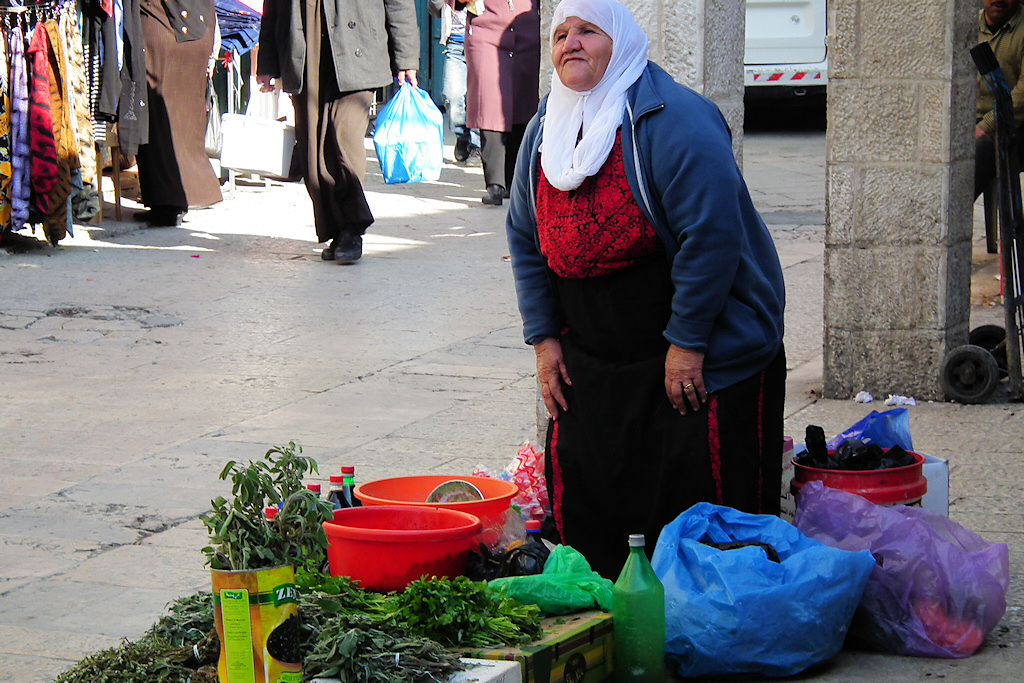
When shopping I went to an old lady I visit regularly. She has a small stall on the streetside in the Old Town. By stall, I mean a stool and a few boxes and bags. She sells herbs and figs. She’s a lovely old lady, clad in her embroidered traditional dress. She walks into town daily with her husband, who leads their donkey, which carries the herbs – then he returns home to work on the land, and he comes back to pick her up later.
Palestinians are big on herbs – they have mint or thyme in their tea and they eat parsley, sage, coriander, spinach and chillies copiously. I buy my herbs from her – big bunches of them, far too big to use on my own, for 1-2 shekels per bunch (20-40p in British money). She likes her pet Englishman. She eyes me closely when she thinks I’m not looking. I think she knows intuitively that I’m roughly the same age as she is, except she’s an old woman and I look younger – apart from a rather wrinkly face which has clearly seen some things. She hasn’t figured me out yet. Life wears out Palestinians.
Then I went down to the market to get vegetables. Two stallholders were trying to steal me off the stallholder I usually go to, but he has the best vegetables. One thing many Palestinians don’t quite understand is this. They tend to think one is obliged to shop with them out of a duty to support them – after all, fair’s fair, isn’t it? Well no, I’m a Westerner, and I go for the best stuff and the best deal. Sorry about that. Also, annoyingly, I buy things only when I need them.
The souvenir shopkeepers down in town think similarly. I’m a Westerner, therefore I have money, therefore I ought to buy from them. Not so. I buy presents only because there are people I know and love to whom I wish to give things, and I buy specifically for them. There’s also the question of how to get it back to England, so I cannot buy much. I’m not a buying machine – well, at least, not in my own head.
Dear reader, this might seem elementary, but it’s not so for Palestinians. This is a walled-off cooperation and mutual-support economy, an economy where everyone depends on everyone else for keeping each other alive, so the emphasis here is on supporting your fellow citizens by trading with them, to some extent whether or not you need what they’re selling.
Nevertheless, when one of the traders, a young chap of seventeen who helps his elder brother run a shop, moaned to me today about having no money to buy schoolbooks, I took pity on him. He had said there had been no business today, and he needed 50 Jordanian Dinars (250 shekels or £50) for the books tomorrow. He was worried and depressed. So I wandered off to do other chores, including raiding a bank machine, and slipped him 50 JDs on the way back. He lit up and hugged me, shedding a tear. Now he could get his books.
I told him that this is a life-lesson we all need to learn: solutions often come when you’ve given up. When you give up, it means you’re opening up to Allah, handing over your problems since you couldn’t solve them yourself. This money is a gift from Allah, through a random Englishman. So give thanks to Allah.
“You are a good man, Mr Balden. I pray that Allah, he will pick you up when you have a need.” Well thanks, I might need your prayer to come true one day. This young Palestinian, poor yet intelligent, has better English than some of the 17-year old Brits I know. Good luck to you, mate – I sincerely hope you get a future.
————————–
My three Palestine books are: – Pictures of Palestine (in print and as a downloadable PDF) – Blogging in Bethlehem (an audiobook and PDF) – O Little Town of Bethlehem (PDF only) Available here: http://www.palden.co.uk/pop/order.html
In my audiobook and various of my postings you’ll have heard of Hope Flowers School in Bethlehem, Palestine (here’s a brief intro). I used to work there.
Here’s a newsletter from Ibrahim Issa, the school’s director. It gives a taste of what it’s like running a school in occupied Palestine at present.
With love, Palden
—————————-
Dear Friends,
Thank you for all your support and solidarity with the Hope Flowers School (HFS). I am trying through this letter, to share with you what happened on 6 December 2023 at the HFS. It is a bit long; I believe that some of you have received a big number of pictures and videos on that day.
It is almost 21 years ago, when James Bennet wrote an article in the New York Times about HFS: “Arab Coexistence school falls victim to violence” you can read this article on: https://www.nytimes.com/…/arab-coexistence-school-falls…
Between December 2002 and December 2023, HFS battle for Peace continues.
The school-day at HFS starts early in the morning. Children and staff start arriving at 07:15 A.m. It is quite difficult to predict the day and whether clashes between Palestinians and Israeli army will erupt that day. Clashes could erupt at any moment of the day. HFS staffs have to be prepared to act in case any violence erupts at a sudden.
Elegant vehicles, huh?
On Wednesday, December 6th 2023, in my way to HFS at 7:15 AM. I have to pass Deheisha refugee camp and Al Khader village. In my way I found tens of Israeli military vehicles and armed personal carriers about to enter the refugee camp and the village. Despite military presence on the way, but I managed to reach HFS at 07:30 A.m. The neighborhood of HFS was quite. I did not see any Israeli soldiers in the neighborhood.
I started to receive calls at about 07:45 from HFS staff that they could not reach the school because of Israeli army presence and clashes between the army and Palestinians. So we decided to start the school day with the absence of two staff members who could not reach the school.
At 8:30 am, I was in my way from HFS to another meeting. On the corner of the school, I was stopped by tens of Israeli soldiers who were just arriving to the street and started to block the road with large concrete blocks using a bulldozer. The soldiers were very tense, especially I found myself with my car surrounded by big number of soldiers. The one soldier asked me to continue driving while another asked me to return backwards to HFS. I decided to stay unmoved because of unclearity in soldiers demands. Any wrong movement at this situation may be interpreted as an attack on soldiers and could kill me.
At this moment a military vehicle stopped next to me and there was apparently the commander of the unit. I talked to him in English and explained the situation that one soldier is asking to drive backwards and the other is asking me to drive forwards, I asked him if I could drive backwards (back to HFS), but he refused and asked me to continue driving forwards. He also instructed the soldiers to allow me moving forwards. I also told the army officer that I am a principle of a school located on the corner, and that I have 350 children aged 4-13 years old right now in the school with some children with special needs, and that I would appreciate if the army could give me 30 minutes to evacuate the school before they enter further in the neighborhood. The commander refused and he told me that in one hour they will finish their operation and that the army will reopen the road.
I cancelled my meeting and decided to stay nearby the HFS. I immediately called the staff at the HFS and asked them to take all measures (according to emergency plan) to protect the children and staff at the school and warned them that soldiers are in the neighborhood near the school.
At about 09:00 I received a call from vice-principle of HFS informing me that soldiers are near the school and that few armored vehicles have blocked the school parking and the main gate of the school and that leaving the school or entering the school is not possible.
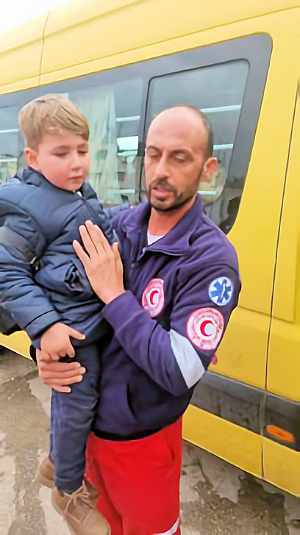
A paramedic comforts an upset boy
At 09:10 I received another call informing me that children with autism spectrum disorder (32 out of 358) are terrified and that social workers and staff need help to calm them down. Then I continued to receive calls from HFS informing me that children are totally in panic after soldiers started to fire teargas and heard of sounds of explosions nearby HFS due to clashing with Palestinian youth outside the HFS.
At this point I asked teachers and all staff of HFS to pay attention for the physical safety of children and to avoid sitting beside windows or even trying to look outside from the windows. I also informed the education department in Bethlehem that we have an emergency at HFS and explained the situation inside the HFS.
Everyone was concerned that the situation will get worse especially that some schools in Bethlehem and in the West Bank have encountered similar problems in the past few weeks.
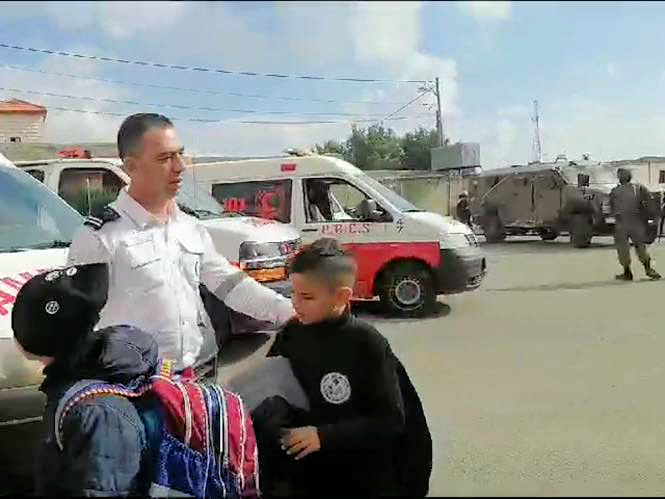
Some children have reacted strongly to fear like inability to breathe, others were crying, etc. Therefore, I asked the health department to help sending ambulances to help the staff to deal with stressed and fearful children at HFS. Indeed, 6 ambulances from Palestine Red Crescent Society arrived few minutes later, but the Israeli army prevented the ambulances to reach the HFS justifying that the area is “a military closed area”.
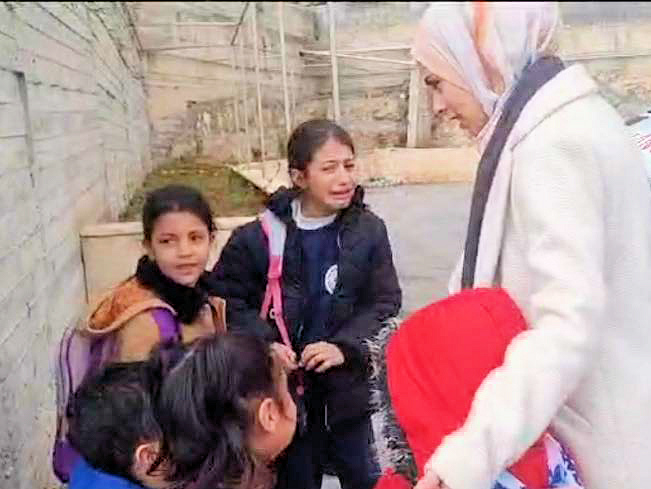
A teacher tries to calm the children
At this moment I started to realize the danger that children are in and started to call the Palestinian-Israeli military coordination office and asked them to speak to the Israeli military to allow the ambulances to reach the school. I decided to call other international organizations and asked them to urgently reach out for Israeli army to allow ambulances to reaching HFS.
The Israeli army has finally agreed to allow the ambulances to reach the school and finally allowed me to get back to the school in one of the ambulances. A detailed inspection of each ambulance was conducted by the army before it was allowed to move ahead. All ambulances were accompanied by an Israeli patrol.
At HFS, children were extremely fearful; in addition we were concerned that clashes between Palestinian and Israelis will erupt further.
Evacuation
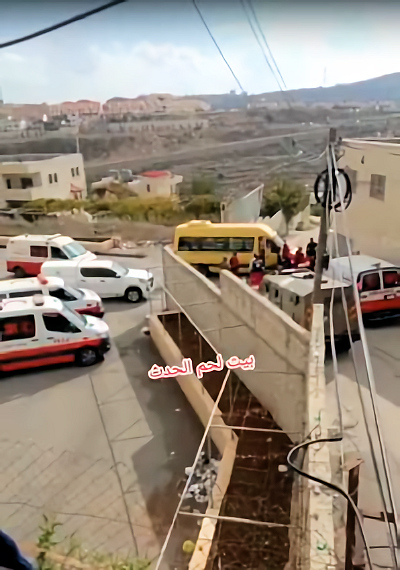
Therefore, in consultation with the paramedics in the ambulances, we decided that it would be better to evacuate the whole school and take children to transport children to a safer place. The ambulances started to transport groups of children (maximum 10 in each ambulance accompanied by one teacher) to a nearby hospital.
Due to intensity of the situation, the general director of the education department arrived at HFS with one of the ambulances to support HFS’s staff and children. With the heroic work of paramedics of the Red Crescent society we managed to get all children and staff out safely.
A neighbour got shot. Well, he might have thrown stones at soldiers twenty years ago in the intifada, but he doesn’t have to die for that. He was just protecting his home.
During the evacuation, it was clear that a ‘demolition order’ was being carried out, and three neighbors’ houses right next to the school were razed to the ground by heavy demolition machines. Much violence was used by the army. Soldiers tried to prevent photos or videos from being taken, neighbors’ and teachers’ phones were roughly taken and broken. Three neighbors were injured, one seriously, he was shot in the head.
Some children have seen this happen. Hundreds of parents have heard about evacuation of the school. Parents started to reach the area of the school asking about their children. They were very scared. We asked parents to wait in hospital, you can imagine hundreds of parents were waiting every ambulance to arrive to see of their child/ren is/ are being safe. At the end of this difficult day, three families were left homeless, three people are injured, one of whom is in danger of life, and hundreds of children are further traumatized.
The impact of this violence on children, families is immense.
Teachers and counselors at HFS will have lots of extra work to do in trauma care in the weeks and months to come. It is therefore as urgent as ever that HFS work continue to provide trauma counseling for children and their families. We are very thankful for all of you who helped us on December 6th and many thanks for your solidarity and support to HFS.
The trauma counseling program at HFS aims to:
• To provide help for the children at the school and for families in Bethlehem to address the effects of the downward-spiralling cycle of violence and trauma that has arisen from violence and the occupation, and to remove the basis for future hostile behaviour.
• To create a model for wider use in Palestinian schools, to become a centre of excellence and dissemination for psychological support for people of the West Bank, and to share our accumulated knowledge and experience with the wider world.
Your support to HFS and trauma counseling program will be highly appreciated. Our battle for peace will continue!
Best regards, Ibrahim Issa, Director of HFS. hopeflowers@palnet.com www.hopeflowers.org Cell: +972(0)599294355











 Notes from the Far Beyond
You must be logged in to post a comment.