
“Where is the world?“, cried a desperate woman in Omdurman, Sudan – in ‘From Our Own Correspondent’ on BBC World Service today. Lebanese will be feeling this feeling right now, though the Sudenese perhaps have it worst. Well, the world is busy with other things. That’s where the world is.
One of the stange paradoxes of our time is that, as world population has grown – exploding to over eight billion – individuals and communities have become more isolated, alienated and dehumanised. In recent years, wars, witnessed onscreen like disturbingly realistic video games, have been stumbled into as if people, cities and landscapes were expendable and there were few consequences to worry about.
We wring our hands, feel smidgeons of the sorrow and pain, grumble and get on with our lives. Others blank it out, as a survival mechanism that allows them to keep going with a daily round of never-ending pressures. And yet others love it, as if feeding on the tensions, the bangs and flashes, and the numbers, and the power of it all.
For the triumph of evil it is necessary that good people do nothing. I keep banging away about this quote from the philosopher Edmund Burke because it sums up the world today and the tenor and background of what is to come.
When wars take place, we easily latch onto the proposition that it’s about Israelis and Palestinians, Russians and Ukrainians, rival generals, or government and rebels – and thus has it ever been. Well, yes, but here we blind ourselves. This is the way it looks, but there’s something else here.
At root it is about the battle for the hearts and minds of humanity – a well-worn phrase which describes what we have been in for a very long time. It seems now to be coming toward a crescendo. This goes right back into prehistory. There are two fundamental mindsets here.
One perceives strangers as a threat, territory and resources as possessions, people as individualised objects, power and wealth as advantages, competition as the sole mechanism by which everything operates, Earth as the universe’s only inhabited world and physicality as our baseline reality.
The other generally likes, loves and trusts fellow humans, tends to treat others as it would like to be treated, identifies with nature, thinks mutually and cooperatively, understands that there is something greater than what we know, and it tends to prefer living relatively simply, sharing resources and staying within its means.
Something like that. These mindsets are more easily felt than defined in words.
All of us hover around various places on the spectrum between these two poles of perspective and experience. We all have to establish a balance between self-interest/sovereignty, and mutuality/shared sovereignty. They both bevel into one another. They can shift quickly in crisis situations. Often the values that position us on this spectrum are formed in teenage and early adult years, though they can shift if life jogs us into it, or through periodic epiphanies.
Seen this way, many of today’s wars aren’t between the commonly-agreed sides. They are wars by people with a competitive mindset against two kinds of people: those with a cooperative mindset, and those who aren’t sure, who acquiesce in whatever situation prevails at the time.
The competitive side is also made up of two main kinds: the oligarchy that drives the mindset and cracks the whip, and those who lock step, join in, to become the executors, officers, influencers, reinforcers and beneficiaries of the oligarchy (to gain advantage or for fear of not joining in).
But it’s not simple and clear-cut. It’s not a goodguys/badguys scenario where one side can blame the other side for the world’s problems, striving then to dominate or eliminate them in order to solve those problems. It’s far deeper and it’s not fully conscious. It’s the frequencies we tune into. Even if we cleave the world into ‘woke’, ‘anti-woke’ and ‘don’t know’, within those divisions are heartless wokes, good-hearted anti-wokes, and a large number of people unwilling to takes sides when the options are presented in such a binary, with-us-or-against-us way.
This last lot is a broad majority – except perhaps temporarily at times such as the outbreaks of wars, when polarisation waxes strong. And this is one reason, deep down, why wars are fomented – to keep polarisation and dehumanisation on top of the world agenda, and to dull people’s sensibilities with scenes of tragedy and destruction.
There are different kinds of ‘don’t knows’ too, and the matter is kept confused because few people have time to think and reflect clearly on what’s happening and what they can do about it. The acquiescent are constrained in what we can do – despite all the hoohah about democracy. We have delicately-balanced, busy lives, and the cost of disruption can be high. Bills must be paid. Some people don’t want to know. Some feel helpless and frustrated. Some try hard to make a difference and don’t get far. Others simply pursue their careers or their lives as best they can.
The key thing here is that acquiescence is the source of the world’s problems. Some like to rail against the perpetrators, the oligarchies and power-structures, and there’s some relevance in this, but really this concerns a deeply-embedded tendency in humanity to shrug shoulders and go along with things it has instinctive reservations about.
This gives oligarchies operational space by which to determine the agenda and co-opt majorities into buying or accepting it. Throughout history it has allowed them to drag humanity through mass experiences they otherwise wouldn’t have chosen. The devastation going on today in Lebanon is but the latest example, and there will be more next year and the year after that.
I’ve spent my life exhorting, encouraging and facilitating people in their change processes, and by no means have I been the only one doing it. In the stretch of history in which I and my generation have participated, some progress has been made, though the fundamental issue has not been resolved. That is yet to come.
It’s the battle for the hearts and minds of humanity. In recent years we’ve had distressing instances presenting us with deep choices. Do we actually want this devastation to continue? If not, to what lengths are we willing to go to end it? If, as it seems, the future is intensifying, the disasters are getting bigger, the pain and costs are rising and we’re heading for a precipice, when will the world’s majority consensus shift sufficiently to tilt the balances and head another way?
This is the bottom-line agenda for the coming decades. Events and collective feelings are moving that way – something is fermenting underneath and, one day, it will come out. We’re approaching an historic choice-point, or a series of them, and we all know what it’s about. Evidential statistics are hardly necessary.
This question lies within all of us. It’s tempting to give a nice, easy answer that looks like a solution, so that everyone can go home and feel okay, but so many of us have done this before so many times, and it doesn’t necessarily help.
It’s the process. We have to go through the process. Globally. Everyone. And it’s a cliffhanger.
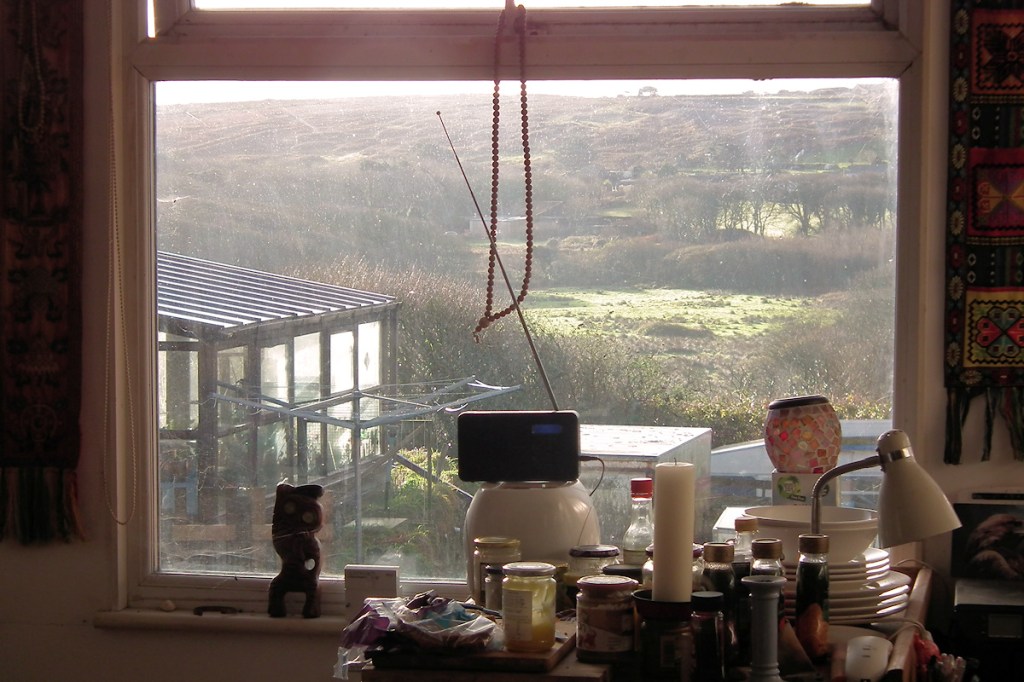
I’ve been reflecting on all this as I’ve gone through what has felt like a long-dark tunnel of illness in recent weeks, as detailed in three recent blogs. I’m gradually reviving, and the muscular pain I’ve had, at 90% two weeks ago, is now around 30% and within my manageable zone. Though I haven’t been close to death medically, at times it has felt like dying, as if the pain might squeeze and pop me out of my body, leaving a curled-up pile of bones behind. Since getting cancer five years ago, I’ve visited that close-but-not-there point a number of times, and perhaps my body-soul connections are a bit loose.
It’s feelings like pain that make us more human. Times when we’re overwhelmed with our own feelings, our phantasmagorical inner dramas, locked inside our personal reality-bubble and struggling through the nettles and brambles overgrowing the path toward finding out who we are. Those bouts of suffering we impose on ourselves or which come at us, just when we were busy making other plans – they can have a humanising effect.
I guess I’m feeling a microcosmic version of what Gazans will feel when the firing at last stops. What then? Will I revive, to return to something resembling the life I had before? Or have I dropped to a new level where my possibilities have shrunk and my dependencies have grown, and that’s what I must accept? We shall see. It’s that post-devastation phase that happens after an enormous struggle. Actually, it’s the mindset that those of my age-group were born into, just after WW2 – a ‘whither the future?’ phase, experienced amongst the rubble of what used to be.
My life has reduced to the size of my cabin – and when the fog is down, as it does here in Penwith, the shrouding is complete. Even so, I’ll still be there every Sunday at the meditation, because that’s something I can do that breaks free from the physical confinement my body has given me. You’re welcome to join our little group and enter the energy-zone of the meditation. It can help greatly in the uncovering of answers. (There’s a link below, explaining more.)

Over the last few weeks, lying there in bed, dead still, propped up on pillows, at times I’ve travelled far and wide, visiting many of you, and visiting people I’ve known through my life (not least friends in the Middle East) to be with you. And to be in the world’s crisis zones, with people who are there. And to swim around in the tangly firmament of the world’s heart-mind, planting love-mines and stockpiles of psychosocial aid for people to draw on, in places I’m drawn to.
I’m not doing it all the time. Often I’ve been just lying there in an opioid-painkiller daze, wondering dreamily whether I have the energy to arise from bed to take a pee. But on occasions I’ve gone deep, through and out, visiting Darfur, Dneipro, Sidon, Bethlehem… or far further out, beyond this world, into the realms of light, timelessness and beatitude, and laying connections between the two.
Which goes to show, even in your darkest days it’s still possible to do something. A candle lit in darkness sheds far more light than a candle in sunshine. And this is what we’re here for. The first Tibetan Lama I met, Akong Rinpoche, taught me that times of enlightenment, freedom and joy are like a holiday, which heals us because it is brief and different, but the times when the real progress is being made are the times when we’re wading through the swamp, struggling to find our way. And it seems to go on and on.
In writing this, I’ve just realised that Lama Akong taught me this in November 1974, almost exactly fifty years ago. Half a century later, I’ve had a reminder of it, and I’m still learning that lesson. But it also says something also about the tribulation humanity is in. We do actually know what is needed on Planet Earth, more or less, and we now have to wade through the mud, the crossfire and the floods to get there. Hearts and minds. For the triumph of humanness, it is necessary that good people do something.
With love, Palden
PS: The next Aha Class in Penzance is re-timed to Wednesday 16th October – I’m not ready to do it on 9th. Ironically, the class is all about time.
The Aha Class: www.palden.co.uk/aha.html
Sunday Meditations: www.palden.co.uk/meditations.html
My website and archive: www.palden.co.uk
Recent public talks: www.palden.co.uk/podtalks.html

 Notes from the Far Beyond
You must be logged in to post a comment.