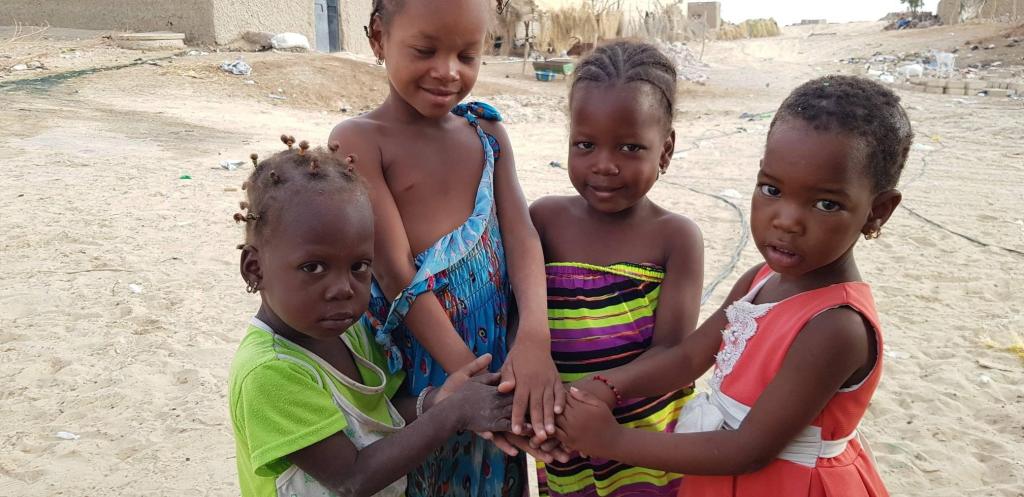
Okomfo Akua Ayensuwaa, Queen Priestess of the Ayensu River, West Africa
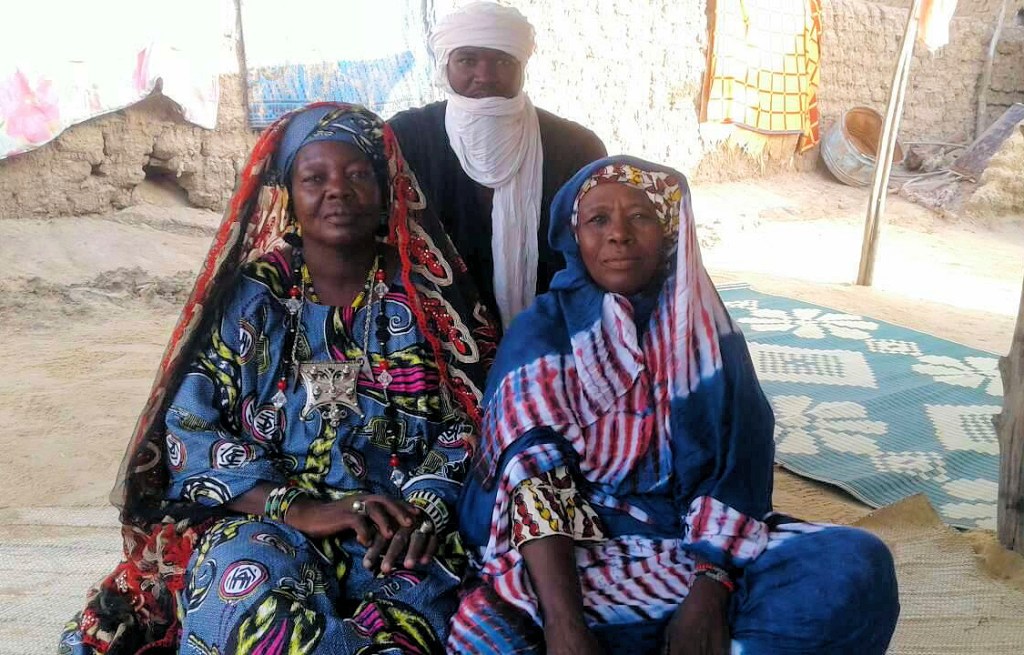
Those of you who know me well and have been following my story for the last year will have heard me mention the Okomfo Akua Ayensuwaa (Maa Ayensuwaa). An Okomfo is a priestess or priest. This is her.
She is a native healer in Ghana who has been working with me to save lives of people in Ghana, Togo and Niger who have been under attack from an international crime gang, since October 2022. The gang do drugs and people-smuggling over the Sahara, for the British-European market – hard, ruthless men who care little about rape, violence and crime.
She has been in hospital with fibroids, which are spreading. This arises from the privations she’s put herself through during this year – she tends to put others first and is a real heroine. I have not been able to finance her hospital treatment and aftercare (£500). So it looks as if she will die before long.
I am really sad about this. Our meeting last December was very special and, between us, we’ve pulled off some amazing miracles. The problem we have had is that the security/anti-fraud wing of the ANZ Bank in Australia, promising to pay all the expenses for this operation, have failed to fulfil their promise and pay up. Perversely, the bank has turned out to be a bigger problem than the crime gang, whom we have disabled considerably.
This debt from the bank now amounts to some £40k, for the repaying of debts incurred (£15k) and for compensation (£25k) to those ‘good samaritans’ who have sought to help and who have paid a high price as a result. This whole story started when I saved one of their men, Andrew, a Scotsman, whom I knew, from attack by the gang – and the crime gang was uncovered in the pursuit of the bank’s anti-fraud business in West Africa.
As a result of this failure to pay, I cannot pay the fees to save Maa Ayensuwaa now. In circumstances like that, hospitals simply dump people outside, since they do not want liability for them. The bank is in a state of corporate denial, yet they are indirectly responsible for the deaths of at least ten people. They owe the Okomfo and me a lot of money.
I am not appealing to you for money, and I do not like to. The best I can do is to fix for some good-hearted person in Ghana to take care of the Okomfo, so that she can at least have a noble and peaceful death, which she deserves. She is currently semi-conscious and about to be dumped. (The doctor I have been dealing with is a good man, and regrets this himself, but he is bound by the rules.)
I do however ask for prayers and inner support for her. May she manifest the support she needs and deserves, and may her likely end be filled with light and with grace. May she be blessed by the angels, gods and spirits. If she is to live, may she find healing and revival – whichever way the Universe chooses. Please surround her in love. She has given so much to so many people, risking her life for them, and she is a true heroine – rather saintly, actually.
I am working on writing the full story, for the time is now coming to tell it in public and expose the bank. Sometimes the pen is mightier than the sword.
For now, may I ask you to put in a prayer for Maa Ayensuwaa? She is 53 years old, a Gemini, and she is Queen Priestess of the Ayensu River in western Ghana. Her magic and her considerable healing powers are rare. She is is one of the most remarkable psychics I have ever met – and I’ve met a good few. She is a sincere woman who gives freely of herself and her abilities, and she is deeply committed to truth and justice. The photo of her here is the only one I have – our contact has been psychic and online only.
I am really sad that it comes to this and I shall miss her. But we shall continue communicating whether she is alive or dead, and we shall meet again. I was aware that she and I could have done so much together in the area of world healing. Whether this is to be or not to be, may the Universe make the best choice, and may Maa Ayensuwaa go well on her journey and be truly blessed. She is one of the most remarkable women I have ever known.
When I was diagnosed with cancer in late 2019 it was at first like receiving a death sentence. I was indeed close. This has a way of changing and reorienting everything inside – or it did so for me.
When it looks like your life really could be ending, it makes you reassess everything, where everything stands, what can be dropped, what means a lot to you, and what is unresolved, regretted and incomplete. It’s a rapid, factual acceptance process, prompted by a loss of ability to act on life, owing to serious illness and malfunction.
So I looked at my life. Some things I could let go of easily, some needed attention, some presented hurdles to cross and some looked impossible. This process went on over a period of weeks while I was flat on my back, struggling to stay alive. As it happened, I made it through, with the loving help of my then partner and the ministrations of the staff at Torbay hospital.
After three months, I was gradually reviving. After six months I was more or less on my feet and functioning – enough to be able to go home to Cornwall and look after myself, with a little help from my friends – and the staff at Royal Cornwall hospital at Treliske. Lucky me. I survived.
Being a writer and communicator, there were still things I could do, and it became part of my cancer therapy. If I were younger, with a job and family, or if I were in engineering or farming, I’d have been in a catastrophic situation. But as a freelance writer and broadcaster, I could carry on. My brains and the creative process changed, and my fingers weren’t as keyboard-accurate as they once were, but it worked.
Even so, part of me was left hanging – the humanitarian part. So were the people in other countries who were affected by my loss of functionality. I could no longer travel long distances and my capacity to get through such a rigorous life had collapsed. If I went to Palestine or Mali now, it might well be a one-way journey. That remains an option, though I’d also be happy for my ashes to be buried under a tree on Botrea Hill.
I made a prayer for clues suggesting how to resolve this question. Three issues came up.
One was the growing needs of the people I’d been working with. This included Hope Flowers School in Bethlehem, all sorts of individuals in Palestine and Syria and in the Tuareg village of Tinzibitane, Mali. In the 2020s, need and crisis levels were rising, and this was vexing.
The second issue was me, since doing such work had meant so much. These people, whom I had grown so close to, were some of the most valuable people in my life – I had learned so much and become so much more of a real human as a result of working with them and finding my place amongst them.
The third was finding people to take over from me. That was the biggest question.
As my old friend Sheikh Bukhari once put it, “God has a staff shortage, with plenty of eligible employees who for some reason prefer to stay unemployed“. A kind of Sufi bishop with a deep Muslim heritage, he had emigrated from Jerusalem to America, landing up flipping burgers in a California burger joint. He returned home after a decade, back into the frying pan that is Jerusalem, to become a leader in a community of spiritual peacemakers in Israel-Palestine – then called Jerusalem Peacemakers, and now called the Abrahamic Reunion.
“I finally accepted Allah’s job offer“, he said. A good man, he was. He’s now in heaven, carrying on up there, and his widow Hala carries on down here. His son Izzedin Naqshband runs a Palestinian vegan restaurant in East Jerusalem, if you’re ever over that way.
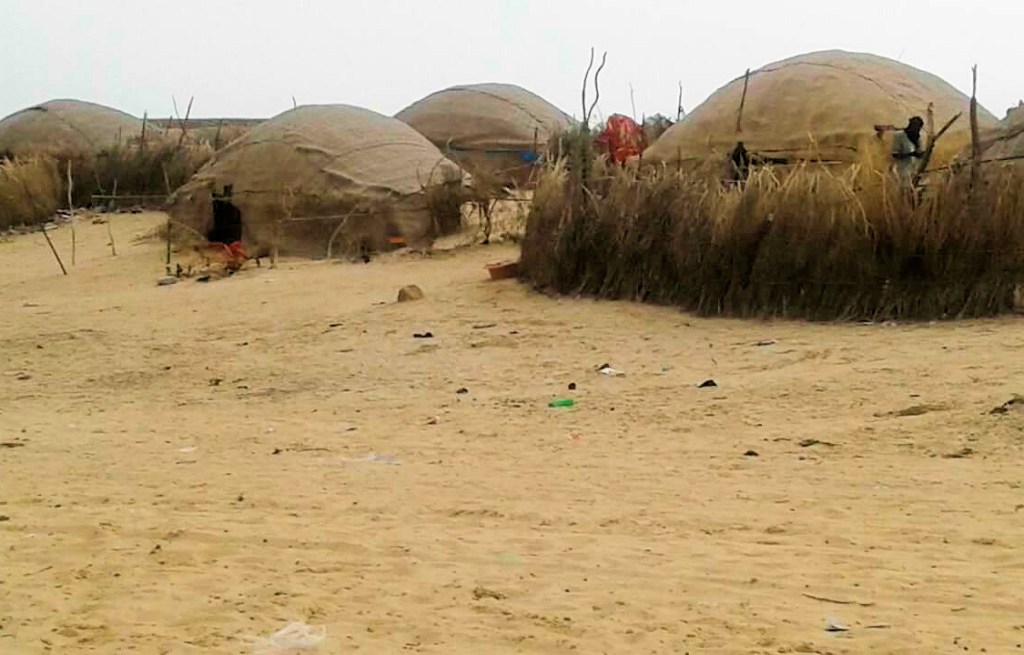
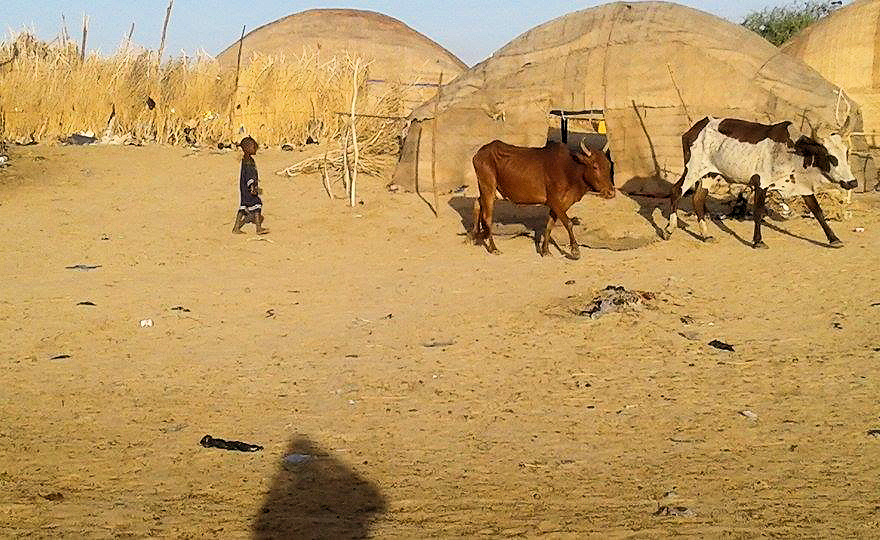
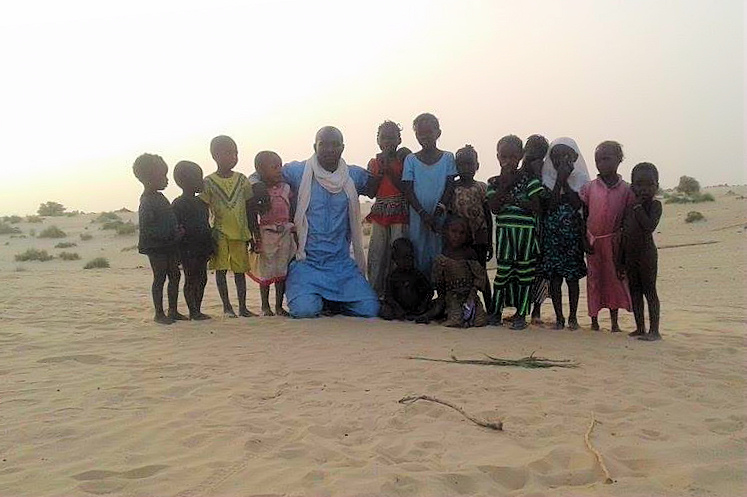
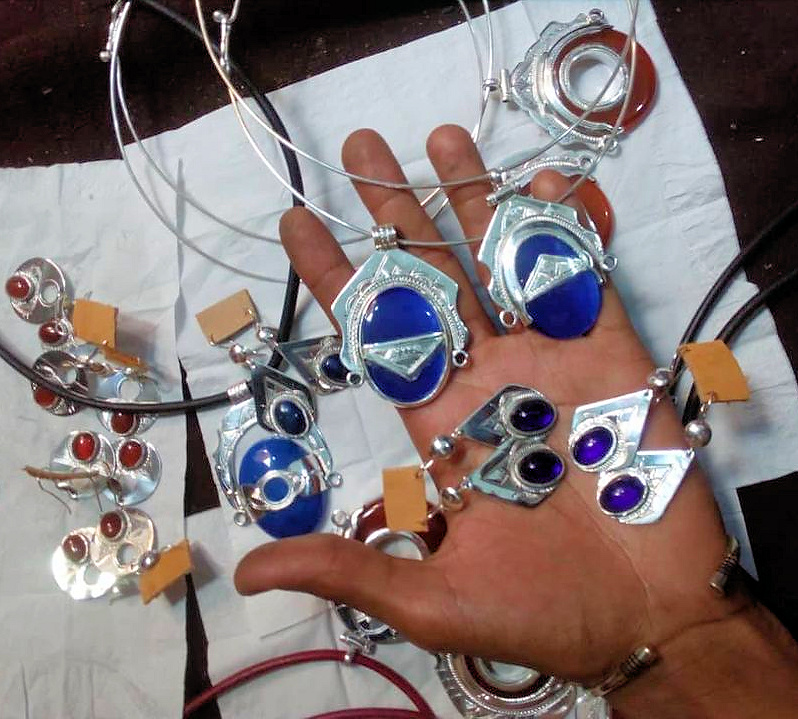
Finding people to take over helping Tinzibitane has been a challenge. The Tuareg don’t have as much PR power and experience as Palestinians do. However, they make amazing hand-made, trademark-free, talismanic jewellery and other crafts, and that’s their tradeable USP or ‘unique selling point’. Many Palestinians are educated, literate, competent, urbanised people, while the Tuareg live a simple life out in the desert, without being highly engaged in the modern world.
They are not tempted by modernity, tending to hold it at bay. From a humanitarian networking viewpoint, this is a good marketing tag to use – the Tuareg have a genuine mystique that charms and fascinates people. If it were lost, it would be a loss to the world. They don’t beg and bleat either.
The modern world comes at them anyway. In 2016 I managed to save the life of a baby, Zeinabou, whose mother died in childbirth. I helped with other survival issues by making Facebook appeals and raising a few hundred quid to help.
Mercifully, I was joined by two others, Eve and Jane, and we were able to fund social-reconstruction projects going into the thousands. Over a few years we restocked their camels and goats, sank a well and funded the building of a small village school, helping them regain confidence as a village after a devastating war and drought around 2011-12.
They hadn’t actively participated in the war, but it had affected them and they had been attacked by both sides – the Malian army and Al Qa’eda-related Jihadi militias spilling over into the Sahel from Libya and Syria. The Jihadis tried to establish an Islamic caliphate to lord it over the independent-minded Tuareg, and they’re still at it. I think they will blow out, get tired and go home eventually, but not anytime soon.
Testosterone does wear out after a while – and this is how many wars come to an end. Eventually, people just want to go home and sleep in a proper bed.
The Chief
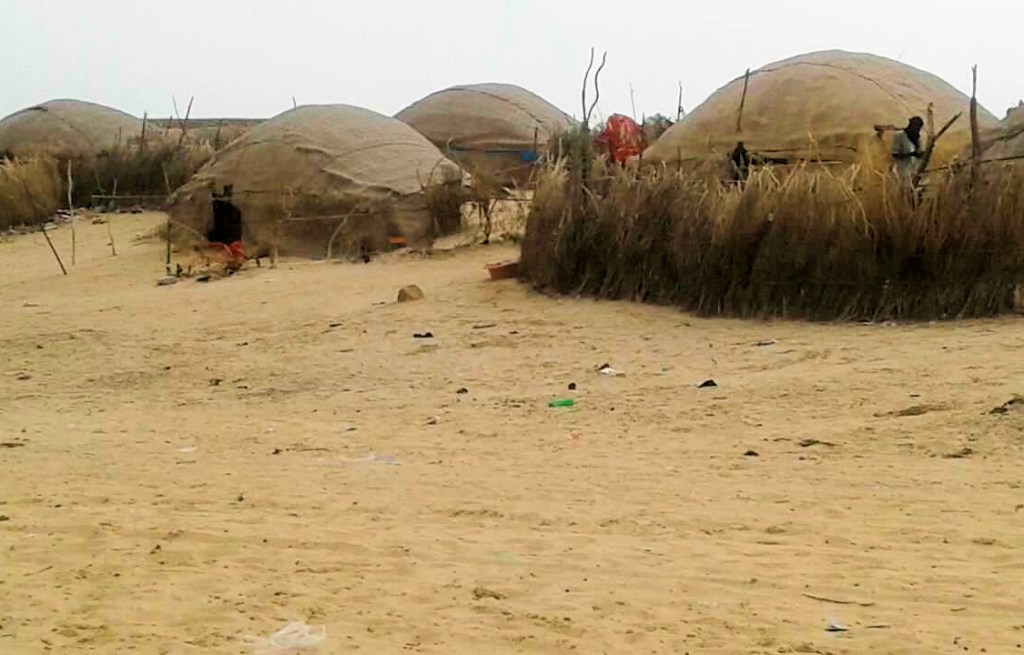
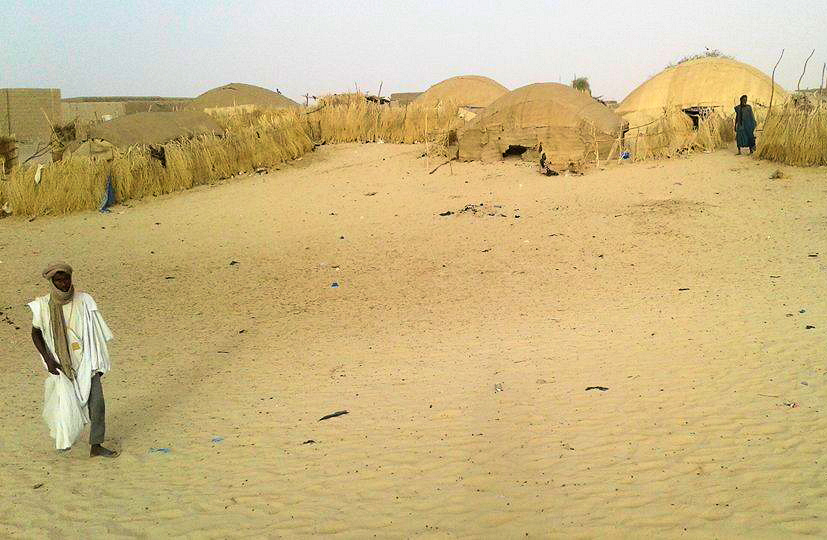
The desert village, some way west of Timbuktu, started coming together again. People returned from refugee camps in neighbouring Mauretania and new people joined from other villages, seeing how they were getting organised and taking life back into their own hands. The chief, a thoughtful man in his early seventies, with good intentions for his people, strengthened the social fabric of the village and gave it new hope, with our help.
The Tuareg are a consensual people with deep traditions going way back before the arrival of Islam in medieval times. They are independent people, with significant gender equality and a strong sense of collective solidarity. I liked working with them, and they did the right things to help us help them.
They are a desert people. For centuries they have been the camel-truckers of the Sahara, carrying goods between south and north, inhabiting the southern edge of the desert, the Sahel. Gold, salt and high-value goods were their main cargoes, plus, in medieval times, slaves to Algeria and Egypt, which they stopped doing later. These goods and people were sold in the souks of the Arab world and forwarded to Europe, Ottoman Turkey and the Middle East.
One thing I like about them is their integrity, honesty and lack of corruption, and this makes it easier to work with them. They don’t like asking for help, and they budget and spend well, and money sent for a particular purpose is usually spent on that purpose, as arranged.
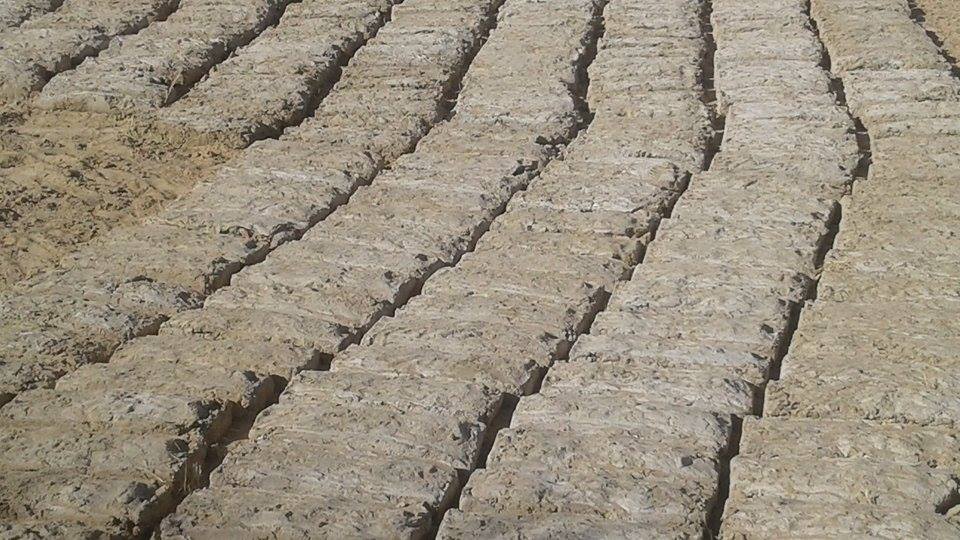
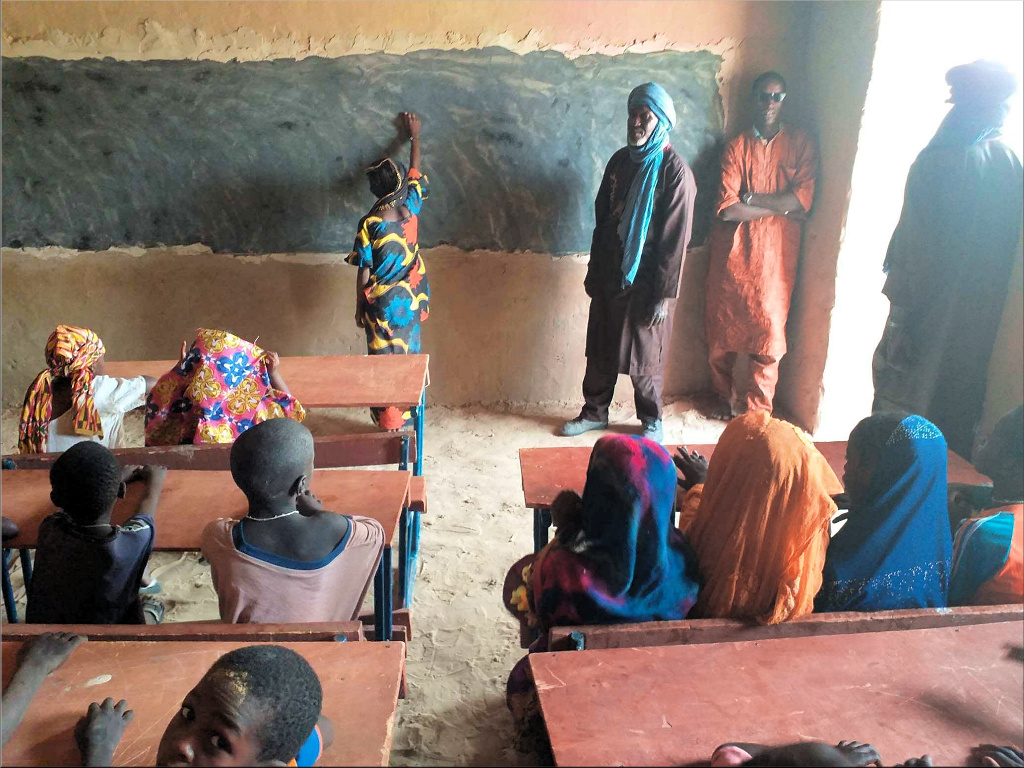
Home-made mud bricks for the school
In many crisis zones, money just gets spent on whatever urgent need comes up next – it’s understandable, a ‘firefighting’ approach, and that’s life there, but from a fundraising viewpoint in the rich world it’s difficult, because of our issues around accountability. Accountability is a polite word for post-Protestant tight-fisted control-freakery, a key quality that has made us whiteskins rich.
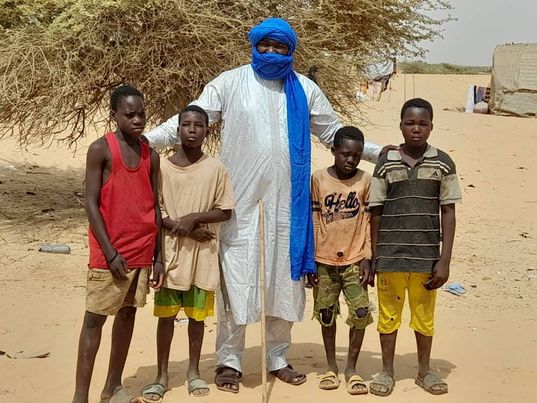
We communicated through Anim al Husseini, who first contacted me in 2015. It was his wife who had died in childbirth, and Zeinabou is now growing up in the village. Anim speaks Tamashek (the Tuareg language), Arabic, French and English, and he’s good at staying in touch and supplying information and photos – without these, support work gets difficult.
The chief has nominated Anim to be the next chief – though, whenever that happens, he will need the consensus of the villagers to step into that role. That’s the way it works amongst the Tuareg: their traditional systems of governance are consultative and confederal. As desert individualists with a self-help survival ethic, any family or tribe may take their leave and join other villages if they feel the need. Nominally the men make the decisions but, if the women disapprove, it simply doesn’t happen, and that’s that. So the women set the norms and the men do the business.
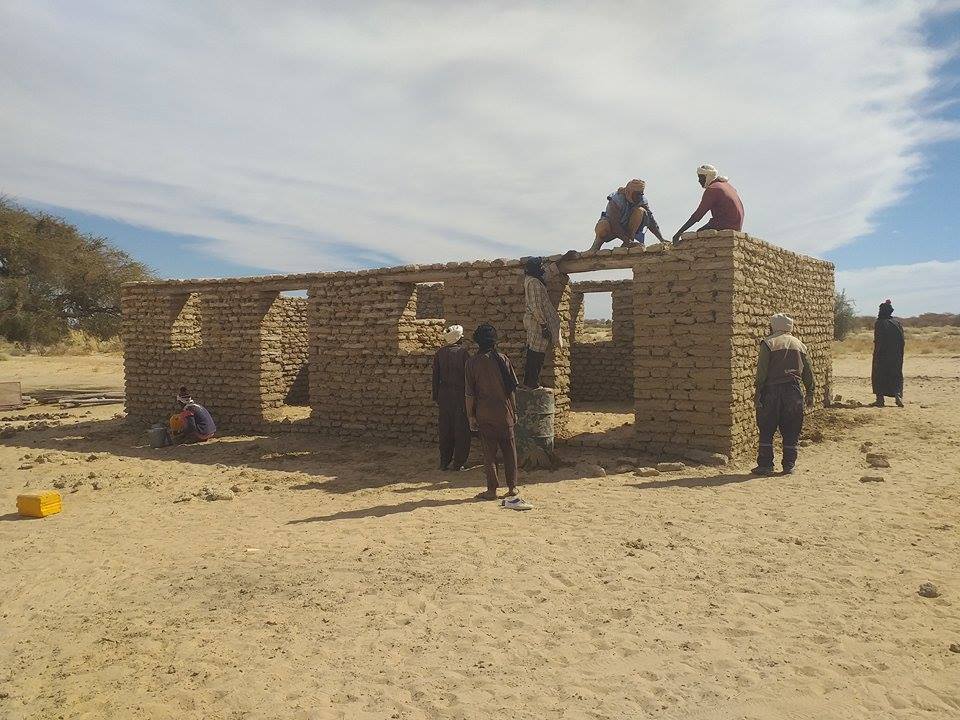
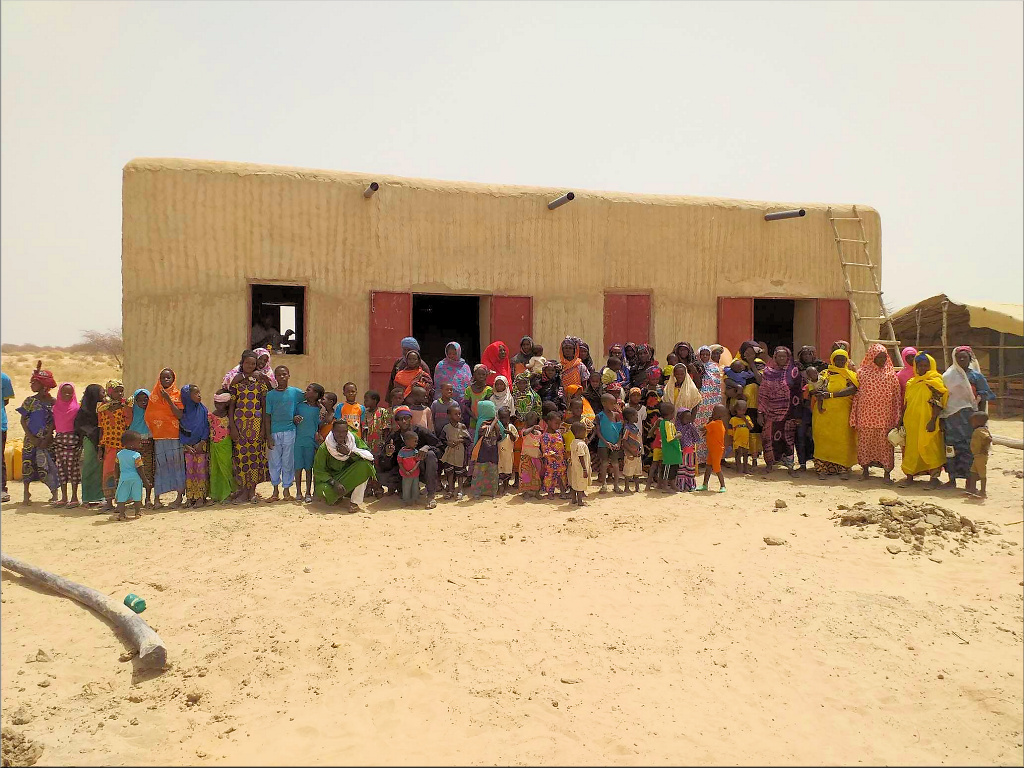
The school in construction
The village has hit new political difficulties. It’s a long story, going back to the 1880s-90s when the French took over the Sahara, dividing it into what are now Mali, Burkina Faso, Niger, Morocco, Algeria and Libya. They took the Tuaregs’ camels, goats and best lands, oppressing, conscripting and enslaving them and discouraging their nomadic lifestyle. Over time there were a few Tuareg revolts against this.
When independence came in the 1960s, power went to the Mandinka and Bambara majorities in the southern, greener part of Mali, who continued discriminating against the Tuareg, regarding them as a threat. Yes, there is black racism too, and the Tuareg are only partly black – they derive from ancient Saharan, Berber, Arabic, Nubian and West African stock.
The school in completion
By the 1990s some Tuareg wanted their own independent country of Azawad in the northern half of Mali – the desert region. The government wouldn’t have it and fought back. There were also frictions with other peoples in the area – the Dogon, Fulani, Songhai, Bambara, Soninka – as populations grew and the region became more desertified.
Recently, Anim Touareg wrote to me, and this is the first time he has ever expressed true fear over the future. This is what he wrote:
Salam Aleykoum dear Palden How are you ? All the people of the village greet you We are very scared about the situation and yes we hope everyone will be safe A lot of people already flee to Mauritania But in the village we discussed about it and we decided to stay in the village Because travelling will cost a lot of money and the last time we went to [refugee camps in] Mauritania, everybody get sick Here now the biggest problem we have is the provision [food] Things are getting very very expensive because of the war However if we get food for the people, we will stay in the village and continue education for the children The chief of the village is sending his worry and ask you to tell to your friends Because this is very emergency and we hope everything is gonna be alright Thank you so much for everything dear Palden Please receive greetings and prayers from all the village Ma’Assalam
And later he added this:
We don’t have access to a good and reliable internet connection these days I am happy to tell you we sent some families to the refugee camps In Mauritania We evacuated elder people first because they have a lot of health issues and can’t support big pressure For me I am still in the village with my family and some other families We will work hard to continue running the school so our children get educated It’s very important for us We are trying our best I know about your health issue dear friend and I don’t want you to work a lot also So take your time and share some Infos when you can Thank you so much for everything dear Palden Please take good care of you and keep in touch Maasalam Anim ❤🙏🙏🙏
Anim is a Capricorn in his early thirties – a Tuareg Millennial and single father, with camel.
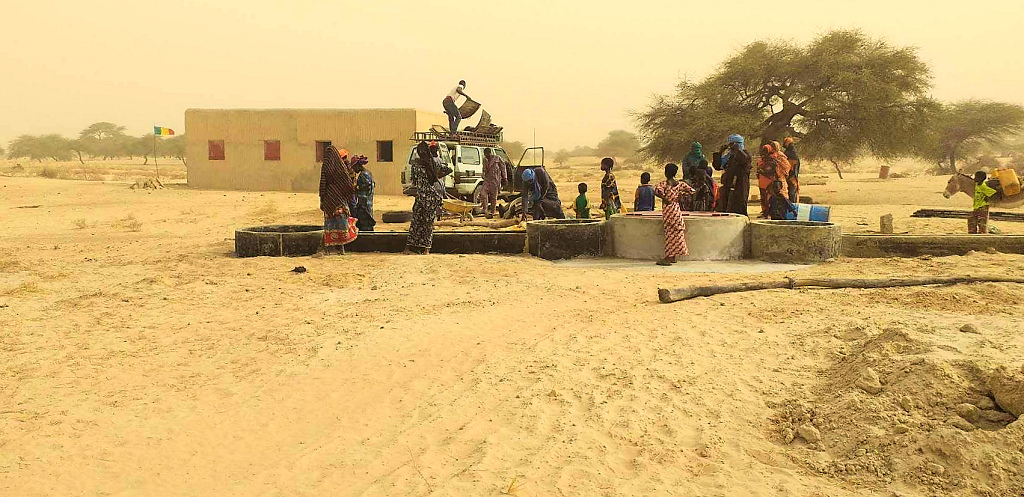
The well in construction
I’m telling you this story partially for your interest and information, but also I’m sniffing around. We need about three people with a good mix of skills who would be happy and willing to work with this and – this is the important bit – stick with it. The good news is that this project is not a big one – it’s human-sized. The turnover of the Hope Flowers School in Bethlehem was over a million dollars a year, with which I could only tinker around the edges and do specific bits of hassle-busting but, with this village, our input has made a total, marked difference.
The well, completed
It’s a smaller-scale project, involving real people. We have no offices or international development degrees, though we’ve lived round campfires in tents and tipis. The involvement of an enlightened NGO might be welcome, yet there’s something special here about people-to-people, ground-to-ground connections – and not just handing it over to the charitable sector.
It feels best for there to be something like a small group of (say) three proactive energy-holders with 2-3 helpers. But it will take the shape it takes, around the people who turn up.
This isn’t about aid and development in the standard model. This is about helping the Tuareg stay Tuareg, and helping them interact constructively with the encroaching 21st Century world – and its guns, troublemakers, competing interests and geopolitics. A friend in Cornwall, Kellie Odgers-Brown, has come forward to market their jewellery here in Britain, and that’s a first step – the Tuareg want to generate their own income.
Now we need:
a good networker experienced in social media, crowdfunding and handling payments,
someone who understands cultural sensitivities and the politics of the region (who has also travelled outside the rich world without staying in hotels),
someone who is good at hustling, writing and organising,
plus a couple of people who are happy to pitch in when needed and handle special issues (such as cultivating a funder, running a website, starting a branch in another country or even going to Mali).
There’s a crisis going on in the Sahel and it is unlikely to end quickly. So this is not an easy mission, but it is doable by keeping an eye to the future. These people are a potential shining light in the post-conflict revival of the area. They stay politically neutral, focusing on their village and raising its game. By setting an example they give a model for other villages and tribes to emulate – this is a multiplier factor that is worth considering, and it’s already ‘case proven’.
But it needs resolute perseverance. It’s not full-time – it’s a spare-time thing that will go in waves and bursts. It might be good if there is one person in their 50s-60s, one in their 30s-40s and one in their teens-twenties, since each generation has its virtues. But those who turn up and make a difference are those who will run it and decide.
My dilemma is that I am no longer able to head this up and I have only a few years to live. The best I can do is advise, support and stand behind you. I no longer have what it takes to shoulder this operation. Think in terms of a minimum three-year commitment, with an added duty of finding someone to replace you if you wish to go.
If there is a gap in your life, if you seek engagement with something meaningful and out of the ordinary, and if it fits your ethical values to the extent that you can focus on it and become a trusty friend to these people, then this might be of interest to you.
If so, think about it for a few days, do some research, take a look at Anim’s Facebook page, contact him if you wish, and write to me with your thoughts (just a few paragraphs at first, please!). We’ll go on from there. Consider your realistically available time-space and your capacity to carry things through, and be clear about where your limits lie.
This is teamwork and others will rely on you to do whatever you take on. It’s unpaid, voluntary work, and it might or might not benefit your CV or resume, but it could benefit your mana – your standing as a soul. At the end of my life, I am so thankful for having been involved in this kind of work – it has been enriching in heart and soul.
That’s what this is about. To fulfil our missions on Earth, we need to get engaged with specific issues, activities and projects. We need to test ourselves with some gritty stuff, bringing light into the darkness. While this world has no shortage of crises and issues to worry about, getting involved with one thing like this is doable, and it can have wider implications longterm. It’s something where you as an individual can make an impact.
You form relationships with these people, and it’s about giving them some hope and backup, to make their lives better. They live in a very different world to us and, in our time, we need to learn to avoid imposing our ways on them and getting them to suck up to us. Instead we need to help them be themselves, stay themselves and develop themselves in their own way.
This is the way of the 21st Century. Leaders in this are the Palestinians – they are advising the Ukrainians in non-violent social survival and resistance skills. This is the stuff of the future – human, spirited aid.
It’s about building resilience, ecological, cultural and societal, about helping people face modern times, and bridgebuilding between cultures while honouring diversity. It isn’t only about helping them: it’s about an energy-exchange where they give what they are strong in, and we give what we are strong in, and it connects up, and everybody benefits.
For we, in the rich world, we need aid too. It’s just that we don’t fully know it yet. These people know a lot about survival and self-sufficiency. They understand the magic of life. They have a deep-rooted culture. They need friends, and so do we.
If this says something to you, or if you know someone who might be interested, or if you’d simply like to donate a tenner to the kitty (details from me), or rustle together tenners from your friends, or even take over the kitty, or make a prayer for protection of the village and the departed villagers, then please do. It would be great to give them some encouragement right now.
I’ve given you another long read, haven’t I? Well, congratulations in getting to the end. Happy newmoon. And Happy Birthday to Lynne too!
Here’s a story from Jenin, in happier times in 2011. It might give you a feel of the place as it is when life is more normal.
THE SPRING OF THE GARDENS, Jenin, 28-29th June
Jenin
Jenin is perched on the north-facing slopes of the West Bank plateau, on the edge of a wide, green plain stretching west from Galilee toward Haifa and north toward Nazareth. The security wall separates Jenin from the Arabic towns of Afula and Nazareth in Israel, not very far away. This is Jesus country, and Mohammed, although Muslim, is enamoured of the Jesus stories here.
Jenin is lower than most West Bank towns – except Jericho, the world’s lowest town. You can feel it in the thicker, moister, softer Mediterranean air of Jenin. A friendly town of 40,000 or so, we made stops at a workshop, then at Mohammed’s family firm’s sizable warehouses and offices. More coffee – I was beginning to get jittery and strung out on the stuff. But another special moment was coming up.
Birqin
We went to the village of Birqin, west of Jenin, to see an ancient Christian church – apparently the world’s fourth oldest church, founded by the Byzantine empress Helena. Here Jesus had healed the lepers, in a biblical story. It was lovely inside, with richly-painted icons and Greek Orthodox paraphernalia. While the caretaker talked to Mohammed, I went into meditation, perched on a wooden pew – the place was tranquil and atmospheric, imbued with radiance.
While in that state, spontaneously I became aware of my mother, who had died 18 months earlier. Something in me suddenly wished, deep in my heart, that I could have brought her here. I don’t know where that feeling came from, but tears welled up inside, trickling down my cheeks. Cleansing tears, tears of release and healing forgiveness. I had always wished to share with her some of the remarkable spiritual experiences I have had in my life, but she never allowed it. She was quite a believer and she would have loved this church. Later I thanked the caretaker, and Mohammed too, for giving me this moment. Another level of resolution with my mother had taken place, unforeseen, yet a great blessing.
Mohammed had a lovely Palestinian wife who had lived in Germany with him, and a family with two girls and a newborn boy. I had a delightful evening with them. Ismael, my taxi-driver in Bethlehem, rang to find out if I was alright – that’s kind of him. He might also have been fishing for me to ask him to come and fetch me tomorrow, but I’ll make my own way back home to Bethlehem.
The market
Being in Palestine is a perpetual process of being waylaid and sidetracked. If you try to change or resist it, or if you attempt to hold on to even the best-laid of plans, you land up worn out and frustrated. If you go along with the flow of it, remarkable things can happen.
Mohammed took me on a tour of Jenin – the market, the main street, the old town – though really the tour consisted of a series of stopovers for Mohammed to have conversations with people in the street, and with cafe owners, the director of the musical conservatory and a former Marxist running a shop next door to it. Well, I’m here to plug into real life in Palestine, and it was an interesting process. If all I can do is to be a character in people’s lives, and they in mine, something has been achieved.
People accost you in the friendliest of ways, even in the middle of a busy street. I was standing in a corner in the market, training my telephoto on people walking past, quietly taking pictures, and a steady stream of people came up asking me where I was from, where I am working, whether I come from London (as if it’s the only place in Britain) and why I didn’t bring my wife (she doesn’t exist, but sometimes I tell them she’s back home, to make it simpler).
The former Marxist was interesting, an intensely ruminative man who struggles within himself to find a new picture of the world and where it is going, after the fall of the USSR and the shift of China to capitalism. He had gone to university in Russia, as a number of older Palestinians have done. “The past is our future”, he said, “and the future is already come”. He sold old relics. He asked me what I recommended for Palestine. I thought about it, knowing he was seeking original thinking, and then told him I thought Palestinians should avoid adopting the wider world’s ways and becoming a client state of Europe and America – otherwise known as ‘economic development’. Or at least, Palestinians should be more discerning about it.
Peace and freedom are the peace that makes traffic jams possible and the freedom to sit in them – Martin Bell, war correspondent
‘Development’ involves an adoption of modern, market-oriented, high-tech, capitalist ways. It is assumed A Good Thing, but this viewpoint comes from one angle only – profit, gain and the assumption that economic growth makes people happy. Culture, society, nature, spirituality and finer human qualities are conveniently overlooked. Palestine would do better to be a cultural originator, not a slavish adopter, finding its own solutions and modifying the best of others’ to suit its own core objectives. He thought this was a good answer.
You can see the price of economic development by the plastic bags that blow around in the wind across the streets and hills of the Holy Land. Shopkeepers give them to you even if you have a cloth bag to use. My cloth bag slings over my shoulder, freeing my hands but, no, everyone carries multiplicities of plastic bags, destined to harness wind power and fly freely once they’ve been used. Or they get burned, releasing PCB toxins. The march of progress comes down to seemingly small issues such as these. Palestinians tend unthinkingly to believe that anything modern is good – it isn’t always so.
A cobbler at the market
In the women’s empowerment courses back in Bethlehem they teach about the dangers of using plastics indiscriminately. For food use, Palestinians often use plastic bags that aren’t food-grade. Thus, invisibly and insidiously, the bags shed phthalates, PCBs and all manner of nasties into people’s food. On the course they teach about the dangers of those Alzheimers-stimulating nightmares called aluminium pans, and about microwaves that can cook you as well as the food, if you’re close. Palestinians use these without knowing their dangers, then wondering why Allah awards them with cancer. I’m sure he shakes his eschatological head in dismay.
I said to the Marxist that they ought to consider banning cars from at least some streets, giving the streets back to the people. That couldn’t happen, of course, and he said so – people wouldn’t agree with it. But they won’t support the idea unless they try it first, to see the difference. Manger Square back in Bethlehem is free of parked cars on Fridays and Sundays, and it’s wonderful – on Fridays hundreds of Muslims do their prayers in the square, and on Sundays churchgoers spill out of the Nativity Church to mill around, while boys kick balls and ride their bikes and people gather in gaggles to chatter.
Ottoman architecture in the Old Town
Oh well, Westerners nagging about environmental issues don’t necessarily help either. People need to discover these things for themselves, learning the connection between baby formula and their babies’ depleted immune systems, or between cancer and the pollution generated from burning plastic.
We left the Marxist, with his visible back pain, to continue with his struggle. One form of development aid would be really valuable here: squads of osteopaths and chiropractors. So many Palestinians are out of joint. Water dowsers would also be valuable, except that the Israelis would quickly deport them because they want control of Palestinians’ access to water.
Jenin is a pleasant town. I came with an image of it as rather squalid, intense and somehow parochial, given its reputation for Israeli army incursions and Palestinian resistance. But no, it’s relaxed, friendly and not as crowded and walled-in as Bethlehem. It has a large, wide-open hinterland with nary an Israeli in sight. Even the local Israeli settlements were vacated – perhaps the Jeninis had succeeded in their resistance. The separation wall is some miles away, leaving open farmland around the town.
Jenin is populated with many refugees who originate from Haifa, on the coast of what’s now Israel. It was once the most tolerant and multicultural town in historic Palestine but it was ethnically cleansed in the 1948 Nakba when it was taken by Israel. Many were killed and the remainder escaped to Jenin.
Tolerant people, if their tolerance is seriously betrayed by sectarian or racist separatism or violence, can become deeply distrustful as a result. Sarajevo in Bosnia is like this, as is Beirut in Lebanon. People’s faith in humanity is more seriously destroyed than it is in the case of people who distrusted others anyway as a matter of course. That’s why Jenin, in the second intifada around 2000, fought ferociously against the Israelis.
I saw a sign saying ‘Dear Haifa, we are returning’. Israelis might interpret this to mean driving Jews into the sea, but it doesn’t. The Palestinian ethos is not ethnically exclusive like that of Israelis. It doesn’t stop them wanting to go back to their foreparents’ home though, to return to what had been a truly multicultural port city.
Jenin is a fertile place with many water sources, and it’s greener than much of Palestine. Its name is derived from Ayn al Janin, ‘spring of the gardens’. But ‘progress’ has had its way. Mohammed, an eco-campaigner, showed me where springs had been canalised, then to dry up, and where trees had been felled and the water table had thus sunk, and where a mosque extension had caused some old fountains to cease flowing. Then people wonder why.
The music conservatory
This ‘progress’ ethos is adopted from abroad. It’s a progress that bulldozes away key resources such as underground water, farmland, clean air and balanced societies, undermining the true and full interests of a nation and its people, ruining everything with concrete and garbage.
Mohammed took me to a bare, wide-open place outside town which, he said, was being built as a result of corruption. It was the site of a new industrial park, as yet unbuilt, where the foundations of what looks like a future eight-lane highway had been laid over rich agricultural land. In development logic, it’s industry and commerce that are priority number one. This will lead to regret one day. Development and resulting crisis go hand in hand, with but a time-gap between them. Perhaps I’ll say that again. Development and crisis go hand in hand, with just a time-gap between them.
Eventually it was time to go home to Bethlehem. Mohammed had hosted me royally. He dropped me off at the taxi station, where I caught a service taxi – a ten-seater VW van – for Ramallah. These guys drive fast, but they do indeed get you there. I sat in the front seat. A young guy behind me was fascinated at what I was photographing, watching me closely as I turned my telephoto to focus on specific scenes, calculating my shooting carefully to avoid wires and roadside obstacles. I told him I was trying to catch a wide range of classic scenes, to build a website about Palestine. He said shukran jazilan, thank you very much, and the driver agreed. Afwan, it’s my pleasure. It really is. It’s an immense honour.
The checkpoints were all open. Things were improving year by year in Palestine and travel was getting easier. Just 5-6 years earlier this journey would have been a major expedition with no guaranteed arrival time – or no guarantee of arrival at all. Travelling to Ramallah from Jenin would have involved bringing out permits and passports at least five times.
Tel Aviv from Bir Zeit
The Samaritan landscape on the way from Jenin, past Nablus and down to Ramallah, is lovely. At Bir Zeit, Palestine’s Oxford, the uplands look west over the Israeli plains with wide-open vistas to the sea – to a Mediterranean which, though not far away, few West Bank Palestinians may visit.
Architectural glories at Qalandia
On arrival at Ramallah I bundled out, with ma’assalams (goodbyes) all round, and bundled straight into a service taxi for Bethlehem – again, luckily, in the front seat. We sped off down to Qalandia, the main Ramallah checkpoint for Jerusalem – a place where queues are guaranteed – but we passed it by and headed down the Jerusalem bypass road, weaving through valleys and up and down hills, down to the Jerusalem-Jericho ‘peace road’.
One wonders why aid donors don’t feel ripped off by the lack of progress in building peace. But it was guilt money, really: on some level aid-providers know they perpetuate injustice and conflict, simply by using money to soften the blow of Israeli occupation. So, really, though it appears that they are helping Palestinians, in reality they are helping Israelis by keeping Palestinians quiet.
The boundary between East Jerusalem and the West Bank
The desert mountains east of Jerusalem are hauntingly, barrenly, dramatically stunning. High limestone ridges, starkly bare of vegetation, sit there like a rock installation of God’s geological artistry – lacking vegetation due to millennia of sheep and goats and a good dose of recent climate change.
This is the land of the prophets, the stomping ground of Jesus and John, of the Essenes, Sufis and the Magi. The road does some tortuously sharp bends which everyone takes at speed. Israeli and Palestinian cars, with different coloured number plates, vie with each other and, generally, the Palestinians, free-range in driving style, get there first. It’s not all Israeli dominance in this crazy country!
The 1990s Japanese-funded ‘peace road’. In front, the illegal Israeli settlement of Ma’ale Adumim, and in the distance, the Mount of Olives in East Jerusalem
As it goes, I’m not a bad holy warrior. By ‘holy warrior’ I mean someone who is willing to get in there and fight for truth – setting out not exactly to win, but to reveal truth and to deal with assholes. To stand up for what is good and right when bad things are happening. But in the saga I’ve been involved with, the battle is pretty much lost. That’s been hard to face. But it’s real life.
It started back in October when a British man, working as an anti-fraud investigator in Ghana, contacted me to ask if I would lend him some money (30ish GBP) to get out of a tricky situation. Yes, sure. Quite quickly things started going crazy – he was being chased by gun-toting, crack-driven gangsters because he had busted them, scrubbed their computers and taken some important information of theirs. He had been sheltering with a friend who first introduced him to me, Felicia. Suddenly they were captured, together with Phyllis, Felicia’s three year old daughter, and taken to the north of Ghana, near Bolgatanga, and kept in captivity for a week. I helped them with money for food and phone.
Then Andrew, the investigator, was taken away across the desert to South Sudan. I managed to negotiate Felicia’s and Phyllis’ freedom and they were dumped in a nearby town. I had to get them home. That took ages, and I ran out of money. We scraped along for a week, and then Felicia needed to meet another investigator, Dennis, in order to carry out some online actions that would free up some money – the company had rigid protocols over this and we could not access funds until this was done. Dennis and Felicia were then attacked, rammed by a car and left dying. A taxi-driver, Kofi, who witnessed this, bravely took them to hospital. They were cared for by Dr Isaac Acquah.
The company had promised me they would pay for everything. Then there were delays, then complications, and then the money didn’t come. They didn’t even pay Dennis’ hospital bills, even though they agreed with the hospital management to do so – he eventually died because of that. The story went on and on. Isaac rescued Phyllis and Felicia and took them home, but then the gang was after him. They raped and captured his wife and teenage daughter Antoinette. His wife was never seen again and Antoinette was returned, ravaged and traumatised. More complications, and then eventually they all fled to the refuge of a native healer, Okomfo Ayensuwaa. The Okomfo and I did a powerful healing on Felicia and Antoinette but the gang came again, killing Antoinette and the Okomfo. Isaac and Felicia escaped to Togo, the neighbouring country – all helped by me.
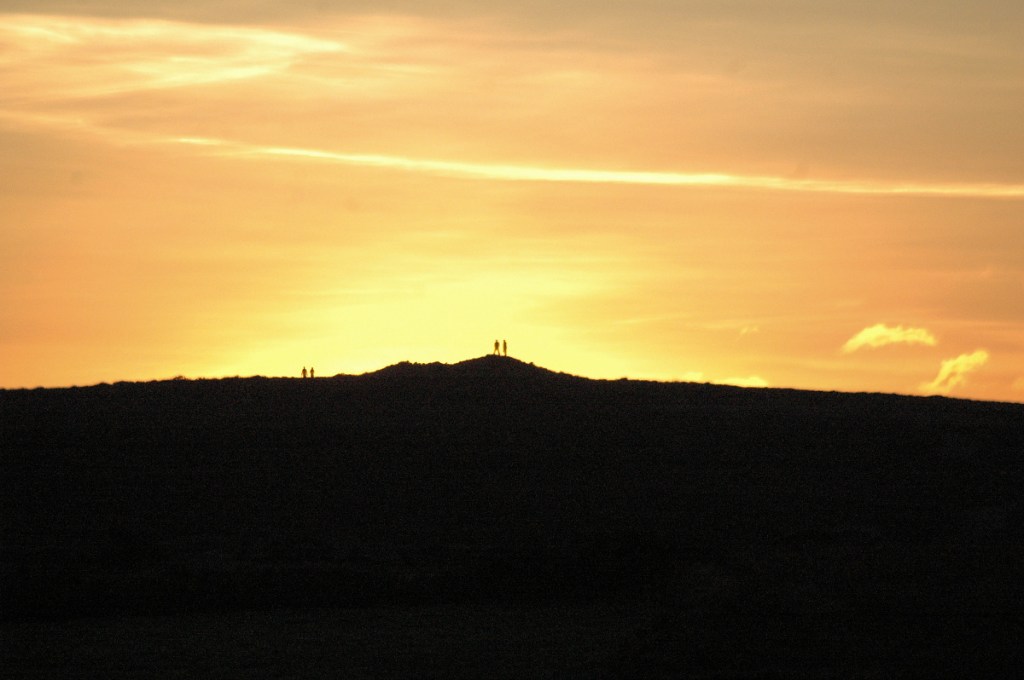
Sunset over the Celtic Sea, from Woon Gumpus
It went on and on like this… I shall tell the whole story sometime. Every single day there were crises and scrapes, and we were perpetually hampered by lack of money. The company had now balked because, after their failure to pay, in late November I had made a public appeal for support – which they did not like. But I could not just dump people in need, even though friends were beginning to encourage me to do so – or at least, they encouraged me to look after myself (a worthy thought) without really considering the consequences for the Africans.
All the time Felicia was guarding a memory stick belonging to the gang, to get it to the company. It contained all the details they needed for accessing their money, so they were desperate for it. When the gang discovered she had it, they chopped off two of Phyllis’ fingers in revenge and multi-raped Felicia.
Around Xmas the company had at last promised to send £8,000 – £5k to repay me and £3k for Felicia, as compensation. But the money did not come. My handler said that some of the company directors had blocked supporting us – I think there was a hard-nosed faction there who didn’t care.
At New Year, more complexities came, and Felicia and Pyllis were again kidnapped, then dumped in Niamey, Niger. Then there was a long saga trying to save Phyllis – she eventually died of infection and tetanus (the gang had used a dirty knife). Felicia then found she was pregnant, and she was also deeply traumatised. This week, after hospital treatment with a fine doctor who cared for her, we tried to get her back to Ghana but she was too weak, and started bleeding. As I write this, her life is again in question, and she’s back with the doctor having blood transfusions I am paying for.
That’s a short version of the story. All the time I was caught in deep dilemmas: financially I could not keep supporting them, but I didn’t want to abandon them. I had seriously misjudged the company and their integrity, though I had had cause to trust them, since my handler promised 6-7 times to pay up. Some friends thought I was being scammed by West Africans, but no, it was not them but the ‘secret’ company, an anti-fraud investigation contractor to a big Australian bank. Well, they defrauded me. Part of me would like to expose them and exact a price, but I must think it through carefully. First I must restore my finances, since I am £6k down – that’s a rather daunting prospect.
Despite everything, I am on the whole happy about the way I have handled this, except for two things: I allowed myself to be defrauded by the company, and I am useless at fundraising and asking for help. As a cancer patient I already have to ask for help quite a lot, and this operation was too much, and complex in its implications, and I was unhappy about asking too much of my online friends and followers. In these two issues I failed.
The shortage of money made everything so much more complex – if the company had paid up I would have been able to finance solutions and end this sorry saga back in November. If they had paid up, at least eight people would still be alive today, and I would not be in dire financial straits. Morally and in terms of duty of care, the company is wrong, wrong, wrong.
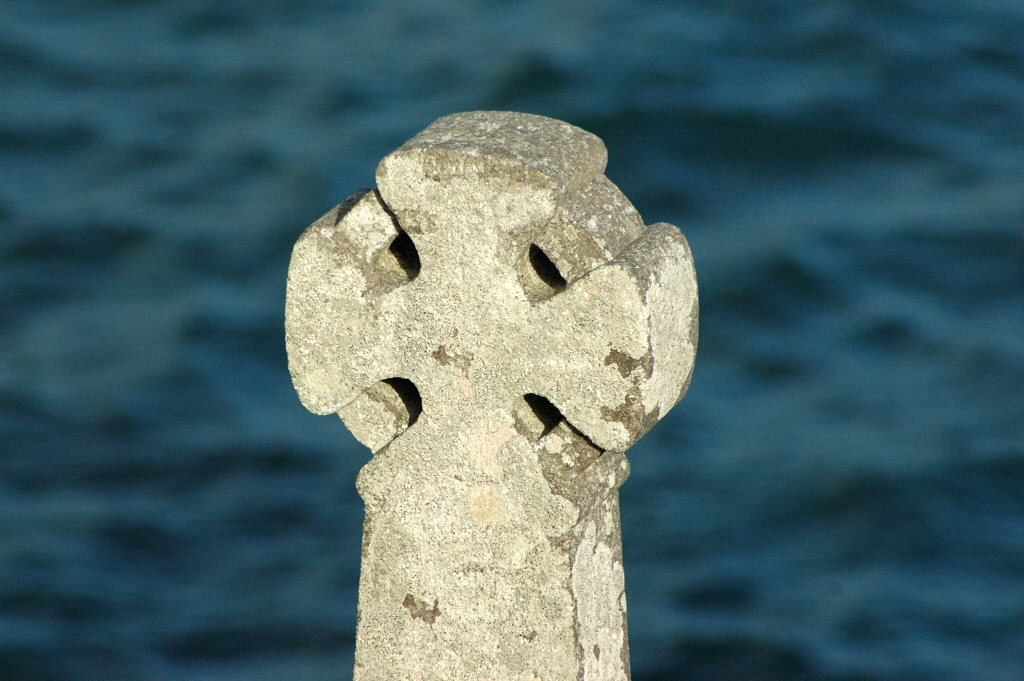
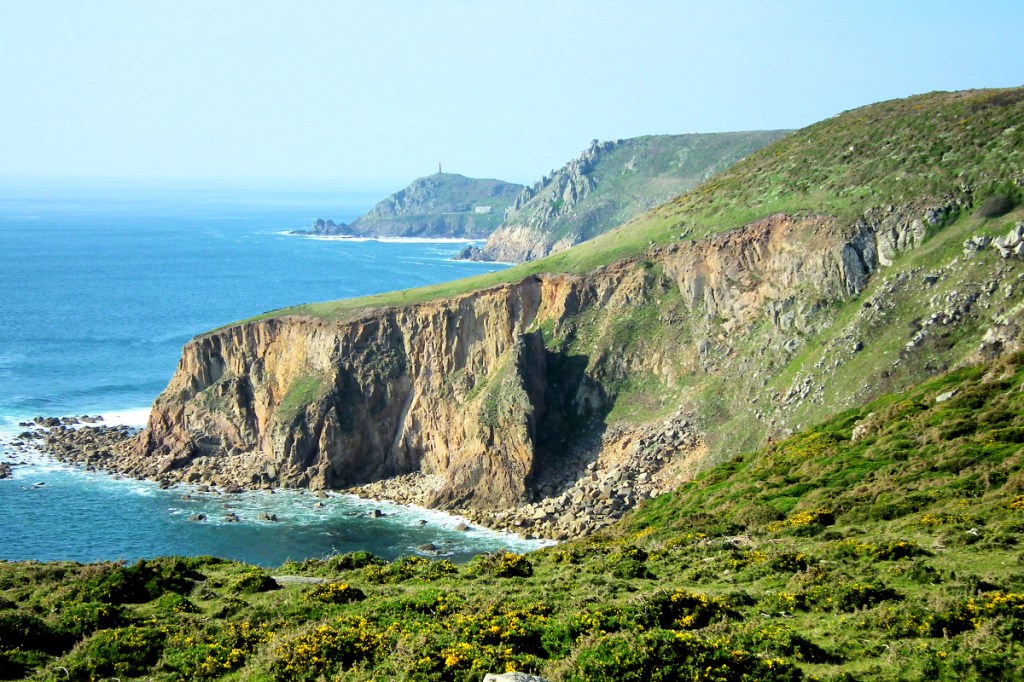
Cross near Porthcurno, West Penwith
Feeling the weight of failure, yesterday I went deep and reviewed the whole situation. One positive thing emerged: on several occasions we had clearly demonstrated the power of remote healing. At times when I appealed for healing support amongst my readers, it really worked. In December, when I was working with the Okomfo, a lovely lady, we did a powerful healing for Felicia and Antoinette, and it really worked.
At one stage I was sending information I had psychically picked up to the Okomfo and she asked, “How do you know this?“. She could not believe that a white man in Britain could do what Okomfos and Mallams (witchdoctors) do. We both realised we had reached across a wide cultural divide: an Akan native healer meets a whiteskin aged hippy, and we clicked.
These spiritual experiences have been remarkable, and my thanks to all those who participated in prayer and healing – particularly Susan in Nova Scotia, Kate in Devon and Zoey in Seattle. Many thanks also to those who have donated money – I wish I could have done more with fundraising, but the ongoing task of crisis-management and spiritual work was well enough to deal with.
So, as I write, on Friday evening, Felicia is again on the edge of death and being given blood transfusions. I have been approaching women’s organisations in Niamey asking if they would take in Felicia for a week or two, if she survives. She cannot travel anytime soon. I now have fundraising to do – short term (£1k) to pay off medical bills and support Felicia until I can get her home (a hard, three-day journey), and longterm to try to rescue my own situation (£6k).
I am weary now. I want to reclaim my life. Did I do the right thing, standing by these people and ruining my own life? Should I have been more sensible? It will take time to answer these questions. I’m certainly paying a high price. Yet despite the tragic and painful things that have happened – I’ve cried tears so many times – I feel quite clean in my heart, since I have managed this whole process, I believe, pretty well. I would have taken on a weight of guilt if I had turned away from them.
Most of them have died anyway. Dr Isaac and his daughter Adjoa, 6, are still alive as far as I know, but I have lost contact with them. He has lost his wife and two kids, his job and home and everything, except Adjoa. I don’t know what happened to Kofi either.
St Michael’s Mount from Botrea Hill
The story has been tragic, lives have been lost, remarkable cruelty has been carried out and, worst, the assholes have won – both the gangsters and the company. I do not like that. One thing that upsets me most is that ‘good samaritans’ in Africa who have helped out have all paid a high price for doing so. Meanwhile, the gangsters are all free and continuing their trade, and the company and its directors… well, I won’t write what I would really like to say about them. Shame on them.
I’m now in a test of faith. I’ve brought big money problems on myself. Thirty years ago, when I was working for the Council of Nine, someone asked them why they did not help with money. They explained that they can help with energy, but money is a human invention, and only humans can work with that. Certainly I have prayed many times for a cascade of money to come my way, and I’ve had to face up to the fact that it is us humans who decide over money, not higher powers.
Nevertheless, just before Christmas, the Okomfo and I did an inner process to remove the conflict within the company, to free up the atmosphere that was blocking payment – and, guess what, a few days later, my handler wrote to say he was going to send that £8k. But somehow, it still didn’t work. Someone blocked it. There’s a lesson in that. Money is very human stuff. Higher powers can help progress things on an energy level, but money is not in their realm. So we did well with healing and energy-support, but the money issue was different.
We’ve been through a time recently where the world’s assholes have been rather successful.
But underneath something else has been happening. There’s a deeper meaning to this whole saga: I can sense it though I cannot see it. Yet. For those of you who understand astrologese, the transit I’m on at present is Uranus opposition my Mars in Scorpio. That’s the holy warrior in me. A few years ago I wondered what this transit would bring, and now I have my answer. And the story is not complete yet. Another transit going on is Saturn conjuncting my Jupiter in Pisces – Jupiter is the humanitarian and deep-spirited part of me, and it’s under test right now. Tested by the agency of money. Saturn.
So while I have a lot to regret, something in me doesn’t regret doing it. There’s a saying that goes: ‘It’s not what you get for it, but what you become by doing it’. Something is changing in me. A battle has been pretty much lost, something in me that feels glad I didn’t walk away from it.
So, dear friends, keep praying for Felicia. She’s a very brave woman. She has dealt with stuff that would scare people like you and me. God bless her for that. After all she has lost, I cannot tell whether life is worth living for her now. But we shall see: she’s in the hands of Spirit and under the care of Dr Mark. Now it is time to get off the computer and make myself some soup.
Thank you all for being with. I’ve been alone for a long time, and your company means a lot to me.
This is supplementary to my last blog entry, for those of you who are following that story. Here are some comments, thoughts and bits of further news posted on my Facebook page, which might interest you.
Jo A heartbreaking story. I’m so sorry Paldywan. Love you. X
Palden Jo, it’s the pathos of human life and death. Over so many lives it has been part of the human condition. I still believe we can wind it down though, over time, to make this world a happier, friendlier and safer place. Big hug, Paldywan.
Stella Only today have I read this story in full. I’ve been putting it off as I knew it would be harrowing. It is impossible and undesirable to make any judgements as none of us are privy to the complete truth in all its details. I can only admire you, Palden, that despite your own serious health challenges you took this on and tried your utmost to help. I feel diminished and ashamed that I would not have been prepared to do the same. In trying to make no assumptions, a deadly sin in my view, I feel that although her story is unbelievably harsh, on some higher level it serves a purpose for humanity and her own sacred contract would have made this clear to her before her life began. Easy for me to say, I know, but all of us who read this story will be deeply affected by it and the wider it is known, the greater the lesson for humanity will be. Blessings to you, Palden. You did an extraordinary deed.
Palden Stella, hello. Yes indeed, the world can be a really harsh place. These events are taking place in an unstable zone as well. In countries like Britain, with notable exceptions, we live in a zone of rights and relative comfort and decency, sort of. It can therefore be difficult to believe some of the things we hear happening elsewhere. Despite such dramas – in the Sahel it’s a mixture of criminality, smuggling, jihadism and foreign interference – normal life goes on too. In our own media-dominated countries we tend either to ignore such places or to over-exaggerate the dramas going on there, when the cameras look, so we have a rather distorted view of what goes on, and also of what doesn’t go on. It wasn’t my plan to get sucked into all this, and it has been a stirring and disruptive experience. But I understand it as part of my pattern, having been involved in similar ‘borderline’ things before in life. This kind of work – as is the case with nurses, firefighters, soldiers, first-responders, aid-workers and activists – does tend to lead to a kind of vocational dedication that many people prefer to steer clear of, and I don’t blame them. But for me it has also met up with a difficulty in being able to hand over such duties to others when I can no longer continue – and this has been the case in my work in Palestine, with the Tuareg in Mali and now with this. It works better when you work for an NGO, where employees can be hired, or they can resign or retire, but there’s a price to pay for working inside that sphere too – not the same closeness to the ground, and not quite the same deep human feeling that draws many people into this field in the first place.
Palden Last night (Saturday 4th March) after talking to the doctor in Niamey (a good man) it was clear to me that Felicia had reached a crossing point. She was drawn to follow her daughter Phyllis, and I could feel her tiredness with everything – in a way, blocked at every turn. She had tried so hard. I felt it was important to nudge the process – not in the sense of encouraging her to die, but in the sense of helping her face that ultimate question of whether to live or to die. To get clear on it. She has been confronted with so much darkness and badness that I took her hand and led her to the light, to love, care and protection of a kind she sorely deserves. I can do this because I’ve been there myself. I gave her to the angels, asking them either to take her or to pump her up with new life and return her – but not the grey zone in between. The important thing is that, if she returns to life, she needs the strength, heart and will to make something good of it. She’s a special person, but she has been up against too much – even when a child she watched her family being killed in front of her, in the Liberian civil war. So I have handed her to the angels. I await news from the doctor as to what has happened at his end (Sunday midday).
Jennifer Palden Jenkins I was seeing/holding the same for her: seeing her held in golden angelic light while she made her decision, telling her either way was ok, and asking the angels to give her all she needed 💛🙏💛
Liz Thank you for sharing. So very sorry to read this – really shocking. I hope you can focus on yourself ❤️
Palden Liz, I wish I could but, unfortunately, it is incumbent on me to get her home and safe. If I worked for an NGO I could sent for reinforcements or be replaced, but I cannot, and this is a price you pay for being an independent humanitarian. But then, I chose to be involved and take responsibility for this, so it’s up to me. Focusing on myself is not right now very easy.
Liz Palden, I understand the need to help, truly. I perhaps haven’t followed everything but hoped so much the money that covered the operation for the little girl would be life saving. I hoped dearly I had made that difference. Again, it’s also important you focus on yourself. Take care ❤️
Palden Monday morning, 6th March. Latest report…. Felicia is alive and conscious and requesting food. She has returned. The doctor (he is Rwandan) reported that she has been near starvation and needs building up. So that is what needs to happen next.
Jennifer Palden, wow, what an amazing, strong woman!
Palden I think the reason she keeps coming back to life (third or fourth time now) is that she has a mission.
Palden Tuesday 7th March. Felicia seems to be improving and has been discharged from hospital, now staying with a nice lady in Niamey. The doctor who has been looking after her has been helpful and good. We hope to get her a ride on a truck back to Ghana in a few days’ time. She is missing Phyllis a lot though. It’s difficult raising money to support these developments while I’m struggling for money myself, and I’m looking forward to bringing this saga to a close, but somehow we’ll get there. Prayers for her and for all of this are welcome! It’s fullmoon, and hopefully a turning-point. Love from me, Palden.
Zoey Paldywan! I just took in the entire thread here. This is real life! So many people are plugged into screens, trying to escape thr collective despair. I don’t know how Felicia is alive,yet i will join in strong prayer for her today.
Palden Zoey, yes indeed, very real life! There’s a lot of it going on. I shall not forget that moment some weeks ago when you and I worked together to revive Phyllis – thanks for being there at that moment, when needed. Even though eventually we did not succeed in keeping her alive, I hope that, in Phyllis’ own journey, she was helped by the intervention of helper souls who supported her. God bless her little great soul. She is being looked after by the Okomfo Ayensuwaa, the Akan native healer who was involved in December, who was killed by the gang for doing so. I miss the Okomfo – for a few days we connected deeply across space and a cultural divide that both of us were able to reach across, to work together on healing Antoinette (Dr Isaac’s daughter, who later died) and Felicia. This whole saga has been so moving and, even now, my cheeks are dripping with tears over the pathos of it all. This is, indeed, real life.
Kath Dear Palden. A harrowing, heartbreaking read. But in its sharing, I hope that it has lightened the load…a little at least. Those who heal, in the reading of your words will pick up the threads, and in compassion and humanity, help to hold them as Felicia makes her way. Blessings to you too Palden, be gentle with yourself. ❤️🙏
Palden Kath, hello. Doing my best, though I’m really ready now to end this saga and bring it to as good a conclusion as I can. Yes, it has been harrowing, even for one who has been involved from a distance. Wearing too. I seem to have held up better than I would have thought. But now I need less uphill grind, sailing against the wind and upstream, and more of at least a level pathway. This has not been the only challenge I’ve been facing, having manifested a number of them, the overall meaning of which I accept but don’t yet fully understand. There is meaning in it though (I can sense it), and that’s why I’ve done my best to stick with it to the end. Thanks to you and everyone else for your heartening messages.
Palden Wednesday 8th March. Things are progressing. My hope is to bring this whole matter to a conclusion by getting Felicia home – Niamey is not a good and safe place for her. So it’s a big push now to try to fix that – involves raising 600 GBP to pay for medical bills in Niamey, for the fare back to Ghana (already paid and booked for tomorrow/Thursday) and for survival money on the journey. The journey will be on the back of a truck going west to Burkina Faso and then another south to Ghana. Today I’m focusing on that.
I shall be so relieved if we can pull this off, because I badly need to get focused back on my own life and needs – this whole saga has been a bit too much for me (though it would have been so different, and so much shorter, if the company had paid up as promised). The doctor is being very helpful, as is a lady who is a pharmacist, who has taken Felicia into her home until it’s time to leave, and thanks so much to both of them. (The doctor wishes to join our Sunday evening meditations.)
Both Felicia and I need to get our lives back, and Felicia needs to be with her friends and in known territory so that she can start rebuilding her life and getting over the loss of Phyllis, her three-year old daughter. I’m really sad about losing Phyllis, having fought so long and hard to keep her alive. Thank you so much to those of you who have sent invaluable healing and support. At some stage I shall be able to tell the whole story, but that’s quite a lot of work, and it involves some tricky issues about what is safe and good to tell and what is not. Meanwhile, the challenge now is to make that final push and pray hard that I can get Felicia home again safely and without further challenges – with luck, by Sunday or so.
So that’s where things stand today, Wednesday 8th March. I hope to report further in a few days’ time. Sometimes I wish I were better at fundraising and hustling money, but my strength is in other areas such as human- and soul-support, negotiation, counsel, remote healing and crisis-management. You can’t do everything. NGOs can be good at providing stuff and facilities for large numbers of people (such as in Turkiye-Syria right now), but they are often not quite so good at the person-to-person stuff.There’s need for both.
Despite everything, here I stand, weak, strong, wobbly and firm
Chapel Carn Brea, the first and last hill in Britain, where the national beacon light-ups start from. That’s a bronze age chambered cairn on top.
One of the best books I ever wrote, ten years ago now, I couldn’t publish. It concerned a plot I helped uncover, involving American financiers funding settlement building in the West Bank, a well-known international meditation organisation making a big error and rogue elements in the Israeli and Palestinian intelligence services. I had to get out of the country pretty quick after dishing up that lot!
The story was quite sensational, though I didn’t publish it because it could endanger people’s lives, many issues would be twisted and misinterpreted in the West, American lawyers would have had a field day, some people would seek revenge, and my friends back home would ask me why I bother risking my life for a few darned Palestinians. Well, it has happened again, except it’s Africans this time. If I told you the story that’s happening now, you’d have difficulty believing it’s for real.
That’s one reason I’ve been rather quiet. It has been difficult knowing what to say. Telling the story can endanger lives, sabotage others, and much of it would, again, be misinterpreted. The number of seriously incorrect diagnoses of the situation that I have received recently has been disturbing, particularly because of their implied racist undertones. Many friends believe I’ve been scammed by West Africans, but the problem comes from a whiteskin company in the rich world, not from Africans. We have been stuck between Western corporate negligence and a crime gang’s violence. Meanwhile, people were getting murdered by the gang, whose market for cocaine, crack, people-smuggling and prostitution is in Britain and Europe. If we want to change the world, we need to end this turning away.
In the last few months I have gained an adopted granddaughter, Phyllis, whose life I have now saved several times. Looks like we might lose her now. She is on the edge of dying, due to a drug overdose and having had two fingers on her left hand cut off by the crime gang. Her mother, Felicia, was gang-raped. The bastards. Felicia is Liberian in origin: when she was young, civil war broke out around her and she was forced to watch her parents and three sisters being shot. When Phyllis’ fingers were being cut off Felicia cried out to me, online, “Why, dear God, is this happening to me AGAIN?”. Phyllis is all she has left.
So while I have a cracker of a story, I cannot tell it. I feel bottled up, but it is safest for those involved that I do not say more. Some good book sales would have been really useful though. This nightmare has cost me a lot and, until the company honours its multiple promises to pay me, I’m seriously in debt. They promised to compensate Felicia for all she has been through, and Felicia is now destitute. This has set me back a lot, affecting my plans for the coming year. But my conscience is as clear as it can be in such a gruesome situation, and I am glad I have not obeyed the advice of many friends to look after my own interests and, in effect, abandon these people to let them die. If I lose friends over this, then so be it.
Bridging gaps. Porthmoina Cove, West Penwith, Cornwall
Last year was a testy year. It wasn’t just the hair-raising story I’ve been involved with. It started a year ago. I was unwell and down, in a mess. My partner suddenly left me – she had her reasons – and I lost another adopted grandchild in the process. Gaining and losing grandchildren is a theme for me at present. Looking back, I was unconsciously picking up forewarnings for nine months beforehand, feeling insecure but unable to figure out why. Something needed to change between us, but I wasn’t ready for total, enforced relationship destruction. I got the blame, though whatever crime I truly committed, in the final analysis, has been far outclassed by the response. I miss her still, and her family. Giving myself a year to get over it, I’ve partially succeeded and also I haven’t. I believed we would go through to the end of my life. But no, I had a big lesson to learn there.
So, I wish her good fortune and many blessings for all that we had together. She is free, and I sincerely hope she finds rebirth and flowering in her new life. She deserves it – she saved my life in my worst cancer days. I am so grateful for our time together. Now a free man with mixed feelings, I’m not managing very well alone. But that’s my problem. It has its plus side though: I’ve used the pain of loss to fire up my creativity, rebirth myself and give the rest of my life, if I can, to starting something new. Or it’s starting me. It concerns a world-healing project. There’s a feeling of rightness to it, like a little seed currently hiding under the snow, awaiting its moment.
In the last year my cancer process has changed. Medically I am more or less stable, and the focus has turned to relationships and the psycho-emotional side of living with cancer. Cancer strips a layer off you and the shields come down. Issues get amplified. A last-chance-saloon feeling takes over. You suddenly find friends and loved ones committing micro-aggressions they didn’t know they were doing. Life becomes raw and unprotected. You get hurt. It has changed my capacity to relate and slowed my capacity to process things through, emotionally. While I’m kinda managing, being on my own means that, if I deteriorate, I have little or no fallback. Sometimes I just need someone to hold me. Sometimes I just want someone around.
One or two friends have suggested that I move upcountry to England, to be closer to people. But I’m electrosensitive and I can’t hobnob in parties and groups or walk down the street without getting zapped and needing to retreat back home – it can take 48 hours to get over it. In effect, to be with friends and loved ones I have to permit them to harm me with radiation. So I could be just as isolated there as I am here. Folks up in England are all very wired-up, busy keeping timetables and treading mills, and that is the central cause of the care crisis we have today – we don’t have time and space to be human, and people in situations like mine demand too much of it. Meanwhile, Cornwall feeds my soul, and the movements of my soul and its expressions seem to be valued nowadays, by you lot. So this seems to be the right place for me. I’m happy doing forays into England, or even elsewhere, but I’d need a lot of persuading to move because I would lose my taproot.
I haven’t been doing well on the family front either. That’s a complex story – another I won’t tell. What with my disability and their busy family lives, it’s difficult for us to meet up, and online relationships don’t really work for me. Mercifully though, all of my offspring get on really well, though they have three different mothers and live in two Brexit-sundered countries. They’re a lovely bunch, and their husbands and children too. In many people’s judgement I’ve been a useless father, and I guess I’m supposed to feel bad about it. Or perhaps I have had Mandela’s dilemma: a conflict between ‘my people’ and ‘my family’, which I have not been able to integrate – and neither did he. However, as an Aspie and weirdo in late life, I’m tired of apologising for being who I am, and I’m not as wrong as I’m often judged to be. It’s time for a change.
In the distance, Kilgooth Ust or Cape Cornwall, as seen from the Boscregan Cairns, one of my favourite haunts
My health is kinda okay, though my back is slowly deteriorating, as if gravitation were increasing. My cancer, Multiple Myeloma, affects blood and bones – will-to-live (blood) and capacity to be active in the world (bones). That’s a wee bit fundamental. Even so, my haematologist is surprised I’ve lasted so long on my current cancer drug, Daratumamab. But, to me, it makes sense that I would do well with it. Dara isn’t a form of ‘chemo’ designed to kill cancer cells. It works by flagging up cancer cells as they emerge so that my immune system can deal with them itself – that’s a brilliant approach, and it’s just right for me. So I’m doing well with Dara. My immune system is in pretty good nick too.
Here’s an observation. I think there are two kinds of immunity: one is to do with the nutrients we take in on a daily basis, which can provide fight-back if our immune system is under pressure or feeling low. Whenever I get the slightest sign of an infection, such as a sneeze, I take a gram of Vit C straight away – and it works. But there’s a deeper immunity level I’d call resilience. If you’ve done immunity-boosting things for a decade or more – good vits, good oils, good everything, though not too fanatical about it – then you’re in a different league. If you’re dabbling with veganism or health-awareness, take note: it truly works if you stay with it for decades, allowing your body-psyche to go through deeper structural changes. Combine this with inner growth, and your cells and genes become transformed. I can verify this from experience.
Longterm resilience has been a life-saver for me, now I have cancer. At root, it lies in attitude. When I’m having a hard time, I look for the gift that’s available. Sometimes I’m forced to lie in bed, watching the buzzards wheeling around over the fields. Sometimes I’m being given a gift of pain to teach me how to move through it and out the other side. Recently I’ve been given a loneliness that has allowed me to spend a lot of time reflecting on life, writing and recording things from my eyrie out here in West Penwith, the Far Beyond.
Immunity is intimately connected with psychic protection too, and right now I’m working on that. Whenever we feel down and got at by life, we have both a protection and an immunity issue. If you want to work positively with cancer or any other adversity, work positively with your protection. This isn’t about throwing up barriers around you – it’s about working on the fears, shame and guilt that grind away underneath, undermining the integrity of your being and giving an opening that outside interference can hook into, draining your power. Sometimes it’s like having fleas, getting nibbled at by lots of small things, and sometimes it’s like a big thump in the stomach. Protection is about the light within us and the degree to which we withhold ourselves behind our shame, guilt and fear.
When I first went into cancer treatment, I hadn’t had pharmaceutical drugs for many years. Suddenly I was getting pumped with chemicals. I called on my inner doctors. “Let it be. We’ll fix it, and follow your instincts on what else will help“. I don’t get it in words like that, but that’s what the message was. I decided to trust, deeply. I started on things like CBD, carefully selected supplements, received healing from many wonderful people, and worked on generating an attitude of yielding and acceptance. On the whole it worked. I’ve balked at a few of the drugs given me, but not many, and in some cases I’ve dosed myself more sensitively to my own actual needs. But I’ve had fewer side-effects than many other people seem to get. That’s resilience: it’s all about strengthening our capacity to handle whatever life throws at us.
Pendeeen Watch, a neolithic cliff sanctuary looking out toward Ireland over the Celtic Sea
At some point, when I can restore my finances, I’ll start doing some events. A monthly online ‘magic circle’ is shaping up, and I’ll be doing some live Magic Circles or talks sometime, though I don’t have it in me to organise them myself. The capacity to handle life’s details and intricacies is one thing that chemo and cancer have taken away – though I’ve gained a widened and deepened understanding of life instead. The only booking I have at present is the Legends Conference in Glastonbury on 8th-10th April, and I shall announce other events when they get fixed.
When I die I shall have no money or property to leave, but I do hope to leave a legacy. We shall see if it works in real life, if I can keep going long enough. When I was young I was heading for a career in diplomacy or government, but then around age 21 I went through an awakening and changed course. I began treading a spiritual-political alternative path. In starting the camps movement in the 1980s I attempted working with the heart and soul of Britain, to transform it from within – with limited success (it was the Thatcher period, after all). In the Hundredth Monkey Project in the 1990s, we attempted direct spiritual work with world events, with some success. With the Flying Squad that followed, we developed the techniques, ethics and practices of such work, forging a synergistic unity and a group bonding that compensated for our lower numbers. This built up a body of experience. There’s further to go, and the world has a need for it.
When cancer came along in 2019, I thought that was it with the world-healing work but, no, reviving last spring from the enormous emotional hit I had a year ago, I got the message, “Ah, there’s one more thing, before you can come home…“. I realised that no one else really had the experience and capacity to take the world-healing work one stage further. In a way it was incumbent on me to do it. I now have a plan, and it’s now a matter of finding out whether and how it will work in real life. It has already started with the Sunday evening meditations, and we’ll let things develop from there.
It involves a group process for which I can prepare the ground, plant seeds and help them germinate, but that’s all. I don’t have much time left, and the events of the last year have shown me how beat up and worn out I am. You see, what decides things for me is not medical prognoses but how long I can keep going, in heart and soul, pushing the limits and remotivating myself to face another day. My current aloneness has tested me profoundly and, while I’m holding up, it has been a big systems check on what I can and cannot do. Overloaded with issues, I’ve been trying hard not to fuck up but only just managing. But then, this is my life, I’ve created it this way, that’s my karmic pattern, and it is as it is. Mashallah – thus has it been ordained. This next chapter is my last dance, and I’m going to give it what I can.
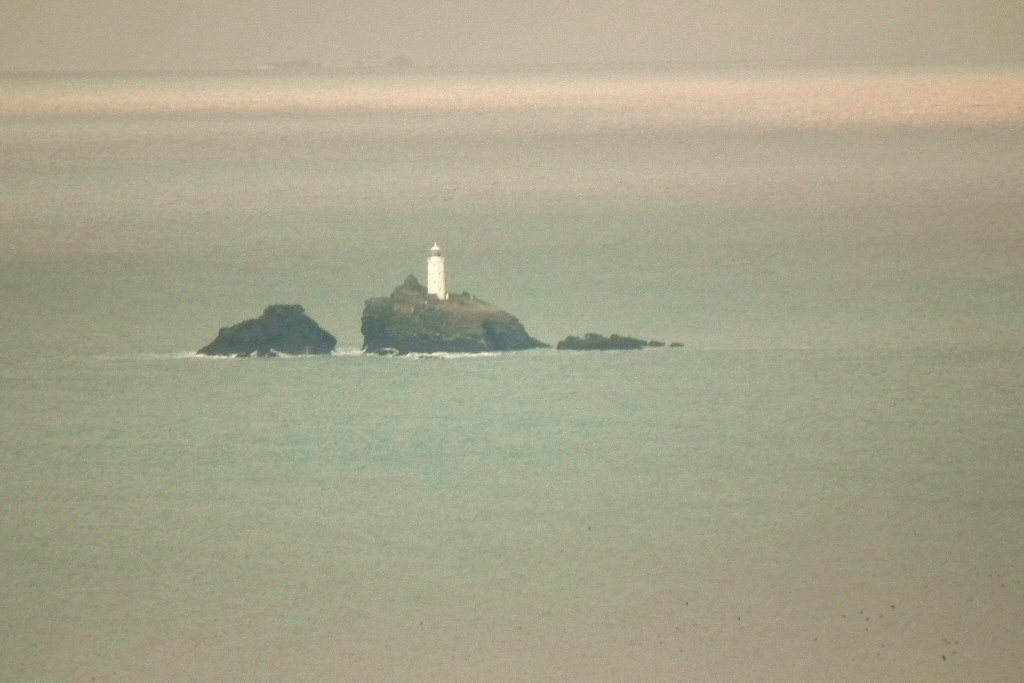
Wolf Rock lighthouse, 11 miles or 17km out to sea, as seen from St Levan, Penwith
But first, there’s business. I want the company to right some wrongs, financially, and I want to get Felicia and Isaac and their remaining children safe and stabilised in a new life. True heroes, they have paid a high price for being good people. Even as a tottering old man, I choose to stand by them, whatever anyone says. Then there’s that gang, who have deprived at least seven people of their lives. This included an Akan native healer, Okomfo Ayensuwaa, with whom I had close miracle-working dealings for a week or so just before Christmas. Killed for protecting Felicia and Isaac and their families, she has decided to work with us on the world healing project, from the other side. She is with us now, in our meditations. A strong, big and good-hearted lady she was, and the river spirits she worked with miss her.
I have shed so many tears over these unjust tragedies, and several times I have been faced with a painful moral choice I would not wish upon any of my readers: the choice between playing safe, prioritising my own interests and security, and standing by my principles in order to keep some good people alive and to stand up for what is good and right. I’ve made that choice, I’m paying that price and, despite everything, I am glad to have done so. The bravery of these people has been a big lesson for me, and my standing by them has been a big lesson for them. Whitemen have a way of walking off. The fates have now separated Felicia and Isaac, and they struggle on alone. I’m still with them, supporting them even though I can’t send money.
Please pray for them, for their safety, healing and relief from their trauma and misfortune – they, and Phyllis, and Isaac’s one remaining child, Adjoa, aged about 6-7, truly need it. They are struggling, materially, emotionally and spiritually. Please be with them in spirit.
One of my missions in life has been to do with righting some of the wrongs committed by the British empire. One grandfather was in Allenby’s invasion of Iraq and Palestine in WW1 and the other was in the Battle of the Somme. My father fought in Egypt in WW2. Northern Ireland started me off on this path, fifty years ago, and I seem to be at it still. Interestingly, it was the Akan, the Ashanti, who, together with the Maoris of New Zealand, were the only peoples who successfully stood up against the empire – at least until the amoral Brits tricked both of them into losing. The empire had its merits and demerits and, while we should forget neither, we do need to own up to the demerits we forced on so many millions of people. For the world cannot progress while unredeemed shadows such as these hang over us all. Every country has its shadow to face.
This has been a difficult time. I’m still here though! As I write, Felicia is watching her only child Phyllis die slowly, in a coma, in hospital, unable to afford treatment. They’re stranded with nothing in a foreign country. That’s the score today. That’s life, as it presents itself. This has been a difficult and risky blog to write – I hope to goodness that I’ve done it right. Meanwhile, I’ll be there as usual at the meditation on Sunday evenings. Bless you all for being my friends, especially the ones closer to me. We all need each other.
Helen, my peerless homoeopath, gave me Pearl last year (beauty out of pain) and Gold this year (lighting up darkness) – spot on. She’s brilliant. If you happen to need an inspired homoeopath who can do it remotely from Cornwall, try her.
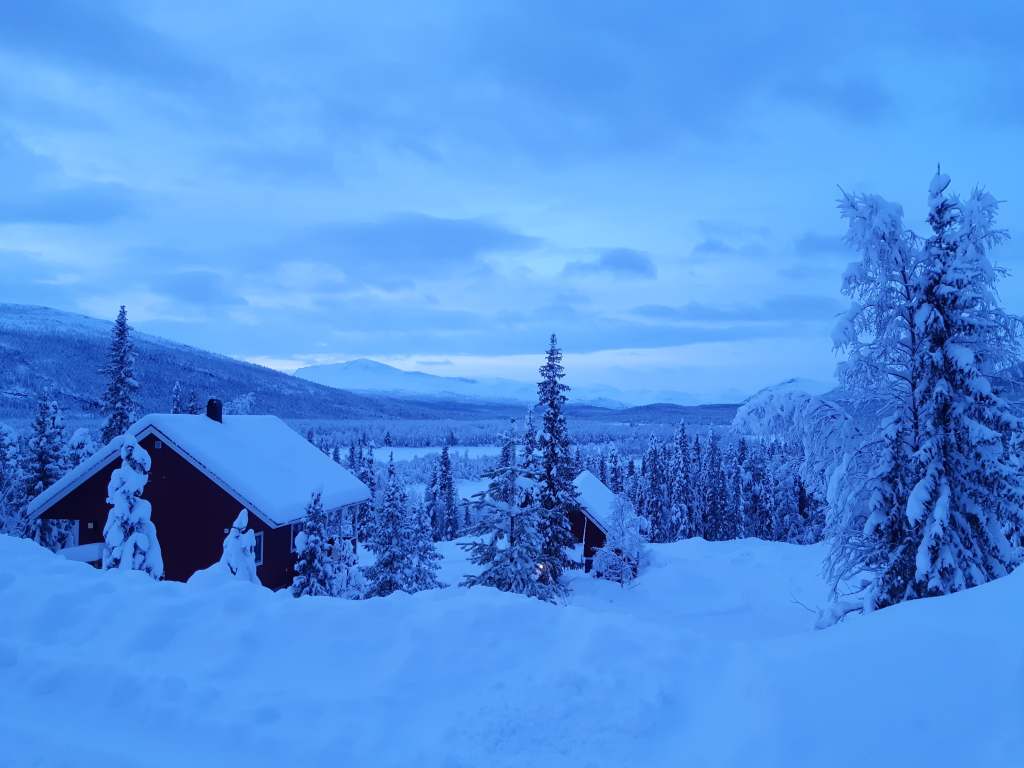
This is not a christmas card. This is Kvikkjokk in the north of Sweden, north of the polar circle, last year. It’s where my daughter Maya lives. It was -30C there last night.
There’s one robin that comes from the thicket above my cabin, and another who lives in the brambles down below the barn.
Problem is, being male robins, and with breeding season coming, they’re doing their territoriality trip – much to the consternation of the tits and the blackie, who also want to get to the feeder just outside my door.
When you spend much of your time alone, issues like this do matter! But it’s a welcome diversion too because, as you might imagine, my thumbs haven’t exactly been twiddling very much recently, and I’ll welcome an off-duty break one day.
It hasn’t snowed here in Penwith, though it went sub-zero and icy in the last few nights. Stuck out in the Atlantic and bathed in water that not too long ago passed Miami Beach, we’ve been about 5 degrees warmer than most of Britain. But then, though Brits love to complain, whatever the weather, up where my daughter Maya lives, north of the polar circle in northern Sweden, it was -30C last night – and the sun won’t rise until mid-January. Welcome to Planet Earth, dear friends – this is what you get on this world, and this is what you chose when you decided to come here.
I get cold feet. I’ve got this weird thing called Peripheral Neuropathy – a side-effect of chemo drugs where your nerve-endings die off. So I can feel the inner feelings in my feet but not the outer ones – and I never knew there was a difference until the Good Lord (or whoever) gave me cancer. This also means I don’t feel the cold in my feet very much – which goes to show how, in life, you win some and you lose some, and that’s the deal. I still have warm double socks on though.
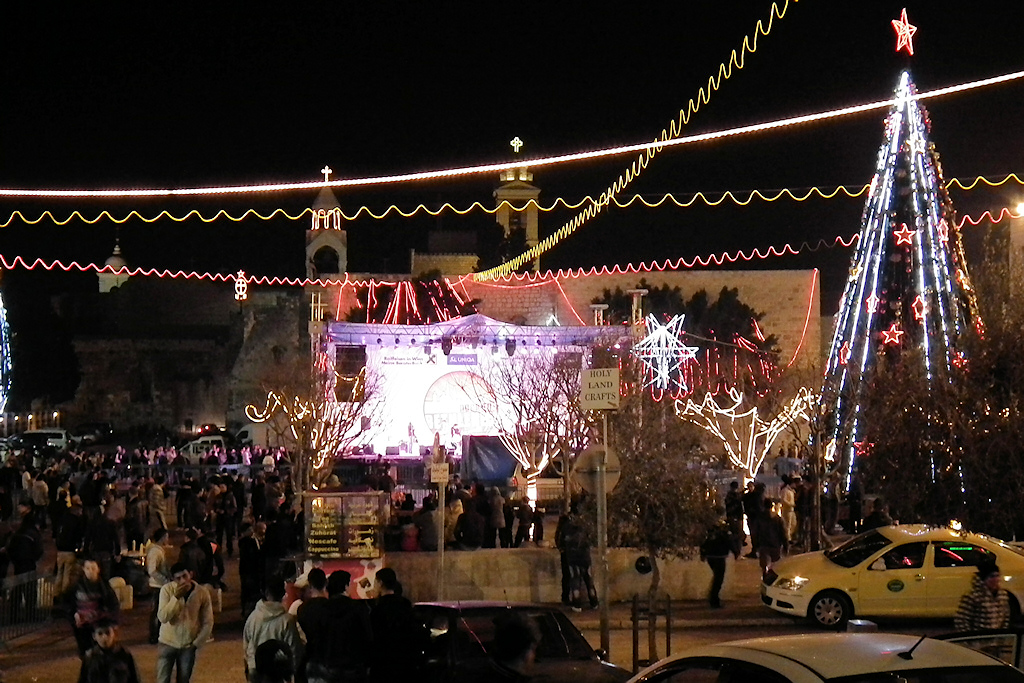
An Indonesian Christian rock band in Bethlehem
One of the narratives of my life has been about dealing with paradox. My mother did love and care for me but she didn’t have the time and presence to mother me in the way I needed – that kind of thing. But that’s alright: it gave me some mother patterns to work with. Or this: my Tibetan name means ‘radiant merit’, my Arabic name ‘servant of the light’ and my Brahmin name is god of the sun, but there’s a shady side to me too, who gets involved in gritty, underworldy, heavy stuff. I’ve been exposing this side of me in the last month, with the strange thriller I’ve found myself in.
It goes to show, I’m not a holyholy meditation teacher at all, but a lawbreaking aged hippy charlatan who does nasty things, corrupts dishy young ladies, leads people astray and ought to be locked up forthwith – a danger to civilised society. Be warned.
I’ve been breaking the law recently, paying bribes. In West Africa, if you don’t pay enablement payments, nothing gets done. However, as my late senior barrister friend Keith used to say, in his endearingly bombastic Leo kind of way, “I, dear boy, am a purveyor of the Law of Man, but you, sir, are a purveyor of the Law of God”. Well, that’s a bit over the top, but there’s truth in it too, and sometimes divine will does need to prevail, whatever anyone thinks. So I’ve paid some bribes because, actually, it’s usually just to pay the guy’s phone bill or taxi fare so that he can do what you’re asking for and perhaps take a few bob home to his missus.
Well, if they want to arrest me for that, I’m over here. It’s a professional expense, and not the least of the sins I’ve committed. I’ve been a traitor, consorted with terrorists, smuggled tofu though Israeli checkpoints (they think it’s Semtex), taken on false guises and a few other things I’d better not mention.
But on the other hand, bad as I am, my life-saving stats measure well against any doctor or paramedic, and I’ve had the pleasure of uplifting thousands of people, and many of the bad things I once did, or decidedly didn’t do, are now, a few decades later, strangely approved of. It took a while. Some people think I’m brave, though my rather naive Aspie response is simply, ‘But why is that unusual?’.
Manger Square, Bethlehem, full of people
I have another weird Aspie thing too. I have an aversion to Christmas. I don’t do it. I’ve always felt unhappy feeling obligated to be happy and congenial when, at the time, I’m feeling contemplative and quiet. So I have a no-compromise approach that, before Xmas, is frowned on and, after Xmas, is envied.
On Xmas Day, if the weather allows, I’ll be out on the moors or the cliffs with a flask and a pie, attending to the top of my head and a few related matters, and if the weather is bad I’ll be huddled round the woodstove, propped in my chair or inner journeying in bed, busy not drinking sherry. Unless I find another person who would delight in an utter non-Xmas with me, I’ll be on my own, and that’ll be alright. You might wonder why.
Well, it’s a time for wrapping up the past and looking toward the future, and I have rather a lot of both at present. That’s solstice, the turning of a tide.
But it’s also a time when, rarely, the Christian and Westernised elements in the world suddenly get excited about peace and goodwill for a day or two. This is really good. My only reservation is that it suddenly ends around lunchtime on Xmas Day, when everyone starts blotting themselves out with food and booze, only to regret it afterwards.
Manger Square, Bethlehem, Palestine, at Christmas
Nevertheless, as a guerrilla planet-fixer with an esoteric style, I find it’s worth scooping up some of this goodwill for good use. After all, there are at least a billion people on Earth who really need some peace and goodwill to be shoved their way right now. If not, truth be told, the whole eight billion of us.
So I spend my solstice-to-Xmas doing consciousness work. It’s secret – don’t tell anyone. It’s a good time for doing some gentle infiltration of the collective psyche, to strengthen that thought: goodwill. If you’re on your own this Christmas, then, wherever you are, stick up your antennae and see whether you can find me in that ‘reality-field’ and come join me. Try 11am and 2pm GMT, Xmas Day.
I’m always there on Sunday evenings at 7pm GMT too, for half an hour.
Ten years ago I was in Bethlehem at Christmas. The slightly sad thing is that Christian numbers for the Christmas Pilgrimage are much diminished nowadays, so Muslims make up the numbers – Palestinians do appreciate Bethlehem’s global name-recognition in such a forgotten land, and Jesus is also one of the prophets of Islam.
The Catholic Xmas is a bit like ours in NW Europe, with a lot of the jingle-jangle, and big concerts in Manger Square with Christian singers and bands from Germany, Indonesia and Nigeria, and a few Papal delegates thrown in. And why on earth do they import Father Christmas to Bethlehem, already replete with Christ Mass primacy, when most Palestinians have no idea where Estonia is or what slieghbells are?
Then comes the Orthodox Xmas, which is a bit more sedate, very ornate and quite delightful to a jaded old heathen like me. The chanting is done with deep faith and mystique, and the archangels and cherubim really do seem to hover around.
Then in mid-January comes the Armenian Xmas, which actually, if I were Christian, is the kind of Christmas I’d prefer – ruminative and richly calm. Either way, they’re all resplendent with candles, incense, chant and reverence – that’s very different to the mosques, where there’s nearly no ceremony or pizazz, just quiet prayer. They both have their virtues, but give me an ocean clifftop or a desert outcrop anyday, and I’ll be happy.
It looks like I’ll still be on duty over Christmas, monitoring the West Africa situation daily. Here’s the latest news from there.
Phyllis, now three, some time ago
Phyllis, the child, is happy and in good shape. She underwent an amazing turnaround last week, going from fever and coughing blood to wanting an ice cream in two days flat. I think you lot, with your prayers, played a key part in that. She is now staying with Dr Isaac and his family. Phyllis seems to be a great kid, easy to have around, and everyone loves her. I’m so happy about that. She’s special, that one.
Felicia… well, she’s improving, but we hit a setback two days ago. She has been reviving, and three days ago we moved her out of hospital into accommodation near the doctor and his wife. She was awake and becoming able to function, but she fell over, and it was bad. She needed two blood transfusions, a drip and medication. I’ve managed to finance that. So, it’s tenuous with her at present.
Those of you who have been giving your prayers, healing and positive thoughts to Felicia… may I ask for another round? Please hold her and raise her up. She has brain injuries from the ‘accident’ two weeks ago (they were rammed, actually). We think she’ll be alright, and she’s in good care, though she isn’t out of danger yet.
I want to put in a word for Dr Isaac and his partner Millicent and their children. They have taken in Felicia and Phyllis. They live simply and have their own family concerns, but they care a lot, and they’re definitely not in it for the money.
One of the greatest benefits I’ve had from my humanitarian work has been meeting simple, good-hearted folk like these who are the real saviours of our planet. They just get on with it and hold the world up. They do so much of the mopping up of the world’s mess.
Here’s Dr Isaac
The people I’m involved with in West Africa, and also my handler with the fraud investigation company, are all good and remarkable people. In this business, you develop ways of finding out who you can and cannot trust, and everyone depends on each other, and there’s a certain implicit code of behaviour, and you bond closely with people you encounter when sharing intense situations with them.
The Syrian Orthodox church, Bethlehem, Palestine
In something like this, to use an old sexist term, it sorts out the men from the boys. The people who hang with you through thick and thin are often amazing people. Dr Isaac is like that. He lost his job for us (though I think he’ll get it back). He risked his and his family’s lives. He’s gone several extra miles. He’s a man of faith and a good doctor who deserves more than a one-room home for his family.
I’ve met many remarkable people, and he ranks high, a true server, a doctor of whom Hippocrates would be proud. We’ve known each other for three rather long weeks. God bless you, Isaac. People like you convince me that this world will survive. My daughters, son and grandchildren do that too.
I guess I’m a sucker for crisis situations because it brings out the best in many people, and I like working with them, and it brings out the best in me. I’m not good at normality, you see. I’ve always felt I’m there to help the helpers, the social healers and the frontline people, and it’s an area of deep late-life satisfaction now.
Here’s the Mosque of Omar on the other side of the square. Sensibly, when they invaded, the Muslims under Caliph Omar didn’t take over and convert the church. Bethlehem has had very good Christian-Muslim relations throughout history. I wonder why?
As an independent ‘freelance humanitarian’, for want of a better term, I’ve held to certain principles I feel are important such as: ‘don’t give a person a fish, but teach them how to fish’, and ‘teach a man and you teach a man, but teach a woman and you teach a generation’. There’s even William Blake’s statement: ‘the path of excess leads to the palace of wisdom’ – and war is excess to human need, in my judgement.
I feel also that, as an educated, white, male, privileged Brit whose ancestors built the empire and kept it going, and living through its downfall and seeing its very mixed outcomes, I have a bit of an urge to complete the job. I’m not a great believer in reparations, guilt or sorrow – I just like to get in there and do something to help people have a better life and rise to their full potential. To the extent I can.
People have asked who or what I work with. To my surprise, at present it’s for a big bank – though that’s not my style. One of my PodTalks, The Only Planet of Choosing, gives clues. I’ve worked with all sorts of people, but the bottom line for me is their humanity, and progressing humanity’s evolution. My focus has been community-building, conflicts and crises, and helping social leaders stay on the rails.
You have to have your wits about you. This is strange because, as an Aspie, I can be at times apparently naively open but it’s not exactly that – it’s because I sense people’s hidden motives and agendas, and I often get delayed-action clarity on what’s really happening. So I look blank for a while. Then it all comes. So I’m best working with others, inputting what I’m good at. Such as total attention, hyper-focus. When I’m on form, I’m brilliant, and when I’m not, I’m best back here in Cornwall, out of everyone’s way.
Which is where I am now, on the farm, and it’s a dark and rainy pre-solstice night, and the owls and crows are all tucked under their wings down in the woods and hiding from the feather-ruffly wind. Wherever you are, may all be well with you.
Don’t worry too much about your circumstances, even if they’re tough at present – look at your attitude, and be innovative. Find simple ways to be happy. We all get inner friction and pain, but these are things we can reduce, even if we can’t reduce the adversity. That’s what’ll get us all through.
The Church of the Nativity began as a goddess temple (hence the Virgin Mary came here), then a Greek Apollo temple, and only then did it become a Christian Church. The front entrance is really low and you have to duck to go through – this is to force Crusaders to dismount and it stopped their hunky stallions from entering the church. But the Israelis just roll bombs in. Interestingly, in Bethlehem, I don’t get a feeling of Jesus – it’s Mother Mary’s or Mariam’s town, and the matriarchs there definitely let you know it
In the 1300s-1400s, when Europe was reeling and depressed after the Black Death, Mali was the richest place in the world – the source of much of the gold that eventually financed the rise of Europe (and eventually its takeover of Africa in the 1800s). It isn’t like that any more.
Those of you who have been following me for some years will be aware that I have been helping and supporting a small village of desert-dwelling Tuareg people called Tinzibitane. The village is roughly 60km west of the historic town of Timbuktu, in the desert.
Lessons!
The Tuareg are an ancient people, formerly the camel-truckers of the Sahara. They’re different from other West Africans, and they aren’t treated well. They’re Muslims yet they have their own ancient traditions, with Goddess roots to them going back millennia. Some Tuareg have become jihadis, further north in the desert, but this village is not involved with that – and you’ll notice they’re educating girls and boys equally. The women of the village are strong.
In Tinzibitane they have a wise chief, around my age (71), and my contact, Anim Touareg, a Millennial in his thirties, is likely to become the next chief. He’s a good man, and a single father (his wife died some years ago in childbirth – we tried to save her but it came too late). In my illness, with cancer, the chief prays for me, and I pray for him too.
The village
Over the years, various of us have been helping finance the re-stocking of their camels and goats, the sinking of a new well in the village, and the building of a school there, after a time of devastation (drought and war) around 2012. They are educating their kids in a Tuareg way. The alternative is to send the kids to the towns for education – and, this way, the young people are lost, heading for the cities and for Europe when they grow up. We are seeking to change this, to help the villagers meet the 21st Century while retaining their traditional desert life – and this means helping the kids stay in the village by educating them in a Tuareg way.
The new well, with the school behind
I am no longer able to run fundraising campaigns fully on their behalf and I need some help with crowdfunding and similar things. I’m good at writing material and liaising with the villagers but I can’t deal with the necessary details around crowdfunding and the necessary networking. I’m not fast enough and my memory for details isn’t as it was.
School dinner
So I am looking for one or two people who might help me with this, willing to do the necessaries that I cannot do and to stick with it for perhaps a few months, working online with me. It needs some focus, work and commitment, but not too much, plus some necessary support-raising skills. This is a really good cause. The aim is to raise money to pay the teachers, who come from other parts of Mali to stay in the village and teach the kids. They are dedicated teachers but they cannot keep their own families alive and happy without pay.
Tuareg women of the future
If anyone is interested, please contact me. This is a people-sized, small-scale enlightened-development project. The Tuareg of Tinzibitane are a self-sufficient people who don’t like to ask for help, but they do need support in dealing with money-interactions with modernity and the outside world. It has felt good working with them over the last seven or so years – they’re good people, with integrity, and they’re taking life in their own hands. I need some assistance in helping them.
Anyone interested? If so, please contact me. They also make remarkable handmade crafts, which you can see on Anim‘s FB page.
Recently I haven’t been in the best of health and spirits and I shall write a blog about that soon, when my energy is right. But if you want clues, listen to my last podcast Popping Clogs and Kicking Buckets.
Meanwhile, I’ve begun a kind of preliminary goodbyeing process, and in the last 24 hours I’ve been wishing I could be back in Palestine, with friends and ‘family’ there. So I was moved this morning to post a chapter from Pictures of Palestine, to share this feeling with you.
(If you like this chapter, you can download a free PDF or e-book version on the site, or order the print version.)
It was written in 2009 but, while details in Palestine have changed, the situation has not, and this chapter in essence has not dated.
The Back-Roads of Palestine – arriving in Bethlehem
“Where you want go?” “Beit Lahem”.
“Where you from?” “Britaniyya.”
“Ah, my son, he in Leicester, doctor in hospital.” I’m never sure whether to be happy or sad when they say things like this, but most Palestinians seem quite happy that at least someone in the family is chasing a future abroad. It’s their family insurance policy.
I was the first to the yellow eight-seater VW service bus, so I would have to wait for more passengers to appear. That was fine – I wanted to assimilate being in Jericho again. Everyone was friendly. If ever you come to Palestine, be ready to be overwhelmed with hospitality – it’s quite moving and takes a while to get used to. It’s not a front. People come up and shake your hand, saying “Wilcome, wilcome to Falastin”, and they really mean it. They know it takes some resolve to get here.
I went off and found some Egyptian mango juice and Jericho springwater to guzzle. The dense Jordan valley heat was like an engulfing blanket but, being thin, I’m fine with that – it’s chilly, damp British weather I have a problem with! I went over to some guys standing around talking. The usual friendly questions. Where you from? What your name? Where you going? How many children you have? What you doing here? They’re often interested in my age, and eyebrows raise when I tell them – Palestinian men of my age often look older and more worn than I do.
I took photos of some of them – they seemed to love it. But some didn’t want it, gesticulating ‘No’ with a quick wave of the finger, and I knew why. It’s politics and security: they or their family have had trouble with the Israelis, or they supported Hamas or another faction, or they had a history, or their brother was in jail, or… Long ago I had been in similar straits and I know what it’s like: it’s not just that you want to avoid the gaze of the powers that be, but also that you don’t want to keep reminding your friends or even yourself that, rightly or wrongly, you’re toxic property.
Eventually the service taxi-van was full and we were off through the streets of Jericho, an ancient city with an 8,000 year history. We left the town, driving some miles up to the main Jerusalem highway and then turning right, following the road as it ascends through the Judean desert hills. It sweeps through the valleys, climbing up and up just to reach sea level, marked by a sign in Hebrew, Arabic and English. After making good progress, still uphill, we suddenly slowed down and pulled off near the Ma’ale Adumim interchange onto a bumpy, crowded road and into a scrappy Palestinian township near Al Azariya.
Ma’ale Adumim is one of the biggest Israeli West Bank settlements, a Jerusalem orbital town and an asset Israel is unlikely to abandon, whatever foreign politicians want. This new town and the roads servicing it, built on confiscated Palestinian land, split the West Bank into northern and southern halves, rendering Palestine territorially sub-functional as a nation.
But we were not going to Ma’ale Adumim. Instead, we hit a bumpy side-road which, for Palestinians, is a key trunk road linking the northern and southern West Bank. It weaves through a small town, then weaving along valleys and up and down the high hills, with sharp switchbacks, steep inclines and loads of traffic. In Britain we’d regard it as a back-country ‘B’ road, but actually it is ‘Palestine Route One’. Nowadays it is being modernised but in 2009 the only sign of its trunk road status was the density of traffic.
Some of the areas it drives through are poor and dilapidated, the houses quite scrappy, the land stony and dry. Garbage, wrecks and piles of rubble are heaped here and there – an alienated landscape where the locals have lost their care and pride. They’re probably rural refugees, thrown off land the Israelis have taken, such as at Ma’ale Adumim. It’s one of the tragic aspects of this country. But then, many Palestinians harbour little hope, so they’re unlikely to invest in longterm improvements. They half-expect the Israelis to come in some day, wreck everything again or drive them out, and they do have reason to anticipate that.
Yet there are some pretty nice houses along the road too, in other locations. Palestinians who are go-getters or beneficiaries of the PA or foreign agencies take great pride in their new-builds, many of which have a fine vista and attractive courtyards with flowering trees and bushes. It’s as if their optimism compensates for their others’ lack of it. It also reveals an emerging class divide between those who benefit from foreign subsidies and advantages and those who do not. Palestine has its haves and have-nots and they nowadays live in quite distinct economies.
The road is exciting to travel as it climbs up steep hills and tips into deep valleys, weaving through an impressive limestone upland landscape, passing through hilltop villages with prominent mosques and affording views stretching many miles. Yes, this is a trunk road – but it’s heartbreaking too. Privileged Israelis drive along their fast, wide highways while Palestinians have to heave up, down and around on side-roads like this: transportation apartheid. Although the West Bank is occupied by Israel, its cars have different number-plates from those of Israelis, conferring different driving and access rights. Go up the wrong road and you could, on a bad day, experience a sudden hail of bullets at worst, or interrogation at best.
It’s not easy, living under military occupation
We passed through only one checkpoint, which today was open. The Israeli soldiers leaned against their booths and bollards, talking to each other and idly gazing at passing traffic. Poor guys – what a job. There they stood sweating, posted in an unfriendly spot next to a Palestinian hilltop village, perpetually on guard against a foe who nowadays rarely materialises and might hardly exist.
In the distance I could see the Herodeon, near Bethlehem, a prominent conical hill and ancient site going back millennia. It looks like a volcano but it was shape-enhanced in ancient times and contains, allegedly, the tomb of Herod the king. Naturally, we didn’t head straight toward it – our route was still sinuous and tortuous. After another twenty minutes we pulled into Beit Sahour – Shepherds’ Fields, referring to the Christmas story – near Bethlehem. The family that made up most of the passengers in the bus was dropped off right outside their gate. The remaining woman asked me, on behalf of the driver, where I wanted to be dropped. I decided to go to Manger Square in central Bethlehem to catch some food, take a rest and ascertain where Ibrahim Issa was to be found.
Church of the Nativity, Bethlehem
There I bundled out of the bus dragging my wheeled bag, my precious technology bag over my shoulder. Containing a netbook computer, camera and lenses, digital sound recording equipment, DVD and card readers, cables, plugs and adaptors, with room for travel papers, passport and a bottle of water, this technology bag is neat – but rather a wrench on the shoulder muscles.
The Christian taxi-drivers near the Nativity Church, seeing a Westerner – who of course must be rich – started hollering at me for my custom. You learn how to gesticulate ‘No’. One bright young driver with a pleasant face got my attention, though I still said no to him. I wanted to sit down and have something to eat. He shepherded me to a nearby café and within seconds a pitta stuffed with salad and falafel was set in front of me, along with fresh carrot juice. What a relief! All the taxi-drivers stood round asking questions and smiling, all very amiable once they’d realised I was no source of business for them right now.
I rang Ibrahim, but no answer. Did I have the right number? Hmmm, what next? Leaving my bag at the café, I went wandering. As I returned, the young taxi-driver signalled me: “I help you. What your name?”
He took me to the Hope Flowers School at the far end of Al Khader, west of Bethlehem, but it was locked and deserted. On the way I noticed that the town was in visibly better shape than on my last trip in 2005, just after the second intifada, during which the Israelis had wrecked Bethlehem and still then staged periodic incursions and searches. But now the separation wall had been built and Bethlehem, imprisoned behind it, was safer and more relaxed. The security wall protects Palestinians from Israelis as well as vice versa. This relaxation of tension was visible on the streets. Another sign of progress was the condition of the trees in the central reservation of the Hebron road leading to Al Khader.
These trees, planted in 2005 by the Earth Stewards, were all intact and growing! I had joined them – mostly Dutch, German and Austrian green activists – in a tree-planting project organised by Hope Flowers. Ibrahim had known the Earth Stewards when he lived in Holland in the 1990s and he had organised PeaceTrees as a joint project with them in Bethlehem, not just as an ecological but also as a social empowerment project. The trees’ continued existence showed that something had worked – the locals had got the message.
During the intifada people had lost hope. It had followed a period in the 1990s when peace and progress came close and then ebbed away, prompting the uprising, a mass expression of sheer frustration. Israeli measures taken against Palestinians were terrible and Bethlehem had been an epicentre of conflict – remember the shoot-out at the Church of the Nativity in 2002? By 2005, when the intifada had subsided, the locals needed jump-starting with initiatives to help them improve their lives and encourage them to invest energy in the future. The regular experience of seeing houses demolished, parts of town wrecked, buildings shelled and people carted off had given Bethlehemites a feeling of futility and pointlessness.
By planting a large number of trees in a very visible place – the main road’s central reservation – we caused mild fascination at first, followed by interest and questions. Then people joined in, then energy and enthusiasm grew. We wrapped up the project by saying, “If you don’t look after these trees, they will die, so it’s up to you” – and we left. The trees survived: someone had made sure they were watered and cared for. PeaceTrees had worked.
The Old Town of Bethlehem
As the young taxi-driver and I returned to central Bethlehem, he told me that he was a student of accountancy in Hebron and drove his uncle’s taxi to pay his way. He wanted to be my friend and I promised I would find him again. Subsequently I had a number of lifts with him, and only half the time did he charge me. He dropped me off and I headed up to Manger Square, standing there awhile, taking it all in. A wide, large square, milling with people.
A man approached, asking in quite good English whether he could help me. Adnan took me to his shop near the square, where he sold souvenirs – olive-wood religious objects, Arabic dresses, Bedouin rugs, decorative inlaid boxes and allsorts. Some of the woodwork was exquisitely carved and the rugs and clothing came in lovely colours, all with a very hand-made feel to them. Mint tea appeared and people came and went as we talked. Adnan discovered I was a webmaster and asked if I would help him make a website – I said I would consider it. He rang a friend who knew Ibrahim – an answer would come soon about where to find him.
I got out my computer and skyped my cousin, then my son and then my ladyfriend back in England, to tell them I’d got here. I wanted to share it with them. A small crowd gathered round, goggling at this visitor’s neat technology, and they said hello on Skype, all very thrilled. My son just said, “Cool”, and carried on tapping on his computer. Then he looked up and suddenly saw several faces looking at him through the screen.
“Who’re they?” “I’ve finally got to Bethlehem, and these are some of the kids here”. “Cool”, he repeated, in his perpetually unfazed way, still tapping keys.
My ladyfriend was dumbstruck at talking live to some real Palestinians. Palestinians are people you hear about on the news, you don’t expect to talk personally with them on Skype. Everyone helloed, and she helloed back. While I was talking to her, the calling to prayers started up – really loud, since we were right next to the Omar Mosque. She was visibly moved at the sound, as it hit her that I was really there. She and my cousin were serving as ‘ground control’ back in England, and it was fitting to share with them my first taste of returning.
Eventually the grapevine worked and Ibrahim Issa came to fetch me. I’d last seen him five months earlier in England during one of his speaking tours. He had looked tired, not really wanting to stand on stages giving speeches, and I was concerned about him, wondering whether he was burning out. But today he was his sprightly self, at ease, smiling. He’s rotund, like a cuddly bear, with a character-filled face and a bright countenance.
I feel brotherly toward him, as if we had made some mutual contract way back in the mists of time, yet I’m old enough to be his father. We hugged in the middle of the street – much to the interest of onlookers – and looked at each other for a long moment. I knew he felt some relief that I was back and had probably wondered whether he would see me here again. Foreigners come and go, saying they will return, but only a few reappear.
Hope Flowers had started as a kindergarten in 1984 and by the late 1990s it was a school with 500 pupils. It shrank after 2000 during the second intifada, as the Palestinian economy tanked and hardship set in, but now the school is growing again and a community development centre was started in 2004. I’d been working with the school from Britain, running its website, writing and editing grant proposals, newsletters and outreach material. Now, one aim of my trip to the school was to re-work the website, then perhaps to edit some teacher-training manuals, possibly even help Ibrahim start writing a book about peace education. That was the idea.
The story of the Issa family and Hope Flowers is poignant. Ibrahim’s father Hussein, an advocate of non-violence, found himself in a dilemma some years ago when Ibrahim narrowly escaped paralysis, shot through the back by Israeli soldiers. Later, Ibrahim saw Palestinian radicals accuse his father of treason because of his commitment to reconciliation. The family was under attack from both Israeli troops and Palestinian radicals. Ibrahim knew the situation was complex but, to quote him, “The most painful thing for me as a child was that I couldn’t recognise the difference between a peace activist and a collaborator – it took years until I did. Palestinian radical groups also couldn’t recognise it. When I grew up I started to see the difference”. But some Palestinian radicals and Israeli Zionists still don’t see that difference, and this makes life risky for people who work for reconciliation.
In 1991 Ibrahim moved to Holland to get out of harm’s way. He studied engineering, got a job and became a permanent émigré. He attended courses on ecology, non-violence, community-building and psychotherapy too, mixing with interesting people, some of whom later came to do stints as volunteers at the school in Palestine. Then his father died unexpectedly in 1999 and Ibrahim was asked to return. This involved leaving a secure, promising Dutch life to jump back into the Palestinian frying pan, taking on a burden most sane people would turn down flat. I greatly admire his steadfastness.
Hope Flowers
Returning to Bethlehem in the midst of the second intifada, Ibrahim joined his sister and his mother in running the school. Later another sister, a teacher, joined them, as did Ibrahim’s new wife, once a kid at the kindergarten. They run the school with a remarkable team of teachers, managers and supporters. It felt right to work with these people – I like them all very much.
Now Ibrahim and I went to a café, had a drink and munched nuts, smoking apple-flavoured hubble-bubble from an ornate water pipe. We discussed what I would do during my three months’ stay. There was certainly a lot to be done and three months might not be long enough.
Ibrahim told me of difficulties he currently had with a faction in the Palestine Authority (PA). It was the product of an awkward public debate concerning the value of negotiating with the Israelis. Ibrahim, a committed peacemaker and bridge-builder who had had regular contact with peace-oriented Israelis, was under suspicion as a collaborator, and this was complex. The PA, seeking to establish control over an ungoverned non-country, had applied a mixture of Western regulations and Arabic bureaucracy, with not a few personal fiefdom issues thrown in, making life difficult for ordinary people. A peacemaker in a conflict-polarised society is susceptible to accusations of collaboration.
The discussion in Palestine about how to relate to the Israelis was heated and ongoing. Palestinians had bent over backwards to comply with international agreements as part of the 1990s peace process, and yet in Palestinians’ perception the Israelis hadn’t budged an inch on crucial issues such as settlement-building, land-seizures, Jerusalem or refugees. The result had been continued losses for Palestinians and a growing number of them were now convinced that negotiation and accommodation were pointless, even though very few wanted any return to conflict. Negotiation had been worth trying in the 1990s, but it had not delivered. It’s a tragic predicament: if you neither want to negotiate nor to fight, what do you do?
Hope Flowers had been teaching the kids Hebrew to help them understand the Israeli mindset. When the kids were older, this would help them deal with Israeli people and officials. The school set out to help the kids understand the perspectives of the very people who had killed or jailed their own fathers, uncles and relatives. This was not a matter of agreeing with or sucking up to the Israelis, as some suspected. It was a matter of following the old military adage, ‘know your enemy’. It was a key issue in preparing Palestinian children for a time when the nightmare of conflict ends – which it shall and must do one day. But in 2009 that day was receding and there was simmering frustration in the air.
Some Palestinian officials didn’t like what the school was doing and didn’t want Palestinians having connections with Israelis. Ibrahim, who had learned to be patient with Israeli arbitrariness and obstructionism, even having been arrested by them for allegedly harbouring terrorists, understood this viewpoint well. But as an educationalist and peace-builder, he stood up for dialogue with people on the other side just as his father had done.
Westerners, with a tendency to see things in black-and-white terms, oversimplify the intricacies of this situation, failing to understand such sharp dilemmas. “Why don’t Israelis and Palestinians just make peace?” Well, as Rabbi Lerner, a Jewish-American thinker, once pointed out, both sides suffer from PTSD, post-traumatic stress disorder – they’re super-touchy, super-reactive and suspicious – and untangling this mess isn’t as simple as outsiders would like it to be.
It had taken me some 20 years to understand the intricacies of the Israel-Palestine situation, and only visiting the place had brought better comprehension. I started as a peacemaker working on both sides, with the best of neutral intents, but found myself gravitating to the Palestinian cause. I was not turning against Israel, but I felt that they shot themselves in the foot by the hostile attitude they took toward Palestinians. I work where I can most assist, and while Palestinians seemed to appreciate my input many Israelis didn’t seem to think there was a need for me to be there. So I ended up working with Hope Flowers.
That’s also why I had sobbed from the soul when I arrived in Jericho earlier that day – there was something personal and emotional about all this. As a British dissident, I had had nonsensical and painful experiences that would shock many people, so I could empathise with the Palestinians’ dilemma. I saw Ibrahim’s dilemma too – that of a peace-bringer whose work is regularly screwed up, not just by Israelis but also by the double-standards of Westerners and the militancy of some Palestinians.
Perhaps Palestinians embody something that exists within many of us when we are repeatedly let down by forces beyond our control, when Murphy’s Law applies itself over and over, or when the narrow interests of the powerful few prevail incessantly over the needs of the majority. It’s a futile feeling that, whatever one does, nothing will really progress. This kind of thing happens everywhere but, in Palestine, people have internalised it and adapted to it more than is healthy for them.
I stayed at the Issa family’s place that night and next day Ibrahim took me to the school, where I was to stay in the volunteers’ accommodation on the top floor. Back again – and now to work.
Things don’t change a lot in Palestine, but one good thing that has changed is that Hope Flowers’ methods and philosophy is now being replicated across the Palestinian school system in the West Bank – this was a major breakthrough a few years ago. However, the school still struggles on financially under, as always, difficult constraints.
2020 has brought us all a lot to think about and, for many, a lot of time to think about it. ‘What am I here for?’ and ‘What’s it all about?’. Some folks have had big reveals and pointers, others have had to dig deeper than ever before, and some have made little or no progress, and some have been run off their feet and burned out by it.
I’ve always been rather purpose-driven. When I was about ten I wanted to be prime minister. By 15 I won a big public speaking competition with a notes-free speech about why Britain should join the European Community – seven years before it happened. Does Brexit, 55 years later, mean I’ve failed? By 18 I realised that politics was too dirty for me. So I followed another path and you got Maggie Thatcher and Tony Blair instead.
It took until I was about 34 to acknowledge that I was at last on track (when I started the Glastonbury Camps). It just had that feeling. Before that I felt like a footloose jack of all trades and master of none. When ‘received my instructions’ I quaked and resisted, but then I realised that, if I didn’t do it, it would not happen. And it needed to happen.
God doesn’t come down and say ‘This is your life-purpose‘. It’s not like that. It’s just that, when you’re more or less on it or you’re heading towards it, you feel it – you’re in the right place at the right time doing the right thing, even if others disapprove, discourage or block you. If you aren’t on it, you feel stuck in a blind alley, getting nowhere, with a meaningless life, as if you’ll stay like that forever. Depression and feeling an unfulfilled calling are closely related.
Purpose is programmed within us. It’s already there. Before getting born, we had a discussion with our angels about the purpose, the motivation, for going to the trouble of birthing ourselves, growing up and living a life on earth. Incarnation is hard work, even for people born in privileged circumstances. Two key things were covered in that discussion: what you were to learn and master, and what you were to contribute. Then you signed a contract in your soul, and it still holds.
Quite often you get clues when you’re about 8-12 years of age – visions of what we want to be when we grow up. Then, during your teenage years, this vision can be clouded and lost (often not helped by parents and careers advisers). These early-life visions can be literal or symbolic. I wanted to be an airline pilot. When I was 15 they ruled that short-sighted ginks like me couldn’t be pilots (that changed back later on, but too late for me). So that door closed. But later in life I realised that I had taken thousands of people on long journeys, up into heaven-worlds and landed them safely at the other end. Mission kinda accomplished.
By 18 I was aiming to become a diplomat, but by 20 I was involved in a life-changing near-revolution at the LSE that ended all that – yet in my adult life I’ve scored some pretty good informal diplomatic hits. So the vision and intention were symbolically correct, but the way things panned out was very different.
As life goes on, our purpose reveals itself through situations that present themselves. We find ourselves doing things we hadn’t foreseen but, when doing it, we feel remarkably fired up, or we make a difference, or we do something really meaningful, sometimes without even realising it. Even washing the dishes or cleaning the toilets can make a big difference in some situations – the chef at a peace conference can save thousands of lives without even knowing it, just by cooking good food for the delegates. So note this and follow it, because there’s your clue – even if it doesn’t make money, look realistic or gain approval, if it fires you up, why aren’t you getting on with it?
We must be willing, if necessary, to tread that path alone. In the Arab revolutions ten years ago, a big issue for people was ‘losing our fear’. Sometimes we must stand up and be counted – and if we hold back we can regret it for the rest of our lives. Like the near-revolution I was a part of fortyish years before, the Arab revolutions failed in the short term yet they started deep changes that will outlast the dictators who tried to stop them.
Here’s an interesting truth: it’s better to fail in something that ultimately will succeed than to succeed in something that ultimately will fail. This concerns posterity and holding out for what is right – and taking a bet that it’ll work, even when you’re not sure, and everyone and everything are against you. Even if you have cerebral palsy. Even if, or perhaps because, you’ve been damaged, disadvantaged and traumatised.
Three things block this coming out process: fear, guilt and shame. Too many people take the safe route in life, to please their family or fit in with the rules, or for fear of loss of security, or fear of being singled out and blamed, or fear of being exposed as unworthy or unable. Human society is riddled with such fears. Our planetary disaster is happening because billions of people are withholding their gifts, setting aside their callings and playing safe. We cook up good reasons to justify this but, in doing so, we are choosing complicity in a collective crime against humanity.
Out of fear, we hold back. This becomes a habit and institution. Then we forget what our instructions were, what the agreement was. Instead, we eat, drink, entertain, worry or work ourselves to death – unless or until a crisis shakes it up, strips our defences, propels us into unknown territory and slams the door shut behind us.
This withholding is dead serious. It means we’re omitting to make our contribution. It’s ours to make, and someone else isn’t going to replace you. Since so many are withholding, there’s a shortage of active server-souls. People have questioned my humanitarian work, believing it is dangerous (yes, occasionally it is) and encouraging me to stop and ‘be responsible’. But then, when I ask them to take my place because the work still needs doing, they wander off.
‘Charity begins at home‘ – sorry, for me that’s only a half-truth. Charity truly begins where the need is greatest. Need pulls the brilliance out of you.
The world is short of active altruists, and the suffering that arises from that is tremendous. It’s all about that old lady down the road who is alone and unvisited, because everyone was too busy and no one thought, no one imagined what it might be like to be that old lady. The world has a crisis of caring, and it’s all to do with withholding our gifts, callings and missions. Playing safe is a very dangerous planetary neurosis.
This brings us to a key issue. It’s not just our option to pursue our life’s calling: it is our duty. It is an imperative. If we don’t do it now, it won’t go away. This is a choiceless choice. Especially in these parlous times.
This isn’t about great and dramatic things. If you’re gifted at embroidery, do it. If you’re good at ‘just’ raising kids, or ‘only’ growing cabbages, you’re here for that. If you can bring light into the life of a hungry or lonely person, do it. Because, when you’re on your deathbed, these are the things you will remember.
And it changes. Life-purpose presents tasks but it is not a job. You can’t resign. It takes on different shapes, progressing as life goes on. One of my big life-lessons and contributions has been in ‘right leadership’ – something I did better in my fifties than in my twenties. I’ve scored a few goals, brought some benefit and made mistakes too. But I learned. It has gone from home-birth campaigns to organising biggish events to helping burned-out Palestinian social activists.
There are paradoxes. Nelson Mandela once confessed that, in his life, he had faced a deep conflict between serving his family and serving his people. He could only do one of them. After all, if you’re doing things that can endanger your family, should you stop serving your people to protect them? Or will your family also benefit if you can improve things for your people?
One of my gifts has been a capacity to struggle for, uncover and articulate insights that other people don’t quite get. I’ve been a speaker, author, editor, broadcaster and a pretty good contributor to public discourse. It didn’t make me rich or famous but I’m really glad I did it and shall continue till I drop – even possibly afterwards. Since I’ve been about 30 years ahead of the times, my work has not succeeded as much as it otherwise might, but after I’m dead it might lift off – you never know – and I’m leaving an online archive of my work just in case.
But perhaps it doesn’t matter. We can never fully see the results of our work and the part it has played in others’ lives. ‘Non-attachment to the fruits of our labours’, is how Buddhists see it. The aim is not to have an impact – it is simply to do your best. Once, when I was in Palestine I confessed to a friend that I didn’t feel I was making much of a contribution on that trip, and I might go home and come back later. She looked at me straight and said, simply: “Balden, when you are here we feel safe“. That hit me hard: sometimes, you don’t even need to do anything. I learned that what I thought was happening didn’t match what actually was happening.
Here’s another thing. Often we think this is all about giving. No, it’s all about interchange. It’s arguable that the people I’ve helped have given me so much more. If you wish to experience true generosity, go to poor people’s houses and countries.
Life purpose has its ins and outs. I’m good at thinking clearly in wider situations but I’m useless at articulating personal feelings on my own behalf – though I’ve done decades of work on myself to change this, and I’ve only made a little progress. But there are things that each of us must accept too: in my case, it’s Asperger’s Syndrome (high-function autism), and that’s what Aspies are like and what we’re good for. Greta Thunberg is a good example – and society is more open to her directness than was the case for me and my kind fifty years ago.
I’ve been nailed and hammered by so many people to be different from the way I am, yet I’ve found that trying to be what I believe others want me to be does not end up well. This has been painful – to be judged as a bad father, a failure, a fascist dictator, a goodfornothing, a criminal and even traitor. “When are you going to get a proper job?”. Something in me, rightly or wrongly, has soldiered on. I have regrets, but I don’t regret it.
There is no right or wrong: there are simply outcomes. Write that on your toilet wall. We’re called to create the best outcomes we can, and for everyone. Become an expert in making something good out of disasters. Don’t indulge in your failings, inadequacies and wrongs – they go on forever – but throttle up your gifts, assets and contribution. Don’t leave it till later, because later means never.
In my life I’ve been a philanthropist without money. My wealth has been magical, not material. Sometimes I’ve thought of myself as a healer of perceptions. People outside the rich world see me coming and they think, ‘Ah, a European – he can raise funds for us’ (Christians do this more than Muslims). No, this is not what I’m here for, and I’m not good at it. I’m here to help with magic solutions, to raise people up, and it has been a challenge to hold to that because people and projects do indeed need money, often very legitimately so.
The worst bit is that some people get so fixated on the funding bit that they accuse me of being rich, mean and selfish, and they miss what I actually can contribute. It’s better to teach someone to fish than to give them a fish – a common saying in the humanitarian world. (Another is: teach a man and you teach a man, but teach a woman and you teach a generation.) I’ve had to learn to work for a good cause not just because it’s a good cause, but because it is run by people I can work with, and because it fires me up, providing a context in which to serve and contribute best.
So, if you’re struggling with life-purpose matters, here’s a recommendation. Do whatever lifts you up, and avoid whatever weighs you down. This is radical. It’s also far more practical than you might believe. When I was 50 I had a ‘dark night of the soul’ crisis and this truth emerged from it. It doesn’t mean taking the easy option – often you must take the scariest option. A lifelong peace activist, I realised that I had to head for the heart of darkness, so I committed to working in Palestine, sensing that justice for all, not exactly peace, is the main objective there. Justice brings peace, but peace doesn’t necessarily bring justice – so more conflict will follow. If Palestine and Israel can break through, the world’s conflicts will change – and wars and violence block world progress far more than we understand. So what lifted me up was the challenge to follow a difficult path.
Twenty years later, the Palestine problem continues and assholes still prevail, but this work hasn’t been a failure. Deep historic turn-arounds take time, often longer than a lifetime. Brian Eno once said, “I have a feeling I’m part of something that should be much bigger than it is“. Yes indeed – the last fifty years have been a frustrating time for change-agents. But many of the greatest breakthroughs in history were groundlaid by forgotten people you’ve never heard of – the people who prepared the way for those that history recognises. Without these forgotten heroes, you would not have the freedoms and blessings you have today.
Getting cancer and becoming physically disabled wasn’t part of my plan. But it has given me new purpose. I might live one year or ten, and this uncertainty is an awakener: what can I lay to rest and what am I still dissatisfied with? It has reminded me that, no matter how difficult things are, everything in life is a gift. If you choose to see things that way. So even if you feel you have no purpose or you can’t find it, that’s your gift, your resource, your background, and do your best with it. That’s where it starts.
Or perhaps you’re doing it but you downplay it, or you fail to see what’s happening as a result of your being there, or you feel you’re such a rotten, godforsaken shit that you’re a no-hoper.
When I was twenty I read a book by Alan Watts, a psychedelic guru, that deeply stirred me. It was called The Wisdom of Insecurity. Yes, the wisdom of insecurity. Sorry, folks, but in 2020, normality was suspended and this is what we’re being shown. It’s time to roll up our sleeves and pitch in. Make steps. Do it. And if you don’t do it, stop beating yourself up about it. Good luck.
You must be logged in to post a comment.