Crickets and Carcinogenicals

It’s funny. Having cancer has been a bit like a fast-track course in spiritual transformation. Well, on good days, and if I choose to see it that way. Perhaps it’s the down-payment for this course that makes a big difference: it’s not about paying money, it’s about giving up your life to a fate you have little control over. If you’re going to gain anything from the cancer process, you have to offer up your life because something greater is making the critical decisions and you are to an extent helpless. Higher powers are taking over. HP Source is placing a call.

Yet a gift can come with it: a certain strength underneath, arising from the fact that you could pop your clogs tomorrow. Or the next day. Or anytime. There’s little way of knowing. Which makes planning tricky: you have to have fallback strategies in case the preferred option – regularity and a longer life – doesn’t work. Every day plans B and C have to be treated as equally likely probabilities. Some good soul takes me out and, half-way through, I can’t handle it and need to lie down or go home, flaked out, batteries emptied. Plan B strikes again.

Recently we’ve had a lot of sea fog. West Penwith, right at the end of Cornwall, is where three sea-masses meet, from the English Channel, the Atlantic and the Celtic Sea, and their swirly interactions, plus humid air from the tropics, at times make for lots of fog. So we’ve had white-outs. The world disappears – recently, for days on end. It has been rather a struggle: I’ve been ‘under the weather’, literally. Stuck in my reality-bubble, rattling the bars of my cage. I’m obliged to deal with myself, and my shadow keeps following me around.

Yet where there’s fog, clarity can come. I found this a few years ago when I had two years of fatigue and brain-fog. Behind it was a gift, an imperceptible, emergent seepage of clarity. Things came back into focus after what seemed like a long time lost in space. Something similar happened this morning. I had a realisation, waking up at dawn to find that the fog had cleared and it was going to become a golden morning.

Neptune seems to be at work (I’m emerging from six years of Neptune transits), surreptitiously peeling off multiple layers to reveal things underneath that seem new and revelatory, yet they’ve been there all the time. It’s all a matter of seeing – and of curtains and the opening thereof. What’s behind the curtains was always there, yet it’s not there until we see it.

This is a key element in the building of the Great Illusion. We fail to see what’s actually there. Yet one of the strange gifts of life is that things such as serious or terminal illness, or other earth-shattering shocks, losses, disruptions and hard truths, reveal to us things that were always there – or perhaps visible if only we had looked ahead. We manifest them unconsciously.

Major illnesses and life’s hammer-blows derive from the unconscious, from the places we don’t see or want to see, and from the stuff we’ve tamped down or avoided. A lot of this is to do with memory – not just conscious memory of events and experiences, but emotional scars, body-armouring, touchy spots and no-go areas impressed on us through earlier-life traumas or repetitive experiences that we don’t want to remember, or we have needed to forget. But sooner or later they come up anyway.

This is what the Israelis fail to see, in their war with Gaza. By devastating the lives of Gazans they’re feeding gallons of trauma to over two million people, many of them young. This will produce a predictable crowd of new ‘terrorists’ (freedom fighters) in about 10-15 years’ time, though it will also yield a crowd of new saints – true peacemakers who have seen through the destruction game, even though they were on the losing side. Those saints could be more deeply confronting to future Israelis than fighters, because fighters are the same old thing while peacemakers in large numbers will not be easy for Israelis to deny or gainsay.
It’s exactly five years since my back cracked and my life changed in my former partner’s back garden, while clearing some tussocks and piling up logs. Three months later I was diagnosed with bone marrow cancer and, since then, life has been very different, in all sorts of ways. I used to be a night-owl and now I’m an earlybird. I used to have a really good stomach and now it’s a problem (Saturn in Virgo). I used to be a really good driver and now I cannot drive a car (Sagittarius rising and Moon in Gemini). I used to be fit and now I’m an old crock. The details are many. A lot has changed.

Something has been troubling me, and this morning I understood it, thanks partially to the clearing of the fog. I understood a contradiction in myself, and where its roots lie. It’s this: although my attitude to life has strengthened as I’ve got to grips with cancer, and it’s quite strong, and it protects me, I’m also much more vulnerable and affected by things, physically and emotionally, than I once was, and this weakens me, making me a bit like a leaf in the wind.

Many of my defences, insensitivities and fallbacks have disintegrated, and small things make a bigger impact than before. Several times a month, especially when out on walks or expeditions in the wider world, I have to go into ‘survival mode’ – a gritty ex-mountaineer’s approach to getting back home, regardless of how I feel or however worn out I am. I stagger on, running on two cylinders, totally focused on hanging in there, keeping my energy moving and getting home.

It’s an act of faith and against-the-odds, Mars-in-Scorpio determination – though in other contexts, some see this resoluteness as stubbornness. But it keeps me going and gets me home – or, at least, to the welcome car seat of whoever has taken me out adventuring.

It gets tricky, though. Quite a few people say I look really well when, underneath, I’m feeling like a turdy morass of aching, creaky detritus. I guess it’s one of the side-effects of handing my life over, to be propped up by spirit more than ever before. It can create a funny kind of deception since dealing with adversity can sharpen and brighten my spirits, even if adversity is grinding away and slowly eroding my sometimes tenuous grasp on life. Yet that vulnerability can cause a marshalling of energy that helps me through. It’s mind-control really.

The secret lies in activating levitational forces through staying focused and subscribing to positive thinking. Not the self-delusion or self-persuading wishful-thinking that denies pain and hardship, desperate to see things through rose-tinted glasses, but a deep conviction that all is well and it really is okay – even when you don’t know whether it is okay or when you don’t feel at all positive. This is not a conviction of the brain but a calm certainty of the cells and bones.

Psychologist Jean Piaget once said that intelligence is not about about what you know, it’s about what you do when you don’t know. So, when I’m faced with difficulty – I’m cold and wet, people are talking too long and my back is killing me – I’m faced with a choice. I can either have a hard time, grinding away through my pains and difficulties, or I can allow it to be as it is, accepting that the right thing is happening and it’s okay and I’ll get through it somehow. That’s the difference between gravitational and levitational thoughts and beliefs.

There are times when even this doesn’t work and I just need to lie down and give up, realising that I’ve lost the battle that day. But it’ll be okay in the long run, somehow. Inshallah, ‘if it is the will of the God’.

And if it isn’t, that’s okay too. Because everything comes for a reason. Seeing that reason can sometimes take time, but it’s quite safe to assume that it is something to do with the education of our souls. Now this is quite a belief-transformer. It changes good and bad, success and failure, ease and difficulty into something else. All experiences are fodder and vitamins for the soul, if we see them to be so.

Including dying – which all of us are irrevocably destined to do anyway, somehow, sometime. ‘Life’s a bitch, then you die‘. They didn’t quite tell you that when they called for volunteers for the Planet Earth experiment. However, they needed volunteers since, having gone along the path of overpopulation, we need to experience its consequences quickly so that we learn that lesson and get it over with. And the extra hands on deck might even persuade us to realise we are one planetary race, all stuck on the same boat and desperately needing not to rock it too much.

I realised this, about fodder for the soul, three years ago. I asked myself what I would be doing if I didn’t have cancer. The straight answer that came up was, “Just carrying on…“. I would be ticking over, continuing with everything I had been doing beforehand, and letting the clockwork of my life slowly run down. I would not be having the cancer experience which, despite the cost, the loss and the pain, had given me a new and completely changed chapter of life and a bizarre kind of spiritual boost that I hadn’t quite anticipated.

We all have to square with death sometime, and a cancer diagnosis (or similar) certainly brings that on. Many cancer patients avoid it, leaning on the medical profession to save them from facing death’s hungry jaws, and thereby delaying doing the spiritual spadework that will stay on their bucket list, whether or not they like it.

Our culture, believing we have only one life, regards death as a failure and an ending, repeatedly saying “Sorry for your loss” to the bereaved as a regret-laden default response. But actually such an attitude protects people from contemplating death, and it’s detrimental, and it costs our medical systems billions. As a culture, we’re shit scared of something that’s perfectly natural. We do this with birth too.

From clinical death onwards, a person is regarded to exist only as a memory, a reputation or a legacy, not as a person or a soul. Ashes to ashes and dust to dust – hmm, what a materialistic statement. In truth, home is what we on Earth, at a stretch, would call the Otherworld. Here on Earth we’re in foreign territory – we’re colonist occupiers, believing we own the place. Well, no, it’s not dust to dust but Heaven to Heaven, with a dusty, earthly interlude in between. During our waking hours, at least.

Earth is a dangerous place because it kills us eventually. Yet we can make the best of it. We live in parlous, vexing times, and the world coin is spinning in the air. We’re in a battle for the hearts and minds of humanity – or for what’s left of them, after all that people’s hearts and minds have gone through in recent times. We’re entering a phase that I wouldn’t exactly call decisive – that comes later, in the late 2040s – but I would call it informative, revelatory, creative and critically developmental. Laying the tracks for the next bit, up to 2050.

Informative in the sense that we’re entering a period of seeing, re-framing and discovery in the late 2020s, amidst a torrent of events that are placing many big questions on the line for us to confront and sort out. Critical developmentally because a lot of new stuff is likely to emerge, and many old realities will fade into obsolescence. We’re moving fast down some intensifying rapids, and it’s risky and dodgy. Yet by 2030 we’ll have moved a long way, probably without really realising it.

Astrologically this is something that doesn’t happen very often. The three major outer planets, Uranus, Neptune and Pluto will be co-thrumming for a few years, and the formation is shaping up now. When a thrum starts up, dead matter gets shaken out and new patterns take shape amongst the strengthened resonance fields. In the next few years Uranus in Gemini (shifts, flips and reversals of ideas) will sextile (60degs) Neptune in Aries (strong individuals and either inspired or mad initiatives), which is sextiling Pluto in Aquarius (crowds, masses, majorities, tribes and matters of belonging). A trine (120degs) links Uranus with Pluto, making a triangle.

This thrum and resonance, this signal-resolution, will shake many things through and sound the bell. It could be called ‘cultural florescence under distress’. It’s in its pre-rumbles now, and a lot is likely to happen in the next 5-6 years. Not so much dramatic events, though we’ll still get these because we do need shaking up, but a strong torrent of developments. Developments where we wake up one day to realise that a lot has suddenly changed, while we were busy doing other things.

As in ‘Life is what happens when you’re busy making other plans‘. I’m reminded of my aunt Hilary, who was closely involved with Alan Turing at Bletchley Park: they thought they were deciphering Hitler’s codes, and they were, but they’ll be remembered by history for playing a key part in the invention of the computer and the early conceptualisation of artificial intelligence. What we believe is happening and what is actually happening can be quite different things.

The last time we had something similar to this triangle was around 1771. A lot was happening in terms of new inventions (steam engines), social change (urbanisation and industrialisation), ideas (technology and the Rights of Man), empire-building (the taking of India) and the emergence of the modern world, but it hadn’t quite gone critical – it was progressing fast and heading toward a series of critical junctures that went from the American Revolution of the 1780s through to full-on industrial revolution by the 1820s. The modern world was emerging fast – with its dark satanic mills, globalising tendencies and humanity’s departure from its agricultural past.

So, unfasten your safety belts: they are attached to past knowns. Keep the anchors down and you won’t go with the tides.

I had a cricket for a teacher yesterday. It had hopped into my house the day before and I’d heard it rustling around all evening. I was unable to find it – they hide in corners and move only when you aren’t there. It went quiet next day and I thought it had died – I’d probably find its shrivelled corpse sometime. But, half way through the morning, it hopped staight onto my left shoulder! Having the sudden arrival of such a primeval critter, bright green, weird and three inches long, rather surprised me, making me jump. It hopped onto the head and shoulders of a nearby metal Healing Buddha who looks after my kitchen. And it looked at me, intently. And I looked at it.

The cricket was asking me to liberate it. It didn’t know how to get out. It addressed me personally, knowing I was probably its last resort. Now that’s intelligence. I have a jar for such occasions, since I get a number of insect and bird incursions. I managed to place the jar over the cricket and a card underneath, taking it out and depositing on a young oak tree I’m growing in a pot. Ah, freedom. Try not to do it again, Cricket!

It rather touched me that it had demonstrably asked for help. This had happened once before, a few years ago, but I didn’t quite believe it then. The cricket communicated well and got the help it needed, from an alien species – me. Thank you, Cricket, for your visit. You taught me about inter-species communication across language barriers, and ways to ask for help.

Weakness can lead to a new kind of strength. It’s the strength of despair, of dread, susceptibility and weariness. Some of the greatest of guiding intuitions can arise at such points. It’s a cards-on-the-table thing. There’s something to learn here from the people of Gaza. The poignant, painful paradox they present to the world is shifting global attitudes, deep down. They’re making a sacrifice for humanity. This kind of devastation – worst in Gaza but happening elsewhere too – is up on our screens presenting an important issue that needs sorting out. What lies beneath and behind this is an incremental shift of power from the rich minority to the world’s vast majority in Asia, Africa and South America.

It isn’t announcing itself as such, but this is what’s happening, and we’ll realise it after it has already happened. There’s further to go on this question but, before long, inshallah, it will no longer be possible for oligarchies and their armies to impose such destruction on the world and its people. That involves an historic change, affecting lots of things. And it’s the kind of surreptitious shift that’s happening in the next few years, methinks. And God bless the people of Gaza, for what they are doing for the world.

The cricket made a leap of faith onto my shoulder, and it found salvation. I’m learning more about leaps of faith. It seems to me that gifts of grace are the one of the fruits of leaps of faith.

And guess what. As I finish this blog there’s some rustling amongst the muesli packets on the shelf in my kitchen – it’s another cricket!

With love, Palden

Site hub: http://www.palden.co.uk
Blog: https://penwithbeyond.blog
Cancer audiobook: http://www.palden.co.uk/boneblessings.html
Palestine audiobook: http://www.palden.co.uk/bethlehemblog.html
Audio Archive: http://www.palden.co.uk/podtalks.html

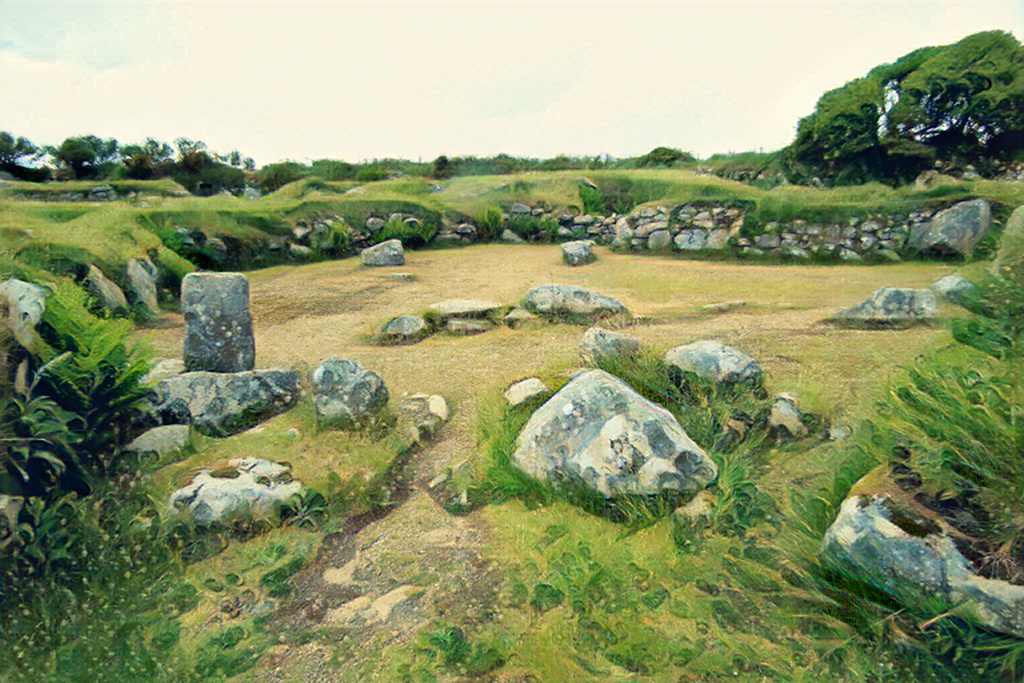
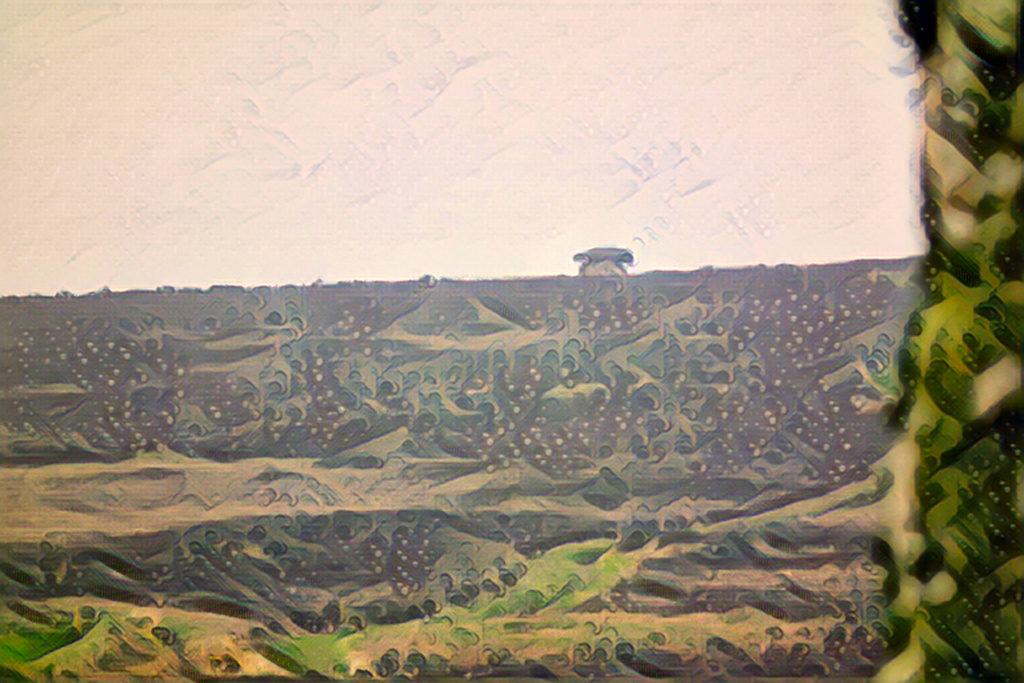
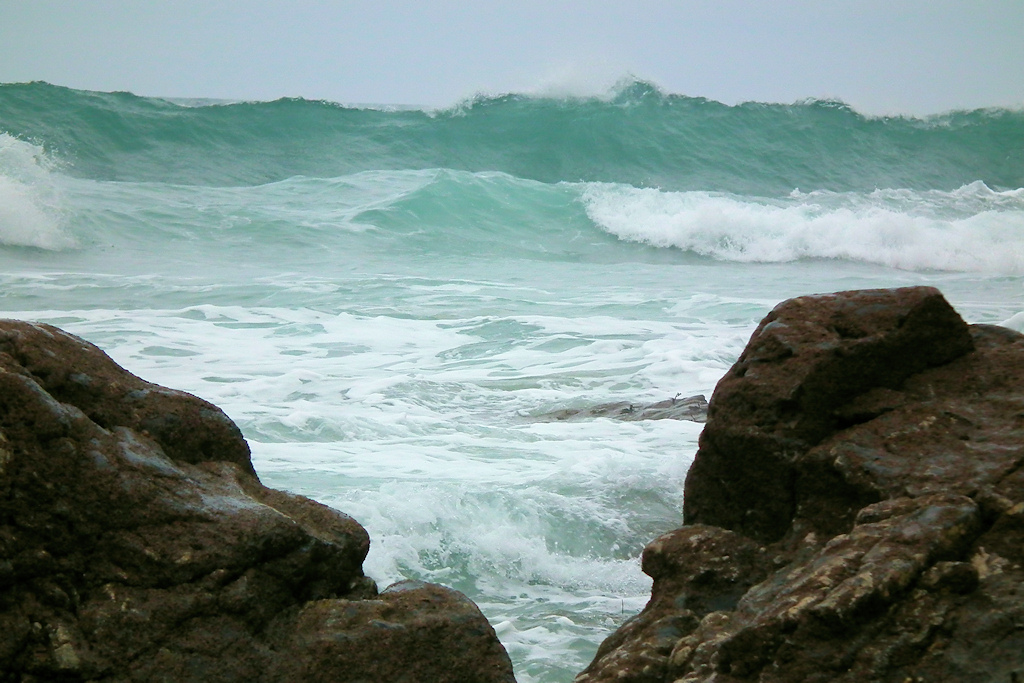
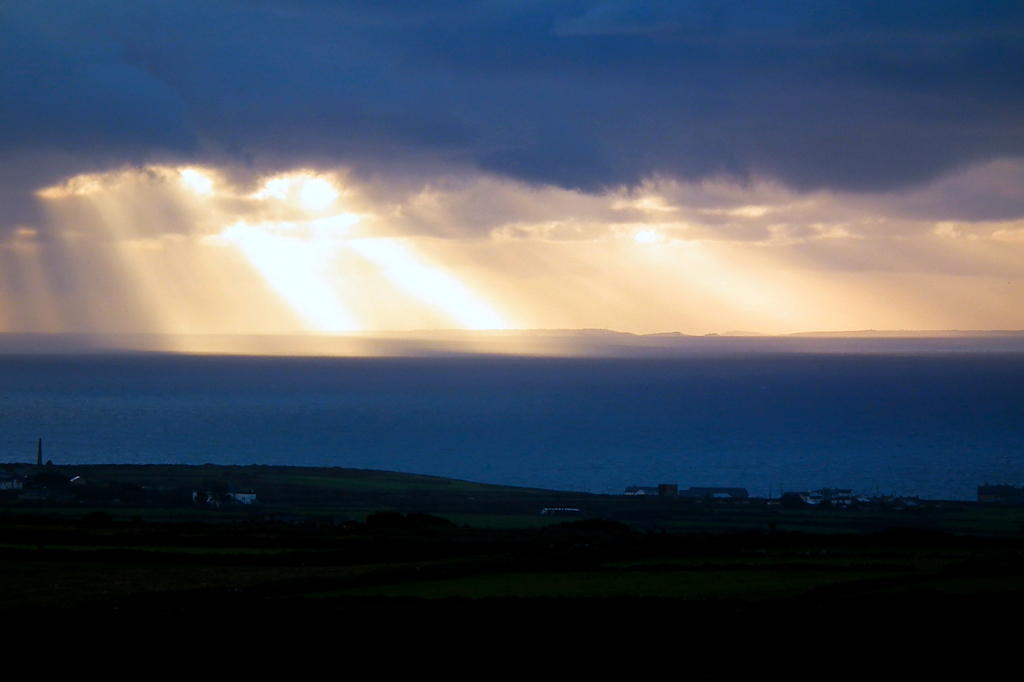
The photos are from Chapel Porth, Cornwall.
The Greatly Unknowable

Zarathrustra spake thus, all over the Isles of Scilly

The world was on tenterhooks. After the assassination of Trump’s vice-president by a white South African, America could no longer play off different groups of nations against each other. Netanyahu’s threat to drop nukes on Turkey had put NATO in an acutely difficult position, exposing its double standards. Trump was raging at Israel’s intransigence and Putin, looking haggard in his hospital bed, uttered boisterous words in support of him when everyone knew that, in his tenuous position, and now being undermined by the Moscow oligarchy, he could promise nothing.

The Israeli civil disturbances were brutal, with neither side willing to step back – the media were under strict instructions not to call it a civil war. The mowing down by the Judaean Settler Army of Palestinians trying to escape over the Jordan valley had variously dismayed the world, exposing the inevitable consequences of their inaction. Even Israelis were not allowed out of Israel – at Ben Gurion airport and the two remaining land crossing points, only approved Israelis could leave. There had been a full-scale call-up of reservists but they were taking different sides, taking their weaponry with them. India had at last withdrawn its support for Israel. China had remained silent, concerned as usual about its markets, oil sources and leverage in the newly denominated West Asia.

After the establishment of the Sahelian Dirham, the currency of the new Sahelian Alliance, other small countries flooded to join it, abandoning the Dollar and distancing also from the newly-minted Renminbi-Rouble bloc – after all, the Russians and Chinese were resource-gulping imperialists too. The resignation of the UN Secretary General, saying he had done his best but it had led only to this, was rejected by a uniquely united Security Council. Then Netanyahu, looking taut-faced and cornered, put the cat amongst the pigeons. He boldly declared in Hebrew that, if threats against Israel continued, he would detonate his country’s nukes and incinerate the country – by implication, a second, self-imposed holocaust, as if to prove his version of history to be correct. Chaos broke out not only in Israel but also in the steets of Damascus, Beirut, Amman and Cairo as crowds panicked.

Trump’s speech from Mar a Lago (since Washington DC had become too dangerous) had been surprisingly firm and calming – the invasion would be paused for now. Secretary Blinken, drafted from his thinktank job by Trump to deal with a situation he had played a large role in creating, was to be given a last chance to pacify the Israelis. Gaza, left with only stragglers and people unable to escape, already looked as if it had been nuked, though it hadn’t. Saudi Arabia had reluctantly opened its borders to Palestinians to relieve refugee pressure on UAE and Egypt – well, it swelled the numbers moving into Neom, the new desert city not too far from Sinai and Gaza. Meanwhile, UNHCR, backed by the first Polish and Swedish battallions in the new European army, had taken over refugee operations in Greece. Refugees were coming in big numbers. Now there was a new crowd from the Tashkent earthquake and nuclear disaster.

In the English Channel, disaster came when a container freighter and an oil tanker collided. An oil and chemical slick was spreading and most shipping through the busy Channel was blocked. Both ships had been trying to avoid refugee boats. The UK authorities were now running ferries to Calais to pick up refugees who were endangering shipping in yet another of the world’s maritime choke-points. This caused further supply-line disruptions in crisis-ridden Europe as shipping was diverted north of Scotland, exposing it to both Russian and American naval attentions. Europe was on its own, suddenly sandwiched between two big powers.

A wee visitor at my home, aspiring to do the washing up

Possible realities… Improbable, yet all the same possible.

A big problem we face is that the world approaches the future facing backwards. We see the future on the past’s terms, afraid to make a leap, afraid to acknowledge that we’re lost at sea, afraid that everything could go wrong – and in so doing, we’re making things even worse. Consequence-delivering chickens are coming home to roost, in waves. This might go on for a number of decades, because the world seems so determined to drag its feet through every single learning experience that comes to face it. Such global brinkmanship arises from a collective failure to own up to the full consequences of what we have done. A multipolar deadlock has unfolded. The powers that be are all busily making sure nothing really changes – not fundamentally.

But there is another kind of brink we’re slipping over. It started around 2012 or, further back, perhaps 1989. Or perhaps 1967-68. It’s this: even if the world decided tomorrow to mobilise humanity, wholeheartedly embracing fundamental change, we would tip into a new, anxious period of at least a few decades. Whatever we do, we would not know for some time whether and how much the solutions we attempt will actually bear fruit.

It takes time for a forest to grow, for an invention to be trialled, for society to change its values and for the fruits of systems-redesign to show themselves. Not all solutions will work, some might backfire, and the world is hamstrung, riddled with complexity, interdependence and conflicting interests. We’ve sidled into a minefield. This creates an underlyingly edgy and anxious atmosphere, stoking up an already insecure and volatile situation.

I’m happy to report that my little visitor did not lay a plonker on my bed while hopping around on it

I was reflecting on all this a few nights ago while lying in bed, listening to the owls hooting and screeching outside. It reminded me of my own cancer story. We all face an underlying, nagging issue, and cancer patients get it in a big, pressing dose, thrust in our faces.

When and how am I going to die?

And here’s the rub: you get no answer.

It could be anytime, anyhow.

Making plans gets difficult when you know there’s a good chance that anything can come along to scupper them. Whether or not you’re going to die soon, this still comes up, variously for everyone, when we’re scared enough to look at it. With cancer, I’ve found I’ve become much more sensitive to anything charged with any feeling at all. It’s not fear, exactly – it’s an insecure, creeping anticipation that hovers in the background. Worse, no one wants to talk about it.

In my own case, I’m rather surprised to be alive. I’m unsure what plans to make, and with what time-perspective. So I tend to keep my perspective open, but with the headlights shining on only the next three months, and anything beyond that is unanswerable. This has a remarkable effect on everything. It’s tenterhooky, no matter how philosophical or optimistic I might be, and no matter how much others encourage me to ‘get better’, not to dwell on morbid things – as if dying were a failure and living a success.

Sorry, dear Kate, Princess of Wales, while I understand your wish to assure everyone by saying you’re getting better, this is unwise. You do not know. It’s unwise to yield to that implicit social pressure to make everything look alright, because it isn’t alright.

When I lie in bed, drifting with fatigue, this is the view. On top of the hill in the left-hand window is an ancient site called Caer Brân (mentioned a couple of blogs back)

This is our world situation. We’ve stumbled into a mire of uncertainty and complexity. We have squads of scientists, super-forecasters and expert-texperts, and mega-millions of people with armchairs and opinions, yet we’ve become unable to accept the obvious – that the future is not as clear and fixable as we would like it to be. It’s left mostly to the young to point this out, while they’re still at an age where they are uncompromised by fear of loss and chaos.

Cancer patients, in my observation, divide into roughly three camps. Some are in denial – they take the pills, do the chemo, get the op, and do their best to appear and return to normal – it was just a bad dream and it’s over now. Some are heroic, fighting, striving to overcome and conquer cancer, and some of these will succeed while they have the willpower to do so, but it’s experienced as a fight, not a gift. And some come through to a level of acceptance and forgiveness that allows them to live and die in greater peace, whatever is to happen. To some extent all cancer patients hover between these three in different ways and proportions because cancer does indeed have a convincing way of putting the fear of God up you.

I have my struggles with this. I get fed up with all the pills, disciplines, diets and doctors’ appointments a valiant cancer patient is supposed to appreciate, to save their life and relieve others of the pain of loss, and sometimes I just want to say ‘fuckit’, to be normal, get my life, or even my ex-partner, back (fat chance). Other times I work on rising up within myself, trying to be a good human, in case God notices and gives me a reprieve – which won’t really happen since it’s a pointless, guilt-ridden belief.

Anyway, I’m doing quite well with my cancer, and I think it has something to do with full-on acceptance, yielding to The Force. I’ve lost control – yet, like a slalom skier, or when you first learn to ride a bike, or even like sex, by losing control you find a new balance.

In times of despair, hope sometimes stretches far further than it realistically should – like the vain hope that many Gazans entertain, that the decent people across the world will step in to save them. But just because something should happen, it doesn’t mean that it will.

At times I’m given deep truth-moments and gifts of spirit. I go down into the depths and up to the heaven-worlds, handing myself over in a humbled acceptance of my powerlessness and the overwhelming force of my circumstances, dependency and weakness – and the paradox is that, every time I drag myself through such a crunch-period, something in me is healed and reborn.

Here I still find myself, alive in a body and wondering what exactly for. Am I just here because I’m here? Or is there more to life? Yet my inner growth process has been ramped up to three times the speed, with a lot more depth, breath and height, and with a vulnerability that has amplified the emotional impacts, the feelingful fullness of being alive. That’s what I’ve been given.

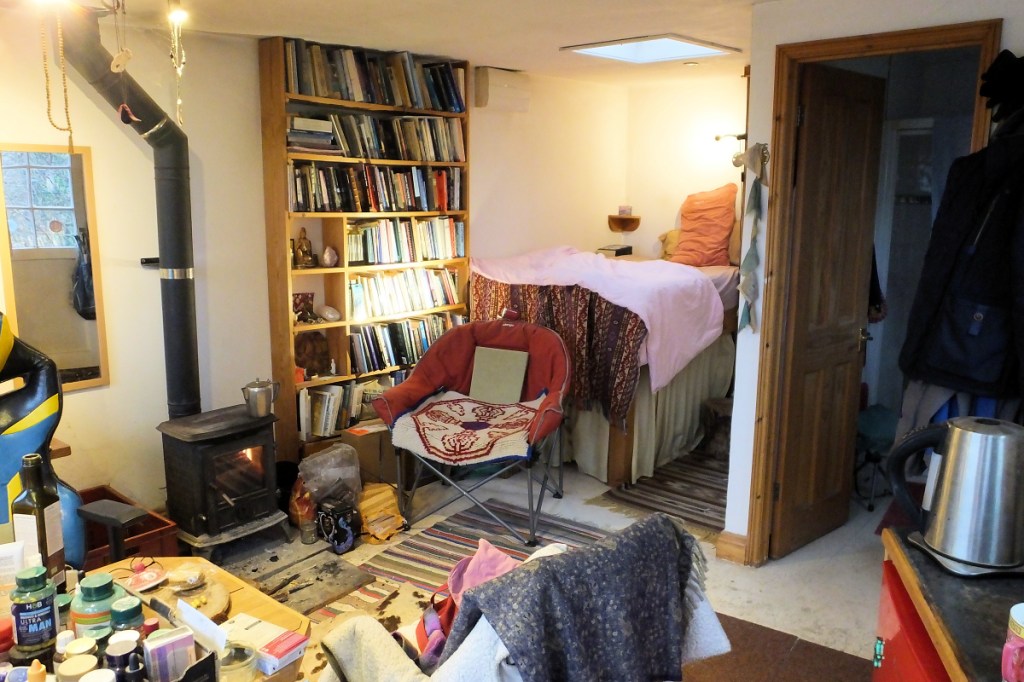
My little house. It’s called The Lookout. That’s what you do there.

So it is with the world. The world has cancer, depression, anxiety, diabetes, fentanyl addiction, ME and a strange mixture of obesity and hunger. Part of us wants everything to return to normal, if only we could just buy an electric car, and part teeters on the edge of an abyss, flummoxed and hovering between lightbulb moments and flounderous resignation.

A nightmare is unfolding. However, while plenty of horror, injustice and destruction are going on, World War Three is now mainly a hearts-and-minds matter, not one of nuclear bombs or evil terrorists.

This is what we have been given. Or, collectively and unconsciously, it’s what we gave ourselves, to teach us something. We’ve created a situation where, kicking and screaming, we’re being arm-twisted into change. This is the great value of the Trumps, Putins, massacres, disasters and tragedies we face: they’re putting options before us. The stakes are rising until, sometime, we get it – we get the fundamental lesson, the lesson that will save us and redeem the damage and pain. So it is with cancer.

What none of the pundits in the commentariat mention is the spiritual crisis the world is in. Mental illness is not limited to those who are diagnosed with it, as if a certification of our woes would contain the crisis: it’s a disease of a psychotic world society, taking different forms in different places. All of it points to one core issue.

We have lost our way, lost our humanity. We’re deeply worried about what’s going on. We don’t know how to make it go away. Even the wisdom teachers, psychologists and solution-bringers are lost. As an astrologer I can often see when a wave is coming, but what will actually happen is at best qualified guesswork.

We’re faced with the Great Yawning Gap, like a black hole sucking us into some sort of final battle for the hearts and minds of humanity. Well, that’s what it feels like, sometimes. This presents heightened choices. These choices have been around for quite a time – I was one of those harping on about it when a Sixties teenager – but the stakes are rising with each year and decade.

It’s highly symbolic of the state of humanity, particularly for the global minority, for the one billion of us privileged to live in the rich world, that cancer has become a big issue. Because cancer hits you like a battering ram, with immediate life-changing consequences and a threat of imminent termination. Loss of control. Loss of everything. When you die you take nothing with you except what you have become.

The biggest, deepest choice we are faced with is this. Just because life doesn’t go the way we want, does this mean it’s going wrong? If we get faced with cancer or similar terminal or disabling ailments, or earth-shaking experiences such as war, disaster, loss, hardship or death, is this something going wrong or something going right?

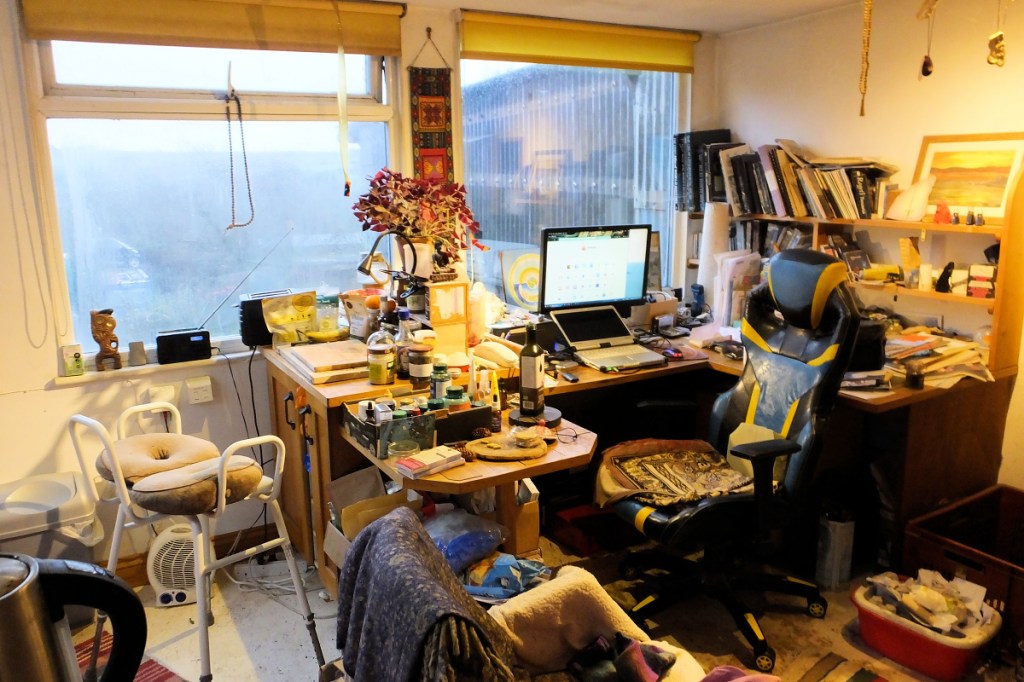
But when I’m alive and kicking, this is where I spend a lot of my time. It’s the bane of being a pathological wordsmith.

This is a very deep question. But in it lies a solution that lies at the foundation of our situation, from personal to global.

With cancer, in my experience, the secret is to embrace it and make friends with it. I manifested it and, whether or not I understand why, it came for a reason, not by chance or bad luck, and it gives me a deep learning for the soul. It’s a life-changer of a high order. Something is going right. Similarly, it might be difficult to see this at present, what with all that’s going on around us, but something is going right in the world.

To see this, it is necessary to step out of life somewhat, out of the mill and the grindstone, to see things from another viewpoint – the viewpoint of a soul visiting Earth. We came into life to do something with it – not only to learn but also to make a contribution. Society doesn’t think that way – it encourages us to snap out of it – but in the cultural, institutional and societal mass-avoidance of our time we miss something crucial about life.

Have we each made our contribution?

In Western culture we even believe that we get only one life, and that when we die we cease existing. This belief is unthought through, ideological and deeply problematic. It’s a key part of the world’s problem today – a way of blanking out the longterm and avoiding taking responsibility for anything much more than ourselves, those close to us, our properties, concerns and beliefs, and only for the next three years.

We’ve become hyper-privatised, socially atomised. The world is crowded but we don’t even know our neighbours. It’s crowded, yet loneliness is at its historic zenith.

The world we omit to save now is the same world that many of us will wish to return to in another life – after all, we have the best chocolate in the universe, and in most worlds getting rich, being a star or a tall poppy is distasteful and antisocial – that’s best done here, if you want it. Even if we don’t come back here, it still matters – after all, once we’ve ascended to the fifth dimension, Andromeda, heaven or wherever, it’ll still be necessary to account for ourselves, to explain the incomprehensible to the souls we meet there.

Sleeping seals at Godrevy Head

Why did you lot screw up your planetary home? After all, being a distinctly desirable residence, billions of souls want to live there. And, (you might have to take my word for this) most worlds in this universe don’t host souls in billions. If I remember rightly, the Nine once said that the optimum population of planet Earth is around two hundred million.

It is a planet of amplified choice – we are each and all given a capacity to create our lives as we feel best. This isn’t just a choice between Toyotas and Mitsubishis, or between Copenhagen and Buenos Aires. It’s deeper, and when we are confronted with earth-shaking crises, we’re given the gift of amplified choice. We’re dragged into fundamentals.

Disaster – which means ‘out of sync with the stars’ – is a gift. This is what we need to get straight about. We need to meet the future facing forwards.

Me too, with my cancer, which will inevitably kill me sometime. It’s alright. My bones could disintegrate, my stomach could block up, an infection could floor me. I could die alone with nobody noticing, nobody here to hold my hand. I could be floored by a blast of phone radiation given to me by someone who loves me and didn’t mean to be so generous. If such is the case, so be it – it’s all for the learning. Soul-learning, about the true and full nature of existence as a human.

I’ll be going home. Done. Cooked. But even then, it doesn’t stop there.

I’m tempted to quote the lyrics of a song, ‘I just wanna be there’, by a late, great soul-friend, John Cartwright, and it went:

I just wanna be there / When we all start to re-pair / All the damage to our Mother / And our sisters and our brothers / All deserving to be fed / In the spirit and the body… / It is doing in my head / There is nothing to be said / Time is running out…
Seeds bursting to grow / Dying of hunger, under the snow / My need, bursting my heart… / Where do we wander? Where do we start? /
My soul… silently smiles / Laughs as the water falls from my eyes. / Each tear, spelling it out… / Rise or go under… Rise here and now!

[Glastonbury friends will know John and Jaki’s band, Court of Miracles – ‘the best band you never heard of’, to quote the late Justin Credible. I couldn’t find an online version of this song, but here’s one of their uplifting albums from the 1980s, called International Times.]

Peace, brothers and sisters. Despite everything, it’s okay – just remember that.

With love, Paldywan Kenobi.

————————
Site: www.palden.co.uk
Blog: https://penwithbeyond.blog
Audiobook: www.palden.co.uk/audiobook.html
Podcasts: www.palden.co.uk/podcasts.html

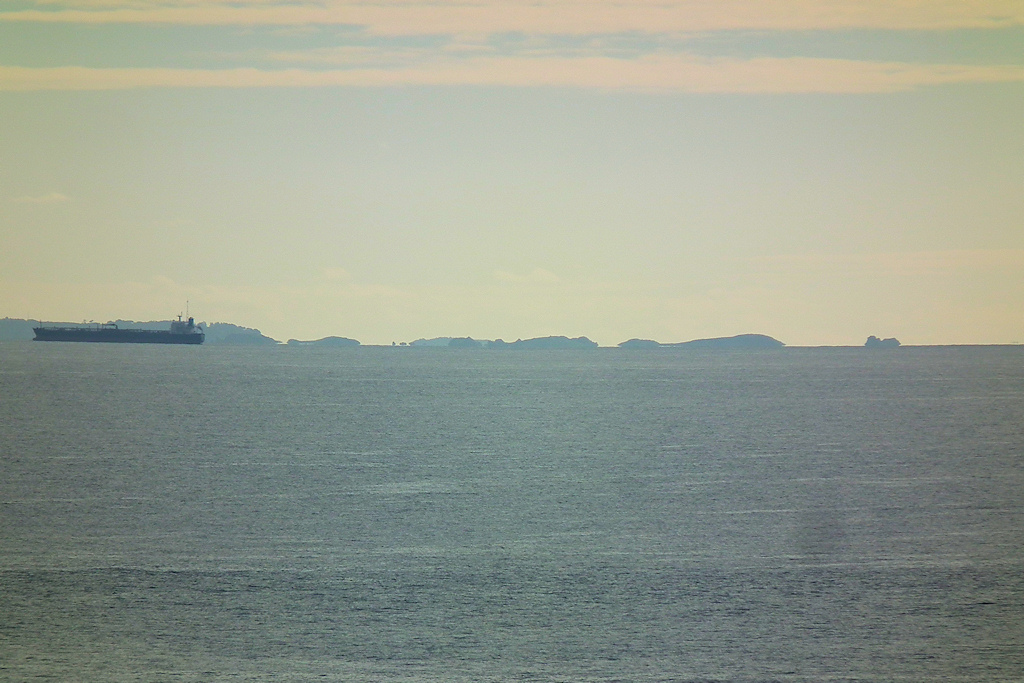
The Islands of the Dead. Sometimes the islands seem to hover above the ocean.

Being in the World

And out of it too

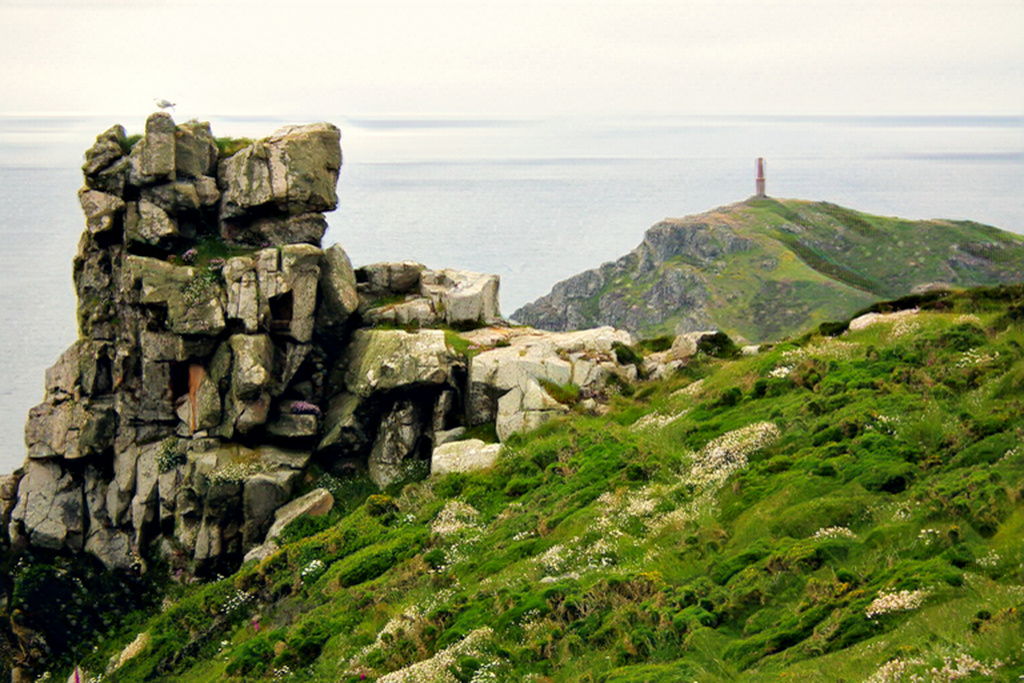
Carn Gloose and, behind, Kilgooth Ust or Cape Cornwall

I’m lucky to be a writer. With my cancer-derived disabilities I can still more or less carry on with my work. If I were a farmer, work would be mostly impossible and my life would fall apart. There’s another side to this though: I get fed up with sitting at the computer – being nerdy and scholastic, I’ve done a lot of that over the last fifty years! My major hurdle at present is fatigue, though even that has its compensations because the rest and the floating-off that fatigue induces gives me space to cogitate things more than I’ve ever done before.

So my current book is taking time, but I’m now on the finishing touches – checking footnotes, indexing and sorting out pictures and maps – ready to send to a printer and publisher I do not yet have. That’s the next hurdle. Fatigue means I have to take things one thing at a time – handling complexity, arrangements and details is distinctly difficult. But I’m really pleased with the book.

The ‘council circle’ at Bosigran cliff sanctuary

In some respects it’s rather obscure – about the ancient sites of West Penwith, here in Cornwall, and what they show us about ‘megalithic geoengineering’ – but in other respects I’ve never been able to give a book so much thought and consideration. It might be one of my best (it’s my eleventh). There has always been a rush to meet a deadline or before other things start happening. But I don’t have a lot happening, and I’m no longer striving to be a successful author – I’m seeking simply to pass on my knowledge to whomever will benefit from it, before I go.

A dear soul-sister, Sophia, suddenly went recently. She was about to stage a big exhibition of her remarkable art and ceramics when she died quietly in her sleep, in her early seventies. It’s one of those deaths that was a surprise – she was in good enough health and spirits, with good prospects. Yet there’s a feeling it was not actually wrong that she passed away there and then. Sophia is a deep and sensitive lady who has done consistent spiritual practice (Subud Latihan) for a long time. We worked together on local and world healing in the 1980s, with an occultist called Gareth Knight and others. Her angels clearly, cleanly and calmly took her out at what they consider exactly the right time.

It’s stirring, when someone suddenly blips out like that. But we’ll probably meet in heaven when I blip out too. It doesn’t bother me the way it seems to bother a lot of people who, in their confusion over death, seem to experience such loss and regret when a person dies. Some people judge that I don’t care when I say this, but they misunderstand me. Yes, there’s an enormous gap, a silence, and it raises big questions about life, bringing up mysterious feelings, and the person is no longer physically present, but why do people stop talking to a person when they die, as if they no longer exist? I’ve sat at funerals where the departed soul says to me, “But can’t anyone see I’m here?“, so I talk to them. Then they, and the attendant angels and beings, seem to wonder why I am not running the funeral myself.

At times in the past I have done so, encouraging the living, standing around the grave, to address the person directly in their thoughts and words. We’d do a talking-stick circle where everyone could say their bit and recount their chunk of the life-story of the walked-out person and their abiding impressions. I’d encourage everyone, silently to themselves, to say all they needed to say to the person, to round out their relationship, and to hear the departed person’s truth, and thank them for their presence and for whatever, knowingly or not, they taught us while they were alive.

Anyway, Sophia is now very much at peace and in good hands, and she is going home, and the quiet manner of her departing was true to form, for her. A death like hers leaves the rest of us in an altered state because part of us goes with her, drawing attention to the wider and deeper meaning of life and what we are doing about it. This leads me to my latest podcast about Soul Education – recorded in early September. It’s not about death but about life. My starting premise is that we as souls did not begin our evolutionary journeys here on Earth, and that we come here for two primary reasons: to learn and to make a contribution.

Carn Euny iron age village, 2,000 years old

Cancer has been something of a gift because it gave me an indefinite though possibly imminent death sentence, which has brought forward this question of the contribution I have made and still make. It sharpens me up, in my constrained and slightly helpless state. Soon after getting diagnosed, in mid-November two years ago, on my back fighting for my life and amidst my pain, I was moved to write down all I knew about prehistoric culture – something I had not properly done before. This knowledge would be lost and wasted if I didn’t get it down. It gave me a focus through the next two years, and now it is virtually complete and ready to ‘put to bed’.

I now face a new question. My life might (or might not) be longer than the few years I expected. But I do not know what will happen, especially since, just two weeks ago, I was again not far from death’s door. I need to face the world and to supplement my income, since my pension and allowances no longer cover all my needs and costs and I have nothing to fall back on. But I cannot make arrangements, keep timetables, remember details and deal with the intricacies and obligations of conducting business – I don’t even know what state I’ll be in next Thursday, next month or next year, so making promises and agreements is just not realistic.

Working for a living (such as editing books or doing astrological sessions) is not easy now, even though I’m a solid workaholic. You see, when I fall ill, I cannot sit at the computer renegotiating arrangements with multiple people and giving them a reliable answer when they ask when I’ll be better and back to normal! If I died suddenly, lots of threads could be left untied. My recent health encounter took three weeks and I’m worn out, running on three cylinders. I’m destined to fail in dealing with the details of working for a living, and I know it, and I’ve had instances already where I have let people down or forgotten something, because I’m in an altered state with chemo-brain and fatigue. Or they’re in more of a hurry than I can keep up with.

I’m just not ‘up to speed’ or ‘in the loop’, and neither should I be. I’m still shielding. But I’m a Virgo with an inbuilt need to do my bit. I need to focus on what actually I can do, such as writing this cancer blog until I no longer can, or churning out podcasts and my forthcoming book, or doing psychic work and playing a part in the lives of people close by and far away. I do these not just for self-entertainment, though they do keep me occupied, but because I believe they bring some value.

Neolithic Chun Quoit as seen from bronze age Boswens menhir

Last week Lynne picked me up and I went to stay in Devon with her. That worked well, and the change and being with her after a too-long pause was good. But while I was there I encountered another issue: electrosensitivity. It has increased since I got cancer. It’s a blood cancer, and iron-rich blood is electronic and magnetic. Lynne is herself electrosensitive, so this is not what otherwise could be a difficult issue between us. But it affects my and our social life a lot.

Most people don’t understand radiation, and many think they are exempt from its effects when this is incorrect. Problem is, it takes me just three seconds of close exposure to mobile phone or wi-fi radiation to set me off for 36 hours. I go through a sequence of cumulative symptoms, depending on the amount of exposure. It starts with an agitated, embattled, uncentred, inarticulate, locked-in kind of feeling, progressing to a high-pitched whine in the centre of my skull, then some sharp, pulsing, show-stopping headaches, then a thumping, irregular heartbeat, then distinct feelings of flu-like illness lasting about 24 hours after exposure has stopped. This is upsetting, especially when it’s friends, loved ones and interesting people killing you. No one understands what they’re doing because it is not recognised as a problem.

From my own perspective, I think that EM and nuclear radiation probably account for at least 20% of the environmental damage, climate change, social stresses and health problems happening right now, globally. The world doesn’t want to know. Many people groan when I come up with things like this, and I have been criticised many times for awkward utterances, only to watch them come true in the longterm. I’m not right every time, but I’m correct enough times for it to matter. It’s the price of being a seer and choosing to live ahead of our time – I’m sure a lot of you know that one.

I turned vegetarian-vegan in 1971, but now is it no longer regarded as a deficiency or weakness, but that took 40-50 years. Twenty years ago I was involved with ‘talking to terrorists’ (Hamas) at a time when it was risky and taboo. But now, British soldiers tell us we should have talked more to the Taliban in Afghanistan – ahem, yes, precisely. It’s painful, living with this wilful blindness and watching the wider costs and hardships rise so high. This is the case now with the question of EM radiation – it is nicely invisible and deniable, and mobiles and wi-fi are so useful, but it’s harming us and our world. Even Extinction Rebellion and the Green Party have a blockage over this issue, and I do wonder why.

Caer Bran, the possible bronze age parliament site for Penwith, as seen from Grumbla in the valley below

It’s past lunchtime and time to go to bed. Fatigue is funny: when it comes, it’s like pushing through treacle. The law of gravity gets switched up, my mind dulls out and it’s like being muffled in wool. It can arrive quite suddenly, often in the afternoon or following a lot of activity. The secret is to accept it and not grind myself up feeling guilty or inadequate. I’ve pushed energy writing this blog, and now I need to put my body-mind system into freewheel for a recharge. Besides, it’s a grotty, rainy, grey, blustery day, and bed is the best place to be. With a cuppa, a few munchies, music by Brian Eno, and a good case of metaversal megaflop.

Thanks for being with. This time you get a podcast too, introduced by a nightingale.

With love from me, Palden.

www.palden.co.uk/podcasts.html – for the latest podcast from the far beyond
www.palden.co.uk/shiningland/ – about my book Shining Land
www.facebook.com/palden.jenkins – my Facebook page

And the pics here are made for but not included in my book.

Risen from the Half-Dead

Normally I’m the kind of person who gets ill only once every twenty years. When people were getting colds and flu, I’d have one-third symptoms for twelve hours and it would be over. In my life I’ve been in some pretty dangerous situations, and amazingly I’m still alive. So incurring bone marrow cancer, or myeloma, last year, has meant a new life. Lynne is continually amazed at my calm in the face of adversity, but I just reply, “Yes, but no one is shooting at us and the world isn’t ending, so all is well“.

This said, a year ago, when I was diagnosed, I went through a week of anger. I had been a meditating wholefood vegetarian since my twenties and had looked after myself well, precisely to avoid issues like cancer. So I felt frustrated, even let down by my beliefs. But then I learned how this particular kind of cancer is caused by toxicity – electromagnetic or chemical – and in my case it has been electromagnetic. This became a problem for me from 2000 onwards as mobile phones and wi-fi came in, though I think I’ve had some nuclear exposure too. This toxicity issue helped me get over the anger, and at that moment I entered the self-healing process fully. I gave myself full permission to make the best of a disaster.

Recently I’ve been wondering how much of a future I have. I’ve had a lot of fatigue – it comes on in the afternoon, sometimes quite suddenly. It’s not just tiredness – it hits the central controls of your bodymind and halves the power. Everything except the force of gravity gets switched down – brain activity, physical strength – and with it can come some pretty downward-facing thoughts. Such as ‘Is all this struggle worth it?‘ and ‘Will it ever end?‘. I’m rather addicted to being an asset to the world and now I find myself wondering, in my down moments, how much of a liability I’ve become. We Westerners are very expensive humans to keep alive.

In my last blog, I told the story of a crisis I had a few weeks ago. It was sciatica, which triggered an outbreak of shingles. The sciatica arises from myeloma, which eats away at the bones. John Tillyard, a gifted and experienced chiropractor in Hayle, who treated me recently, said that the gaps between my back vertebrae are very large. When I lie down flat I can click myself in 3-5 different places – it’s rather shocking to anyone who hears it!

The sciatica arose from this issue – the bottom few vertebrae in my back had collapsed or compressed last year and I cannot fully support my back for more than a few minutes without resting on walking sticks. So my back clicked out, very painfully. The shingles is a side-effect of the chemo drugs of last winter. It’s the chickenpox virus, that hides in a corner of our nervous system and erupts in later life when prompted – the sciatica prompted it.

So I’ve been pretty wiped out by that. My active day lasts 6-8 hours only – and that includes doing housekeeping or indulging in small pleasures such as just sitting. Which is why I don’t chat on Messenger or answer messages quickly or at all – sorry about that. Writing this blog will finish me off for today. Oh, and I sincerely recommend that you don’t get shingles, if you can help it!

So I was worried that I might slowly be going downhill. I had a blood test and, yes, my readings were slowly going up. Liz, the haematologist at Treliske hospital in Truro, started preparing me for the possibility of another round of chemotherapy, but booked me for a PET scan to check if damage was being done. Lynne took me to Truro for the PET scan on Monday – and that was a fullmoon adventure in its own right (her car broke down)! But we’re a good team, she and I, and magic happened, and we got home, and all was well.

The next day, Liz rings up sounding happy, saying that my scan results were really good and that the two things that had worried them were no cause for concern. That was heartening – I needed some good news! But, to me, it had extra meaning. A year ago, when I was lying there in hospital, assimilating my situation, I realised, “Well, Palden, you’ve been given a challenge, and that is, ‘healer, heal thyself’!“.

Throughout my life I haven’t been a healer in the normal sense, but as an astrologer I’ve seen myself as a perceptual healer, and in my community and humanitarian work I’ve seen myself as a social healer, and at times, in crisis situations, I’ve used laying-on-of-hands and psychic healing to amazing effect – but none of these has been my primary focus. Now I have been challenged to apply healing power to myself and, not only that, but to demonstrate it to the doctors.

The primary issue for me has been meditative – opening myself up fully to the spiritual and medical attention of my ‘angels’, and opening up my cells to the medications I’ve been given, asking my body-mind intelligence to regulate the process to best effect. I’ve allowed myself to be held in the upturned palms of the Goddess, showered with light by my ‘friends upstairs’, included in the prayers and meditations of all sorts of people in a range of countries and cultures, and helped by the humans in my life and by the wonderful landscape I live in – the magic land of Belerion, the Shining Land, in West Cornwall. Thanks and many blessings for that, to all of you. It means so much.

What happened? Well, my six-cycle chemo last winter was stopped at five – job done. Although side-effects of treatments have been an issue for me, they are not as much an issue as they are for many other people. And now there are the latest results, causing some eyebrow-raising in the haematology department at Treliske. So, thus far I have managed to demonstrate, at least to myself, that innerwork like this, plus the beliefs, diet and lifestyle habits I have had for decades, seem to have a discernable positive effect on my medical outcomes. What disappoints me, though, is that the doctors are not interested in finding out why and how. To them, my results are just ‘good luck’ – that’s a very scientific evaluation, if ever there was one.

When death is tapping you on the shoulder it makes you review your life and look hard at what you’re happy and unhappy with. Two big life lessons for me (and for a good few of my friends) have been ‘the pain of history’ and ‘living behind enemy lines syndrome’. As a radical and pioneer, I’ve had to learn that changing history takes time, and it can take longer than a lifetime – especially during periods when the world is, on the whole, in denial and blocking, messing around with phantasms like Donald Trump or the latest iPhone rather than addressing the major matters at hand – ‘amused to death’, as Roger Waters (formerly of Pink Floyd) would put it.

So, in the projects I’ve undertaken throughout my life, there has been success in some cases, but not as much as there could have been, and many project failures have been the fault not of the project itself but of the politics, economics and social values around it. Despite our exertions over the decades against war, war has not ended and my own country is still a leading arms exporter. The situation in Palestine has not improved at all since I first got involved in 1997. The Tuareg village I work with in Mali could still get wiped out in one afternoon, either by jihadi extremists or by French troops. Has there been progress? No, but in the longterm, yes – though it should be happening quicker. This has been difficult to live with and, in my later years, I’m deeply tired of it – rather deeply exhausted with the fact that things have not changed as much as they have needed to change.

‘Living behind enemy lines syndrome’ – hm, that’s a tricky one. It’s all to do with having ways and values that are not in line with the majority of people and the dominant culture we live in. If you don’t play along with the rules, you could get busted, anytime, and for ridiculous, trumped-up reasons. I was busted, criminalised, exiled, scapegoated, disrespected and robbed of my rights – and I’m not the only one. And things that should have happened were blocked and obstructed for stupid and, in the end, destructive, selfish reasons.

In the mid-1990s I worked with a doctor who, with Prince Charles, was seeking to develop Integrated Medicine – a fusion of conventional and complementary therapies in healthcare. Has there been progress? No, not really – because government, Big Pharma, the medical profession and even the BBC are against it. And, worse, this affects me now because, more than anything, I now need the supervision of a doctor with full knowledge of both health sectors, who does not suffer from the ideological, political and business biases that are definitely not in humanity’s best longterm interests.

We’ve had fifty years of this enormous cover-up and I’m tired of it. I’m tired of having to try to persuade doctors to give me lower dosages, because unlike many people I don’t need hitting with a medical sledgehammer. I’m tired of doctors’and nurses’ distrust of my intuitions whereby, with some drugs, I ask them to change it or reduce the dosage while with other drugs I’m fine, and when they ask why, I simply say “It doesn’t feel right“. But they fail to remember that it is I who pays the price of medical sledgehammering, and that dealing with the side-effects of previous treatments is half of the problem I face today, and that it is possible for a person to have accurate and practical internal feelings and intuitions.

I must finish now – the clock is ticking. I wanted to say something, because I’ve been silent recently. I have more to say about the coming decade and the state of the world, but that must wait, and Lynne and I have been recording material for some ‘Podcasts from the Far Beyond’ too, which will come online whenever they’re ready.

But here’s a hint: the distresses and difficulties of the Covid experience of 2020 mark the beginning of a longer process, and it represents a turning of the tide in human history: it’s all about the rehumanisation of life on Earth. And this is the agenda from now until the early 2040s.

Now it’s time to climb back into bed and stare at the crows wheeling around over the fields outside my window.

Beeee goooood. ET right here. Thanks for lending me your eyeballs. Bless you. All is well, Palden.