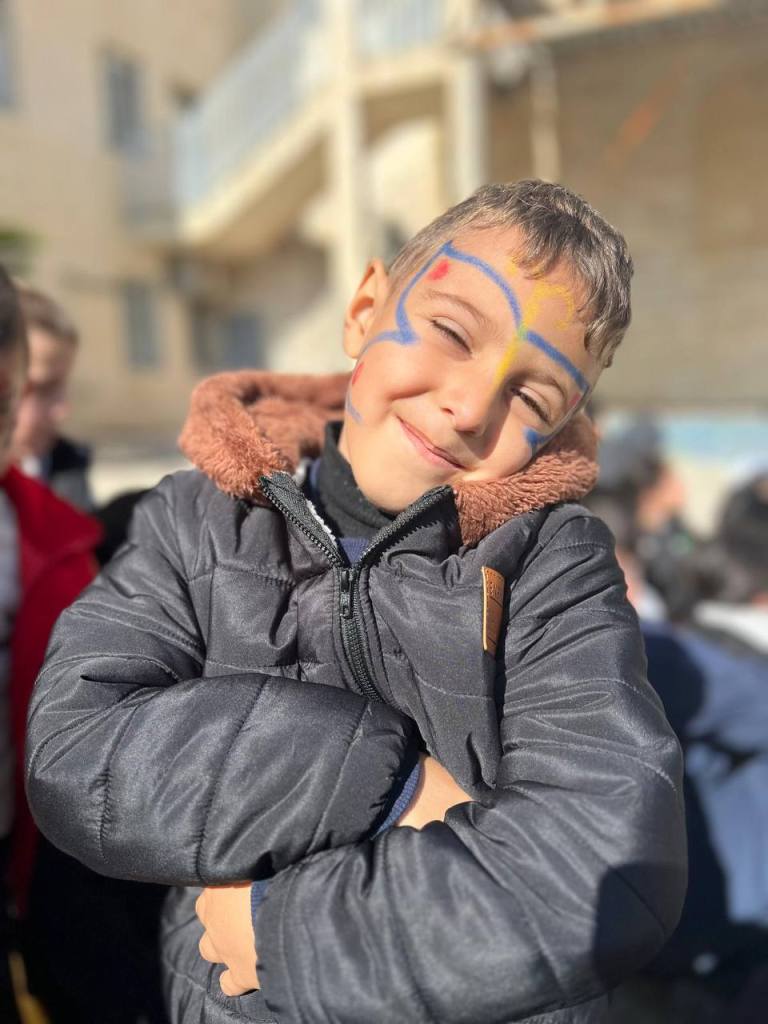
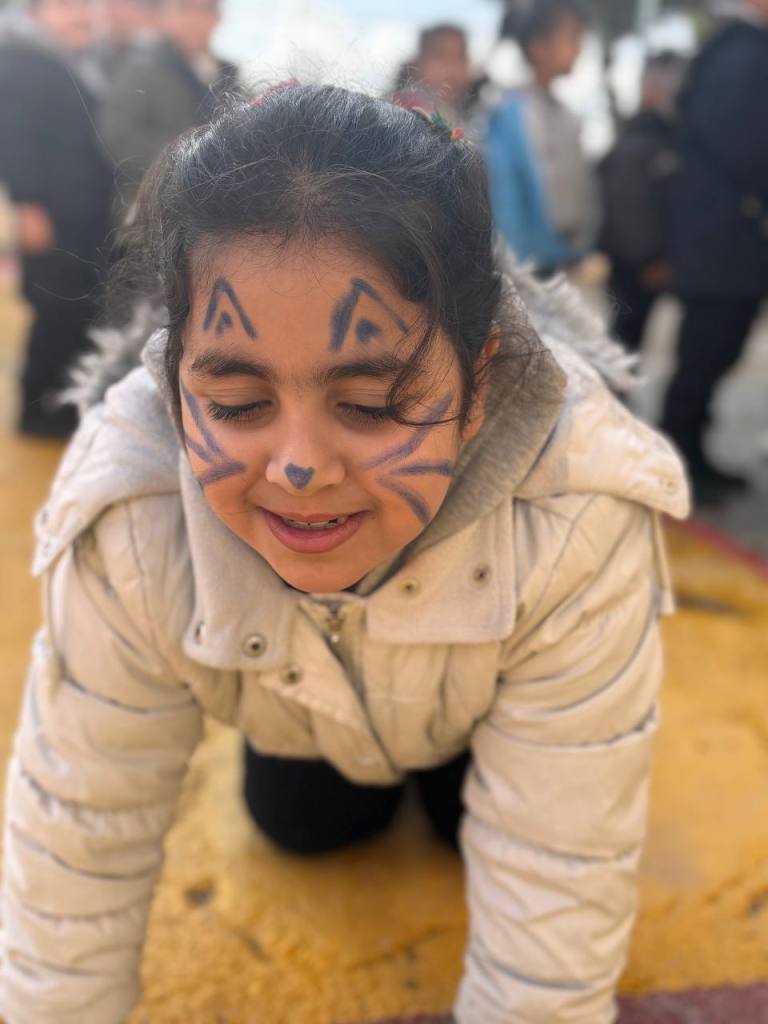
These are kids at the Hope Flowers School in Bethlehem, West Bank, Palestine, and these pics were taken in the last few days.
They are orphans from Gaza, and refugee and special needs kids from the West Bank. Apart from giving a good education under difficult circumstances, the school gives kids the tools to process their anger, loss, fear and trauma, so that they grow up knowing there is another way. Another way from what has happened over the last hundred years in Palestine and Israel.
Note the performers. These look like visiting Europeans. They are independent humanitarians: they set about brightening up the lives of people in places like Palestine and they make a big difference. They often fund themselves to do so, and travel cheap and crash on sofas. Some are performers, some hairdressers, some are welders and some are law graduates, artists and retired professionals. Have you ever considered doing something like this?
Forget Trump and Natanyahu: this is the human frontline, where the real work of peacemaking happens. These children are, I hope, the generation who will see a big change across the Middle East. The times of war need to end now: we must do things another way. And these are the people who will do it. That is my prayer for them.
Here’s the translation of the text that came with the pics:
In an atmosphere filled with fun and positive energy, the professor of physical education, Mr. Mustafa, organized a special recreational day for the students of the school, in cooperation with the refugee center, where play, art, and laughter came together in an unforgettable day ✨
⭕ A variety of events between animated games that enhanced activity and interaction, face painting added colors of joy to the faces of children, alongside a theatrical circus that presented pleasant performances that brought joy to the hearts🎪😊
Our students also participated in playing with parschute and other group activities that contributed to promoting a spirit of cooperation, active discharge, and building self-confidence in a fun and safe way 🌟
⛔ This day was an open space for joy and expression, and an integrated recreational educational experience that emphasizes the importance of play in supporting our children’s physical and psychological development 💚
ـــــــــ🍂ــــــ We learn for human well-being ــــــ🍂ــــــــ
To make a donation to Hope Flowers, go to this page for links to Hope Flowers’ supporting organisations in different countries: https://hopeflowers.org/wp/support/
Here’s a readable story about the history and philosophy of the school. It’s from my book Pictures of Palestine, and it’s called ‘Korea meets Palestine’. (Korea and Palestine were both divided in the same year, 1948.) https://www.palden.co.uk/pop/korea-meets-palestine.html
I’m away for two weeks, at the Oak Dragon Camp (I was its founder nearly 40 years ago) and speaking at the Glastonbury Symposium – so you won’t be hearing from me for a while! Recently I’ve been rendering my cancer book Blessings that Bones Bring into audiobook format, and that’s now complete.
Just in case you were desperate for something to read, haha, here’s a chapter from my 2012 book O Little Town of Bethlehem – Christmas in God’s Holy Land (here). Compared with the situation now, Palestine in 2011 was much better but, even then, people were beset with issues to deal with, and this excerpt gives some examples. It’s also about one of the key activities a foreigner visiting Palestine needs to be willing to do – listening.Bearing witness.
In the streets of Bethlehem, December 2011
When I went to town to check out various friends, many of them were gloomy, beset with problems. It was one of those days. Each person had their own particular issues, but they all add up to a morass of collective difficulty which the customary Palestinian good humour cannot penetrate.
Naturally, our perception of life is made up of an interaction of circumstances and our feelings about them, and these are two rather different things. For Palestinians living under occupation, the circumstances side of the equation bites and scrapes harder than for most people across the world. Especially since the occupiers deliberately go about making life difficult, complex and insecure for the occupied, in military, administrative, legal and quite everyday ways. This is what Jeff Halper, a critical Israeli thinker, calls ‘the matrix of control’. The ultimate goal is to make Palestinians submit to Israeli rule, give up, go quiet and preferably leave the country.
But they don’t give up, despite the muddy mire of problems they can be beset with – or perhaps it’s a dust-storm where it’s impossible to see far and sand gets in the engine and all the moving parts. Palestinians have a life-philosophy which is admirable. But some days they go down into the doldrums and they need a good moan.
That’s one of the roles of foreigners who come here: bearing witness. This often means letting Palestinians have a good moan, describing to you with a full spectrum of feeling how difficult everything is. It can be quite challenging though if you have something in your own life that’s nagging you too – happily, this wasn’t the case for me today. So I was able to listen fully and, when a person ground to a halt, I could start up something that might change the context of things, so that they see the situation in a different way – for the difference between a situation and a problem lies in our state of heart and mind.
There’s a Christian grocer in town who stocks a lot of things I like, so I went to his place. While wandering around looking through the densely, intricately packed shelves, a guy comes in and starts up. I don’t understand much Arabic, but the tone of his voice translated easily – he was on a down day, overwhelmed. He and the grocer were so engaged in this man’s inventory of problems that I had to stand there patiently waiting to pay, listening too.
Little did he know, but in the process I did a little psychic healing on this man – smoothing out his aura, shifting the movement of his energy and the orientation of his aura from downward to upward and reconnecting him with his guardian angel. After a while, the grocer turned, noticed me, apologised and started totting up my buys. Suddenly, his friend said to him (it could have been), “And guess what…?”. The grocer grunted, to say go on, and the guy burst out laughing and said something. The grocer turns to me and said, “He tell me all these problem, and now he say his wife just got pregnant again – fifth. He say only now. Why not before, eh?”. Well, looks like the healing did something to loosen things up.
With goods in hand, I wandered off down Faraheih Street, turned left through the market, to be how-arre-youed and wherre-you-frommed by stall-keepers as I strolled past. Mid-afternoon, they were all sitting around wondering whether to close for siesta.
An elder angel in the vegetable market
I’m always amazed that being British is regarded positively by Palestinians, despite what we’ve done in the past. Announcing Britaniyya to them always seems to elicit a good response. Perhaps they think we’re less bad than others, therefore good. Just as well. A Danish guy I met a few days ago had complained that Denmark is notorious for offensive cartoons of the Prophet Mohammed, and he often had to prove to people that he didn’t agree with it.
Down the passageway and some steps leading from the market I was accosted by a sweet-seller. He asked how arre you, as they do, and I joked back hamdulillah – thanks God (I’m okay). It was a joke because, last time I was here, I couldn’t manage responses in Arabic. He has a hand-pushed cart parked at the top of the main steps down toward the Omar Mosque and Manger Square. Palestinian sweets are gooey, rich, soft cakes of honey, almond and who knows what, often eaten by dropping a cubic inch of the stuff straight into the mouth and swilling it down with coffee. I got some, in order to augment my weight-gain programme. Yes, folks, one of the ways I differ from many people is that I’m thin and bony, so I actually have to eat calorie-rich things to gain weight.
I then proceeded down the steps and met up with a shopkeeper I know who was sorely troubled by the lack of trade. The pilgrim and tourist business is down and the Israelis have creamed off most of the business. Most visitors come in shepherded groups for just a few hours in an Israeli coach from Jerusalem, visiting the Church of the Nativity and an approved souvenir shop, from which 30% of the takings are paid to the Israeli tour operators. Then they’re shuttled back to Jerusalem. The Israelis have niftily captured the income from Bethlehem’s pilgrimage tourism.
Independent travellers who arrive here – not exactly in floods – tend to run on a tight budget, so they aren’t big consumers. Norwegians seem to be the richest at present. Instead of money, these visitors mainly bring ‘witness’ and interaction, a social currency, worth perhaps more than money, if truth be known.
The shopkeeper complained that he had made only 100 shekels today – about £20 or $30. He thrust tea before me and carried on. Usually he has quite positive attitude, but this time he was struggling. I let him run with it, and it did him good. It does give them some assurance to be able to offload like this and to gain some understanding from another person – it helps them objectivise their lives.
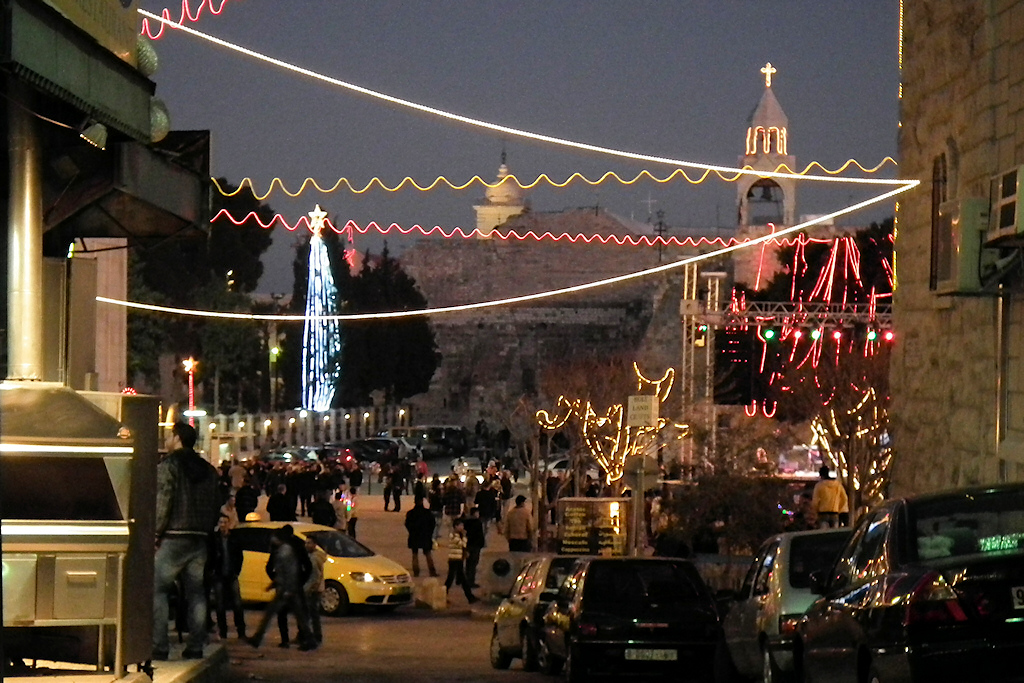
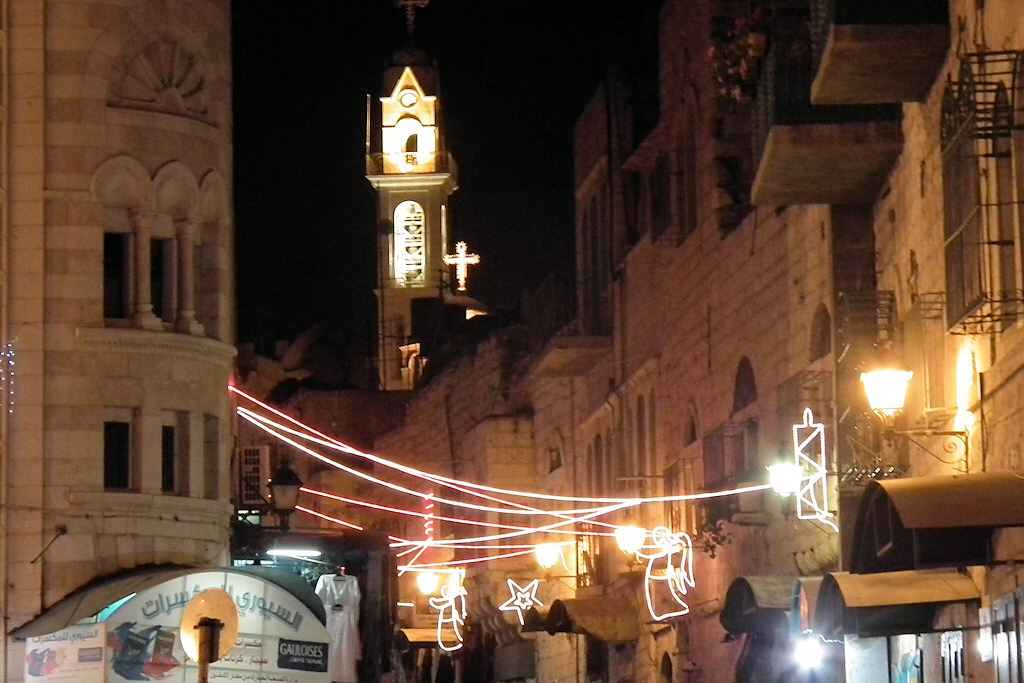
Street scene in Bethlehem Old Town
Then I went round the corner to a café run by Adnan’s brother. I had falafel, hummus, pitta, salad and sage tea, as a late lunch. In came Adnan, plonking himself straight down and huffing. He starts up. His story is always complex, but he’s in the tourist souvenir trade too and he’s almost bankrupt. I know some of the things he could do to improve things (such as trading on eBay), and I have told him about them, but he doesn’t get it. He perpetually hopes things will work well next time, things will get better, but they don’t. Or someone else is making his life difficult and he wishes they would stop. So I usually let him blurt out his complaints, in the hope that some relief of pressure might lead him to form new conclusions.
The souvenirs he sells are lovely – especially if you’re a Christian. Lovely hand-carved olive-wood effigies of Jesus, Mary, the saints and the Nativity. Bedouin carpets, lovely Arabic dresses, inlaid boxes – all made within a few miles of here. But they don’t sell, the overheads are high, the checkpoints scare visitors away and, if your spirits are down, it’s a disaster.
Round and round in loops he goes. Adnan requires perseverance because he’s quite resistant. It’s the world that’s wrong, not him. But he appreciates the listening ear anyway, and soon we were talking about other things – mainly about the carpets his grandmother had diligently woven throughout her life, adorning the floors of many of his vast Bedouin family’s network of homes. Well, that’s that done. Now to see Jack, down in the Christian Quarter.
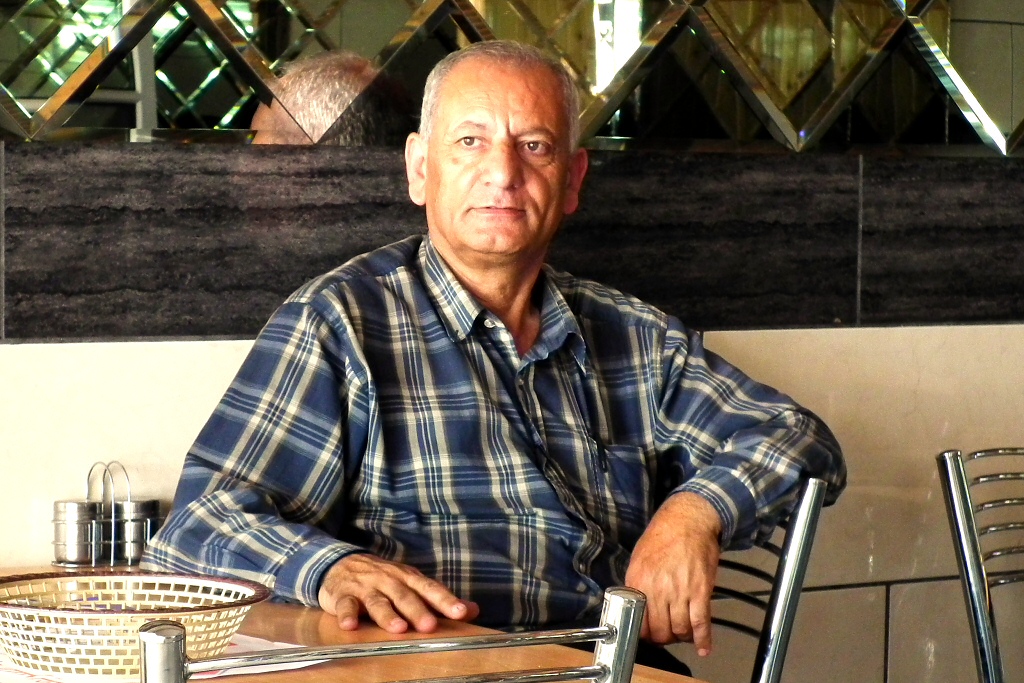
Jack is not a complainer, but he is in a sorry state. One year ago he had a major accident at work, fracturing his skull, haemorrhaging his brain and breaking some ribs. Then his wife, who had suffered MS, had died. Understandably, he had plummeted. His capacity to work is now much reduced, though he carries on all the same. He’s 52 and worn out. He works as a security guard for UNRWA, and he also clears out old wells and builds walls for a living. His spare-time obsession is billiards – his friends come round to play. He’s a real character – altruistic, humorous, maverick, but nowadays much faded. I cannot tell whether this is a low patch of life, or whether he’s on his way to dying. Bless him.
But he doesn’t moan. In fact, we started up a really good conversation, but it was still about his difficulties. He talked about how, at the bottom of some wells – many of them centuries old, some millennia old – there is no air and he has sometimes nearly suffocated. In a few others there are underground toxic flows of petrol or sewage, which he refuses to work with. At his work at UNRWA a few days ago, he was caught sleeping – not a good thing for a security guard – and given a warning. But they seem to like him too.
Jack, Catholic wheelchair smuggler, in happier days
But then he started up telling his stories of former days. There was one time he took his wife to an Israeli hospital without having a permit. He managed to get her in by a combination of charm, bluster and play-acting and then, having sat with her for hours, made his way home. But in the lift he had a heart attack – he was found lying there by a doctor, who rushed him to a ward and saved him. When Jack came to, the doctor came to visit him and simply said, with a wry smile, “Next time, get a permit if you’re going to have a heart attack, won’t you?” The doctor fixed him a lift to a checkpoint, to get back home. You do indeed get remarkable acts of compassion in this strangely conflicted country.
Jack’s son came in, looking really annoyed – fuming, in fact. I understood he had had an argument with his sister in his grandmother’s house next door. He’s 21 and quite a special young guy – plays Liszt and Chopin on the piano and works with computer hardware – but he had recently flunked his mathematics at college and, for reasons I couldn’t quite fathom, could not re-take the exam. Which meant he couldn’t go to university, and they couldn’t afford it anyway. So he was in a state.
He sat there listening – his English is good – and then he perked up when he told me about the free trip he had had with the Salesian Brothers (a Catholic order) to see the Pope in Spain, visiting Italy on the way. He was selected from a large crowd of applicants and he was away for three weeks. He’s a Sagittarian, our Shukry, and travelling the world is what he would love to do – but he’s imprisoned behind walls instead, living in a world-famous city, Bethlehem, that’s strangely isolated. If I could wave a magic wand I’d love to fix him three years at the Royal College of Music in London. He deserves it, and his frustration at getting nowhere in life was probably the underlying cause of his argument with his sister.
Jack was falling asleep. The drugs the doctor had given him to deal with the after-effects of his brain haemorrhage last year make him drowsy. I told him to get to bed instead of forcing himself to stay awake. “Yes, doctor”, he replied, and we parted company. I made my way out, walking back through the narrow stone streets of the Old Town to Manger Square. Another shopkeeper tried waylaying me but, by this time, I was tired and I didn’t want tea. I wanted a taxi home.
But even then, the taxi-driver, whom I knew from previous years, had a tale to tell. One of his children had died – I think about a month ago. Of what, I don’t know, because the word he gave me was in Arabic. In limited English he said he had not had enough money for the hospital. I could tell by the tone of his voice he was cut up about it, probably feeling like a failed father.
When we got to the school at Al Khader, I asked him how much he wanted for the trip. Thirty, he said – the evening rate (usually it’s twenty shekels). I only had 25 in change, and otherwise only a 200 shekel note (£40), which he couldn’t change. So I dug around in my bag, leafing through my carefully-stashed collection of Euros, Swiss Francs, Pounds, Kronor and Dinars to find him a Jordanian ten dinar note. He smiled. This was worth 50 shekels. “God bless you, Mister Balden. I like you. Thanks God. Ma’assalam.” The only trouble is, I’m not a banker or an oil sheikh, but it was worth it – even a bit of money can raise the spirits sometimes.
Sometimes I wonder what good I bring by being here. It’s as if the mountain of life-obstacles people experience in this place is too large for someone like me to make a difference. But then, as the Dalai Lama is quoted to have said: “If you think you’re too small to make a difference, try spending a night in a room with a mosquito”.
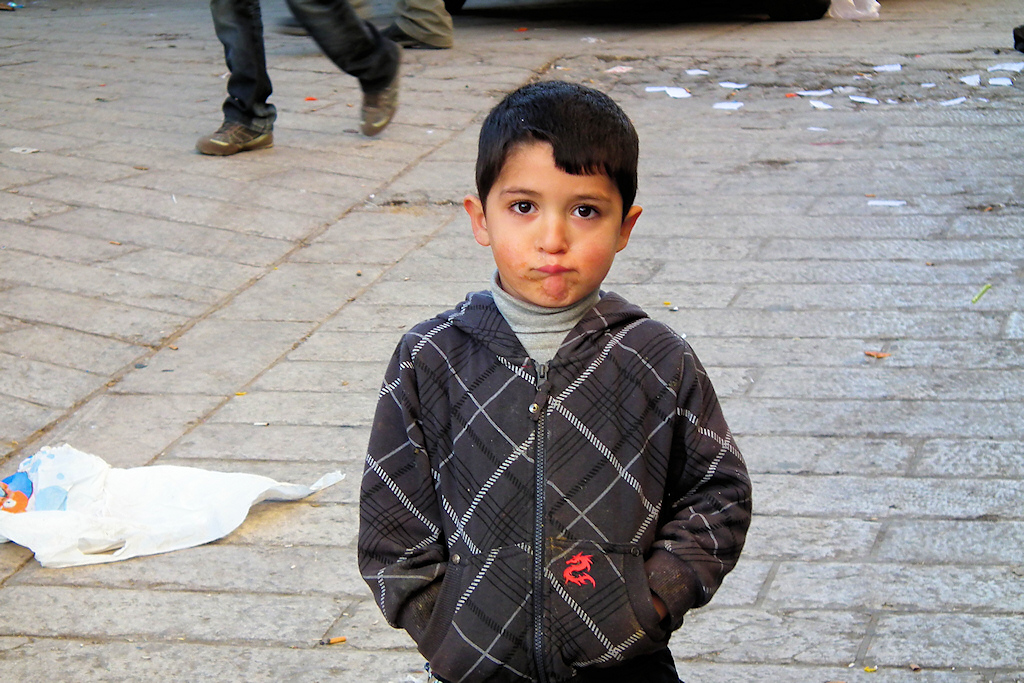
This young chap is now around 20 – as he’s grown up life has got worse, and I find myself wondering how he’s dealing with it.
It’s funny. I’ve always had a strange allergy to Christmas. In recent weeks I’ve been looking into this issue. What is bizarre is that I have lived in the Baltic region – the source of Father Christmas and sleighbells – and also in Bethlehem – the source of the Christ-is-born part of the package. So I’ve lived in the source-places of Christmas but I’m not particularly into it. Well, we all have our weird pathologies.
I have fond memories of both places – of genuine sleighbells (except on horses pulling sledges through the snow-bedecked forest), and of crowds of the devout in Manger Square, Bethlehem, during the three Christmases they have (Catholic, Orthodox and Armenian) at roughly two-week intervals. When I was in Bethlehem one Christmas I wrote a blog about it all. The town customarily welcomes 100,000 visitors for the Christmas Pilgrimage, and often it’s utter madness in town. It’s not happening this year: Palestinians are really downhearted, in no mood for celebrating the birth of a holy child, or celebrating anything.
I’ve asked myself why I have this Yuletide allergic reaction. In my case, part of the answer is Asperger’s Syndrome – ‘Wrong Planet Syndrome’. It’s an inherent feeling of outsideness, and it brings both benefits and problems. It’s a bit like the day you land in a foreign country: you understand nothing of the language and you experience the funky quirks of that country with the eye of an outsider – like the smelly toilets in Austria, the crooked telegraph poles in USA, or the way that Australian wildlife is busily noisy in the night and quiet during the day, or the sheer colourful intensity and olfactory richness of India, or the foot-washing places outside mosques in Jordan.
Another factor was the Christmases we had in our rather dysfunctional family. I couldn’t stand the pressure to ‘behave myself’ and to eat food I didn’t really like. Things got more interesting when I was around age eleven, when my parents started inviting three or four foreign students from the School of Tropical Medicine in Liverpool to our house for Christmas Day. Suddenly I was meeting people from Uganda, India, Hong Kong, Egypt and Barbados. But even then I was frustrated because we had to enact the Christmas rituals and suffer the stomachic consequences instead of getting into far more interesting things… and meanwhile my mother worked her socks off, not enjoying Christmas at all, and getting annoyed with my father, my brother or me for reasons I never fully understood.
I’d stand there thinking ‘Why can’t we make this easier and have a good time together without all this fuss and bother?‘. But relentlessly, each year, it had to be done. I never quite figured out why. So perhaps that’s a cause of my allergy.
In Bethlehem, as a lifelong vegetarian, it was always a bit difficult passing the meat market – another rich olfactory experience. I turned vegetarian long ago in 1971 and, for fortyish years, people would regard folks like me as strange and awkward, missing something important in life. In Palestine I got away with it by saying it was part of my religion – and that’s something they easily accept and oblige. However, to a vegetarian, being vegetarian is a perfectly logical and sound way of behaving and conducting one’s life. Being an Aspie is rather like that – you’re regarded as strange, abnormal and in need of correction, while from your own minority viewpoint the world around you is incomprehensible and crazy.
An Indonesian Christian rock band, Manger Square, Bethlehem
Yet Aspergers is not a programming error – it’s a different operating system. I believe it’s not really a ‘spectrum’ issue either – to me, that’s a neurotypical excuse for not really understanding what’s going on. The way I see it, you’re either an Aspie or you aren’t, since this concerns operating systems, and the spectrum bit relates to an Aspie’s capacity to adjust, or not, to the world around – what’s called the ‘Aspie mask’. How well we adjust depends a lot on how we were brought up – whether we were encouraged to grow into being ourselves or whether we had to conform to imposed behaviours that weren’t our own. That adjustment factor is what gives the appearance of a continuous ‘autistic spectrum’.
It seems that the proportion of Aspies, Autistics, ADHDs and others in society is increasing, and this is an evolutionary change for humanity. It’s the direction the world is heading in and it’s happening for a reason. It’s not a problem, and Aspies and Auties generally aren’t ill or malfunctioning. Actually, there is cause for us to feel sympathy for ordinary, neurotypical people and the templated, frameworked world they live in.
It has a fascinating side to it, inasmuch as, not seeing life in the same way as most other people, your perceptions are inherently out-of-the-box. So it means that you can come up with solutions that seem mad to some and brilliant to others – depending largely on whether their primary optic looks forwards or backwards. It also has a problematic side because it’s then a matter of whether it’s possible for that perspective to be expressed and accepted in society, for our strengths to be taken up and valued. This is slowly changing as society notes a growing variety of interesting public figures with this ‘condition’.
This was my problem. At Christmas, it was the implicit social requirement to behave in certain prescriptive ways, irrespective of how I felt inside myself, and the indulgence, waste and pretence of the relentlessly rolling bulldozer of Christmas behaviours. It grated for me and still does, and my own Xmas-avoidance can grate for other people.
In the 1980s, when I was in my thirties, I decided to clarify things, come out with it and just stop doing Christmas. If I was unclear I’d get drawn back into it, so I got clear and became ‘antisocial’ instead. In the later 1980s I started doing non-Christmas retreats for about ten people in the mountains of Snowdonia, which were fully booked. There would be no Xmas rigmarole, no presents, no special food or boozing, and we’d have silence and personal time up to 2pm each day and then hanging out together after that. The people who came to the retreats would rest, recharge and have some genuine human togetherness, without all the ritual. We had a great time!
Even though I’ve played a significant part in encouraging ceremony and ritual in Glastonbury, in the camps movement and elsewhere, and I’ve designed and led a good number of ceremonies myself, I’m not really into ceremony and ritual very much. I prefer to act spontaneously, picking up on and acting out the drama of the moment without making plans or imposing structures. I think this arises from a psychic sense of participating in a much broader and deeper reality-landscape and dialogue than many non-psychics perceive. If you’re in the right inner state, the spirits of the four directions will come and be there with you without needing much invitation. Like perceptive humans, they get a sense of where the action is and they go there.
I used to have problems when attending funerals. The vicar would be standing there leading the funeral service, while the hovering soul, looking for someone receptive, would find me sitting there in the pews. In some cases they would want me to lead the service, since I would be able more properly to speak on their behalf. But this was not to be, and I had to tell them so, secretly in my thoughts – the formalities had to be adhered to during such a solemn occasion.
The dead and the beings of the otherworlds run their own realities in parallel to ours, and the objective in ceremony is to bring those worlds closer. However, a direct psychic connection renders formalised ceremony less necessary – the action happens in ‘deep thought’. Formalised ceremony can indeed truly entrance people, enacting something that genuinely helps the interaction between worlds but, in my judgement, many ceremonies don’t do this as much as they could. The soul-quality of it can be obscured by the script. While many participants might wish to believe the gods are present, only sometimes do they seem to really feel it in their hearts and through their antennae. So there can be an element of pious game-playing to it. I hope I don’t offend by saying that. One of the things I’ve had to learn is how to say awkward things in an acceptable way – it took until my mid-thirties – and I’m not sure whether I’ve succeeded in that.
So, at funerals I have run, I asked people to address the departed soul directly, not as him or her but as you – since that soul was actually there (well, most times – there can be exceptions). It can be quite upsetting to someone who has just died to hear yourself being talked about and ignored by old friends and family, as if you no longer exist. I’d invite people to participate in a talking-stick process, each giving a short anecdote of their interaction with the deceasing person, addressing them personally as you – we were talking to that person about their life, and this is an important life-review process to help a departing soul understand nuances of their life that they’d perhaps never seen before. People were really moved by this. But I haven’t noticed such a method being widely adopted.
Bethlehem. But do they need to import north European pagan imagery such as sleighbells? Most Arabs don’t even understand what a sleigh is.
Winter Solstice and Christmas are important times for connecting with and reflecting on ancestry, origins, custom and tradition, but their importance lies not so much in ritual observance or cringeing Christmas habits as it lies in shared feeling and togetherness. It’s a time of social love and mutual support. The past is not important in itself, except inasmuch as it has some relevance to the present as a stabilising though not as a constraining factor.
There’s something wonderful about Christmas – the gathering of clans, the giving of gifts and the feasting. But for much of human history there has been a different context to these: today, in affluent societies, the feasting isn’t really necessary or good for us, and we already mostly have what we need so gifts have acquired hyper-consumption undertones, and while the gathering of families and friends can be wonderful, it can also be mixed in atmosphere, landing up with the TV, alcohol and niggly narrow-mindedness controlling the occasion.
Over the years I’ve found that, before Christmas, I get a slightly humbug, silent-to-disapproving response from many people when I tell them I’m not interested in it. Then after Christmas I’m told I’m lucky, or even envied. Most strange. We live in a very schizoid world. Some years, such as this year, with the devastation of Gaza, or back in 2004 with the Tsunami, the contradictions get quite stark, with people hungry in one place and over-filled in another, and both having a hard time over it. Sorry, but this doesn’t strike me as a good way to design the world of the future.
Anyway, that’s just me – though perhaps I’m articulating something for a few others too. Plenty of people are alone or lonely at Christmas. I am happy for those who are happy celebrating Christmas – it’s good for society to do things like this. And also I think about people who are unhappy about it, either because they’re left out or because they feel obliged to play along with something they don’t really feel right about. Perhaps Christmas needs a redesign to fit the reality of our current time. Less of the consumption, profiteering and excess, and more of the human aspect of things – the peace and the goodwill.
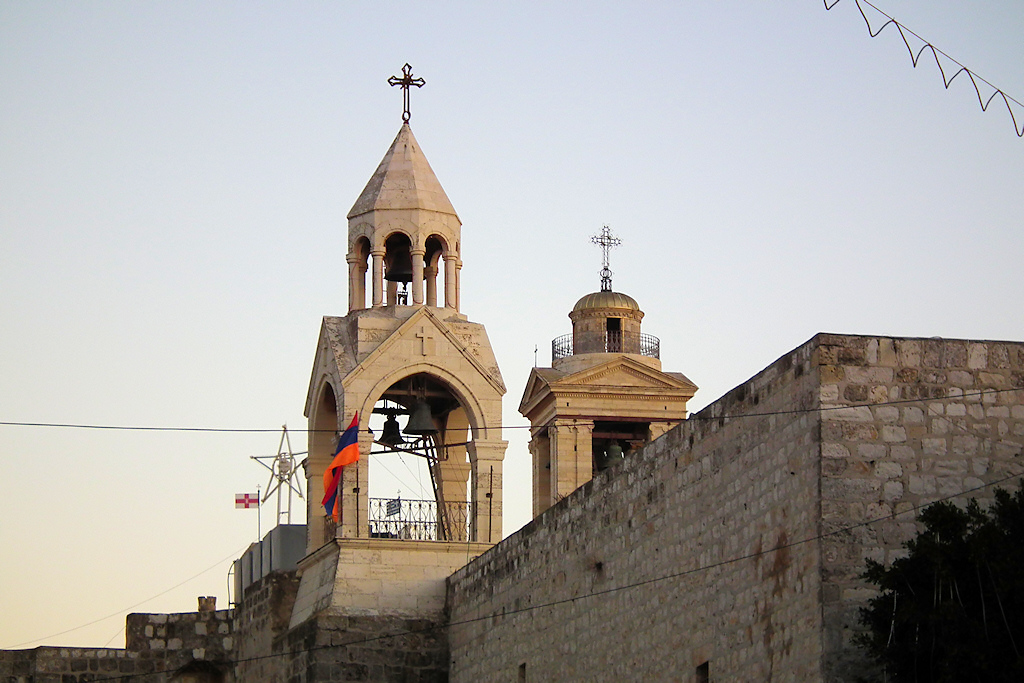
The Church of the Nativity (on the site of an Apollo temple and a Canaanite Goddess temple)
This is important. On the run-up to Christmas, one issue that has been bugging me is that I’m getting too many requests for help from people in many places and situations around the world, and it’s getting to be too much. Human need on Planet Earth is rising. My own sense of peace and goodwill has been under test. I’m currently working on three missions and I have the capacity for one. I’m having to remind people not to depend too much on me, because one day they won’t get an answer – I’ll be incapacitated or dead. I can’t find people to take on these people and their needs for help, all of which are genuine and legitimate. So that presents a problem. They need to get sorted out and back on their feet, and it’s good for us, for our souls, to take on karma-yogic responsibilities such as these. Well, that’s what I have found, at least.
So I’ve been experiencing compassion fatigue. Too many people asking for help. I have to remind them I am not a public-service help agency – I’m an old crock running on three cylinders. This fatigue has been accentuated by a need to re-focus on my own life – after all, living with cancer is a wee bit challenging – and on keeping my own head above water. If I don’t do this, I might well have a shorter life, meaning that I won’t be here any more for these people to contact. But then, to be ruthlessly honest, perhaps I need them as much as they need me.
But then, after I pop my clogs I’ll be Upstairs, accessible at least to those who attune their inner devices sufficiently and sign in to the dialogue. It’s certainly possible for me to tap on the top of people’s heads, or to walk into one of their dreams but, even then, it’s a toss-up whether they will notice or respond.
If you see things from the viewpoint of the ancestors, it’s difficult for them when the majority of people disregard them, or think of them as fantasy, as imaginary or even hauntingly disturbing. Or people shut off their receptivity by ‘just’ having another drink, or rushing off to spend money in shopping malls and bowling alleys, or arguing with each other over unresolved issues or trivialities. It can be frustrating being an ancestor in modern times, especially if there’s some wisdom to impart during moments of Christmastide reflection. Wisdoms such as…
Sometimes the young are wiser than the old. Sometimes adversity is really helpful. Or no matter how close you get to someone, there can still be light-years between you. Or that many hands make light work. Or that you can have the world’s greatest army but you still don’t win your wars. Or that the people who are regarded as winners are often very alone, even when they’re popular.
So I spent Christmas Day with a friend I met in 2022 who seems like an old friend already – Brian Abbot from Devon (he of the Invisible Opera Company of Tibet). Two aged hippies having a deep dialogue over all that has changed and all that has not changed, in our own lives, in the wider world and in the cosmos. One an author and the other a musician, both of us having started on our spirit-paths by consorting with Lucy in the Sky with Diamonds, in her blotter and microdot format, fiftysomething years ago in another millennium. He cooked a nut roast.
That was our Christmas. The wind blew, the rain came down, the woodstove burned bright with aromatic birchwood, and no animals died to feed us with Christmas dinner. All was well down’ere in West Penwith, at the end of the world – well, the end of the small British part of our world. And the Atlantic rollers crashed against the rocks on the coast with not a single care for human beliefs such as Christmas. As for Jesus, he was in Khan Younis, not Bethlehem, busy ministering to people in need. Good on him – we need a few more people like him around.
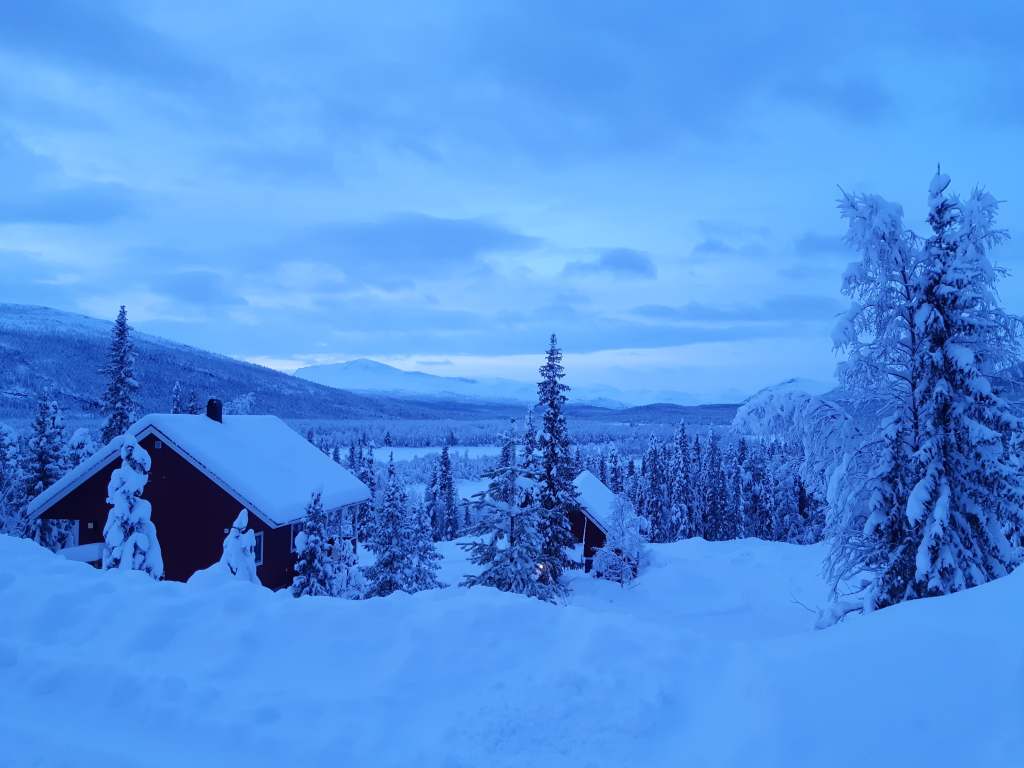
This is not a christmas card. This is Kvikkjokk in the north of Sweden, north of the polar circle, last year. It’s where my daughter Maya lives. It was -30C there last night.
There’s one robin that comes from the thicket above my cabin, and another who lives in the brambles down below the barn.
Problem is, being male robins, and with breeding season coming, they’re doing their territoriality trip – much to the consternation of the tits and the blackie, who also want to get to the feeder just outside my door.
When you spend much of your time alone, issues like this do matter! But it’s a welcome diversion too because, as you might imagine, my thumbs haven’t exactly been twiddling very much recently, and I’ll welcome an off-duty break one day.
It hasn’t snowed here in Penwith, though it went sub-zero and icy in the last few nights. Stuck out in the Atlantic and bathed in water that not too long ago passed Miami Beach, we’ve been about 5 degrees warmer than most of Britain. But then, though Brits love to complain, whatever the weather, up where my daughter Maya lives, north of the polar circle in northern Sweden, it was -30C last night – and the sun won’t rise until mid-January. Welcome to Planet Earth, dear friends – this is what you get on this world, and this is what you chose when you decided to come here.
I get cold feet. I’ve got this weird thing called Peripheral Neuropathy – a side-effect of chemo drugs where your nerve-endings die off. So I can feel the inner feelings in my feet but not the outer ones – and I never knew there was a difference until the Good Lord (or whoever) gave me cancer. This also means I don’t feel the cold in my feet very much – which goes to show how, in life, you win some and you lose some, and that’s the deal. I still have warm double socks on though.
An Indonesian Christian rock band in Bethlehem
One of the narratives of my life has been about dealing with paradox. My mother did love and care for me but she didn’t have the time and presence to mother me in the way I needed – that kind of thing. But that’s alright: it gave me some mother patterns to work with. Or this: my Tibetan name means ‘radiant merit’, my Arabic name ‘servant of the light’ and my Brahmin name is god of the sun, but there’s a shady side to me too, who gets involved in gritty, underworldy, heavy stuff. I’ve been exposing this side of me in the last month, with the strange thriller I’ve found myself in.
It goes to show, I’m not a holyholy meditation teacher at all, but a lawbreaking aged hippy charlatan who does nasty things, corrupts dishy young ladies, leads people astray and ought to be locked up forthwith – a danger to civilised society. Be warned.
I’ve been breaking the law recently, paying bribes. In West Africa, if you don’t pay enablement payments, nothing gets done. However, as my late senior barrister friend Keith used to say, in his endearingly bombastic Leo kind of way, “I, dear boy, am a purveyor of the Law of Man, but you, sir, are a purveyor of the Law of God”. Well, that’s a bit over the top, but there’s truth in it too, and sometimes divine will does need to prevail, whatever anyone thinks. So I’ve paid some bribes because, actually, it’s usually just to pay the guy’s phone bill or taxi fare so that he can do what you’re asking for and perhaps take a few bob home to his missus.
Well, if they want to arrest me for that, I’m over here. It’s a professional expense, and not the least of the sins I’ve committed. I’ve been a traitor, consorted with terrorists, smuggled tofu though Israeli checkpoints (they think it’s Semtex), taken on false guises and a few other things I’d better not mention.
But on the other hand, bad as I am, my life-saving stats measure well against any doctor or paramedic, and I’ve had the pleasure of uplifting thousands of people, and many of the bad things I once did, or decidedly didn’t do, are now, a few decades later, strangely approved of. It took a while. Some people think I’m brave, though my rather naive Aspie response is simply, ‘But why is that unusual?’.
Manger Square, Bethlehem, full of people
I have another weird Aspie thing too. I have an aversion to Christmas. I don’t do it. I’ve always felt unhappy feeling obligated to be happy and congenial when, at the time, I’m feeling contemplative and quiet. So I have a no-compromise approach that, before Xmas, is frowned on and, after Xmas, is envied.
On Xmas Day, if the weather allows, I’ll be out on the moors or the cliffs with a flask and a pie, attending to the top of my head and a few related matters, and if the weather is bad I’ll be huddled round the woodstove, propped in my chair or inner journeying in bed, busy not drinking sherry. Unless I find another person who would delight in an utter non-Xmas with me, I’ll be on my own, and that’ll be alright. You might wonder why.
Well, it’s a time for wrapping up the past and looking toward the future, and I have rather a lot of both at present. That’s solstice, the turning of a tide.
But it’s also a time when, rarely, the Christian and Westernised elements in the world suddenly get excited about peace and goodwill for a day or two. This is really good. My only reservation is that it suddenly ends around lunchtime on Xmas Day, when everyone starts blotting themselves out with food and booze, only to regret it afterwards.
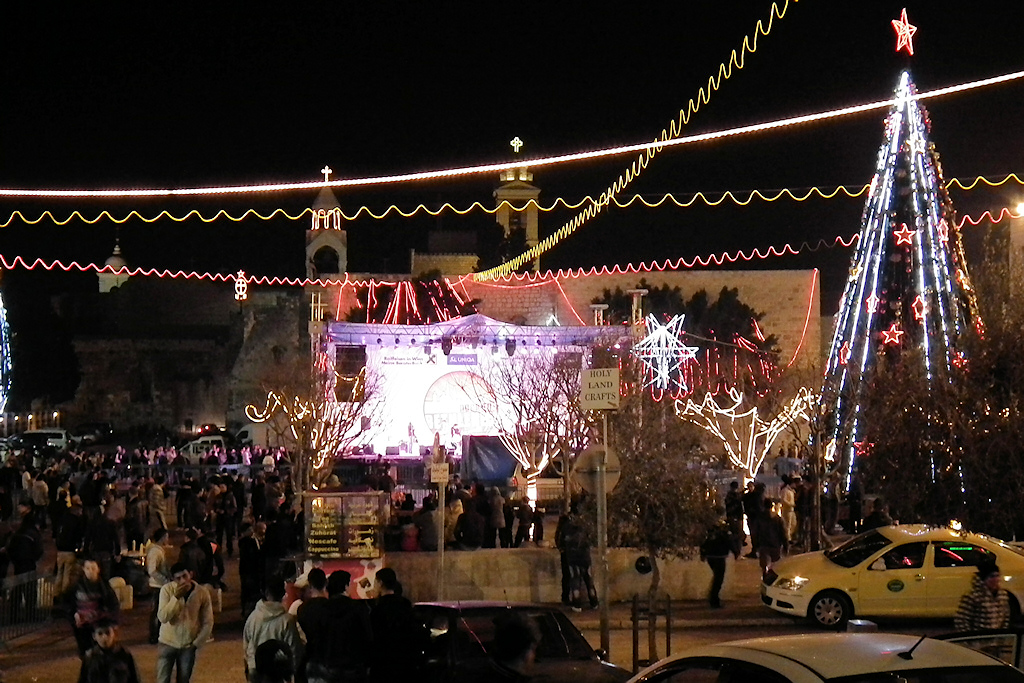
Manger Square, Bethlehem, Palestine, at Christmas
Nevertheless, as a guerrilla planet-fixer with an esoteric style, I find it’s worth scooping up some of this goodwill for good use. After all, there are at least a billion people on Earth who really need some peace and goodwill to be shoved their way right now. If not, truth be told, the whole eight billion of us.
So I spend my solstice-to-Xmas doing consciousness work. It’s secret – don’t tell anyone. It’s a good time for doing some gentle infiltration of the collective psyche, to strengthen that thought: goodwill. If you’re on your own this Christmas, then, wherever you are, stick up your antennae and see whether you can find me in that ‘reality-field’ and come join me. Try 11am and 2pm GMT, Xmas Day.
I’m always there on Sunday evenings at 7pm GMT too, for half an hour.
Ten years ago I was in Bethlehem at Christmas. The slightly sad thing is that Christian numbers for the Christmas Pilgrimage are much diminished nowadays, so Muslims make up the numbers – Palestinians do appreciate Bethlehem’s global name-recognition in such a forgotten land, and Jesus is also one of the prophets of Islam.
The Catholic Xmas is a bit like ours in NW Europe, with a lot of the jingle-jangle, and big concerts in Manger Square with Christian singers and bands from Germany, Indonesia and Nigeria, and a few Papal delegates thrown in. And why on earth do they import Father Christmas to Bethlehem, already replete with Christ Mass primacy, when most Palestinians have no idea where Estonia is or what slieghbells are?
Then comes the Orthodox Xmas, which is a bit more sedate, very ornate and quite delightful to a jaded old heathen like me. The chanting is done with deep faith and mystique, and the archangels and cherubim really do seem to hover around.
Then in mid-January comes the Armenian Xmas, which actually, if I were Christian, is the kind of Christmas I’d prefer – ruminative and richly calm. Either way, they’re all resplendent with candles, incense, chant and reverence – that’s very different to the mosques, where there’s nearly no ceremony or pizazz, just quiet prayer. They both have their virtues, but give me an ocean clifftop or a desert outcrop anyday, and I’ll be happy.
It looks like I’ll still be on duty over Christmas, monitoring the West Africa situation daily. Here’s the latest news from there.
Phyllis, now three, some time ago
Phyllis, the child, is happy and in good shape. She underwent an amazing turnaround last week, going from fever and coughing blood to wanting an ice cream in two days flat. I think you lot, with your prayers, played a key part in that. She is now staying with Dr Isaac and his family. Phyllis seems to be a great kid, easy to have around, and everyone loves her. I’m so happy about that. She’s special, that one.
Felicia… well, she’s improving, but we hit a setback two days ago. She has been reviving, and three days ago we moved her out of hospital into accommodation near the doctor and his wife. She was awake and becoming able to function, but she fell over, and it was bad. She needed two blood transfusions, a drip and medication. I’ve managed to finance that. So, it’s tenuous with her at present.
Those of you who have been giving your prayers, healing and positive thoughts to Felicia… may I ask for another round? Please hold her and raise her up. She has brain injuries from the ‘accident’ two weeks ago (they were rammed, actually). We think she’ll be alright, and she’s in good care, though she isn’t out of danger yet.
I want to put in a word for Dr Isaac and his partner Millicent and their children. They have taken in Felicia and Phyllis. They live simply and have their own family concerns, but they care a lot, and they’re definitely not in it for the money.
One of the greatest benefits I’ve had from my humanitarian work has been meeting simple, good-hearted folk like these who are the real saviours of our planet. They just get on with it and hold the world up. They do so much of the mopping up of the world’s mess.
Here’s Dr Isaac
The people I’m involved with in West Africa, and also my handler with the fraud investigation company, are all good and remarkable people. In this business, you develop ways of finding out who you can and cannot trust, and everyone depends on each other, and there’s a certain implicit code of behaviour, and you bond closely with people you encounter when sharing intense situations with them.
The Syrian Orthodox church, Bethlehem, Palestine
In something like this, to use an old sexist term, it sorts out the men from the boys. The people who hang with you through thick and thin are often amazing people. Dr Isaac is like that. He lost his job for us (though I think he’ll get it back). He risked his and his family’s lives. He’s gone several extra miles. He’s a man of faith and a good doctor who deserves more than a one-room home for his family.
I’ve met many remarkable people, and he ranks high, a true server, a doctor of whom Hippocrates would be proud. We’ve known each other for three rather long weeks. God bless you, Isaac. People like you convince me that this world will survive. My daughters, son and grandchildren do that too.
I guess I’m a sucker for crisis situations because it brings out the best in many people, and I like working with them, and it brings out the best in me. I’m not good at normality, you see. I’ve always felt I’m there to help the helpers, the social healers and the frontline people, and it’s an area of deep late-life satisfaction now.
Here’s the Mosque of Omar on the other side of the square. Sensibly, when they invaded, the Muslims under Caliph Omar didn’t take over and convert the church. Bethlehem has had very good Christian-Muslim relations throughout history. I wonder why?
As an independent ‘freelance humanitarian’, for want of a better term, I’ve held to certain principles I feel are important such as: ‘don’t give a person a fish, but teach them how to fish’, and ‘teach a man and you teach a man, but teach a woman and you teach a generation’. There’s even William Blake’s statement: ‘the path of excess leads to the palace of wisdom’ – and war is excess to human need, in my judgement.
I feel also that, as an educated, white, male, privileged Brit whose ancestors built the empire and kept it going, and living through its downfall and seeing its very mixed outcomes, I have a bit of an urge to complete the job. I’m not a great believer in reparations, guilt or sorrow – I just like to get in there and do something to help people have a better life and rise to their full potential. To the extent I can.
People have asked who or what I work with. To my surprise, at present it’s for a big bank – though that’s not my style. One of my PodTalks, The Only Planet of Choosing, gives clues. I’ve worked with all sorts of people, but the bottom line for me is their humanity, and progressing humanity’s evolution. My focus has been community-building, conflicts and crises, and helping social leaders stay on the rails.
You have to have your wits about you. This is strange because, as an Aspie, I can be at times apparently naively open but it’s not exactly that – it’s because I sense people’s hidden motives and agendas, and I often get delayed-action clarity on what’s really happening. So I look blank for a while. Then it all comes. So I’m best working with others, inputting what I’m good at. Such as total attention, hyper-focus. When I’m on form, I’m brilliant, and when I’m not, I’m best back here in Cornwall, out of everyone’s way.
Which is where I am now, on the farm, and it’s a dark and rainy pre-solstice night, and the owls and crows are all tucked under their wings down in the woods and hiding from the feather-ruffly wind. Wherever you are, may all be well with you.
Don’t worry too much about your circumstances, even if they’re tough at present – look at your attitude, and be innovative. Find simple ways to be happy. We all get inner friction and pain, but these are things we can reduce, even if we can’t reduce the adversity. That’s what’ll get us all through.
The Church of the Nativity began as a goddess temple (hence the Virgin Mary came here), then a Greek Apollo temple, and only then did it become a Christian Church. The front entrance is really low and you have to duck to go through – this is to force Crusaders to dismount and it stopped their hunky stallions from entering the church. But the Israelis just roll bombs in. Interestingly, in Bethlehem, I don’t get a feeling of Jesus – it’s Mother Mary’s or Mariam’s town, and the matriarchs there definitely let you know it
Aisha and I went into Bethlehem. The town was crowded, mostly with Palestinians, Christian and Muslim, who come from around the West Bank, Gaza and in Israel, but also with a much larger number of foreigners than usual. Eventually 100,000 visitors hit Bethlehem by Christmas Eve, the largest turnout for at least a decade.
We went to the Nativity Church but it was packed with visitors. There are two halves to the church, Orthodox and Catholic, and the place was crowded mainly with Italians, flashing their cameras and forming long queues to visit the shrines. We didn’t stay long. I don’t think Jesus would have done so either – though I can’t really speak for him. I reflected on the strange fact that, whenever I come to this church, I seem to be brought here by Muslims.
Aisha, a British Muslim, had to go home to Ramallah where she lived, so we had hummus and falafel at a friend’s cafe and then trogged up through the Old Town to Bab-al-Sqaq where she caught the 21 bus to Jerusalem. She was trying out this route because, though it requires passing through two major checkpoints near Bethlehem and Ramallah, it’s shorter and cheaper than going along the circuitous Palestinian main route around Jerusalem, staying within the West Bank.
I walked back as darkness fell toward Manger Square, taking photos and chatting with people. The square was heaving by now, with people streaming in from all directions. I spent much of the time with an enterprising young coffee seller, Mahmoud, who places his big charcoal-fired coffee pot on a concrete pedestal and does a roaring trade, selling coffee for a shekel (20p). We have an ongoing dialogue, and he likes his pet Englishman – except that I don’t support Real Madrid, but no one is perfect. I somehow doubt that Jesus supports Real Madrid either, or Barcelona for that matter, and told him so. “Ah, but Mohammed the Prophet supports Madrid!”, he joked.
Indonesian evangelism, no less
Soon a weird and very loud concert cranked up, by an Indonesian Christian rock band. The concert was sponsored by an Indonesian evangelical foundation. I heard the best rendering of the Lord’s Prayer that I have ever heard, quite tastefully done. One of them gave a lovely rap about harmony between Christians and Muslims, and everyone cheered, even though there was an embarrassing moment when he asked Christians, then Muslims, to stick up their hands, and the Muslims outnumbered the Christians by three to one – oops!
Before long I had had enough of harking to herald angels, soon degenerating into Santa and sleighbell songs, even though the music was rocking and rolling with vigour and aplomb, Indonesian style. Do Indonesians, or Palestinians for that matter, actually know what sleighbells are? I took refuge at my friend Alaa ad-Din’s shop, sitting people-watching as the endless crowds streamed down the narrow street. An old taxi-driver I knew drove past and I asked him to return in twenty minutes to pick me up.
I’ve never been one for Christmas – usually I go quiet and into retreat. This year I have felt more sociable about it but, suddenly, I realised that Bethlehem was becoming a nightmare. Why, in this source-point of the Christmas tradition, do they have to import all the Santa razzmatazz, all the commercial crap that has so ruined the spirit of Christmas, burying peace and goodwill under a mountain of consumptive blindness and artifice? After all, this is Bethlehem, the home of Christmas – it doesn’t need to import anything, and in fact it should by rights set the tone. When I had mentioned this to Aisha, she had said I was welcome to come to Ramallah to escape. Suddenly I knew I was going to Ramallah tomorrow, on Christmas Eve.
The taximan never came. After an hour of waiting – allowing for Palestine Inshallah Time – I waved goodbye to my friends at the shop, who were duly worried that I wasn’t enjoying myself, but I was just fine. In truth, if they stopped deluding themselves, most people in these crowds didn’t seem too happy to me either. But then, as someone aptly wrote recently, if you live inside a myth it looks like reality – though the gentleman in question was referring to the growth-economics of recent decades. Yet this rendering of Christmas, in my judgement, has more to do with growth-economics than Jesus, peace and goodwill. Or perhaps I’m just being Scrooge-like and grumpy, or becoming jaded?
It took a while to find a taxi, and then we had to weave around backstreets dodging the traffic-jams. Looking out at the crowds, it’s rather tragic that the majority of people here were Muslims. This isn’t a problem – it’s a blessing, saving the Christmas celebrations from moribund decline. What’s sad is that the Christian presence is so thin. Most of Palestine’s Christians have emigrated.
I had an image of Jesus coming down the street ranting at the desecration of his memory, vaulting onto the stage in Manger Square to unplug the amps and tell the privileged visitors in their allocated seats in front of the stage to yield them up to the poor and needy. Or perhaps just to go home and get on with the job of building Heaven on Earth and acting on His teachings. I’m sure there are spiritual moments for many people here, when they contemplate the tender meaning of the Christ Mass, of the shepherds who came up from Beit Sahour to see the newborn babe and of the Holy Mother and Child, but this… this is something else. I was glad to get out.
So, to all my dear readers, my apologies for omitting to give you a warm and toasty image of Christmas in Bethlehem! I’m sure it has its finer side, and it certainly puts this walled-in city on the world map, at least for a few days each year. It’s good to make a bit of a fuss about peace and goodwill, but why don’t we do this all year?
Ismael
Next day I pottered around the apartment tidying up and exercising my fingers on my computer keyboard, then I rang Ismael and left with him for the service-taxi station, to go to Ramallah. Ismael was a happy man today – his son Tareq had just been released early from jail, thanks to Hamas’ clever politics in exchanging a thousand Palestinian prisoners for one woe-begotten Israeli soldier, Gilad Shalit. This says something about Hamas’ strategy: they doggedly hold out for their principles without budging an inch, and this time it worked. Israel, which desperately believes Hamas is a bunch of terrorists, did the deal and paid the price. Ismael’s son was free.
Ismael had driven with his wife to the prison near Ramallah to meet him, but the Israelis kept everyone waiting until late into the night, to prevent an outburst of celebration and protest – though it hadn’t worked. There had been a near-riot outside the jail, and Ismael and his wife had beaten a retreat until things calmed down. Ismael is a respectable gentleman, by profession a surveyor but now redundant and a taxi-driver, and quite poor. But they found Tareq and brought him home at last. Their house had since then been busy for some days as people came by to congratulate the son and family, bringing gifts and partying. Released prisoners are heroes in Palestine. Tareq had been jailed for throwing stones at Israeli soldiers who were raiding Deheisheh refugee camp, themselves breaking the rules of the Oslo Accords.
Ismael is trying to get Tareq into Abu Dis university. But he’s worried because the jail term has delayed his son’s entry into university, meaning that one of his daughters has reached the age for university too. He can’t afford to pay for both of them. This is deeply vexing to him, because Palestinians value education very highly. A while ago I had given Ismael 400 shekels toward the 8,000 shekel (£1,600 or $2,000) fine he would have to pay for his son on release in about nine months’ time, except the Hamas deal had cut this short and saved the fine, so I told him to put it in Tareq’s self-help fund. He was so grateful, it was touching, and we both cried a few tears together.
Bethlehem was choked with traffic. The place was crawling with armed security men because Abu Mazen, the president, and Salam Fayyad, the prime minister, were on their way here to deliver annual Christmas speeches – a tradition started by Yasser Arafat. There were loads of big SUVs everywhere, the cars of privileged members of the PA hierarchy – people who have done well from Western and Gulf subsidies that support this nation. Unfortunately these subsidies support the hierarchy more than the nation. There’s no major crime in Palestine except for this.
Eventually we reached the service-taxi station. I bundled into a van and we were soon off, down through Beit Sahour and onto the main trunk road northwards. Most of the traffic was coming the other way – not least the armed motorcade of the president and prime minister, with flashing blue lights and a swarm of big motorbikes out in front and in the rear.
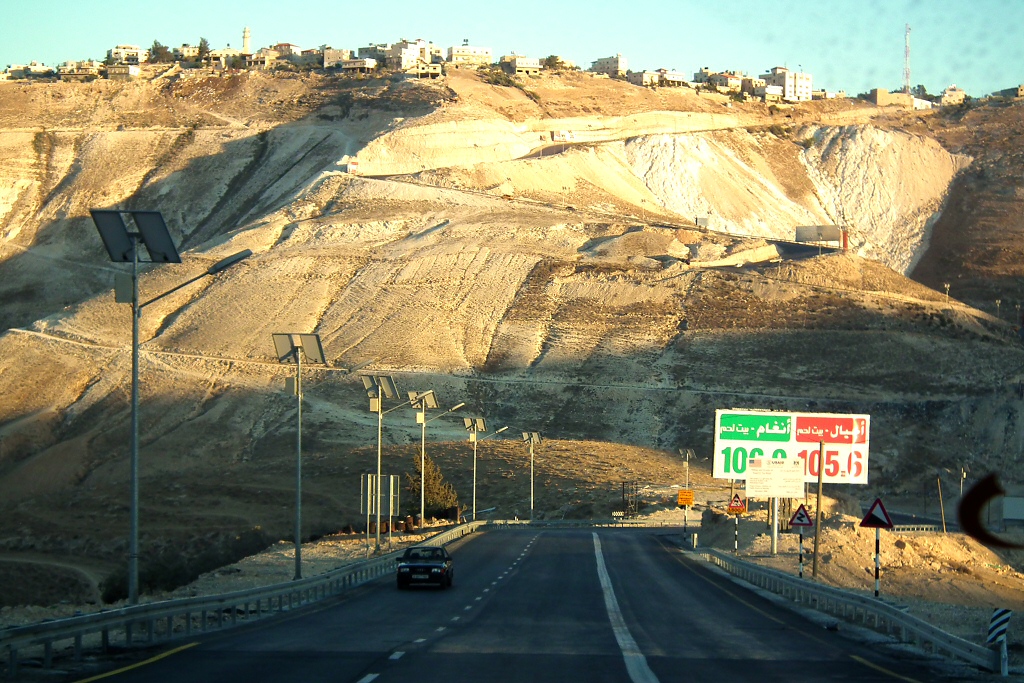
This is a trunk road not because of its quality – in British terms it’s a bumpy old ‘B’ road – but because it’s the only road from the southern to the northern West Bank, from Bethlehem to Ramallah, avoiding Israeli controls. Most Palestinians are not permitted to enter Israel proper or Jerusalem, which would be the shortest route – 25km instead of 70km – so they have to go round Jerusalem along this convoluted mountain route.
Palestine Route One
This road is dramatic, a tremendous ride. At first it weaves along the top of the limestone plateaux east and north of Bethlehem, where there’s a view down into a deep valley and then, on the other side, high up, the walled-off outskirts of East Jerusalem. This is vivid enough in itself, but then it suddenly plunges dramatically 1,000ft (300m) down a steep switchback into Wadi Nar, the Valley of Fire, where it changes from a winding old road into a new USAid-modernised dual carriageway heading north to Abu Dis and Al Azariyah, through more wild semi-desert mountain landscape, and winding tortuously through Wadi Nar until it eventually joins the Israeli east-west Route 1 from Jerusalem to the King Hussein Bridge and Jordan. This is a full-scale modern dual carriageway, financed in the 1990s by the Japanese government as a peace road linking Jerusalem and Amman – except peace never came. As far as I know the Japanese never asked for their money back.
We cannonaded down this road, past the Ma’ale Adumim Israeli settlement, perched on a hilltop to the right, then we turned left toward Ramallah. More dramatic landscape, and a few impoverished Bedouin shack-villages. This certainly is a memorable trip, this road. It weaves around hither and thither, and the service-taxi drivers do it at breakneck speed – mercifully they seem to be good drivers. Eventually we reached Ramallah – and it suddenly started raining! This was the first rain for over a month. It was tipping down. I waited to meet Aisha at Manara Circle, the centre of town – a funny bi-directional roundabout with a monument in the middle, dating back to British Mandate times. The British used to come here to get out of Jerusalem and enjoy themselves – rather like a hill-station in the Indian Raj.
Aisha took me to a Latin (Catholic) church for the Christ Mass. It’s the first time I’ve been to a church service for, er, well, must be over a decade, heathen that I am. The service was in Arabic and the church was packed. I floated off into another world, standing up and sitting down when required, looking as if I knew what I was doing. I had been in rather an altered, spaced-out state during the day, so it was rather nice to let myself drift along with the choral singing.
Again, I was taken to a church by a Muslim. I didn’t understand a word of the sermon, but the priest, dressed in white robes with lovely embroidery on it, spoke quite clearly and slowly – useful to listen to, picking up Arabic words I’m beginning to recognise. I hadn’t realised until now that Christians also use the term ‘Allah’ in Arabic. But then, he’s the One God, so why shouldn’t they? For your interest, Allah means ‘The God’ – it has a slightly different nuance to the Western personalisation of ‘God’ as a name, while the Arabic term is a noun.
Ramallah – where the foreign money is
We emerged from the church into the pouring rain, dodging torrents of water, and found a taxi to take us to the village outside town where Aisha and her husband Ahmed live. He’s a web-designer and film-maker, and we had lots to chatter about. They’re moving to England in a few months’ time to work and study (inshallah, if the British do the right thing with his visa, at a cost of £800). Ahmed likes the relatively high educational and intellectual standards of the English. The idea of living in London gives me a sinking feeling, but they’re excited about it. Perhaps I’m just a provincial country bumpkin with moss in my brains.
Next morning, Christmas Day, I sat writing my blog – I was falling behind – while Aisha went out and Ahmed updated websites. It was raining hard – not a day for sightseeing or footling around outside. It was a slow, do-nothing-much day. The calling to prayers at the local mosque was particularly tuneful – though Aisha later told me that, unlike in Bethlehem where it is sung by live singers and therefore quite variable in quality, this was pre-recorded by star muezzin from Mecca or Medina, and pumped out through sound systems paid for by Saudi sheikhs. Then we had a chat and a late lunch, and I bade them farewell to return to Bethlehem. I was still feeling rather wobbly, and wanted to get home to be in my own space.
At the service-taxi station I had to wait some time for the taxi to fill up – it has space for eight passengers. The driver thought I was German, but when I told him in German that I wasn’t, and came from Britaniyya, he didn’t understand, so I stuttered it in Arabic. He was fascinated when I stood outside smoking my pipe – around here, the only pipe-smokers are wizened old Bedouin out in the hills. Eventually people came and we started out.
It was still swilling down with rain and progress was slow. Palestinian roads aren’t built for handling rain, so there were massive pools and floods, and we had some great moments of aquaplaning. Heavy rain in a desert landscape is quite paradoxical. When eventually we reached the steep, winding switchback at the far end of Wadi Nar there was a big traffic jam. People had ground to a halt on the 1-in-3 hill and, the road being covered with a film of rubber and oil from the customarily hot weather, they couldn’t get up. Neither could they back down because of the traffic jam behind them. But Palestinians are good at crises, and it sorted itself out in due course.
When we reached Bethlehem the taxi-station was closed. Since it was still bucketing down the passengers nagged the driver to take them up toward Manger Square, which he duly did, and we tipped out into the monsoon, running everywhichway. By now I was not just wobbly and vulnerable but cold and wet and, being a thin pile of bones, I decided to run for the nearest shelter to ring Ismael, to ask him to come and rescue me. The nearest shelter was a coffee bar called – wait for it – Stars and Bucks, a Palestinian chain that has taken this name to dig Starbucks in the ribs for avoiding setting up in Palestine. Some global corporations (such as Coca Cola, Wall’s ice cream or Nestle) come to Palestine and others, such as Starbucks, don’t. So it looks like Starbucks has lost its chance for business in Palestine – though they probably don’t care.
Whatever, Stars and Bucks had a heater on and served a good cup of tea, and I waited for Ismael. The guys there interviewed me about what I am doing in Palestine: Palestinians are so interested in foreigners, especially the ones who stay a long time and return repeatedly. The usual questions came about my family, my wife (haha), with the customary expression of surprise when I said I had grandchildren (to them I look young), and the questions about my work, where I was staying, and then the riveted attention watching me lighting my pipe.
Bethlehem Old Town
Ismael arrived at last and off we went, weaving around the Old Town, slowing for the virulent speed-bumps, stopping at a shop to get a few provisions and then water-skiing back to Al Khader. I promised to come to visit his son soon. We waved goodbye. Ismael and I are getting like brothers of the soul – he looks my age but he’s ten years younger. I’ll miss him when I go back to Britain, since it’s so good having someone who thinks of me and rings me regularly to make sure I’m alright. He also knows that, as an old revolutionary and dissident who has had his own problems with police and authorities, I understand his son and I have a few survival secrets to share with him.
The apartment was quiet and cold but, once I’d had a bite to eat and a cuppa, I put my hot water bottle on my lap and wrapped a big blanket around myself, finished and uploaded my blog about Hebron, processed my latest photos, did a few e-mails, did my meditation and then staggered off to bed.
So much for Christmas 2011. I went back to Britain in late March 2012.

















 Notes from the Far Beyond
You must be logged in to post a comment.