Ruminating on the 2020s

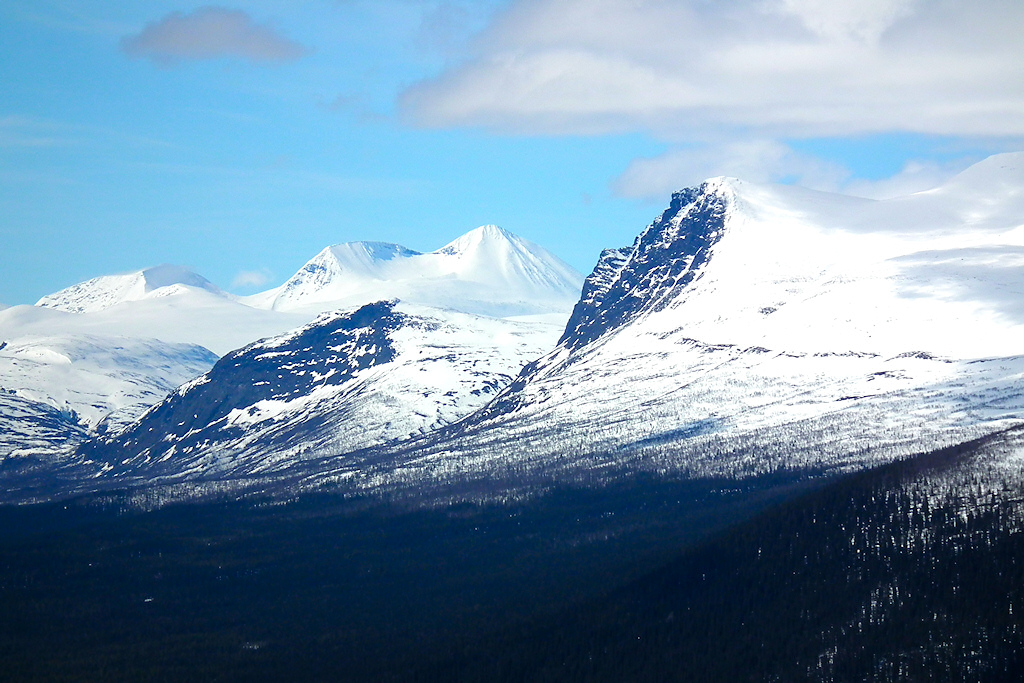
Padjelanta national park, Sapmi - Swedish Lappland
Padjelanta national park, Sapmi – Swedish Lappland

I’ve had good news. I talked on the phone to the haematologist at Treliske hospital in Truro (about 40 miles away) and she seems pleased with my results. Although the readings from blood tests are slowly rising – this is to be expected, but I could be worse than I am – the PET scan I had a couple of weeks ago, to see whether any further damage was being done, turned out well. So I do not need to go back on chemo right now. I’m glad, because I’m tired of getting poleaxed by medication and fatigue. I need to revive before the next round.

But that’s not what I want to write about.

As promised, here are my thoughts on the next ten years or so. There’s a combination of a historian, futurologist, astrologer and seasoned observer coming through here, and long hours in bed have meant a lot of time to ruminate on these things.

I think the 2020s are going to be both difficult and more encouraging than the 2010s. Covid is the beginning of a process, and there are more storms to come – that’s the difficult bit. It’s going to be an uphill grind. Or a different kind of grind than the one we had before.

Looking more longterm, this process started around 2008-12, when the overall balance of global trends tipped critically, and it has been ramping up over the last ten years: the world crisis is no longer a thing of the future but it’s now present and here, in all departments of life and coming at us in waves. We have entered the inevitable period of price-paying for the profligate lives we’ve led in the rich countries and the destructive aspects of the world system we’ve created. Some of us saw this coming way back in the 1960s, but the majority didn’t agree or want to look.

During the 2010s we needed to be given gritty, distressing challenges to get us engaged, to grind us down and prepare us for what happens next. It was in many ways a dispiriting decade, but a lot of good things bubbled underneath. Many revolutions failed, but many people were changed by them. Covid is in a way a climax of that phase and the beginning of the next one. It’s a punctuation point.

The issue is this: since the world has delayed action on necessary human and planetary issues, there’s a lot of catch-up to do, and a lot of damage has been done. We’ve lost fifty years, and things can’t wait. Events are taking over. This is no lnger a matter of opinion.

There’s a long way to go before we find the full range of solutions – it will take the whole 21st Century. To progress, we need to be accelerated into a process of change that will take us out of our comfort zones and confront us with hard facts. Humanity needs to get itself mobilised. Now it’s a time of consequences, imperatives and seeking solutions.

Though a few might think it’s the only option, an all-out catastrophe would not help. Catastrophes hurt, disable, stun and set people back, and they are not the best recipe for change. We need to make big choices and get behind them – even if we’re arm-twisted by events to do so. What’s needed is a deepening series of crises that tip us incrementally into change-processes, forcing us over a succession of thresholds and pushing us to get really real about our situation and its many details, nuances and implications.

It’s especially about human society. Without substantial changes in our group psychology and behaviour, we will not get through the century intact. This concerns cooperation and sharing, and it brings up collective emotional issues about identity, power, who decides, and how much we really care about nature and human nature. It concerns Us and Them.

So people across the world are variously cleaving into progressives and resisters, new tribes and old tribes, and this is the new politics. Ultimately, humanity has to realise it is one tribe, but this will come clear only when Ronald Reagan’s late-1980s Reykjavik Proposition comes true: humanity will unite when it realises it is not alone. But without humanity cooperating as one planetary race, there will be insufficient resolution of environmental issues, tech hazards and the wide range of potentially fatal issues that face us now.

So we’re being accelerated, and it is reasonable to expect further crises ahead, and particularly multiple crises happening at once, or cascading crises with proliferating implications – as Covid is with the social and economic issues it has precipitated. The urge to restore normality is an unconscious reaction to this acceleration, part of the process of letting go of the past. Normality will not be restored, no matter how many dollars and scientists you throw at it. But there are still options. It’s just that the new normal is going to keep changing.

The 2020s are likely to be very different from the 2010s. The shit will increasingly hit the fan. But something else has been bubbling up underneath to meet this and change the equation: a growing surge of new ideas, perspectives, attitudinal changes, technological advances and challenging situations that nevertheless prompt progress and positive developments – as in ‘necessity is the mother of invention’.

Astrologically, an interesting and rare configuration is approaching in the later 2020s for which my best description is ‘cultural florescence under duress’. This will not be easy because we’ll be battling with more crises. But the difference is that the tide will be flowing more strongly then, and this loosens things up. It allows creativity, innovation, new ways of seeing things and new reality-configurations. There is likely to be a battle of ideas, perspectives and loosening positions, and a generational change in which Millennials will be coming to power (and my own generation will be dying off).

One of the big questions will be, do the people exist for the system or does the system exist for the people? Questions of systemic control, the rights of the individual, the needs of the collective and the balance of the three.

This will not be the old workers-and-capitalists battles of the 20th Century: it will be between progressive people and ideas at all levels of society, and resisters, some of them indisposed to change, some victims of change, some of them vested interests, and many who are older, marginalised and disoriented. These too need to be considered, because this isn’t any more about my side or your side of the argument, it’s about the complete outcome of all arguments, for all people and in all areas of life.

So we have come to a need to rehumanise society. Another issue concerns social willingness to cooperate. If change is imposed, and if governments and those at the top of society fail to act in people’s overall benefit and society fails to come together to cooperate, then resistance, exceptionalism and non-cooperation will ensue, complicating things terribly – this issue has been tested in the Covid crisis.

So we’re likely to get an escalation of both problems and solutions, and we’ll be challenged to see when solutions are actually solutions. If we judge events on the basis of past norms, there will be a plethora of problems, but if we judge them on the basis of the possibilities they offer, they become a solution. Much hangs on this. In the Covid crisis, from which everyone is so anxious to escape, we have been given multiple solutions but we fail to see them – we choose to focus on the problem side, on what’s being lost. And yes, things are hard.

This year we have wobbled over a tipping point, toward rehumanising society and making the world more fit to live in. Millions of people are thinking deeply about their lives and about life itself. The rich world is at last starting to become aware of its consumption patterns, which need to reduce radically. And the developing world needs to find new ways of developing from those that have existed before.

Then there’s ‘mental health’, a term based on the presumption that conventional normality is good health. Chaos has broken out in people’s lives, and for many people it’s really hard work. Many, including me, have also had to face being very alone. But calling it a ‘mental health crisis’ avoids the main point.

We’re in a rather necessary spiritual crisis, affecting everyone in varying degrees and ways. For some, this has been really tough – the bottom has dropped out of their universe and many people are flailing. It’s all about facing our demons and fears and, as individuals, communities and societies, we all need to face them. Old values, expectations, judgements and preferences are becoming obsolete, and there’s a lot of grasping at straws, blame and escapology going on. This is a transitional inner growth crisis for many, a time of what disaster professionals call ‘epistemic insecurity’ – confusion over what and who to believe.

In the later 2020s, specifically around 2024-2028, we’re coming into an avalanche period, a torrent of events and issues – but I don’t think it will be as blocked and struggly as the 2010s were. There will be pain and also increasing relief – relief arising from a cumulative adjustment to and acceptance of what’s happening. But the pain often comes first and the relief tends to follow. We’re in the pain bit for now.

Conservative forces from the top to the bottom of society are beginning to realise that things are changing anyway – and this applies also to that part of ourselves that prefers our comfortable routines, habits and security. The part that wants to be the exception. The part that says, ‘I’m up for change as long as it doesn’t affect me’.

There’s a rule in geology: the erosive power of a river increases as the square of its volume. That is, when volume of flow increases three times, erosive power increases nine times. That’s what we’ll see in the 2020s: the erosive power of events. The flow and volume of change is increasing, and it’s eroding anything that gets in the way. Whether we like it or not, it’s coming at us.

But the good news is that a flood also clears out the channels and generates energy. The challenge for us all, for individuals, communities and nations, is to get used to living and operating in a far more tumultuous and challenging world.

What is the gift in that? It will make it easier to face the 2030s and 2040s. Because things are not going to slow down.

But there’s an extra issue here. Whenever the world fully accepts change, things will progress faster but it will still take time. Forests take half a century to grow. People need time to adjust and sort things out. Innovations need trialling. Cities take years to redesign. Soil takes time to reconstitute. This means that, even when the big decisions have been made, it will take decades to find out whether it will actually work. By the 2040s this could raise world neurosis levels to a peak – or it could bring a new kind of sanity. This is new territory – we’ve never done this before and we don’t know what will happen. So the decades following 2030ish could be a nail-biting period.

To put a time-perspective on all this, the two big dates of the 21st century are these: 2048 and 2065. The changes we’re in now are operating in a time-frame from 2012 to 2048ish. I won’t go into that now (my book Power Points in Time tells all), but it’s worth flagging up here.

The 2020s are part of the run-up to 2048 – astrologically a Uranus opposition Pluto. The conjunction, the beginning of the cycle, was in 1965-66, and the square, the growth-crisis, was in 2012ish. So 2048 is the climax of all that started in the 1960s. The 1960s were a time of dawning awareness that all was not well on our planet, and that we faced daunting times. Times that we now are in.

2065 I would call the beginning of the start of the future. The time of nail-biting might well be over, and we’ll know the facts of our situation – the crunch-time is likely to have been around 2048, followed by a rather shell-shocked post-crisis period following it, dealing with pressing realities and taking stock. By 2065 I would imagine that, whatever the state of the world, we’ll have a clearer sense of what comes next. It’s a Neptune square Pluto, the crunchpoint of a cycle starting in 1892.

So Covid has upset the apple-cart. The starting gun has been fired. And, to be honest, even though things are hard, do you really want normality restored? Do you really want to go back to the way things were before? It’s strange to say this, but in some respects, since cancer took over my life a year ago, it’s been coming clear that it’s the best thing that could happen to me. But I do also choose to see it that way – not just in my head but in my bones.

Well, that’s what I think anyway. Whether my prognoses resemble the reality to be, we shall see. None of us can presume to know the big answer. That’s quite amazing, really.

Some links:
www.possibilities2050.org – my free online report on the state of the world in 2050 (not astrological) – free online
https://www.penwithpress.co.uk/product/power-points-in-time/ – my book Power Points in Time, and how time passes
http://www.palden.co.uk/living/lit16-makinghistory.html – if you’re interested in astrological cycles in the 19th and 20th Centuries – free online
http://www.palden.co.uk/ephem/The Historical Ephemeris, for serious astrology and history wonks – free online
Still here, Amazingly

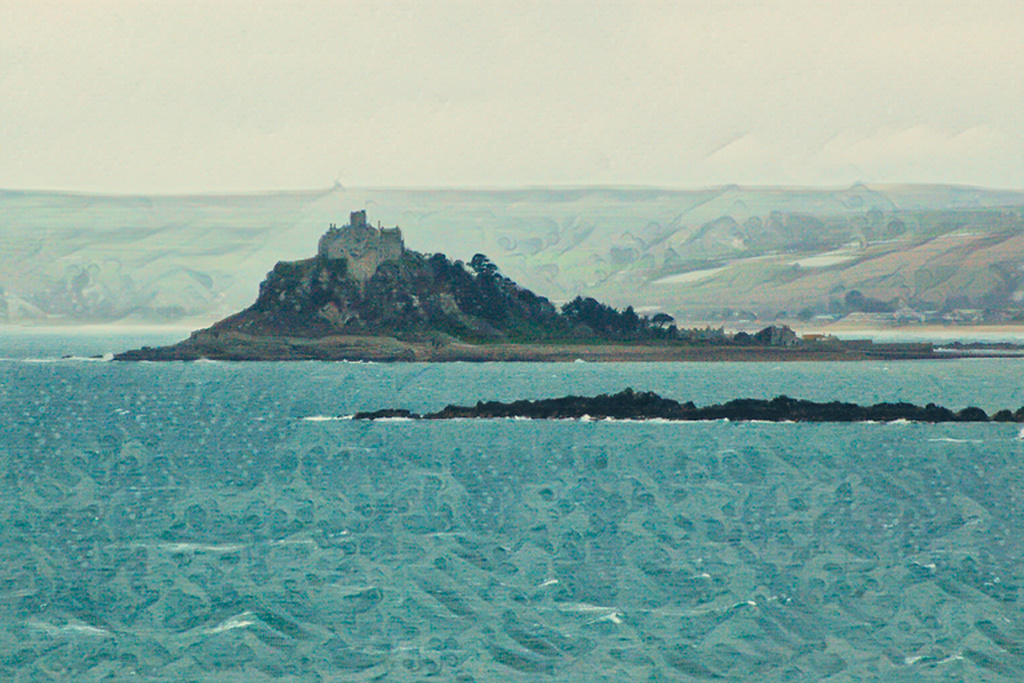
St Michael’s Mount – 5,500 years ago a Neolithic Tor Enclosure. Picture from my book.

The deed is done. I finished writing my book Shining Land. Been writing it since December. So now it will go out to a few readers for checking – I present quite a few radical ideas, and I want to make sure they make sense. It’s all about the ancient sites of West Penwith and ‘megalithic geoengineering’. Phew, so that’s done. Now I can pay more attention to family, friends and people.

After my cancer treatment in November to March I landed up with a lot of fatigue and brain-fog, so in the last six months I haven’t been very functional. I’ve been alive and active for only 6-8 hours each day, with a need to do my daily tasks, cook food and run my house as well as write the book and live a life. All in a slow and doddery way.

I’ve had a lot of trouble with making decisions, complexity and problem-solving, and yet, when I’ve been clear enough to write, my brains have done well. Obviously it concerns different parts of the brain. But one advantage of the fatigue has been that, when I go to bed in the afternoon, lying there in a strange heavy stupour with my leaden body totally flumped, my psyche floats around the subtle worlds in a hypnopompic, dreamlike state, and in that time I’ve mulled sluggishly over things and given each proposition and paragraph far more thought than I’ve done in the ten previous books I’ve written.

It’s strange, writing books. You can’t show anyone until long after it’s finished. It’s hidden away in a computer file, and I can’t hold it, prod it or wave it around. As far as you lot are concerned, I’ve been quiet, seemingly doing nothing. But I’ve been doing lots. It’s now ready – apart from a final review after a few readers have vetted it.

Lockdown hasn’t been a problem. Every time I write a book I go into lockdown, so I’m well practiced. When I did The Only Planet of Choice in 1992 I was locked down for 18 months. The main difference has been that, usually, people think I’m being antisocial. But during Covid I’ve suddenly not been antisocial. Nothing changed for me – it was others’ attitudes that changed! But if ‘normality’ returns, I’ll be antisocial again, haha.

Meanwhile, healthwise I have been improving 5-10% each month. As Victoria, a nurse heroine, warned me back in March, I won’t return to the same place where I was before I was diagnosed with bone marrow cancer. Back at winter solstice I felt like a 95 year old. Now I feel like an 80 year old – getting younger! But I don’t think I’ll get a lot younger. My body is getting older – I’ve just reached what my old friend Sig Lonegren, the dowser, called the Big-Seven-Oh. He reached it ten years before me.

You ought to see all the supplements and remedies I’m taking. Most of them are capsuled in those funny plasticky capsules, and I don’t want to swallow 15 of those every day. So religiously I break open these dratted things, mix them together, add a dash of top-grade local runny honey, let it soak in, and then I take this superpowered spludge on a teaspoon. I’m no longer on pharmaceuticals, thanks be.

One of the weird things has been that, during my treatment since November, only one doctor has actually touched me – that was a poor registrar who had to stick his finger up my bum to see whether I had prostate cancer (I don’t). It has been ‘bloods’, x-rays, PET scans, CT scans and MRI scans and, sure, they’re amazing. But not a soul has actually listened to my heart, looked at my tongue or touched me. This is modern medicine.

So when I went to John Tillyard, a brilliant chiropractor in Hayle, he actually touched me, and it was amazing! His hands were so firm, and he was so good at what he was doing – he hit me on the spot first time and every time. Three treatments and I was standing and moving so much better. Bless you, John – you’re a good man. Soul-sister Miriam has been giving me remote healings on Zoom too – I am much blessed.

My back will never return to its former strength and straightness – I’ll probably be using sticks for the rest of my life. It’s useful having four legs though. I can stagger around the house without sticks for up to three minutes, and that’s it. Three vertebrae in my lower back collapsed a year ago – that was the first sign of the cancer. My bones have lost substance: I click my back in at least five places when I lie down. You can hear it – it’s quite shocking first time. Bone marrow cancer erodes your bones, and though this has been stopped by the chemo treatment, my bones aren’t what they were.

For astrologers out there, guess what, I’m on a Neptune opposition Saturn right now, and it’s all about bones. Bones that have lost their firmness. I’ve had teeth falling out too. But I’m still here and, despite this, when my energy is up I can walk a mile or two – slowly and dodderily – especially in inspiring places, of which there is no shortage around here.

Thanks be to three amazing ladies. First is Lynne, who cares for my heart, spirits and soul, second is Penny, a fine soul who cleans my house and does tasks, and third is Karen, a Brummie angel who does my shopping each Thursday. I am held in the hands of the Goddess. Also Helen, my homoeopath, who gave me a radioactive lanthanide Curium 1M remedy recently, and that really pulled me together. Oops, was it legal to say that?

The doctors are happy with my cancer – the readings are good – but they think I might have lung cancer. I don’t. When I said this to the specialist I could see her thinking, “Uh-oh, he’s one of those”. She politely called my response ‘conservative’. Then, just this morning, a lung cancer nurse rang me, following a recent CT scan – a really nice chap – to tell me that the suspected lung cancer has not got worse and might even have got a bit better. They’ll test me again in a year. I told him that, all my life, I’ve been something of a healer, especially in my humanitarian work, and this is a case of Healer, heal thyself. “Interesting attitude”, he said. “You might be right”.

I’ve been rather shocked though at the extent to which the NHS hasn’t been caring much for me – and I’m glad I have holistic treatments and practitioners to resort to. But there’s a problem with both doctors and holistic practitioners: they are all specialists, all stuck in silos. It’s a completely non-integrated system, both in the NHS and the holistic sector. No one except Lynne is watching my overall condition. I’ve even had difficulty getting advice and appointments from my GP. When I ring them they take copious notes and… nothing happens.

That’s weird. I understand their situation with Covid, but I’m feeling ignored. But then, that simply means it’s for me to self-manage and do whatever I feel best, and that suits me fine. Kind of. I’d appreciate more knowledge and advice, especially (here comes a pipedream) from someone who understands both pharma and holistic medicine.

So now I’m a seventysomething. I never thought I’d get this far. In my life I’ve had at least ten opportunities to die, and I’m still here! Hello world. I’ll live until my angels decide it’s no longer worth keeping me here, and I get the feeling they have a few more tasks lined up. The book I’ve just written was the first. Since having cancer I’ve moved into a new archetype within – which many might see, for better or worse, as a ‘wise old man’ archetype. I’m becoming a voice calling from the far beyond (well, down’ere near Land’s End, it does feel like that). That’s what ‘Penwith’ means – the end of the beyond.

The ancient name for this Land’s End area is Belerion – the shining land. And it does.

Some time ago, when fire-walking was all the rage, people nagged me to join in and I just wasn’t taken with it. Perhaps they thought I was weak-willed – me, with Mars in Scorpio? No, if you want a test of the will, try cancer. It’ll get you where expensive new age trainings just don’t reach. It’ll confront you with all your fears. It’ll give you the biggest choice you ever made. It’s gloriously unromantic. It’ll truly test your will to live. It will hone your spirit – if, that is, you choose that route. It’ll prepare you for joining the Ancestors. It’s a bizarre kind of Gift of God. I don’t recommend it, but if it comes to you, do your best with it.

I’ve done acid, been with Tibetan Lamas, swamis, shamans, sheikhs and so many wondrous people, I’ve communed with ETs and transdimensional beings, hobnobbed with magnates, hippies, monarchs and Gazans, and cancer is another stage on that enlightenment path. Before any of us came here, we were, after all, warned that it was not going to be easy on Earth. We thought, “That’s okay, I’ll manage it, and besides, I want the chocolate”. And here we are, on this Earth – and you ought to find out about the crimes, injustices and near-slavery that are involved in providing you with that chocolate too.

This is the time and the future is here, now. This is it. Forget returning to normality: too much in this world needs to change and we can’t afford normality – it’s a killer. Normality is eating out the heart of the Mother.

Now that I’ve finished the book, I might muster up some further utterances on the state of the world, as I see it. Might even do some podcasts from stone circles and clifftops, far beyond, with not a surveillance camera in sight. We shall see. One day at a time.

And bless you all for being you. Thanks for reading this.

Palden

Powers That Be

bosigran-33882
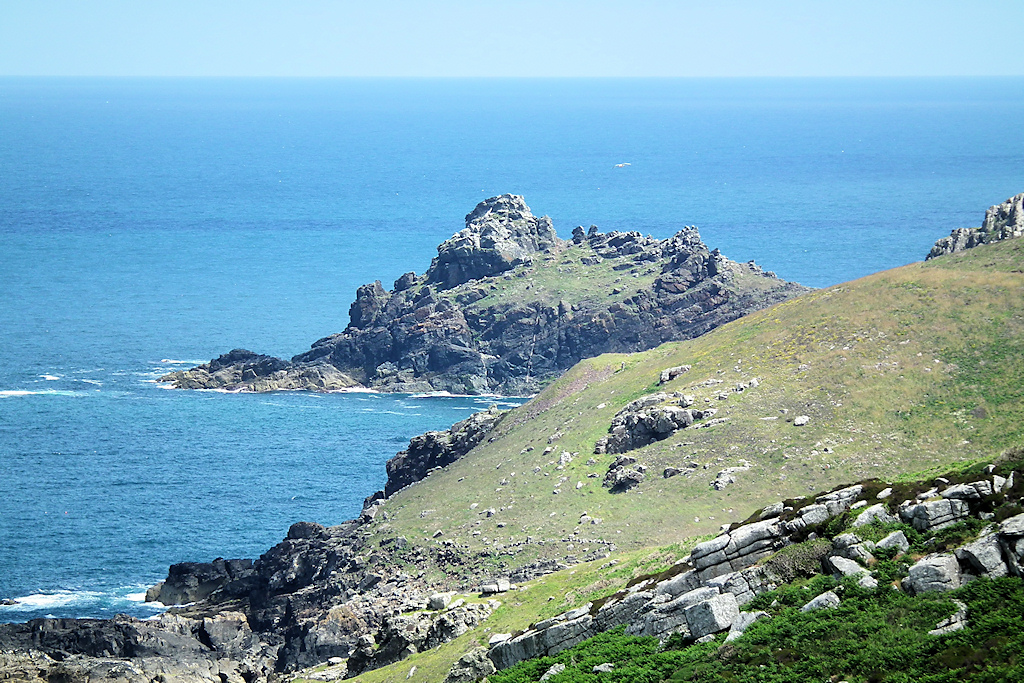
Gurnard’s Head, West Penwith, Cornwall

There’s a lot of conspiracy stuff going on right now. In my estimation, some of it is more or less correct, and quite a lot is projection and a rather paranoiac interpretation of life, history and geopolitics.

In a way, conspiracy thinking is useful. Divide and rule. Polarise the debate. Analysis paralysis. Release some useful information, knowing that some people will interpret things extremely, then rubbish them. This is partially deserved because of many conspiratorialists’ deficient sense of historical and political proportion. Shit does happen, yes, but a lot of what looks like shit isn’t really.

Nothing is as black-and-white as we might wish. It’s not just smoke and mirrors: reality is like that, a matter of perception and interpretation – Buddhists, the world’s first psychologists, have been teaching us that for over two millennia.

There’s a selectivity to conspiracy theories: it’s easy to rail against things we hate and resent, but we fail to go the whole way – conspiracy buffs still love their mobile phones, oppress women and believe whites are in charge. Some have a strange way of adopting populist right-wing politics.

I was a victim of conspiracy at age twenty, persecuted as a dissenter and dealer. The masons did it for me and I landed up in trouble, eventually seeking refuge in Sweden. I learned something from that experience: my oppressors lacked true intelligence and they were on the wrong side of history. I felt sad for them.

They are victims of a virus, an emotional-mental virus driven by fear, a narrowness of spirit that believes that self lies at the centre of all things. A fear of the vastness, of ‘God’, of the other inhabitants of the universe.

Here we come to Covid. I’m going to say something strangely controversial: Covid is a great gift. It represents a solution, a breakthrough, a relief, the beginning of a great healing. By saying this I seek not to deny the dead and the suffering (I’m getting my fair share). The best medicine does taste bitter. But Covid is saving us from far more deaths and much more suffering later on.

How so? Covid is accelerating change and bringing forward issues we need to face. We were too busy deluding ourselves, avoiding the big questions. It’s significant that Black Lives Matter is coming up right now – black people are beginning to assume their future role as leaders of humanity, following after the Chinese by the end of this century.

They raise a bigger question on behalf of all of us: is the system here for the people, or are the people here for the system? Thanks to African-derived people for bringing this up: their frustration is sufficient to actually rock the boat.

We’re being saved from a bigger catastrophe. We’re being let down slowly in an incremental series of shocks. Though some are dying and having a hard time, these shocks are saving us from a bigger, potentially terminal, catastrophe. The soul of humanity is in a process of redeeming itself. It’s a shock even to archangels as they watch a world die, and they debate how they might save eight billion hurt, damaged and excarnated souls from a destroyed Earth, who risk infecting the wider universe with their anger, ill-will, corruption and pain.

On the news, as I write, in a shocked tone they are announcing that the UK economy shrank by 20% in April. Well folks, this is a gift. It has long been needed. The economy will have to shrink yet more in order for us to achieve sustainability. People have had a revelation through Covid: a realisation that the lives they lived were not the lives they feel best living and giving to their kids.

Now we shall see who has the guts, the necessary despair, to follow through.

Problem is, there are conspiracies. And some things look like conspiracies but they aren’t. Covid was not caused by conspiring humans – that’s too narrow and reductionist an assessment. But, given that Covid is happening, power-holders indeed are making use of Covid as a way of increasing social control, reinforcing fear, making money and pursuing their agendas, driven by a fear of losing power, of facing their naked truth. But it’s not a neatly simple conspiracy, and there are also rivalries at the top.

Some things look like conspiracies but they are often coincidences, fuckups or groups acting in concert since they share interests – there is an ingrained, conditioned tendency amongst humans to act in self-interest and we’re good at it. Also, conspiracies, even the great Illuminati themselves, even when advised by the greatest of professors, do not have all the answers or exercise their full intelligence, because they are limited by fear. And as white men, their time is ending.

And as an educated, relatively privileged white man, my time is over.

Conspiracies rarely work properly. They can jog things in certain directions to an extent, but look more closely at the main issues that have been labelled as conspiracies in recent decades. Most were screwed up, or circumstances overrode them, or they’ve created unintended consequences. Oil interests did not succeed in the Iraq war. The British empire fell, and badly. PNAC, the Project for a New American Century that devised 9/11, is producing the opposite result longterm to what was intended. Organisational systems are clunky. There are wild cards. And the world system is inherently flawed and self-destructive.

If Covid was indeed thought up by a conspiracy, then they needed to think further. It wasn’t a good plan. They could have done better. The mobile phone and EM conspiracy is far more effective than Covid, though fortuitously Covid has given it a lift. No, if Covid was devised, it was devised by nature and higher powers, as a perfect awakening plan. Shake up the humans, twist their arms, put a spanner in their works – give them a revelation exposing where power really lies.

Besides, are you not part of a conspiracy? If not, why not? People think Big Brother is the only show in town – this is a father/authority complex that obscures clearer vision. No, it is not the only show. History is on the side of the conspiracy that has thus far been suppressed: the people, nature and the ways of the universe. The Unconscious always wins because the Conscious and the Ego are but concepts, complexes. However, they’re strong, and people sincerely believe in them. If in doubt, head for the nearest security – we all do it.

This concerns competing viral thoughtforms. There is the Logic of Destruction and the Logic of Life. We’re all being faced with another layer of a perennial question: which side are we on? The battle for the hearts and minds of humanity is hotting up, and our children and grandchildren have come here for it. There’s more to go.

There’s also a further truth hidden behind this. Life is a movie, a phantasm, a fiction. Everything we have ever experienced passes. There’s light and dark within all of us. Light shines awareness on hidden things, and darkness gives meaning to light.

Both levels are true. This paradox doesn’t make sense, but rationality is a construct, an explanation, not a reality. So, listen more clearly to things than to people. The fear of death that so dominates the Covid crisis arises from a fear of facing a deeper truth: the unavoidable truth that life is like a fart in the Void and we’re all forgotten. Everything that starts comes to an end.

So give thanks – we live in blessed times. The curtains are being opened, stage by stage. The main problem is summed up by philosopher Edmund Burke: for the triumph of evil it is necessary only that good people do nothing. And that the goodness within all of us remains dormant, withheld, concealed unless we let it out.

So yes, be aware of hidden dynamics in our society, of where the power is believed to lie, but get on with your life while you have one.

Follow your truth. Be willing to self-question and re-evaluate. This way, the evolution of humanity is accelerated. This way we avoid disaster. This way, we teach our children well, conveying a lesson they won’t be taught in school. To qualify as humans we need to pass the tests of heart and soul. Pass this, and we qualify for the next stage.

Well, that’s what I believe, at least. With love. Palden

Social Distancing

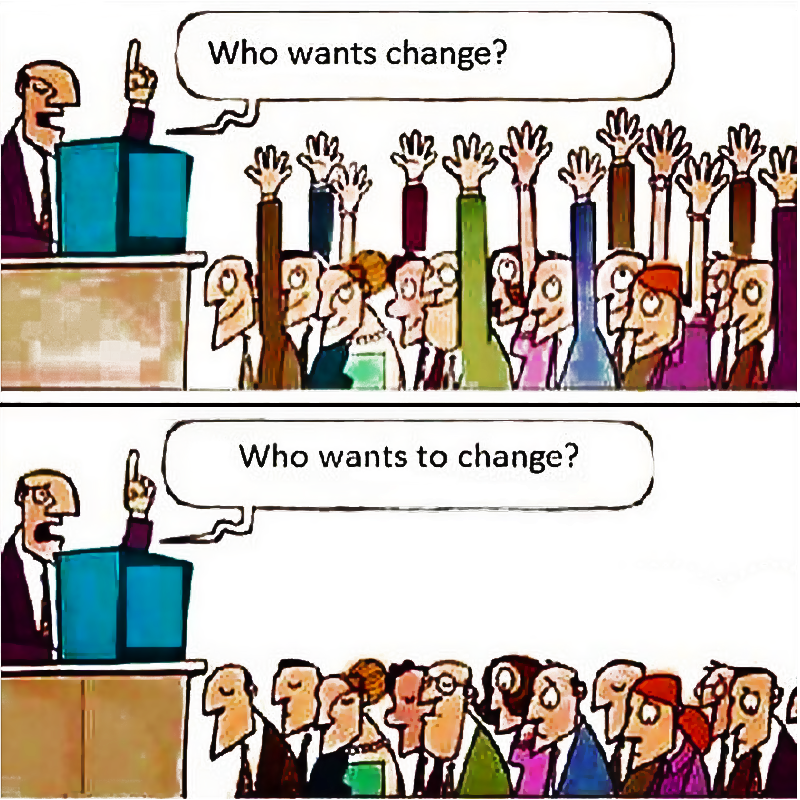
change

This year we’ve stumbled into a yawning abyss called society. There are approaching eight billion of us here on Earth, in various stages of individualisation. Departure. Uprooting. Alienation. Social distancing.

It’s partially a cultural issue and partly to do with urbanisation. Urbanisation is the largest movement of people in the world today. All the world’s population growth is in cities – rural population is declining, paradoxically creating more space for nature. Stranger still, one of the biggest pandemics of today is loneliness.

Yet we’re suddenly facing each other. Saturn and Jupiter are passing into Aquarius, the sign of society, membership, belonging, ideas, plans, principles and ‘how things ought to be’. When Pluto moves into Aquarius in 2024-5 for eighteen years until 2043, well, we enter a social process. Since 2008 we’ve been in a systemic process, and what matters next is people. Last time Pluto was in Aquarius, we had the French Revolution.

Some people give up on humanity, dedicating themselves to the natural environment, or wishing they could or would do so. But if we people don’t change, environmental issues won’t get resolved. We’re transitioning from exploiters to guardians of nature. To do that, we need also to transition from exploiters to guardians of our fellow humans. The main variable is the destruction we permit ourselves to go through to get there. Humanity’s crimes against itself rest on omission and commission.

Uranus and Neptune went through Aquarius in 1996-2003 and 1998-2011 respectively. That took us through globalisation and the social impacts of the economic crisis, which began with food riots, through to the Arab Revolutions – and it didn’t stop there.

No politics or religion were involved in the Arab revolutions: young, marginalised people just wanted to get a life. This matter is still pending. The current frontline is Sudan, with Iraq and Lebanon close behind. And Hong Kong, and Chile, and the emergent ramifications of Covid.

Many issues are pending and our planet has grown anxious. Angst about anything and everything. Partially this is psychological, a winding up of tightening hearts and minds, and partially it is circumstantial, since the world is getting crazier, more complex, polarised and dangerous.

We’re facing up to each other. My freedoms aren’t your freedoms, those people over there aren’t like us, and yet we’re all in the same crowd, utterly dependent on each other.

The world is cleaving into thoughtful and inconsiderate people, empathics and libertarians, public and individual priorities, matters of control, influence and freedom, with surprisingly large sub-surface reservoirs of social schism lurking underneath. “Who’s going to die first?”, “Who can I blame?”, “Who’s going to get the last loaf of bread?”, “How much do I care?”.

Not that anyone really knows what’s going on, and that’s a key part of the training. We’re out of our depth. This is bigger than we can see.

It’s not exactly a disaster. Change always looks like a disaster when we’re plummeting into it. Then it becomes crisis, and then transition, then a stunned quietness, then relief, revival and a new reality. It’s a question of the extent of pain and loss we humans must go through to get there, but get there we shall, by fair means or foul.

What’s wrong is that some people bear this burden of change far more than others – this is a fundamental issue of principle, of sharing. You can’t have privilege and deprivation when, like it or not, you all sit in the same boat.

It’s also about inner resilience – the capacity to make something good out of a bad situation. And social resilience – the capacity to change our social and community ways to meet whatever life throws at us, and regardless of whatever went on before. How to make life as easy as possible in the circumstances we get. How to feed and look after each other, and how to organise that.

It’s a big shock. Things have been going the other way in recent decades – or was it centuries? Humanity is meeting itself. This is the planetarisation of consciousness, the deeper aspect of globalisation. The bit we’ve stumbled upon is the horrifying realisation that we’re all so profoundly different. Yet, just somehow, we’re all part of a human family. And we’re in danger of making a mess of it.

Some of us run forward to change things while we have the chance, and some run back to safe territory to try to keep things the same – and there’s a bit of both in all of us. The bit of ourselves that we don’t like, we blame on others. If we are to survive, the twain must meet. We must get along with people we disagree with. But wait, they’ve got kids and grannies too – they’re just like us.

This is what’s emerging in the collective psyche, and it’s the big theme for the coming years. Is the system here to serve the people, or are the people here to serve the system? And what tribe do you belong to?

Until recently we were focused on climate change and a plethora of issues that all confusingly melted into a soup of horror – sub-surface political angst.

And now, this, this thing that we all wish we could get control of and cannot. How much it’s a virus and how much it’s a miasm, an epidemic of the psyche, is open to question.

If we dig a level deeper, we’re faced with a test of faith. Not my faith or your faith, but faith.

When the chips are down, how much are we prepared to sacrifice ourselves for what we believe to be good and right? Or is it safer to withhold, let others take the strain and see what happens?

There’s some good news too. But that awaits another day.

With love, Palden.

And if you want a bit more, try this.

Willful Ignorance

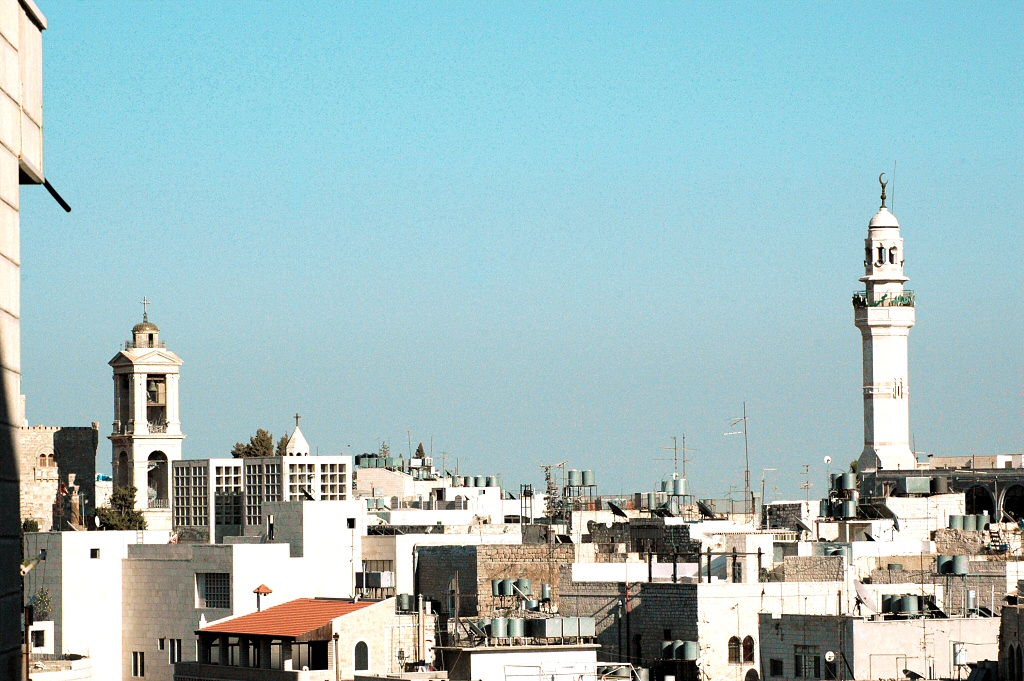
Bethlehem, Palestine
The Church of the Nativity and the Omar Mosque, Bethlehem, Palestine.

Not many things make me angry, but some do. Working with conflict has, strangely, helped me come to peace over many things, mainly by forcing me to face facts.

And anger transforms. I’ve got a deeply smouldering Mars-in-Scorpio righteous kind of anger. I get steamed up over indifference, mindless groupthink-compliance and willful ignorance – sadly flourishing syndromes in our day. Mercifully, society’s covidisation process is seemingly beginning to change things.

Groupthink indifference gives rise to all sorts of situations. Here’s one. It’s the very British ‘perhaps you should…‘ hyper-suggestion syndrome. It appears helpful but actually it is obstructive, a discreet withholding strategy. I get roughly five requests for financial help every week, mainly from Asia and Africa but even from Britain. These sincere requests come from people who genuinely are hungry or destitute, right now, and feeling it. Many of them don’t deserve to be in this situation – they were caught on the hop.

In many countries the lockdown is weighing heavily on people lower down the pile who, in turn, battle with their self-esteem and dignity over asking for support. When you’re hungry, patience is not easy and the end of your life lurks before you like a stealthy ghost that’s coming to take you away.

I have cancer and sit in the needy and vulnerable group that everyone makes so much fuss about. And, in the default Western way, my friends, who do genuinely care for me, recommend me to pull back from helping people and to ‘look after number one’. Well, yes, I agree. This isn’t news to me!

But there’s a problem. If I step down, few step up to take over. The consequences are systemic. It means that a person like me unwittingly takes on a responsibility: the burden of consigning a person to possible death by saying ‘No’ to them. Because I’m busy ‘looking after number one’ and doing what most people do. The burden doesn’t go away by ignoring it.

And, a footnote. I’m not so hot at fixing money, but I do always try to assist a person magically, if I can. In many cases it’s a matter of helping them overcome fear, or fixing them a good contact, or helping them go through an inner change that unlocks solutions, or dropping them a quick tenner for some food. It’s necessary to do something – not just to turn away. I’m much better at magic solutions than fixing funds. But it does require sticking with people in spirit, praying for their souls, giving them full attention, standing in their flipflops. In some respects, such solidarity of the soul can be a greater boost than money.

Server syndrome has subtle ways of presenting itself. In Syria in 2013 I had one of my premonitions, waking up in the night with a feeling that a neighbouring village was in danger. I reported this and was told, “No chance – that village is safe – don’t worry“. I raised it again next evening, getting the same response. So I did my polite Englishman bit and went quiet. Next week, back in Jordan, I heard that around 100 people were killed in a regime attack on the village.

It was the biggest humanitarian failure of my life. Yes, I know, everyone will say, “It wasn’t your responsibility – don’t take it on yourself“. True. In a way.

But if I had made more noise and fuss, those people would probably be alive today. I landed up an inadvertent killer. We do this. We commit crimes against humanity through simple omission.

Even in the pursuit of good intention, things can fuck up. Here’s another issue that sets me smouldering. In Bethlehem, where I’ve spent a lot of time, the world’s Christian churches have been rescuing Palestinian Christians. I would not begrudge a Christian the right and need to move to USA, Sweden, Germany or Chile (their main destinations) and I completely understand their reasons for leaving. They want to get a life!

But this has consequences. Bethlehem is increasingly binary-polarised. A century ago it had three faiths and now it has two, Judaism and Islam, with a wall between them. This is fatal to basic peacebuilding. Bethlehem’s Muslims are lovely, hospitable people, and they don’t want the Christians to go either. The Muslims keep the Christmas Pilgrimage going, not only to swell Christians’ numbers and keep Bethlehem on the map, but also because Jesus is a prophet of Islam.

But in all their intended goodness in rescuing Christians, the churches are sabotaging Palestine and the multifaith, multi-ethnic nature of the Middle East. The Israelis exploit this as part of their longterm takeover strategy. Europeans and Americans aid and abet it, quietly supporting the Israelis partially out of WW2 guilt, partially to control the oil-soaked, geostrategic Middle East, partially to keep trouble and refugees at arm’s length, and partially to create a market for armaments.

I really think the Christian churches should look long and hard at their part in this. This said, I support and admire the brave and radical work of a small number of activist Christians – Italians, Irish, Basques and Greeks particularly – who go to Palestine to rebuild demolished houses, accompany women and children past aggressive settlers, minister to refugees, help on farms and run services for the needy.

This is not a blame game. It’s a serious collective issue that we all need to own up to and change. We avoid facing such moral dilemmas by ‘looking after number one’.

As it happens, I do reject most appeals for money support. It’s a fact of the game and the philanthropist’s nightmare – we have to say ‘No‘ 90% of the time. Why? Because money and energy are finite and everything always takes twice as much and twice as long as first reckoned. You can’t just scatter funding and support everywhichway. Aid is karmic and, to create positive outcomes, everything must be carefully engineered and monitored.

I learned this from Richard Branson in the early 1990s. I asked him for funding for the Hundredth Monkey Project. He wrote back, saying “Looks interesting. Do it. No time. Good luck“. Just like that. It said it all. And I did find a way forward, utilising an algorithm called going forward in faith.

But the main problem here is that giving, sharing and helping are done by insufficient people insufficiently. So it falls on those who have large dollops of the necessary empathic foolishness to carry the world’s load, sometimes at risk of criticism, jail, bullets or, at minimum, continual admonitions to ‘be sensible’.

The big paradox here is that the best way to pursue self-interest is to practice altruism. But for the energy to circulate, everyone must do it.

This is why we have extremes of wealth and poverty on our home planet. It’s societal, national and global, not just personal. It’s ‘one planet, different worlds’. In Britain, even benefits claimants are in the world’s wealthiest 30% (on GDP terms).

The power lies mainly with the affluent: a country like Britain needs to reduce its consumption by a whole 60% to achieve some sort of sustainability. But the drift of Covid events is suggesting that we relatively rich gits are likely to make this change more by necessity than by choice. Unwise, but that’s the way it goes here on Earth.

In the end, such a reduction of consumption will properly be achieved not by regulation and decree but by a psycho-emotional transformation across society. It’s a matter of the heart, and how to catalyse such a change has vexed progressives for centuries.

Reduction of the desperate need to consume. Reduction of the need to cushion our pain through avocados, ice creams and indifference. Discovery that a simpler life brings a smile to our faces and a dawning relief in our hearts. Revelation that things will work out okay.

To achieve this, we need to share. That’s what lies before us. The agenda concerns cooperation and sharing as a pragmatic response to evolving events.

Greetings and love from The Lookout.

Paldywan