


In this blog I seek to share some of the things that come up for me, as a cancer patient. This one was written while I was on the amphetamine cancer drug Dexamethasone, and perhaps it demonstrates the scatty mindset it generates – though hopefully not as disastrously as what happened with Donald Trump when he was on it. So here we go…
I was thinking back to a time thirtyish years ago when a number of us were cooking up an idea and designs for a complex in an old, deserted industrial estate outside Glastonbury, including a holistic hospital, conference centre and university. I also worked on a campaign to change Glastonbury into a county borough with special planning status – one idea was to initiate a ten-year programme to make Glastonbury into Britain’s first totally traffic-free town.
All this didn’t happen. It couldn’t. It was far too big a stretch for British people to encompass, and it grated with the politics, media-manias and vested interests of the 1990s. But I need that holistic hospital now. It doesn’t exist. I cannot resort to holistic healthcare because there is no all-round system for supporting a cancer patient – not something I can afford, that is within my limited travel range, including availability of an ambulance, paramedic or nurse if I had a need.
The best chance for this was killed off thirtyish years ago when the Bristol Cancer Help Centre was discredited, defunded and closed, for entirely political reasons. There are a few options further away (such as the Care Oncology Clinic), but these are just not doable, for me, in the state I’m in. Besides, these options didn’t appear quickly enough at the moment I needed them, when I had to make urgent life-or-death, next-day choices.
As I wrote this I was sitting once again in the cancer unit at Treliske hospital. The tea lady came round. The guy sitting next to me, with his arm hooked up to a chemo drip, requested strong coffee with three sugars in. It’s amazing that this is permitted in a cancer unit. I was sitting there surrounded by cancer patients getting pumped up with drugs, some at £1,000 per shot, and most were sitting with their mobile phone radiation-generators held just one foot from their prostate, stomach or breast, irradiating themselves.
Somehow, they don’t feel it. Somehow, the medical profession studiously ignores this, even though the figures for epilepsy, headaches, anxiety, depression, alcoholism and domestic violence have risen sharply in the last year, thanks partially to all the wi-fi radiation generated by the video-streaming so many people are doing, for hours on end.
A nurse came round who was there last week. We had had a conversation about humanitarian work – she had a wish to do something like that. Good on her. Many believe they would have to be taken on by a big NGO, and I encouraged her to think and act independently, to go as a freelance volunteer humanitarian to a country she felt drawn to in her heart. I think she was rather stirred by that conversation. As has happened so many times, I found myself appearing in a person’s life to act as a magical prompt, a timely whisper from the soul, giving a jog from The Fates.
I also mentioned to her that you don’t have to completely change your life for this: do three months every year or two and you will serve optimally as a humanitarian. Keep part of your life anchored and normal so that you can handle stirring, chaotic and emotionally challenging stuff more easily, and so that you can bring a certain calm and openness to the people you’re mixing with. Above all, follow your heart: you will fall in love with these people and they with you.
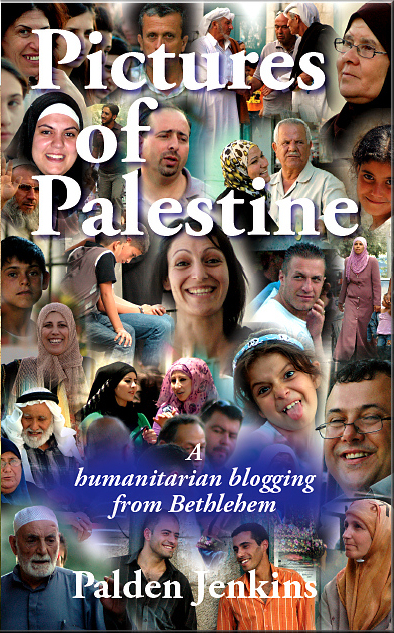
So this week I brought her a copy of Pictures of Palestine – a humanitarian blogging from Bethelehem that I wrote ten years ago. It reads like a travel book, telling of a three-month stay in 2009, talking of ordinary life in Palestine’s West Bank and the daily life of an activist humanitarian. (You can get a free online copy here.).
Such a life is not as excitingly romantic as you might imagine: there’s a lot of waiting, drudge, complexity, chaos, broken plans, roadblocks, funding problems, form-filling and plenty of assholes to deal with. You land up wondering whether you’re actually helping, whether you’re making just minuscule ripples in a vast, turbulent ocean of need, or even whether you’re part of their problem. After all, we Brits have given the world loads of problems: my own maternal grandfather was in General Allenby’s army invading Iraq and Palestine in WW1.
Working in conflict and disaster zones is deeply rewarding: life is lived more fully and intensively. In our rich, safe countries where too much, not too little, is the problem, we live with life’s settings at three or four, but outside it the settings are pretty full-volume and tonally rich. Relationships are deeper, life is more intense, risky, edgy, uncertain and alive. This said, an old friend from Devon, Gillian, was killed not in Bosnia or Palestine but in a taxi-crash in Luton, near London, on the way home from the airport – life takes strange twists.
Here am I, stuck in Britain, homesick for Bethlehem. Missing old friends there, and missing its amplified humanity. In Palestine I would not have access to the cancer medication I’m receiving here but I would be under all-embracing human care because Bethlehem has pretty fully-functioning clans, communities and families – a family of forty can take in a cancer patient without great difficulty. The warm, dry climate of the Judaean Desert would be better for the aching arthritis I’ve acquired through my cancer treatment – a side-effect of violent pharmaceuticals I might not have needed if that holistic hospital had come into being in the 1990s.
This is why I like living at the far end of Cornwall: the people here understand the frailness of life – sometimes the storms here can be frightening, and Cornwall has long traditions of marine rescue, mining accidents and self-sufficiency. Living here is more edgy, a bit more alive, and we’re all in it together. Except we live under English colonial governance – Boris and his cronies.
Out here in the ‘Celtic Fringe’, during 2020 we left the UK in our hearts: we have better governance and more social solidarity, and Covid and Brexit have accentuated it. When Covid came along, we looked after each other. My shopping lady, Karen, who has breast cancer and osteoporosis, and who knows nothing about meditation or all the cosmic stuff I’m into, is nevertheless an amazing walking angel: she knows what it’s like being human and she’ll do anything she can to save souls while she’s still alive. She’s a good example. If she went to Palestine she’d quickly be taken in and made an ‘honorary Palestinian’.

The gift of cancer is that you start valuing life in a new way. If you so choose. You have to get straight with people too. It’s amazing how many people think they know what’s right for you. The people who don’t do that become your true friends and helpers. The English do have a habit of marking their own homework, assuming they’re right and telling everyone else what they ought to think – and this is why they are losing the Celtic Fringe.
I have this right now with a dear old English friend and brother who wanted to come and visit for some time and space in Cornwall. But while I’m on chemo, taking immuno-suppressant drugs, I can be seriously affected by the slightest infection of any kind, even a common cold. I’ve had to tell him straight that he has more likelihood of killing me than I have of killing him, and that’s not equal or true friendship, so please modify his behaviour when he comes. He’s welcome though: we’re soul-brothers.
I don’t take the same stand on Covid as many people do. I can relate to anti-maskers and anti-vaxx types. People are free to follow their conscience. But there’s something far greater here than individual freedom: you are not free to impose your values on others. You may not harm others because of your beliefs. Social and transnational solidarity is a key issue for the whole 21st Century: we will not survive the future unless we all work together.
So it is imcumbent on people who are unhappy about masks and vaccinations to take extra measures to protect their fellow humans, to avoid imposing on the vulnerable and to recognise that freedom applies to all of us. This means behavioural change, such as social distancing and emphasised thoughtful behaviour.
“Who wants change?” – and everyone shouts Yes! “Who wants to change?” – silence. This attitude undermines humanity.
This pandemic is the beginning of a big, long, total, global process of social change, and every pandemic in history has lasted 30-40 years. There are more crises and crunches coming – Covid has uncorked a formerly stoppered bottle and the genie is now out. We have an intelligent virus in our midst that has come to change us because we’re reluctant to change ourselves. It’s faster than us – nature’s answer to artificial intelligence. And it raises many other questions, such as that of social control – and Covid dissenters are at least partially right on this point.
The 1920s pursuit of individual freedom, understandably born out of a legitimate breakout-reaction to the Spanish flu pandemic and WW1, brought about a political disunity that allowed Nazism to gain power by 1930 in Germany. Take a lesson from this. Today, overblown individualism is helping the rise of a privatised form of totalitarian control called Google, Facebook, Apple and Amazon, now becoming embedded in governments too – the Stalinists’ dream come true – and few people really notice.
For the triumph of evil it is necessary only that good people do nothing. That’s a quote from 18th C philosopher Edmund Burke.
As a lifelong dissenter I have exercised my personal freedom, and this has brought blessings and it has also charged a price to me and to others. I had to learn to stop being a male crusader and to wait for people to come, of their own choice, toward my way of seeing things – and only a few actually did. Who wants to learn astrology when there’s a mortgage to pay? That’s a big lesson in itself. Visiting cultures outside the rich world changed me: I saw societies that were economically deprived yet socially richer than in the materially rich world, with communities that work better, in real terms of mutual support.
This was blatantly obvious in Israel and Palestine: Israelis are by nature individualists while, as one Palestinian put it, “We have each other, but they just have themselves“. Though the Palestinians have repeatedly lost the battle, when you cross through the checkpoints from Israel to Palestine you’re entering a society that, despite everything, is strangely happier, more secure and more free. Despite everything. By social consensus.
In Israel, many people would say to me, “Why do you come here to interfere when your own country has plenty of problems?“. In Palestine people would say, “Willcome in Falastin, and why you not bring your children too?“.
Now the Celtic countries are pulling away from England, our former colonial master. We have each other, relatively speaking, while the English have themselves, and many prefer things that way. Seen from here, England seems to care more about money than people, yet in so doing they lose economically in the longterm. Brexit, born of an eruption of English exceptionalism and media-owning offshore tycoons’ profit margins, is now demonstrating the point.
I’m half-English and half-Welsh, but I have become one of the ‘new Cornish’. This isn’t just a matter of moving here and bringing English ways with you: it’s necessary to change, to become Cornish. Besides, the Cornish winter gets rid of people who think it’s a holiday paradise that’s here for their leisure. Celtic nationalism welcomes anyone who is truly here, in body and in heart – your bloodline is secondary. The Cornish are a European minority respected more by Brussels than by London.
So these issues are personal to me, as an English-Welsh new-Cornishman living closer to Dublin than to London. When I visit others’ countries I sit on the floor with them and pray with them in their mosques and temples – when invited. I’m not a big-booted Englishman, and one of my underlying purposes has been to help redeem the shadow of the British Empire.
There’s still an Englishman in me though, and here I wish to honour the human side of the English, that decent, fair-minded, broader-thinking aspect of Englishness that the rest of the world loves and respects. You find a lot of these amongst humanitarians abroad, and the carers, nurses and charitably-driven people here in Britain. The people who, when all is said and done, hold this world up. My partner Lynne is one.
She sobbed deep tears last weekend because of a new wave of realisation that, when I die, she’ll have a yawning gap in her life. She was feeling it in her heart, in advance of the event. This wasn’t self-pity – it was far deeper. After passing away I shall be with her in spirit but that will just not be the same, whatever anyone says. It has something to do with that special quality of love we humans can generate, here in this benighted world, stuck between a rock and a hard place – a kind of love that doesn’t exist up in heaven, where love and soul-melding come more naturally and easily.
We have a tremendous power to love despite everything. Paradoxically, those who have gone through it, feeling the full power of the pain and the joy of earthly life, tackling life’s questions instead of avoiding them, seem to love in a profoundly real way. It’s rather like the wise maturity that some ex-criminals, terrorists, druggies and alcoholics can gain when they pull back from the brink – a benefit gained from having visited hell and returned, much the wiser. Some of these people are the most principled, human, courageous people around. By their actions, not their words and beliefs, you will know them. And there are lots of words and beliefs flying round nowadays, including mine.
Bless you all. Be yourself. Have your beliefs. Be willing to review them and consider everyone else too, for none of us is free until we all are free. From now on, personal freedom has to balance with collective needs, worldwide, and Westerners are not the only people with big ideas on this front. We’re just 15% of the world’s population.
With love from me. Palden.


 Notes from the Far Beyond
You must be logged in to post a comment.