

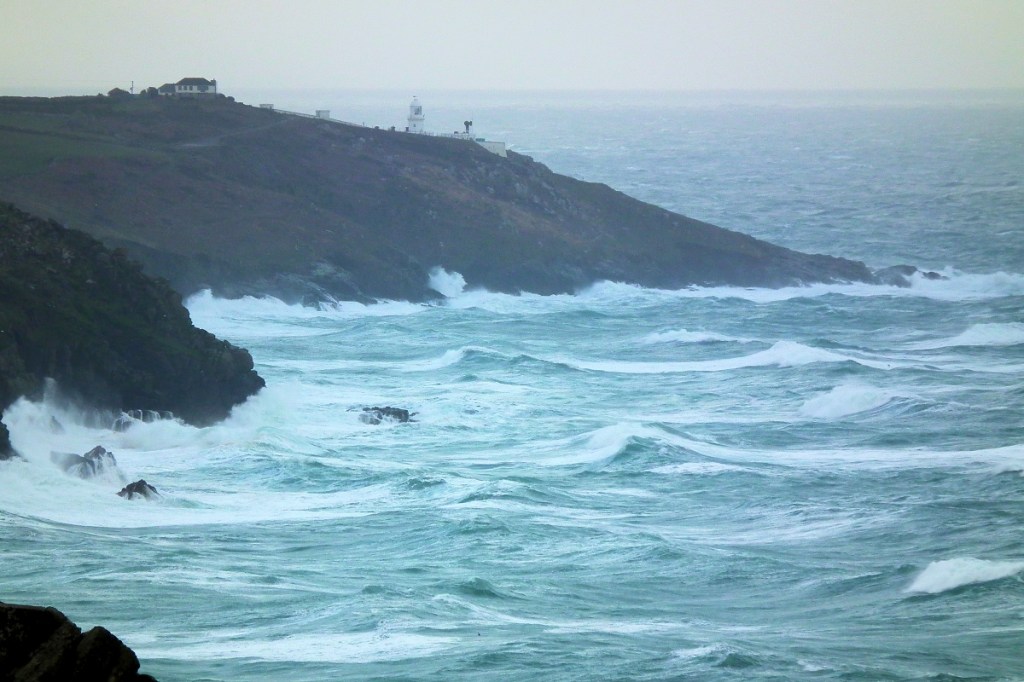
They came. And they went. They went scorching along the south coast of Britain toward the Netherlands. The storm gods, that is. It was a right old holy hoolie, a demonstration of the Power and the Glory for everyone in Cornwall to hide away from. And we did.
It’s one of those situations where you just have to huddle down, say your prayers and wait. One of those situations where even proudly hubristic secular rationalists start saying a prayer, just in case. You have to wait until it’s over, because it’s no longer in your power to do anything much else.
The winds were resolute, firm and consistent, not blustery or tricksy – they were forceful, merciless and thoroughly unrestrained. This was what in capitalism they call a hostile take-over. No consultation, no regard for human rights, no compassion: just the energy and might of a full-on Atlantic storm, a gift of the gods to remind us how small we are and how easy it is to wipe us out and dispose of us, if Nature so chooses.
Too often, we arrogant, self-centred, comfort-addicted humans forget this. It’s not that difficult for Nature to blink or cough, sending us beetling off to Heaven in our thousands, for the angels to sort out. Well, I’m heading that way anyway, sometime soon, and if the weather gods wish to take me today, getting in there first before the cancer gods get me, then what a way to go. I won’t complain. You have to get to Heaven somehow, after all, and in this there is no choice except for timing and method.
But it was okay. The lights went off and I sat in bed, reading in candlelight a novel about the Dreyfus Affair of 1890s France – as it happens, topically, a prime example of institutional anti-Semitism if ever there was one. Then I dropped off to sleep, with 100mph winds screeching over my little cabin, The Lookout.
They were coming from the northwest, and a hill stands there behind the farm, sheltering us from the Atlantic vastness, 3,000 miles of it, and it was okay. Had the winds been coming from the south, as in some of the storms of 2014, there would have been trouble on the farm. We were okay, but across Cornwall a lot of people were not, and many trees lost their lives. I found myself wondering what small birds do in super-storms like this, like the tits, dunnets and the robin who patronise the feeder outside my door.
Anyhow, I’m a survivor, and programmed up for it. Well, much of the time. The main dangers I have faced in my life have been from humans – control-freaky Israeli soldiers, nervy Palestinian freedom fighters, gritty ISIS terrorists and crack-addled Nigerian criminals – and the force of Nature has a more comforting side to it.
It is mighty, threatening and decisive, administering justice in a remarkably even-handed way and singling out all those things you’d failed to notice or do anything about during calmer times, making them fly. But it speaks the words of The Ultimate, and no one can argue with that – even The Donald, living as he does in a hurricane corridor called Florida, the land of the flowers, who badly needs to realise that he is not God and never will be.
But human dangers are another matter, and with them you’re dealing with a different, more capricious and regrettable kind of randomness.
When I woke up there was no power or water. Jon, the farmer, was clearing up the mess in the farmyard – the roof of his woodshed had radically repositioned itself. There was no phone signal, so a neighbour had driven to where there was a signal, finding out that we might, with luck, expect power back Friday afternoon. It took until Saturday afternoon.
Well and good. Except there’s one problem. Why is it that the power always returns just at that moment when you’re beginning to enjoy the calm and the candlelight?
But I do have a woodstove, and it soon was alight. There was the light of a lovely golden dawn over the valley, exhibiting another kind of Power and Glory from that of the night before. The birds were very quiet, probably a bit groggy after a long, trying midwinter night. There was no sign of the flight of geese who pass over the farm in the morning, hooting and croaking to the Void as if sadly lamenting the insecurity and non-attachment that migrating animals have to accept. They’d probably come from Greenland, Iceland or Norway, now wondering whether they might have been better to stay there.
So I pottered around. The worst that can happen is that the food in my freezer defrosts. No bombs are falling, and no earthquake-aftershocks are to be expected. Before long a saucepan was on the woodstove, warming up for the first pot of tea. I stumbled down into the farmyard and along the track to check a neighbour – yes, she was okay and huddling in bed with her dog. I came back, making my walking-stick work hard, poured the tea and read more of my book. Then I rooted around in the cupboards and found a Tilda pack of lemon and herb rice – and that went on the stove too, with some grapes thrown in.
One of the best meals I’ve ever had was during an Israeli lockdown on the West Bank. People in the rich world, all neurotic about our loss of freedoms, complained loudly during the Covid lockdowns, but with an Israeli lockdown, well, if you go out, you risk getting shot – it’s quite simple. Israeli troops are trained to shoot first and think later. In circumstances such as this, a kind of culinary gallows humour takes over and, using what you have in the cupboards, some amazing feasts can be had.
This is partially a perceptual issue. At a Palestinian refugee quarter outside Damascus, since I was a European with some diplomatic skills, I went out to see if I could find some food for the family I was staying with. We outsiders sometimes could get to places and negotiate things that others could not – though it would depend, of course, on the mood and values of any gun-toting man you met along the way, and whether they spoke English, German, Swedish or French. My ageing, sixty-something brains were having difficulty absorbing Arabic.
I usually managed to convince them I was a decent chap. Arabs are good at reading your body-language. Anyway, it was my lucky day and I came back with a shoulder-bag of bread – including, strangely, a plastic-wrapped pack of German pumpernickel. We had a true feast – of bread, with a few old, chewy olives thrown in. And, believe me, it was a wondrous and happy feast. Palestinians are well used to this kind of thing, though they have one weak point: they go through big coffee-withdrawal problems during lockdowns and hard times.
People often ask me what I used to do in Palestine and Syria. Well, I’ve done three books and an audiobook on the matter (links below), but the short answer is, things like this. Such as finding bread for a family to eat because, in the circumstances, I had the capacity to do so. It’s a small matter, finding food, but a meal can have a big effect on people’s mood and welfare. And you get to eat something too.
So a Cornish winter hoolie, well, it takes me back to that alert, resigned, improvisational, ready-to-run state that you get into when stuck in an emergency. You’re out of control of your fate, yet strangely in control too – though it’s necessary to leave the fear until later. In a funny sort of way it brings out the best in me. Comfortably normal regularity is not my forte, as my former partners can easily testify.
My computer battery is running out and I’ve said enough. I’ve been churning out verbiage for a whole lifetime, so no more is necessary. And, as usual, I’ve forgotten my tea and it has gone cold. So I’ll put my mug on the woodstove and, lo behold, in a few minutes it’ll be warm again. What simple delight can be found in small mercies.
And, as Arabs often say, Allahu Akbar, God is Great. Life is a wondrous thing. It’s a gift that’s worth cherishing while we have it. As something of an expert in other worlds and their characteristics, I can safely inform you that the tea on Earth is the best in the whole Universe. If you don’t believe me, your turn will come to find out.
However, compensations are available in Heaven. It’s a cool place to be, so don’t worry about the tea or other such things. Other things matter there. But just make sure that, when your own time comes, you’ve had enough of the experiences of this world to have, in another sense, truly had enough of them.
With love, Palden.
Pictures of Palestine: www.palden.co.uk/pop/
Palestine audiobook: www.palden.co.uk/bethlehemblog.html

 Notes from the Far Beyond
You must be logged in to post a comment.