

and the Four Seasons
Since it’s solstice, here’s an extract from a book of mine, Power Points in Time, about the cycle of the solar year, for your interest. More about the book below.
We tend to take the cycle of the year for granted, viewing it in a rather reductionist, calendrical and mechanical manner. This is partially because the Western calendar has no natural basis, so we tend to think of a calendar as a matter of dating with no further significance. For a solar-based calendar it would make better sense to anchor it in the solstices and equinoxes, allowing us to move more in harmony with the seasonal undertow of life and nature and with overall energy-conditions.
The seasons are brought about by Earth’s orbital relationship with the Sun, in which she exposes each of her poles to the Sun for half of the year as she orbits around it. Each pole is maximally exposed to the Sun around the time of summer solstice, experiencing the midnight sun, while the other pole is in perpetual darkness during its winter solstice.
Outwardly, the Sun gives Earth light and heat, and inwardly there is a deeper energy-weather cycle activating and modulating life-force on Earth, connected with the solstices. Life-force courses through the subtle meridians of the Earth and the energy-systems and patternings of all living things. In terms of our daily lives, a year takes a while, but for the Earth it is just a short inbreath and outbreath in the long course of geological time.
The ancients took it upon themselves to invoke favourable seasonal change, in the knowledge that change is the essence of earthly life and rhythm is the breathing of life-force. They knew also that subtle energy patternings are the energy-framework upon which physically manifest things are draped.
Psycho-spiritually, the Sun within us resides at the centre of our being, around which all of the constituent parts of our psyche orbit. The Sun represents our fundamental raison d’etre, our will-to-live and our source of aliveness. It gets us up in the morning to meet a new day. You could say it channels the soul through into our personalities and earthly natures. It’s a vibrant, shining place within us which seeks to make something good out of life and to evolve through life’s experiences.
Through the Sun in our birth charts, we seek to become something more than we now are, to evolve and serve our purpose, to be part of the life-process and to contribute to it.
This inner Sun goes through its own cycle of the year. We each relate differently to it, depending on the position of the Sun in our birth charts, but we have a common cycle too – the Earth’s cycle. It’s about the fluxings of energy in life and nature and the thrumming of the resonant sphere of the Earth – we’re bathed in it, even when we live in big cities, even on the 25th floor. The Sun moves around the zodiac in the course of a year, exposing us to different shades and tonalities of life-experience as it moves through the signs. An Aquarian day can feel quite different from a similar Piscean day, and what we make of each is up to us.
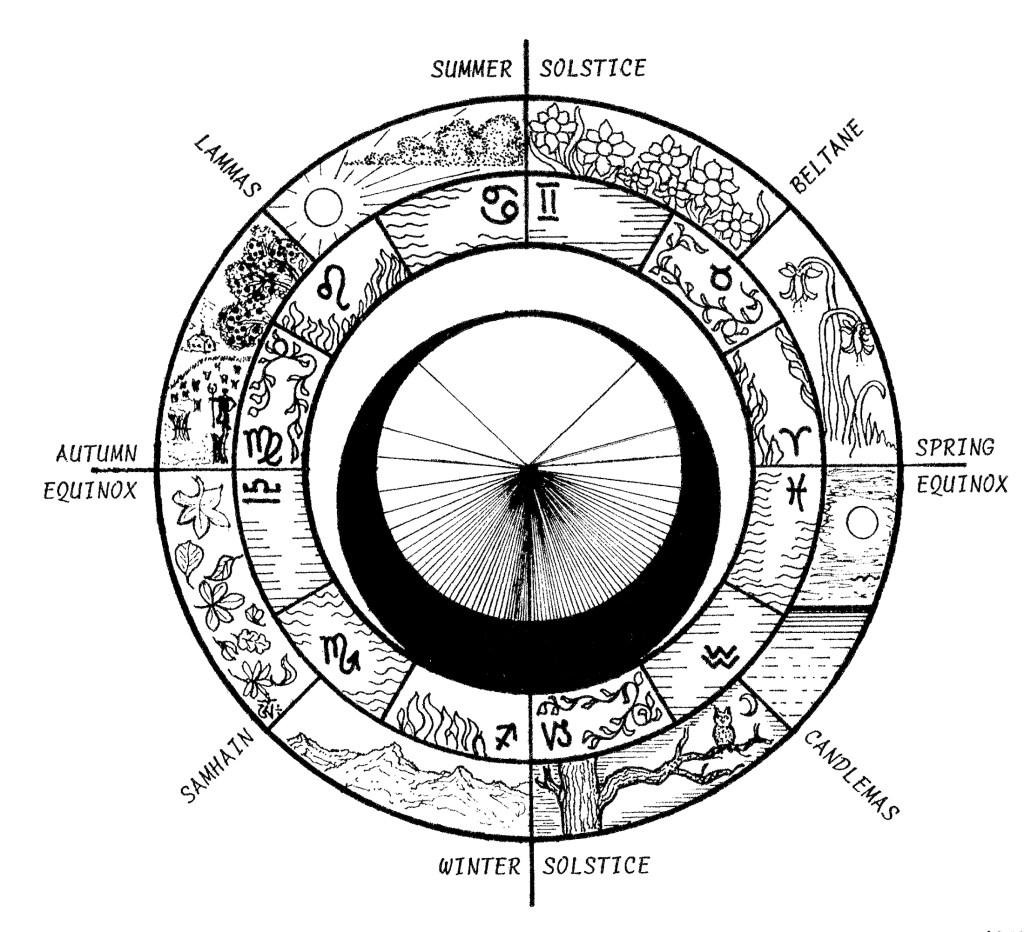
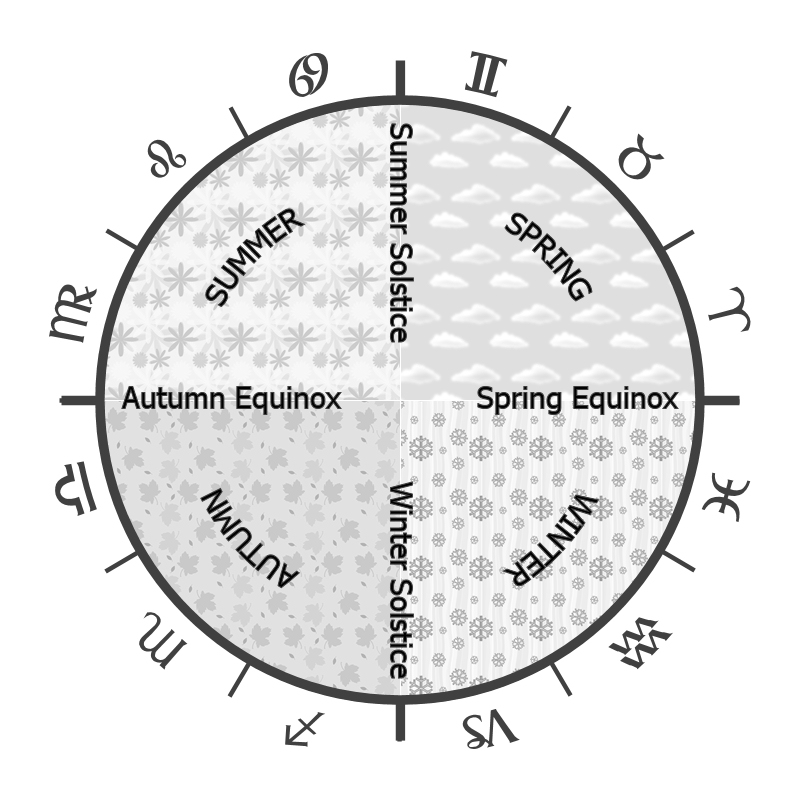
There are twelve signs of the zodiac, and the zodiac is anchored in the four quarter-points of the year – the two solstices and two equinoxes. The solstices represent turning points and the equinoxes represent tipping points in the four seasons.
There’s a three-sign sequence in each season. The zodiac has little to do with the stars and everything to do with the solstices, equinoxes and seasonal alternation, outlining the qualitative and archetypal undertow of the four seasons.

An archetype is an image or root-model of fundamental patterning behind and within all happenings and situations. If I say ‘oak tree’ then you will immediately form an image of an idealised oak tree, even though oak trees vary in shape, size and detail. So an archetype represents a basic patterning or template by which living beings and things shape themselves, even though the precise manner of their shaping varies enormously in real life. And yes, trees have thoughts and feelings.
There’s something interesting here. In Britain, NW Europe and other temperate climes (between about 40° and 60° from the Earth’s equator), nature manifests its actual physical changes in an eightfold, not really a twelvefold pattern. This eightfold pattern is marked out by the four quarter points and also by the mid-points (or cross-quarters) between these. These are important in temperate higher latitudes because the alternation of light and dark, day-length and temperature are more emphasised there. This also happens on a subtle-energy level, and it is these changes which pull us around and squeeze us through certain kinds of experiences at certain times of year.
In latitudes closer to the equator, other factors are emphasised by local circumstances or traditions, such as prevailing winds, rainy seasons, river floods, the rising points of stars such as Sirius or the orbital cycles of Venus. Localised cultures saw things in the light of what was visibly important in their own localities. In Europe, the great ocean is westwards, yet in China it is eastwards, and in Brazil the rainy season determined the way indigenous peoples structured their beliefs, while in Europe or Canada spring and autumn do so.
An eightfold calendar is more natural in NW Europe than a twelvefold one, which originated in Mesopotamia – though they interlock. The Sami (Lappish) people of far-northern Europe have an eightfold year, five seasons being different kinds of what most of us would call winter. The ancient megalith builders of Atlantic Europe 4-5,000 years ago, stretched between Portugal and the Baltic, embodied eightfold mathematics into the alignments and placing of the standing stones and stone circles they built. But both eightfold and twelvefold calendars are anchored similarly in the solstices and equinoxes. So they are related.
The energy principles behind each year are represented by the twelve zodiac signs, and manifest seasonal changes are represented by an eightfold subdivision of the year. This interlocking of principles and practicalities has meaning to it. Here we’ll look at the eight annual subdivisions, and in the next chapter we’ll examine the twelve, the zodiac. The eight, the quarters and cross-quarters, were marked in ancient times by festivals when fires, beacons and lights were lit, representing and re-invoking the life-force.
Power Points in Time. This isn’t a normal astrology book – it has little to do with birth charts or specific events. It’s all about cycles of time – cycles big and small, as astrologers see them. But when the original version of this book, Living in Time, came out in 1987, we found that it wasn’t so much astrologers who got excited about it, but it was pagans, druids and lovers of nature, ancient sites and shamanic practices. So, 28 years later, I updated and reworked the book, which came out in 2015.
It’s still available in print, published by Penwith Press and, while it’s a bit late for Christmas, here’s a thought…
If you are a seeker on a quest to understand a bit more about what lies behind and underneath the events of your life, it pays to have a modicum of understanding of astrology as part of your general knowledge – really, the basics should be taught in schools to teenagers.
It takes a while to get your head and heart around the details, but it pays off, since it’s really interesting, and your understanding of it and of life will evolve over time, as the years progress – whether or not you become an actual astrologer. And wintertime is a great time to get focused on it.
If you’re into ancient sites and working with the inner magic of nature and of time, then here’s a secret. The ancients built their sacred sites at power points in the landscape, but they carried out their ceremonies, rites, healings and workings at power points in time. I wrote this book to help my friends identify and understand power points in time.
Time is what stops everything happening all at once.
With love, Palden
This is where to get the book:
https://penwithpress.co.uk/product/power-points-in-time/
This is about the book:
http://www.palden.co.uk/time/
And this is the original 1987 book, Living in Time:
https://www.palden.co.uk/living/

 Notes from the Far Beyond
You must be logged in to post a comment.