

The world is in such a parlous state, and we’ve seen so much mindless devastation and tragedy recently.
Below is a chapter extracted from my 2012 book Pictures of Palestine. It’s about the amazing creative contributions that some people make, with a view to re-heartening downhearted people.
This might not be a thought for you now, but it might become relevant in perhaps a few years’ time. The agenda here is to help people rebuild, once the horrors have stopped. There are plenty of countries to choose from.
It can be done for (say) two months each year. If you’re in your 20s or 30s, or approaching retirement, it’s a chance to do something really meaningful. This extracted chapter will give a taste of it.
Or, regardless, it’s a good read!
Love, Palden
———————–
Fun in Beit Lahem
bagpipes and saxes in the Old Town
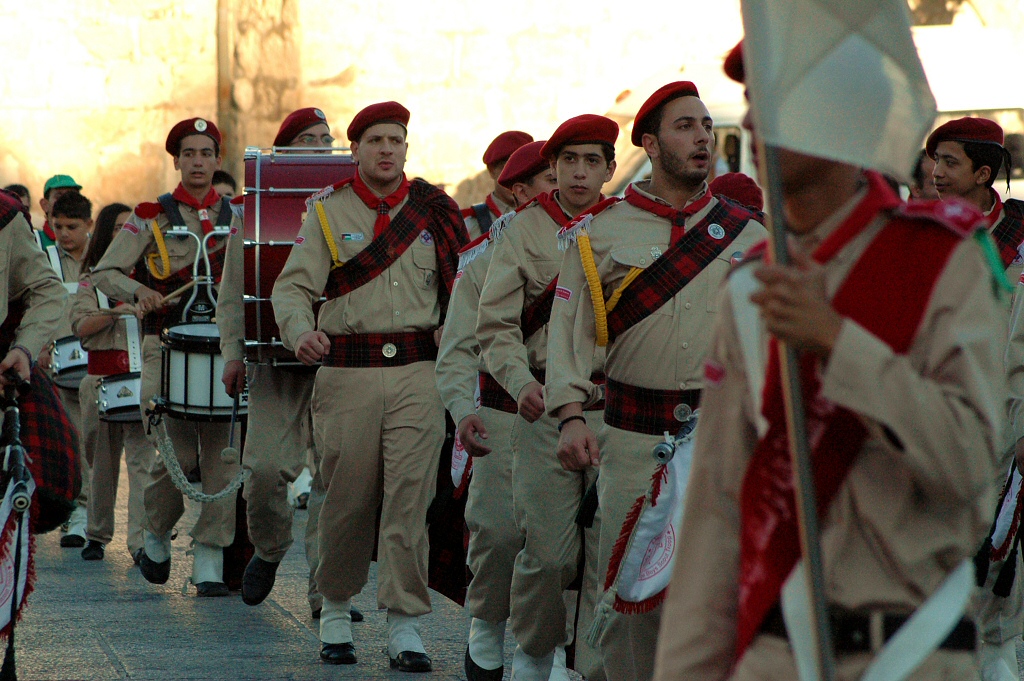
Arriving back in Bethlehem from Ramallah, I went to Adnan’s shop to sit down. But then something else happened: music started playing down in Manger Square. It turned out to be a Palestinian Christian marching band playing, to my surprise, Scots bagpipes and drums. The shutter on my camera was busy for a while.
This was a throwback to the days of the British Mandate. The band, clothed in smart uniforms with red berets, marched around Manger Square, then up Al-Najmah Street into the Old Town. It was rousing music, yet coloured with a wry sense of historic tragedy, a hint of wishful thinking of former days. It faded into the distance, there was a pause and then they came back down again, with gaggles of people in tow and others hanging out of the windows watching. The band marched around the square again and then stopped. People hung around, chatting and the atmosphere on the square was sociable and upbeat.
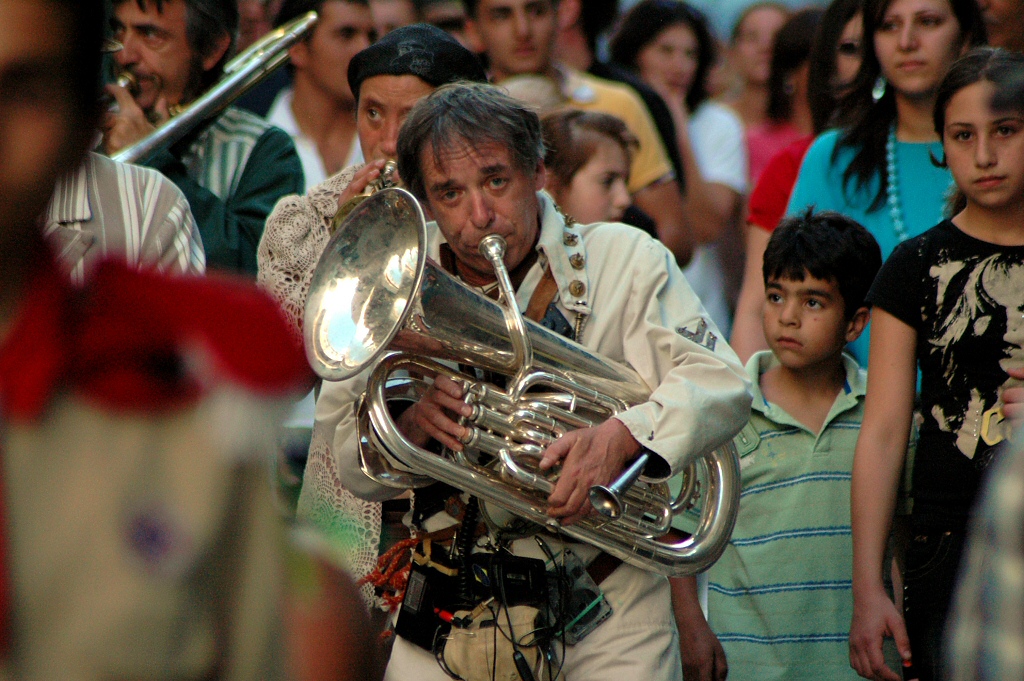
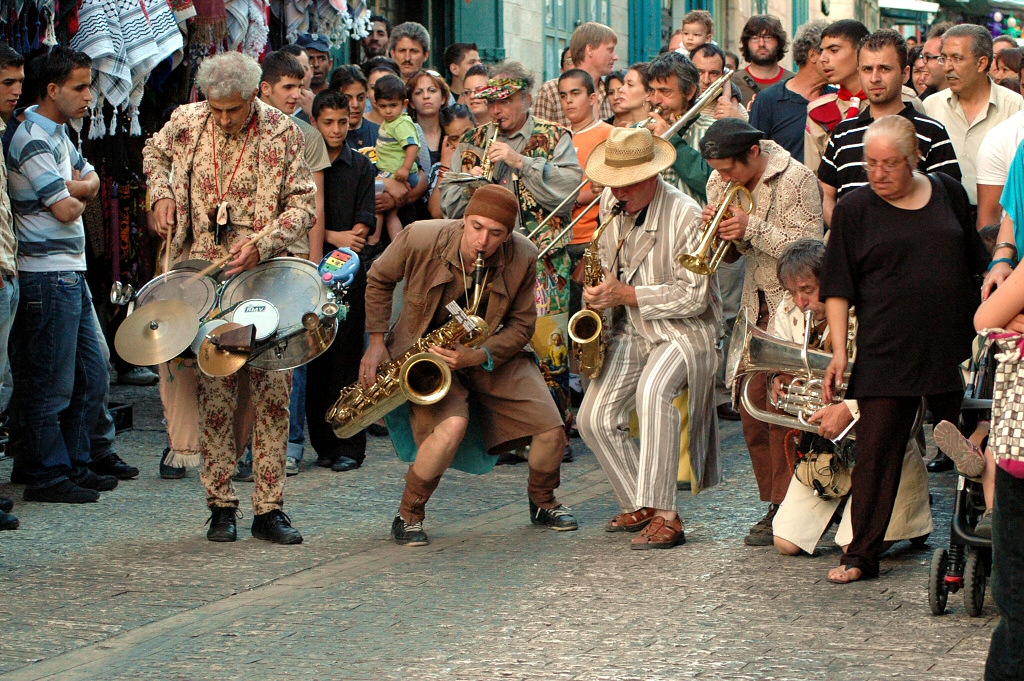
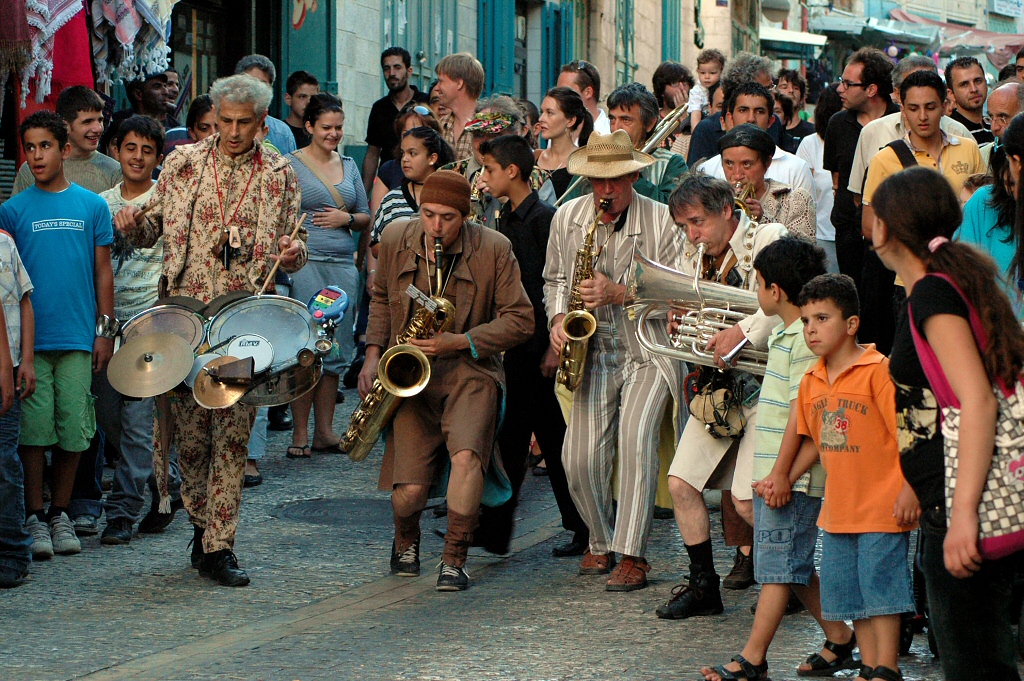
Then something else started up: the unmistakeable sound of ragtime jazz, coming closer down Al-Najmah Street. As I went down to see, seven Austrian musicians appeared, dressed in comical clothing and followed by a happy crowd of kids and adults, all now entering the square. Everything and everyone perked up and people flooded into the square from all directions. Eventually hundreds were gathered, young and old. The jazz band stood in a semi-circle, striking funny poses, eyeballing people as they played, taking turns to do solos, and people gathered around, taken with the witty ragtime music. It was good music, skilfully played.
Bravo to them. The group had come to Palestine to entertain, and they were succeeding spectacularly. Their crazy humour connected well with Bethlehemites, everyone smiling and chuckling. Christian monks in their habits hung around, chatting with the remnants of the marching band; boys on bikes weaved around them, and families, old ladies, kids and sundry foreigners all were drawn in by the happy din.
My eyes were becoming moist – the scene was so poignant. Here was an imprisoned people chattering, laughing, hanging out. This musical intervention is real aid and development, providing an ignition-spark to raise people’s spirits, give youngsters ideas, remind oldsters of happier times and simply to exorcise all current gloom. Bethlehem broke out into a smile and tapped its feet while the trombone, clarinet, cornet, trumpet and drums blasted out jazztime ditties and the Austrians sweated in their funny costumes.
A number of private initiatives like this do happen in Palestine – people come here bringing spirited cultural and human input. They bravely contribute what they’re good at to a remarkably grateful and responsive audience. Carrying a trombone through security checks can’t be the easiest thing to explain to a sceptical Israeli officer.
I heard of a project by a Dutch rock band, half of them working in Israel, half in Palestine. They held drumming workshops on both sides to train people up for the main event. They got loads of people drumming on anything they could find, all ages joining the training. Then one day everyone trooped upstairs through the buildings on each side of the separation wall on to the flat rooftops, where they played together for hours, across the concrete curtain of the security wall. Apparently it was quite a gig.
Some years ago a German installation artist came to Palestine, mobilising people to assemble junk, wrecks and bits of old metal, of which there is plenty. Then he set to welding them into massive statues outside various Palestinian towns. After completing one junk-sculpture, he would move to another town, leaving a series of sculptures which are mostly still there.
There was also a woman from Switzerland, whom I helped to get fixed up, carrying out her own aid initiative. She taught the European Computer Driving Licence, a certificate course in computer and software use. Her aim was to teach five Palestinians whom she would then set loose to teach others, and she would return later to supervise developments. She had discovered the Hope Flowers Centre in Deheisheh as a place to help facilitate this process – they had a newly kitted-out computer room funded by a European charitable trust.
I talked her through a few facts of the game, and she was receptive. This was a good sign: many Westerners have difficulty encompassing the differences between Palestine and the West. I told her that the basic efficiency standards we take for granted in the West were unlikely to work here – people turning up on time and things happening as planned. She wouldn’t achieve her teaching task in just a few days, as she first had anticipated. I advised her to give it a few weeks, and she’d probably need to do more supervision and follow-up than intended, but her students would be intelligent and motivated. She would also make many friends and might even fall in love with the place – these are the truly human spin-offs that can arise. She got the message and I think it rather excited her.
This kind of thing can be problematic though. As Hope Flowers’ webmaster, people e-mail me with offers of help, but they don’t necessarily understand the realities involved. There’s an expectation that Palestinians will jump to attention and accommodate their generosity, and it’s not quite like that.
One lady from New York City wished to teach cartoon-drawing to the children, to help them deal with their trauma by externalising their life-stories in cartoon format. A very good idea! Except that she wanted to have everything lined up so that she could do it in just one day. This was just not doable: it’s not possible to move everything around to accommodate the urgent timetables of a visiting Westerner. People wouldn’t be convinced of the value of cartooning until they tried it. To succeed in her mission, she would have to adapt to the situation, give it time and take things as they come. I had to decline her offer and regretted that.
A charity in California wanted to send vitamin pills for the school kids, another wonderful idea. Usually they sent them to Africa or to disaster areas, so they didn’t quite understand the unique political circumstances here: the Israelis would not allow such a consignment through. The charity could not believe this – after all, Israel is an ally of USA, isn’t it? Well, that makes no difference.
There’s an extra twist to this. It’s not just a question of straight, oppressive restrictions. If the charity gave the school money to buy the vitamins from abroad, then the business would go through an Israeli importer who would profit from the transaction and, eventually, inshallah, the vitamins would probably get through. The fact that this was an aid donation made it different, since Israeli policy firmly has it that there is no humanitarian problem in the West Bank, so no aid is needed. The charity got upset with us because they thought we were being ungrateful and obstructive.
Such ungratefulness also happened with a charity seeking to send Christmas gifts. Theoretically a good idea, except that Muslims don’t do Christmas. A consignment of gifts was sent but Israeli customs got hold of them, so Ibrahim worked hard to release the gifts. Eventually they arrived long after Christmas, with most gifts removed and distributed to poor Orthodox Jewish families, whose parents don’t work for a living.
Disappointingly, only the boxes and a few leftover gifts were allowed through. Ibrahim told the charity not to send more gifts the following year but they couldn’t believe that the Israelis would block such a donation. Surely corrupt Palestinians had embezzled the gifts instead?
There’s another issue here: cultural sensitivity. Palestinian children don’t need Santa socks. As for cake with brandy in, books with Bible stories or plastic toys that break on day two, forget it. So, the thought is nice, but it’s necessary to find out what’s actually needed or to send some money, or to come over to visit and find out what will work and why. We might ask for art materials or photocopier spare parts, or even money to cover the accountants’ and auditors’ services that Western organisations often require, to prove that we’re not embezzling funds. Westerners’ generosity is sincere but it doesn’t always have the intended effect and the hassles incurred can be immense. Or the aid that is sent mainly benefits educated, well-connected Palestinians who need it less than the underprivileged. Complications that are encountered can cause charities and well-wishers to withhold support, which in turn increases Palestinians’ feelings of abandonment.
The street-level aid and support ventures that individual people think up and carry out are heart-warming, imaginative and, at times, genuinely helpful – often in different ways than first conceived. Healers, artists and all sorts of people come here, and the locals appreciate it. Fancy taking an initiative yourself? Someone might fix you a piano, a room or a crowd of people. If not, something else will happen. But it’s probably best to make a reconnaissance trip first, to find out what reality looks like in Palestine.


You must be logged in to post a comment.